
Home » Student experience (Page 4)
Category Archives: Student experience

Meet the Team: Tré Ventour, Associate Lecturer in Criminology

Hello everyone. My name is Tré and I will be one of the student success mentors [SSMs] starting from December 2021. Some of the now third-year criminology students reading this may remember me from when I attended some sessions within my role as a student union sabbatical officer (2019-2020) in their first year. However, as an SSM, I have previously been in some of the same situations many students have as I was also a student at the university (2016-2019).
The BTEC / A-Level-to-University pipeline can be challenging, but not impossible to navigate while the transition from school to university, is a social and cultural change that takes getting used to. Particularly the codes of acting and being so ingrained in university learning and working cultures.
I did my undergraduate degree in Creative Writing at Northampton. But I did my postgraduate degree in a completely different area of study — reading Race, Education, and Decolonial Thought within Leeds Beckett’s Centre for Race, Education, and Decoloniality. My academic interests are in race and social inequalities (but I previously used creative writing to discuss it), with my undergraduate dissertation being Permission to Speak: On Race, Identity, and Belonging. Furthermore, lots of my experience comes from the many talks I have done on Black history and race (including whiteness), further to the social investments I have in the local Northampton community where I grew up. Most recently, I am co-leading a Windrush project with a charity called NorFAMtoN built off an earlier largely Black community-led response to inequalities exasperated from issue relating to the COVID-19 pandemic (a project that is ongoing).
In 2018, I started using my knowledge on race to help organisations and that started with a theatre company called Now and Then Theatre where I was consultant on their play about Walter Tull. This took place in Buckingham and Northants. I became a student union sabbatical officer for Global Majority students in June 2019 where more questions about race occured. Leaving that role in July 2020, the overlap with the murder of George Floyd also saw more questions. And though I had done this sort of work prior to that summer, this time saw me and many of my colleagues being asked to do things where I have been freelancing as a race and Black history educator more consistently since September 2020.
Yet, I fell into criminology (as a sabbatical officer) when criminology programme leads @manosdaskalou and @paulaabowles contacted me to discuss my SU role, possibly in the July or August 2019. Unknown to me then, lots of the work I had done in the community including the types of poetry events I did (could be considered criminological). Over my year in the student union, I did think a lot about what my life would have been like had I done a creative writing-criminology joint honours degree rather than single honours creative writing. Anyhow, enough of whatifs. My life with the team since meeting Paula and Manos has not been the same, as they and Stephanie (@svr2727) convinced to go for my MA.
I didn’t study criminology in a formal capacity, but in terms of understanding crime — race and thus whiteness certainly have roles (which is my area). Criminology via many conversations with the team, pertinently interacting with Paula’s module on violence (and engaging with these students when I was sabb), showed me a context for my institutional experiences at university and elsewhere. Criminology simply added more layers to my understandings of the world. As an artist, I find criminology to be multidisciplinary informing some of my poetry as what happened when I went to Onley Prison in February 2020 showing criminology’s relevance in life beyond theory (as valuable as theory is).
As an artist, I try to approach as much as possible with an open-mind. Yet, as an academic as well, I also try my best to think how the issues we teach also have a human cost. For example, we must not only talk about violence as a purely academic matter. The decisions we make can have consequences. So, here then in your study time, I encourage you to think about the human cost of research (as there is both good and bad). Remember, there is no such thing as ‘being objective’ (there’s always a perspective or an agenda … see what I did there?). Debate with your lecturers, but more importantly debate with each other.
As an SSM, my role is about helping all students. Those that are just starting and also students that have been here for a while. I am here to help students that study at Northampton, including those who came straight from school all the way to those that came to university after a working career before going back to study. However, as an associate lecturer, I’m here specifically for criminology students.
My name is Tré and will be back at the university on a part-time basis starting from December 2021, and I look forward to meeting you all very soon! 😀
More on me here – https://linktr.ee/treventoured
Share this:


Striking is a criminological matter

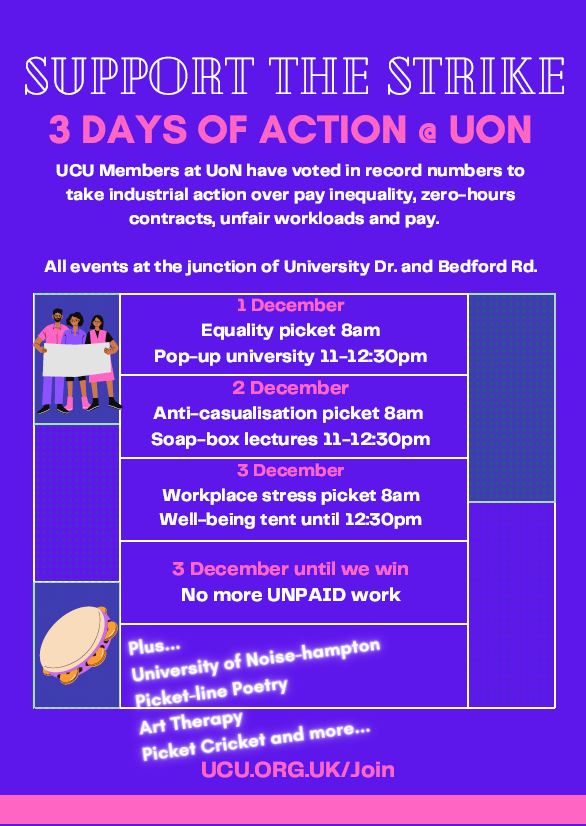
You may have noticed that the University and College Union [UCU] recently voted for industrial action. A strike was called from 1-3 December, to be followed by Action Short of a Strike [ASOS], in essence a call for university workers to down tools for 3 days, followed by a strict working to contract. For many outside of academia, it is surprising to find how many hours academics actually work. People often assume that the only work undertaken by academics is in the classroom and that they spend great chunks of the year, when students are on breaks, doing very little. This is far from the lived experience, academics undertake a wide range of activities, including reading, writing, researching, preparing for classes, supervising dissertation students, attending meetings, answering emails (to name but a few) and of course, teaching.
UCU’s industrial action is focused on the “Four Fights“: Pay, Workload, Equality and Casualisation and this campaign holds a special place in many academic hearts. The campaign is not just about improving conditions for academics but also for students and perhaps more importantly, those who follow us all in the future. What kind of academia will we leave in our wake? Will we have done our best to ensure that academia is a safe and welcoming space for all who want to occupy it?
In Criminology we spend a great deal of time imagining what a society based on fairness, equity and social justice might look like. We read, we study, we research, we think, and we write about inequality, racism, misogyny, disablism, homophobia, Islamophobia and all of the other blights evident in our society. We know that these cause harm to individuals, families, communities and our society, impacting on every aspect of living and well-being. We consider the roles of individuals, institutions and government in perpetuating inequality and disadvantage. As a theoretical discipline, this runs the risk of viewing the world in abstract terms, distancing ourselves from what is going on around us. Thus it is really important to bring our theoretical perspectives to bear on real world problems. After all there would be little point in studying criminology, if it is only to see what has happened in the past.

Criminology is a critique, a question not only of what is but might be, what could be, what ought to be. Individuals’ behaviours, motivations and reactions and institutional and societal responses and actions, combine to provide a holistic overview of crime from all perspectives. It involves passion and an intense desire to make the world a little better. Therefore it follows that striking must be a criminological matter. It would be crass hypocrisy to teach social justice, whilst not also striving to achieve such in our professional and personal lives. History tells us that when people stand up for themselves and others, their rights and their future, things can change, things can improve. It might be annoying or inconvenient to be impacted by industrial action, it certainly is chilly on the picket line in December, but in the grand scheme of things, this is a short period of time and holds the promise of better times to come.
Share this:




Meet the Team: Stephanie Richards, Associate Lecturer in Criminology

A Warm Welcome
Hello all! I would like to introduce myself. My name is Stephanie Richards and I am your Student Success Mentor (SSM). Some of the criminology and criminal justice students would have already had the opportunity to meet me, as I was their Student Success Mentor previously. So, it will be great to touch base with you all and it would also be great for the new cohorts to say hi when you see me on campus.
It is that time of the year when we see new students and our existing students getting ready to tackle the trials of higher education. Being a SSM I am fully aware of the challenges that you will face, and I am here to support you throughout your time at UON. As a previous student I can testify that studying at university is incredibly challenging. The leap from school/ college can be daunting at first. A new building that seems like a maze or the idea of being surrounded by strangers that you probably think you have nothing in common with can be enough to encourage you to run for the hills….stepping into a workshop for the first time can give you a stomach flip, but once you take that first seat in class you will come to realise it does get easier.
Upon reflection of my experience as a new undergraduate student I would have to be honest and express the difficulties that I suffered adjusting to my new way of life. I could not keep my head above the masses of reading, and when I did manage to get some of the seminar prep completed, most of the time I struggled with the new questions and concepts that were posed to me. This will be the experience of most, if not all the new students starting out on their university education. This is part of the complex journey of academia. My advice would be to pace yourself, time management is key, if you struggle to understand the work that has been set, ask for clarity and develop positive relationships with your peers and the staff at UON…………..being part of a strong community will get you through a lot!
My role is not just about assisting the new students that have started their university journey, I am also here to help UONs existing students. Getting back into the swing of studying can be daunting after the summer break. Adjusting to face-to-face education can be an overwhelming process but one that should be embraced. We will all miss our pyjama bottoms and slippers but being back on campus and getting some normality back in your day is worth the sacrifice.
The team of SSM’s are here to support you throughout your journey so please get in touch if you require our assistance. We never want you to feel alone in this journey and we want to assist you the best ways we can. We want you to progress and meet your full learning potential, and to get the most out of your university experience.
Share this:


The ‘Dangers’ of Travelling

This month, during the brief lull between the teaching and marking season, I had allocated myself a bit more free-time than usual. I have not been able to indulge in my hobby of travelling for a while, so instead of this, I have been watching travel related-television programmes with the hope that these will provide me with some kind of joy.
This attempt has been a partial success; an influx of comedy travel shows have worked wonders to uplift my spirits whilst simultaneously reminding me about the beauty of nature; animals, plants, sea, land…(and even humans).
Covid has taken over travel related news at the moment, but in ‘usual’ times it does not require much effort to come across travel documentaries or news reports that seem to encourage prejudice by depicting other countries and travelling as being strange or dangerous. I do worry that this type of coverage might discourage people from wanting to explore the world.
It is difficult to assess the extent to which the television influences our opinions, but when I was a bit younger and discussing my travel plans with others, sometimes I would be met with the following comments:
Response: I would love to travel but I can’t
Me: Why can’t you?
Response: It is dangerous!
Me: How do you know this?
Response: …It said so on the television
There are many genuine reasons that prevent people from travelling, such as, money, responsibilities, health, conflict, misogyny and racism etc. But I find the above reason to be such a shame.
I have encountered many myths over the years which seem to have been gained from watching the television. Here are some of my favorites:
Myth 1: If you see a [insert wild animal here], it will eat you alive
My experience: Take crocodiles for example, these are not as bad as they seem. Yes, arguably crocodiles are death machines but I have seen many in the wild and I am still alive.
Myth 2: The local ‘criminals’ are dangerous
My experience: On very rare occasions I have witnessed crime being committed whilst abroad. I once sat on a coach full of people who were attempting to smuggle cocaine to Brazil. I have also stumbled upon situations which the media described as ‘riots’ and I have also witnessed a few thefts. In these situations, the locals were not a danger to myself, but crime seemed to be a way of being able to afford to live or the result of the occasional angry outburst amongst crowds of protesters, motivated by frustrations with the state.
Myth 3: If you accept the hospitality of strangers you will be murdered in your sleep
My experience: The chances of this happening are very slim. Travelling tends to restore my faith in humanity, the people that I meet whilst travelling can be incredibly kind and helpful.
I found that whilst I was a student, I was able to travel to many places on relatively limited over-draft funds. I hope that the students that I teach are able to do the same, as travel really can broaden the mind. Although, maybe I am wrong for encouraging others to travel, as travelling also makes you very aware of the damage that has been caused to the world, and my own part with in it.
Share this:


Reflecting on reflection

For some years now students taking the third year Critiquing Criminalistics module on our criminology course at the university have had an assessment relating to a reflective diary. Most educators and those in other professions will be aware of and understand the advantage of reflection and reflective diaries so it is probably not necessary to revisit the well-rehearsed arguments about benefits to learning and personal development. Each year, I have found that over the course of the module, the students have come to recognise this and have intimated how they have enjoyed reflecting on what they have learnt in the class or how reflecting on personal experiences has been beneficial. And they comment on how they have sought out further information to gain additional knowledge or to put what they have learnt in some form of perspective. It is of course what we as educators would want and expect from a reflective diary assessment that after all counts towards their marks for the module.
What has surprised me though is how much reviewing these modules has benefited me. I have learnt from and continue to learn my students. We all recognise or at least should the old saying ‘the more I know, the more I realise I don’t know’ or similar. My students prove that is the case often with each round of diary entries I review. The diaries can provide an insight into students lives and thoughts. For some of them it may be a cathartic release to capture their feelings on paper, for me it is enlightening and provides a greater understanding of some of the challenges they face not only as students but also as predominately young adults in a challenging and at times hostile social and economic environment. Perhaps what is equally as enlightening is the additional knowledge that students provide about the subject area being discussed and taught. It is almost like sending out my own little army of literature reviewers with a challenge to advance their knowledge and ipso facto, mine. I am clear that part of the reflection process is about taking what you have learnt further and as this an assessment, demonstrating this additional knowledge with some academic rigor. And so, I find that in some cases what I have stated in the class (currently online) is challenged and that challenge is supported by academic reading. When I read some of these little gems, I smile but alongside this is the additional work created as I review the journal article they have referenced and then decide whether to revisit my lectures to add in the additional information. Even if I don’t, it all adds to my knowledge and, on reflection as my students are proving, there is plenty of scope to find out more.
Share this:


Reality and the fairy tale world of policy and procedures

In the concept of managerialism, we see that both policy and procedures form part of the techniques employed to enhance productivity and cultural changes. These changes use a ‘calculative and rationalistic knowledge base’ which appears both ‘universalistic’, and [at first sight] ‘seems entirely good sense’ (Gilling, 2014:82).
However, this knowledge base is far from universalistic and to the ‘street level bureaucrat’ (Lipsky, 1980) often falls little short of complete naivety. Lipsky (2010) provides a valuable insight into how individuals in public service adapt unworkable policies and procedures as the idealistic meets the reality of overstretched resources and ever demanding and needy consumers of services.
Whilst both working in and studying the police as an organisation subjected to and adopting managerialist policies, I witnessed the nonsensical notions of measuring activities and the subjugation of professionalism to management ideals (Hallam, 2009). Perhaps, there could be no better example than the measurement of the length of time a call handler spent dealing with a call. This derived from the need to answer calls within a target time period. It all made sense until you begin to take into account reality – the lack of resources and the nature of calls which demanded that on some occasions operators ought to spend far longer on the phone to deal with more protracted matters, such as someone in crises who really needed help and a comforting voice whilst someone was on their way. The result of the measurements was often counterproductive, officers being sent to incidents that amounted to little more than a waste of time, ‘My Jimmy is missing and I haven’t seen him for three days’ – when the officers turn up, Jimmy turns out to be a cat or, officers being sent to locations where information regarding the incident is scant because little time has been spent on the phone to get sufficient details. In the clinical world of the policy maker, there are ideal call takers, those that have knowledge about every eventuality, and ideal call makers, those that are precise, unemotional and to the point. Nothing of course could be further from reality.
Disappointingly, I find little solace in academia. Policy and procedures abound. Teaching styles are based, not on the nuances of student types but on the ideal student. The student that has the requisite skills to read and write and think critically. The student that is always engaged and always turns up and above all else, teaching is based on idealistic (see Morse and Lewis for tutorial sizes) small student classes. Policies that are well meaning such as catering for additional needs, become unworkable in an environment where class sizes and teaching demands outstrip available resources. Like the call handler, for the lecturer, it becomes impossible to cater for those that need more attention and time. And like the call handler, lecturers are subjected to managerialist idealistic measurements of success and failure. I once heard of a manager that referred to academics as ‘slackademics’, I think is probably just an indication of how far removed from reality managers are. There are two worlds in organisations that provide a service to the public, one is based on reality the other, a fairy tale world of policies and procedures based on the ideal.
References
Gilling, D. (2014) Reforming police governance in England and Wales: managerialisation and the politics of organisational regime Change, Policing and Society, 24 (1): 81-101.
Lipsky, M. (2010) Street-Level Bureaucracy: Dilemmas of the Individual in Public Services. New York: Russell Sage Foundation.
Share this:


Meet the team – Amy Cortvriend, Lecturer in Criminology

I am one of the new members of the criminology team at UoN and have joined from the University of Manchester where I have been a teaching assistant (probably the equivalent of associate lecturer at UoN) for the last couple of years while I’ve been working on my PhD. I’m looking forward to my new role as lecturer in criminology and hopefully at some point meeting students in real life, face to face. It’s a bit strange starting a new job in a new town when I’m still sat in my living room in Manchester, but the rest of the team have made me feel welcome regardless.
My journey into criminology is a funny one. I did life the opposite to many people, having my first child at 16. When my second child went to school I decided to return to education and as I didn’t have A-levels I has to undertake an Access diploma to get into university. I was required to choose three subjects and at first, I opted for English literature because I love(d) reading (I’m sure I still love reading but I’ve not read anything non-work related for a long time). I picked sociology because it sounded interesting and the same with history. At the last minute I swapped history to criminology and never looked back. From my first lesson I knew this was my future, although at that point I wasn’t sure how.
I always had imposter syndrome and never thought my work was good enough (still do today but we’ll save that for another blog post), but my Access tutor believed in me and suggested I apply to the University of Manchester. As I was a mature student, I had to attend an interview with two of the lecturers. I was super nervous, but I got a place and never left. The undergraduate degree was difficult at times because there were only a couple of mature students and they eventually dropped out. I wasn’t in halls and had kids at home, so I didn’t have the same student experience as many of my cohort, however I made some great friends particularly those who stayed to undertake our MRes.
I finished my undergraduate degree with a first and was awarded a scholarship for my research Masters’ then luckily got another studentship for my PhD which is near completion and here I am. Since I’m teaching research methods modules this year my students will be pleased to know that my BA (Hons) and MRes were heavily focussed on research methods and my PhD has given me three years of real-life research experience. My dissertations and thesis have all followed my research interests in the psychology of victimisation and border criminology. My PhD thesis explores the victimisation of refugees and how they cope. That’s all I will say about my research right now, but I will write another blog about it at some point. Probably when I’ve finished writing it and the hard work is a distant memory.
On a personal note, the daughter I had at 16 is now grown up and lives on her own and my youngest is a sassy 14-year-old girl. We have also just got our Pomeranian puppy Prince. In my free time I’m usually doing something active. I’m a Crossfitter and many of my closest friends are gym friends so the gym is both my mental health crutch and my social life. When I do eventually sit down, I love a good box set. I’m currently watching The Morning Show with Jennifer Aniston and Reese Witherspoon. Recommendations via email are welcome.
Now you know a little bit about me. I’ll look forward to getting to know all the criminology students soon, either virtually or face to face. Hopefully some of you will put your cameras on at least for a day so that when we eventually meet, I’ll know who you are.

Share this:


A commuting student and how to be as organised as possible

As a commuting student, I have a very different experience to most students. Many go to uni to get a sense of freedom away from their parents and away from their hometown. I knew this was not something for me. I had no reason to want to get away, I have a job and friends around me that I am not ready to leave.
I would say most students think that those of us who commute are not experiencing a sense of freedom, however I found the opposite. I would feel more trapped being in student accommodation and not having the freedom of leaving whenever I pleased. Keeping university and my home life separate meant my life didn’t really need to change that much, compared to the traditional student.
For me, university is a part of my life, not my whole life. This balance was much more manageable for me. I wouldn’t have been able to make my whole life about uni because that is not who I am. Completing my assignments in a quiet place at home, with my dog by my side was much more appealing to me than being in halls surrounded by noise and distractions.
As I have said, I was not ready to leave my job and all the friends I have made there over the years. Without my job, I wouldn’t have the freedom that I do. My job pays for my car and that is my lifeline when it come to getting anywhere. I need it to get to uni and to get my education.
I have really enjoyed the balance of university and home life. However, I can see the appeal of it, it’s just not something for me. I couldn’t imagine moving away from my parents and my little dog. I didn’t want university to change my day-to-day life much and it hasn’t.
As a commuting student, to some it may seem difficult to keep motivated as you are surrounded by home comforts and home life. I do believe you have to be very disciplined with yourself, especially when you have a deadline due and you can’t join in with a family night. Although I did try my best to get assignments done as soon as I could for the sake of this and if I was desperately needed at work. Although at sometimes I felt swamped by assignments and overtime at work, if you manage your time right, in the end you wonder why you even worried yourself about it.
Another way I keep my uni and home separate is by using my uni laptop for assignments and society related tasks. I do not use it for anything else and this helps me keep my two lives completely separate. This way I never get them mixed up and confused. My uni email strictly stays on my uni computer, which keeps it as only a part of my life and not overtaking it.
I would say to anyone wishing to commute to university to go for it. It’s the best thing I have ever done. But you need to remember to keep uni separate and make sure it doesn’t swamp the rest of your life. In my house, uni consists of one shelf and a desk. And if you are fortunate enough to have your own car, it makes a world of difference as you can come and go as you please from uni, with no strings attached.
To anyone beginning their studies, I would say start prepping your assignments before you think you should. Get ahead and then you’ll never fall behind. If you have a day where you just want to take some time to yourself, you will be able to as you have already prepared in advance. If you let it slip and fall behind with assignments, you have no space to breath when it comes to needing a break. I think this may be easier for commuting students due to the lack of distraction, but even in halls, separate your time according to how much work you have to do and if you need to take time out for yourself.
Overall, I would say to those commuting, be organised, be on time and get ahead. And to those in halls, ignore distractions when you have deadlines to achieve, be organised and make time for yourself.
Share this:


“Things you need to know about criminology”: A student perspective – Bonnie Middleton (2017-2020)

We are all living in very strange times, not sure when life will return to normal...but if you're thinking about studying criminology, here is some advice from those best placed to know!

The most important module to my understanding of criminology is: All of them! Every module contributes to your understanding of Criminology and all are different and enjoyable. Personally, my favourite module was Violence: From Domestic to Institutional in Year 3; this module ties together everything you know about Criminology; the reasons why we are subjective as criminologists and our ability to look beyond the scope of what we know.

The academic criminology book you must read:
Outsiders: Studies in the sociology of deviance (1963) by Howard Becker. Albeit a dated book, its ideas are relevant and relate to many criminological such as; how and why criminals are labelled and stigmatised; why are the youth demonised; why people reject the norms and values of society and become criminals in doing so.

The academic journal article you must read:
This is a hard one. Articles are great for discovering new ideas and methodologically testing theories. I would recommend reading: Arrigo, J. (2004). A Utilitarian Argument Against Torture, Interrogation of Terrorists. Science and Engineering Ethics. 10(3), pp. 543-572. This article poses many questions for a criminologist which enlightens you to think subjectively and challenge your own views; which is what Criminology is all about. From reading this article you will learn to think critically when faced with a challenging dilemma; the rights of a terrorist and how can the law can be tailored to fit the crime.

The criminology documentary you must watch:
Where do I begin? Louis Theroux and Stacey Dooley are both great journalists and documentary makers. If I had to pick one, I would recommend watching the BBC’s documentary on Grenfell If you watch this documentary you must consider; the government’s response; who is accountable; why are the residents of Grenfell still in temporary accommodation. These are the sorts of questions you should be asking as someone studying Criminology.

The most important criminologist you must read:
Familiarise yourself with the ideas of Lombroso, this will aid your understanding on how criminological theory and ideas have developed overtime through biological, psychological and sociological standpoints.

Something criminological that fascinates me:
Domestic abuse. I had done my dissertation on this as I have a great interest in male dominance and power over women, especially in intimate relationships. Gender plays a key role in this which when examined in depth, will change your view on gender paradigms.

The most surprising thing I know about criminology is: Criminality was believed by Lombroso to be inherited and that criminals possessed physical defects, criminality would be measured by the size and shape of particular body parts; this was later discredited. I can remember learning this in first year and it fascinated me.

The most important thing I've learnt from studying criminology is:
To not judge a book by its cover and to not take everything at face value. Do not be afraid to challenge other’s standpoints and beliefs. Thinking critically is the most important skill to have, search deeper into issues and apply your own thoughts and experiences.

The most pressing criminological problem facing society is:
Mass incarceration and reoffending rates. The UK is yet to move away from the ‘tough on crime’ approach favouring law and order and punishment. The penal system needs to be reformed to ensure offenders are rehabilitated to break the cycle of criminality; definitely educate yourself on political party’s manifesto’s and what they say about crime and justice before voting.

When family and friends ask, I tell them criminology is: I tell family and friends that criminology is such a broad field of study; we look at law, psychology, science, sociology, politics, penal systems, criminal justice organisations, media and much more. From this, you attain the ability to think critically and reflect, it can help you in many situations not just criminological issues. It is an incredibly insightful and enlightening field to study; it opens up many opportunities.

 Thoughts from the criminology team