
Home » Stereotype
Category Archives: Stereotype

Sabrina Carpenter and Feminist Utopia
I have recently been introduced to Sabrina Carpenter via online media commentary about the image of her new album cover Man’s Best Friend. Whilst some claim the image is playing with satire, the image appears to have been interpreted by others as being hyper-sexual and pandering to the male gaze.

I am not sure why this specific album cover and artist has attracted so much attention given that the hyper-sexual depiction of women is well-represented within the music industry and society more generally. However, because Sabrina’s main audience base is apparently young women under 30 it did leave me thinking about the module CRI1009 and feminist utopia, as it left me with questions that I would want to ask the students like: In a feminist utopia should the hyper-sexualized imagery of women exist?
Some might be quick to point out that this imagery should not exist as it could be seen to contribute towards the misogynistic sexualisation of women and the danger of this, as illustrated with Glasgow Women’s Aid comments about Sabrina’s album cover via Instagram (2025)
‘Sabrina Carpenter’s new album cover isn’t edgy, it’s regressive.
Picturing herself on all fours, with a man pulling her hair and calling it “Man’s Best Friend” isn’t subversion. 😐
It’s a throwback to tired tropes that reduce women to pets, props, and possessions and promote an element of violence and control. 🚩
We’ve fought too hard for this. ✊🏻
We get Sabrina’s brand is packaged up retro glam but we really don’t need to go back to the tired stereotypes of women. ✨
Sabrina is pandering to the male gaze and promoting misogynistic stereotypes, which is ironic given the majority of her fans are young women!
Come on Sabrina! You can do better! 💖’
However, thinking about utopia is always complicated as Sabrina’s brand appears to some a ‘sex-positive feminism’ by apparently allowing women to be free to represent themselves and ‘feel sexy’ rather than being controlled by the rules and expectations of other people. For some this idea of sexual freedom aka ‘sex-positive feminism’ branded via an inequitable capitalistic male dominated industry and represented by an incredibly rich white woman would be a bit of a mythical representation. As while this idea of sexy feminism is promoted by the privileged few this occurs in a societal context where many feel that women’s rights are being/at risk of being eroded and women are being subjected to sexual violence on a daily basis.
I am not sure what a workshop discussion with CRI1009 students would conclude about this, but certainly there would need to be a circling back to more never- ending foundational questions about utopia: what else would exist in this feminist utopia? Whose feminist utopic vision should get priority? Would anyone be damaged in a utopic society that does promote this hyper-sexualization? If so, should this utopia prioritise individual expression or have collective responsibility? In a society without hyper-sexualisation of women would there be rule breakers, and if so, what do you do with them?
Share this:


When will these issues be addressed?
In the realm of education, inclusivity and accessibility should be the foundation of any society aspiring for progress. However, in the case of special education schools in the United Kingdom, there exists a troubling narrative of systemic failings. Despite efforts to provide tailored education for students with diverse needs, the British educational system’s shortcomings in special education have cast a shadow over the pursuit of equal opportunities for all.
One of the main challenges facing special education schools in the UK is inadequate funding. These institutions often struggle with limited resources, hindering their ability to provide the necessary support for students with special educational needs. Insufficient funding results in larger class sizes, fewer specialized staff, and a lack of essential resources, all of which are detrimental to the quality of education these schools can offer. Furthermore, the heavy reliance on the UKs crumbling social care services and the overstretched NHS within special education settings exasperate poor outcomes for children and young people.
Special education students require a range of support services tailored to their individual needs. However, the inconsistency in the provision of support services across different regions of the UK is a glaring issue. Disparities in access to speech therapists, occupational therapists, and other essential services create an uneven educational landscape, leaving some students without the critical support they require to thrive.
Effective collaboration and communication between educators, parents, and support professionals are vital for the success of any special education school. Unfortunately, there is often a lack of seamless coordination. The lack of collaboration can and has result in fragmented support for the students, hindering their overall development and thus making it difficult to implement cohesive and effective educational plans.
The success of special education programs relies heavily on well-trained and empathetic educators. Unfortunately, the British educational system falls short in providing comprehensive training for teachers, working in special education schools. Many teachers express a lack of preparation to address the unique challenges posed by students with diverse needs, leading to a gap in understanding and effective teaching strategies. It is also important to note that many staff members that work within special education settings are not trained teachers, although they have been given the title of teachers. This further leads to inadequate education for children and young people. Moreover, post-covid has seen a high staff turnover within these settings. There have been many reports that have alluded to the notion that British schools are failing our children, but it seems that children from special education provisions are ignored, and families are dismissed when concerns are raised about the lack of education and preparation for the ‘real world’.
I am also critical of the overreliance of labelling students with specific disabilities. While categorization can be useful for designing targeted interventions, it can also lead to a narrow understanding of a student’s capabilities and potential. This labelling approach inadvertently contributes to stereotypes and stigmas, limiting the opportunities available to students with special needs….. There tends to be a focus on the troubling history of the way people with disabilities in the UK have been treated, but what I find interesting is there is a sense of disregard for the issues that are occurring in the here and now.
There is also a lack of special education provisions in the UK. This has led to many children with additional needs without a school place. And while a specific figure of the number of children being excluded from education has not been disclosed, West Northamptonshire, has awarded families over £49,000 over special education failings in 2023 (ITV, 2023). Furthermore, Education health care plan recommendations (EHCP) have not been followed within schools. These are legally binding documents that have been continuously dismissed which has led to further legal action against West Northants council in recent years (Local Government and Care Ombudsman, 2023).
The failings in special education schools have repercussions that extend beyond the classroom. Many students who leave these schools face challenges in transitioning to higher education, entering the workforce or living independently. The lack of adequately tailored support for post-education opportunities leaves these individuals at a disadvantage, perpetuating a cycle of limited prospects, which inevitably pull people with disabilities into a cycle of poor health and poverty (Scope, 2023). The disability employment gap in the UK is 29% and the average disabled household faces a £975 a month in extra costs (Scope, 2023) access to employment and financial independence is out of reach for disabled people due to failings within education because lack of preparation for life beyond school.
There needs to be reform in British schools from mainstream to special education. There are failings across the board. Adequate funding, improved teacher training, consistent support services, enhanced collaboration, and a shift away from overreliance on labelling are all crucial steps toward creating an inclusive educational environment. It is difficult to draw on optimism when the UK government continues to ignore age old concerns. This blog entry is to bring awareness to an issue, that may not be on your radar, but will hopefully get you to reflect on the copious barriers that people with disabilities face. Childhood should be a time when there is a fence built to protect children is schools. As we get older and face the challenges of the wider world, we should be equipped with some skills. Special education schools should not be used as a holding place until a child comes of age. There should be provisions put in place to give all young people an equitable chance.
Share this:


Reproductive Healthcare Ramblings
Reproductive health in England and Wales is a shambles: particularly for women and people who menstruate. The failings start early, where, as with most things, stereotypes and ‘norms’ are enforced upon children from GPs, schools, from parents/guardians who have experienced worse, or who do not know any different, which keep children from speaking up. These standards and stereotypes come from a male dominated health care system especially in relation to gynaecology, and our patriarchal society silences children without the children even realising they are being silenced. As a child, you are expected to go about your daily routine, sit your exams, look after your siblings, represent the school at the tournament of the week, and do all this while, for some, bleeding, cramping, being fatigued but not be expected to talk about it. After all, you are told time and time again: it’s normal.
Moving through life, women and people who menstruate face similar stigma, standards, assumptions during adulthood as they faced during childhood. There is more awareness now of endometriosis, adenomyosis, uterine fibroids, Polycystic Ovary Syndrome Condition (PCOS) to name but a few. But women and people who menstruate report feelings of being gaslighted by [male] gynaecologists, encouraged to have children in order to regulate their hormones (pregnancy and childbirth comes with a whole new set of healthcare problems and conditions), to take the contraceptive pill and deal with the migraines, mood swings, weight gain and depression which many women and girls report. Some of the above chronic illnesses impact fertility, so ‘try for a baby’ is not an easy, or even a wanted path. Diagnosis is also complex: for example a diagnosis for endometriosis takes on average 8 years (Endometriosisuk, 2023), and can only be confirmed with surgery. That relies on women and people who menstruate going to their GP, reporting their symptoms, listening to the ‘have you tried the pill’ or ‘having a baby will help manage your symptoms’: which relies on trust. Not everyone trusts the NHS, not everyone feels comfortable being dismissed by a nurse, or GP or then their gynaecologist. Especially when a number of these illnesses are framed and seen as a white-woman illness. Communities of women and people who menstruate remain hidden, dealing with the stigma and isolation that our reproductive health system carries in England and Wales. And this is not a new issue.
The reproductive healthcare for women and people who menstruate is dire. Just ask anyone who has experienced it. What then is it like for women in prison? The pains of imprisonment are well documented: deprivation of goods, loss of liberty, institutionalisation, no security, depreciation of mental health (Sykes, 1958; Carlen, 1983). The gendered pains, fears and harms less so, but we know women in prison are fearful about the deterioration of relationships (especially with children), lack of facilities to support new mothers, physical and sexual abuse, and poor mental and physical health support including reproductive health. The poor reproductive healthcare available to women and people who menstruate within society, is a grade above what is available in prisons. These women are quite literally isolated, alone and withdrawn from society (through the process of imprisonment), and for some, they will become further isolated and withdrawn via the pains of their chronic illness.
There isn’t really a point to this blog: more like a rambling of frustrations towards all the children who will journey through our subpar reproductive healthcare system, who will navigate the stigma and assumptions littered within society. To all the women and people who menstruate who are currently wading through this sh*t show, educating themselves, their family, their friends and in some cases their GPs, those people unable to speak out, not knowing how or simply not wanting to. And to those in the Secure Estate, grappling with the pains of imprisonment and having their reproductive healthcare needs ignored, overlooked or missed.
I haven’t even mentioned menopause…
References:
Carlen, P. (1983) Women’s Imprisonment, Abingdon: Routledge.
Corston, Baroness J. (2007) The Corston Report: A Review on Women with Particular Vulnerabilities in the Criminal Justice System, London: Home office.
Endometriosis UK (2023) Endometriosis Facts and Figures [online] Available at: https://www.endometriosis-uk.org/endometriosis-facts-and-figures#:~:text=Endometriosis%20affects%201.5%20million%20women,of%20those%20affected%20by%20diabetes.&text=On%20average%20it%20takes%208,symptoms%20to%20get%20a%20diagnosis. [Accessed 24th August 2023]
Sykes, G. (1958/2007) The Society of Captives: A Study of a Maximum Security Prison, Princeton: Princeton University Press.

Share this:


Gypsy, Roma, Traveller History Month: #MakeSomeSpace

When I reflect upon my childhood, I recall the fondness that I have towards the Romany culture. I am reminded of the wonderful bond that my family had with horses, of good people, of the older generations of my family telling stories and singing Romany songs around tables at parties, of a strong sense of tight-knit togetherness and resilience when times got tough. I remember being educated about life from a young age and being taught the skills needed to be able to earn a living when it became difficult to do so. I am also reminded of the generosity involved in giving all that you can to your family and friends despite not having much. I especially think of this generosity in relation to the Irish Travellers that welcomed my brothers into their homes and provided for them when they were in times of need.
My instant thoughts about Gypsy, Romany Travellers (GRT) is that of fondness, but living in our society I have learnt that this is not the typical thoughts of the dominant public, media or government. When considering dominant media, public and government attitudes towards travellers, I am reminded of the GRTs that live in a society where people are prejudice because of long-standing stereotypes that have been created about their culture. I am also reminded of the lack of understanding and/or empathy that others have about the disproportionate amounts of social harm that those within the GRT families will encounter.
Since the recent Black Lives Matter protests there has been an explosion of anti-racist efforts, which I am hopeful of, yet, even some of those who are passionately ‘anti-racist’ continue to either project prejudice towards GRT people or deny that prejudice towards GRT is a problem. Adding to this, anti-racist messages communicated via the media do not seem to apply to GRT. A recent example of this is Dispatches: The Truth About Traveller Crime which is like a thorn in my side. This documentary discusses GRT as though they are a group of ‘dangerous criminals’. With an ‘expert’ criminologist present within the documentary it becomes difficult for the public to understand the stereotypes and lack of understanding that the documentary includes.
This year I have been able to incorporate GRT into the modules that I teach. I am pleased that some students have been able to navigate themselves to information about GRT from organisations like Traveller Movement and Friends Families and Travellers as these provide me with some hope in terms of GRT awareness and inclusion. However, it seems that these organisations will continue to have many pressing concerns to deal with, especially as the recent government proposals included within the Police, Crime, Sentencing and Courts Bill seem to be nothing more than another attack on the more traditional way GRT of life.

There is a worry for some GRT that upon moving into housing these cultures will decline. In terms of my own family my Nan was my idol, she was born in the 1920s in a traditional horse drawn wagon. Since moving into housing my Nan remained proud of her Romany heritage and she instilled this within my Dad’s upbringing. I only ever practiced aspects of the Romany culture in a marginal sense, and the decline of this part of my own heritage is connected to the social harm that my own family have experienced.
With GRT month I hope that more people question the prejudices that they have about others, I hope that people also question the media, government and supposed ‘experts’. You could begin by attempting to put yourself in the shoes of others, try to imagine how you would feel if society collectively judged yourself or your family despite knowing little to nothing about who you/they are. After all, this kind of overt prejudice that GRT encounter would not be acceptable in many situations if this was aimed at other groups, so why should it be acceptable when aimed at GRT?
Share this:


We are not the same…respectfully
Disclaimer: whilst I can appreciate that it’s Women’s History Month and it would be appropriate that we all come together in support of one another, especially in the notion of us vs them (men). However, I am undoubtedly compelled to talk about race in this matter, in all matters in that sense. I can only speak on the influence of the women who are around me and of women who look like me. Black women. So, to the lovely white girl on twitter who felt the need to express under my thread how disheartened she was by the racial separation of womanhood in feminism … from the bottom of my heart, I am not sorry.
Sometime last year I stumbled across a book called They Were Her Property: White Women as Slave Owners in the American South by the marvellous Stephanie Jones Rogers. The book protested against the belief that white women were delicate and passive bystanders to the slave economy due to masculine power in the 18th century. Instead, it explores the white supremacy of white women and the high level of protection they had which, which often led to the lynching and killing of many Black men and boys (Emmett Till, 1955). The book also looks at the role of enslaved wet nurses, as many white women perceived breastfeeding to be uncultured and therefore avoided it. However, while enslaved children were flourishing and healthy, many of the white babies were dying. As a result, Black mothers were forced to separate from their babies and dedicate their milk and attention to the babies of their mistresses.
Consequently, this led to the high rise of neglect and death of black babies as cow’s milk and dirty water was used as a substitute (Jones-Rogers, 2019). Furthermore, Rogers goes on to explain how the rape of Black women was used to ensure the supply of enslaved wet nurses. As you can imagine the book definitely does not sugar coat anything and I am struggling to finish it due to my own positionality in the subject. One thing for sure is that after learning about the book I was pretty much convinced that general feminism was not for me.
When I think about the capitalisation and intersectional exploitation that black women endured. I lightly emphasise the term ‘history’ when I say women’s history, because for Black women, it is timeless. It is ongoing. We see the same game play out in different forms. For example, the perception that white women are often the victims (Foley, et al., 1995) and therefore treated delicately, while Black women receive harsher/ longer sentences (Sharp, 2000). The high demand of Black women in human trafficking due to sexual stereotypes (Chong, 2014), the injustice in birth where Black women are five times more likely to die from pregnancy and childbirth than white women in the UK (University of Oxford, 2019) and the historical false narrative that Black women feel less pain than white women (Sartin, 2004, Hoffman et al, 2016).
So again, we are not the same…. Respectfully.
It is important for me to make clear that we are not the same, because we are viewed and treated differently than white women. We are not the same, because history tells us so. We are not the same, because the criminal justice system shows us so. We are not the same, because the welfare system and housing institutions show us so. We are not the same, because of racism.
This year’s women’s history month was more so about me learning and appreciating the Black women before me and around me. As I get older, it represents a subtle reminder that our fight is separate to much of the world. There is nothing wrong in acknowledging that, without having to feel like I am dismissing the fight of white women or the sole purpose of feminism in general. I am a Black feminist and to the many more lovely white women who may feel it’s unnecessary or who are disheartened by the racial separation of womanhood in feminism, I am truly, truly not sorry.
P.s to Nicole Thea, Sandra Bland, Toyin Salau, Blessing Olusegun, Belly Mujinga and Mary Agyeiwaa Agyapong. I am so sorry the system let down and even though you are not talked about enough, you will never be forgotten.
References:
Chong, N.G., (2014). Human trafficking and sex industry: Does ethnicity and race matter?. Journal of Intercultural Studies, 35(2), pp.196-213.
Foley, L.A., Evancic, C., Karnik, K., King, J. and Parks, A. (1995) Date rape: Effects of race of assailant and victim and gender of subjects on perceptions. Journal of Black Psychology, 21(1), pp.6-18.
Hoffman, K.M., Trawalter, S., Axt, J.R. and Oliver, M.N. (2016) Racial bias in pain assessment and treatment recommendations, and false beliefs about biological differences between blacks and whites. Proceedings of the National Academy of Sciences, 113(16), pp.4296-4301.
Jones-Rogers, S.E.(2019). They were her property: White women as slave owners in the American South. Yale University Press.
Sartin, J.S. (2004) J. Marion Sims, the father of gynecology: Hero or villain?. Southern medical journal, 97(5), pp.500-506.
Sharp, S.F., Braley, A. and Marcus-Mendoza, S. (2000) Focal concerns, race & sentencing of female drug offenders. Free Inquiry in Creative Sociology, 28(2), pp.3-16.
University of Oxford. (2019) NPEU News: Black women are five times more likely to die in childbirth than white women. Why? {Online}. Available from:https://www.npeu.ox.ac.uk/mbrrace-uk/news/1834-npeu-news-black-women-are-five-times-more-likely-to-die-in-childbirth-than-white-women-why {Accessed 29th March 2021}
Share this:


“Things you need to know about criminology”: A student perspective – Natalie Humphrey, 1st Year student

We are all living in very strange times, not sure when life will return to normal...but if you're thinking about studying criminology, here is some advice from those best placed to know!

The most important module to my understanding of criminology is: At the beginning of the year I believed the True Crime module to be the most important in understanding why crimes are caused. However, I quickly learned that these are not always the best source of information! The Science module is the basis of Criminology in the first year, laying down where it emerged, with Lombroso and Bertillon. I believe these figures are important to understand to grasp criminology.


The academic criminology book you must read:
The SAGE dictionary of Criminology has helped me with the basics of the subject. If there was something I became stuck on, this book would usually have an explanation for it. It also has examples which make it much easier to apply

The academic journal article you must read:
Attitudes towards the use of Racial/Ethical Profiling to Prevent Crime and Terrorism, by Johnson, D et al.(2011)
I came across this article when researching my Independant Project on racial stereotyping. It goes into the systematic racism that black people face and how disproportionate racism truly is. With more recently, the George Floyd case, this is still a very prominent article that is true to date

The criminology documentary you must watch:
I am a lover of many true crime documentaries and am always first to watch the new one that has been added to Netflix! The famous ones, such as Ted Bundy’s confession tapes, are fascinating to me, Bundy especially. However, there are many injustices that need to be addressed, not just the notorious serial killers. Jeffrey Epstein’s new documentary is very important in understanding sexual abuse that happened to over 200 underage girls. Athlete A also shows the sexual abuse of underage girls who were part of USA gymnastics.

The most important criminologist you must read:
Becker stood out to me this year as a very important figure. Understanding how young people are so heavily influenced by the labels people and society give, so much so it can shape their lives. Even older people can be easily labelled. This was quite surprising to me at the beginning of my studies.

Something criminological that fascinates me:
DNA and fingerprinting are fascinating to me. I find the science behind the discovery of what occurred at a crime scene and how they unpick it very interesting. This is definitely something I would like to study further.

The most surprising thing I know about criminology is:
It is a much wider subject than I first thought, it involves so much more than you could imagine. It questions everything in society.

The most important thing I've learnt from studying criminology is:
I have learned how unjust our criminal justice system is and how much, we as individuals, stereotype every person we meet. I’ve become more aware of this and have a better understanding of what needs to change.

The most pressing criminological problem facing society is:
Racism is a massive problem today. The racism black people face, especially in the US, is hard to understand as a white woman, but difficult to even contemplate people are treated in such ways. George Floyd, as I mentioned before, was killed because of his race. Problems like this would not happen to a white male, especially when his alleged crime was not violent. Young black men are labelled by the media to be seen as a thug and dangerous, causing many to be assumed of acts they just would not commit. Jane Elliott’s experiment on racism and eye colour from the 1970s is still a lesson that needs to be learned today!

When family and friends ask, I tell them criminology is:
Its more than it seems. Most just think it's about crime, which yes it is, but there is so much more to it. It is not one subject, it is so many put together. Science, psychology, sociology for example.

Share this:


“I can’t breathe”

George Floyd’s words: “I can’t breathe”, have awaken almost every race and creed in relevance to the injustice of systematic racism faced by black people across the world. His brutal murder has echoed and been shared virtually on every social media platform – Floyd’s death has changed the world and showed that Black people are no longer standing alone in the fight against racism and racial profiling. The death of George Floyd has sparked action within both the white and black communities to demand comprehensive police reforms in regards to police brutality and the use of unjust force towards ethnic minorities.
There have been many cases of racism and racial profiling against black people in the United Kingdom, and even more so in the United State. Research has suggested that there have been issues with police officers stereotyping ethnic minorities, especially black people, which has resulted in a vicious cycle of the stopping and searching of those that display certain physical features. Other researchers have expounded that the conflict between the police and black people has no correlation with crime, rather it is about racism and racial profiling. Several videos circulating on social media platforms depict that the police force does harbour officers who hold prejudice views towards black people within its ranks.
Historically, black people have been deprived, excluded, oppressed, demonised and brutally killed because of the colour of their skin. As ex-military personnel in Her Majesty’s Armed Forces and currently working as a custody officer, I can say from experience that the use of force used during the physical restraint on George Floyd was neither necessary nor proportionate to the circumstances. In the video recorded by bystanders, George Floyd was choked in the neck whilst fighting for his life repeating the words “I can’t breathe”. Perhaps the world has now noticed how black people have not been able to breathe for centuries.
The world came to halt because of Covid-19; many patients have died because of breathing difficulties. Across the world we now know what it means if a loved one has breathing issues in connection with Covid-19 or other health challenges. But nothing was done by the other police officers to advise their colleague to place Floyd in the recovery position, in order to examine his breathing difficulties as outlined in many restraint guidelines.
Yet that police officer did not act professional, neither did he show any sign of empathy. Breath is not passive, but active, breathing is to be alive. Racial profiling is a human problem, systematic racism has destroyed the world and further caused psychological harm to its victims. Black people need racial justice. Perhaps the world will now listen and help black people breathe. George Floyd’s only crime was because he was born black. Black people have been brutally killed and have suffered in the hands of law enforcement, especially in the United States.
Many blacks have suffered institutional racism within the criminal justice system, education, housing, health care and employment. Black people like my own wife could not breathe at their workplaces due to unfair treatment and systematic subtle racial discrimination. Black people are facing unjust treatment in the workplace, specifically black Africans who are not given fair promotional opportunities, because of their deep African accent. It is so naïve to assume that the accent is a tool to measure one’s intelligence. It is not overt racism that is killing black people, rather the subtle racism in our society, schools, sports and workplace which is making it hard for many blacks to breathe.
We have a duty and responsibility to fight against racism and become role models to future generations. Maybe the brutal death of George Floyd has finally brought change against racism worldwide, just as the unprovoked racist killing of black teenager Stephen Lawrence had come to embody racial violence in the United Kingdom and led to changes in the law. I pray that the massive international protest by both black and other ethnicities’ will not be in vain. Rather than “I can’t breathe” reverberating worldwide, it should turn the wheel of police reforms and end systematic racism.
“Restricting someone’s breath to the point of suffocation is a violation of their Human Rights”.
Share this:


Rocket Scientist (Ode to those real-life really Hidden Figures all around us) #BlackenAsiaWithLove
Rocket scientist.
Let’s face it. When most of us read those words,
We ‘see’ a man in our mind’s eye.
The so-called smartest job on earth belongs solely to women men.
What if those dreams kids dreamed – of going anywhere in the world –
Also included smart women?
What if we grew up knowing that women were rocket scientists?
As much as we use the oft phrase “it’s not rocket science” to exclaim simplicity,
What if the smartest person nobody ever met was a woman?
Nobody anybody knows has ever met a rocket scientist or a nuclear physicist, but we’re all sure THESE guys represent humanity’s brightest.
What if the brightest people in the world were both women AND men?
The black women ‘behind’ America’s space race, yet, ‘one step for man…’ really did mean one giant step for man-kind.
Have we stolen little girls’ dreams?
By concealing the truth of the Black women rocket scientists behind America’s moon landing,
Haven’t we squashed those ambitions for black girls?
It’s not that Black girls are absent in Pop Culture, they’re just normally, regularly
Relegated to a few very banal stereotypes.
By praising Black Jezebels, Sapphires and Mammies above all,
Haven’t we assured everyone on the planet that the last thing a black girl could do was grow up to become a rocket scientist?
Or president of America?
One giant step for white man-kind, indeed!
Now we have an unkind thug running thangs.
Mr. Backlash! Mr. Backlash!
It’s telling that the biggest modern feminist march happened because of his inauguration.

Michele Obama as Sapphire
What if the most powerful leaders in history were women?
What if, instead of deifying generals and soldiers, and
Rather than holding the torch for sword-bearers,
What if we regarded HIS-story through women’s contributions to society?
How have women determined the fates of nations,
Irregardless of men’s war of conquest and colonization?
What if we studied those who avoided war, not just those who indulged?
Would so many world leaders be calling the Coronavirus an “enemy” that we must “defeat”?
What if we celebrated the survivors of millennia of mostly male belligerence – where
Women couldn’t even own property, let alone vote.
Let alone control their own bodies.
Who were those men and women who fought for equality even then, and
Who were the detractors?
Who were those masochists who believed God had a son, not a daughter, and
Therefore, men have divine right to rule?
What if women had written the Bible, or any holy book or writings from any world religion?
Would patriarchy so regularly be the order of the day?
I’ll have an order of patriarchy with a side of misogyny and sexual objectification for dessert!
My drink order?
Ah, give me a cup of control over every business, government, religious and labor institution for over a thousand years!
Don’t forget the lemon, this is a sour business!
Oh great, free refills!
[sigh]
Wasn’t Shirley Chisholm brave for being the first black woman to run for president?
Let’s face it, a woman running for any office right now is likely to get trolled online,
Likely to have folks write that they’re gonna rape her, so
You can imagine the hate Ms. Chisholm faced.
And oh, did I mention she was queer?
What gymnastics did Ms. Chisholm have to practice in earnest in those days?
“A woman cannot do the job of a man.”
This is a direct quote from a policeman’s wife when the NYPD integrated patrol teams back in the 70’s.
Aren’t the brave first female officers heroes?
A woman said the same thing at a 2016 Trump rally.
Aren’t women brave for running for political office and raising their voices in chambers?
[sigh]
There is no equal pay.
There are plenty o’ glass ceilings to shatter all around the world.
Yet, we take issue with this word feminist.
Feminist.
When some hear feminist, they think bra-burning,
Even though they never burned bras at the infamous feminist protest at the ‘68 Miss America pageant.
Media coverage dismissed this early feminist protest for equality as “bra-burning,” and thus the moniker stuck!
Bra-burning!
You side with anti-feminist masochists when you use that phrase.
You outta keep “bras” outta your mouth until you know first-hand what you’re talking ‘bout!
When some hear feminist, they don’t think ‘feminism’ oh, that means
‘My sister shouldn’t grow up beside me, scared of getting raped by a man in our family.’
When some hear feminist, they think ‘lesbians’.
So, feminists are lesbians, or lesbians are feminists?
What-ever!
It’s way too easy to say straight women can’t support equality in power, opportunity and access for all genders!
Seriously?!?
When some hear feminist, they think about men being oppressed.
They don’t think about the rights husbands have over wives’ bodies – marital rape is a fairly recent feminist protection.
When some hear feminist, they think feminists are ugly, jealous women.
They don’t think about the pressure to be beautiful,
Even in the age of social media where millennials show-up selfie-ready at breakfast, and
Spend half of breakfast posting about the breakfast rather than actually enjoying said breakfast.
But at least their lashes and brows are flawless!
Naw, when some people hear feminist,
They couldn’t even begin to think the amount of money an average woman spends on make-up over a lifetime, trying to make herself beautiful for the male gaze.
[Sing] “The men all paused when I walked into the room…
The men all paused and the brides held their grooms!”
You can best bet her face was beat up before she stepped a foot outside for her “burgers and sodas”.
Yes, there’s “A Meeting in the Ladies Room,” so you’d better bring your best compact, girl.
Flawless!
When some hear feminist, they think privileged white women.
They don’t think, ‘oh, my sister should have the same opportunities as me’.
Or, ‘gee, my sister shouldn’t have to worry about some creep making moves on her at work while she’s trying to feed her kids.’
They couldn’t even begin to know about the Hidden Figures.
When some hear feminist, they think men-haters.
They don’t think about all the hateful things we’ve heard our whole lives
About the dangers of women’s bodies:
Females menstruate -problem 1.
Menstruation makes females moody – problem 2.
Females can get pregnant- problem 3.
Female bodies are problematic… dangerous.
We teach this to everyone.
We teach girls to be mindful of men; we don’t teach boys not to prey on women.
We teach girls to dress appropriately; we don’t teach boys to respect girls’ bodies.
We teach girls to take a pill, almost a rite of passage, but
We don’t teach boys to grow up and research, develop and market a pill for men.
We teach girls: her power is in her sex; we don’t teach boys ‘conquering her sexually is sexist’.
Bash her!
“Beat that p*ssy up!” goes the chant of an infamous deep House beat!
You can take these lessons to the Supreme Court and still win!
So, what if we grew up knowing women were rocket scientists?
What if boys and girls grew up knowing this… taking for granted that girls were smart, too?
If this AND may such stories hadn’t been so conveniently “forgotten”
Would women have to prove themselves so much at work?
Would we be asking women how they balance a career and motherhood?
Or would we be asking dads that question just as often and effortlessly?
So, what if we grew up knowing women were rocket scientists, that
Women were excellent and disciplined at the height of logic?
What if we grew up knowing women were rocket scientists?
Would we use words like “hysterical” to mete out a symbolic hysterectomy?
Would insults like “bitch” or “like a girl” carry any weight?
Notice by adding “like a girl” to any phrase, it becomes an insult!
If women were known to excel at rational thinking like rocket science, then
Wouldn’t we then assume males are emotional beings, too?
Would there be such a thing as toxic masculinity, the irrational, natural extension of teaching kids the ‘Boys Don’t Cry’?
Did you know that by age 7,
Girls know significantly more words to talk about their feelings than boys?
If women were rocket scientists, too,
Would we still refuse to teach boys Emotional Intelligence?
Bury your feelings, boys, take it out with your fists.
Would we still refuse to teach girls that they can excel at math?
What world would we craft, if little boys and girls grew up knowing that muscle and brawn didn’t matter in the world of equality and respect we were told we’d built?
Michele Obama as Sapphire
Share this:


A $40 tip at the all-day-breakfast joint (A Prose about this American moment). #BlackenAsiaWithLove

1st Sunday 2020 Sunrise over Lake Jordan, Alabama
It’s 6:20am.
I’ve stopped by an infamous breakfast food chain and ordered a bottomless coffee, and a breakfast combo that comes with two fried eggs, two different rations of fried pork and bottomless pancakes.
Waiting for my order, I notice that not less than four varieties of syrup rest on the table, accompanied by salt, pepper, and a ceramic cup full of packages of sugar and two varieties of artificial sweeteners.
A whole tub of single-serve full fat creamers comes with my bottomless coffee, which I promptly sent back.
The young lady serving is massively obese, as are most of the other people who both serve and patronize this business.
And this is business as usual throughout the south, and now most of America, particularly at these sorts of times, especially in these sorts of businesses.
The joint had only been open since the top of the hour, and so I could overhear the duty manager dealing out the day’s duty rations.
As two of the team followed her around, I heard her explain that she was reserving the spillover seating section for whoever showed up “super-late.”
Knowing management speak, I heard ‘super-late’ as a shaming label used to monitor and control behavior.
I heard her punctuate these instructions by explaining that someone’s shift had started at 5:30 yet they still hadn’t shown up.
“You ok, sweetie,” the young lady breezes over and asks me casually.
“I’m fine,” I quickly replied, adding: “It’s good, too,” as if she or the cook had actually hand-made any of this meal.
They’ve each opened a prescribed set of processed-food packages, followed heavily prescribed recipes, and followed heavily prescribed orders passed down from management.
And yet I do appreciate their labour.
In my capacity, I get to sit and muse about them, while THIS is their career.
Yesterday, while sitting in another infamously southern* roadside-mass-food-chain, my uncle mentioned that he was pleased to see that young people were working at these types of places again.
“Uh huh,” I hummed agreeingly as I panned the restaurant noting the youthfulness of the staff.
Since the 90’s and certainly since the recession, these jobs had become life-long career moves, where previously these were held down by early-career part-timers.
Whether paying their way through school or training, or beefing their resumes for eventual factory employment, these part-timer jobs weren’t suitable for adults as they come with few, if any, benefits…most notably, healthcare.
This satellite town, for example, sits just outside the seat of Civil Rights and grew during Jim Crow around a large paper mill that one can still smell miles away.
Back in my bottomless breakfast, my server keeps inquiring if I’m ok as she goes about setting up the condiments and flatware for each table.
I’m the only one here, which I remark upon.
This is the south, so that remark garnered a whole commentary on her part.
She detailed when they opened and closed, and that she’d recently shifted from the nightshift to mornings, as “making $10 here and $10 there don’t cut it.”
She then added that she’d served a party of 15 who’d left her a $40 tip.
She further explained that last year she’d served at a 1-year old’s birthday party, “because they didn’t have no cake.”
By now, I’ve gotten a good look at the server and sense that she’s in her mid-twenties.
As I listen, I, of course, contemplate what sort of tip I should leave: Would it be obscene to leave a $10 tip which I could easily afford. Afterall, I had shown up in what must seem like a large, expensive, exotic European vehicle (how could she know it’s my mom’s not mine; how would she know that I’m just passing through town).
This year, she continued, they had her “second birthday party right back there,” pointing to a far corner.
Remember, all I did to kick off this conversation was remark how quiet it was at this time in the morning.
From then on, the server kept offering me little tidbits of info each time she passed by.
I hadn’t lived in the south for many years, but it was still this sort of human interaction that drummed-up home for me.
“I’m gonna go ahead and do my syrups,” she quipped as she passed each table over lightly with a dry cloth.
Then, after passing to reassure me that my next helping of pancakes was on its way, she explained that the location was under new management.
Pointing to the woman I’d overheard earlier dealing out duties and instructions, the server said, “This one’s only been here since Sunday.”
It’s Tuesday morning.
Now, I notice that the server has leaned against a nearby chair, pausing with her other hand on her hip.
It’s as if settling in to tell me a good story. She is now giving me unsolicited insider information.
I start to realize and remember just how such interactions are so disarming. She had something to say each time she was within earshot, as if mindfully managing our shared personal space.
I smile at this realization, recalling the familiarity with which people speak in Vietnam. The distance of more formal ways of being and communicating seem silly here…and there.
I am simultaneously reminded of life in Mali, where people genuinely do greet anyone nearby, referring to those in their personal space with some term of familial familiarity depending on the relationship and perceived ages like auntie/uncle, or else girl/boy-friend (teri- muso/ce), big/little- sister/brother (koro-/dogo- muso/ce).
It’s as if all of these experiences collide into the present moment, and I experience them all at once, like Dr. Manhattan.
The server then explained in detail how the previous manager had fallen ill and could therefore only show up intermittently.
Apparently, the point of all this was that they were hiring a manager, and sought someone outside the current team, because, as my server said, “We all know one another.”
“Don’t that make sense,” she said raising her brow, nodding grinningly.
“So, if you know anybody with management experience,” she said, then tailored off.
I suddenly wonder what Flannery O’Conner must have witnessed in her life and times in the dirty south.
I was on my way to grab a coffee at THAT internationally known coffee house, but passed this all-day-breakfast joint on the way.
I recalled the bottomless offers here and knew I could get more value here than a $5 Latte. Sure, I’ve got country music in the background, but at least it’s not tuned to conservative propaganda Faux News like in most other public spaces here in Alabama.
Indeed, for just a few dollars more, I’ve got access to bottomless filtered coffee and well more than any human should eat in any one sitting.
Besides, no one is in here posing, and, as I said, I got a side of free companionship.
—
*Infamously southern food consists of mostly fried foods negotiated in ingredients and meaning along the color line.
Share this:

‘Guilty’ of Coming Out Daily – Abroad. #BlackenAsiaWithLove
I am annoyed that our apartment-building manager told my husband that a two-bedroom had recently become available, and that we should move in because we would be “more comfortable.” My husband always takes such statements at face value, then performs his own cost/benefits analysis. Did the manager offer a discount, I asked? I mean, if he’s genuinely concerned about our comfort, shouldn’t he put his money where his mouth is? That’s probably just the American in me talking: He was either upselling the property or probing us to see what the deal was – not at all concerned about our comfort. I speak code, too.
The most homophobic thing that anyone has ever said to me is not any slur, but that gay people should not “flaunt it.” As if concealing our identities would magically erase homophobia. This reveals that the speaker either doesn’t know – or doesn’t care to know – how readily people everywhere speak about our personal lives. There are random people I have met in every single part of the world, that ask my marital status. It comes shortly after asking my name and where I’m from. The words used are revealing – just ask any divorced person who has engaged with any society’s traditions. Is it deceptive to say that they are “single,” instead? What’s more, regardless of language, preferred terms like “unmarried” reveal the value conferred upon this status. You’re not a whole person until you’re married, and a parent. It is only then that one is genuinely conferred what we sociologists call ‘personhood’. Also, are married lesbians called two Mrs.?
Come out, come out wherever you are.
In many parts of the world, being ‘out’ carries the death penalty, including parts of my father’s homeland, Nigeria. I’ve literally avoided visiting Nigeria because of the media-fueled fear of coming out. I hate the distance it’s wedged between my people, our culture and I. There was a time when coming out was literally the hardest thing I ever had to do. Now, l must come out daily.
Back in the UK, many educators would like to believe that they don’t discuss their personal lives with students. But who hasn’t been casually asked how one spent the weekend? Do I not say “My husband and I…” just as anyone else might? Abroad, do I correct co-workers when they refer to us as ‘friends’? Yesterday, I attended an academic conference. All the usual small talk. I came out a dozen times by lunch.
In teaching English here in Asia, isn’t it unfair for me to conceal from my students the gender of my “life-partner,” which is actually our formal legal status? Am I politicising my classroom by simply teaching gender-neutral terms like ‘spouse’ or ‘partner’? Or, do I simply use the term ‘husband’ and skim over their baffled faces as they try to figure out if they have understood me properly? Am I denying them the opportunity to prepare for the sought-after life in the west? Further, what about the inevitability of that one ‘questioning’ student in my classroom searching for signs of their existence!
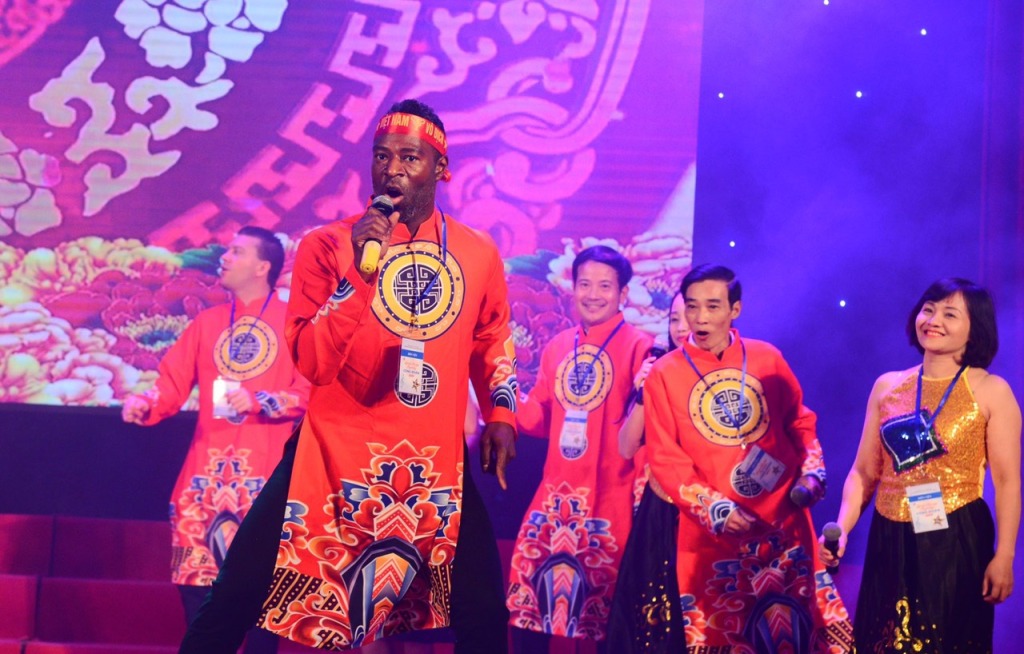
I was recently cornered in the hallway by the choreographer hired by our department to support our contribution to the university’s staff talent competition (see picture below*). She spoke with me in German, explaining that she’d lived several years in the former GDR. There are many Vietnamese who’d been ‘repatriated’ from the GDR upon reunification. So, given the historical ties to Communism, it’s commonplace to meet German (and Russian) speakers here. Naturally, folks ask how/why I speak (basic) German. My spouse of seventeen years is German, so it’d be weird if I hadn’t picked up any of the language. It’s really deceptive to conceal gender in German, which has three. I speak German almost every day here in Hanoi.
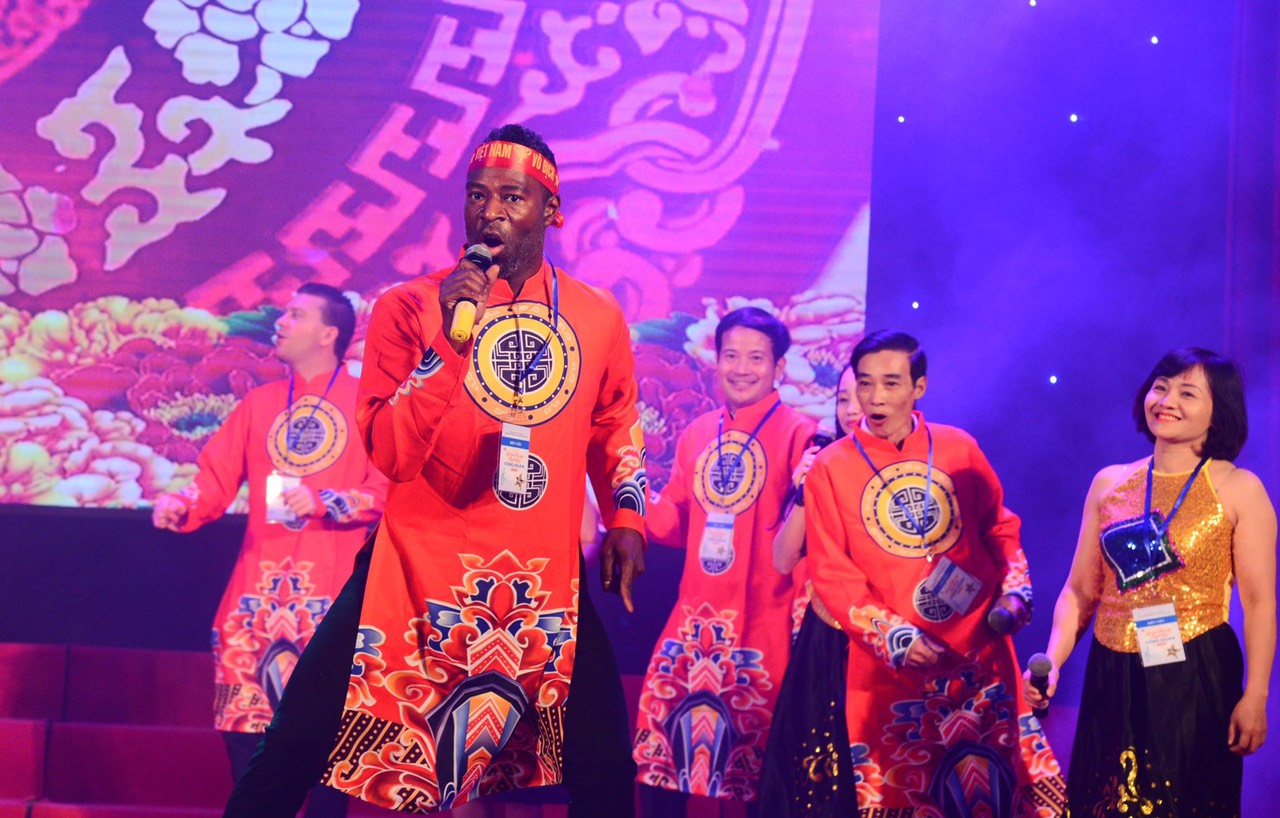
The word is ‘out’.
In Delhi, we lived in the same 2-bedroom flat for over 7 years. It became clear to our landlady very early on that we slept in one bedroom. Neighbours, we’re told, also noticed that we only ever had one vehicle between us and went most places together. Neither the landlady nor any neighbour ever confronted us, so we never had to formally come out. Yet, the chatter always got back to us.
As a Peace Corps volunteer in rural Mali in the late 90’s, I learned to speak Bambara. Bambara greetings are quite intimate: One normally asks about spouses, parents and/or children, just as Black-Americans traditionally would say “How yo’ momma doin?’” In Mali, village people make it their business to get single folks hitched. Between the Americans, then, it became commonplace to fake a spouse, just so one would be left in peace. Some women wore wedding bands for added protection, as a single woman living alone was unconscionable. The official advice for gays was to stay closeted L. While I pretended to be the husband of several volunteers, I could never really get the gist of it in my village. Besides, at 23 years old, being a single man wasn’t as damning as it is for women. I only needed excuses to reject the young women villagers presented to me. Anyhow, as soon as city migrants poured back to the village for Ramadan, I quickly discovered that there are plenty of LGBTQ+ folks in Mali! This was decades before Grindr.
Here in Hanoi, guys regularly, casually make gestures serving up females, as if to say: ‘Look, she’s available, have her’. I’ve never bothered to learn the expected response, nor paid enough attention to how straight men handle such scenarios. Recently, as we left a local beer hall with another (gay) couple, one waiter rather cheekily made such gestures at a hostess. In response, I made the same gestures towards him; he then served himself up as if to say ‘OK’. That’s what’s different about NOW as opposed to any earlier period: Millennials everywhere are aware of gay people.
A group of lads I sat with recently at a local tea stall made the same gestures to the one girl in their group. After coming out, the main instigator seamlessly gestured towards the most handsome in his clique. When I press Nigerian youth about the issue, the response is often the same: We don’t have a problem with gay people, we know gay people, it’s the old folk’s problem. Our building manager may be such a relic.
*Picture from The 2019 Traditional Arts Festival at Hanoi University of Science and Technology (HUST)

 Thoughts from the criminology team