
Home » Slavery (Page 3)
Category Archives: Slavery

What the fluff

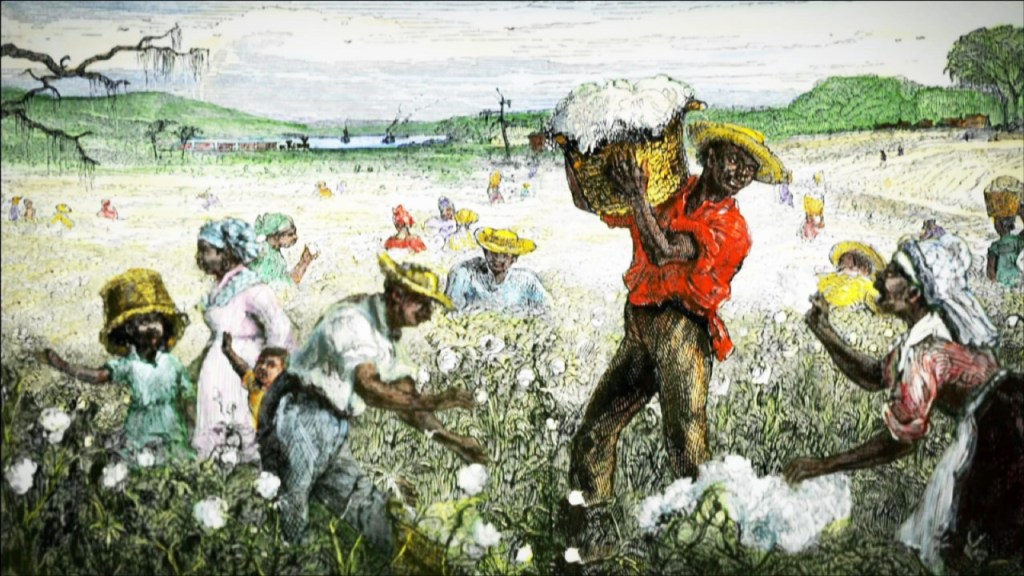
“History is not just stuff that happens by accident, we are the products of the history that our ancestors chose, if we are White. If we are Black we are products of the history our ancestors most likely didn’t choose.”
Kevin Gannon, 13th
And many of our cities in Britain are this melting pot due to the very same history our ancestors chose / didn’t choose; and the reason Britain has a variation of different faces is much to do (but not only) because of Britain’s colonial ambition.
Episode seven of the latest series of Who Do You Think You Are? was on TV entertainer Sharon Osbourne. Her family were victims of the Irish Potato Famine. Whilst the episode skirts over it, saying it occurred due to crop failures (with no real explanation), some would suggest that it was due to heavy-handed (British) colonial rule which assured those crop failures, leading to mass migration, starvation and death. For a show that is basically a series of history lectures, it does a good job of tiptoeing around uncomfortable (truths) bits of history.
As the late Jamaican philosopher and academic Stuart Hall said, “We are here because you were there” and we are now all here together, the products of our ancestors’ choices. I’ve been following this series of Who Do You Think You Are? with great interest and fascination. Almost every episode has had me hooked. And this latest episode with Sharon Osbourne was heartbreaking, with her great-grandmother Annie being the sole survivor of her six siblings, after disease and weakness took them.
The family emigrated to Massachusetts, USA in the mid-19th century and they worked in a cotton mill, the biggest in America and the second biggest in the world, only dwarfed by one in Manchester, Lancashire.
What irked me was the lack of contextual explanation around cotton during this time. Why wasn’t there any explanation regarding the history of cotton in the United States? Moreover, that relationship between American cotton and the mills of Lancashire and Cheshire (some 4500 mills in Lancashire and southern Scotland). What about the Industrial Revolution and how colonialism and the enslaved Black people that paid for it?
In a country still living in the aftermath of The Slave Trade, you cannot talk about cotton in America without talking about where the cotton came from. The same cotton made into cloth in Massachusetts would have came from cotton plantations, whether picked by African-Americans slaves (pre-1865) or “like-labour,” post-Civil War – since after abolition, the establishment entered into something called convict leasing. Prisoners loaned to plantation owners for a period, which (in itself) was legalised slavery. A loophole in the 13th Amendment stated that you could not be a slave, unless you were a criminal and imprisoned, thus America enters mass incarceration.
Black people in America were arrested for minor crimes like theft and vagrancy, and then imprisoned in mass. These prisoners were “rented” and put to work on plantations through the South – sugar, tobacco, cotton and more. The fact they didn’t feel the need to mention the context behind cotton in America is astounding, nor how the American cotton trade impacted Britain, for example the Lancashire Cotton Famine (1861 – 1865).

Yes, this episode is about Sharon Osbourne’s ancestors, but they were part of a longer story – a subtler history – the other half of cotton’s history that isn’t taught at school. And in places like Mississippi, where cotton was sailed down the Mississippi River by paddle steam, the local planters said:
“Cotton Is King.”
In Britain, we learn about spinning jennies. We learn about water frames and the Child Labour Act (1833), but not where cotton came from. This is American history and British history. It’s also working-class history. But in addition, it’s Black (British) history.
We are here because you were there; this is the history our ancestors chose, if you are White. But if you are Black, it’s the history your ancestors didn’t choose. And the least we can do is tell it right.
Bibliography
13th. Dir. Ava DuVernay. Netflix. 2016. Streaming platform.
Alexander, Michelle. The New Jim Crow. New York: The New Press, 2010. Print.
Olusoga, David. Black and British: A Forgotten History. London: Macmillan, 2016. Print.
Share this:


Is unconscious bias a many-headed monster?
When I was fourteen, I was stopped and searched in broad daylight. I was wearing my immaculate (private) school uniform – tie, blazer, shoes… the works. The idea I went to private school shouldn’t matter, but with that label comes an element of “social class.” But racial profiling doesn’t see class. And I remember being one of those students who was very proud of his uniform. And in cricket matches, we were all dressed well. I remember there being a school pride to adhere to and when we played away, we were representing the school and its reputation that had taken years to build. And within those walls of these private schools, there was a house pride.

Yet when I was stopped, it smeared a dark mark against the pride I had. I was a child. Innocent. If it can happen to me – as a child – unthreatening – it can really happen to anyone and there’s nothing they can to stop it. Here I saw unconscious bias rear its ugly head, like a hydra – a many-headed monster (you have to admire the Greeks, you’re never stuck for a metaphor!)
If we’re to talk about unconscious bias, we must say that it only sees the surface level. It doesn’t see my BA Creative Writing nor would it see that I work at a university. But unconscious bias does see Black men in hoodies as “trouble” and it labels Black women expressing themselves as “angry.”
Unconscious bias forces people of colour to censor their dress code – to not wear Nike or Adidas in public out of fear that it increases your chances of being racially profiled. Unconscious bias pushes Black and Asians to code-switch. If a White person speaks slang, it’s cool. When we do it, it’s ghetto. That’s how I grew up and when I speak well, I’ve had responses such as “What good English you speak.” Doomed if you do, doomed if you don’t.
How you speak, what you wear – all these things are scrutinised more when you don’t have White Privilege. And being educated doesn’t shield non-White people (British people of colour included) from racist and xenophobic attacks, as author Reni Eddo-Lodge says in her book:
“Children of immigrants are often assured by well-meaning parents that educational access to the middle classes can absolve them from racism. We are told to work hard, go to a good university, and get a good job.”
The police can stop and question you at any time. The search comes into play, depending on the scenario. But when I was growing up, my parents gave me The Talk – on how Black people can get hassled by police. For me, I remember my parents sitting me down at ten years old. That at some point, you could be stopped and searched at any time – from aimlessly standing on a street corner, to playing in the park. Because you are Black, you are self-analysing your every move. Every footstep, every breath.
And to be stopped and searched is to have your dignity discarded in minutes. When it happened, the officer called me Boy – like Boy was my name – hello Mr Jim Crow – like he was an overseer and I was a slave – hands blistering in cotton fields – in the thick of southern summertime heat. Call me Boy. Call me Thug. No, Call me Target. No, slave. Yes master, no master, whatever you say master. This was not Mississippi, Selma or Spanish Town – this was Northamptonshire in the 2000s and my name is Tré.

Yes, Northamptonshire. And here in 2019, the statistics are damning. Depending on which Black background you look at, you are between six and thirteen times more likely to be stop and searched if you are Black than if you are White (British). And reading these statistics is an indication of conversations we need to be having – that there is a difference between a Black encounter with the police and a White encounter. And should we be discussing the relationship between White Privilege and unconscious bias?
Are these two things an overspill of colonialism? Are they tied up in race politics and how we think about race?
Whilst these statistics are for Northamptonshire, it wouldn’t be controversial to say that stop and search is a universal narrative for Black people in Europe and the Americas. Whether we’re talking about being stopped by police on the street or being pressed for papers in 1780s Georgia. Just to live out your existence; for many its tiring – same story, different era.
You are between six and thirteen times more likely to be stopped if you are Black than if you are White (British) – but you know… let’s give Northamptonshire police tasers and see what happens. Ahem.
Bibliography
Eddo-Lodge, Reni. Why I’m No Longer Talking to White People About Race. London: Bloomsbury Publishing, 2018. Print
Share this:


Empower like Michelle
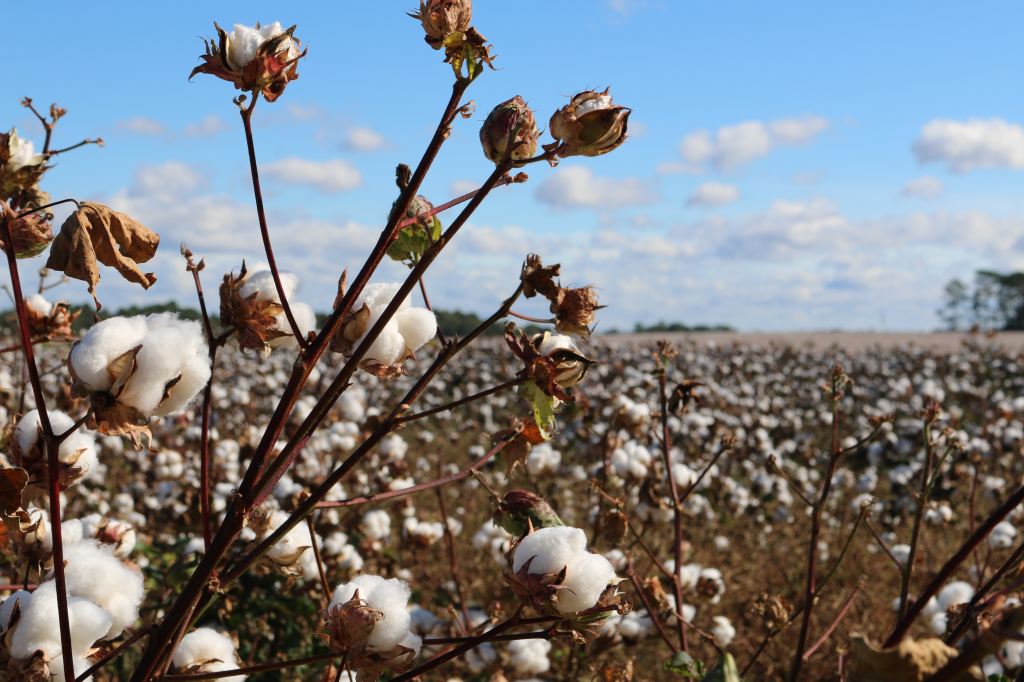
If you go to Freshers’, you will probably think this is for White people. But you’ve got to occupy your space. Better get used to occupying your space now because you’ll have to fight wherever you go, university or otherwise. Don’t let that deter you from your goals but more vitally, don’t let anybody make you feel bad about yourself. Don’t be silent in the discussions on slavery or the prison system. Use your voice, a sonicboom in the seminar. Don’t be mute to appease the White fragility of your peers, or even your lecturers and personal academic tutors.

You worked hard to get here, so occupy your space. Fill these spaces with jollof rice and jerk chicken and calypso and steel drums – the guts, determination and sheer willpower your parents and grandparents had when they arrived all those years ago. Don’t ever feel that you have to dilute your opinions for White consumption, or tell bitesize histories for the masses. In that Business class, talk loud about the Cheshire and Lancashire cotton mills written in the blood of African-American slaves.
Students, you might get lecturers that call you angry, who will have a hard time coming to terms with their own prejudice and White privilege. You will see that within a few weeks of studying. But keep your head down and think about graduation. Come and speak to me at the Students’ Union if you have any worries or just want to vent. Sometimes it’s just about finding solace in someone that gets it. Cry into that cheeky Nando’s. Buy that weave. Write a damn good assignment and prove all the naysayers wrong.
You will also find lecturers that are willing to listen to your experiences of racism and prejudice. They will implore you to write a dissertation that’s personal to you. You will find lecturers that give a shit, and will stand by you to the very end – who will say it’s absolutely fine to lace your dissertation with personal history – roots, rocks, and rebellion – academic staff that are activists in their own right (but will never openly admit it!)
Write about the politics of Black hair. Write about the Windrush Scandal or the legacy of colonialism on the Black body, or even Black men and mental health. Write every assignment for your aunties, who live in headwraps, talking in Twi and give you sound advice. Write in ruthless rebellion to the White Eurocentric reading of your degree, break the colour bar in style!
You will likely not relate to your course content. You will find it reflects the experiences of White people. No Afropean stories. No love for Sarah Forbes on History, or the Slave Trade cases of the 1700s on Law – the cases that helped forge the legal profession into what it is today. Or even the racial theories of the 18th and 19th century that we living in the remnants of – not Edward Long’s History of Jamaica nor the Black writers that top bestsellers lists. Write about a decolonised curriculum and inclusive course content.
When your lecturers make no allusion to American Slavery when you study the Industrial Revolution, give them the evilest evils you can muster. And challenge them on it. Leave them shook. Educate your “woke” White friends on why this is important. And when it comes to race, don’t feel you need to talk about race just because you’re the only non-White person in the class.
When you come to university, you will feel the urge to be someone that you are not just to fit in. BE YOU. You will try studenty things. JUST DO YOU. You’ll go out drinking, even if you don’t normally drink. You will join every society at Union Day and your emails will be chocka block. You’ll change your accent and “be friends” with people you dislike to conform to social norms. You will then admit you hate going out out and prefer a good book, or one of my poetry nights or just a chat with good people in your halls.
Tell yourself “Black is beautiful.” You know it, I know it. But there are people out there that’ll try to make you feel bad about your culture, as is life. Come back to campus in January with that Angela Davis afro, or be a dreadlock rastaman. Play cricket, like Jofra Archer or play football like Raheem Sterling. And, your hair is not an exotic specimen to gawked at and touched like a museum exhibit. Remember, say no. No means no. Always.
Black students, walk with pride. YOU DO YOU. Be united. You’ll see quickly that there are forces that are waiting for you to make a mistake. To fail. To point the finger. You’ll see quickly that failure is racialised and that failure in a White person is not as bad. You’ll see that we live in a society that doesn’t include you in its definition of beauty standards. So girls, when someone says “You’re pretty for a dark-skinned girl,” pay them no mind. Find beauty in your melanin. Find your tribe. Sisterhood is paramount.
When someone asks “Where are you from?” – it’s fine to say London or Milton Keynes or any British town or city. You do not need to entertain them when they ask “Where are you really from?” You can be British and African. You can be British and Caribbean. You belong here. You can just be British. And that is also fine. Previously, you’d not have found events that represent Black people or felt inclusive. But my philosophy is “Black History Month is every month, 365 days a year.” October, November forever. See me!
Listen, you might be made to feel conscious of your otherness and not everyone will get your “I Am Proud of My Blackness” mentality. Not everyone will understand the nuanced politics of Blackness at Northampton. That even in inaction, the supposed “woke” White people are still complicit in racism. And remember it isn’t YOUR JOB to explain what is racist and what is not. Do not take on that emotional labour. You are not the mouthpiece for Black people, and you don’t have to be.
You will have days where you will say “I hate this town, I want to go home – there is no culture and nothing to do” but Northampton can work for you. There are other communities of African and Caribbean here where you will be welcomed with rice and stew. You will find family and community.

And you are not alone. There are a lot of us here. Build communities. Join the resident ACS (African-Caribbean Society). Empower yourselves. Come to see me, as your Student Union representative. Look after each other. Be good to yourselves and one another – and above all, enjoy it.
Yours,
Tré Ventour
Vice President BME
Northampton Students’ Union
Share this:


Should reading be a punishment?
Gillian is an Academic Librarian at the University of Northampton, supporting the students and staff in the Faculty of Health and Society.
I was inspired to write this blog post by an article from the BBC news website that my friend sent me (BBC, 2019). A reading list was used as a punishment for teenagers who were convicted of daubing graffiti across a historically significant building in the state of Virginia, USA. Normally such an offence would earn a community service order. In this case, due to the nature of the crime – using racially charged symbols and words, the Prosecutor and Deputy Commonwealth Attorney Alejandra Rueda decided education may be the cure. She provided the five teenagers with a reading list that they had to read, and write assignments on, over the course of their 12-month sentence.
“Ignorance is not an excuse” is a principle expressed regularly throughout society, yet are we doing anything to address or dispel this ignorance? Rueda realised that books may help these teenagers to understand the impact of what they’d done and the symbols and language they had used in the graffiti. She chose books that would help educate them about racism, anti-Semitism, apartheid and slavery, to name just a few of the topics covered in the reading list. These were the books that helped her understand the wider world, as she grew up. Rueda’s approach indicated that punishment without an understanding of the impact of their crime, would not help these teenagers to engage with the world around them. These books would take them to worlds far outside their own and introduce them to experiences that were barely covered in their High School history lessons.
It’s not the only time an ignorance of history has been highlighted in the news recently. A premiere league football player was investigated for apparently making a Nazi salute. Although he was found not guilty, the FA investigation found him to be appallingly ignorant of Fascism and Hitler’s impact on millions of people across the globe (Church, 2019). Whilst the FA lamented his ignorance, I’m unsure they have done anything to help him address it. Would he be willing to read about the Holocaust and impact of Fascism in Europe? Would being forced to read about the lives of people over 70 years ago, help him understand how a chance photograph can affect people?
Should reading be a punishment, would it help people understand the impact of their actions? As a Librarian, people often assume that all I do all day is read. For me, reading is a luxury I indulge in daily, when I’m at home. I find a distinct difference between reading by choice, for escapism, and reading because you have to. I remember studying English Literature at school and finding any books I was forced to read, quickly lost their charm and became a chore rather than a pleasure. I’m not sure reading should be a punishment; it could disengage people from the joy and escapism of a good book. However, I understand the value of reading in helping people to explore topics and ideas that may be well outside their own world.
There is a growing body of literature that reflects on bibliotherapy and how reading can help people in varying stages of their life (Hilhorst et al., 2018; Brewster et al., 2013). A recent report by Hilhorst et al., (2018) advocates reading to transform British society, address isolation and improve social mobility. I believe reading can help improve our quality of life, helping us improve literacy, understand complex social issues and offer escapism from the everyday. However, I hesitate to view reading as a magical solution to society’s problems. Some people advocate the literary classics, the numerous lists you can find online that extort the virtues of reading the finest of the literary canon – but how much of it is just to conform to the social snobbery around reading ‘good literature’, a tick list? We should encourage reading, not force it upon people (McCrum, 2003; Penguin Books Ltd, 2019; Sherman, 2019).
Reading can help expand horizons and can have a tremendous impact on your world view, but it shouldn’t be a punishment. What Rueda did in Virginia, is illustrate how an education can help us address the ignorance in our society. We should encourage people to explore beyond their community to understand the world around us. Reading books can offer an insight and allow us to explore these ideas, hopefully helping us to avoid repeating or perpetuating the mistakes of the past.
References:
BBC (2019) Graffiti punished by reading – ‘It worked!’ says prosecutor, BBC News [Online]. Available from: https://www.bbc.co.uk/news/stories-47936071 [Accessed 18/04/19].
Brewster, L., Sen, B. and Cox, A. (2013) ‘Mind the Gap: Do Librarians Understand Service User Perspectives on Bibliotherapy?’, Library Trends, 61(3), pp. 569–586. doi: 10.1353/lib.2013.0001.
Church, B. (2019) Wayne Hennessey: EPL player showed ‘lamentable’ ignorance of Fascism, CNN [Online]. Available from: https://edition.cnn.com/2019/04/16/football/wayne-hennessey-fa-nazi-salute-english-premier-league-crystal-palace-spt-intl/index.html [Accessed 18/04/19].
Hilhorst, S., Lockey, A. and Speight, T. (2018) “It’s no exaggeration to say that reading can transform British society…”: A Society of Readers, DEMOS [online] Available from: http://giveabook.org.uk/wp-content/uploads/2018/11/A_Society_of_Readers_-_Formatted__3_.pdf [Accessed 15/04/19]
McCrum, R. (2003) The 100 greatest novels of all time: The list, The Guardian [Online]. Available from: https://www.theguardian.com/books/2003/oct/12/features.fiction [Accessed 18/04/19].
Penguin Books Ltd (2019) 100 must-read classic books, as chosen by our readers, Penguin [Online]. Available from: https://www.penguin.co.uk/articles/2018/100-must-read-classic-books/ [Accessed 18/04/19].
Sherman, S. (2019) The Greatest Books, The Greatest Books [Online]. Available from: https://thegreatestbooks.org/ [Accessed 18/04/19].
Share this:


A Love Letter: in praise of poetry

Avoid loud and aggressive persons,
they are vexations to the spirit.
If you compare yourself with others,
you may become vain and bitter;
for always there will be greater and lesser persons than yourself.
Enjoy your achievements as well as your plans
(Max Ehrmann, 1927)
Last week marked International Poetry Day (21 March 2019, to be precise) and it seems only right to consider this form of narrative in more detail. When I was younger (so much younger than today)[i] poetry left me rather cold. Why read short, seemingly impenetrable bursts of language when you could read whole books? To me, it seemed as if poetry was simply lyrics that no-one had got around to putting music to.[ii] Looking back, this may have been the folly of youth, alternatively, I simply was unable at that time to see the value, the beauty of poetry, both written and spoken.
Poetry isn’t meant to be consumed whole, like fast food to be gobbled in between anything and everything else, fuel to get you through the day. Neither is it like googling facts, just enough to enable you to know what you need to know at that instant. Instead, it’s meant to be savoured, to stay with you; like many good things in life, it takes time to ponder and digest. In turn, it takes on its own distinct and entirely personal meaning. It offers the opportunity for all of us, individually, to reflect, ruminate and interpret, at our own pace, according to our own place in time and space. The extract which opens this entry comes from Desiderata which carries particular resonance for me and my academic journey. It may or may not do the same for you, but it’s worth having a look at the entirety of the text, just in case.
An obvious criminological place to start to explore poetry, was always a favourite. Long before I discovered criminology, I discovered the work of Oscar Wilde (1854-1900). Starting with his novels, it wasn’t long before I stumbled upon his Ballad of Reading Gaol. With its haunting refrain; ‘each man kills the thing he loves’ it is difficult not to captured by its innate melody, as well as the story of the murderous soldier. After studying criminology and spending time in prison (albeit not serving a sentence), the verses take on a different dimension. It is difficult not to be moved by his description of the horror of the prison, even more so, given his practical experience of surviving in this hostile and unforgiving environment:
With sudden shock the prison-clock
Smote on the shivering air,
And from all the gaol rose up a wail
Of impotent despair,
Like the sound that frightened marshes hear
From a leper in his lair
(Oscar Wilde, 1898)
On the surface, poets like the Greek, civil servant C. P. Cavafy (1863-1933) have nothing to say about my life, yet his words make my heart ache. Cavafy’s tale of a mystical and mythical journey to Ithaka which seems to me to represent my educational journey in ways that I am only just beginning to appreciate. Replace the mythical Ithaka, with my all too real experience of doctoral study and you get the picture.
Keep Ithaka always in your mind.
Arriving there is what you’re destined for.
But don’t hurry the journey at all.
Better if it lasts for years,
so you’re old by the time you reach the island,
wealthy with all you’ve gained on the way,
not expecting Ithaka to make you rich
(C. P Cavafy, 1910/1911)
Furthermore, The Satrapy appears to represent ambition, desire and above all, the necessity of educating oneself in order to become something more. To truly realise your humanity and not just your mere existence, is a constant struggle. Cavafy’s words offer encouragement and a recognition that individual struggle is a necessity for independence of thought.
Your soul seeks other things, weeps for other things;
the praise of the public and the Sophists,
the hard-won and inestimable Well Done;
the Agora, the Theater, and the Laurels
(C. P. Cavafy, 1911)
Poets like Maya Angelou celebrate gender and race (among many other aspects), identifying intersectionality and the struggles fought and won, and the struggles still ongoing. Despite historical and contemporaneous injustice, to be able to shout from the rooftops Still I Rise in answer to the questions she poses, is truly inspirational:
Did you want to see me broken?
Bowed head and lowered eyes?
Shoulders falling down like teardrops,
Weakened by my soulful cries?
(Maya Angelou, 1978)
Likewise, Hollie McNish utilises her anger and frustration to powerful effect, targeting racism with the linguistic gymnastics and logic of Mathematics , demonstrating that immigration is one of the greatest things to happen in the UK. To really get the full force, you should watch the video!
Cos sometimes one that comes makes two
And sometimes one can add three more
And sometimes two times two is much much more
Than four
And most times immigrants bring more
Than minuses
(Hollie McNish, 2013).
To conclude, you have nothing to lose by immersing yourself in a bit of poetry, but everything to gain. The poets and poems above are just some of my favourites (what about Akala, Cooper Clarke, McGough, Plath, Tempest, Zephaniah, the list goes on) they may not be yours, but it doesn’t matter. Don’t rush it, read a little something and read it again. Let the words and imagery play around in your head. If it sings to you, try to remember the name and the poet, and you can return again and again. If it doesn’t sing to you, don’t lose hope, choose another poet and give their work a chance to inveigle its way into your life. I promise you, it will be worth it
Selected Bibliography
Angelou, Maya, (1978/1999), And Still I Rise, (8th ed.), (London: Virago Press)
Cavafy, C. P., (2010), Collected Poems, tr. from the Greek by Daniel Mendelsohn, (New York: Alfred A. Knopf)
Lennon, John and McCartney, Paul, (1965) Help!, [CD], Recorded by The Beatles in Help!. Parlophone, [s.l.], Apple
Wilde, Oscar, (1898), The Ballad of Reading Gaol by C. 3. 3., (London: Leonard Smithers)
[i] Lennon and McCartney, (1965).
[ii] Not always the case, as can be seen by the Arctic Monkey’s (2013) musical rendering of John Cooper Clarke’s I Wanna Be Yours
Share this:


‘The Problem We All Live With’

The title of this blog and the picture above relate to Norman Rockwell’s (1964) painting depicting Ruby Bridges on her way to school in a newly desegregated New Orleans. In over half a century, this picture has never lost its power and remains iconic.
Attending conferences, especially such a large one as the ASC, is always food for thought. The range of subjects covered, some very small and niche, others far more longstanding and seemingly intractable, cause the little grey cells to go into overdrive. So much to talk about, so much to listen to, so many questions, so many ideas make the experience incredibly intense. However, education is neither exclusive to the conference meeting rooms nor the coffee shops in which academics gather, but is all around. Naturally, in Atlanta, as I alluded to in my previous entry this week, reminders of the civil rights movement are all around us. Furthermore, it is clear from the boarded-up shops, large numbers of confused and disturbed people wandering the streets, others sleeping rough, that many of the issues highlighted by the civil rights movement remain. Slavery and overt segregation under the Jim Crow laws may be a thing of the past, but their impact endures; the demarcation between rich and poor, Black and white is still obvious.
The message of civil rights activists is not focused on beatification; they are human beings with all their failings, but far more important and direct. To make society fairer, more just, more humane for all, we must keep moving forward, we must keep protesting and we must keep drawing attention to inequality. Although it is tempting to revere brave individuals such as Ruby Bridges, Claudette Colvin, Martin Luther King Jr, Rosa Parks, Malcolm X to name but a few, this is not an outcome any of them ascribed to. If we look at Martin Luther King Jr’s ‘“The Drum Major Instinct” Sermon Delivered at Ebenezer Baptist Church’ he makes this overt. He urges his followers not to dwell on his Nobel Peace Prize, or any of his other multitudinous awards but to remember that ‘he tried’ to end war, bring comfort to prisoners and end poverty. In his closing words, he stresses that
If I can help somebody as I pass along,
If I can cheer somebody with a word or song,
If I can show somebody he’s traveling wrong,
Then my living will not be in vain.
If I can do my duty as a Christian ought,
If I can bring salvation to a world once wrought,
If I can spread the message as the master taught,
Then my living will not be in vain.
These powerful words stress practical activism, not passive veneration. Although a staunch advocate for non-violent resistance, this was never intended as passive. The fight to improve society for all, is not over and done, but a continual fight for freedom. This point is made explicit by another civil rights activist (and academic) Professor Angela Davis in her text Freedom is a Constant Struggle. In this text she draws parallels across the USA, Palestine and other countries, both historical and contemporaneous, demonstrating that without protest, civil and human rights can be crushed.
Whilst ostensibly Black men, women and children can attend schools, travel on public transport, eat at restaurants and participate in all aspects of society, this does not mean that freedom for all has been achieved. The fight for civil rights as demonstrated by #blacklivesmatter and #metoo, campaigns to end LGBT, religious and disability discrimination, racism, sexism and to improve the lives of refugees, illustrate just some of the many dedicated to following in a long tradition of fighting for social justice, social equality and freedom.

 Thoughts from the criminology team