
Home » Research (Page 2)
Category Archives: Research

A response to the Government’s plans to address ‘Mickey-mouse degrees’.

The Government’s latest plans to scrap university courses that are being considered as ‘under-achieving’ through poor graduate outcomes and progression should deeply concern all of us who work in and who have a passion for the Social Sciences, Arts and Humanities across Higher Education. It is no secret that Rishi Sunak and his Government have traditionally favoured apprentices in replacement of graduates. It is a truth that university and higher education is not for everyone, so whilst the value of undertaking an apprentice should be unequivocally un-challenged, this moment of rupture and insecurity for the Higher Education Sector should provoke us to think about how the culture of Higher Education has changed, and why people come to university in the first place. Engaging in these perspectives will put us in a stronger position to contribute to these debates occurring across the chambers of Parliament and at dinner tables across the country. So too should we as academics be actively challenging these attacks on the disciplines that we have passion for.
Before the awakening of neoliberalism, higher education was a vocation and a pursuit for those seeking to climb the ladder of ‘social mobility’. It is without question, that UK universities, particularly in the inter-war and the early post-war period were filled with young people with pre-existing economic fortune and privilege. Universities were not spaces for the working classes, nor for individuals achieving low grades outcomes. However, we can acknowledge that the class-based, gender and racial barriers into Higher Education have improved, yet we still have progress to make moving forward. Since the 2008 Global Financial Crash and the series of events that have followed, the motivations for coming to university have largely changed. Seemingly, it is predicated on a mode of response to economic re-structuring, particularly when the opportunities in the labour markets erode and become increasingly competitive, university seems for some as a suitable option to both buy time and up-skill to ‘stand out’. A sad truth remains however that these gravitations to university have contributed to degree inflation that has changed the way we see and value a degree. These changes have partially allowed the Government to play loose and fast with degrees that they consider ‘worthless’. However, those of us who actively teach and research in the social sciences will know that these degrees are invaluable…. Invaluable through teaching students to critically think about the seemingly ‘normal world’ around them- to question the logic of everyday practices, attitudes, norms and values that are engrained into our social fabric. To work with communities and organisations to identify and respond to issues of criminal and social injustice…. Be that austerity, homelessness, poverty, miscarriages of justice, and inequality. With this in mind, as educators in the social sciences, arts and humanities, we have a duty to show-case the momentous impact of our disciplines. To show-case movements of activism, government lobbying and social change. This emphasises the importance of research, knowledge exchange and adopting pedagogies enabling students to develop these works. Only then, can we put forward cases for impacts that at a government level could challenge these narratives. So too can we utilise these cases to infuse a passion for the discipline that with luck would enable a student to make a choice of coming to university that is right for them.
As a sector, we have numerous challenges facing us…. we need to think like and be activists…. We need to embody what we teach and speak out against those who reduce our work as a ‘worthless’ or ‘Mickey-Mouse’ degree. We may not change the Government’s approach but at least if departments do get shut down…. We went with a fight.
Share this:


Meet the Team: Liam Miles, Lecturer in Criminology

Hello!
I am Liam Miles, a lecturer in criminology and I am delighted to be joining the teaching team here at Northampton. I am nearing the end of my PhD journey that I completed at Birmingham City University that explored how young people who live in Birmingham are affected by the Cost-of-Living Crisis. I conducted an ethnographic study and spent extensive time at two Birmingham based youth centres. As such, my research interests are diverse and broad. I hold research experience and aspirations in areas of youth and youth crime, cost of living and wider political economy. This is infused with criminological and social theory and qualitative research methods. I am always happy to have a coffee and a chat with any student and colleague who wishes to discuss such topics.
Alongside my PhD, I have completed two solo publications. The first is a journal article in the Sage Journal of Consumer Culture that explored how violent crime that occurs on British University Campuses can be explained through the lens of the Deviant Leisure perspective. An emerging theoretical framework, the Deviant Leisure perspective explores how social harms are perpetuated under the logics and entrenchment of free-market globalised capitalism and neoliberalism. As such, a fundamental source of culpability towards crime, violence and social harm more broadly is located within the logics of neoliberal capitalism under which a consumer culture has arisen and re-cultivated human subjectivity towards what is commonly discussed in the literature as a narcissistic and competitive individualism. My second publication was in an edited book titled Action on Poverty in the UK: Towards Sustainable Development. My chapter is titled ‘Communities of Rupture, Insecurity, and Risk: Inevitable and Necessary for Meaningful Political Change?’. My chapter explored how socio-political and economic moments of rupture to the status quo are necessary for the summoning of political activism; lobbying and subsequent change.
It is my intention to maintain a presence in the publishing field and to work collaboratively with colleagues to address issues of criminal and social justice as they present themselves. Through this, my focus is on a lens of political economy and historical materialism through which to make sense of local and global events as they unfold. I welcome conversation and collaboration with colleagues who are interested in these areas.
Equally, I am committed to expanding my knowledge basis and learning about the vital work undertaken by colleagues across a breadth of subject areas, where it is hoped we can learn from one another.
I am thoroughly looking forward to meeting everyone and getting to learn more!
Share this:


Meet the Team: Angela Charles, Senior Lecturer in Criminology

I would like to take this opportunity to say a warm hello to my colleagues and to the students at the University of Northampton.
I am Angela Charles, a senior lecturer in criminology. I have a passion and deep interest in this discipline for a number of reasons. Firstly, criminology is such a fascinating and thought-provoking subject that is constantly evolving and expanding. Secondly, criminology is a subject where I believe social justice can be fought for and in many cases achieved, through researching and gaining evidence to push for change, and through perseverance. Thirdly, criminology requires us to discuss, debate, analyse and build on what has been previously argued and discussed; thereby strengthening, tweaking or dismantling and rebuilding previous theoretical knowledge and criminological concepts.
My research interests are within prisons and penology, and race and gender. My most recent research explored and analysed the experiences of Black women in English prisons, paying particular attention to the intersections of race, class and gender. Black women are at the margins of society and face multiple intersecting oppressions. The prison is arguably a microcosm of society and perpetuates the same oppressive structural inequalities. It is often these racialised and gendered pains of imprisonment that are rarely discussed or mentioned both within scholarly literature and the public realm more widely. I hope to disseminate my research in the coming years and amplify some of the voices of Black women in UK prisons.
I’m also keen to explore research methods that arguably move away from traditional research methods and instead aim to decolonise research methods. Criminologists need to adapt the methods they use to suit the differing backgrounds and cultures of the participants that we research, and we need to incorporate different cultural aspects into the research process. I believe this not only will create richer data, but will also increase participant engagement as they become co-producers of knowledge.
Lastly, I look forward to working closely with my colleagues to learn about their research interests, passions and to collaborate on ensuring that studying criminology is enjoyable, rewarding and insightful at the University of Northampton!

Share this:


A Snapshot of My Dissertation: Portuguese Drug Decriminalisation and Some Other Things
I submitted my dissertation back in April, and now the dust has settled I thought it would be good to share the most interesting parts of my research, think of this blog post as an abridged version of my dissertation. Towards the end I’ve also included some tips for completing a dissertation, along with some reading you might like to do if you found this interesting.
What Was my Research About?
My research was about two main areas; Firstly, I wanted to assess the effects of Portugal’s 2001 drug policy whereby all illicit drugs were decriminalised, meaning drug offences relating to personal possession result in a civil punishment rather than a criminal punishment. I assessed key indicators within Portuguese society, gathering data from international, European and national databases which measured public health trends, criminal justice trends and economic trends. Some fields of data I looked at included prices of drugs at market level, drug seizure data, HIV/ AIDS rates among people who inject drugs and the Portuguese prison population.
The second part of my research involved understanding whether a drug decriminalisation policy similar to Portugal’s could currently happen in the UK. I researched this by performing a discourse analysis on drug related House of Commons debate occurring between the years 1970- 2023, selecting roughly one debate every two years. By doing this, I was able to analysis common themes across the years, understanding the political barriers which may mean drug decriminalisation is not a feasible policy idea at the moment given the political attitude and climate within the House of Commons when it comes to illicit drug policy.
What Did I Find Out?
Look through the slideshow below to view summaries of my findings.

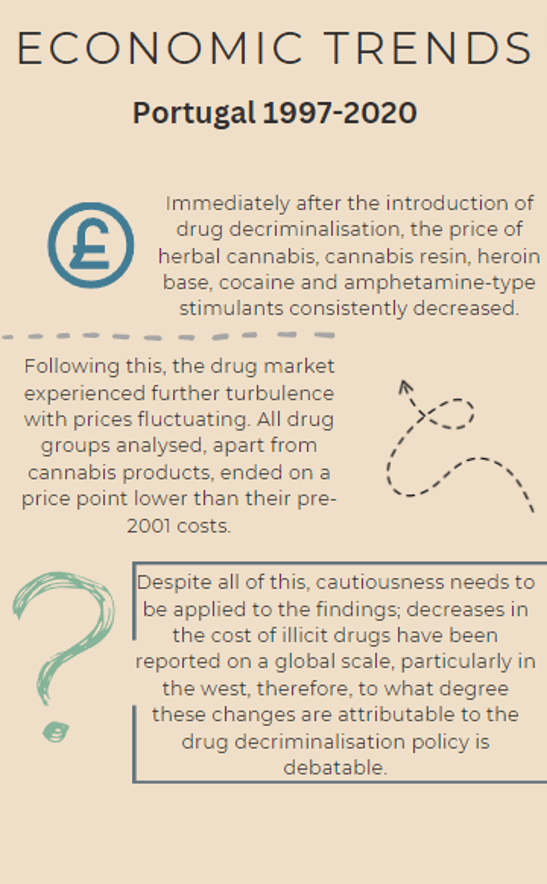


Some Final Comments and Conclusions:
Generally, my research found that Portuguese drug decriminalisation correlated with effects that can be seen as positives. Of course, my research needs to be looked at critically, I don’t claim that all of the societal indicators are directly attributable to the drug decriminalisation policy, however, the correlations that were found are promising. Policy is always a really complex, multi-faceted topic and it would be simplistic to suggest otherwise.
So is a drug decriminalisation policy likely to happen in the UK? The short answer is probably not very likely at all. My discourse analysis pointed towards five decades of debate which was hyper focused on a law and order approach to drug use, a fixation on low level cannabis use and an insistence on the idea that deterrence measures and the war on drugs is actually working. The debates felt stagnant, with new and progressive approaches being hindered by penal populism and ‘tough on crime’ stances.
During my research I found some really interesting reads and different points of view that I hadn’t considered before. I’ve listed some of my favourite pieces below if you’d like to have a read further into this subject.
- Cebral T.S. (2017) “The 15th anniversary of the Portuguese Drug Policy: Its history, its success and its future,” Drug Science, Policy and Law, 3. https://doi.org/10.1177/2050324516683640
- Eastwood, N., Fox, E. and Rosmarin, A. (2016) “Portugal,” in A quiet revolution: Drug decriminalisation across the Globe. London, UK: Release drugs the law and human rights. https://www.release.org.uk/sites/default/files/pdf/publications/A%20Quiet%20Revolution%20-%20Decriminalisation%20Across%20the%20Globe.pdf
- Goldstein, P.J. (1985) “The drugs/violence nexus: A Tripartite Conceptual Framework,” Journal of Drug Issues, 15(4). https://doi.org/10.1177/002204268501500406
- Jacques, S. and Allen, A. (2015) “Drug market violence: Virtual anarchy, police pressure, predation, and retaliation,” Criminal Justice Review, 40(1). https://doi.org/10.1177/0734016814553266
All of the data used is available from The Hansard Archives, European Monitoring Centre for Drugs and Drug Addiction, European Centre for Disease Prevention and Control and The World Prison Brief. Also, I used Taguette to analyse my qualitative data, it’s totally free and it was so useful.

Share this:


Reflecting on Research Access

I am currently undertaking a part-time PhD and, as part of my qualitative research project, I need to keep a reflexivity diary, reflecting on my own position in relation to the subjects of my research. My first entry reflects on the process of negotiating access, and I thought it might make an interesting subject for a criminology blog!
As a reflexive qualitative researcher it is important constantly to reflect on my own position in relation to my research and my participants. I am about to start collecting data but only after a very lengthy process of negotiating access (12 months). This process was one in which my own position and history had a significant influence.
For my first project, I am conducting detailed qualitative interviews with serving prisoners. This required approval from the HMPPS National Research Committee (NRC). As a former HMPPS employee, I thought that my inside knowledge would be helpful – indeed at a later stage, in negotiating access to specific prisons, I think it has been. However, at the stage of submitting my application for national approval my prior experience added emotional baggage.
I worked for the Prison Service for nearly 12 years. I really enjoyed working with prisoners and I also enjoyed the camaraderie of working within the tight community of a prison. I worked with some lovely individuals who were dedicated to helping people and who supported me personally in my career. However, the Prison Service is a large, unwieldy organisation and large unwieldy organisations do not always treat individuals well. There were several times in my career when I felt that the organisation had treated me badly: when a recruitment freeze was introduced just after I passed the assessment centre so that I was stuck in limbo without a permanent job; when the in-house MSc was abolished (with no replacement) just before I was due to start it; when I ended up taking on my boss’ responsibilities as well as my own with no promotion or increase in pay; when my request to work part-time after maternity leave was declined; when my post was put on the “surplus list” during a phase of job cuts. It was not all negative – as I say, I enjoyed the work very much, I was proud to be a prison psychologist and there were times when the organisation was good to me (I eventually had a different distance learning MSc funded by the Prison Service, and I was able to take a 12 month career break following my maternity leave) but those negative incidents felt like personal insults when I was working hard. The biggest kick in the teeth came more recently in 2020 when I applied to re-join HMPPS when my tenure on the Parole Board came to an end. I had an unremarkable remote interview and was then turned down. I knew that HMPPS advertised for qualified psychologists every month, so there were plenty of vacancies – that they didn’t want me when I knew I was a good psychologist and had already given them the best years of my career really hurt.
Since then, I have started my PhD and secured a great job with St Andrew’s Healthcare which suits me better and has taken me in a new direction. The memory of the rejection was still lingering, however, when my initial research application to the HMPPS NRC was rejected. I felt like they were kicking me in the teeth again. My initial application was for a piece of research with both a quantitative and a qualitative element. The feedback in relation to the quantitative project was so devastating that I scrapped this part of the research altogether and focused on the qualitative part only. To be fair, the feedback was justified and the re-written proposal is for a much more methodologically sound piece of research, but it still felt personal at the time.
Conducting research during a pandemic is not easy. By the time I had responded to the NRC feedback and was ready to re-submit, there was a resurgence in COVID-19 cases and the NRC were not accepting any further applications. I was advised not to re-submit until applications were being accepted again, otherwise I would have been rejected with no chance to re-submit again. This caused a three-month delay and I had to chase to find out when applications re-opened. When I finally re-submitted, my application was not rejected, but I did receive a long list of requests for further information. Some of these seemed very petty. Responding to them was a significant piece of work and the sense of personal rejection and being made to jump through hoops returned. I was very grateful to one of my supervisors who read my responses before I submitted them and helped to remove the irritation that was evident!
Having submitted the answers to these further questions I waited for ages for a reply. By this stage, I was on first name terms with the reviewer on the NRC. She had sent my application for further feedback from the HMPPS Interventions Team (one of whom I had worked closely with in the past). I was given further questions to answer (which seemed to miss the point of what I was trying to achieve). I tried my hardest to remain positive and to suppress the irritation. HMPPS had the power and were entitled to it. They had every right to reject my research application. Just because I had been a good employee in the past, did not oblige them to give me research access. I resigned myself to receiving a final rejection and started to think of other ways to explore my research questions. And as I reached this point of acceptance, I finally received a positive response saying that my application had been accepted!
Since then, things have moved quickly. I revised my University ethics application in the light of all the amendments I had made following the HMPPS feedback and this was quickly approved. I approached individual prisons for specific access and received positive responses from HMP Grendon and HMP Onley – in these cases possibly reaping the benefits of personal connections from my time in the Prison Service. I will be going into HMP Grendon in early January to start to recruit participants. I no longer work for HMPPS or for the Parole Board, but my status as a Forensic Psychologist and as a former HMPPS employee and Parole Board member will have an influence on my relationships with participants. They will have had experiences with psychologists (and may have had experiences with the Parole Board) which may be positive or negative and which may facilitate or hinder trust in me as a researcher. I will need to look out for these influences and reflect on them as the research progresses.
Share this:


Public confidence in the CJS: ending on a high?

2022 has been a turbulent and challenging year for many. Social inequalities and disadvantage are rife, with those in power repeatedly making bad, inhumane decisions and with very little, to no, accountability or consequences (insert your favourite example from the sh** storm that is the Conservative Party here). Union after Union, across sectors, engage in industrial action in response to poor working conditions and pay, amidst a cost-of-living crisis. And although seemingly unconnected, as the year comes to a close, the Sentencing Guidelines (2022) report on Public Confidence in the Criminal Justice System (CJS) has got me feeling frustrated. My previous blog entries have often been ‘moans’. And whilst January is often dubbed the month of new beginnings and change for the year ahead: we’re not quite there yet so true to form here is my latest moan!
The report exists as one of many conducted by Savanta to collate data on public confidence, in terms of effectiveness and fairness, in the CJS and public awareness of the sentencing guidelines. The data collected in March 2022, was via online surveys given to a “nationally representative sample of 2,165 adults in England and Wales” (Archer et al., 2022, p.9). Some of their highlighted ‘Key Findings’ include that confidence levels in CJS remains relatively stable in comparison to 2018, on the whole, respondents viewed sentences as ‘too lenient’ however this varied based on offence, the existence of the sentencing guidelines improves respondent’s confidence in the fairness of sentencing, and that engagement with broadcast news sources was high across respondents (Archer et al., 2022). It is not the findings, per se, that I take umbrage with, but rather the claim it is a “nationally representative sample of adults in England and Wales” (Archer et al., 2022, p.9).
I take issue on two fronts. The first being that the sample size of 2,165 adult respondents is representative when the demographic factors included are: gender (male and female), age (18-34yo, 35-54yo and 55+), region, ethnicity (White, Mixed, Asian, Black and Other) and socio-economic grade. Now considering we are, thankfully, at the end of 2022 we should all be able to recognise that a sample which only includes cis-gendered options, narrows ethnicity down to 4 categories and the charming ‘other’, and does not include disabilities is problematic. There has been a large body of research done on people with disabilities and their experiences within the CJS, the lack of representation, the lack of accessibility to space and decisions, potentially impacting a defendant’s right to a fair trial, and a victim’s right to justice (Equality and Human Rights Commission, 2021; Hyun et al., 2013 ). So I ask, is this not something which needs considering when looking at public confidence in the CJS of a “nationally representative” sample?
In addition to this, I take issue with the requirement that the sample be “nationally representative”. We have research piece upon research piece about how Black men and Black boys experience the CJS and its various agencies disproportionately to their white counterparts (Lammy, 2017; Monteith et al., 2022; Parmar, 2012). Their experiences of stop and search, sentencing, bail, access to programmes within the Secure and Youth estate. There is nothing representative about our CJS in terms of who it processes, how this is done, and by whom. According to Monteith et al., (2022) 1% of Judges in the CJS are Black, and there are NO Black judges on the High Court, Court of Appeal of Supreme Court: this is not representative! Why then, are we concerned with a representative sample when looking at public confidence in CJS and the sentencing guidelines, when it is not experienced in a proportionate manner?
Maybe I’ve missed the point?
The report is clear, accessible, visible to the public: crucial concepts when thinking about justice, and measuring public confidence in the CJS is fraught with difficulties (Bradford and Myhill, 2015; Kautt and Tankebe, 2011). But this just feels like another nail being thumped into the coffin that is 2022. Might be the eagerness I possess to leave 2022 behind, or the impeding dread for the year to follow but the report has angered me rather than reassured me. As a criminologist, I am hopeful for a more inclusive, representative, fair and accountable CJS, but I am not sure how this will be achieved if we do not accept that the system disproportionately impacts (but not exclusively) Black men, women and children. Think it might be time for another mince pie…
Happy New Year to you all!
References:
Archer, N., Butler, M., Avukatu, G. and Williams, E. (2022) Public Knowledge of Confidence in the Criminal Justice System and Sentencing: 2022 Research. London: Sentencing Council.
Bradford, B. and Myhill, A. (2015) Triggers of change to public confidence in the police and criminal justice system: Findings from the crime survey for England and Wales panel experiment, Criminology and Criminal Justice, 15(1), pp.23-43.
Equality and Human Rights Commission (2021) Does the criminal justice system treat disabled people fairly? [Online] Available at: https://www.equalityhumanrights.com/en/inquiries-and-investigations/does-criminal-justice-system-treat-disabled-people-fairly [ Accessed 4th November 2021].
Hyun, E., Hahn, L. and McConnell, D. (2013) Experiences of people with learning disabilities in the criminal justice system, British Journal of Learning Disabilities, 42: 308-314.
Kautt, P. and Tankebe, J. (2011) Confidence in the Criminal Justice System in England and Wales: A Test of Ethnic Effects, International Criminal Justice Review, 21(2),pp. 93-117.
The Lammy Review (2017) The Lammy Review: An independent review into the treatment of, and outcomes for, Black Asian and Minority Ethnic Individuals in the Criminal Justice System, [online] Available at: https://assets.publishing.service.gov.uk/goverment/uploads/system/uploads/attachment_data/file/643001/lammy-review-final-report-pdf [Last Accessed 14th February 2021].
Monteith, K., Quinn, E., Dennis, A., Joseph-Sailsbury, R., Kane, E., Addo, F. and McGourlay, C. (2022) Racial Bias and the Bench: A Response to the Judicial Diversity and Inclusion Strategy (2020-2025), [online] Available at: https://documents.manchester.ac.uk/display.aspax?DOCID=64125 [Accessed 4th November 2022].
Parmar, A. (2012) Racism and ethnicity in the criminal justice process, in: Hucklesby, A. and Wahidin, A. (eds.) Criminal Justice, 2nd ed, Oxford: Oxford University Press, pp.267-296.
Share this:


Refugee Week 2022

Next week (20th-26th June) is Refugee Week, coming at a moment in time days after the first deportation flight of asylum seekers to Rwanda was scheduled. Luckily the government’s best efforts were thwarted by the ECHR this time. Each year Refugee Week has a theme and this year’s focus is healing. People fleeing conflict and persecution have a lot to heal from and I am pessimistic about whether healing is possible in the UK. My own research examines the trajectories of victimisation among people seeking safety. I trace experiences of victimisation starting from the context from which people fled, during their journeys and after arrival in the UK. It is particularly disturbing as someone who researches people seeking safety that once they arrive in a place they perceived to be safe, they continue to be victimised in a number of ways. People seeking safety in the UK encounter the structurally violent asylum ‘system’ and discriminatory attitudes of swathes of the public, sections of the media and last not certainly not least, political discourse. Even after being granted leave to remain, refugees face a struggle to find accommodation, employment, convert education certificates and discrimination and hate crime is ongoing.
Over the years I have supported refugees who suffered breakdowns after having their asylum claim awarded. They are faced with the understanding of the trauma they suffered pre-migration, compounded by the asylum system and the move-on period following claims being awarded. Yet this is no time to heal. In the wake of the Nationality and Borders Act 2022, no migrant nor British citizen with a claim to citizenship elsewhere is safe. There is no safety here and therefore there can be no healing, not meaningful healing anyway.

Despite my negative outlook on the state of immigration policy in the UK, there are some positive signs of healing for some people seeking safety. These experiences are often facilitated by peer support, grassroots organisations and charities. I recall one woman who had fled Iraq coming into a charity I was undertaking research in. When we met for the first time, she was tiny and looked much older than she was. She would pull her veil tightly around her head, almost like it was protecting her. This woman did not speak a word of English and the only volunteer Kurdish Sorani interpreter did not attend the group every week. The womens’ group I attended conducted activities which overcame language barriers and at the time we were working with tiles and mosaics on a project which lasted a few weeks. During this time I could visibly see this woman start to heal. She started to stand up straight, making her appear taller. Her face softened and she appeared younger. She started smiling and her veil loosened. She was relaxing among us. In my experience, I’ve noticed that the healing comes in ebbs and flows. Relief of being ‘safe’, compounding stress of asylum, making friends, waiting, waiting, waiting for a negative decision, being supported by NGOs, letters threatening deportation, having a ‘safe’ place to live, having a firework posted through your letterbox.
For me this week is about celebrating those fleeting moments of healing, since I spend so much of my time discussing and researching the negative. The University of Northampton is co-hosting a number of events to mark Refugee Week 2022, starting with a service being held to remember all those seeking sanctuary both past and present. The event will be held on Monday 20th June at 1pm at Memorial Garden, Nunn Mills Road, Northampton, NN1 5PA (parking available at Midsummer Meadow car park).
Monday will end with an ‘in conversation with’ event with University of Northampton doctoral candidate Amir Darwish. Amir is Kurdish-Syrian and arrived in the UK as an asylum seeker in 2003. He is now an internationally published poet and writer. This event will be run in conjunction woth Northampton Town of Sanctuary and will be hosted at Delapre Abbey at 7pm. You can find further details and book tickets here.
On Wednesday the University of Northampton and Northampton Town of Sanctuary will be hosting an online seminar at 3pm with Professor Peter Hopkins, whose recent research examined the exacerbation of existing inequlaities for asylum seekers during the pandemic. I’ve just written a book chapter on this for a forthcoming volume reflecting on the unequal pandemic and it was staggering – but unsurprising – to see the impact on asylum seekers. This seminar can be accessed online here.
The week’s events will conclude with a Refugee Support Showcase which does what it says on the tin. This event will be an opportunity for organisations working with refugees in the local area to show the community the valuable work they do. This event will take place on Thursday 23rd June 4-6pm at the Guildhall, St. Giles Square, Northampton.
This year the University has worked with a number of organisations to produce a well-rounded series of events. Starting with reflection and thought of those who have sought, and continue to seek sanctuary and celebrating the achievements of someone who has lived experiences of the asylum system. Wednesday contibutes to the understanding of inequalities for people seeking safety and we end Friday on a positive note with the work of those who facilitate healing.
Share this:


Meet the Team: Helen Trinder, Associate Lecturer in Criminology

My Academic Journey
Two weeks ago, I attended a university reunion. My cohort are now in our late 40s or early 50s but it is remarkable how little we had all changed. Being back in the place where we all studied together put me in reflective mood and that (combined with some timely prompting from Paula) inspired me to share my academic journey.
I was one of those annoying kids who did well at school and knew exactly what they wanted to do. As a small child, I wanted to be a nurse but I later developed an aversion to bodily fluids which made that career choice untenable. I briefly flirted with the idea of being an English teacher, but both of my parents were in education and strenuously tried to dissuade me. So, at the age of about 14, I decided that I wanted to be a prison psychologist. I was in a careers lesson at school, and we had a big green plastic box filled with cards on which were written descriptions of different jobs. I announced that I wanted to be a psychiatrist (I think I was just being provocative) but I couldn’t find “psychiatrist” in the box, so I picked the closest one that I could find: “psychologist”. I read the card and it sounded really interesting, so I decided to find out more about psychology. The more I read, the more interesting I found it, and when I looked into the sorts of settings where I could work as a psychologist, prisons called out to me.
I was very lucky to secure a place to read Experimental Psychology at University College, Oxford in 1990. People have an image of ancient universities as being elitist, but what struck me was the huge diversity of people who were there. They were all clever and had studied hard to achieve their places, but beyond that they came from an enormous range of backgrounds – a far greater variety than I had encountered in my Shropshire comprehensive school. Our tutors worked us extremely hard. We had weekly tutorials, either in pairs or one-to-one, in two modules every term and we had to prepare an essay for each tutorial (two essays a week). In tutorials, we read out, discussed and analysed our essays and the reading on which they were based. There were lectures and practical classes on top of that and we had exams at the beginning of each term to make sure that we hadn’t forgotten anything over the vacations! That’s why I’m sometimes not very sympathetic to students who struggle to read one paper in preparation for a seminar!
At the end of my undergraduate studies, I still wanted to work in prisons but I knew very little about them. My degree had given me an excellent grounding in psychology but I knew little about the study of crime. So I applied to do an M.Phil. at the Institute of Criminology in Cambridge. This gave me an extra year as a full-time student and I thoroughly enjoyed it! I was privileged to be taught by such eminent criminologists as Loraine Gelsthorpe, Alison Liebling and David Farrington. I particularly enjoyed the penology seminars with Nigel West, which I attended just out of interest – I wasn’t taking the assessment in that module! The assessments were all coursework (extended essays and a dissertation) and had to be submitted at the start of each term, so I studied hard in the vacations, and I attended my seminars in term time, but there was also plenty of time for sport and socialising and making the most of my last year as a student!
At that time, HM Prison Service recruited new psychologists once a year through a national assessment centre. I applied in 1994, just after I had submitted my M.Phil. dissertation but I was unsuccessful. I got a job instead at the University of Wales, Swansea, as a research assistant in the Department of Social Policy and Applied Social Studies. I was involved in an evaluation of drug and alcohol treatment centres, funded by the Welsh Office, which employed both quantitative measures and participant observation. When that contract ended, I obtained another contract with Swansea City Council to compile a community profile of a “problem” estate. This required knocking on doors to interview residents, and participant observation in community settings such as the youth club, old people’s bingo sessions and the local pub. It was considered a rather intimidating environment to drop a well-educated 24-year-old English girl into, but I found the residents to be remarkably warm and welcoming and it was a highly rewarding piece of work.
By the time I finished the community profile, I had re-applied to the Prison Service and passed the assessment centre – the interpersonal skills I had developed through my action research had served me well. I had, however, joined the Prison Service at an unfortunate time. There was a recruitment ban in force which meant that although I had passed the psychologist assessment centre, I couldn’t actually secure a job. I was eventually given a temporary contract to collect data at HMP Littlehey for a large-scale research project analysing effective prison regimes. After 10 months of doing this, the recruitment ban was lifted and I was taken on as a prison psychologist, sharing my time between HMP Littlehey and HMP Wellingborough. The Prison Service used to fund a part-time M.Sc. at Birkbeck University, which all newly recruited psychologists undertook. Obtaining a suitably accredited M.Sc., along with completing a satisfactory period of supervised practice, is an essential requirement of becoming a fully qualified “Chartered” psychologist. In another piece of unfortunate timing, the Birkbeck M.Sc. ceased to run just as I joined the service. At first, there was nothing to take its place. However, other universities soon noticed the gap in the market. I, and others in my prison psychology cohort, were relieved when the University of Leicester set up an M.Sc. in Forensic and Legal Psychology by Distance Learning. The Prison Service agreed to pay my fees and my manager allowed a small amount of study leave when assignments were due. Completing a post-graduate degree while working full-time in a demanding job was hard work and I vowed I would never do it again!
I moved to HMP Woodhill in 1998, completed my M.Sc. in 1999 and became a Chartered Psychologist in 2001. At some point after that, I remember receiving a phone call at work from someone called “@manosdaskalou” at, what was then, University College Northampton! I don’t know where he got my number from, but he wanted someone to talk to his third year Forensic Psychology students about the work that psychologists do in prisons. My parents had not completely succeeded in knocking a desire to teach out of me (in fact I probably inherited my urge to educate from them), and my Dad had taught at Northampton when it was Nene College, so I was keen to fulfil the request. The talk became a regular fixture and, after a few years (by which time I was Head of Psychology at HMP Woodhill), we extended it from a single guest lecture to a series of four, to allow me to cover topics such as risk assessment and offending behaviour interventions in more detail.
My son was born in 2008 and I took 12 months maternity leave from the Prison Service. At the end of that time, I didn’t feel ready to go back, so I negotiated a further 12 months career break. I wasn’t ready to return to the full intensity of managing a team in a high security prison, but I did want to keep my brain active. I asked Manos if there were any opportunities to expand my teaching commitments. The University was in the process of setting up a foundation degree in Offender Management, which was aimed primarily at custodial officers at HMP Rye Hill but was also delivered to a small cohort of full-time students. They were short of lecturers to deliver the modules and my offer to help out was eagerly accepted. The terms of my career break meant that I couldn’t earn money from another employer, but a couple of hours a week teaching suited me very well, so I gave my services for free and taught a module on Professional Practice alongside a lecturer with a background in probation, from another university, called Keith Davies.
After a year of this arrangement, HMP Woodhill were unwilling to have me back part-time, so I resigned from the Prison Service and joined the Parole Board as a part-time psychologist member. This allowed me to work much more flexibly and, with a toddler in the family, it suited me well. It also meant that I could have a proper contract with the University of Northampton and I became an associate lecturer in September 2010. Keith had moved to a different job but I continued to teach Professional Practice on the Offender Management degree. There was also a module in Offender Management on “The Psychology of Crime and Criminal Behaviour”. The person who taught this left after a couple of years and I took it over. Returning to basic psychology and teaching it every week was daunting at first, but I really enjoyed going back to what I had learned as an undergraduate and re-discovering how relevant it was to real-life criminal justice.
The arrangement with HMP Rye Hill had never really taken off and the Offender Management degree only ever attracted small numbers of full-time students, so in 2014 the course closed. Manos was keen, however, to incorporate more psychology into the B.A. Criminology course, so we adapted “The Psychology of Crime and Criminal Behaviour” into a first-year criminology module and I’ve been teaching it ever since! I’ve also taught a module on violence and I’ve covered maternity leave and sickness absence in other modules too. My students will have heard me banging on about forensic psychologists being “scientist-practitioners” and I feel that teaching at the University of Northampton has allowed me to fulfil this role. As a practitioner, I have lots of interesting real-life examples to use to illustrate points to my students, but teaching also keeps me up-to-date with research and theory which I can use to inform my practice.
My academic journey continues to take me to new places. My position on the Parole Board was a public appointment with a fixed tenure that came to an end in September 2020. I decided at that point to start a part-time Ph.D. with the University of Birmingham. I had not wanted to go into research straight from my M.Phil. because I felt that, in order to understand people who committed offences, I really needed some direct experience of working with them, but after 24 years as a practitioner, the time seemed right. I am now 18 months into a 6-year part-time degree. I am exploring the role of empathy deficits in violent and sexual offending. Trying to undertake research (which ideally requires access to prisoners) has not been easy during a pandemic and I have faced a number of obstacles but nothing insurmountable yet.
I am still keen to maintain a scientist-practitioner balance, and I need to pay my university fees and make a contribution to the family income, so in February of last year I started working as a Forensic Psychologist at St Andrew’s hospital. I am primarily based on a medium-secure ward for men with learning disabilities. Forensic mental health is a new area of practice for me and, although I have plenty of transferable skills from my previous roles, I have had to adapt to a different approach to the people we work with and a completely new set of jargon.
Reflecting on my academic journey, it is the people that stand out. I think that the most profound learning has taken place when I have been able to engage with experts who have shared their enthusiasm. In this respect, my undergraduate tutorials and M.Phil. seminars contrast with my distance learning M.Sc., which was a means of obtaining a qualification rather than an immersive learning experience. I hope that, as a practitioner who also teaches, I have been able to share some of my enthusiasm for forensic psychology with my own students. In order to benefit from this, however, students need to take up the opportunity to engage fully with teaching and not just see their university experience as a means to a qualification. Of course, COVID has not helped this, and the university’s penchant for remote learning placed it in a good position to maintain teaching when the pandemic struck. But it is very difficult to engage students when they are just names on a screen. I hope that, as we return to more face-to-face teaching, I can once again inspire my students, not just to pass their exams but to develop a life-long fascination for understanding criminal behaviour and the people that perpetrate it.
Helen Trinder, M.A., M.Phil., M.Sc., C.Psychol.
Forensic Psychologist and Associate Lecturer

Share this:


Meet the Team: Paul Famosaya, Lecturer in Criminology

Hi all! My name is Dr Paul Famosaya and I have just joined UoN as a Lecturer in criminology. Prior to joining UoN, I have taught as a Lecturer in criminology and policing at the University of Cumbria – where I contributed to the development and running of modules at both Undergraduate and Masters level. In addition, I have taught criminology at Middlesex University, London as an HP Lecturer (during my PhD days). So, over the years really, I have developed and taught a variety of modules around the theories of crime, the crimes of the powerful, global dimensions of crime, policing, new ideas in criminology, crimes & deviance, social exclusion, criminological frameworks etc. I also serve as a reviewer of a few international reputable journals.
In terms of my academic background, I completed my undergraduate degree in Nigeria, 2010 and then went straight on to complete my Masters in Criminology at Middlesex University, London. I then dived straight in to my PhD, which I completed also at Middlesex in 2019 – with my thesis focusing on police experiences, actions and practices.
I came into the world of Criminology simply for my interest in understanding the logic of corruption and the network of greed. I realised that these two components are largely the foundational problems of my home country Nigeria, and many other countries. So, the plight to unravel these dynamics from both institutional and personal level triggered my interest in the discipline. To a large extent, this interest has continued to strengthen my area of specialisation which concentrates largely on the areas of Critical and Theoretical criminology, Police culture, Social harms and Injustice. Criminology is something I’ve really enjoyed doing and while I have taught it for many years, I still consider myself to be a student of Criminology really.
I am currently completing another article on pandemics and criminology – so it’ll be cool to chat with colleagues looking at similar area(s). Looking forward to meeting everyone soon!
Share this:


United Nation’s (UN) World Day of Social Justice

Achieving justice through formal employment
This Sunday 20th February marks the United Nation’s (UN) World Day of Social Justice. The theme this year is ‘achieving justice through formal employment’. The focus is on the informal economy, in which 60% of the world’s employed population participate. Those employed in the informal economy are not protected by regulations such as health and safety or employment rights and are not entitled to employment benefits such as sickness and holiday pay. People who work in the informal economy are much more likely to be poor, in which case housing and unsanitary conditions can compound the impact of working in the informal economy.
When we in the global North talk about the informal economy, there is often an assumption that this occurs in poorer, less developed countries (it is semantics – here in the UK we use the preferred term of the ‘gig economy’). However, this is a global problem and often the richest industries and countries engage in abusive employment practices that form part of the problem of the informal economy. Let’s take Qatar as an example. Qatar has one of the highest GDP per capita in the world, but it also has an extremely high level of income inequality. I heard Natasha Iskandar recently discussing the case of migrant workers in Qatar during construction for the football world cup. Migrant workers are vulnerable to the informal economy due to various labour and visa restrictions throughout the world. In Qatar migrant workers were needed to build the stadia, however this came at a cost to employment conditions including wage theft, forced overtime, debt bondage and intimidation. At the time in Qatar, it was illegal for such workers to withhold labour and they could not voluntarily leave the country without the consent of their employers. The often-abusive employment conditions within the Kafala system of sponsored migrant labour would push people into the informal economy. Having come under some criticism, Qatar has since reformed the Kafala system to improve social protections for migrant workers and were the first of the Gulf countries to do so.
The informalisation of the education economy
On a global scale, the problem of the informal economy is vast there are unique challenges to different groups and social contexts. It will take a large-scale effort to make changes needed to abolish the informal economy globally if it ever can be abolished. Perhaps though we can start by looking a little closer to home and see if we can make a difference there. Academia has traditionally been perceived by those outside of it as a sector of elite institutions, the ‘ivory towers’, where highly paid, highly skilled academics talk from their parapets in a language those outside of it cannot understand. There is a perception that academics are highly paid, highly skilled workers with job security, good pensions, and a comfortable working life. Higher education management in some institutions have been known to refer to academics using derogatory terms such as ‘slackademics’. As every hard-working academic will tell you, this cannot be further from the truth.
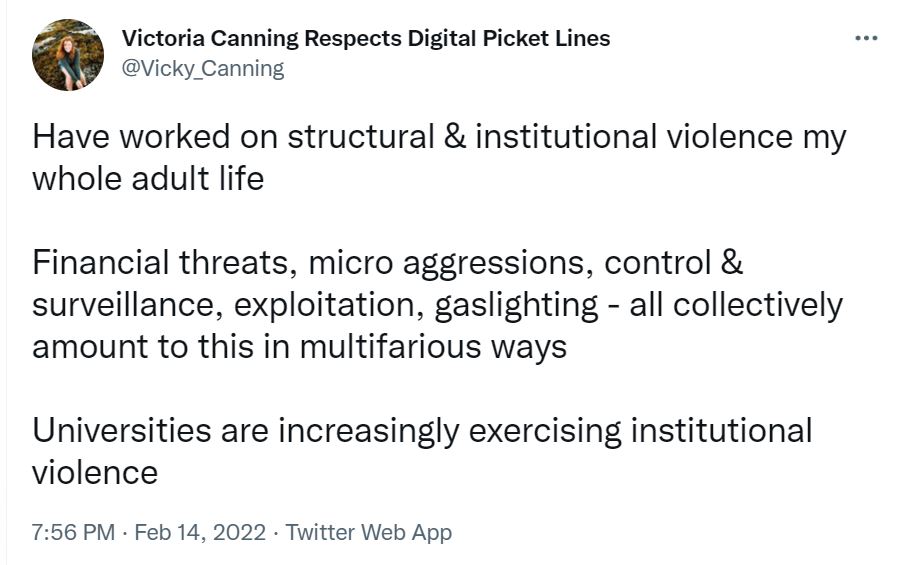
What used to be a place of free thinking, sharing of ideas, and encouraging students to do the same (note: I’m told academics used to have time to think and read) has become a place where profit and business ethos overrides such niceties. The marketisation of education, which can be traced back to the early 1990s has seen a growth in informal employment putting paid to the myths of job security inter alia, lecturing staff well-being. As Vicky Canning put it in the below Tweet, this constitutes institutional violence, something we criminologists are charged with speaking up against.
The university industry has become increasingly reliant on casualised contracts leading to staff not being able to get mortgages or tenancies. During my time at a previous institution, I worked on fixed term contracts as a teaching assistant. The teaching contracts would typically last for 10-12 weeks, there were constant HR errors with contracts, which were often not confirmed until the week before teaching or even after teaching had started. Each semester there would be at least a few teaching assistants who got paid incorrectly or did not get paid at all. These are the people delivering teaching to students paying at least £9,250 per year for their education. Is this value for money? Is this fair? In a previous round of strikes at that institution I let my students know that after all the work they put into writing, I only got paid for 20 minutes to mark one of their 3,500-word essays. They did not seem to think this was value for money.
While I was working under such contracts, I had to move to a new house. I visited many properties and faced a series of affordability checks. As the contracts were short term, landlords would not accept this income as secure, and I was rejected for several properties. I eventually had to ask a friend to be a guarantor but without this, I could easily have ended up homeless and this has happened to other university teaching staff. It was reported recently in the Guardian that a casualised lecturer was living in a tent because she was not able to afford accommodation. All this, on top of stressful, unmanageable workloads. These are the kinds of things casualised university staff must contend with in their lives. These are the humans teaching our students.
This is just one of the problems in the higher education machine. The problems of wage theft, forced overtime, debt bondage and intimidation seen in Qatar are also seen in the institutionally violent higher education economy, albeit to a lesser (or less visible) extent. Let’s talk about wage theft. A number of universities have threatened 100% salary deductions for staff engaging in action short of strike, or in simple terms, working the hours they are contracted to do. Academics throughout the country are being threatened with wage theft if they cannot complete their contractual duties within the hours they are paid for. Essentially then, some higher education establishments are coercing staff to undertake unpaid overtime, not dissimilar to the forced overtime faced by exploited migrant workers building stadia in Qatar.
Academics across the country need to see change in these academic workloads so we can research the exploitation of migrants in the informal labour market, to work towards UN sustainability goals to help address the informal economy, to engage in social justice projects within the informal economy in our local area, and to think about how we can engage our students in such projects. In effect academics need to work in an environment where they can be academics.
How can we begin to be critical of or help address global issues such as the informal economy when our education system is engaging in questionable employment practices, the kind of which drive people into the informal economy, the kind of employment practices that border the informal economy. Perhaps higher education needs to look inwards before looking out


