Home » representation
Category Archives: representation

What society do we want to live in?

Recently after using a service, I received an email to provide some online feedback. The questionnaire was asking about the services I received and to offer any suggestions on anything that could be done to improve services. This seems to become common practice across the board regarding all types of services and commercial interactions. This got me thinking…we are asked to provide feedback on a recent purchase, but we are not asked about issues that cut through the way we live our lives. In short, there is value in my opinion on a product that I bought, where is the value in my views of how I would want my community to be. Who’s going to ask me what society I want to live in!
Consumerism may be the reason we get asked questions about products but surely before and above being consumers, aren’t we all citizens? I can make helpful suggestions on what I would like to see in services/products but not on government. We profess democratic rule but the application of vote every now and then is not a true reflection on democracy. As we can offer online surveys for virtually everything, we have ways of measuring trends and reactions, why not use these to engage in a wider public discourse on the way to organise our communities, discuss social matters and engage in a public dialogue about our society.
Our political system is constructed to represent parties of different ideologies and practices offering realistic alternatives to governance. An alternative vision about society that people can come behind and support. This ideological diversion is essential for the existence of a “healthy political democratic process”. This ideological difference seems to be less prevalent in public dialogue with the main political parties focusing their rhetoric on matters that do not necessarily affect society.
Activism, a mechanism to bring about social change is becoming a term that sparks controversy whilst special interest groups maintain and even exert their influence on political parties. This allows private special interests to take the “ear of the government” on matters that matter to them, whilst the general public participate in social discourses that never reach the seat of power.
Asking citizens to be part of the social discussion, unlike customer service, is much more significant; it allows us to be part of the process. Those who have no other way of participating in any part of the system will be castigated to cast their vote and may participate in some party political activities. This leaves a whole heap of everyday issues unaddressed. In recent years the cost of living crisis pushed more people into poverty, food, housing and transport became issues that needed attention, not to mention health, post-covid-19.
These and many more social issues have been left either neglected only to be given the overhead title of crisis but with no action plan of how to resolve them. People affected are voiceless, having to pick up the injustices they suffer without any regard to the long term effects. Ironically the only plausible explanation given now that “Brussels’ rule” and “EU bureaucracy” are out of the picture, has become that of the immigrants. The answer to various complex problems became the people on the boats!
This is a simplification in the way social problems happen and most importantly can be resolved. Lack of social discourse has left the explanation and problem solving of said problems to an old rhetoric founded on xenophobia and discrimination. Simple explanations on social problems where the answer is a sentence tend to be very clear and precise, but very rarely can count the complexity of the problems they try to explain. There is a great disservice to our communities to oversimplify causes because the public cannot understand.
Cynically someone may point out that feedback from companies is not routed in an honest request to understand customer satisfaction but a veiled lip-service about company targets and metrics. So the customer’s response becomes a tradable figure of the company’s objectives. This is very likely the case and this is why the process has become so focused on particular parts of the consumer process. Nonetheless and here is the irony; a private company has some knowledge of a customer’s views on their recent purchase, as opposed to the government and people’s views and expectations on many social issues.
Maybe the fault lies with all of us. The presumption of democratic rule, especially in parliamentary democracies, a citizen is represented by a person they elect every four years. This representation detaches the citizen from their own responsibilities and obligations to the process. The State is happy to have citizens that engage only during elections, something that can be underscored by the way in recent years that protests on key social issues have been curtailed.
That does not sound right! I can provide an opinion over the quality of a chocolate bar or a piece of soap but I cannot express my views as a citizen over war, climate, genocide, immigration, human rights or justice? If we value opinion then as society we ought to make space for opinion to be heard, to be articulated and even expressed. In the much published “British Values” the right to protest stands high whilst comes in conflict with new measures to stop any protests. We are at a crossroads and ultimately we will have to decide what kind of society we live in. If we stop protests and we ban venues for people to express themselves, what shall we do next to curtail further the voices of dissent? It is a hackneyed phrase that we are stepping into a “slippery slope” and despite the fact that I do not like the language, there is a danger that we are indeed descending rapidly down that slope.
The social problems our society faces at any given time are real and people try to understand them and come to terms with them. Unlike before, we live in a world that is not just visual, it relies on moving images. Our communities are global and many of the problems we face are international and their impact is likely to affect us all as people, irrespective of background or national/personal identity. At times like this, it is best to increase the public discourse, engage with the voices of descent. Maybe instead of banning protests, open the community to those who are willing to discuss. The fear that certain disruptive people will lead these debates are unfounded. We have been there before and we have seen that people whose agenda is not to engage, but simply to disrupt, soon lose their relevance. We have numerous examples of people that their peers have rejected and history left them behind as a footnote of embarrassment.
Feedback on society, even if negative, is a good place to start when/if anyone wants to consider, what kind of society I want and my family to live in. Giving space to numerous people who have been vastly neglected by the political systems boosts inclusivity and gives everyone the opportunity to be part of our continuous democratic conversation. Political representation in a democracy should give a voice to all especially to those whose voice has long been ignored. Let’s not forget, representation is not a privilege but a necessity in a democracy and we ensure we are making space for others. A democracy can only thrive if we embrace otherness; so when there are loud voices that ask higher level of control and suppression, we got to rise above it and defend the weakest people in our community. Only in solidarity and support of each other is how communities thrive.
Share this:


#UONCriminologyClub: What should we do with an Offender? with Dr Paula Bowles
You will have seen from recent blog entries (including those from @manosdaskalou and @kayleighwillis21 that as part of Criminology 25th year at UON celebrations, the Criminology Team have been engaging with lots of different audiences. The most surprising of these is the creation of the #UONCriminologyClub for a group of home educated children aged between 10-15. The idea was first mooted by @saffrongarside (who students of CRI1009 Imagining Crime will remember as a guest speaker this year) who is a home educator. From that, #UONCriminologyClub was born.
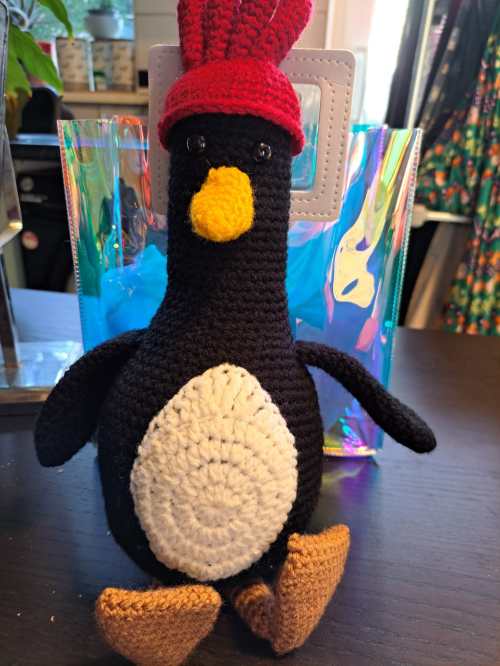
As you know from last week’s entry @manosdaskalou provided the introductions and started our “crime busters” journey into Criminology. I picked up the next session where we started to explore offender motivations and society’s response to their criminal behaviour. To do so, we needed someone with lived experience of both crime and punishment to help focus our attention. Enter Feathers McGraw!!!
At first the “crime busters” came out with all the myths: “master criminal” and “evil mastermind” were just two of the epithets applied to our offender. Both of which fit well into populist discourse around crime, but neither is particularly helpful for criminological study, But slowly and surely, they began to consider what he had done (or rather attempted to do) and why he might be motivated to do such things (attempted theft of a precious jewel). Discussion was fast flowing, lots of ideas, lots of questions, lots of respectful disagreement, as well as some consensus. If you don’t believe me, have a look at what Atticus and had to say!
We had another excellent criminology session this week, this time with Dr Paula Bowles. I think we all had a lot of fun, I personally could have enjoyed double or triple the session time. Dr Bowles was engaging, fun and unpretentious, making Criminology accessible to us whilst still covering a lot of interesting and complex subjects. We discussed so many different aspects of serious crime and moral and ethical questions about punishment and the treatment of criminals. During the session, we went into some very deep topics and managed to cover many big ideas. It was great that everyone was involved and had a lot to say. You might not necessarily guess from what I’ve said so far, how we got talking about Criminology in this way. It was all through the new Aardman animations film Wallace and Gromit: Vengeance Most Fowl and the cheeky little penguin or is it just a chicken? Feathers McGraw. Whether he is a chicken or a penguin, he gave us a lot to discuss such as whether his trial was fair or not since he can’t talk, if the zoo could really be counted as a prison and, if so was he allowed to be sent there without a trial? Deep ethical questions around an animation. Just like last time it was a fun and engaging lesson that made me want to learn more and more and I can’t wait for next time. (Atticus, 14)
What emerged was a nuanced and empathetic understanding of some key criminological debates and questions, albeit without the jargon so beloved of social scientists: nature vs. nurture, coercion and manipulation of the vulnerable, the importance of human rights, the role of the criminal justice system, the part played by the media, the impetus to punish to name but a few. Additionally, a deep philosophical question arose as to whether or not Aardman’s portrayal of Feathers’ confinement in a zoo, meant that as a society we treat animals as though they are criminals, or criminals as though they are animals. We are all still pondering this particular question…. After deciding as group that the most important thing was for Feathers to stop his deviant behaviour, discussions inevitably moved on to deciding how this could be achieved. At this point, I will hand over to our “crime busters”!
What to do with Feathers McGraw?
At first, I thought that maybe we should make prison a better place so that he would feel the need to escape less. It wouldn’t have to be something massive but just maybe some better furniture or more entertainment. Also maybe make the security better so that it would be harder to break out. If we imagine the zoo as the prison, animals usually stay in the zoo for their life so they must have done some very bad stuff to deserve a life sentence! Is it safe to have dangerous animals so close to humans? Feathers McGraw might get influenced by the other prisoners and instead of getting better he might get more criminal ideas. I believe there should be a purpose-built prison for the more dangerous criminals, so they are kept away from the humans and the non-violent criminals. in this case is Feathers considered a violent or non-violent criminal? Even though he hasn’t killed anyone, he has abused them, tried to harm them, hacked into Wallace’s computer, vandalised gardens through the Norbots, and stole the jewel. So, I think we should get a restraining order against Feathers McGraw to stop him from seeing Wallace and Gromit. I also think we should invest in therapy for Feathers to help him realise that he doesn’t need to own the jewel to enjoy it, what would he even do with it?! Maybe socializing could also help to maybe take his mind of doing criminal things. He always seems alone and sad. I’m not sure whether he will be able to change his ways or not but I think we should do the best we can to. (Paisley, 10)
I think in order to stop Feathers McGraw’s criminal behaviour, he should go to prison but while he is there, he should have some lessons on how to be good, how to make friends, how to become a successful businessman (or penguin!), how to travel around on public transport, what the law includes and what the punishments there are for breaking it etc. I also think it’s important to make the prisons hospitable so that he feels like they do care about him because otherwise it might fuel anger and make him want to steal more diamonds. At the same time though, it should not be too nice so that he’ll think that stealing is great, because if you don’t get caught, then you keep whatever you stole and if you do get caught then it doesn’t matter because you will end up staying in a luxury cell with silky soft blankets.
After he is released from prison, I would suggest he would be held under house arrest for 2-3 months. He will live with Wallace and Gromit and he will receive a weekly allowance of £200. With this money, he will spend:
£100 – Feathers will pay Wallace and Gromit rent each week,
£15-he will pay for his own clothes,
£5-phone calls,
£10-public transport,
£35-food,
£5-education,
£15-hygiene,
£15- socialising and misc.
During this time, Feathers could also be home educated in the subjects of Maths, English etc. He should have a schedule so he will learn how to manage his time effectively and eventually should be able to manage his timewithouta schedule. The reason for this is because when Feathers was in prison, he was told what to do every day and at what time he would do it. He now needs to learn how to make those decisions by himself. This would mean when his house arrest is finished, he can go out into the real world and live happy life without breaking the law or stealing. (Linus, 13)
I think that once Feathers McGraw has been captured any money that he has on him will be taken away as well as any disguises that he has and if he still has any belongings left they will be checked to see whether he can have them. After that he should go to a proper prison and not a Zoo, then stay there for 3 months. Once a week, while he is in prison a group of ten penguins will be brought in so that he can be socialised and learn manners and good behaviour from them. However they will be supervised to make sure that they don’t come up with plans to escape. After that he will live with a police officer for 3 years and not leave the house unless a responsible and trustworthy adult accompanies him until he becomes trustworthy himself. He will be taught at the police officers house by a tutor because if he went to school he might run away. Feathers McGraw will have a weekly allowance of £460 that is funded by the government as he won’t have any money. Any money that was taken away from him will be given back in this time. Any money left over will be put into his savings account or used for something else if the money couldn’t quite cover it.
In one week he will give
£60 for fish and food
£10 for travel
£50 for clothing but it will be checked to make sure that it isn’t a disguise.
£80 for the police officer that looking after him
£15 for necessities (tooth brush, tooth paste, face cloth etc…)
£70 for his tutor
£55 for education supplies
£20 will be put in a savings account for when he lives by himself again.
And £100 for some therapy
After 1 year if the police officer looking after him thinks that he’s trustworthy enough then he can get a job and use £40 pounds a week (if he earns manages to earn that much.) as he likes and the rest of it will be put into his savings account. Feathers McGraw will only be allowed to do certain jobs for example, He couldn’t be a police officer in case he steals something that he’s guarding, He also couldn’t be a prison guard in case he helped someone escape etc… If at any point he commits another crime he will lose his freedom and his job and will be confined to the house and garden. When he lives by himself again he will have to do community service for 1 month. (Liv, 11).
Feathers McGraw has committed many crimes, some of which include attempted theft, abuse towards Wallace and Gromit, and prison break.
Here are some ideas of things that we can do to stop him from reoffending:
Immediate action:
A restraining order is to be put in place so he can’t come within 50m of Wallace and Gromit, for their protection both physical and mental. Penguins live for up to 20 years so seeing as he is portrayed as being an adult, my guess is he is around 10 years old. His sentence should be limited to 2 years in prison. Whilst serving his sentence he should be given a laptop (with settings so that he can’t use it to hack) so he can write, watch videos, play games and learn stuff.
Longer term solutions:
When Feathers gets out he will be banned from seeing the gem in museums so there will be less chance of him stelling it. He also will be given some job options to help him get started in his career. His first job won’t be front facing so Wallace and Gromit won’t have to be worried and they will get to say no to any job Feathers tries to get. If he reoffends, he will be taken to court where his sentence will be a minimum of 5 years in prison.
Rehabilitation:
I think Feathers should be given rehabilitation in several different forms, some sneakier than others! One of these forms is probation: penguins which are trained probation officers who will speak to him and try to say that crime is not cool. To him they will look like normal penguins, he won’t know that they have had training. He also should be offered job experience so he can earn a prison currency which he can use to buy upgrades for his cell (for example a better bed, bigger tv, headphones, an mp3 player and songs for said mp3 player) to give him a chance to get a job in the future. (Quinn, 12)
The “crime busters” comments above came after reflecting on our session, their input demonstrates their serious and earnest attempt to resolve an extremely complex issue, which many of the greatest minds in Criminology have battled with for the last two centuries. They may seem very young to deal with a discipline often perceived as dark, but they show us an essential truth about Criminology, it is always hopeful, always focused on what could be, instead of tolerating what we have.
Share this:


Public confidence in the CJS: ending on a high?

2022 has been a turbulent and challenging year for many. Social inequalities and disadvantage are rife, with those in power repeatedly making bad, inhumane decisions and with very little, to no, accountability or consequences (insert your favourite example from the sh** storm that is the Conservative Party here). Union after Union, across sectors, engage in industrial action in response to poor working conditions and pay, amidst a cost-of-living crisis. And although seemingly unconnected, as the year comes to a close, the Sentencing Guidelines (2022) report on Public Confidence in the Criminal Justice System (CJS) has got me feeling frustrated. My previous blog entries have often been ‘moans’. And whilst January is often dubbed the month of new beginnings and change for the year ahead: we’re not quite there yet so true to form here is my latest moan!
The report exists as one of many conducted by Savanta to collate data on public confidence, in terms of effectiveness and fairness, in the CJS and public awareness of the sentencing guidelines. The data collected in March 2022, was via online surveys given to a “nationally representative sample of 2,165 adults in England and Wales” (Archer et al., 2022, p.9). Some of their highlighted ‘Key Findings’ include that confidence levels in CJS remains relatively stable in comparison to 2018, on the whole, respondents viewed sentences as ‘too lenient’ however this varied based on offence, the existence of the sentencing guidelines improves respondent’s confidence in the fairness of sentencing, and that engagement with broadcast news sources was high across respondents (Archer et al., 2022). It is not the findings, per se, that I take umbrage with, but rather the claim it is a “nationally representative sample of adults in England and Wales” (Archer et al., 2022, p.9).
I take issue on two fronts. The first being that the sample size of 2,165 adult respondents is representative when the demographic factors included are: gender (male and female), age (18-34yo, 35-54yo and 55+), region, ethnicity (White, Mixed, Asian, Black and Other) and socio-economic grade. Now considering we are, thankfully, at the end of 2022 we should all be able to recognise that a sample which only includes cis-gendered options, narrows ethnicity down to 4 categories and the charming ‘other’, and does not include disabilities is problematic. There has been a large body of research done on people with disabilities and their experiences within the CJS, the lack of representation, the lack of accessibility to space and decisions, potentially impacting a defendant’s right to a fair trial, and a victim’s right to justice (Equality and Human Rights Commission, 2021; Hyun et al., 2013 ). So I ask, is this not something which needs considering when looking at public confidence in the CJS of a “nationally representative” sample?
In addition to this, I take issue with the requirement that the sample be “nationally representative”. We have research piece upon research piece about how Black men and Black boys experience the CJS and its various agencies disproportionately to their white counterparts (Lammy, 2017; Monteith et al., 2022; Parmar, 2012). Their experiences of stop and search, sentencing, bail, access to programmes within the Secure and Youth estate. There is nothing representative about our CJS in terms of who it processes, how this is done, and by whom. According to Monteith et al., (2022) 1% of Judges in the CJS are Black, and there are NO Black judges on the High Court, Court of Appeal of Supreme Court: this is not representative! Why then, are we concerned with a representative sample when looking at public confidence in CJS and the sentencing guidelines, when it is not experienced in a proportionate manner?
Maybe I’ve missed the point?
The report is clear, accessible, visible to the public: crucial concepts when thinking about justice, and measuring public confidence in the CJS is fraught with difficulties (Bradford and Myhill, 2015; Kautt and Tankebe, 2011). But this just feels like another nail being thumped into the coffin that is 2022. Might be the eagerness I possess to leave 2022 behind, or the impeding dread for the year to follow but the report has angered me rather than reassured me. As a criminologist, I am hopeful for a more inclusive, representative, fair and accountable CJS, but I am not sure how this will be achieved if we do not accept that the system disproportionately impacts (but not exclusively) Black men, women and children. Think it might be time for another mince pie…
Happy New Year to you all!
References:
Archer, N., Butler, M., Avukatu, G. and Williams, E. (2022) Public Knowledge of Confidence in the Criminal Justice System and Sentencing: 2022 Research. London: Sentencing Council.
Bradford, B. and Myhill, A. (2015) Triggers of change to public confidence in the police and criminal justice system: Findings from the crime survey for England and Wales panel experiment, Criminology and Criminal Justice, 15(1), pp.23-43.
Equality and Human Rights Commission (2021) Does the criminal justice system treat disabled people fairly? [Online] Available at: https://www.equalityhumanrights.com/en/inquiries-and-investigations/does-criminal-justice-system-treat-disabled-people-fairly [ Accessed 4th November 2021].
Hyun, E., Hahn, L. and McConnell, D. (2013) Experiences of people with learning disabilities in the criminal justice system, British Journal of Learning Disabilities, 42: 308-314.
Kautt, P. and Tankebe, J. (2011) Confidence in the Criminal Justice System in England and Wales: A Test of Ethnic Effects, International Criminal Justice Review, 21(2),pp. 93-117.
The Lammy Review (2017) The Lammy Review: An independent review into the treatment of, and outcomes for, Black Asian and Minority Ethnic Individuals in the Criminal Justice System, [online] Available at: https://assets.publishing.service.gov.uk/goverment/uploads/system/uploads/attachment_data/file/643001/lammy-review-final-report-pdf [Last Accessed 14th February 2021].
Monteith, K., Quinn, E., Dennis, A., Joseph-Sailsbury, R., Kane, E., Addo, F. and McGourlay, C. (2022) Racial Bias and the Bench: A Response to the Judicial Diversity and Inclusion Strategy (2020-2025), [online] Available at: https://documents.manchester.ac.uk/display.aspax?DOCID=64125 [Accessed 4th November 2022].
Parmar, A. (2012) Racism and ethnicity in the criminal justice process, in: Hucklesby, A. and Wahidin, A. (eds.) Criminal Justice, 2nd ed, Oxford: Oxford University Press, pp.267-296.
Share this:

‘By order of the Peaky Blinders’: GRT History Matters
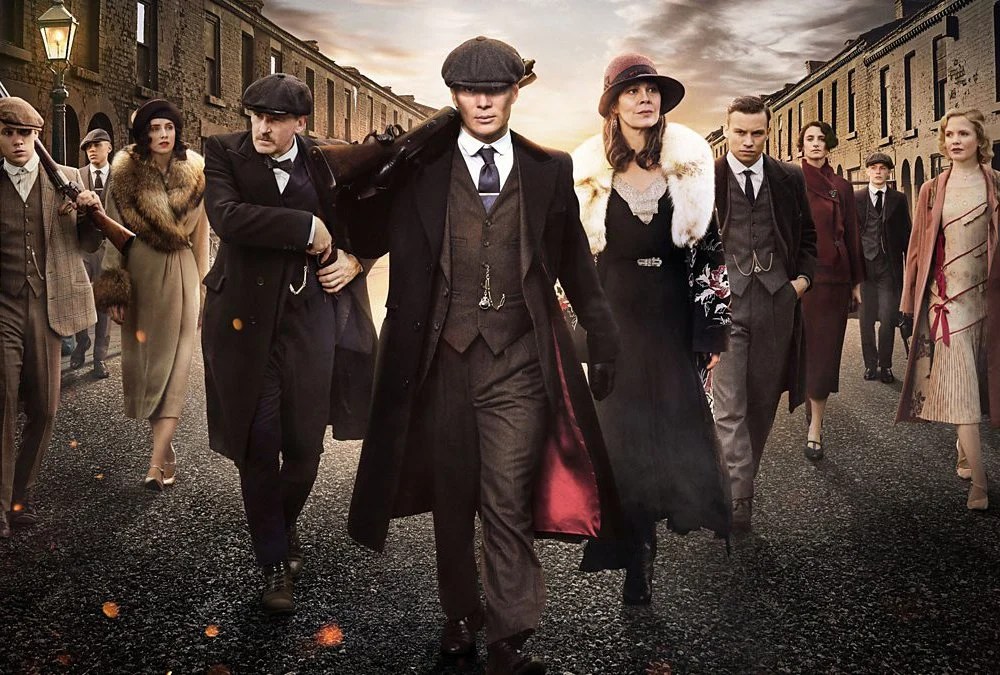
Once Gypsy Roma and Traveller (GRT) history month commences Gypsy and Traveller histories are largely ignored. This is on par with the the erasure of GRT history and contemporary culture within mainstream Britain. Given this, I was surprised that the very popular Peaky Blinders starred Birmingham based main characters and their families who appear to be Brummies, of Romany, Gypsy and Irish Traveller heritage.
In many ways representation within Peaky Blinders is problematic, it is typical that once GRT people appear as main characters their lifestyles are associated with gangs, sex and violence. But there are a lot of positives, the episodes are filled with fabulous costumes, interesting characters, plots, settings and music. There is certainly a lot of pride that comes with the representation of Birmingham based lives of mixed heritage Gypsy and Traveller families on screen.
Peaky Blinders is set in a time era which is just after WWI and appears to end in the 1930s. Whilst the series is fictional, there are many parallels that can be drawn between the lives of the fictional main character Tommy Shelby and his family and the real-life lived histories of Gypsy and Traveller people.
Peaky Blinders does well to de-mythisise the assumption that Gypsy and Traveller people do not mix with gorgers and do not participate within mainstream society. To illustrate, Tommy and his brother’s fought in WWI and experienced the damaging aftereffects of war participation. In reality, despite previously being subjected to British colonial practices and being treated with distain by the State many British Gypsy and Traveller people would have had no choice but to fight in this war due to conscription. Many would have lost their lives because of this.
Note that Tommy’s family mostly lived within housing and were working within mainstream industrial society. In reality, in industrial cities like Birmimgham many nomadic Gypsy and Traveller lifestyles would have been under threat due to land purchases made by gorgers for the purpose of building factories and housing (Green, 2009). Upon purchase of this land nomadic groups would be evicted from it, this would have left many homeless, with the increased the pressure to assimilate. This would result in work life changes, hence, Gypsy and Traveller people worked alongside gorgers in factories, where the pay and conditions would have been poor (Green, 2009).
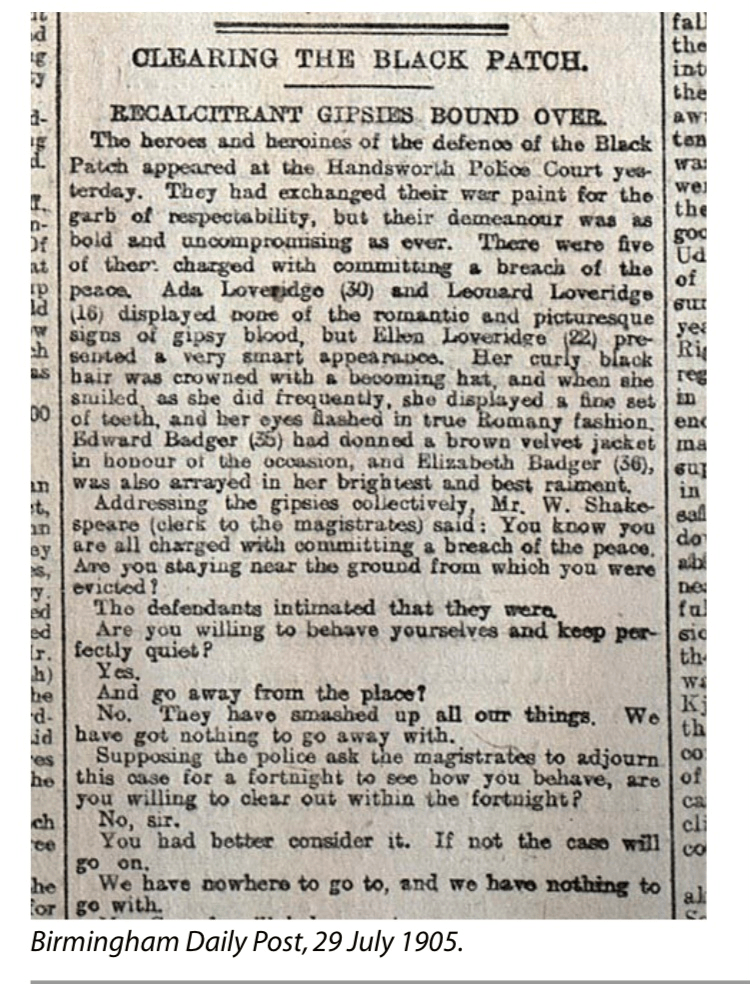

Just like prejudice in reality, even when living within housing Tommy and his family experience prejudice from within and outside of their own community. Tommy is referred to as a ‘dirty didicoi’ seemingly due to the perception of his mixed heritage and not being of ‘full-blooded’ Gypsy stock. In response to an anti-gypsy slur Tommy mocks stereotypes by stating that as well as his day job he ‘also sells pegs and tells fortunes’.
Towards the end of Peaky Blinders the promotion of fascism by elite figures is central to the storyline. Just as in reality, there was the development of the British Union of Fascists political party. Prejudice and fascist ideas contributed to categorising Gypsys as an inferior race. Whilst Peaky Blinders ends before WWII it is harrowing to know that these ideas influenced the extermination of Roma and Gypsies during the Nazi regime. Many British Gypsy and Traveller soldiers lives would have also been lost in fighting the Nazi’s in WWII due to this.
It is unfortunate that the women have less screen time in Peaky Blinders, but their personalities did shine. Ada’s character and response to prejudice is ace, whether this is responding to street hecklers, an elite eugenicist women’s ethnic cleansing ideas, or her son’s prejudice towards his sister. When her son refers to his sister as a ‘thing’ and states that she would ‘get them killed’ as she was a Black-mixed race child she responds by stating, ‘where will they send you Karl?’ whilst making him aware that he could also be subjected to persecution due to having a Jewish father and a Gypsy mother.
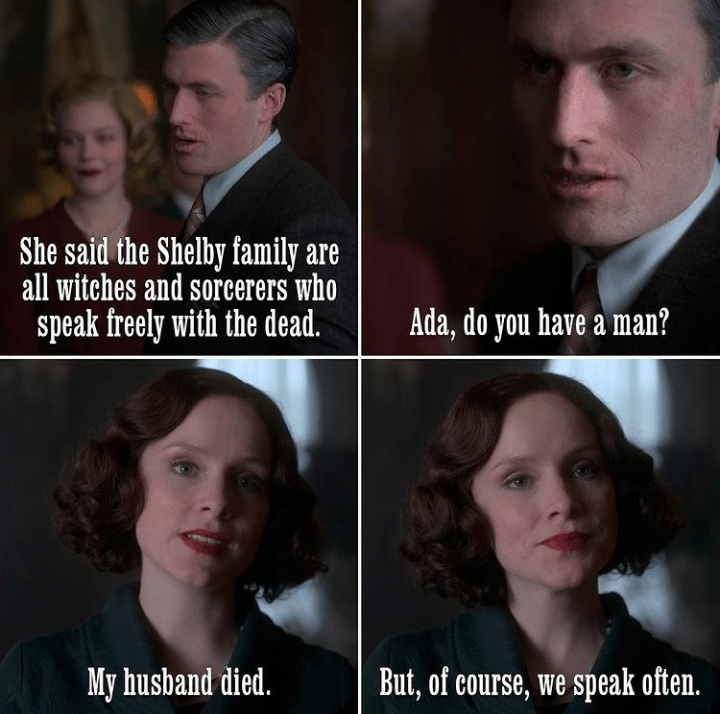
This year marks the end of Peaky Blinder’s episodes, the last episode is great. Tommy returns to his roots – choosing to end his days with his horse, wagon and photographs of his family. But he then wins against all the odds! Unfortunately, whilst Peaky Blinders has been celebrated there is less celebration of Gypsy and Traveller ethnicities, these were completely ignored within the documentary The Real Peaky Blinders.
Through whitewashing Gypsy and Traveller peoples histories are frequently denied. To adapt David Olusoga’s words, ‘[Gypsy and Traveller] history is British history’. An awareness of Roma Gypsy and Traveller history should not only reside with Gypsies and Travellers alone, or exist at the margins, as these are connected to all of us. As Taylor and Hinks (2021) indicate, if there is increased awareness that past and present themes of percecution this might enable increased support for Gypsy, Roma and Traveller rights – this is vital.
References:
Olusoga, D. (2016) Black and British: A forgotten History, BBC [online].
Taylor, B. and Hinks, J., (2021). What field? Where? Bringing Gypsy, Roma and Traveller History into View. Cultural and social history, 18(5), pp.629–650.

 Thoughts from the criminology team