
Home » Reading (Page 2)
Category Archives: Reading

Witches, Broomsticks and Libraries
My son has been gifted and collected many delightful children’s books since his recent birth. A book which stands out to me on Women’s History Month is: Room on the Broom (2001) by writer Julia Donaldson and Illustrator Axel Scheffler.
Aside from the fabulous use of words and illustrations, the main character of the story is a lovely witch who makes room on her broom for her cat, a dog, bird and frog. The latter part of the story consists of the broom snapping, presumably due to the extra weight of these passengers, then the witch risks being eaten by a dragon. But eventually all is well as the witch creates a new super broomstick with;
seats for the witch
and the cat and the dog,
a nest for the bird and
a shower for the frog.

This book’s depiction of the witch as a morally good character is wonderful but this is not usual. In popular culture, such as fiction, television and film witches seem to have flawed character traits, are morally bad cackling devious women who fly about casting spells on poor and (un/)suspecting folk.
The negative connotations of witches today reflect a long dreadful real-life history of outsiders being accused of being witches – with some being tortured and murdered due to this. The outsiders aka witches tended to be women, women who were providing a service for other women, such as support during childbirth or healing practices, or those that practice spiritualisms that differ to dominant religions. If re-born today some of these women may have been celebrated as midwifes and nurses, although their wages and workloads would still illustrate that predominantly women centered roles tend to be under appreciated.
On International Women’s Day I finished reading Disobedient Bodies (2023) by Emma Dabiri. Disobedient Bodies reminds me about how in a white capitalist cis male world bodies categorised as female and women are constructed as deviant. Proof of being a witch was apparently not just found in practices but on the bodies of women. Emma Dabiri adds to the discussion on witches that I did not consider; that groups of women aka groups of deviant witches were considered to be the most threatening to witch hunters. For a long time women have been pitted against each other, the historical nature of women meeting in groups to support each other as a threat to patriarchal capitalist white systems has added to this.
My son is very privileged to have so many book at the age of 1. Unfortunately I am writing during a time where there are threats to close 25 libraries in Birmingham. Notably, the libraries that me and my son frequent consist of mostly women staff (both paid and volunteers). In addition to the potential for job losses, if this happens there will be babies, children and adults without access to books, artistic classes, warm and safe spaces. To quote my friend and colleague, “soon there will be nothing left”.
Share this:


Headlines and Happiness: Balancing News Consumption and Wellbeing

As part of my reflective diary assessment for my third-year module ‘Critiquing Criminalistics’, I reflected on the importance of being up to date with world events to be able to apply criminological knowledge to them. I also reflected on the fact that I have avoided much of the news and media to manage my despair at the current state of the world. However, in order to further my academic knowledge and its application, I decided I just needed a safe way to keep on top of these things, so I compiled some tips and reminders for myself, and I’d like to share them with you.
Choose wisely: Choose reputable news sources, academic reports or reviews from trusted organisations, some will be better balanced, and much less sensationalised than others.
Practice media literacy: Be critical of the information you find; don’t believe everything you see and hear. Verify news stories from multiple sources before accepting them and remember what the media is designed to do. Plus, social media is full of misinformation and sensationalism and largely speaking, not a good resource!
Need to know basis: Consider which topics are most important for you to stay informed about, and limit exposure to news that is not relevant to your wellbeing or interests. It’s very easy to fall down the rabbit hole!
Limit your consumption: Put some boundaries in place that work for you, whether that’s setting an allotted time frame to catch up like to only listen to the radio on your drive into campus, taking a break from social media, or making sure those notifications are turned off so you’re not ambushed by breaking news.
Managing Traumatic Topics: If you are avoiding any particular topic, it might be helpful to have a trusted person read/watch for you first. Additionally, for any recommended films or series, try finding them on ‘Does the Dog Die?’ https://www.doesthedogdie.com/ to check for triggering content.
Find the happy stuff too: There is so much good happening in the world as well as all the bad, make sure you feed your brain some of that too, whether that’s in the news, or on social media.
Here are some other sources:
Look after yourself: Further to those things, take a break every once in a while, prioritise whatever it is that makes you see your world positively and seek support if you need it, that might be support from a professional, or talk to a trusted person, colleague, or staff member to air out those thoughts – go and ‘talk to a criminologist!’ If you’re particularly prone or you are a chronic catastrophiser (guilty!) – a perspective from someone else can be a useful tool.
Lastly, there is a quote I heard years ago, and while over time, there are some thoughts and applications of it that are less than favourable, I occasionally find it comforting; Fred Rogers passed along a message from his mother who said ‘Look for the helpers. You will always find people who are helping.’
If you are able to manage the discomfort, sometimes it is good to find what makes you feel, and listen to it, let it fire you up! Perhaps you’ll become the helper.
Share this:


A Snapshot of My Dissertation: Portuguese Drug Decriminalisation and Some Other Things
I submitted my dissertation back in April, and now the dust has settled I thought it would be good to share the most interesting parts of my research, think of this blog post as an abridged version of my dissertation. Towards the end I’ve also included some tips for completing a dissertation, along with some reading you might like to do if you found this interesting.
What Was my Research About?
My research was about two main areas; Firstly, I wanted to assess the effects of Portugal’s 2001 drug policy whereby all illicit drugs were decriminalised, meaning drug offences relating to personal possession result in a civil punishment rather than a criminal punishment. I assessed key indicators within Portuguese society, gathering data from international, European and national databases which measured public health trends, criminal justice trends and economic trends. Some fields of data I looked at included prices of drugs at market level, drug seizure data, HIV/ AIDS rates among people who inject drugs and the Portuguese prison population.
The second part of my research involved understanding whether a drug decriminalisation policy similar to Portugal’s could currently happen in the UK. I researched this by performing a discourse analysis on drug related House of Commons debate occurring between the years 1970- 2023, selecting roughly one debate every two years. By doing this, I was able to analysis common themes across the years, understanding the political barriers which may mean drug decriminalisation is not a feasible policy idea at the moment given the political attitude and climate within the House of Commons when it comes to illicit drug policy.
What Did I Find Out?
Look through the slideshow below to view summaries of my findings.

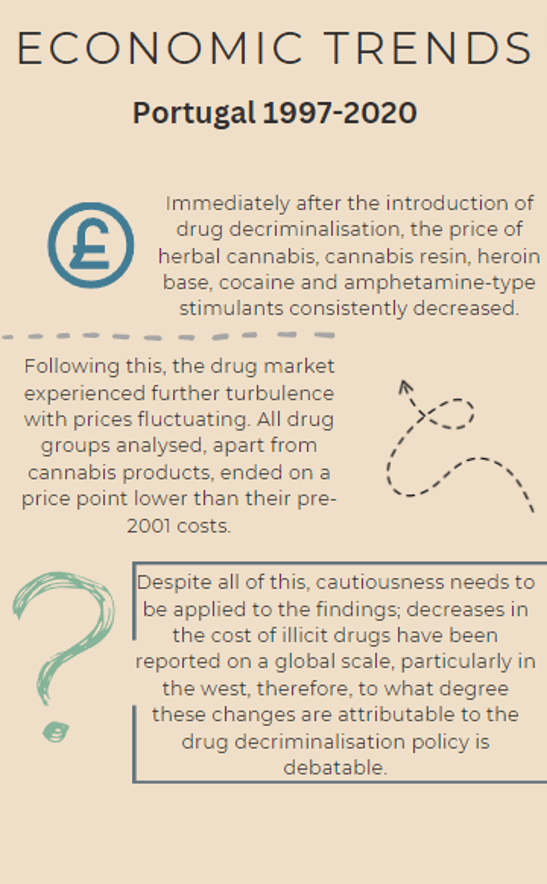


Some Final Comments and Conclusions:
Generally, my research found that Portuguese drug decriminalisation correlated with effects that can be seen as positives. Of course, my research needs to be looked at critically, I don’t claim that all of the societal indicators are directly attributable to the drug decriminalisation policy, however, the correlations that were found are promising. Policy is always a really complex, multi-faceted topic and it would be simplistic to suggest otherwise.
So is a drug decriminalisation policy likely to happen in the UK? The short answer is probably not very likely at all. My discourse analysis pointed towards five decades of debate which was hyper focused on a law and order approach to drug use, a fixation on low level cannabis use and an insistence on the idea that deterrence measures and the war on drugs is actually working. The debates felt stagnant, with new and progressive approaches being hindered by penal populism and ‘tough on crime’ stances.
During my research I found some really interesting reads and different points of view that I hadn’t considered before. I’ve listed some of my favourite pieces below if you’d like to have a read further into this subject.
- Cebral T.S. (2017) “The 15th anniversary of the Portuguese Drug Policy: Its history, its success and its future,” Drug Science, Policy and Law, 3. https://doi.org/10.1177/2050324516683640
- Eastwood, N., Fox, E. and Rosmarin, A. (2016) “Portugal,” in A quiet revolution: Drug decriminalisation across the Globe. London, UK: Release drugs the law and human rights. https://www.release.org.uk/sites/default/files/pdf/publications/A%20Quiet%20Revolution%20-%20Decriminalisation%20Across%20the%20Globe.pdf
- Goldstein, P.J. (1985) “The drugs/violence nexus: A Tripartite Conceptual Framework,” Journal of Drug Issues, 15(4). https://doi.org/10.1177/002204268501500406
- Jacques, S. and Allen, A. (2015) “Drug market violence: Virtual anarchy, police pressure, predation, and retaliation,” Criminal Justice Review, 40(1). https://doi.org/10.1177/0734016814553266
All of the data used is available from The Hansard Archives, European Monitoring Centre for Drugs and Drug Addiction, European Centre for Disease Prevention and Control and The World Prison Brief. Also, I used Taguette to analyse my qualitative data, it’s totally free and it was so useful.

Share this:


What to do with my criminology?

Let’s arrange time and set out two temporal constants: point one: a random meeting now and another one about three years later! The first one occurs during a standard University Open Day; a young person coming to a session to hear about criminology; they have seen crime programmes, read crime fiction, bought some real crime literature and now they feel fascinated. There is an interest there; what happens next? Why did they do it? How did they do it? Many questions and even more ideas of what to do to those who do horrible things. The Open Day is not just a response to singular identities, in fact it takes these curiosities and turns them on their head. Crime is bigger and smaller; its is more and less and, of course, most importantly is socially constructed, meaning that is does not mean the same thing across time and space.
This first encounter, was interesting, informative, and on the way home generated more questions and more curiosities. It is the first step to a decision to come back to read the subject, to get involved studying the course material and engaging in discussions. Suddenly the crime programme seems artificial; it does not explore social realities; the methods employed are too expensive and the investigation timeframe random. Knowledge is constructed on information but challenging the source of that information becomes the tool of academic exploration. Reading the crime novel or exploring true crime literature is not simply a guilty pleasure, it is a means to get narratives to ascertain cultural dominance and to address crime prioritisation (you wish to know more…then join us!).
Point two: an event sometime after the three years; a graduation. Wearing a gown and taking pictures with family and friends. A recognition that three years of study have come to a successful conclusion. The curiosity remains; there are still a lot of questions to ponder but now there is a difference in how this takes hold. The concept of crime becomes complex, interconnected with social and personal experience, but this is just the beginning. Studies haven’t answered the original questions, in fact they have added more questions, but they have given a “methodology of thought”. A process to relate to any situation that is known or unknown and explore the criminology within.
The completion of studies inevitably bring the issue of what to do next. How to use criminology; professionally, educationally, academically. As a social science, criminology contains plenty of theoretical perspectives and those relate to the lived experience and in many ways explain it or even predict future criminalities. Some decades ago, criminological imagination, considered cyber justice as a model of swift resolution, international justice was seen as the tool to prevent conflict and global crisis. Suffice to say that neither worked. Criminologists are more than keen to explain why neither of these work.
At both points we have been there; we saw you struggle at first to set the question, to consider the merit of the argument. We also saw you growing in confidence and writing work that you never thought you would, but most importantly to consider perspectives never thought of before. Your criminology is a tool; an instrument to understand social realities, when people are at their worst. To observe, study, analyse and explain crime without judgment or bias. Your criminology is a tool to let you join those groups that will ask “what about the human rights” that will consider “what is the value in this rehabilitation” that will advocate the objections for those people who are deprived a voice and for you to give them space. It is not always easy working with people who are kept locked up for the protection of others but it is in that point that your criminology lights up their lives. When all others give up and when the systems seem not to be working and when all seems so hopeless, your criminology will give hope and clarity to those who need it.
From a small personal curiosity, this is not a simple journey, but it is definitely one worth taking and now that you finish, you take with you that mindset and the professional obligation to carry it further. It’s your voice and the way you articulate it; it’s your appreciation of the complexity and these are invaluable skills to carry with you. From us, all we have to say now is…Happy journeys.
Share this:

Refugee Week 2023

Monday 19th June commences the 2023 Refugee Week and this year’s theme is compassion, a quality we have seen little of in Fortress Europe policy and practice this year. As many of you will know, Jessica James and I founded the Northampton Freedom From Torture local supporter’s group earlier this year. Part of the reason for setting up the group was to help foster compassion towards people seeking safety in our local area. Admittedly, we’ve been pretty quiet so far (workloads, life etc. – we welcome volunteers to help organise events) but for Refugee Week we have organised a film screening of MATAR and The First Drop of Rain: Making MATAR.
MATAR is a WaterBear Original following the story of an asylum seeker in England who, when confronted with the hostile immigration system in the UK, is forced to live on the fringes of society and rely on his bike to survive.
A powerful and poignant story of resilience and perseverance, based on the lived experience of co-writer Ayman Alhussein. MATAR stars actor Ahmed Malek (The Swimmers) in the titular role, with BAFTA-nominated actor Youssef Kerkour (Home) and Elmi Rashid Elmi (The Swimmers). This docu-fiction short film is directed by BAFTA-winning Hassan Akkad and produced by Deadbeat Studios in association with Choose Love.
The event will be hosted on Wednesday 21st June 2023 from 5.30pm in the Morley Room at the University of Northampton. Tickets are free and can be booked here but we welcome donations and sponsorship for @jesjames50’s forthcoming half marathon.
In October, Jes will be running the Royal Parks Half Marathon to fundraise for Freedom From Torture. Running is one of Jes’ favourite hobbies and is enjoyed by millions across the globe as a popular pastime and fitness activity. However, running in this capacity is a privilege. For some it is forced upon them to flee harm, torture and unlawful prosecution. Freedom For Torture is a charity which is dedicated to helping, healing and protecting people who have survived torture. The half marathon is 13.1miles and has raised nearly £60million for over 1000 charity partners since 2008, and in 2023 we are aiming to contribute to this! Watch this space for more details about the upcoming fundraising activities and sponsoring Jes take on her longest run ever for survivors of torture. You can find Jes’ Just Giving page here.

Now we have the promotion out of the way, let’s talk about why compassion matters. The UK government is intent on ‘stopping the boats’, yet the policies they propose to achieve this do not include opening safe and legal routes to those seeking safety here. Instead, governments throughout much of Europe opt for deterrent measures, the results of which mean border deaths as we have seen in the tragedy off the coast of Greece this week. The omission of opening safe routes contributes to the structural violence of immigration policy and practice in Europe and means that deaths at the border are, as Shahram Khosravi argues, an acceptable consequence of border practices. There exists a gaping chasm where the compassion should be.
Meanwhile, those who do show compassion such as those volunteering to help refugees, protesters and even refugees themselves risk criminal prosecution. Sara Mardini is among a group of volunteers who faced prosecution in Greece earlier this year for a number of charges relating to their voluntary work with refugees. Although acquitted of a number of charges, some of the volunteers still face investigation for people smuggling and other offences. Meanwhile in the UK protesters are routinely arrested for protesting inhumane deportation and the Nationality and Borders Act 2022 allows maximum sentences of life imprisonment for those piloting small boats to smuggle migrants into the UK, not considering that many of these people will be refugees themselves who have paid smugglers and been forced to pilot boats, or who have agreed to pilot a boat in return for their passage. The stakes are high for acts of compassion.
As a border criminologist and activist, the refugee ‘crisis’, political, media and public responses to people seeking safety can feel overwhelming at times. It is difficult to comprehend what one person can do, yet there is power where lots of individuals stand up against injustice. Just over a year ago, I was at a protest outside an immigration removal centre on the day the first flight to Rwanda was due to take place. There were others there and at various locations around the country, and even more mobilised on social media. Campaign groups, charities and lawyers worked together to bring a court case against the UK government. While the war is ongoing, we won the battle that day and the plane was not allowed to leave.
We can all do something to spread compassion towards people seeking safety. Actions could be as simple as learning about refugees by watching a film or reading a book. It could mean sharing your thoughts in conversations and viA social media platforms. You could write to your MP and ask them to show some compassion or volunteer with a group like our Freedom From Torture local group or participate in a protest.
Share this:


Violence on the Frontline: Guest speakers and CRI3003

Before starting the CRI3003 module, if you asked me what violence was, I was pretty confident that I could answer. Violence, of course, is a “behaviour involving physical force intended to hurt, damage, or kill someone or something” (Oxford Dictionary). Alike to the Oxford Dictionary, this was also my understanding. It wasn’t until I started the module that I was bombarded by a whole different understanding: violence as institutional.
At first, this concept confused me. I think anybody who believes they fully understand the complexities of violence is not yet finished in their journey to understanding. This module, unlike other modules on the course, allowed students to listen to guest speakers from the frontline of the many institutions in which we learnt about. This, for me, proved invaluable. It helped me understand institutional violence, and why it is so complex. The speakers, albeit brilliant and informing, sometimes themselves didn’t completely understand the concept of institutional violence, and for me this highlighted the exact reason why it flourishes: lack of understanding within the institution. As violence is not understood as institutional, its insidious nature will never be understood, and neither will its impact. Instead, institutions desperately want to point the finger, and struggle to understand violence which has no actor.
In my opinion, not only did I learn as a student from the guest speakers, I believe the guest speakers also learnt from us. The interaction and questioning as a result of these sessions is where the crucial learning took place, as it allowed me as a student to understand an institutionalised perspective, and it allowed the guest speaker to understand an outsider perspective; a view they may not be encouraged to adopt within the institution in which they operate. This cross examination of ideas allowed for a more informed, deeper understanding. I think it is very easy to think you understand a concept, but applying it in your evaluation of the guest speaker’s experiences accelerates your understanding.
It is fair to say I learnt a lot from all the guest speakers on the module, and I believe it is a great opportunity and privilege to have had as an undergraduate student. Just when you think you understand a case in class, the guest speaker will make you re-evaluate everything you had learnt previously. This is a skill which is not only useful for a criminology degree, but also for everyday life when you enter the social world in which is made up by such institutions.
It is for the reasons stated above that I believe CRI3003: Violence from Domestic to Institutional is a brilliant module. Personally, it was my favourite. It consolidated my learning perfectly and allowed me to demonstrate all of the knowledge I had previously learnt. As I said before, the guest speakers allowed students to question their own understanding, and perhaps view a case in an alternative lens. This multifaceted understanding of such complex concepts is crucial in criminology, and life as a whole.
From my experience, the guest speaker sessions are only as good as the questions asked, so come prepared! In asking the right questions, invisible violence becomes visible, and all of the content learnt before finally falls into place.
Share this:


When This is Over: Reflections on an Unequal Pandemic
This week a book was released which I both co-edited and contributed to and which has been two years in the making. When This is Over: Reflections on an Unequal Pandemic is a volume combining a range of accounts from artists to poets, practitioners to academics. Our initial aim of the book was borne out of a need for commemoration but we cannot begin to address this without considering inequalities throughout the pandemic.
Each of the four editors had both personal and professional reasons for starting the project. I – like many – was (and still is) deeply affected by the COVID-19 pandemic. When we first went into lockdown, we were shown the data every day, telling us the numbers of people who had the virus and of those who had died with COVID-19. Behind these numbers, I saw each and every person. I thought about their loved ones left behind, how many of them died alone without being able to say goodbye other than through a video screen. I thought about what happened to the bodies afterwards, how death rites would be impacted and how the bereaved would cope without hugs and face to face social support. Then my grandmother died. She had overcome COVID-19 in the way that she was testing negative. But I heard her lungs on the day she died. I know. And so, I became even more consumed with questions of the COVID-19 dead, with/of debates. I was angry at the narratives surrounding the disposability of people’s lives, at people telling me ‘she had a good innings’. It was personal now.
I now understood the impact of not being able to hug my grandpa at my grandmother’s funeral, and how ‘normal’ cultural practices surrounding death were disturbed. My grandmother loved singing in choirs and one of the traumatic parts of our bereavement was not being able to sing at her funeral as she would have wanted and how we wanted to remember her. Lucy Easthope, a disaster planner and one of my co-authors speaks of her frustrations in this regard:
“we’ve done something incredibly traumatising to the families that is potentially bigger than the bereavement itself. In any disaster you should still allow people to see the dead. It is a gross inhumanity of bad planning that people couldn’t’t visit the sick, view the deceased’s bodies, or attend funerals. Had we had a more liberal PPE stockpile we could have done this. PPE is about accessing your loved ones and dead ones, it is not just about medical professionals.”
The book is divided into five parts, each addressing a different theme all of which I argue are relevant to criminologists and each part including personal, professional, and artistic reflections of the themes. Part 1 considered racialised, classed, and gendered identities which impacted on inequality throughout the pandemic, asking if we really are in this together? In this section former children’s laureate Michael Rosen draws from his experience of having COVID-19 and being hospitalised in intensive care for 48 days. He writes about disposability and eugenics-style narratives of herd immunity, highlighting the contrast between such discourse and the way he was treated in the NHS: with great care and like any other patient.
The second part of the book considers how already existing inequalities have been intensified throughout the pandemic in policing, law and immigration. Our very own @paulsquaredd contributed a chapter on the policing of protests during the pandemic, drawing on race in the Black Lives Matter protests and gender in relation to Sarah Everard. As my colleagues and students might expect, I wrote about the treatment of asylum seekers during the initial lockdown periods with a focus on the shift from secure and safe self-contained housing to accommodating people seeking safety in hotels.
Part three considers what happens to the dead in a pandemic and draws heavily on the experiences of crematoria and funerary workers and how they cared for the dead in such difficult circumstances. This part of the book sheds light on some of the forgotten essential workers during the pandemic. During lockdown, we clapped for NHS workers, empathised with supermarket workers and applauded other visible workers but there were many less visible people doing valuable unseen work such as caring for the dead. When it comes to death society often thinks of those who cared for them when they were alive and the bereaved who were left to the exclusion of those who look after the body. The section provides some insight into these experiences.
Moving through the journey of life and death in a pandemic, the fourth section focusses on questions of commemoration, a process which is both personal and political. At the heart of commemorating the COVID-19 dead in the UK is the National COVID Memorial Wall, situated facing parliament and sat below St Thomas’ hospital. In a poignant and political physical space, the unofficial wall cared for by bereaved family members such as Fran Hall recognises and remembers the COVID dead. If you haven’t visited the wall yet, there will be a candlelit vigil walk next Wednesday, 29th March at 7pm and those readers who live further afield can digitally walk the wall here, listening to the stories of bereaved family members as you navigate the 150,837 painted hearts.

The final part of the book both reflects on the mistakes made and looks forward to what comes next. Can we do better in the next pandemic? Emergency planner Matt Hogan presents a critical view on the handling of the pandemic, returning to the refrain, ‘emergency planning is dead. Long live emergency planning’. Lucy Easthope is equally critical, developing what she has discussed in her book When the Dust Settles to consider how and what lessons we can learn from the management of the pandemic. Lucy calls out for activism, concluding with calls to ‘Give them hell’ and ‘to shout a little louder’.
Concluding in his afterword, Gary Younge suggests this is ‘teachable moment’, but will we learn?
When This is Over: Reflections on an Unequal Pandemic is published by Policy Press, an imprint of Bristol University Press. The book can be purchased directly from the publisher who offer a 25% discount when subscribing. It can also be purchased from all good book shops and Amazon.
Share this:


Thinking about ‘Thoughts from the Criminology Team’

This is the sixth anniversary of the blog, and I am proud to have been a contributor since its inception. Although, initially I only somewhat reluctantly agreed to contribute. I dislike social media with a passion, something to be avoided at all costs, and I saw this as yet more intrusive social media. A dinosaur, perhaps, but one that has years of experience in the art of self-preservation. Open up to the world and you risk ridicule and all sorts of backlash and yet, the blog somehow felt and feels different. It is not a university blog, it is our team;s blog, it belongs to us and the contributors. What is written are our own personal opinions and observations, it is not edited, save for the usual grammar and spelling faux pas, it is not restricted in any way save that there is an inherent intolerance within the team for anything that may cause offence or hurt. Government, management, organisations, structures, and processes are fair game for criticism or indeed ridicule, including at times our own organisation. And our own organisation deserves some credit for not attempting to censure our points of view. Attempts at bringing the blog into the university fold have been strongly resisted and for good reason, it is our blog, it does not belong to an institution.
As contributors, and there are many, students, academics and guests, we have all been able to write about topics that matter to us. The blog it seems to me serves no one purpose other than to allow people space to write and to air their views in a safe environment. For me it serves as a cathartic release. A chance to tell the world (well at least those that read the blog) my views on diverse topics, not just my views but my feelings, there is something of me that goes into most of my writing. It gives me an opportunity to have fun as well, to play with words, to poke fun without being too obvious. It has allowed us all to pursue issues around social injustices, to question the country, indeed the world in which we live. And it has allowed writers to provide us all with an insight into what goes on elsewhere in the world, a departure from a western colonial viewpoint. I think, as blogs go it is a pretty good blog or collection of blogs, I’m not sure of the terminology but it is certainly better than being a twit on Twitter.
Share this:


I am not your “ally” (or am I?)

Today’s blog entry is a stream of consciousness rather than a finished entry with an introduction, middle and conclusion. It’s something that has been puzzling me for sometime, trying to work out why the term “ally” discomforts me and yet, not really coming to a firm conclusion. So I thought I’d explore it through a blog entry and would welcome anyone’s input to help me clarify and refine my own thinking and either embrace or reject the term.
Anyone that knows me, knows I love reading and of course, I love words. I love to play with them, say them, write them, discover new ones and trace the etymology as far as I can. Equally, I do not hide the fact that I try to understand the world through both pacifism and feminism. This makes me rather susceptible to interrogating and challenging the things that I see around me, including the written and spoken word.
The most obvious place to start when exploring words, is a dictionary, and this blog entry does similar. According to the Cambridge English Dictionary the term “ally” has three distinct definitions:
“a country that has agreed officially to give help and support to another one, especially during a war”
“someone who helps and supports someone else”
“someone who helps and supports other people who are part of a group that is treated badly or unfairly, although they are not themselves a member of this group”
Now for obvious reasons, I find the first definition problematic, put simply for me, war is a crime. The act of waging war includes multiple violences, some individual, some institutional, some structural and all incredibly harmful decades, or even centuries later. Definitions which have roots in the military and warfare leave me cold and I hate the way in which they infiltrate civilian discourse. For example “the war on drugs”, “the war on poverty”, “officer to the meeting” and the reshaping of the term “ally” for the twenty-first century” I definitely don’t want to be the “ally” described in that definition.
Definition two is also problematic, albeit for different reasons. This definition seems far too broad, if I hold the door open for you, is that me being an ally? If I help you carry your heavy bags, can I say I’m your ally? This seems a nonsensical way to talk about everyday actions which would be better described as common civility, helping each other along the way.Should I say “thank you kind ally” every time, someone moves out of my way, or offers their seat on the bus? It seems evident that this definition does not help me explore my reservations.
The third definition appears to come closest to modern usage of the term “ally”. This term can be applied to many different groups (as can be seen from the badges below and these are just some of the many examples). “whilst I identify as cisgender, I’m a trans ally”, whilst currently heterosexual, I’m a LGBTQ+ ally”, despite being white, I’m a BLM ally” and so on. On the surface this is very positive, moving society away from the nonsense of people describing themselves as “colour-blind”, “gender-blind” or such trite phrases as “we all bleed the same”, ignoring the lack of equity in society and pretending that everyone has the same lived experience, the same opportunities, the same health, wealth and happiness. Buying into the hackneyed idea that if only you work hard enough, you will succeed, that we live in a classless society and the only thing holding anyone back is their own inertia.

However, maybe my problem isn’t with the word “ally” but the word “I”, and the fact that the two words seem inseparable, After all who decides who is an ally or who is not, is there a organisation somewhere that checks your eligibility to be an ally? I’m pretty sure there’s not which means that that “ally” is a description you apply to yourself. After all you can buy the badge, the t-shirt, the mug etc etc, capitalism is on your side, provided the tills are ringing, there’s every reason to sign up. Maybe a tiny percentage of your purchases goes to financially benefit the people you aim to support, for example the heavily criticised Skittles Pride campaign which donated only 2p to LGBTQ+ charities (and stands accused of white supremacy and racism). Of course, once you have bought the paraphernalia, there is no need to do anything else, beyond carrying/wearing/eating your “ally” goods with pride.
All of the above seems to marketise and weaponise behaviour that should be standard practice, good manners if you like, in a society. Do we need a special word for this kind of behaviour or should we strive to make sure we make space for everyone in our society? If individuals or groups gain civil rights, I don’t lose anything, I gain a growing confidence that the society in which I live is improving, that there is some movement (however small) toward equity for all. Societies should not make life more difficult for the people who live in them, regardless of religious or spiritual belief, we have one opportunity to make a good life for ourselves and others and that’s right now, so why seek to dehumanise and disadvantage other humans who are on the same journey as we are.
Ultimately, my main concern with the use of term of “ally” is that it obscures incredibly challenging social harms, with colour and symbols hiding inaction and apathy. Accept the label of “ally”, wear the badge, if you think it has meaning, but if you do nothing else, this is meaningless. if you see inequality and you do not call it out, take action to remedy the situation, the word “ally” means nothing other than an opportunity to make yourself central to the discussion, taking up, rather than making, room for those focused on making a more just society.
I still remain uncomfortable with the term “ally” and I doubt it will ever appear in my lexicon, but it’s worth remembering that an antonym of ally is enemy and nobody needs those.
Share this:


Poetry on prisons

Recently in CRI3001 Crime and Punishment we’ve been exploring prison poetry drawn from the volumes published by the fantastic Koestler Arts (some examples and inspiration can be found here). Students were inspired by this to write their own poems on prison and you will find some excellent examples below.
Moonlight
I sing to all of the spiders on the wall
They comfort me from my fear of the unknown
All the sounds outside as I lay here petrified
Of the consequences that lay aheadTime is far behind my state of mind
Noran
Deprived myself of the will to fight
For peaceful nights
Moving on
Longing for the past,
Wanting to go back,
To change our future.
Living with regret,
Feeling sorry for hurting you,
Living in isolation,
Needing to hear from you.
Wondering if you’re doing well,
Do you remember me?
Are you moving on?
Do you like it?
Living on the outside?
Outside of these four walls.
These grey walls entrap me,
Every day I feel smaller.
Unimportant. I’m suffocating.
I hope the world hasn’t changed.
I hope everything stays the same.
So that one day, maybe
I could come back to you
Danique
Trapped,
Between four walls for life.
Non-existent,
I am but a shadow of my past self.
Detached,
No amount of WIFI can ever reconnect what was lost.
A
Prisoner’s Perspective
Prison is an escape, prison is a relief, prison is warm, prison is secure. Prison is easier than the cold, sleepless, torrid nights. Prison is not a punishment. Prison is a consolation.
Prison is lonely, prison is isolated. Prison does not help; it does not rehabilitate. Prison stops the time. Prison fails us.
Prison is opportunistic, prison allows me to be a leader, prison allows people to live in fear of me. Something I never was in the outside world.
Prison isn’t a one fits all, prison is individualised offender to offender. Does prison work? Is Prison effective? Is prison the way forward?
Saiya
I Created This
Pulled up and stopped
Big iron gates spiked with fear and dread
he shouts “Clear” and gates open
with rumbling vibration
Why does this feel like the beginning of the end
Queueing quietly waiting turn for changing clothing
Wishing the view was slightly different
This is my home, the world is now distant
Showers cold and beds so hard
Waiting for the order from the guards
“Dinner served” I hear them shout
Hoping it’s not just bland
Thinking about roast dinners
This is my life, I created this
Given the chance, time and again,
But now this is my life, I created this
SKM
Poetry and other forms of literature offer the opportunity to explore criminological issues in a different medium. They allow for ideas to develop in a more natural way than academic conventions usually allow. As you can see from the poems above, our students rose to the challenge and embraced the opportunity to think differently about Criminology.

 Thoughts from the criminology team