
Home » Race
Category Archives: Race

25 years of Criminology

When the world was bracing for a technological winter thanks to the “millennium bug” the University of Northampton was setting up a degree in Criminology. Twenty-five years later and we are reflecting on a quarter of a century. Since then, there have been changes in the discipline, socio-economic changes and wider changes in education and academia.
The world at the beginning of the 21st century in the Western hemisphere was a hopeful one. There were financial targets that indicated a raising level of income at the time and a general feeling of a new golden age. This, of course, was just before a new international chapter with the “war on terror”. Whilst the US and its allies declared the “war on terror” decreeing the “axis of evil”, in Criminology we offered the module “Transnational Crime” talking about the challenges of international justice and victor’s law.
Early in the 21st century it became apparent that individual rights would take centre stage. The political establishment in the UK was leaving behind discussions on class and class struggles and instead focusing on the way people self-identify. This ideological process meant that more Western hemisphere countries started to introduce legal and social mechanisms of equality. In 2004 the UK voted for civil partnerships and in Criminology we were discussing group rights and the criminalisation of otherness in “Outsiders”.
During that time there was a burgeoning of academic and disciplinary reflection on the way people relate to different identities. This started out as a wider debate on uniqueness and social identities. Criminology’s first cousin Sociology has long focused on matters of race and gender in social discourse and of course, Criminology has long explored these social constructions in relation to crime, victimisation and social precipitation. As a way of exploring race and gender and age we offered modules such as “Crime: Perspectives of Race and Gender” and “Youth, Crime and the Media”. Since then we have embraced Kimberlé Crenshaw’s concept of intersectionality and embarked on a long journey for Criminology to adopt the term and explore crime trends through an increasingly intersectional lens. Increasingly our modules have included an intersectional perspective, allowing students to consider identities more widely.
The world’s confidence fell apart when in 2008 in the US and the UK financial institutions like banks and other financial companies started collapsing. The boom years were replaced by the bust of the international markets, bringing upheaval, instability and a lot of uncertainty. Austerity became an issue that concerned the world of Criminology. In previous times of financial uncertainty crime spiked and there was an expectation that this will be the same once again. Colleagues like Stephen Box in the past explored the correlation of unemployment to crime. A view that has been contested since. Despite the statistical information about declining crime trends, colleagues like Justin Kotzé question the validity of such decline. Such debates demonstrate the importance of research methods, data and critical analysis as keys to formulating and contextualising a discipline like Criminology. The development of “Applied Criminological Research” and “Doing Research in Criminology” became modular vehicles for those studying Criminology to make the most of it.
During the recession, the reduction of social services and social support, including financial aid to economically vulnerable groups began “to bite”! Criminological discourse started conceptualising the lack of social support as a mechanism for understanding institutional and structural violence. In Criminology modules we started exploring this and other forms of violence. Increasingly we turned our focus to understanding institutional violence and our students began to explore very different forms of criminality which previously they may not have considered. Violence as a mechanism of oppression became part of our curriculum adding to the way Criminology explores social conditions as a driver for criminality and victimisation.
While the world was watching the unfolding of the “Arab Spring” in 2011, people started questioning the way we see and read and interpret news stories. Round about that time in Criminology we wanted to break the “myths on crime” and explore the way we tell crime stories. This is when we introduced “True Crimes and Other Fictions”, as a way of allowing students and staff to explore current affairs through a criminological lens.
Obviously, the way that the uprising in the Arab world took charge made the entire planet participants, whether active or passive, with everyone experiencing a global “bystander effect”. From the comfort of our homes, we observed regimes coming to an end, communities being torn apart and waves of refugees fleeing. These issues made our team to reflect further on the need to address these social conditions. Increasingly, modules became aware of the social commentary which provides up-to-date examples as mechanism for exploring Criminology.
In 2019 announcements began to filter, originally from China, about a new virus that forced people to stay home. A few months later and the entire planet went into lockdown. As the world went into isolation the Criminology team was making plans of virtual delivery and trying to find ways to allow students to conduct research online. The pandemic rendered visible the substantial inequalities present in our everyday lives, in a way that had not been seen before. It also made staff and students reflect upon their own vulnerabilities and the need to create online communities. The dissertation and placement modules also forced us to think about research outside the classroom and more importantly outside the box!
More recently, wars in Europe, the Middle East, Africa and Asia have brought to the forefront many long posed questions about peace and the state of international community. The divides between different geopolitical camps brought back memories of conflicts from the 20th century. Noting that the language used is so old, but continues to evoke familiar divisions of the past, bringing them into the future. In Criminology we continue to explore the skills required to re-imagine the world and to consider how the discipline is going to shape our understanding about crime.
It is interesting to reflect that 25 years ago the world was terrified about technology. A quarter of a century later, the world, whilst embracing the internet, is worriedly debating the emergence of AI, the ethics of using information and the difference between knowledge and communication exchanges. Social media have shifted the focus on traditional news outlets, and increasingly “fake news” is becoming a concern. Criminology as a discipline, has also changed and matured. More focus on intersectional criminological perspectives, race, gender, sexuality mean that cultural differences and social transitions are still significant perspectives in the discipline. Criminology is also exploring new challenges and social concerns that are currently emerging around people’s movements, the future of institutions and the nature of society in a global world.
Whatever the direction taken, Criminology still shines a light on complex social issues and helps to promote very important discussions that are really needed. I can be simply celebratory and raise a glass in celebration of the 25 years and in anticipation of the next 25, but I am going to be more creative and say…
To our students, you are part of a discipline that has a lot to say about the world; to our alumni you are an integral part of the history of this journey. To those who will be joining us in the future, be prepared to explore some interesting content and go on an academic journey that will challenge your perceptions and perspectives. Radical Criminology as a concept emerged post-civil rights movements at the second part of the 20th century. People in the Western hemisphere were embracing social movements trying to challenge the established views and change the world. This is when Criminology went through its adolescence and entered adulthood, setting a tone that is both clear and distinct in the Social Sciences. The embrace of being a critical friend to these institutions sitting on crime and justice, law and order has increasingly become fractious with established institutions of oppression (think of appeals to defund the police and prison abolition, both staples within criminological discourse. The rigour of the discipline has not ceased since, and these radical thoughts have led the way to new forms of critical Criminology which still permeate the disciplinary appeal. In recent discourse we have been talking about radicalisation (which despite what the media may have you believe, can often be a positive impetus for change), so here’s to 25 more years of radical criminological thinking! As a discipline, Criminology is becoming incredibly important in setting the ethical and professional boundaries of the future. And don’t forget in Criminology everyone is welcome!

Share this:


A Love Letter: in praise of board games
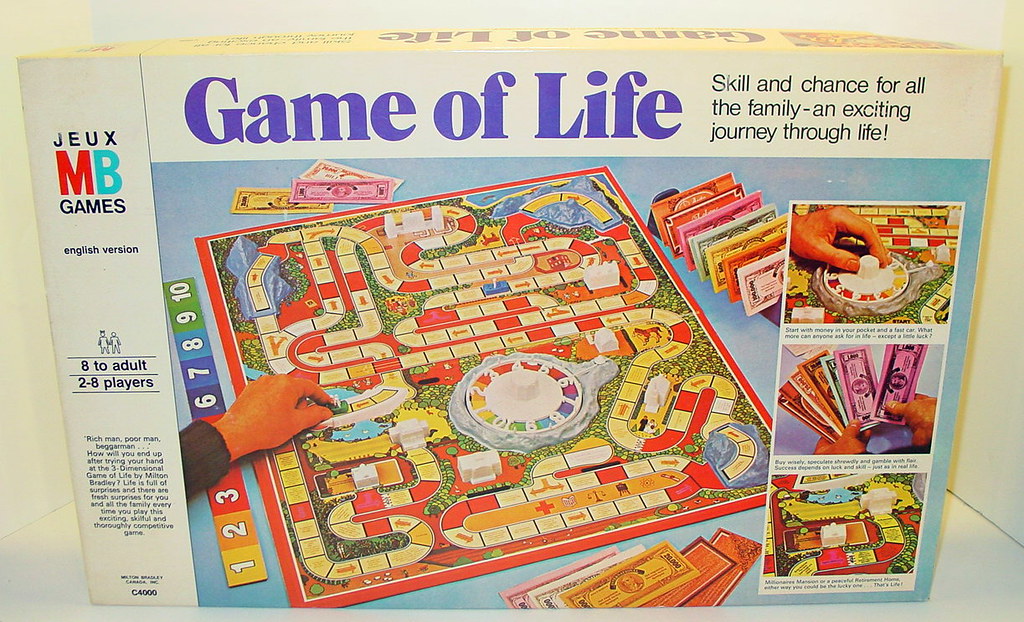
This my fifth love letter, previously I have written in praise of poetry, art, Agatha Christie and the Thoughts from the Criminology Team blog. Since early childhood, I have loved playing games and today’s entry is dedicated to this form of media. In the early years, the focus on fun is paramount, after all who wants to play a dull game? Equally important, the educational aim of games is sometimes explicit, other times less so. Nevertheless, they help us learn to match and sort colours and shapes, to develop our counting skills in an applied setting and improve our memory recall, as well as spelling. Games likes Snap, Happy Families, Hungry Hippos, Snakes and Ladders, Guess Who, Junior Scrabble offer a variety of different ways for children to learn important skills whilst playing. These games enable even very small children to share space, develop important interpersonal skills like taking turns and learn to deal with winning, and of course, losing. Often the latter is a very slow and painful lesson to learn….and one that isn’t always remembered into adulthood!
Of course, one of the most explicit part of playing games is learning the rules of the game, and of course, what happens when we deviate from those rules. It might lead to the loss of a turn or even forfeiture of the entire game. People interpret rules in different ways and families often develop their own “house” rules, but nevertheless there is always an agreed upon set of rules and a way of policing and punishing those who break them.
But once these lessons have been learned, what do games have to teach us as adults? I would say plenty! On a surface level, they offer an opportunity to relax and do something outside of our humdrum lives. Once the games have been purchased, they generally cost nothing to play unlike other forms of leisure time.1 Some can be played alone, others require competitors or even teams. They can aid our thinking, concentration and develop skills of strategy and tactics. They also have the general benefit of not being all consuming (unless at competition level), allowing for conversation to flow. The latter, conversing whilst doing something else, can often be useful for difficult emotional conversations, allowing people to open up without pressure (known colloquially as “health by stealth”).
But do board games have anything to offer to Criminology? Again, I would argue yes! Most games involve chance or luck, will you get the numbers you need, will you have the right pieces/cards in your hand, will the other person play their game in a way that benefits you? It is easy to recognise the role that luck or chance plays in games, but are we equally aware of their role in our lives. More importantly, as criminologists do we fully understand and acknowledge the role played by both in relation to criminality and victimisation?
We have no choice about whether we are born or not, when and where we arrive on the earth, who our parents are. These are all down to forces outside our individual and collective control. Our upbringing, our education, our employment opportunities are largely constrained by geography, money and influence. Compare the opportunities available to a baby born today in Sudan, with one born in the UK, another born in Palestine, and another born in Finland. Compare again, thinking about race, sex, class, disability, sexuality and so on. Very quickly you begin to understand the role played by chance and luck.
So if all of the above are imponderables, how much of a role does luck play in relation to criminality and victimisation? The regular publication of data relating to crime in postcodes, towns/cities and globally show huge diversity in the chance of victimisation. Lucky you, if you were born and live in the ‘Nordic countries of Europe (Norway, Sweden, Denmark, Iceland, and Finland) who rank among the 25 safest globally, most of them also being among the top 10 happiest nations worldwide’. Less fortunate, if you were born in Haiti, Ukraine, Palestine, Sudan or Iraq identified as some of the most dangerous places on earth currently. It is not very difficult to imagine the difference in opportunities in fundamental human rights; food, shelter, healthcare, education and so on. In war ridden nations it is incredibly difficult to separate different typologies of victimisation and for the individuals living under these conditions, it makes no meaningful difference who is/are the perpetrators.
Even if you are living in a “peaceful” state2 such as the UK, there are vast differences in the opportunities available. If you have money you can buy a car to get to work in your evening/night job, if you don’t, maybe you can take a bus, failing that you can walk. Each of those journeys carries its own risks. Your sex, your race, your ethnicity, your sexuality, your abilities/disabilities, your age add the aggravating/mitigating factors and see your risk increase/decrease. All a matter of chance and luck
What about criminality, is this, as the Classical School of Criminology would have us accept, a matter of free will, weighing up the pros and cons and making a deliberate and calculating choice to commit crime? Or can we also identify the same issues of luck and chance as shown above? If your family is loving, everyone has good health, housing is secure, food is plentiful and there are plenty of educational and employment opportunities in your area, would you still choose a life of crime? If there is violence at home, poverty impacts health, housing and regular meals, making it challenging to study or work, would you perceive crime to be a choice?
And what of those board game rules and consequences, real life has its own rules, some written in the forms of laws, others engrained via family, friends, institutions; the norms of our society. In the board game, these rules apply equally (aside from luck and chance) but in real life, not so much. Consider racial and ethnic disproportionality and the treatment of vulnerable women in the CJS, as just two examples. We may all be playing in the same “Game of Life”, but luck, chance and the rules we are subjected to are very different when it comes to criminality and victimisation.
- I appreciate that there are some very expensive board games out there, as well as expansion packs to enhance play. ↩︎
- There are lots of academic arguments around what constitutes a peaceful state, most agree that it more than just the absence of war. Whilst the UK has not seen active warfare on its shores for decades, its military has been involved in conflict throughout the world for more than a century. ↩︎
Share this:


Black History Month 2024
We have entered Black History Month (BHM), and whilst to some it is clear that Black history isn’t and shouldn’t be confined to one month a year, it would be unwise not to take advantage of this month to educate, raise awareness and celebrate Blackness, Black culture.
This year the Criminology department is planning a few events designed to be fun, informative and interesting.
One event the department will hold is a BHM quiz, designed to be fun and test your knowledge. Work individually or in groups, the choice is yours. The quiz will be held on the 17th October in The Hide (4th floor) in the Learning Hub from 4.30-6pm.
The second event will draw on the theme of this year’s BHM which is all about reclaiming narratives. In the exhibition area (ground floor of the Learning Hub) we will be presenting a number of visual narratives. I will be displaying a series of identity trees from Black women that I interviewed as part of my PhD research on Black women in English prisons. With a focus on race and gender, these identity trees represent a snapshot of the lives and lived experiences of these women prior to imprisonment. The trees also highlight the hopes and resilience of these women. This event will be held on the 31st October between 4.30-6pm. Please do walk through and have a look at the trees and ask questions. The event is designed for you to spend as little or as much time as you would like, whether it is a brief look or a longer discussion your presence is much welcomed!
If you would like to be part of this event, whether that is sharing your own research (staff and students), or if you would like to use the space to share your own narrative as a Black individual please get in contact by the 21st October by emailing angela.charles@northampton.ac.uk or criminology@northampton.ac.uk
Lastly, I would like to put a spotlight on a few academics to maybe read up on this month and beyond:
A few suggestions for important discussions on Black feminism and intersectionality:
A few academics with powerful and interesting research that proved very important in my PhD research:
- Maria Adams
- Angela Davis
- Beth Richie
- Corretta Phillips
- Ruth Chigwada-Bailey
- Jason Warr
- Julia Chinyere-Oparah (previously Julia Sudbury)
Share this:


Starting a new school year
What makes university unique?
Unlike school, students make the choice to come to university. What’s more, it is often a student’s first-time experiencing independence from caregivers, e.g. outside the purview of their own parents. For many, this may mean learning how to shop, cook, budget, clean and take care of their own stuff. This is an entirely new series of decisions leading to the person you will become. Never shy away from seeking help, support and advice, and use every resource at hand, including and especially people.
Build relationships. You will undoubtedly be tempted to spend lots of time on your digital devices – alone – but this will most certainly lead you down a dark path towards isolation, loneliness and the false feeling of control. Instead, accept that you must fashion a new independent self. Who are you outside your caregivers/parent’s home? Put the phone down and give yourself a fighting chance to find out!
Find kinship beyond superficial similarities, and sow the seeds for happiness in your new environment. At our university, the biggest mistake I’ve consistently seen students make is failing to create community here. Often, for example, UK-based students are anxious to spend the weekend at home with their parents or school friends. International students may either indulge in regional tourism, indulge their homesickness, and/or only seek to build relationships within their own ethno-linguistic group. Again, this all feeds a false sense of control.
This mirrors my experiences at Hanoi University of Science and Technology, where I taught during my sabbatical year in Vietnam (see featured image). There, I had to not only learn from my students how to navigate the local environment, but crucially, learn local classroom norms from both them and colleagues so that I could teach more effectively.
With that said: Build relationships right here through the university community. Join a club, explore and develop your interests and cultivate support networks. These may overlap or be three different ventures. If you work, then find employment that anchors you here in Northampton. Use every job experience as A) An opportunity to improve your communication skills, and B) As building blocks towards your own goals.
Within the first few weeks of starting university 30 years ago, I met a student who quickly became my best friend. He came from a country I couldn’t have pointed out on a map, was from a different religion, and studied something far from my own interests. As our friendship blossomed, we easily discovered that we had far more in common than not, which in turn fed my own curiosity and confidence to get to know more about this planet we all call home. Even though he’s passed away, our friendship still sustains me to this day (Rest in Power, dear Numair).
On the mentor/disciple relationship between students and teachers
At university, there is no separation between staff/students, adults/youth like in school. Please find opportunities to develop mentor/mentee relationships with your tutors*. Find a tutor with whom you can share your new world and reflect upon your growth. Ask them exactly what excellence looks like in their classroom and on assessments so you can foster the right study skills.
Yes, find mentors and become one, too! Learn from others who are further along the journey you now tread. At the same time, find ways to work with youth to inspire those who follow your path. This not only develops your own confidence and communication skills, but collectively contributes to a vibrant university community.
As someone who has studied and practiced Buddhism my whole life, I am convinced that what we give, we get in return. Cultivate a spirit of generosity and feed your own open-mindedness. This support and tolerance will be returned to you ten-fold.
*hooks, bell (2003). Teaching Community: A pedagogy of hope. New York ; Routledge.
Share this:


The colour of my skin

In recent weeks one politician, let’s call him “Doug” questioned the colour of another politician, let’s call her “Karen”. According to Doug, Karen decided to change the colour of her skin from brown to black. The way the colour change took place was presented as capricious and confusing. This little discussion took place in an event organised by the National Association of Black Journalists and it raised some very negative reactions namely on Doug’s audacity to interfere with the right of another person, in this case Karen, to self-identify and chose her own racial identity.
Perhaps these comments will be remembered or forgotten, but regardless they resonate with me because racial profiling and race identification is still a highly contested term in judicial processes namely law enforcement. It is even more controversial when considering the origins of these racial profiling and attribution. One word: colonialism! I appreciate that this is something that we converse about when we are talking about historical events, on empire expansion and exploitation, that led to genocide and slavery, but this is when I actually think that is partially the picture. Maybe because the roots on colonialism live with us and they still influence our social reality.
Colonialism turned skin colour into a commodity. It became part of the empire’s structure and all European and European influenced empires (i.e. USA or Australia) stand accused of their influence in criminalising skin and racial features. This influence is long lasting and its indelibly connected with the glorious past of all empires. Colourism and racial profiling were exploited to justify some of the most heinous crimes in human history.
To explain; colonialism sounds like an act that happened and eventually ended in time of British abolition of slavery and in US the Emancipation proclamation. After that, the world fought against it and all forms of it internationally entering article 4 of the UN convention. All is well! On the contrary! My point is that colonialism is far more insidious and deceitful. People presume that skin colour is a description of attributes and for millennia it was; the intensity of imperial exploitation of people used the colour of the skin as an obvious demarcation of racial separation. That allowed the imperial powers to keep different populations under control. Colour became the vehicle of oppression and subjugation. Empires thrived in dividing the population, utilising race and colour as a wedge that will make it difficult to understand their connected history of repression, making it difficult for people to rise against the tyranny of imperialism.
Consider the following. A fourth or fifth child of a Scottish labourer back in the early 19th century. Barely educated in reading and writing in a village in the highlands from a family that is hardly making ends meet. At age 17 he will join the British red coats or scarlet tunics, to be sent anywhere in the empire. This young man with hardly any life experience will be travelling across the world, using the privilege of his uniform to take, steal and do whatever he wants with impunity.[1] Years after he will return back to the village he came from with wealth and loot. His contemporaries will hail him as a success. In a garage sale today, a delightful old lady is holding a precious tea cup left by her beloved great-grandfather.
She holds it in her trembling hands as if the tea cup is talking to her, giving her meaning. Who can dare to tell this lovely old lady the history of this cup; the blood and pain that it contained long before it travelled across continents? This is why colonialism is so insidious because it’s subversive making people of the present and the future, custodians of that past, even unbeknown to them.
Of course, in the original instance between Doug and Karen, what is left out is the biggest and most challenging facet. That purity of race is a great read for those studying ethnology in the early 20th century, but we now know that people’s colours and races are a mixture of transgenerational journeys. People who identify as mixed race, a constituency of people, largely ignored by colonialism because it did not fit into their absurd sense of race classification, is rising.
Empire with its tales of heroism and greatness makes people yearn for a past that never existed, from a partial perspective that benefited the oppressors, minimising the impact it had on those who they oppressed. People, their cultures and most importantly their physiology become the casualties of said greatness. Years and years ago, in conversation with a dear Persian friend I realised that Alexander was Great for me but for Darius, my friend, he was Alexander the Accursed. If we can see beyond the “greatness” of our own past, perhaps we can read human history more accurately, where human attributes are just that and the colour of the skin should bear no consequences on people’s life or death.

[1] Similarly to the actions of a Scottish nobleman who stripped off the sculptures of a national monument; something akin to a sport of plunder among the European empires.
Share this:


Still holding Black women to European beauty standards

Many of you, like me will be enjoying the 2024 Olympic games in Paris: from the sheer amount of dedication, talent, and passion, to the ups and downs, the shocks and surprises and everything else in-between. However, it was something outside of the games that struck me. Simone Biles, the most decorated gymnast in history, received negative criticism online about her hair being unkempt on a video that she uploaded of herself and teammates on a bus. Simone then felt the need to address the comments and remind the public about overstepping the mark.
At first, Simone justified why her hair may have looked ‘messy’, explaining that it had been done prior to the bus journey, and that it was the heat and the long bus ride that had led to her hair falling out of place. She followed up these justifications with another post that reminded the public to kindly not mention a Black woman’s hair. This brought me back to discussions within my research where I highlight the European beauty standards that Black women are held to (Charles, 2024). Black women’s hair has for a long time been seen as unprofessional, messy and problematic. On the other spectrum, Black women’s natural hair has been marvelled at and touched without permission, causing Black women to feel hyper-visible and uncomfortable. Whichever encounter, it can lead to many Black women feeling the need to change their hair or mould it into something that looks more European (Charles, 2024; Patton, 2006). European beauty ideals and standards create further challenges and judgement that Black women face in society. Black women are scrutinised against racialised beauty ideals they cannot achieve, and they are perceived to be failing to measure up to the normative standard (Patton, 2006).
It should be a woman’s choice to style her hair how she wants, without external factors influencing or determining these choices. Additionally, Black hair needs to stop being compared to European hairstyles, in which such comparisons put European hairstyles on a pedestal. Speaking from experience, for many Black women, learning to love your hair for what it is rather than lament over what it is not can sometimes be a process. It can be a process of confusion, growth, trial and error, liberation, empowerment and pride. Moreover, it can be an important part of someone’s identity. I hope Simone Biles’ courage to challenge such comments can act as a springboard for others to do the same with power and resilience, and I hope we can start to normalise Black hair and hairstyles for future generations.
References
Charles, A. (2024) Black Women in Prison: Exploring the Intersection of Race and Gender in Experiences of Imprisonment. Unpublished PhD Thesis. Milton Keynes: The Open University.
Patton, T. O. (2006) ‘Hey Girl, Am I More than My Hair?: African American Women and Their Struggles with Beauty, Body Image, and Hair’, NWSA Journal, 18(2), pp. 24-51. Available at: http://www.jstor.org/stable/4317206
Share this:


Reflecting on my viva experience
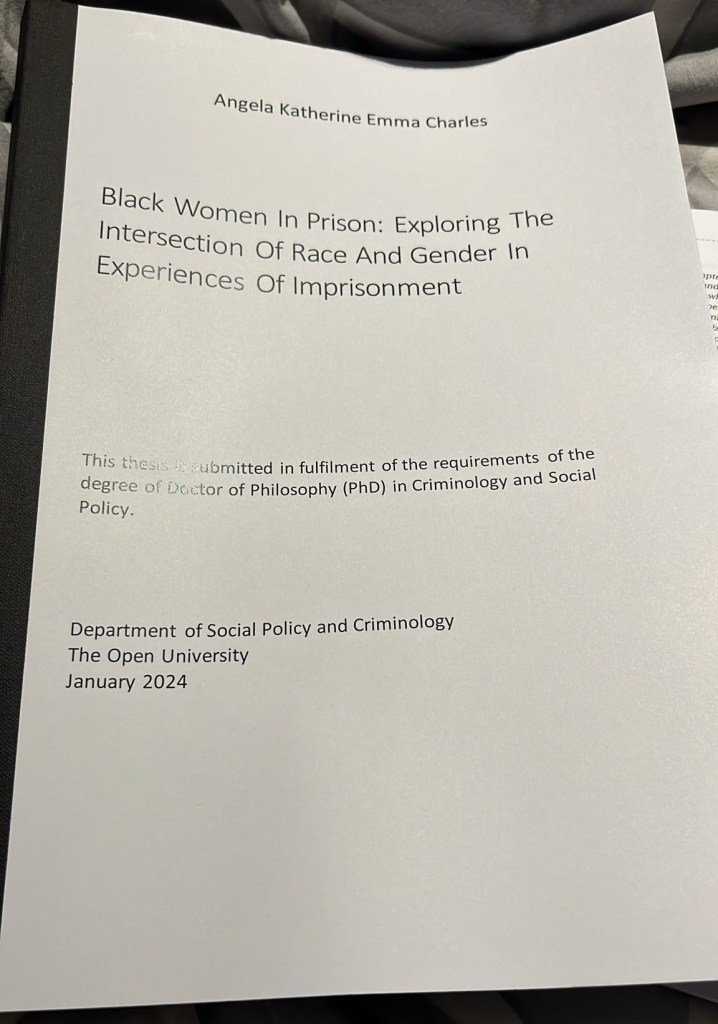
I reflect one week after one of the most important examinations in academia, the viva. Like any examination you never know what is going to come up and therefore you have to be prepared for anything. This makes preparation tricky, uncertain and at times perplexing. There were areas I thought might come up, and in those cases I had a response ready.
On the day, despite all the preparation there were questions that required pause, thought, navigation and discussion. Upon reflection, there were times where I would have liked to provide a more polished and articulate answer, but I am not a robot and therefore my answers are human, with stutters and pauses, passion and dedication; they are unpolished and there is a beauty to that.
What made the difference was having two very supportive examiners that were approachable, interested in my research and wanting me to fulfil my potential. Their additional years in the field/academia over mine were not used to demonstrate their superiority, but instead to guide me in the final process of completing my thesis.
The process acted as a reminder to me that how you approach a situation is so important. In academia, whilst we may be trying to highlight the flaws in a potential project or correcting errors or misconceptions in student’s writing so they can improve, we also ought to put the effort into seeing the good in someone’s work where possible. Think about whether your approach is constructive, how can that individual be supported to the finish line. It pays to maybe think back to the time when your work was being dissected, analysed, with the outcome affecting your academic career in front of you, what type of examiner would you have wanted, maybe that is the one you need to strive to be to others.
I passed with minor corrections that they stressed would only take a few days work. I hope this is acts a testament to what is possible. As a first-generation Black woman that tentatively stepped into academia, achieved a first-class honours degree, navigated a masters at Oxford University, was successful in achieving a funded PhD to then pass with minor corrections, challenge yourself and dare to dream!
Share this:


I’m not Black; my Friends and I are Brown, not Black

I recently began the process of preparing my child for the imminent transition to a new school situated in a diverse community. Despite being born into a similarly diverse environment, his early educational exposure occurred in an ethnically varied setting. Venturing into this new chapter within a racially diverse community has sparked a keen interest in him.
My child soon articulated a perspective that challenged conventional racial labels. He asserted that he and his friend Lucien are not accurately described as ‘black,’ rather he believes they are ‘brown.’ He went further to contest the classification of a lady on TV, who was singing the song “Ocean” by Hillsong, as ‘white.’ According to him, his skin is not black like the trousers he was wearing, and the lady is not white like the paper on my lap. This succinct but profound statement held more critical significance than numerous conversations I’ve encountered in my over five years of post-PhD lecturing.
The task at hand, guiding an under seven-year-old questioning the conventional colour-based categorisation, proved challenging. How do I convince an under seven-year-old that his knowledge of colours should be limited to abstract things and that persons with brown toned skin are ‘black’ while those with fair or light toned skinned are ‘white’? I found myself unprepared to initiate this complex conversation, but his persistent curiosity and incessant ‘why prompts’ compelled me to seek creative ways to address the matter. Even as I attempted to distract myself with a routine evening shower and dinner, my mind continued to grapple with the implications of our conversation.
Post-dinner, my attempt to engage in my usual political news catch-up led me to a YouTube vlog by Adeola titled ‘How I Almost Died!’ where she shared her pregnancy challenges. One statement she made struck a chord: ‘if you are a black woman and you are having a baby in America, please always advocate for yourself, don’t ever keep quiet, whatever you are feeling, keep saying it until they do something about it’ (18:39). This sentiment echoed similar experiences of tennis star Serena Williams, who faced negligence during childbirth in 2017.
The experiences of these popular ‘black’ women not only reminds me that the concept ‘black’ and ‘white’ are not only symbolic, but a tool for domination and oppression, and disadvantaging the one against the other. Drawing inspiration from Jay-Z’s ‘the story of O.J’, the song drew attention to the experiences of race, success, and the complexities of navigating the world as a ‘black’ individual. In the song, two themes stood out for me, the collective vulnerability to prejudice and the apparent bias in the criminal justice system towards ‘black’ people. In the UK, both proportional underrepresentation in staff number and proportional overrepresentation of minoritized groups in the criminal justice system and the consequences therefrom is still topical.
Jay-Z’s nuanced understanding of ‘black’ identity rejects simplistic narratives while emphasising its multifaceted nature. The verse, “O.J. ‘like I’m not black, I’m O.J.’ Okay” underscores the challenges even successful ‘black’ individuals face within racial systems. As criminologists, we recognize the reflection of these issues in daily experiences, prompting continuous self-reflexivity regarding our values, power positions, and how our scholarly practice addresses or perpetuates these concerns. Ultimately, the question persists: Can a post-racially biassed world or systems truly exist?
Share this:


Meet the Team: Angela Charles, Senior Lecturer in Criminology

I would like to take this opportunity to say a warm hello to my colleagues and to the students at the University of Northampton.
I am Angela Charles, a senior lecturer in criminology. I have a passion and deep interest in this discipline for a number of reasons. Firstly, criminology is such a fascinating and thought-provoking subject that is constantly evolving and expanding. Secondly, criminology is a subject where I believe social justice can be fought for and in many cases achieved, through researching and gaining evidence to push for change, and through perseverance. Thirdly, criminology requires us to discuss, debate, analyse and build on what has been previously argued and discussed; thereby strengthening, tweaking or dismantling and rebuilding previous theoretical knowledge and criminological concepts.
My research interests are within prisons and penology, and race and gender. My most recent research explored and analysed the experiences of Black women in English prisons, paying particular attention to the intersections of race, class and gender. Black women are at the margins of society and face multiple intersecting oppressions. The prison is arguably a microcosm of society and perpetuates the same oppressive structural inequalities. It is often these racialised and gendered pains of imprisonment that are rarely discussed or mentioned both within scholarly literature and the public realm more widely. I hope to disseminate my research in the coming years and amplify some of the voices of Black women in UK prisons.
I’m also keen to explore research methods that arguably move away from traditional research methods and instead aim to decolonise research methods. Criminologists need to adapt the methods they use to suit the differing backgrounds and cultures of the participants that we research, and we need to incorporate different cultural aspects into the research process. I believe this not only will create richer data, but will also increase participant engagement as they become co-producers of knowledge.
Lastly, I look forward to working closely with my colleagues to learn about their research interests, passions and to collaborate on ensuring that studying criminology is enjoyable, rewarding and insightful at the University of Northampton!

Share this:


Public confidence in the CJS: ending on a high?

2022 has been a turbulent and challenging year for many. Social inequalities and disadvantage are rife, with those in power repeatedly making bad, inhumane decisions and with very little, to no, accountability or consequences (insert your favourite example from the sh** storm that is the Conservative Party here). Union after Union, across sectors, engage in industrial action in response to poor working conditions and pay, amidst a cost-of-living crisis. And although seemingly unconnected, as the year comes to a close, the Sentencing Guidelines (2022) report on Public Confidence in the Criminal Justice System (CJS) has got me feeling frustrated. My previous blog entries have often been ‘moans’. And whilst January is often dubbed the month of new beginnings and change for the year ahead: we’re not quite there yet so true to form here is my latest moan!
The report exists as one of many conducted by Savanta to collate data on public confidence, in terms of effectiveness and fairness, in the CJS and public awareness of the sentencing guidelines. The data collected in March 2022, was via online surveys given to a “nationally representative sample of 2,165 adults in England and Wales” (Archer et al., 2022, p.9). Some of their highlighted ‘Key Findings’ include that confidence levels in CJS remains relatively stable in comparison to 2018, on the whole, respondents viewed sentences as ‘too lenient’ however this varied based on offence, the existence of the sentencing guidelines improves respondent’s confidence in the fairness of sentencing, and that engagement with broadcast news sources was high across respondents (Archer et al., 2022). It is not the findings, per se, that I take umbrage with, but rather the claim it is a “nationally representative sample of adults in England and Wales” (Archer et al., 2022, p.9).
I take issue on two fronts. The first being that the sample size of 2,165 adult respondents is representative when the demographic factors included are: gender (male and female), age (18-34yo, 35-54yo and 55+), region, ethnicity (White, Mixed, Asian, Black and Other) and socio-economic grade. Now considering we are, thankfully, at the end of 2022 we should all be able to recognise that a sample which only includes cis-gendered options, narrows ethnicity down to 4 categories and the charming ‘other’, and does not include disabilities is problematic. There has been a large body of research done on people with disabilities and their experiences within the CJS, the lack of representation, the lack of accessibility to space and decisions, potentially impacting a defendant’s right to a fair trial, and a victim’s right to justice (Equality and Human Rights Commission, 2021; Hyun et al., 2013 ). So I ask, is this not something which needs considering when looking at public confidence in the CJS of a “nationally representative” sample?
In addition to this, I take issue with the requirement that the sample be “nationally representative”. We have research piece upon research piece about how Black men and Black boys experience the CJS and its various agencies disproportionately to their white counterparts (Lammy, 2017; Monteith et al., 2022; Parmar, 2012). Their experiences of stop and search, sentencing, bail, access to programmes within the Secure and Youth estate. There is nothing representative about our CJS in terms of who it processes, how this is done, and by whom. According to Monteith et al., (2022) 1% of Judges in the CJS are Black, and there are NO Black judges on the High Court, Court of Appeal of Supreme Court: this is not representative! Why then, are we concerned with a representative sample when looking at public confidence in CJS and the sentencing guidelines, when it is not experienced in a proportionate manner?
Maybe I’ve missed the point?
The report is clear, accessible, visible to the public: crucial concepts when thinking about justice, and measuring public confidence in the CJS is fraught with difficulties (Bradford and Myhill, 2015; Kautt and Tankebe, 2011). But this just feels like another nail being thumped into the coffin that is 2022. Might be the eagerness I possess to leave 2022 behind, or the impeding dread for the year to follow but the report has angered me rather than reassured me. As a criminologist, I am hopeful for a more inclusive, representative, fair and accountable CJS, but I am not sure how this will be achieved if we do not accept that the system disproportionately impacts (but not exclusively) Black men, women and children. Think it might be time for another mince pie…
Happy New Year to you all!
References:
Archer, N., Butler, M., Avukatu, G. and Williams, E. (2022) Public Knowledge of Confidence in the Criminal Justice System and Sentencing: 2022 Research. London: Sentencing Council.
Bradford, B. and Myhill, A. (2015) Triggers of change to public confidence in the police and criminal justice system: Findings from the crime survey for England and Wales panel experiment, Criminology and Criminal Justice, 15(1), pp.23-43.
Equality and Human Rights Commission (2021) Does the criminal justice system treat disabled people fairly? [Online] Available at: https://www.equalityhumanrights.com/en/inquiries-and-investigations/does-criminal-justice-system-treat-disabled-people-fairly [ Accessed 4th November 2021].
Hyun, E., Hahn, L. and McConnell, D. (2013) Experiences of people with learning disabilities in the criminal justice system, British Journal of Learning Disabilities, 42: 308-314.
Kautt, P. and Tankebe, J. (2011) Confidence in the Criminal Justice System in England and Wales: A Test of Ethnic Effects, International Criminal Justice Review, 21(2),pp. 93-117.
The Lammy Review (2017) The Lammy Review: An independent review into the treatment of, and outcomes for, Black Asian and Minority Ethnic Individuals in the Criminal Justice System, [online] Available at: https://assets.publishing.service.gov.uk/goverment/uploads/system/uploads/attachment_data/file/643001/lammy-review-final-report-pdf [Last Accessed 14th February 2021].
Monteith, K., Quinn, E., Dennis, A., Joseph-Sailsbury, R., Kane, E., Addo, F. and McGourlay, C. (2022) Racial Bias and the Bench: A Response to the Judicial Diversity and Inclusion Strategy (2020-2025), [online] Available at: https://documents.manchester.ac.uk/display.aspax?DOCID=64125 [Accessed 4th November 2022].
Parmar, A. (2012) Racism and ethnicity in the criminal justice process, in: Hucklesby, A. and Wahidin, A. (eds.) Criminal Justice, 2nd ed, Oxford: Oxford University Press, pp.267-296.

 Thoughts from the criminology team
%3Amax_bytes(150000)%3Astrip_icc()%3Afocal(749x0%3A751x2)%2Fsimone-biles-hair-paris-heatwave-073024-tout-52887c1302ff465d8797f003c452ecba.jpg&imgrefurl=https%3A%2F%2Fpeople.com%2Fsimone-biles-claps-back-people-commenting-hair-amid-2024-paris-olympics-heatwave-8685988&docid=8zbppZtCkxUTxM&tbnid=VEKrr21i-NVrWM&vet=12ahUKEwj_0LS80-WHAxV2UkEAHZ8GAGkQM3oECF0QAA..i&w=1500&h=1000&hcb=2&ved=2ahUKEwj_0LS80-WHAxV2UkEAHZ8GAGkQM3oECF0QAA)