
Home » Profiling
Category Archives: Profiling

Exploring the National Museum of Justice: A Journey Through History and Justice

As Programme Leader for BA Law with Criminology, I was excited to be offered the opportunity to attend the National Museum of Justice trip with the Criminology Team which took place at the back end of last year. I imagine, that when most of us think about justice, the first thing that springs to mind are courthouses filled with judges, lawyers, and juries deliberating the fates of those before them. However, the fact is that the concept of justice stretches far beyond the courtroom, encompassing a rich tapestry of history, culture, and education. One such embodiment of this multifaceted theme is the National Museum of Justice, a unique and thought-provoking attraction located in Nottingham. This blog takes you on a journey through its historical significance, exhibits, and the essential lessons it imparts and reinforces about justice and society.
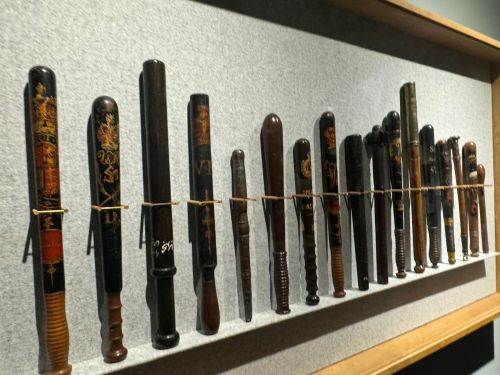
A Historical Overview
The National Museum of Justice is housed in the Old Crown Court and the former Nottinghamshire County Gaol, which date back to the 18th century. This venue has witnessed a myriad of legal proceedings, from the trials of infamous criminals to the day-to-day workings of the justice system. For instance, it has seen trials of notable criminals, including the infamous Nottinghamshire smuggler, and it played a role during the turbulent times of the 19th century when debates around prison reform gained momentum. You can read about Richard Thomas Parker, the last man to be publicly executed and who was hanged outside the building here. The building itself is steeped in decade upon decade of history, with its architecture reflecting the evolution of legal practices over the centuries. For example, High Pavement and the spot where the gallows once stood.
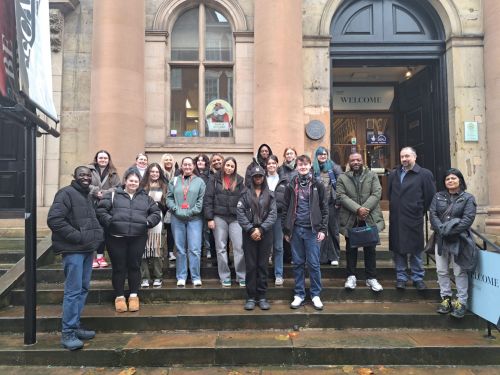
By visiting the museum, it is possible to trace the origins of the British legal system, exploring how societal values and norms have shaped the laws we live by today. The National Museum of Justice serves as a reminder that justice is not a static concept; it evolves as society changes, adapting to new challenges and perspectives. For example, one of my favourite exhibits was the bench from Bow Street Magistrates Court. The same bench where defendants like Oscar Wilde, Mick Jagger and the Suffragettes would have sat on during each of their famous trials. This bench has witnessed everything from defendants being accused of hacking into USA Government computers (Gary McKinnon), Gross Indecency (Oscar Wilde), Libel (Jeffrey Archer), Inciting a Riot (Emmeline Pankhurst) as well as Assaulting a Police Officer (Miss Dynamite).
Understanding this rich history invites visitors to contextualize the legal system and appreciate the ongoing struggle for a just society.
Engaging Exhibits
The National Museum of Justice is more than just a museum; it is an interactive experience that invites visitors to engage with the past. The exhibits are thoughtfully curated to provide a comprehensive understanding of the legal system and its historical context. Among the highlights are:



1. The Criminal Courtroom: Step into the courtroom where real trials were once held. Here, visitors can learn about the roles of various courtroom participants, such as the judge, jury, and barristers. This is the same room that the Criminology staff and students gathered in at the end of the day to share our reflections on what we had learned from our trip. Most students admitted that it had reinforced their belief that our system of justice had not really changed over the centuries in that marginalised communities still were not dealt with fairly.
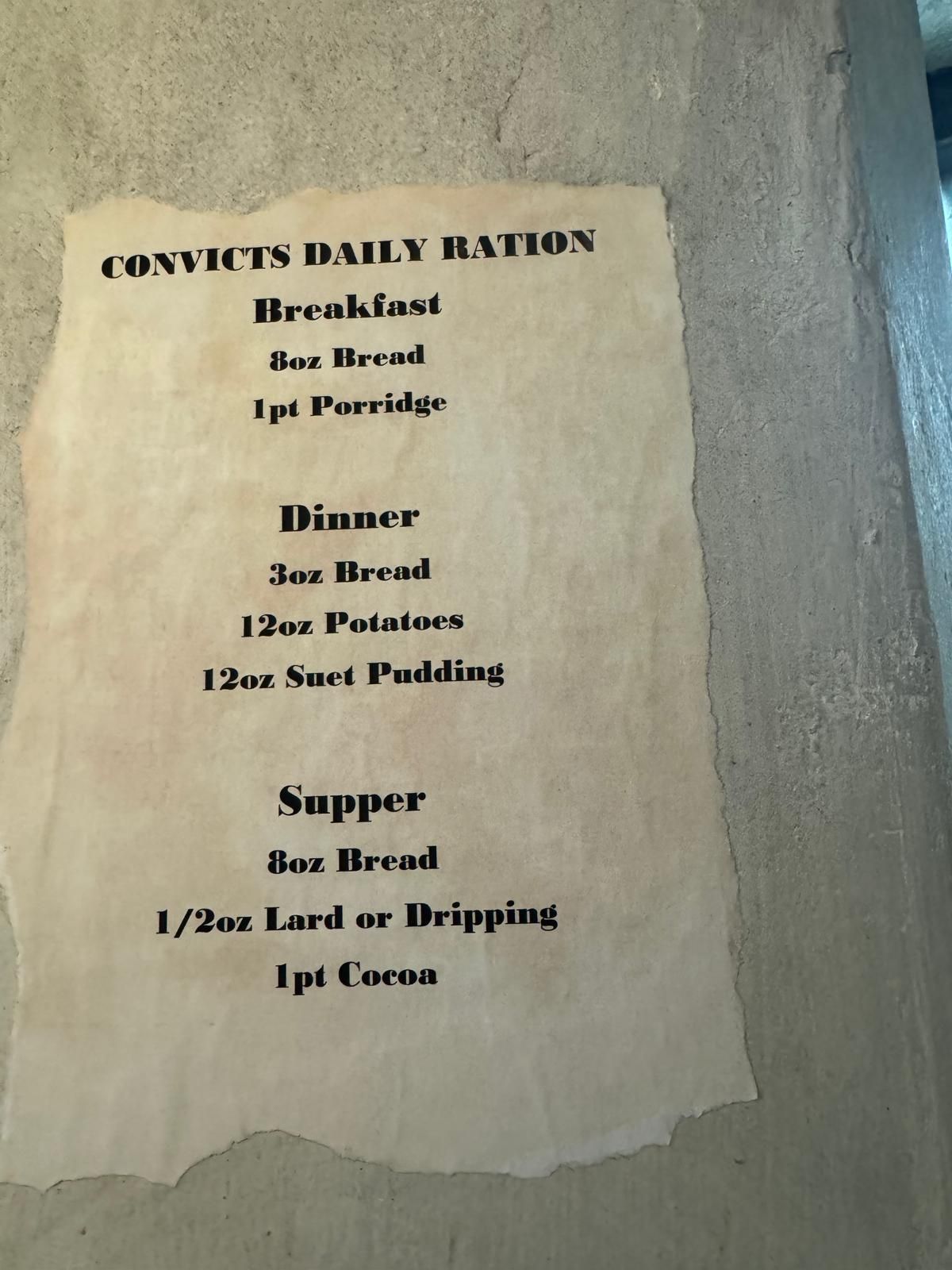
2. The Gaol: We delved into the grim reality of life in prison during the Georgian and Victorian eras. The gaol section of the gallery offers a sobering look at the conditions inmates faced, emphasizing the societal implications of punishment and rehabilitation. For example, every prisoner had to pay for his/ her own food and once their sentence was up, they would not be allowed to leave the prison unless all payments were up to date. The stark conditions depicted in this exhibit encourage reflections on the evolution of prison systems and the ongoing debates surrounding rehabilitation versus punishment. Eventually, in prisons, women were taught skills such as sewing and reading which it was hoped may better their chances of a successful life in society post release. This was an evolution within the prison system and a step towards rehabilitation of offenders rather than punishment.
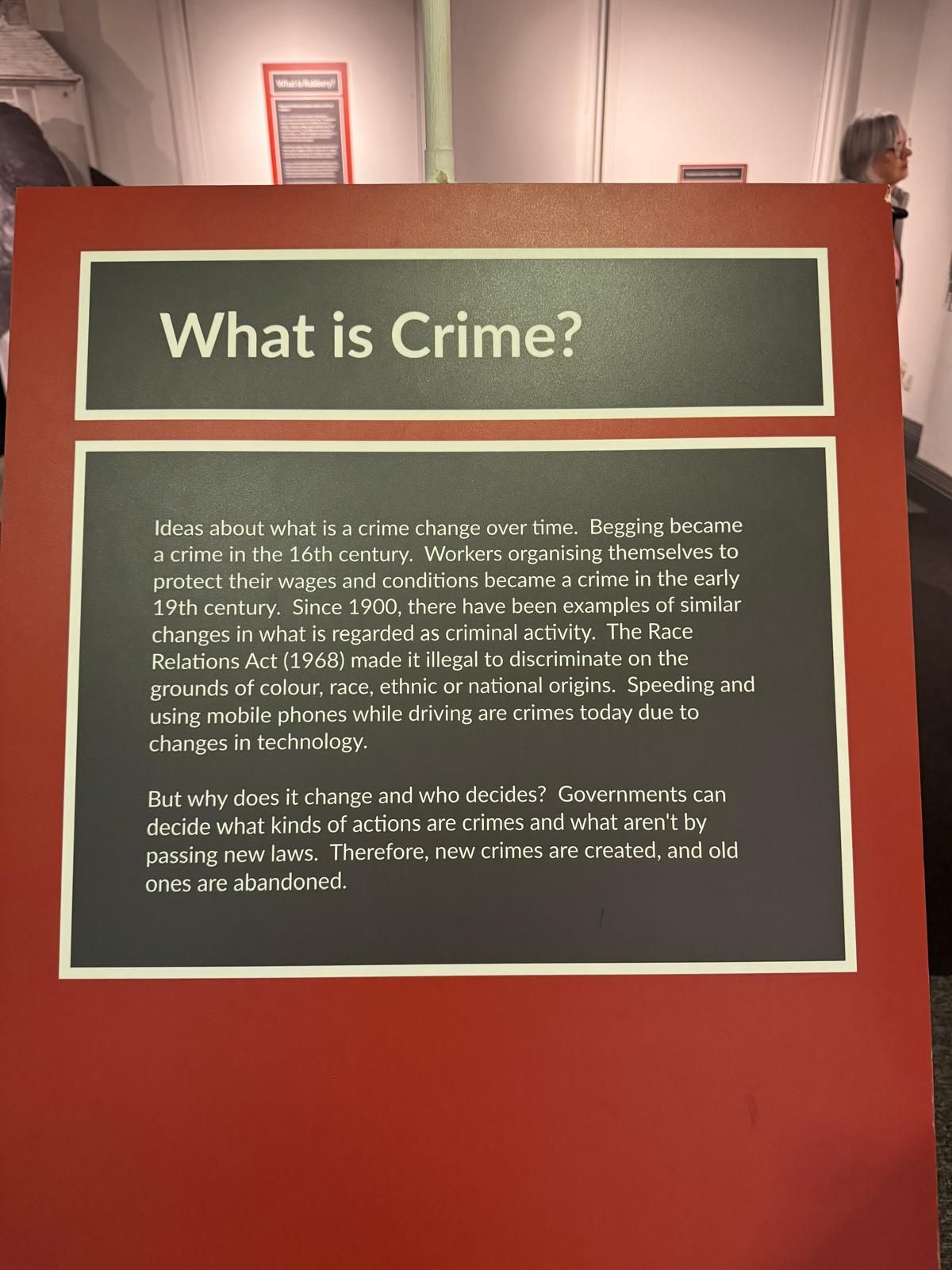
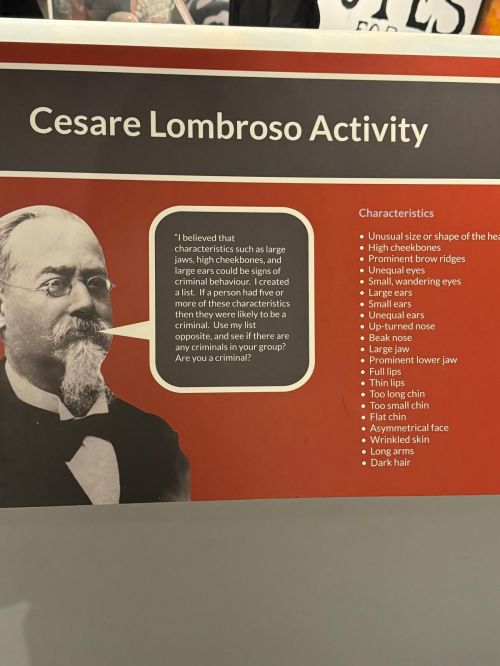
3. The Crime and Punishment Exhibit: This exhibit examines the relationship between crime and society, showcasing the changing perceptions of criminal behaviour over time. For example, one famous Criminologist of the day Cesare Lombroso, once believed that it was possible to spot a criminal based on their physical appearance such as high cheekbones, small ears, big ears or indeed even unequal ears. Since I was not familiar with Lombroso or his work, I enquired with the Criminology department as to studies that he used to reach the above conclusions. Although I believe he did carry out some ‘chaotic’ studies, it really reminded me that it is possible to make statistics say whatever it is you want them to say. This is the same point in relation to the law generally. As a lawyer I can make the law essentially say whatever I want it to say in the way I construct my arguments and the sources I include. Overall, The Inclusions of such exhibits raises and attempts to tackle difficult questions about personal and societal morality, justice, and the impact of societal norms on individual actions. By examining such leading theories of the time and their societal reactions, the exhibit encourages visitors to consider the broader implications of crime and the necessity of reform within the justice system. Do you think that today, deciding whether someone is a criminal based on their physical appearance would be acceptable? Do we in fact still do this? If we do, then we have not learned the lessons from history or really moved on from Cesare Lombroso.
Lessons on Justice and Society
The National Museum of Justice is not merely a historical site; it also serves as a platform for discussions about contemporary issues related to justice. Through its exhibits and programs, our group was invited to reflect on essentially- The Evolution of Justice: Understanding how laws have changed (or not!) over time helps us appreciate the progress (or not!) made in human rights and justice and with particular reference to women. It also encourages us to consider what changes may still be needed. For example, we were incredibly privileged to be able to access the archives at the museum and handle real primary source materials. We, through official records followed the journey of some women and girls who had been sent to reform schools and prisons. Some were given extremely long sentences for perhaps stealing a loaf of bread or reel of cotton. It seemed to me that just like today, there it was- the huge link between poverty and crime. Yet, what have we done about this in over two or three hundred years? This focus on historical cases illustrates the importance of learning from the past to inform present and future legal practices.
– The Importance of Fair Trials: The gallery emphasizes the significance of due process and the presumption of innocence, reminding us that justice must be impartial and equitable. In a world where public opinion can often sway perceptions of guilt or innocence, this reminder is particularly pertinent. The National Museum of Justice underscores the critical role that fair trials play in maintaining the integrity of the legal system. For example, if you were identified as a potential criminal by Cesare Lombroso (who I referred to above) then you were probably not going to get a fair trial versus an individual who had none of the characteristics referred to by his studies.
– Societal Responsibility: The exhibits prompt discussions about the role of society in shaping laws and the collective responsibility we all share in creating a just environment. The National Museum of Justice encourages visitors to think about their own roles in advocating for justice, equality, and reform. It highlights that justice is not solely the responsibility of legal professionals but also of the community at large.
– Ethics and Morality: The museum offers a platform to explore ethical dilemmas and moral questions surrounding justice. Engaging with historical cases can lead to discussions about right and wrong, prompting visitors to consider their own beliefs and biases regarding justice.
Conclusion
The National Museum of Justice in Nottingham is a remarkable destination that beautifully intertwines history, education, and advocacy for justice. By exploring its rich exhibits and engaging with its thought-provoking themes, visitors gain a deeper understanding of the complexities surrounding justice and its vital role in society. Whether you are a history buff, a legal enthusiast, a Criminologist or simply curious about the workings of justice, the National Museum of Justice offers a captivating journey that will leave you enlightened and inspired.
As we navigate the complexities of the modern world, it is essential to remember the lessons of the past and continue striving for a fair and just society for all. The National Museum of Justice stands as a powerful testament to the ongoing quest for justice, inviting us all to be active participants in that journey. In doing so, we honour the legacy of those who have fought for justice throughout history and commit ourselves to ensuring that the principles of fairness and equity remain at the forefront of our society. Sitting on that same bench that Emmeline Pankhurst once sat really reminded me of why I initially studied law.
The main thought that I was left with as I left the museum was that justice is not just a concept; it is a lived experience that we all contribute to shaping.

Share this:


The colour of my skin

In recent weeks one politician, let’s call him “Doug” questioned the colour of another politician, let’s call her “Karen”. According to Doug, Karen decided to change the colour of her skin from brown to black. The way the colour change took place was presented as capricious and confusing. This little discussion took place in an event organised by the National Association of Black Journalists and it raised some very negative reactions namely on Doug’s audacity to interfere with the right of another person, in this case Karen, to self-identify and chose her own racial identity.
Perhaps these comments will be remembered or forgotten, but regardless they resonate with me because racial profiling and race identification is still a highly contested term in judicial processes namely law enforcement. It is even more controversial when considering the origins of these racial profiling and attribution. One word: colonialism! I appreciate that this is something that we converse about when we are talking about historical events, on empire expansion and exploitation, that led to genocide and slavery, but this is when I actually think that is partially the picture. Maybe because the roots on colonialism live with us and they still influence our social reality.
Colonialism turned skin colour into a commodity. It became part of the empire’s structure and all European and European influenced empires (i.e. USA or Australia) stand accused of their influence in criminalising skin and racial features. This influence is long lasting and its indelibly connected with the glorious past of all empires. Colourism and racial profiling were exploited to justify some of the most heinous crimes in human history.
To explain; colonialism sounds like an act that happened and eventually ended in time of British abolition of slavery and in US the Emancipation proclamation. After that, the world fought against it and all forms of it internationally entering article 4 of the UN convention. All is well! On the contrary! My point is that colonialism is far more insidious and deceitful. People presume that skin colour is a description of attributes and for millennia it was; the intensity of imperial exploitation of people used the colour of the skin as an obvious demarcation of racial separation. That allowed the imperial powers to keep different populations under control. Colour became the vehicle of oppression and subjugation. Empires thrived in dividing the population, utilising race and colour as a wedge that will make it difficult to understand their connected history of repression, making it difficult for people to rise against the tyranny of imperialism.
Consider the following. A fourth or fifth child of a Scottish labourer back in the early 19th century. Barely educated in reading and writing in a village in the highlands from a family that is hardly making ends meet. At age 17 he will join the British red coats or scarlet tunics, to be sent anywhere in the empire. This young man with hardly any life experience will be travelling across the world, using the privilege of his uniform to take, steal and do whatever he wants with impunity.[1] Years after he will return back to the village he came from with wealth and loot. His contemporaries will hail him as a success. In a garage sale today, a delightful old lady is holding a precious tea cup left by her beloved great-grandfather.
She holds it in her trembling hands as if the tea cup is talking to her, giving her meaning. Who can dare to tell this lovely old lady the history of this cup; the blood and pain that it contained long before it travelled across continents? This is why colonialism is so insidious because it’s subversive making people of the present and the future, custodians of that past, even unbeknown to them.
Of course, in the original instance between Doug and Karen, what is left out is the biggest and most challenging facet. That purity of race is a great read for those studying ethnology in the early 20th century, but we now know that people’s colours and races are a mixture of transgenerational journeys. People who identify as mixed race, a constituency of people, largely ignored by colonialism because it did not fit into their absurd sense of race classification, is rising.
Empire with its tales of heroism and greatness makes people yearn for a past that never existed, from a partial perspective that benefited the oppressors, minimising the impact it had on those who they oppressed. People, their cultures and most importantly their physiology become the casualties of said greatness. Years and years ago, in conversation with a dear Persian friend I realised that Alexander was Great for me but for Darius, my friend, he was Alexander the Accursed. If we can see beyond the “greatness” of our own past, perhaps we can read human history more accurately, where human attributes are just that and the colour of the skin should bear no consequences on people’s life or death.

[1] Similarly to the actions of a Scottish nobleman who stripped off the sculptures of a national monument; something akin to a sport of plunder among the European empires.
Share this:


“I can’t breathe”

George Floyd’s words: “I can’t breathe”, have awaken almost every race and creed in relevance to the injustice of systematic racism faced by black people across the world. His brutal murder has echoed and been shared virtually on every social media platform – Floyd’s death has changed the world and showed that Black people are no longer standing alone in the fight against racism and racial profiling. The death of George Floyd has sparked action within both the white and black communities to demand comprehensive police reforms in regards to police brutality and the use of unjust force towards ethnic minorities.
There have been many cases of racism and racial profiling against black people in the United Kingdom, and even more so in the United State. Research has suggested that there have been issues with police officers stereotyping ethnic minorities, especially black people, which has resulted in a vicious cycle of the stopping and searching of those that display certain physical features. Other researchers have expounded that the conflict between the police and black people has no correlation with crime, rather it is about racism and racial profiling. Several videos circulating on social media platforms depict that the police force does harbour officers who hold prejudice views towards black people within its ranks.
Historically, black people have been deprived, excluded, oppressed, demonised and brutally killed because of the colour of their skin. As ex-military personnel in Her Majesty’s Armed Forces and currently working as a custody officer, I can say from experience that the use of force used during the physical restraint on George Floyd was neither necessary nor proportionate to the circumstances. In the video recorded by bystanders, George Floyd was choked in the neck whilst fighting for his life repeating the words “I can’t breathe”. Perhaps the world has now noticed how black people have not been able to breathe for centuries.
The world came to halt because of Covid-19; many patients have died because of breathing difficulties. Across the world we now know what it means if a loved one has breathing issues in connection with Covid-19 or other health challenges. But nothing was done by the other police officers to advise their colleague to place Floyd in the recovery position, in order to examine his breathing difficulties as outlined in many restraint guidelines.
Yet that police officer did not act professional, neither did he show any sign of empathy. Breath is not passive, but active, breathing is to be alive. Racial profiling is a human problem, systematic racism has destroyed the world and further caused psychological harm to its victims. Black people need racial justice. Perhaps the world will now listen and help black people breathe. George Floyd’s only crime was because he was born black. Black people have been brutally killed and have suffered in the hands of law enforcement, especially in the United States.
Many blacks have suffered institutional racism within the criminal justice system, education, housing, health care and employment. Black people like my own wife could not breathe at their workplaces due to unfair treatment and systematic subtle racial discrimination. Black people are facing unjust treatment in the workplace, specifically black Africans who are not given fair promotional opportunities, because of their deep African accent. It is so naïve to assume that the accent is a tool to measure one’s intelligence. It is not overt racism that is killing black people, rather the subtle racism in our society, schools, sports and workplace which is making it hard for many blacks to breathe.
We have a duty and responsibility to fight against racism and become role models to future generations. Maybe the brutal death of George Floyd has finally brought change against racism worldwide, just as the unprovoked racist killing of black teenager Stephen Lawrence had come to embody racial violence in the United Kingdom and led to changes in the law. I pray that the massive international protest by both black and other ethnicities’ will not be in vain. Rather than “I can’t breathe” reverberating worldwide, it should turn the wheel of police reforms and end systematic racism.
“Restricting someone’s breath to the point of suffocation is a violation of their Human Rights”.
Share this:

‘Guilty’ of Coming Out Daily – Abroad. #BlackenAsiaWithLove
I am annoyed that our apartment-building manager told my husband that a two-bedroom had recently become available, and that we should move in because we would be “more comfortable.” My husband always takes such statements at face value, then performs his own cost/benefits analysis. Did the manager offer a discount, I asked? I mean, if he’s genuinely concerned about our comfort, shouldn’t he put his money where his mouth is? That’s probably just the American in me talking: He was either upselling the property or probing us to see what the deal was – not at all concerned about our comfort. I speak code, too.
The most homophobic thing that anyone has ever said to me is not any slur, but that gay people should not “flaunt it.” As if concealing our identities would magically erase homophobia. This reveals that the speaker either doesn’t know – or doesn’t care to know – how readily people everywhere speak about our personal lives. There are random people I have met in every single part of the world, that ask my marital status. It comes shortly after asking my name and where I’m from. The words used are revealing – just ask any divorced person who has engaged with any society’s traditions. Is it deceptive to say that they are “single,” instead? What’s more, regardless of language, preferred terms like “unmarried” reveal the value conferred upon this status. You’re not a whole person until you’re married, and a parent. It is only then that one is genuinely conferred what we sociologists call ‘personhood’. Also, are married lesbians called two Mrs.?
Come out, come out wherever you are.
In many parts of the world, being ‘out’ carries the death penalty, including parts of my father’s homeland, Nigeria. I’ve literally avoided visiting Nigeria because of the media-fueled fear of coming out. I hate the distance it’s wedged between my people, our culture and I. There was a time when coming out was literally the hardest thing I ever had to do. Now, l must come out daily.
Back in the UK, many educators would like to believe that they don’t discuss their personal lives with students. But who hasn’t been casually asked how one spent the weekend? Do I not say “My husband and I…” just as anyone else might? Abroad, do I correct co-workers when they refer to us as ‘friends’? Yesterday, I attended an academic conference. All the usual small talk. I came out a dozen times by lunch.
In teaching English here in Asia, isn’t it unfair for me to conceal from my students the gender of my “life-partner,” which is actually our formal legal status? Am I politicising my classroom by simply teaching gender-neutral terms like ‘spouse’ or ‘partner’? Or, do I simply use the term ‘husband’ and skim over their baffled faces as they try to figure out if they have understood me properly? Am I denying them the opportunity to prepare for the sought-after life in the west? Further, what about the inevitability of that one ‘questioning’ student in my classroom searching for signs of their existence!
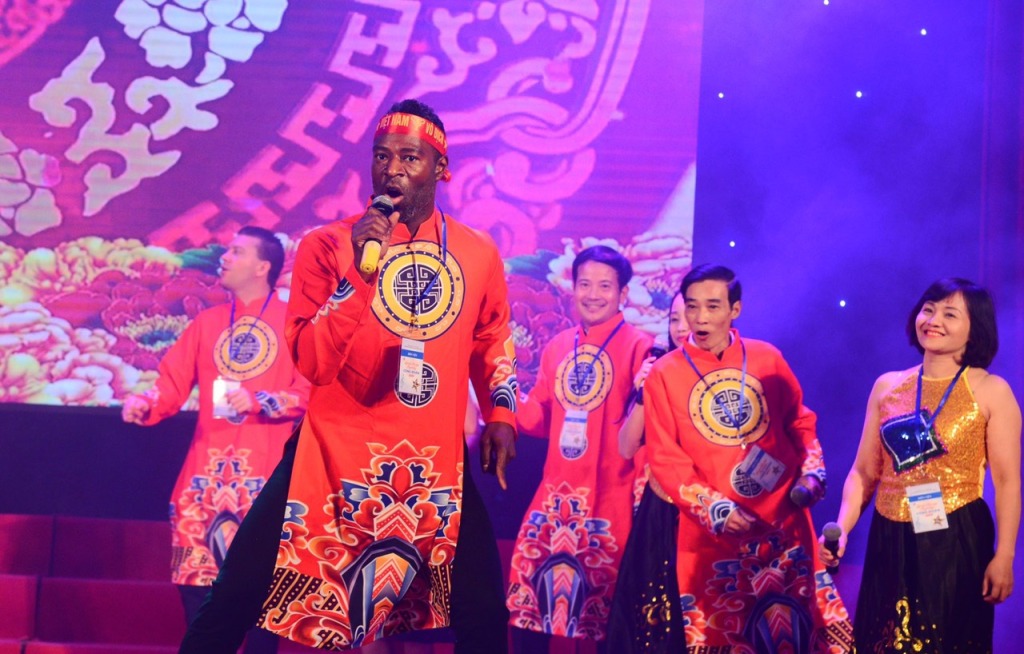
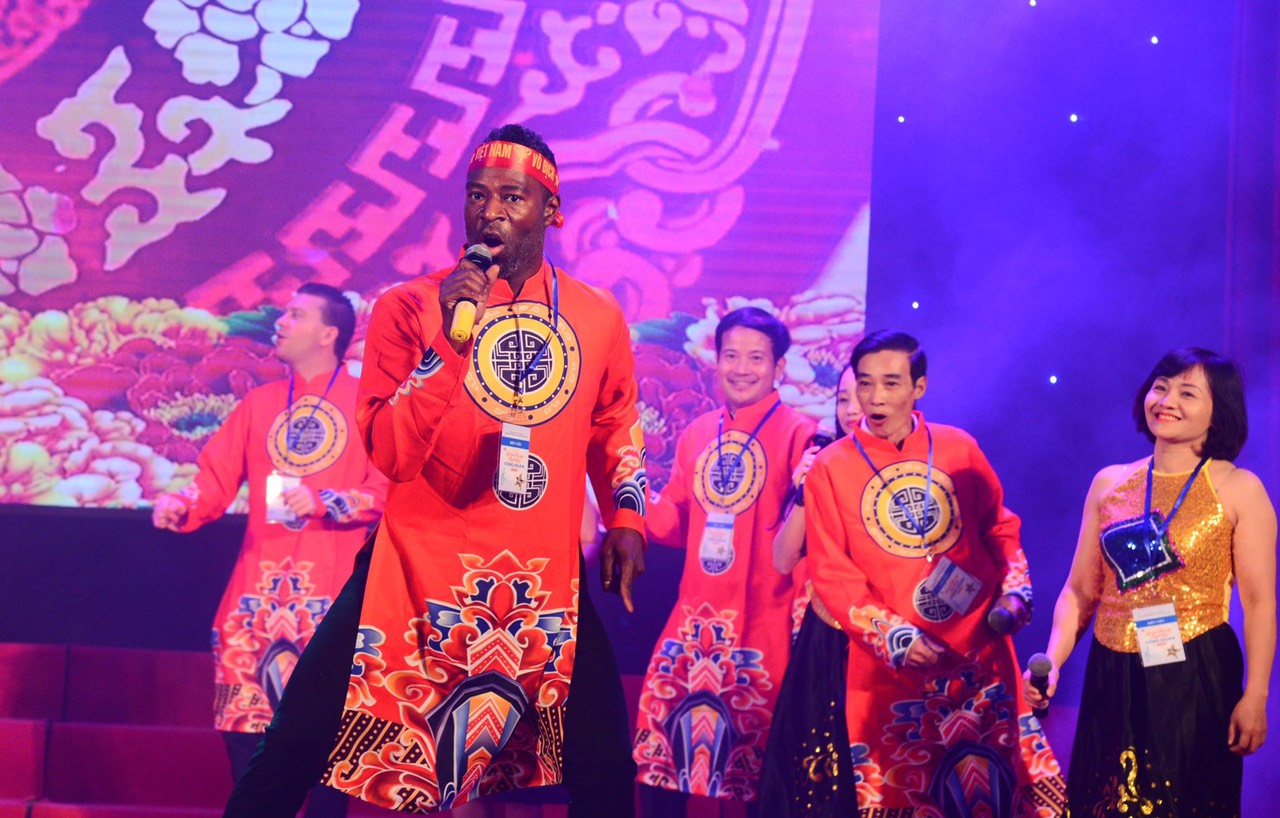
I was recently cornered in the hallway by the choreographer hired by our department to support our contribution to the university’s staff talent competition (see picture below*). She spoke with me in German, explaining that she’d lived several years in the former GDR. There are many Vietnamese who’d been ‘repatriated’ from the GDR upon reunification. So, given the historical ties to Communism, it’s commonplace to meet German (and Russian) speakers here. Naturally, folks ask how/why I speak (basic) German. My spouse of seventeen years is German, so it’d be weird if I hadn’t picked up any of the language. It’s really deceptive to conceal gender in German, which has three. I speak German almost every day here in Hanoi.
The word is ‘out’.
In Delhi, we lived in the same 2-bedroom flat for over 7 years. It became clear to our landlady very early on that we slept in one bedroom. Neighbours, we’re told, also noticed that we only ever had one vehicle between us and went most places together. Neither the landlady nor any neighbour ever confronted us, so we never had to formally come out. Yet, the chatter always got back to us.
As a Peace Corps volunteer in rural Mali in the late 90’s, I learned to speak Bambara. Bambara greetings are quite intimate: One normally asks about spouses, parents and/or children, just as Black-Americans traditionally would say “How yo’ momma doin?’” In Mali, village people make it their business to get single folks hitched. Between the Americans, then, it became commonplace to fake a spouse, just so one would be left in peace. Some women wore wedding bands for added protection, as a single woman living alone was unconscionable. The official advice for gays was to stay closeted L. While I pretended to be the husband of several volunteers, I could never really get the gist of it in my village. Besides, at 23 years old, being a single man wasn’t as damning as it is for women. I only needed excuses to reject the young women villagers presented to me. Anyhow, as soon as city migrants poured back to the village for Ramadan, I quickly discovered that there are plenty of LGBTQ+ folks in Mali! This was decades before Grindr.
Here in Hanoi, guys regularly, casually make gestures serving up females, as if to say: ‘Look, she’s available, have her’. I’ve never bothered to learn the expected response, nor paid enough attention to how straight men handle such scenarios. Recently, as we left a local beer hall with another (gay) couple, one waiter rather cheekily made such gestures at a hostess. In response, I made the same gestures towards him; he then served himself up as if to say ‘OK’. That’s what’s different about NOW as opposed to any earlier period: Millennials everywhere are aware of gay people.
A group of lads I sat with recently at a local tea stall made the same gestures to the one girl in their group. After coming out, the main instigator seamlessly gestured towards the most handsome in his clique. When I press Nigerian youth about the issue, the response is often the same: We don’t have a problem with gay people, we know gay people, it’s the old folk’s problem. Our building manager may be such a relic.
*Picture from The 2019 Traditional Arts Festival at Hanoi University of Science and Technology (HUST)
Share this:


Is unconscious bias a many-headed monster?
When I was fourteen, I was stopped and searched in broad daylight. I was wearing my immaculate (private) school uniform – tie, blazer, shoes… the works. The idea I went to private school shouldn’t matter, but with that label comes an element of “social class.” But racial profiling doesn’t see class. And I remember being one of those students who was very proud of his uniform. And in cricket matches, we were all dressed well. I remember there being a school pride to adhere to and when we played away, we were representing the school and its reputation that had taken years to build. And within those walls of these private schools, there was a house pride.

Yet when I was stopped, it smeared a dark mark against the pride I had. I was a child. Innocent. If it can happen to me – as a child – unthreatening – it can really happen to anyone and there’s nothing they can to stop it. Here I saw unconscious bias rear its ugly head, like a hydra – a many-headed monster (you have to admire the Greeks, you’re never stuck for a metaphor!)
If we’re to talk about unconscious bias, we must say that it only sees the surface level. It doesn’t see my BA Creative Writing nor would it see that I work at a university. But unconscious bias does see Black men in hoodies as “trouble” and it labels Black women expressing themselves as “angry.”
Unconscious bias forces people of colour to censor their dress code – to not wear Nike or Adidas in public out of fear that it increases your chances of being racially profiled. Unconscious bias pushes Black and Asians to code-switch. If a White person speaks slang, it’s cool. When we do it, it’s ghetto. That’s how I grew up and when I speak well, I’ve had responses such as “What good English you speak.” Doomed if you do, doomed if you don’t.
How you speak, what you wear – all these things are scrutinised more when you don’t have White Privilege. And being educated doesn’t shield non-White people (British people of colour included) from racist and xenophobic attacks, as author Reni Eddo-Lodge says in her book:
“Children of immigrants are often assured by well-meaning parents that educational access to the middle classes can absolve them from racism. We are told to work hard, go to a good university, and get a good job.”
The police can stop and question you at any time. The search comes into play, depending on the scenario. But when I was growing up, my parents gave me The Talk – on how Black people can get hassled by police. For me, I remember my parents sitting me down at ten years old. That at some point, you could be stopped and searched at any time – from aimlessly standing on a street corner, to playing in the park. Because you are Black, you are self-analysing your every move. Every footstep, every breath.
And to be stopped and searched is to have your dignity discarded in minutes. When it happened, the officer called me Boy – like Boy was my name – hello Mr Jim Crow – like he was an overseer and I was a slave – hands blistering in cotton fields – in the thick of southern summertime heat. Call me Boy. Call me Thug. No, Call me Target. No, slave. Yes master, no master, whatever you say master. This was not Mississippi, Selma or Spanish Town – this was Northamptonshire in the 2000s and my name is Tré.

Yes, Northamptonshire. And here in 2019, the statistics are damning. Depending on which Black background you look at, you are between six and thirteen times more likely to be stop and searched if you are Black than if you are White (British). And reading these statistics is an indication of conversations we need to be having – that there is a difference between a Black encounter with the police and a White encounter. And should we be discussing the relationship between White Privilege and unconscious bias?
Are these two things an overspill of colonialism? Are they tied up in race politics and how we think about race?
Whilst these statistics are for Northamptonshire, it wouldn’t be controversial to say that stop and search is a universal narrative for Black people in Europe and the Americas. Whether we’re talking about being stopped by police on the street or being pressed for papers in 1780s Georgia. Just to live out your existence; for many its tiring – same story, different era.
You are between six and thirteen times more likely to be stopped if you are Black than if you are White (British) – but you know… let’s give Northamptonshire police tasers and see what happens. Ahem.
Bibliography
Eddo-Lodge, Reni. Why I’m No Longer Talking to White People About Race. London: Bloomsbury Publishing, 2018. Print
Share this:


How literature failed me as a black student

My name is Francine Bitalo, I am 21 years old and a Criminology undergraduate at the University of Northampton. Coming from a black African background I have always had a strong interest in the Criminal Justice System and its treatment towards different groups in society.
My dissertation was based on the impact of police practices such as stop and search on young black men and their families. Whilst statistics present the alarming racial disproportionately which exist in many areas in the criminal justice system, it fails to portray the long-lasting effects it has had on Black families. For example, the daily harassment and differential treatment subjected to young Black men has forced black families to reinvent themselves to conform to institutional racism. Coming from a Black family myself and having male family member, the findings in my dissertation quickly became personal to me, as I could constantly relate them to the structuring of my own family. For example, the fact that it would take my father longer to find a job due to institutional racism, making my mother the breadwinner, or when my mother is preparing my brothers for police harassment and discrimination, but not me and sisters.
While conducting my research I was quick to learn that what literature may describe as a phenomenon, for many of us is a reality. If I am honest the writing stage of my dissertation was difficult for me because it was a passionate topic. I experienced a lot of self-doubt regarding my positionality for example, being a Black woman and facing my own forms of discrimination and now having to talk about the experiences of young Black men. I think my dissertation tutor would agree with me on this as I remember emailing her after I submitted my work expressing how I felt like I didn’t effectively capture the effects and the voices of the young Black men I interviewed, despite that being my main goal. I mean who would blame me, as a student, if I am honest I felt like literature really let me down for instance, when writing my literature review I found that literature neglected the subject of racism solely from the perspectives of young Black men, despite statistics showing them to being the largest group to experience institutional racism. At this point I had to laugh at the criminal justice system and its propositions to improving police relations as well as re offending.
With that being said the information I did come across I couldn’t help but sense the notion of white privilege lingering in the perspective of some scholars. I understand this is a strong claim to make however I say this because not only did literature provide little of the work of Black scholars regarding the topic, yet it was evident that most white scholars did not see the issue with stop and search and its discriminate use. Arguments for this were discussed in my dissertation for example, some argued that the process of racial socialisation in Black households were ineffective to police relations and the functioning of their services, which creates the notion that the Black community should submit to discrimination and harassment in favour of procedures and compliance during police encounter. Some tried to justify the disproportionality in stop and search by claiming that young Black men should be harassed because they tend to be out more especially in certain urban areas or the disproportionate targeting of Black minors is due to parental criminality. I felt there was a lack of accountability from white scholar thus, little understanding in the issue of race which is natural because their experiences do not allow them to understand. Yet this led me to ask questions such as why shouldn’t Black mothers have the right to prepare their sons for police discrimination, does it matter what time and area should a person of colour be around for them to be targeted at?
After completing my dissertation and getting a First Class I felt extremely proud of myself, the fact that I did not shy away from the research topic despite it being limited in literature. As a result, it was satisfying to know that I was able to articulate the experiences of others to a First Class standard. I hope this can encourage others to trust in their abilities and put aside any doubts especially when choosing a research topic. As a student writing a dissertation or even an assignment, I believe we should explore the unexplored, open the unopened and always be willing to discover and learn. Do not be afraid of researching something that is limited or has never been done. Lastly as my dissertation was extremely passionate to me I have decided to turn it into a personal project and continue researching the topic
Share this:


Divided States of America

Nahida is a BA (Hons) Criminology graduate of 2017, who recently returned from travelling.
Ask anyone that has known me for a long time, they would tell you that I have wanted to go to America since I was a little girl. But, at the back of my mind, as a woman of colour, and as a Muslim, I feared how I would be treated there. Racial discrimination and persecution is not a contemporary problem facing the States. It is one that is rooted in the country’s history.
I had a preconceived idea, that I would be treated unfairly, but to be fair, there was no situation where I felt completely unsafe. Maybe that was because I travelled with a large group of white individuals. I had travelled the Southern states, including Louisiana, Texas, Tennessee and Virginia and saw certain elements that made me uncomfortable; but in no way did I face the harsh reality that is the treatment of people of colour in the States.
Los Angeles was my first destination. It was my first time on a plane without my family, so I was already anxious and nervous, but on top of that I was “randomly selected” for extra security checks. Although these checks are supposedly random and indiscriminate, it was no surprise to me that I was chosen. I was a Muslim after all; and Muslim’s are stereotyped as terrorists. I remember my travel companion, who was white, and did not have to undergo these checks, watch as I was taken to the side, as several other white travellers were able to continue without the checks. She told me she saw a clear divide and so could I.
In Lafayette, Louisiana, I walked passed a man in a sandwich café, who fully gawked at me like I had three heads. As I had walked to the café, I noticed several cars with Donald Trump stickers, which had already made me feel quite nervous because several of his supporters are notorious for their racist views.
Beale Street in Downtown Memphis is significant in the history of the blues, so it is a major tourist attraction for those who visit. It comes alive at night; but it was an experience that I realised how society has brainwashed us into subliminal racism. The group of people I was travelling with were all white and they had felt uncomfortable and feared for their safety the entire time we were on Beale Street. The street was occupied by people of colour, which was not surprising considering Memphis’ history with African-Americans and the civil rights movement. That night, the group decided to leave early for the first time during the whole trip. I asked, “Do you think it’s our subconscious racist views, which explains why we feel so unsafe?” It was a resounding yes. As a woman of colour, I was not angry at them, because I knew they were not racist, but a fraction of their mind held society’s view on people of colour; the view that people of colour are criminals, and, or should be feared. That viewpoint was clearly exhibited by the heavy police presence throughout the street. It was the most heavily policed street I had seen the entire time I was in the States. Even Las Vegas’ strip didn’t seem to have that many police officers patrolling.
It was on the outskirts of Tennessee, where I came across an individual whose ignorance truly blindsided me. We had pulled up at a gas station, and the man approached my friends. I was inside the station at this point. The man was preaching the bible and looking for new followers for his Church. He stumbled upon the group and looked fairly displeased with the way they were dressed in shorts and skirts. He struck a conversation with them and asked generic questions like “Where are you from?” etcetera. When he found out the group were from England, he asked if in England, they spoke English. At this point, the group concluded that he wasn’t particularly educated. I joined the group outside, post this conversation, and the man took one look at me and turned to my friend who was next to him, and shouted “Is she from India?” The way he yelled seemed like an attempt to guage if I could understand him or not. Not only was that rude, but also very ignorant, because he made a narrow-minded assumption that a person of my skin colour, could not speak English, and were all from India.
I was completely taken aback, but also, I found the situation kind of funny. I have never met someone so uneducated in my entire life. In England, I have been quite privileged to have never faced any verbal or physical form of racial discrimination; so, to meet this man was quite interesting. This incident took place in an area populated by white individuals. I was probably one of the very few, or perhaps the first Asian woman he had ever met in his life; so, I couldn’t make myself despise him. He was not educated, and to me, education is the key to eliminating racism.
Also, the man looked be in his sixties, so his views were probably set, so anything that any one of us could have said in that moment, would never have been able to erase the years of discriminatory views he had. The bigotry of the elder generation is a difficult fight because during their younger days, such views were the norm; so, changing such an outlook would take a momentous feat. It is the younger generation, that are the future. To reduce and eradicate racism, the younger generation need to be educated better. They need to be educated to love, and not hate and fear people that have a different skin colour to them.

 Thoughts from the criminology team