
Home » Prison (Page 7)
Category Archives: Prison

‘I read the news today, oh boy’
 The English army had just won the war
A crowd of people turned away
But I just had to look
Having read the book
(Lennon and McCartney, 1967),
The news these days, without fail, is terrible. Wherever you look you are confronted by misery, death, destruction and terror. Regular news channels and social media bombard us with increasingly horrific tales of people living and dying under tremendous pressure, both here in the UK and elsewhere in the world. Below are just a couple of examples drawn from the mainstream media over the space of a few days, each one an example of individual or collective misery. None of them are unique and they all made the headlines in the UK.
‘Deaths of UK homeless people more than double in five years’
‘Syria: 500 Douma patients had chemical attack symptoms, reports say’
‘London 2018 BLOODBATH: Capital on a knife edge as killings SOAR to 56 in three months’
So how do we make sense of these tumultuous times? Do we turn our backs and pretend it has nothing to do with us? Can we, as Criminologists, ignore such events and say they are for other people to think about, discuss and resolve?
At the beginning of the twenty-first century, Stanley Cohen, posed a similar question; ‘How will we react to the atrocities and suffering that lie ahead?’ (2001: 287). Certainly his text States Of Denial: Knowing about Atrocities and Suffering makes clear that each of us has a part to play, firstly by ‘knowing’ that these things happen; in essence, bearing witness and acknowledging the harm inherent in such atrocities. But is this enough?
Cohen, persuasively argues, that our understanding has fundamentally changed:
The political changes of the last decade have radically altered how these issues are framed. The cold-war is over, ordinary “war” does not mean what it used to mean, nor do the terms “nationalism”, “socialism”, “welfare state”, “public order”, “security”, “victim”, “peace-keeping” and “intervention” (2001: 287).
With this in mind, shouldn’t our responses as a society, also have changed, adapted to these new discourses? I would argue, that there is very little evidence to show that this has happened; whilst problems are seemingly framed in different ways, society’s response continues to be overtly punitive. Certainly, the following responses are well rehearsed;
- “move the homeless on”
- “bomb Syria into submission”
- “increase stop and search”
- “longer/harsher prison sentences”
- “it’s your own fault for not having the correct papers?”
Of course, none of the above are new “solutions”. It is well documented throughout much of history, that moving social problems (or as we should acknowledge, people) along, just ensures that the situation continues, after all everyone needs somewhere just to be. Likewise, we have the recent experiences of invading Iraq and Afghanistan to show us (if we didn’t already know from Britain’s experiences during WWII) that you cannot bomb either people or states into submission. As criminologists, we know, only too well, the horrific impact of stop and search, incarceration and banishment and exile, on individuals, families and communities, but it seems, as a society, we do not learn from these experiences.
Yet if we were to imagine, those particular social problems in our own relationships, friendship groups, neighbourhoods and communities, would our responses be the same? Wouldn’t responses be more conciliatory, more empathetic, more helpful, more hopeful and more focused on solving problems, rather than exacerbating the situation?
Next time you read one of these news stories, ask yourself, if it was me or someone important to me that this was happening to, what would I do, how would I resolve the situation, would I be quite so punitive? Until then….
Whoever fights monsters should see to it that in the process he does not become a monster. And when you look long into an abyss, the abyss also looks into you (Nietzsche, 1886/2003: 146)
References:
Cohen, Stanley, (2001), States Of Denial: Knowing about Atrocities and Suffering, (Cambridge: Polity Press)
Lennon, John and McCartney, Paul, (1967), A Day in the Life, [LP]. Recorded by The Beatles in Sgt Pepper’s Lonely Hearts Club Band, EMI Studios: Parlaphone
Nietzsche, Friedrich, (1886/2003), Beyond Good and Evil: Prelude to a Philosophy of the Future, tr. from the German by R. J. Hollingdale, (London: Penguin Books)
Share this:

Anniversaries and Festivities
 About a year ago, as a team we started this blog in order to relate criminological ideas into everyday life. News, events and markers on our social calendar became sources of inspiration and inquiry. Within a year, we have managed somehow to reflect on the academic cycle, some pretty heavy social issues that evoked our passions and interests. Those of you who read our entries, thank you for taking the time, especially those who left comments with your own experiences and ideas.
For us as a contributing team, the opportunity to talk outside the usual spaces about things that we regard as interesting is a real pleasure. A colleague of mine, tends to say that criminology is a subject made for discussions. These discussions usually grow in classrooms but they are restricted of time. In some way, our blog is an extension of that environment but we are also cognisant that we want to talk beyond the parochial “ivory towers” of academia.
The first blog entry was about running a pilot then, for a new module delivered entirely in prison with students from the university and the prison. This week, we celebrated the first cohort who completed the module. I have been an observer of social conventions all my life and to see the way people in the celebration connected with each other was great. For all of us in the module, it makes perfect sense because we have done that journey together but for anyone coming for the first time in prison this must have been an astounding experience.
This is what we commemorate in a celebration. Not necessarily the end result whatever that is, but the journey. As people consumed with speed in a modern society, we very rarely take the time to look back and reflect. It can be argued that we can do so when we reach our ever expanding retiring age; reflect on our life’s work. Nonetheless, it is important now and then to look back and see how we get here. For example, I am proud that I serve a university that offers opportunities to students from the wider society without barriers or obstacles. Some of our students are first in their family to go to University. This is an amazing opportunity that leaves the doors of social mobility open. A number of our graduates are now my colleagues or work in the wider criminal justice system.
So what is a celebration? A moment in time to look back and say, “hey I have a journey ahead but look how far I have come”. This is why these little moments are so watershed to all; whether we celebrate a year in the blog, a year on a module or a year in a job, marriage etc. Some celebrations are small reminders of time, other of events and some other of accomplishments. In a world where the news should be accompanied with health warnings, as people feel insignificant as individuals to bring about change, a celebration is a mark that things can happen. A person who decides to be an agent of change, whether it is a message against racism (#blacklivesmatter) sexual abuse (#metoo), or gun violence (#enoughisenough), they can do so without realising that one day when they will look back things will be very different for all; a possible cause for another celebration then. It matters to look back when you want to change the future. Life is experiential journey and marking these experiences is our way of leaving a trace on a large social wall.
In a couple of months (May 14) we shall be celebrating 18 years of Criminology at the University of Northampton. Another moment in time to reflect of the impact and the effects this programme has had on the students and the community.
Cheers
Share this:


Out early on good behaviour
Dr Stephen O’Brien is the Dean for the Faculty of Health and Society at the University of Northampton
The other week I had the opportunity to visit one of our local prisons with academic colleagues from our Criminology team within the Faculty of Health and Society at the University of Northampton. The prison in question is a category C closed facility and it was my very first visit to such an institution. The context for my visit was to follow up and review the work completed by students, prisoners and staff in the joint delivery of an academic module which forms part of our undergraduate Criminology course. The module entitled “Beyond Justice” explores key philosophical, social and political issues associated with the concept of justice and the journeys that individuals travel within the criminal justice system in the UK. This innovative approach to collaborative education involving the delivery of the module to students of the university and prisoners was long in its gestation. The module itself had been delivered over several weeks in the Autumn term of 2017. What was very apparent from the start of this planned visit was how successful the venture had been; ground-breaking in many respects with clear impact for all involved. Indeed, it has been way more successful than anyone could have imagined when the staff embarked on the planning process. The project is an excellent example of the University’s Changemaker agenda with its emphasis upon mobilising University assets to address real life social challenges.
My particular visit was more than a simple review and celebration of good Changemaker work well done. It was to advance the working relationship with the Prison in the signing of a memorandum of understanding which outlined further work that would be developed on the back of this successful project. This will include; future classes for university/prison students, academic advancement of prison staff, the use of prison staff expertise in the university, research and consultancy. My visit was therefore a fruitful one. In the run up to the visit I had to endure all the usual jokes one would expect. Would they let me in? More importantly would they let me out? Clearly there was an absolute need to be on my best behaviour, keep my nose clean and certainly mind my Ps and Qs especially if I was to be “released”. Despite this ribbing I approached the visit with anticipation and an open mind. To be honest I was unsure what to expect. My only previous conceptual experience of this aspect of the criminal justice system was many years ago when I was working as a mental health nurse in a traditional NHS psychiatric hospital. This was in the early 1980s with its throwback to a period of mental health care based on primarily protecting the public from the mad in society. Whilst there had been some shifts in thinking there was still a strong element of the “custodial” in the treatment and care regimen adopted. Public safety was paramount and many patients had been in the hospital for tens of years with an ensuing sense of incarceration and institutionalisation. These concepts are well described in the seminal work of Barton (1976) who described the consequences of long term incarceration as a form of neurosis; a psychiatric disorder in which a person confined for a long period in a hospital, mental hospital, or prison assumes a dependent role, passively accepts the paternalist approach of those in charge, and develops symptoms and signs associated with restricted horizons, such as increasing passivity and lack of motivation. To be fair mental health services had been transitioning slowly since the 1960s with a move from the custodial to the therapeutic. The associated strategy of rehabilitation and the decant of patients from what was an old asylum to a more community based services were well underway. In many respects the speed of this change was proving problematic with community support struggling to catch up and cope with the numbers moving out of the institutions.
My only other personal experience was when I spent a night in the cells of my local police station following an “incident” in the town centre. This was a case of being in the wrong place at the wrong time. (I know everyone says that, but in this case it is a genuine explanation). However, this did give me a sense of what being locked up felt like albeit for a few hours one night. When being shown one of the single occupancy cells at the prison those feelings came flooding back. However, the thought of being there for several months or years would have considerably more impact. The accommodation was in fact worse than I had imagined. I reflected on this afterwards in light of what can sometimes be the prevailing narrative that prison is in some way a cushy number. The roof over your head, access to a TV and a warm bed along with three square meals a day is often dressed up as a comfortable daily life. The reality of incarceration is far from this view. A few days later I watched Trevor MacDonald report from Indiana State Prison in the USA as part of ITV’s crime and punishment season. In comparison to that you could argue the UK version is comfortable but I have no doubt either experience would be, for me, an extreme challenge.
There were further echoes of my mental health experiences as I was shown the rehabilitation facilities with opportunities for prisoners to experience real world work as part of their transition back into society. I was impressed with the community engagement and the foresight of some big high street companies to get involved in retraining and education. This aspect of the visit was much better than I imagined and there is evidence that this is working. It is a strict rehabilitation regime where any poor behaviour or departure from the planned activity results in failure and loss of the opportunity. This did make me reflect on our own project and its contribution to prisoner rehabilitation. In education, success and failure are norms and the process engenders much more tolerance of what we see as mistakes along the way. The great thing about this project is the achievement of all in terms of both the learning process and outcome. Those outcomes will be celebrated later this month when we return to the prison for a special celebration event. That will be the moment not only to celebrate success but to look to the future and the further work the University and the Prison can do together. On that occasion as on this I do expect to be released early for good behaviour.
Reference
Barton, R., (1976) Institutional Neurosis: 3rd edition, Butterworth-Heinemann, London.
Share this:


Modern University or New University?

As I am outside the prison walls on another visit I look at the high walls that keep people inside incarcerated. This is an institution designed to keep people in and it is obvious from the outside. This made me wonder what is a University designed for? Are we equally obvious to the communities in which we live as to what we are there for? These questions have been posed before but as we embark in a new educational environment I begin to wonder.
There are city universities, campuses in towns and the countryside, new universities and of course old, even, medieval universities. All these institutions have an educational purpose in common at a high level but that is more or less it. Traditionally, academia had a specific mandate of what they were meant to be doing but this original focus was coming from a era when computers, the electronic revolution and the knowledge explosion were unheard of. I still amuse my students by my recollections of going through an old library, looking at their card catalogue in order to find the books I wanted for my essay.
Since then, email has become the main tool for communication and blackboard or other virtual learning environments are growing into becoming an alternative learning tool in the arsenal of each academic. In this technologically advanced, modern world it is pertinent to ask if the University is the environment that it once was. The introduction of fees, and the subsequent political debates on whether to raise the fees or get rid of them altogether. This debate has also introduced an consumerist dimension to higher education that previous learners did not encounter. For some colleagues this was a watershed moment in the mandate of higher education and the relationship between tutor and tutee. Recently, a well respected colleague told me how inspired she was to pursue a career in academia when she watched Willy Russell’s theatrical masterpiece Educating Rita. It seems likely that this cultural reference will be lost to current students and academics. A clear sign of things moving on.
So what is a University for in the 21st century? In my mind, the university is an institution of education that is open to its community and accessible to all people, even those who never thought that Higher Education is for them. Physically, there may not be walls around but for many people who never had the opportunity to enjoy a higher education, there may be barriers. It is perhaps the purpose of the new university to engage with the community and invite the people to embrace it as their community space. Our University’s relocation to the heart of the town will make our presence more visible in town and it is a great opportunity for the University to be reintroduced to the local community. As one of the few Changemaker universities in the country, a title that focuses on social change and entrepreneurship, connecting with the community is definitely a fundamental objective. In this way it will offer its space up for meaningful discussions on a variety of issues, academic or not, to the community saying we are a public institution for all. After all, this is part of how we understand criminology’s role. In a recent discussion we have been talking about criminology in the community; a public criminology. One of the many reasons why we work so hard to teach criminology in prisons.
Share this:


“Letters from America”: Why do we even bother?

As I sit in one of those busy hotel cafés writing these lines, worrying that someone will spill their double decaf latte with a dash of hazelnut, over my laptop, I wonder. What is the point to a conference? Why seemingly normal academics will spend any time in hotels next to noisy honeymooners or loud party people who like to play their tunes at 03:00?
As we finished our first session the other day, in keeping with our own tradition, we overran, we sat and had a long discussion of the key points we got out of the session. The discussion was very interesting to talk to people who may do something similar to you, but so very different. “Comparing notes” has always been one of those processes in academia that promote understanding and enhance the way we learn.
The conference for any discipline is a mass gathering of professionals that do just that; exchange ideas and engage in discussions about the discipline and its practices away from all the other less academic endeavours of the profession.
Usually conferences carry a theme, our conference the theme this year is “Crime, Legitimacy and Reform”. I found it interesting, considering the sessions we are presenting, focus on subverting facets of an established penal institution into providing higher education classes and altering ever so slightly some of its founding principles. Reform? Perhaps, but definitely an attempt to address a profound disciplinary question what are prisons for? This is a question that considers if prison is a relevant institution for a 21st century society. Education in prisons is not a novel idea, but introducing HE education inside a carceral environment provides a new suggestion of what prisons might be for. Clearly this is something worth debating and this week we have been exploring some of the aspects of our work and research.
In a group discussion after one session, we identified the principle ideas of our approach to HE in prisons. The notions of mutual respect, equity for all and educational purpose are the things we identify as the most important. It was interesting to hear the responses from other delegates who seemed to have slightly different views about who ought to participate in such an educational initiative. Sessions such as these allows me to reflect also on what we do. One of the thoughts, I have had regarding the educational approach we have taken, is whether we “normalise” incarceration in a way that justifies/legitimises its hold as an established penal institution rather than challenging its authority (as @paulaabowles asks, quite graphically, is it better to be inside the tent and pissing outside than be outside the tent pissing in?!) Leaving colourful metaphors to one side, the question of what is the obligation/duty of a modern day criminologist regarding criminal justice institutions remains. In essence, should it be different from before; what Liebling calls; a critical friend towards all those institutions of control or not?
Finally the conference is where trends and ideas come to be tested, explored and debated. I remember being in one session back in 2000, when one colleague said; looking into the new century and predicting that the main concern for criminology will be youth crime and initiatives to control it. A year later, 9/11 made terrorism an emerging priority and the collective discussion shifted quite dramatically.
What are conferences for? A great deal of academic discourse…and an interaction that reaffirms why we care so deeply for our discipline
Share this:


“Letters from America”: III
 For those of you who follow The Criminology Team on Facebook you might have caught @manosdaskalou and I live from Eastern State Penitentiary [ESP]. In this entry, I plan to reflect on that visit in a little more depth.
We first visited ESP in 2011 when the ASC conference was held in Washington, DC. That visit has never left me for a number of reasons, not least the lengths societies are prepared to go in order to tackle crime. ESP is very much a product of its time and demonstrates extraordinarily radical thinking about crime and punishment. For those who have studied the plans for Jeremy Bentham’s panopticon there is much which is familiar, not least the radial design (see illustration below).
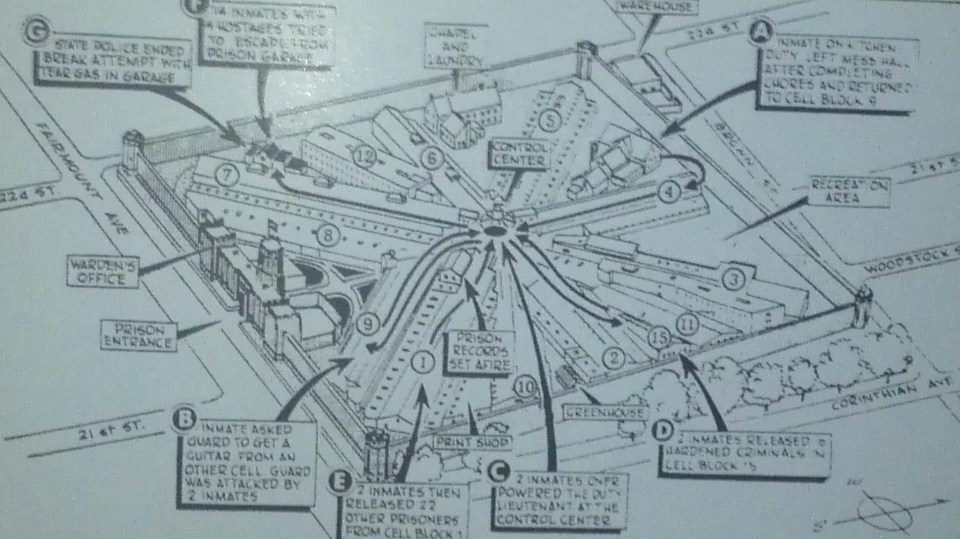
This is an institution designed to resolve a particular social problem; crime and indeed deter others from engaging in similar behaviour through humane and philosophically driven measures. The Philadelphia Society for Alleviating the Miseries of Public Prisons* was philanthropic and guided by religious principles. This is reflected in the term penitentiary; a place for sinners to repent and In turn become truly penitent.
This philosophy was distinct and radical with a focus on reformation of character rather than brutal physical punishment. Of course, scholars such as Ignatieff and Foucault have drawn attention to the inhumanity of such a regime, whether deliberate or unintentional, but that should not detract from its groundbreaking history. What is important, as criminologists, is to recognise ESP’s place in the history of penology. That history is one of coercion, pleading, physical and mental brutality and still permeates all aspects of incarceration in the twenty-first century. ESP have tried extremely hard to demonstrate this continuum of punishment, acknowledging its place among many other institutions both home and abroad.
For me the question remains; can we make an individual change their behaviour through the pains of incarceration? I have argued previously in this blog in relation to Conscientious Objectors, that all the evidence suggests we cannot. ESP, as daunting as it may have been in its heyday, would also seem to offer the same answer. Until society recognises the harm and futility of incarceration it is unlikely that penal reform, let alone abolition, will gain traction.
*For those studying CRI1007 it is worth noting the role of Benjamin Rush in this organisation.
Share this:


“Letters from America”: I

This weekend @manosdaskalou and I flew from London to the USA and thus had the opportunity of experiencing two different airports. Travelling is always an insightful – if sometimes physically draining – experience and even more so when crossing continents. It is striking that one of the very first things that you confront upon arriving at your destination (no matter whether home or abroad) is generally a very long queue. There are queues to check in, queues to drop bags, queues for security, queues to get on the plane and to get off the other end. These are followed by yet more queues to enter the country and a wait to collect your bags. All of this is par for the course and perhaps to be expected given the volume of people travelling. What is perhaps more unexpected is the overall patience demonstrated by those in the seemingly endless queues.
I find the airport an interesting no-man’s land where individuals appear to become simply part of a giant machine. Once inside the airport you become subject to the whims and vagaries of the machinery. “Take off your shoes”, “take off your coats, jackets, scarves”, “laptops here”, “bags there’ ,”show your clear plastic bag containing approved liquids”, the list goes on and that’s before you’ve even let the country. If we want to fly we accept these rituals as a price worth paying. However, it is worth considering if many would tolerate such rituals away from this setting?
All of these processes are predicated on an ethos of security and the protection of life and limb. However, we do not insist on such protocols when we use other forms of transport; buses, trains, trams or the tube where similar conditions prevail (i.e.lots of people, baggage etc. moving from place to place. The tactics used in the airport are far more reminiscent of the police station or the prison than they are of travel yet we simply grit our teeth and bear the incongruity and indignity of the situation.
Whilst not suggesting that security is unimportant, it is worth considering that we focus far greater attention on flying than we do on other modes of transport. Of course, for those who fly infrequently this can be absorbed as a part of their travelling experience as predictable as a trip to the duty free shop. On a daily basis, as part of the 9-5 commute, such tactics would bring the world to a grinding halt…
Share this:


Do you consent to read on?

The more eagle-eyed amongst you may have spotted that @manosdaskalou and I are due to present during ‘I Heart Consent’ Week (still plenty of time to book a space!). The topic – ‘Consent in the Classroom’ is one that is close to our hearts and something we have discussed in different environments with different people. In this week’s entry I want to consider why the subject of consent is particularly important for criminologists.
An obvious area to start is research; ethics are fundamental to all of the projects we do from undergraduate all the way through to seasoned academic. Discussions around ensuring participants are able to fully engage in the process of gaining informed consent are imperative. At times this may be viewed as procedural; simply going through the motions but given the sensitivity of much criminological research it has a primacy and an urgency necessary to avoid harm.
The last few weeks have seen a flurry of accusations directed at Hollywood’s “finest” (cf. Harvey Weinstein, Kevin Spacey, Ed Westwick et al.) and government ministers and MPs (cf. Michael Fallon, Stephen Crabb, Kelvin Hopkins et al.). These often, light on factual evidence and heavy on prurient judgement, throw the spotlight once more on the issue of sexual consent. These cases are concerning on many levels and it is apparent from much of the discussion which often ensues whether on television, radio, in the newspapers or on social media, that many people are confused around the very nature of consent. Attempts have been made to counteract these lack of knowledge, often in creative ways; for example ‘Consent: It’s as simple as tea’ but looking at many of the comments, there is still a great deal of work to do. There are also wider issues in relation to consent; the absence of the victims’ consent to have their information paraded to feed the public’s desire for detail Likewise, the nature of summary justice being dispensed (e.g. expulsion from organisations, cancellation of contracts and resignations) deprives suspects of their right to defend themselves in court; there is no option for those suspected to opt for a trial by media.
Notwithstanding, the imperative to understand sexual consent, for Criminology, there is a further complication. When much, if not all crime, criminality and criminal justice, is predicated on the absence of consent, the issue becomes even more tenacious. If we consider that victims don’t consent, offenders may not consent to what ensues; certainly the criminal justice system’s [CJS] apparatus deliberately and meticulously removes consent throughout the process. Even when it comes to the professionals who work within the CJS, they may not consent, rather they are obeying guidance/policy/instructions/orders (delete as appropriate). After all, it cannot be consent if derived at the barrel of a gun, or in a police interview suite or a prison cell or when the economic situation is so bleak you are terrified of losing your job. When there is no room for manoeuvre, there can be no consent. Institutions and individuals may decide that this is a necessary price to pay in respect of crime and punishment, but that decision should never be taken without reflection.
All of the above shows the importance of consent, not only between the sheets, but in all aspects of criminology. Whatever side of criminal justice you might find yourself on, an understanding of consent is essential.
Share this:


Reading is dead, long live the book

The first week of teaching is always a bit of a culture shock. The transition at the end of term from teaching to other activities and vice versa marks a change of tempo and a change of focus. For me, the summer is a time of immersion in reading, thinking and writing. All of these activities continue throughout the year but far less intensively. It’s is perhaps ironic then, that this week’s blog post has left me struggling for ideas…
Previously, I have blogged about the stresses and strains of writing, so this week I thought I might turn my attention to reading; a far more pleasurable personal experience. The first questions is why read? The simple answer is to accumulate knowledge, to find the answer to a question and to educate and entertain. Arguably, all of these purposes can be achieved far more easily by looking on the internet, getting a quick (if not always correct) answer. Why bother learning things when the internet can provide information 24 hours a day? Furthermore, who can fail to find something to entertain and amuse on the television, in the cinema or on the internet? Perhaps the death knell for the old-fashioned art of reading books is sounding with increasing urgency and volume? I disagree!
I learnt to read at around the age of 5 and very quickly I was hooked. Throughout my childhood I was teased for my seeming inability to put a book down even with eating or walking. This never dissuaded me away from the book and even when that one was finished, there would always be another one to take its place. This reading “addiction” has never left me and has meant that I have been able to explore mythical places such as Eastasia, Erewhon, Gilead, Lilliput, Manderley, Narnia and Utopia and without even leaving my armchair. I have explored America, Australia, Botswana, Germany, India, the Netherlands and South Africa to a name a few, not to mention my home city, both over ground and underground. In my reading life, I have travelled on the Orient Express, fought in the American Civil War, WWI and WWII, hidden from Nazis, as well as served prison sentences in Reading Gaol and Robben Island. I have solved crimes with Mikael Blomkvist, Scout Finch, the Famous Five and Hercule Poirot. I have felt the pains of Lady MacBeth, Jane Eyre and the second Mrs de Winter, been left unmoved by Flora Poste and Jay Gatsby and felt terrorised with Joanna Eberhart, Offred and Gregor Samsa.
Whilst the above may illustrate my love of reading, it does not really explain why it is so important to me and my career. For one, it is the only activity that really holds my concentration, particularly for extended periods of time. In the twenty-first century, where life seems so fast-paced and we jump from screen to screen, triggered by notifications as if we are one of Pavlov’s dogs, such a skill requires protection and cultivation. Second, it is intensely independent and personal; I can share stories with others, I can even discuss books in detail, but my reading is my own. Thirdly, and probably the most important for criminology is the opportunity to try someone else’s life for size. The famous line from Harper Lee; that ; ‘[y]ou never really understand a person until you consider things from his point of view – until you climb into his skin and walk around in it’ sums this up beautifully (1960/2006: 30). By reading accounts of crime, criminality, victimisation and criminal justice; even if fictionalised, we have an opportunity to test out ideas, to find out how comfortable we are with responses, actions and penalties. In particular, dystopic novels offer the unique potential to imagine the world differently. Whilst on the surface such texts, as with criminology, are presented as negative; dealing with uncomfortable, frightening and disturbing behaviours and responses, they are ultimately full of hope. The potential for change is both explicit and implicit in dystopic fiction and criminology; all is never lost, hope remains no matter what.
If you still need to be persuaded by my argument for reading everything and anything that can get your hands on, perhaps Beccaria’s words of wisdom will help ‘I should have everything to fear, if tyrants were to read my book, but tyrants never read’ (1872: 18).
And after all, who wants to be a tyrant? Not me!
Beccaria, Cesare, (1872), An Essay on Crimes and Punishments, (Albany: W. C. Little Co.), [online]. Available from: http://oll.libertyfund.org/index.php?option=com_staticxt&staticfile=show.php%3Ftitle=2193&Itemid=27 [Last accessed 24 March 2012]
Lee, Harper, (1960/2006), To Kill A Mockingbird, (London: Arrow Books)
Share this:


The Criminology of the Future

As we are gleefully coming towards the start of yet another academic year, we tend to go through a number of perpetual motions; reflect on the year past, prepare material for the upcoming year and make adjustments on current educational expectations. Academics can be creatures of habit, even if their habit is to change things over. Nonetheless, there are always milestones that we all observe no matter the institution or discipline. The graduation, for example brings to an end the degree aspirations of a cohort, whilst Clearing and Welcome Week offer an opportunity of a new group of applicants to join a cohort and begin the process again. Academia like a pendulum swings constantly, replenishing itself with new generations of learners who carry with them the imprint of their social circumstance.
It was in the hectic days at Clearing that my mind began to wonder about the future of education and more importantly about criminology. A discipline that emerged at an unsettled time when urban life and modernity began to dominate the Western landscape. Young people (both in age and/or in spirit) began to question traditional notions about the establishment and its significance. The boundaries that protect the individual from the whim of the authorities was one of those fundamental concerns on criminological discourses. A 19th century colleague questions the notion of policing as an established institution, thus challenging its authority and necessity. An end of 20th century colleague may be involved in the training of those involved in policing. Changing times, arguably. Quite; but what is the implications for the discipline?
My random example can be challenged on many different fronts; the contested nature of a colleague as a singular entity that sees the world in a singular gaze; or the ability to diversify on the perspectives each discipline observes. It does nonetheless, raises a key question: what expectations can we place on the discipline for the 21st century.
If we and our students are the participants of social change as it happens in our society then our impressions and experiences can help us formulate a projective perspective of the future. Our knowledge of the past is key to supplying an understanding of what we have done before, so that we can comprehend the reality in a way that will allow us to give it the vocabulary it deserves. A colleague recently posted on twitter her agony about “vehicles being the new terrorist weapon,” asking what is the answer. The answer to violence is exactly the same; whether a person gets in a van, or goes home and uses a bread knife to harm their partner. Everyday objects that can be utilised to harm. A projection in the future could assert that this phenomenon is likely to continue. The Romans called it Alea iacta est and it was the moment you decide to act. In my heart this is precisely the debate about the future of criminology; is it crime with or without free will?

 Thoughts from the criminology team