
Home » Prison (Page 5)
Category Archives: Prison

Things I Miss: Small Pleasures – Helen

Small pleasures mean a lot, particularly at the moment when many normal pleasures are denied to us. If I can’t meet my friends, or go to restaurants, or engage in my hobbies at least I can enjoy a gin and tonic in the bath, or a nice dinner with an indulgent dessert (it is worrying how many such small pleasures involve food and alcohol!!). The lockdown hit halfway through Lent, when I was trying to exercise some self-discipline and lose a little weight, but having been forced to give up so much I could no longer do without chocolate and snacks! I am kept sane by daily walks around the village, appreciating (until today) the glorious spring weather and the emerging wild flowers and butterflies (six different species on our last long walk). And my husband and I distract ourselves with light-hearted TV. Friday Night Dinner and Britain’s Got Talent help to define the week and we’ve been working through old-favourite box sets of Phoenix Nights and I’m Alan Partridge.

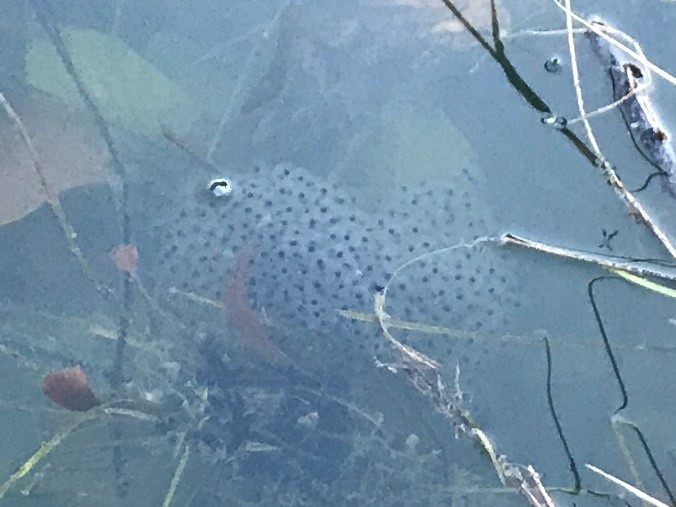
In some ways the first couple of weeks were the hardest, when the rules kept changing. After a trying morning shopping for three households in a supermarket with bare shelves, at least I could reward myself with a cappuccino on the way home (I couldn’t sit down, or use a re-usable cup, but I could get a disposable take-away). But then all the coffee shops closed. On the evening of the day the schools closed, we went for a family walk in our local forest. At least we could enjoy that. We found a pond full of frogspawn and toad spawn and took pictures, planning a science project on reproduction in amphibians. We would go back every week and check on the progress of the tadpoles. But then they closed the forest. Each new lockdown was a fresh loss.
In the “Good Lives Model” (Ward, 2002) Tony Ward and colleagues propose that all people try to achieve a set of fundamental “primary goods”. These are: life; knowledge; excellence in work; excellence in play; agency; inner peace; relatedness; community; spirituality; pleasure; and creativity. In lockdown, many of our usual means of achieving these goods are no longer accessible. However, there is evidence all around of people striving towards these goods in novel ways. The primary good “life” refers to health and fitness. We may no longer be able to go to gyms or practise team sports, but country roads are full of cyclists and walkers, solitary or in family groups, and there has been an explosion in people exercising at home, with or without the assistance of Joe Wicks! My son, who is a junior sailor, is achieving his “excellence in play” through “Virtual Regatta”, a computer game which adheres to the principles of dinghy sailing and which has provided the platform through which competitions that should have taken place can continue after a fashion.

Our local vicar is in his element providing novel ways through which his flock can achieve “spirituality”: services live-streamed from his dining room; virtual coffee mornings; resources to use at home. I’ve outlined above some of the ways in which I am achieving “pleasure” in small ways. I’m sure the current shortages in flour are caused in some part by an increase in people achieving “creativity” through baking. My son alone has clocked up two different types of pastry, two different types of scone, two fruit crumbles, shortbread and a Simnel cake since the lockdown began! We achieve “relatedness” through Zoom and Skype and Facetime: I speak to my parents much more often than I did before the crisis and my husband replaces visits to the pub with his father and brother with a weekly “virtual pint night”. And we achieve “community” through standing together on our doorsteps every Thursday at 8pm to clap for the NHS.

The Good Lives Model was developed to understand and improve the rehabilitation of offenders. It proposes that offenders are trying to achieve the same primary goods as everyone else, but lack the skills, opportunities or resources to do so in pro-social ways. They therefore pursue their goods through methods which are illegal or harmful. Traditional approaches to working with offenders have been risk-focussed, analysing their past mistakes and telling them what they mustn’t do in the future. The Good Lives Model points us towards strengths-based and future-focussed interventions, whereby offenders identify new, prosocial ways of achieving their primary goods and are equipped with the skills to do so. The focus is on building a new “good life”, with the emphasis on what they can do rather than what they can’t.
It seems trite to compare life in lockdown to life in prison (although Jonathan Freedland in last Saturday’s Guardian references ex-prisoner Erwin James who believes the parallels are strong). There are, however, some similarities to life on probation supervision or parole licence. I can’t pretend to understand how it feels to live subject to licence conditions whereby even a minor breach could result in imprisonment. But in the current situation, I have a little insight into how it feels to live according to strict rules designed to minimise risk to myself and others; rules which are frustrating but for the common good; rules which tell me what I can’t do and where I can’t go; rules which sometimes change and goalposts which sometimes move. In this climate, as described above, small pleasures are important and it is essential to find new ways of achieving and maintaining primary goods. Lockdown has given me a fresh appreciation of Good Lives and, I hope, a deeper understanding of the impact of the decisions I make and the conditions I impose.
Helen Trinder
Associate Lecturer in Criminology at the University of Northampton and Psychologist Member of The Parole Board for England and Wales
References
Freedland, J. Adjust your clocks, lockdown is bending time completely out of shape. The Guardian, 25th April 2020.
Ward, T. (2002). The management of risk and the design of good lives. Australian Psychologist, 37, 172-179.
Share this:


That old familiar feeling

It would seem it’s human nature to seek out similarities in times of uncertainty. An indication that someone somewhere has experience they can share. Some sort of wisdom they can provide or at the very least a recognisable element that can somehow be interpreted to give an indication, that when it happened before everything turned out ok in the end. With the current world pandemic leaving so much free time to think and observe what is going on, one has to wonder at some point if the differences should be a more prominent focus point.
Historically world pandemics are not new. The plague, small pox, Spanish flu, all form part of a collective historical account of the global devastating impacts a new disease has on mankind. I found myself re-reading The Plague (Camus, 1947/2002) and pondering the similarities. Self-isolation and whole town isolation, the socioeconomic impacts on the poor seeking employment, despite the risk to health these roles carried and the heart-breaking accounts of families unable to say goodbye to loved ones or bury the dead in a dignified, ordinary manner.
Early on politicians and media were quick to compare the pandemic with war. Provocative language became commonplace. Talk of fighting the invisible enemy in the new ‘war’, with the ‘frontline’ NHS staff our new heroes giving the country hope we could win. It came as no surprise to wake one morning and see ‘memes’ shared on social media portraying Boris Johnson as the new Churchill.
Media quickly changed. Suddenly films which dramatised pandemics grew in popularity. These fictitious accounts of how the world would respond, the mistakes which would be made and the varying outcomes individual responses towards official advice would have on their chances of survival. Even I have to admit a scene from Contagion discussing the use of hand washing and refraining from touching your face seemed to echo government advice. Fortunately, the scenes of supermarket looting were overdramatic but the empty supermarket shelves and panic buying hysteria was all the same.
There were however, some comparisons made, which haunted me. I’m sure everyone has their own reasons for finding distaste and maybe mine were unique to me. A combination of my academic knowledge and background mixed amongst my own personal views and current situation. As a mother of three, I had suddenly become a teacher with the closure of schools. My recent master’s degree in education fortunately allowed me a basic, self-researched understanding of mainstream education and home education methods.
I watched as friends and family members concerns grew about how they as parents could provide an education. Initially most looked-for similarities once again. Similar timetables to school, similar methods of teaching, trying as a parent to morph into a similar role their children’s teacher has. I think most parents felt overwhelmed quite early on. Many most likely still do, because the thing is, home education is not comparable to mainstream education in many ways at all. That’s not to say one is superior, this is certainly not my opinion. Quite simply, they’re fundamentally different approaches.
I often find myself throughout my academic journey looking for comparison with concepts and areas in which I’m familiar. My undergrad in law and criminology makes occasional appearance in most of my writing, perhaps more often than not, in fact, I used my continued interest in criminological and legal concepts to make my education MA my own. Further reinforcing the idea, familiarity provides some sort of comfort as we enter something unknown.
One comparison which deeply worried me that finds its roots in criminological concepts, is those who have compared self-isolation with prison. Having experienced a long, heated debate previously following a comment I made displaying my disgust for the re-introduction of the death penalty, it seemed futile to raise the issues with this in the only social environment I had access to currently, social media. I remain hopeful, most criminologists recognise the obvious differences between the two.
In the end when we look back at this moment in history, there will no doubt be many more comparisons made. We often look to history to learn lessons and I’m not sure we can do that without recognising some sort of parallels with the situation. Whether that be for comfort, guidance, information or to learn, entirely depends on the individual. I will leave you with a quote of something I heard a few days ago which has stuck with me and provided inspiration for this writing…
“History doesn’t repeat itself but it often rhymes”
With that in mind, I would suggest we take comfort in the familiarity of similar situations, that this pandemic won’t last forever, but the difference it may make on our lives will always be our personal experiences. When we look back and search for comparison of life during the pandemic and life afterwards, we may well appreciate the experiences we once took for granted.
Reference
Camus, A (2002). The Plague. London: Penguin classics
Share this:


Within Grey Walls

“Waking up to gray walls and black bars…in the silence of ones own thoughts, leaves one to a feeling of somberness…as those around begin to stir and began their individual day, hope creeps into ones mind….as the discussions regarding legal strategies began, hope then becomes more than just a shadow…as guys began to discuss their potential future beyond prison and being locked in a cell for days at a time, hope becomes more than just a fleeting moment! Silence can sometimes be ones own enemy on death row:-…So I condition myself to discover the “why” I fight through the fits of depression and despair, instead of focusing on the “how’s”….because pursuit of the “why’s” bring about methods of finding a solution….encouragement to remain hopeful!”
Everyone has the right to life, liberty and security of person (1).
Without the right to life, we cannot enjoy the freedoms set forth in the Universal Declaration of Human Rights.
However, what if one’s life was imprisoned and waiting to be ended for crime? In addition, what if a person was to be put to death for associating with a particular demographic?
The death penalty is the authorization of the state to kill a citizen for a crime, whether it’s murder, rape, treason, or more severe crimes, such as crimes against humanity and genocide (2).
Whilst the death penalty can be a deterrent, provide justice, and be the ultimate punishment for a crime and justice for victims, it is also used in some countries to persecute minority groups, such as the LGBT community (3) (4). (In references, there is a link to an interactive map of countries that utilize the death penalty for LGBT groups).
According to the Death Penalty Information Centre (DPIC), around 82% of cases involving capital punishment, race was a determining factor of giving this punishment, in comparison to white counterparts (5). However, the justice system is far from perfect, and miscarriages of justice occur. Due to issues of racism and racial bias (particularly within the American Justice System), this has seen members of minority groups and innocent people put on death row whilst a criminal still walks free. A damning example of a miscarriage of justice, and a clear demonstration of racism, is the case of George Stinney, whom, at the age of 14, was wrongly accused of murdering 2 girls. He was taken to court, tried by an all white jury, and was given the electric chair (6).
This, ultimately, is the state failing to protect its citizens, and causing irreparable damage to others. The George Stinney case is a condemnatory example of this. On top of that, it is hard to measure deterrence, and whether capital punishment actually deters people from committing crime.
However, what is it actually like being on death row?
June 2017 saw the start of a new friendship – a unique friendship. What simply started out with me wanting to reach out and be a ray of light to someone on death row, turned into a wonderful experience of sharing, support and immeasurable beauty. In June 2017, I began writing to a man on death row, and simply wanted to be a ray of light to someone in a dark place.
He has shared some of his thoughts of what it is like to be on death row:
“Perseverance. This is key when facing a day in prison (physically and mentally) because is never “where” you are physically, but your ability and willingness took push through those times of adversity and overcome the very things that have the power to bring you down….such as evil”. BUT- when we examine the word “evil” look closely…. Do you see it yet? ….. It’s “LIVE” backwards and to me its when we lose our patience to “LIVE” that we have brushes with “evil”…no???? So within these walls I do my best to find the “silver lining” and develop the better aspects of me”.
Now, it may seem effortlessly -but- in all honestly….its very difficult to face each day with the uncertainty of knowing whether the presence I have is one that has significance….in here I have to prepare myself on a constant basis in order to be the best version of myself no matter what lays ahead.
Thankfully….I have met an incredible person, who guides me by way of her words…offers me comforts by way of her thoughts and prayer and encourages me through her never ending presence! She is beautiful in every aspect of the word…She has helped me to discover that EVERYTHING and NOTHING awaits beyond forever!
References
(1) Universal Declaration of Human Rights (UNDH) Article 1 Available online at: https://www.un.org/en/universal-declaration-human-rights/ Accessed on 21/01/2020
(2) Louise Gaille ’15 Biggest Capitol Pros and Cons’ Available online at: https://vittana.org/15-biggest-capital-punishment-pros-and-cons Accessed on 24/03/2020
(3) The Human Dignity Trust ‘Saudi Arabia: Types of Criminalisation’ Available online at: https://www.humandignitytrust.org/country-profile/saudi-arabia/ Accessed on 24/03/2020
(4) Death Penalty Information Centre ‘Executions By Race and Race of Victim’ Available online at: https://deathpenaltyinfo.org/executions/executions-overview/executions-by-race-and-race-of-victim
(5) Ibid
(6) Snopes Fact Check ‘Did South Carolina Execute 14-year-old George Stinney, then declare him innocent 70 years later?’ Available online at: https://www.snopes.com/fact-check/george-stinney-execution-exoneration/ Accessed on 24/03/2020
Other
Interactive map of countries where the death penalty is used against the LGBT community: https://www.humandignitytrust.org/lgbt-the-law/map-of-criminalisation/?type_filter=crim_gender_exp
Human Writes: https://www.humanwrites.org
Share this:


“TW3” in Criminology
In the 1960s, or so I am told, there was a very popular weekly television programme called That Was The Week That Was, informally known as TW3. This satirical programme reflected on events of the week that had just gone, through commentary, comedy and music. Although the programme ended before I was born, it’s always struck me as a nice way to end the week and I plan to (very loosely) follow that idea here.
This week was particularly hectic in Criminology, here are just some of the highlights. On Monday, I was interviewed by a college student for their journalism project, a rather surreal experience, after all, ‘Who cares what I think?’
On Tuesday, @manosdaskalou and I, together with a group of enthusiastic third years, visited the Supreme Court in London. This trip enabled a discussion which sought to unpack the issue of diversity (or rather the lack of) within justice. Students and staff discussed a variety of ideas to work out why so many white men are at the heart of justice decisions. A difficult challenge at the best of times but given a new and urgent impetus when sat in a courtroom. It is difficult, if not impossible, to remain objective and impartial when confronted with the evidence of 12 Supreme Judges, only two of which are women, and all are white. Arguments around the supposed representativeness of justice, falter when the evidence is so very stark. Furthermore, with the educational information provided by our tour guide, it becomes obvious that there are many barriers for those who are neither white nor male to make their way through the legal ranks.

Wednesday saw the culmination of Beyond Justice, a module focused on social justice and taught entirely in prison. As in previous years, we have a small ceremony with certificate presentation for all students. This involves quite a cast, including various dignitaries, as well as all the students and their friends and family. This is always a bittersweet event, part celebration, part goodbye. Over the months, the prison classroom leaves its oppressive carceral environment behind, instead providing an intense and profound tight-knit learning community. No doubt @manosdaskalou and I will return to the prison, but that tight-knit community has now dissipated in time and space.

On Thursday, a similarly bitter-sweet experience was my last focused session this year on CRI3003 Violence: From Domestic to Institutional. Since October, the class has discussed many different topics relating to institutional violence focused on different cases including the deaths of Victoria Climbié, Blair Peach, Jean Charles de Menezes, as well as the horror of Grenfell. We have welcomed guest speakers from social work, policing and the fire service. Discussions have been mature, informed and extremely sensitive and again a real sense of a learning community has ensued. It’s also been my first experience of teaching an all-female cohort which has informed the discussion in a variety of meaningful ways. Although I haven’t abandoned the class, colleagues @manosdaskalou and @jesjames50 will take the reins for a while and focus on exploring interpersonal violence. I’ll be back before the end of the academic year so we can reflect together on our understanding of the complexity of violence.
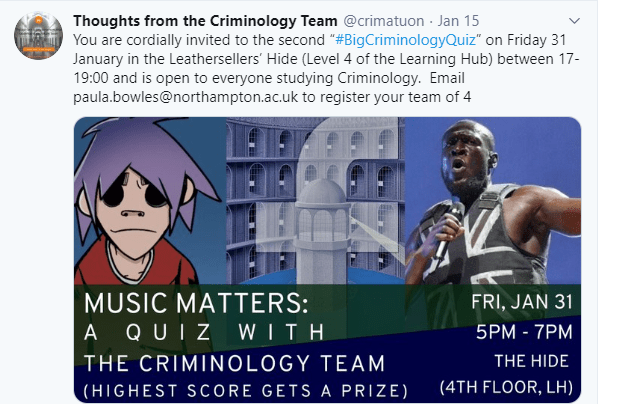
Finally, Friday saw the second ever #BigCriminologyQuiz and the first of the new decade. At the end of the first one, the participants requested that the next one be based on criminology and music. Challenge completed with help from @manosdaskalou, @treventoursu, @svr2727, @5teveh and @jesjames50. This week’s teams have requested a film/tv theme for the next quiz so we’ll definitely have our work cut out! But it’s amazing to see how much criminological knowledge can be shared, even when you’re eating snacks and laughing. [i]
So, what can I take from my criminological week:
- Some of the best criminological discussions happen when people are relaxed
- Getting out of the classroom enables and empowers different voices to be heard
- Getting out of the classroom allows people to focus on each and share their knowledge, recognising that
- A classroom is not four walls within a university, but can be anywhere (a coach, a courtroom a prison, or even the pub!)
- A new environment and a new experience opens the way for discord and dissent, always a necessity for profound discussion within Criminology
- When you open your eyes and your mind you start to see the world very differently
- It is possible (if you try very hard) to ignore the reality of Friday 31 January 23:00 ☹
- It is possible to be an academic, tour guide, mistress of ceremonies and quiz mistress, all in the same week!
Here’s looking forward to next week….not least Thursday’s Changemaker Awards where I seem to have scored a nomination with my #PartnerinCriminology @manosdaskalou.
[i] The first quiz was won by a team made up of 1st and 2nd years. This week’s quiz was won by a group of third years. The next promises to be a battle royale 😊 These quizzes have exposed, just how competitive criminologists can be….
Share this:


20 years of Criminology

It was at the start of a new millennium that people worried about what the so-called millennium will do to our lives. The fear was that the bug will usher a new dark age where technology will be lost. Whilst the impending Armageddon never happened, the University College Northampton, as the University of Northampton was called then, was preparing to welcome the first cohort of Criminology students.
The first cohort of students joined us in September 2000 and since then 20 years of cohorts have joined since. During these years we have seen the rise of University fees, the expansion of the internet and google search and of course the emergence of social media. The original award was focused on sociolegal aspects, predominantly the sociology of deviance, whilst in the years since the changes demonstrate the departmental and the disciplinary changes that have happened.
Early on, as criminology was beginning to find its voice institutionally, the team developed two rules that have since defined the focus of the discipline. The first is that the subject will be taught in a multi-disciplinary approach, widely inclusive of all the main disciplines involved in the study of crime; so alongside sociology, you will find psychology, law, history, philosophy to name but a few. The impetus was to present these disciplines on an equal footing and providing opportunity to those joining the course, to discover their own voice in criminology. The second rule was to give the students the opportunity to explore contentious topics and draw their own perspective. Since the first year of running it, these rules have become the bedrock of UoN Criminology.
The course since the early years has grown and gone through all those developmental stages, childhood, adolescence and now eventually we have reached adulthood. During these stages, we managed to forge a distinctiveness of what criminology looks like; introducing for example a research placement to allow the students to explore the theory in practice. In later years we created courses that reflect Criminology in the 21st Century always relating to the big questions and forever arming learners with the skills to ask the impossible questions.
Through all these years students join with an interest in studying crime and by the time they leave us, to move onto the next chapter of their lives, they have become hard core criminologists. This is always something that we consider one of the course’s greatest contribution to the local community.
In an ordinary day, like any other day in the local court one may see an usher, next to a probation officer, next to a police officer, next to a drugs rehabilitation officer, all of them our graduates making up the local criminal justice system. A demonstration of the reach and the importance of the university as an institution and the services it provides to the local community. More recently we developed a module that we teach in prison comprised by university and prison students. This is a clear sign of the maturity and the journey we have done so far…
As the 21st century entered, twin towers fell, bus and tube trains exploded, consequent wars were made, riots in the capital, the banking crisis, the austerity, bridge attacks, Brexit, extinction rebellion, buildings burning, planes coming down, forest fires and #metoo, and we just barely cover 20 years. These and many more events keep criminological discourse relevant, increase the profile of the subject and most importantly further the conversation we are having in our society as to where we are heading.
As I raise my glass to salute the first 20 years of Criminology at the University of Northampton, I am confident that the next 20 years will be even more exciting. For those who have been with us so far a massive thank you, for those to come we are looking forward to discussing some of the many issues with you. We are passionate about criminology and we want you to infect you with our passion.
As they say in prison, the first 20 years are difficult the rest you just glide through…
Share this:


Empathy Amid the “Fake Tales of San Francisco”*

This time last week, @manosdaskalou and I were in San Francisco at the American Society of Criminology’s conference. This four-day meeting takes place once a year and encompasses a huge range of talkers and subjects, demonstrating the diversity of the discipline. Each day there are multiple sessions scheduled, making it incredibly difficult to choose which ones you want to attend.
Fortunately, this year both of our two papers were presented on the first day of the conference, which took some of the pressure off. We were then able to concentrate on other presenters’ work. Throughout discussions around teaching in prison, gun violence and many other matters of criminological importance, there was a sense of camaraderie, a shared passion to understand and in turn, change the world for the better. All of these discussions took place in a grand hotel, with cafes, bars and restaurants, to enable the conversation to continue long after the scheduled sessions had finished.
Outside of the hotel, there is plenty to see. San Francisco is an interesting city, famous for its Golden Gate Bridge, the cable cars which run up and down extraordinarily steep roads and of course, criminologically speaking, Alcatraz prison. In addition, it is renowned for its expensive designer shops, restaurants, bars and hotels. But as @haleysread has noted before, this is a city where you do not have to look far to find real deprivation.
I was last in San Francisco in 2014. At that point cannabis had been declassified from a misdemeanour to an infraction, making the use of the drug similar to a traffic offence. In 2016, cannabis was completely decriminalised for recreational use. For many criminologists, such decriminalisation is a positive step, marking a change from viewing drug use as a criminal justice problem, to one of public health. Certainly, it’s a position that I would generally subscribe to, not least as part of a process necessary to prison abolition. However, what do we really know about the effects of cannabis? I am sure my colleague @michellejolleynorthamptonacuk could offer some insight into the latest research around cannabis use.
When a substance is illegal, it is exceedingly challenging to research either its harms or its benefits. What we know, in the main, is based upon problematic drug use, those individuals who come to the attention of either the CJS or the NHS. Those with the means to sustain a drug habit need not buy their supplies openly on the street, where the risk of being caught is far higher. Thus our research population are selected by bad luck, either they are caught or they suffer ill-effects either with their physical or mental health.
The smell of cannabis in San Francisco is a constant, but there is also another aroma, which wasn’t present five years ago. That smell is urine. Furthermore, it has been well documented, that not only are the streets and highways of San Francisco becoming public urinals, there are also many reports that public defecation is an increasing issue for the city. Now I don’t want to be so bold as to say that the decriminalisation of cannabis is the cause of this public effluence, however, San Francisco does raise some questions.
- Does cannabis cause or exacerbate mental health problems?
- Does cannabis lead to a loss of inhibition, so much so that the social conventions around urination and defecation are abandoned?
- Does cannabis lead to an increase in homelessness?
- Does cannabis increase the likelihood of social problems?
- Does the decriminalisation of cannabis, lead to less tolerance of social problems?
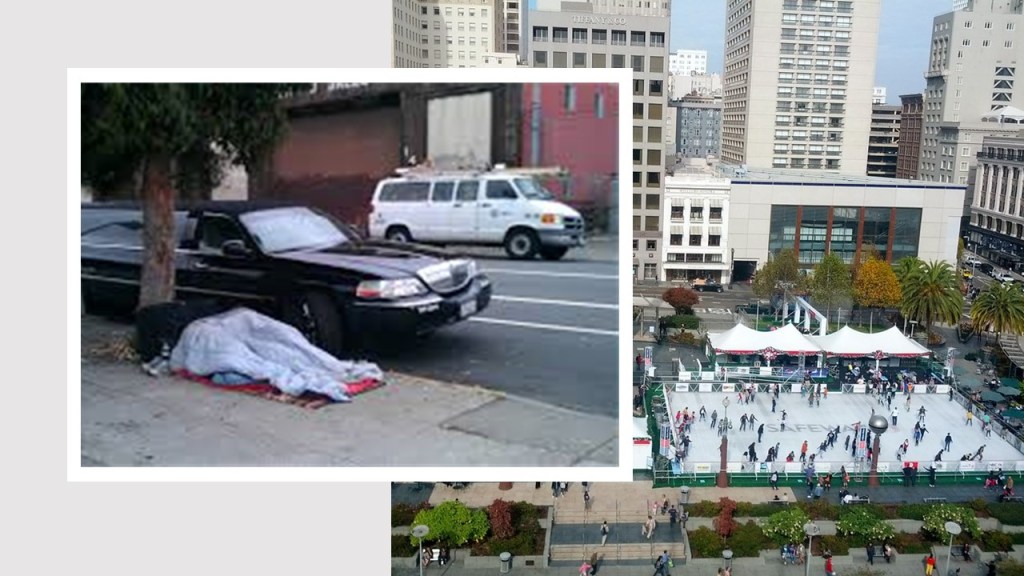
I don’t have any of the answers, but it is extremely difficult to ignore these problems. The juxtaposition of expensive shops such as Rolex and Tiffany just round the corner from large groups of confused, homeless people, make it impossible to avoid seeing the social problems confronted by this city. Of course, poor mental health and homelessness are not unique to San Francisco or even the USA, we have similar issues in our own town, regardless of the legal status of cannabis. Certainly the issue of access to bathroom facilities is pressing; should access to public toilets be a right or a privilege? This, also appears to be a public health, rather than CJS problem, although those observing or policing such behaviour, may argue differently.
Ultimately, as @haleysread found, San Francisco remains a City of Contrast, where the very rich and the very poor rub shoulders. Unless, society begins to think a little more about people and a little less about business, it seems inevitable that individuals will continue to live, eat, urinate and defection and ultimately, die upon the streets. It is not enough to discuss empathy in a conference, no matter how important that might be, if we don’t also empathise with people whose lives are in tatters.
*Turner, Alex, (2006), Fake Tales of San Francisco, [CD]. Recorded by Arctic Monkeys in Whatever People Say I Am, That’s What I’m Not, The Chapel: Domino Records
Share this:


Care Leavers, Criminal Justice and Higher Education

“These children are in our care; we, the state, are their parents- and what are we setting them up for…the dole, the streets, an early grave? I tell you: this shames our country and we will put it right.”
David Cameron MP, Prime Minister October 2015 at the Conservative Party Conference.
Well, I think it would be fair to say that politicians’ minds have not been exercised unduly over the fate of care leavers since David Cameron made the above promise in 2015. I worked with children in care and care leavers involved in the youth justice system for over thirty years and although his analysis of the outcomes for care leavers was simplistic and crude, tragically Cameron’s statement rings true for many of those leaving care.
With regard to the criminal justice system, Lord Laming’s independent review “In Care, Out of Trouble” http://www.prisonreformtrust.org.uk/Portals/0/Documents/In%20care%20out%20of%20trouble%20summary.pdf, notes that there is no reliable data on the numbers of looked after children in custody. However, based on data from a number of sources, the review came to the conclusion that around 400 looked after children are in custody at any one time. The total number of children in custody for July 2019 is 817. So, slightly less than half of those children in custody are looked after children according to the best estimates available, drawn from different sources. http://youthjusticeboard.newsweaver.co.uk/yots2/1g2x6m3h9q315chudc9elc?email=trueYJBulletin
Moving the spotlight, a huge 40% of care leavers are not engaged in Education, Training or Employment and only 6% of care leavers gain entry to university https://assets.publishing.service.gov.uk/government/uploads/system/uploads/attachment_data/file/464756/SFR34_2015_Text.pdf . This at a time when around 50% of children now have access to Higher Education and the opportunities that this can provide. Also, 20% of young people who are homeless have previously been in care.
Naturally, we have to be careful to provide a level of balance to the above rather desperate and shocking figures. Lord Laming’s review found that 94% of children in care did not get in trouble with the law. However, children in care are six times more likely to be cautioned, or convicted of an offence than children in the wider population. Furthermore, children in care who come to police attention are more likely to be prosecuted and convicted than cautioned when compared to the wider child population.
So, what has happened since 2015 when David Cameron declared his intention to “put it right”? In truth, there have been some steps forward and these need to be celebrated and built upon. The Care Leaver Covenant, a promise made by private, public or voluntary organisations to provide support for care leavers aged 16-25 has meant the availability of employment opportunities for young care leavers in the Civil Service, local authorities and a range of private sector organisations. Closer to home, here at the University of Northampton, we have launched a new package of support for care leavers who want to study with us. The package offers the possibility, from 2020, of a fully funded place in our Halls of Residence for the first academic year, a contract which extends their accommodation lease to include the summer vacation. A block for many care leavers entering Higher Education is the very real issue of where to live at the end of the academic year, so this tries to address this issue. Another block experienced is financial hardship; the offer provides a non-means tested financial award of up to £1,500 per year to help with course and living costs, and this alongside the local authority’s statutory responsibility to support access to higher education may also help. We also have a designated member of support staff to provide advice and guidance. All these demonstrate our commitment to widening participation and encouraging ambition.
Of course, this is only part of the picture. Arguably, our engagement with young people in care needs to start shortly after their transition to secondary school. The wider social structures which perpetuate disadvantage and poverty will continue to challenge those who are children in care and leaving care. The “adverse childhood experiences” – a rather unedifying term for physical, sexual, and emotional abuse perpetrated by carers or parents-will still have an impact for this group and potentially impair their ability or commitment to study.
If however, I learnt anything from my years working with children in care and children leaving care, it is that you should not underestimate their ability to overcome the obstacles placed in their way. With the right support and a child centred approach, education can provide the right framework for opportunities. Victor Hugo famously said that if you open a school door, you close a prison. Let’s kick open the door of Higher Education a little wider and increase the life chances of these children in OUR care.
As a footnote, I should say that my mum was in care from the age of four until she was fifteen when she was adopted. I would therefore be happy to acknowledge that this has some influence on my perspective and my interest in this group of young people.
Dave Palmer Lecturer in Criminal Justice Services
Share this:


You can’t tell me what to do….
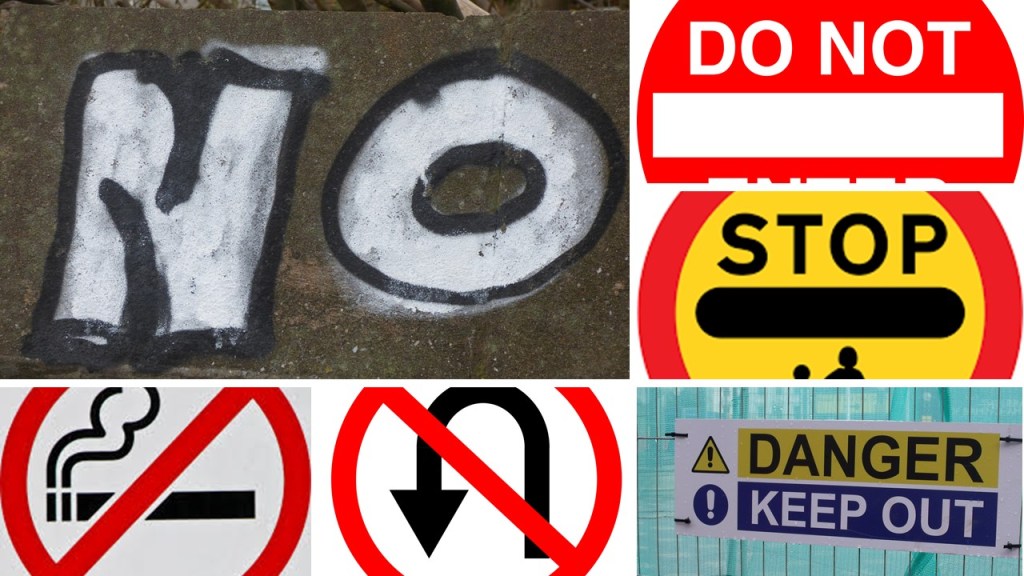
It seems that much criminological discussion centres on motivation. This ranges from focusing on the motivation to commit crime, the motivation to report victimisation, the motivation to work within the criminal justice system, all the way though to the motivation for punishment. In each of these circumstances, much is taken for granted, assumed and reacted to as if there were a consensus.
However, how much do we really know about motivation? To be sure, there are plenty of criminological theories focusing on individual explanations for criminality and deviance, particularly around psychopathy, personality and biology. Others, such as Classical theory assume that we are all the same, rational creatures motivated by the same factors. But take a moment and consider what motivates you? Are those factors positive or negative?
Let’s take the prison for example. According to some politicians, the media and other commentators, incarceration can punish and rehabilitate, frighten people out of crime whilst also empowering them to move away from crime. It offers an opportunity to desist from drug taking, whilst simultaneously enabling prisoners to develop a drug habit. Prison can offer a haven from social problems on the outside, whilst also creating a dangerous environment on the inside and these are just a few of the many pronouncements on the prison. Although oppositional, these differing narratives all indicate the prison as a place of change; transformation, the only difference is whether this is positive or negative, in essence does prison make people better or worse?
Considering much of the blog’s readership is focused on education, it might be useful to apply the prison experience to our own personal motivations. Would it be helpful to have someone constantly telling you what to do? Escorting you to and from the toilet, the classroom, the workplace? Controlling your every move? Deciding when and what you eat? Determining if you can access a shower, the library, the gym and so on? Passing judgement on who can visit you and when they can come? Would these “motivational” factors inspire you to study more? What if you were locked in a very small room (think student accommodation) for hour upon end, would your essays be any better?
For me personally, all of the above, would not motivate; they might frighten or even terrify me. They would allow me to feel resentful, bitter, alienated, perhaps even aggressive. Maybe I would become depressed, self-harm, or turn to drugs for consolation. Maybe, I could retreat into studying as release from an oppressive regime, but is that motivation? or escapism? or even institutionalisation?
I wonder, surely there must be far better, less harmful ways of tapping into motivation? By looking at our own experiences and considering what has motivated us in a positive way previously, we can begin to consider how we might motivate ourselves and others. Some of the motivational factors I can identify from my own life include, people who are prepared to listen to my ideas (good and bad) without interrupting, to guide (but not tell, never tell!) me to finding solutions to problems and to treat me with dignity and respect. Other examples, include introducing me to important literature, but not batting an eyelid when I excitedly tell them all about the content. Being there for me as a fellow human regardless of status (perceived or otherwise), when everything is a challenge, and I just want to vent and celebrating all successes (however tiny). These are just a few, personal reflections, but what they have in common, is the focus on another human who matters to you, who is cheering you on from the side-lines and is able to empathise and encourage. The other commonality, of course, is that these factors are not entrenched within the prison or the wider criminal justice system.[1]
Have a think for yourself and see if you can find anything currently within the prison or CJS that would motivate you! If it doesn’t, you need to question what it is the prison is actually trying to achieve.
[1] This does not preclude individual positive interpersonal relationships within the prison or CJS, but it is not a primary function of either.
Share this:


What the fluff

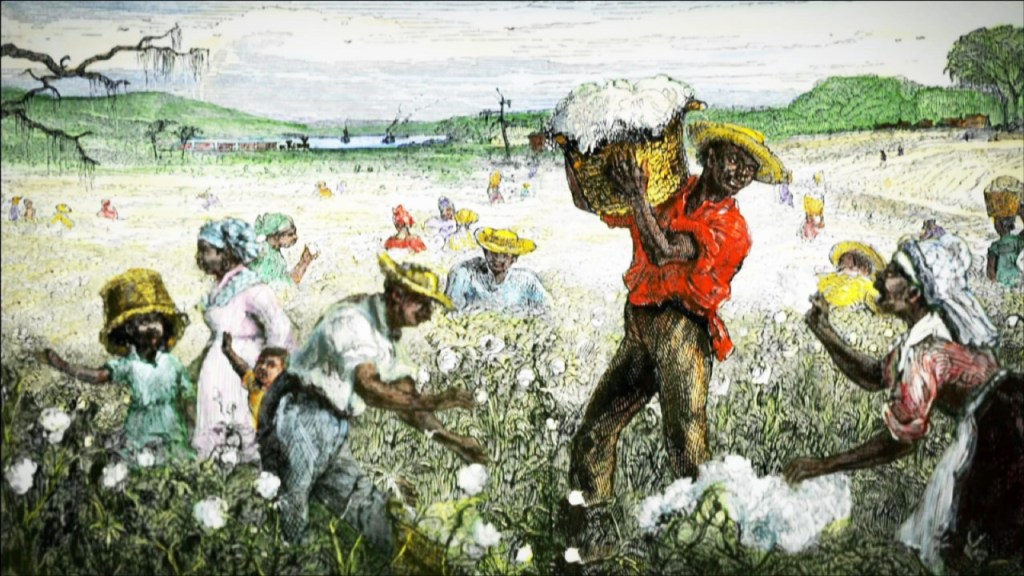
“History is not just stuff that happens by accident, we are the products of the history that our ancestors chose, if we are White. If we are Black we are products of the history our ancestors most likely didn’t choose.”
Kevin Gannon, 13th
And many of our cities in Britain are this melting pot due to the very same history our ancestors chose / didn’t choose; and the reason Britain has a variation of different faces is much to do (but not only) because of Britain’s colonial ambition.
Episode seven of the latest series of Who Do You Think You Are? was on TV entertainer Sharon Osbourne. Her family were victims of the Irish Potato Famine. Whilst the episode skirts over it, saying it occurred due to crop failures (with no real explanation), some would suggest that it was due to heavy-handed (British) colonial rule which assured those crop failures, leading to mass migration, starvation and death. For a show that is basically a series of history lectures, it does a good job of tiptoeing around uncomfortable (truths) bits of history.
As the late Jamaican philosopher and academic Stuart Hall said, “We are here because you were there” and we are now all here together, the products of our ancestors’ choices. I’ve been following this series of Who Do You Think You Are? with great interest and fascination. Almost every episode has had me hooked. And this latest episode with Sharon Osbourne was heartbreaking, with her great-grandmother Annie being the sole survivor of her six siblings, after disease and weakness took them.
The family emigrated to Massachusetts, USA in the mid-19th century and they worked in a cotton mill, the biggest in America and the second biggest in the world, only dwarfed by one in Manchester, Lancashire.
What irked me was the lack of contextual explanation around cotton during this time. Why wasn’t there any explanation regarding the history of cotton in the United States? Moreover, that relationship between American cotton and the mills of Lancashire and Cheshire (some 4500 mills in Lancashire and southern Scotland). What about the Industrial Revolution and how colonialism and the enslaved Black people that paid for it?
In a country still living in the aftermath of The Slave Trade, you cannot talk about cotton in America without talking about where the cotton came from. The same cotton made into cloth in Massachusetts would have came from cotton plantations, whether picked by African-Americans slaves (pre-1865) or “like-labour,” post-Civil War – since after abolition, the establishment entered into something called convict leasing. Prisoners loaned to plantation owners for a period, which (in itself) was legalised slavery. A loophole in the 13th Amendment stated that you could not be a slave, unless you were a criminal and imprisoned, thus America enters mass incarceration.
Black people in America were arrested for minor crimes like theft and vagrancy, and then imprisoned in mass. These prisoners were “rented” and put to work on plantations through the South – sugar, tobacco, cotton and more. The fact they didn’t feel the need to mention the context behind cotton in America is astounding, nor how the American cotton trade impacted Britain, for example the Lancashire Cotton Famine (1861 – 1865).

Yes, this episode is about Sharon Osbourne’s ancestors, but they were part of a longer story – a subtler history – the other half of cotton’s history that isn’t taught at school. And in places like Mississippi, where cotton was sailed down the Mississippi River by paddle steam, the local planters said:
“Cotton Is King.”
In Britain, we learn about spinning jennies. We learn about water frames and the Child Labour Act (1833), but not where cotton came from. This is American history and British history. It’s also working-class history. But in addition, it’s Black (British) history.
We are here because you were there; this is the history our ancestors chose, if you are White. But if you are Black, it’s the history your ancestors didn’t choose. And the least we can do is tell it right.
Bibliography
13th. Dir. Ava DuVernay. Netflix. 2016. Streaming platform.
Alexander, Michelle. The New Jim Crow. New York: The New Press, 2010. Print.
Olusoga, David. Black and British: A Forgotten History. London: Macmillan, 2016. Print.
Share this:


Empower like Michelle

If you go to Freshers’, you will probably think this is for White people. But you’ve got to occupy your space. Better get used to occupying your space now because you’ll have to fight wherever you go, university or otherwise. Don’t let that deter you from your goals but more vitally, don’t let anybody make you feel bad about yourself. Don’t be silent in the discussions on slavery or the prison system. Use your voice, a sonicboom in the seminar. Don’t be mute to appease the White fragility of your peers, or even your lecturers and personal academic tutors.

You worked hard to get here, so occupy your space. Fill these spaces with jollof rice and jerk chicken and calypso and steel drums – the guts, determination and sheer willpower your parents and grandparents had when they arrived all those years ago. Don’t ever feel that you have to dilute your opinions for White consumption, or tell bitesize histories for the masses. In that Business class, talk loud about the Cheshire and Lancashire cotton mills written in the blood of African-American slaves.
Students, you might get lecturers that call you angry, who will have a hard time coming to terms with their own prejudice and White privilege. You will see that within a few weeks of studying. But keep your head down and think about graduation. Come and speak to me at the Students’ Union if you have any worries or just want to vent. Sometimes it’s just about finding solace in someone that gets it. Cry into that cheeky Nando’s. Buy that weave. Write a damn good assignment and prove all the naysayers wrong.
You will also find lecturers that are willing to listen to your experiences of racism and prejudice. They will implore you to write a dissertation that’s personal to you. You will find lecturers that give a shit, and will stand by you to the very end – who will say it’s absolutely fine to lace your dissertation with personal history – roots, rocks, and rebellion – academic staff that are activists in their own right (but will never openly admit it!)
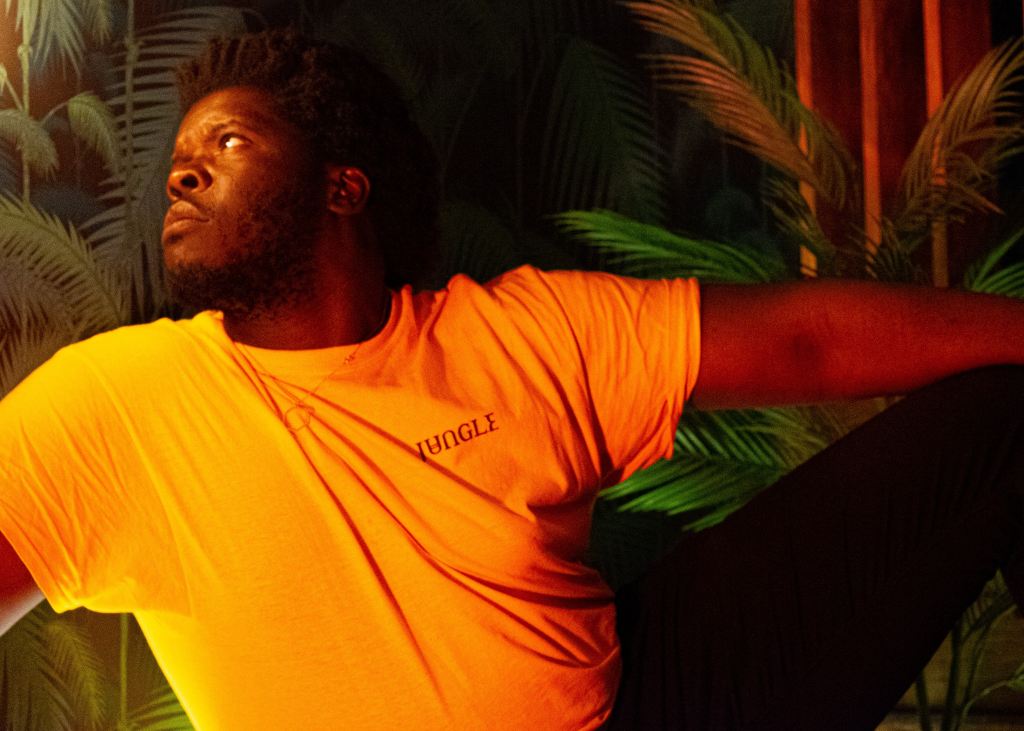
Write about the politics of Black hair. Write about the Windrush Scandal or the legacy of colonialism on the Black body, or even Black men and mental health. Write every assignment for your aunties, who live in headwraps, talking in Twi and give you sound advice. Write in ruthless rebellion to the White Eurocentric reading of your degree, break the colour bar in style!
You will likely not relate to your course content. You will find it reflects the experiences of White people. No Afropean stories. No love for Sarah Forbes on History, or the Slave Trade cases of the 1700s on Law – the cases that helped forge the legal profession into what it is today. Or even the racial theories of the 18th and 19th century that we living in the remnants of – not Edward Long’s History of Jamaica nor the Black writers that top bestsellers lists. Write about a decolonised curriculum and inclusive course content.
When your lecturers make no allusion to American Slavery when you study the Industrial Revolution, give them the evilest evils you can muster. And challenge them on it. Leave them shook. Educate your “woke” White friends on why this is important. And when it comes to race, don’t feel you need to talk about race just because you’re the only non-White person in the class.
When you come to university, you will feel the urge to be someone that you are not just to fit in. BE YOU. You will try studenty things. JUST DO YOU. You’ll go out drinking, even if you don’t normally drink. You will join every society at Union Day and your emails will be chocka block. You’ll change your accent and “be friends” with people you dislike to conform to social norms. You will then admit you hate going out out and prefer a good book, or one of my poetry nights or just a chat with good people in your halls.
Tell yourself “Black is beautiful.” You know it, I know it. But there are people out there that’ll try to make you feel bad about your culture, as is life. Come back to campus in January with that Angela Davis afro, or be a dreadlock rastaman. Play cricket, like Jofra Archer or play football like Raheem Sterling. And, your hair is not an exotic specimen to gawked at and touched like a museum exhibit. Remember, say no. No means no. Always.

Black students, walk with pride. YOU DO YOU. Be united. You’ll see quickly that there are forces that are waiting for you to make a mistake. To fail. To point the finger. You’ll see quickly that failure is racialised and that failure in a White person is not as bad. You’ll see that we live in a society that doesn’t include you in its definition of beauty standards. So girls, when someone says “You’re pretty for a dark-skinned girl,” pay them no mind. Find beauty in your melanin. Find your tribe. Sisterhood is paramount.
When someone asks “Where are you from?” – it’s fine to say London or Milton Keynes or any British town or city. You do not need to entertain them when they ask “Where are you really from?” You can be British and African. You can be British and Caribbean. You belong here. You can just be British. And that is also fine. Previously, you’d not have found events that represent Black people or felt inclusive. But my philosophy is “Black History Month is every month, 365 days a year.” October, November forever. See me!
Listen, you might be made to feel conscious of your otherness and not everyone will get your “I Am Proud of My Blackness” mentality. Not everyone will understand the nuanced politics of Blackness at Northampton. That even in inaction, the supposed “woke” White people are still complicit in racism. And remember it isn’t YOUR JOB to explain what is racist and what is not. Do not take on that emotional labour. You are not the mouthpiece for Black people, and you don’t have to be.
You will have days where you will say “I hate this town, I want to go home – there is no culture and nothing to do” but Northampton can work for you. There are other communities of African and Caribbean here where you will be welcomed with rice and stew. You will find family and community.

And you are not alone. There are a lot of us here. Build communities. Join the resident ACS (African-Caribbean Society). Empower yourselves. Come to see me, as your Student Union representative. Look after each other. Be good to yourselves and one another – and above all, enjoy it.
Yours,
Tré Ventour
Vice President BME
Northampton Students’ Union

 Thoughts from the criminology team