
Home » Power (Page 2)
Category Archives: Power

I’m not Black; my Friends and I are Brown, not Black

I recently began the process of preparing my child for the imminent transition to a new school situated in a diverse community. Despite being born into a similarly diverse environment, his early educational exposure occurred in an ethnically varied setting. Venturing into this new chapter within a racially diverse community has sparked a keen interest in him.
My child soon articulated a perspective that challenged conventional racial labels. He asserted that he and his friend Lucien are not accurately described as ‘black,’ rather he believes they are ‘brown.’ He went further to contest the classification of a lady on TV, who was singing the song “Ocean” by Hillsong, as ‘white.’ According to him, his skin is not black like the trousers he was wearing, and the lady is not white like the paper on my lap. This succinct but profound statement held more critical significance than numerous conversations I’ve encountered in my over five years of post-PhD lecturing.
The task at hand, guiding an under seven-year-old questioning the conventional colour-based categorisation, proved challenging. How do I convince an under seven-year-old that his knowledge of colours should be limited to abstract things and that persons with brown toned skin are ‘black’ while those with fair or light toned skinned are ‘white’? I found myself unprepared to initiate this complex conversation, but his persistent curiosity and incessant ‘why prompts’ compelled me to seek creative ways to address the matter. Even as I attempted to distract myself with a routine evening shower and dinner, my mind continued to grapple with the implications of our conversation.
Post-dinner, my attempt to engage in my usual political news catch-up led me to a YouTube vlog by Adeola titled ‘How I Almost Died!’ where she shared her pregnancy challenges. One statement she made struck a chord: ‘if you are a black woman and you are having a baby in America, please always advocate for yourself, don’t ever keep quiet, whatever you are feeling, keep saying it until they do something about it’ (18:39). This sentiment echoed similar experiences of tennis star Serena Williams, who faced negligence during childbirth in 2017.
The experiences of these popular ‘black’ women not only reminds me that the concept ‘black’ and ‘white’ are not only symbolic, but a tool for domination and oppression, and disadvantaging the one against the other. Drawing inspiration from Jay-Z’s ‘the story of O.J’, the song drew attention to the experiences of race, success, and the complexities of navigating the world as a ‘black’ individual. In the song, two themes stood out for me, the collective vulnerability to prejudice and the apparent bias in the criminal justice system towards ‘black’ people. In the UK, both proportional underrepresentation in staff number and proportional overrepresentation of minoritized groups in the criminal justice system and the consequences therefrom is still topical.
Jay-Z’s nuanced understanding of ‘black’ identity rejects simplistic narratives while emphasising its multifaceted nature. The verse, “O.J. ‘like I’m not black, I’m O.J.’ Okay” underscores the challenges even successful ‘black’ individuals face within racial systems. As criminologists, we recognize the reflection of these issues in daily experiences, prompting continuous self-reflexivity regarding our values, power positions, and how our scholarly practice addresses or perpetuates these concerns. Ultimately, the question persists: Can a post-racially biassed world or systems truly exist?
Share this:


Christmas Toys

In CRI3002 we reflected on the toxic masculine practices which are enacted in everyday life. Hegemonic masculinity promotes the ideology that the most respectable way of being ‘a man’ is to engage in masculine practices that maintain the White elite’s domination of marginalised people and nations. What is interesting is that in a world that continues to be incredibly violent, the toxicity of state-inflicted hegemonic masculinity is rarely mentioned.
The militaristic use of State violence in the form of the brutal destruction of people in the name of apparent ‘just’ conflicts is incredibly masculine. To illustrate, when it is perceived and constructed that a privileged position and nation is under threat, hegemonic masculinity would ensure that violent measures are used to combat this threat.
For some, life is so precious yet for others, life is so easily taken away. Whilst some have engaged in Christmas traditions of spending time with the family, opening presents and eating luxurious foods, some are experiencing horrors that should only ever be read in a dystopian novel.
Through privileged Christmas play-time with new toys like soldiers and weapons, masculine violence continues to be normalised. Whilst for some children, soldiers and weapons have caused them to be victims of wars with the most catastrophic consequences.
Even through children’s play-time the privileged have managed to promote everyday militarism for their own interests of power, money and domination. Those in the Global North are lead to believe that we should be proud of the army and how it protects ‘us’ by dominating ‘them’ (i.e., ‘others/lesser humans and nations’).
Still in 2023 children play with symbolically violent toys whilst not being socialised to question this. The militaristic toys are marketed to be fun and exciting – perhaps promoting apathy rather than empathy. If promoting apathy, how will the world ever change? Surely the privileged should be raising their children to be ashamed of the use of violence rather than be proud of it?
Share this:


Is the cost of living crisis just state inflicted violence

Back in November 2022, social media influencer Lydia Millen was seen to spark controversy on the popular app ‘TikTok’ when she claimed that her heating was broken, so she therefore was going to check into the Savoy in London.
Her video, which she filmed whilst wearing an outfit worth over £30,000, sparked outrage on the app and across popular social media platforms. People began to argue that her comment was not well received in our current social climate, where people have to choose whether they should spend money on heating or groceries. For many, no matter your financial situation, problems with heating rarely resorts in a luxury stay in London.
With pressure mounting, Lydia decided to reply to comments on her video. When one individual stated “My heating is off because I can’t afford to put it on”, Lydia replied “It’s honestly heart breaking I just hope you know that other people’s realities can be different and that’s not wrong”. Sorry, Lydia; it is wrong. Realities are not different; they are miles apart. This is clearly seen in the fact that the National Institute of Economic and Social Research estimate that 1.5 million households in the UK over the next year will be landed in poverty (NIESR, 2022).
Ultimately, this is a social issue. Like Lydia said, in a society in which individuals are stratified based on their economic, cultural and social capital, we are conditioned to believe that this is just the way it is, and therefore, it is not wrong that other people have different realities. However, for me, it is not ‘different realities’, it is a matter of being able to eat and be warm versus being able to stay in a luxury hotel in London.
So, why is this a criminological issue? The cost of living crisis is simply just state inflicted poverty. Alike to Lydia with her social following, the government have the power to make change and use their position in society to remedy cost of living issues, but they don’t. This is not a mark of their failure as a government, it is a mark of their success. You only have to look at the government’s complete denial surrounding social issues to realise that this was their plan all along, and the longer this denial continues, the longer they succeed. This is seen in the case of Lydia Millen, who has acted as a metaphor for the level of negligence in which the government exercises over its citizens. Ultimately, for Lydia, it is very easy to tuck yourself into a luxury bed in the Savoy and close the curtains on the real world. The people affected by the crisis are not people like Lydia Millen, they are everyday people who work 40+ hours a week, and still cannot make ends meet. For the government, the cost of living crisis is the perfect way to separate the wheat from the chaff.
Ultimately, the cost of living crisis is not too dissimilar to the strikes that the UK is currently experiencing. Alike to the strikes, the cost of living crisis was always going to happen at the hands of a negligent government. The only way we can begin to address this problem is by giving our support, by supporting strikes all across the country, and by standing up for what is right. After all, the powers in our country have shown that our needs as a society are not a priority, so it is time to support ourselves.
“Injustice anywhere is a threat to justice everywhere.” ― Martin Luther King Jr.
References:
National Institute of Economic and Social Research (2022) What Can Be Done About the Cost-of-Living Crisis? NIESR [online]. Available from: https://www.niesr.ac.uk/blog/what-can-be-done-about-the-cost-of-living-crisis [Accessed 23/01/23].
Share this:


‘Now is the winter of our discontent’

As I write this blog, we await the detail of what on earth government are going to do to prevent millions of our nations’ populations plummeting headlong into poverty. It is our nations in the plural because as it stands, we are a union of nations under the banner Great Britain; except that it doesn’t feel that great, does it?
As autumn begins and we move into winter we are seeing momentum gaining for mass strikes across various sectors somewhat reminiscent of the ‘winter of discontent’ in 1979. A few of us are old enough to remember the seventies with electricity blackouts and constant strikes and soaring inflation. Enter Margaret Thatcher with a landslide election victory in 1979. People had had enough of strikes, believing the rhetoric that the unions had brought the downfall of the nation. Few could have foreseen the misery and social discord the Thatcher government and subsequent governments were about to sow. Those governments sought to ensure that the unions would never be strong again, to ensure that working class people couldn’t rise up against their business masters and demand better working conditions and better pay. And so, in some bizarre ironic twist, we have a new prime minister who styles herself on Thatcher just as we enter a period of huge inflationary pressures on families many of whom are already on the breadline. It is no surprise that workers are voting to go on strike across a significant number of sectors, the wages just don’t pay the bills. Perhaps most surprising is the strike by barristers, those we wouldn’t consider working class. Jock Young was right, the middle classes are staring into the abyss. Not only that but their fears are now rapidly being realised.
I listened to a young Conservative member on the radio the other day extolling the virtues of Liz Truss and agreeing with the view that tax cuts were the way forward. Trickle down economics will make us all better off. It seems though that no matter what government is in power, I have yet to see very much trickle down to the poorer sectors of society or for that matter, anyone. The blame for the current economic state and the forthcoming recession it seems rests fairly on the shoulders of Vladimir Putin. Now I have no doubt that the invasion of Ukraine has unbalanced the world economic order but let’s be honest here, social care, the NHS, housing, and the criminal justice system, to name but a few, were all failing and in crisis long before any Russian set foot in the Ukraine.
That young Conservative also spoke about liberal values, the need for government to step back and to interfere in peoples lives as little as possible. Well previous governments have certainly done that. They’ve created or at least allowed for the creation of the mess we are now in by supporting, through act or omission, unscrupulous businesses to take advantage of people through scurrilous working practices and inadequate wages whilst lining the pockets of the wealthy. Except of course government have been quick to threaten action when people attempt to stand up for their rights through strike action. Maybe being a libertarian allows you to pick and choose which values you favour at any given time, a bit of this and a bit of that. It’s a bit like this country’s adherence to ideals around human rights.
I wondered as I started writing this whether we were heading back to a winter of discontent. I fear that in reality that this is not a seasonal thing, it is a constant. Our nations have been bedevilled with inadequate government that have lacked the wherewithal to see what has been developing before their very eyes. Either that or they were too busy feathering their own nests in the cesspit they call politics. Either way government has failed us, and I don’t think the new incumbent, judging on her past record, is likely to do anything different. I suppose there is a light at the end of the tunnel, we have pork markets somewhere or other.
Share this:

No April Fools
The first of April has consisted of a steep 54% rise in what energy company’s can charge customers for using energy, with further rises set to occur in October. This coincides with rises to other bills such as council tax, national insurance and water within a climate of inflation. Previous to this many were struggling to make ends meet…what are these people supposed to do now?
Russia’s atrocities and Covid-19 have been blamed for the steep price increases and inflation. I suspect that employers will be using this as a reason to not increase the persistent low rises in wages that workers are receiving, all whilst their bosses are becoming richer and richer. Of course, both Russia and Covid will have a significant impact on the economy, however, it does not take a genius to be aware that people have been struggling to survive well before this, hence terms like, food poverty, period poverty and fuel poverty predate these issues. Also, so do the persistent low rises in wages for workers.
Apparently, MPs are due a £2,200 pay rise which whilst it seems low (2.7%) compared to inflation, a few MPs themselves (such as Zarah Sultana) have stated that they do not need this pay rise as they already receive a high paying wage.
Oh, and let us not forget that the increasing energy prices will ensure that privatised fuel companies such as Shell and BP continue to profit, with a predicted profit of £40 BILLION for this year.
Meanwhile benefits for those who are not formally employed and spend a higher proportion of money on household bills and rent are set to increase by 3.1% – a rise which will not cover these price increases.
How is it that employers and the State cannot afford to pay people more – but can ensure high wages for the already rich, privileged and powerful?
It is not surprising that the government’s measures to deal with the problem, such as one-off payments and energy loans, have been heavily criticised as inadequate and significantly failing to support the lowest income homes. The government employs a group of elites and many are completely out of touch with reality. Apparently the man presiding over these measures, millionaire Rishi Sunak and his billionaire wife, often donate to charitable causes, such as donating £100,000 to Rishi’s former elitist private school. Because a private school in need is a pressing cause…yeah right!

The opposition parties have rightly criticised the Conservatives take on this but listening to Keir Starmer’s bumbling take on what Labour would do to solve these issues is also worrying. During an interview he stated that windfall tax could be a solution ‘for right now’ with no feasible long term plan. My usual vote for Labour in May will be damage control against more Tory time in power.
A long term TAX on THE RICH to use this money to support those that need it is not even that simple, given that the government accepts donations from the super-rich it is unlikely that decisions would be made to genuinely reduce inequality between the rich and poor. The world will never be a better place if those in power continue to focus on their own interests and huge profits in place of looking after people. The rise in energy prices on the first of this month was no April Fools’ joke…I really wish that it was.
Share this:


Who’s to blame, Jimmy Carr or the system that feeds him?

NB: The term ‘white’ in this blog is being used to describe those racialised as white within the dominant culture of the UK, and those that benefit the most from white privilege. Though Gypsy Roma Traveller [GRT] communities may in cases be racialised as white, their culture sits juxtaposed to the dominant thus ‘not white enough’, so may not always be seen as white by white British people (see Bhopal, 2018: 29-47).
“Extending the gaze to whiteness enables us to observe the many shades of difference that lie within this category – that some people are ‘whiter’ than others, some are not white enough and many are inescapably cast beneath the shadow of whiteness” (Nayak, 2007).
Following Haley’s excellent blog on the Jimmy Carr debacle, I would like to bring another perspective. For those of us racialised outside of whiteness, I know I do not need to describe the litany of examples where those racialised as white portray racist hatred as humour on and off social media. Haley continues in writing, “Jimmy Carr’s [His] Dark Material stand-up comedy is the latest in a long line of everyday racism that has been subjected to a trial by Twitter.” When we challenge these “jokes”, at least in my experience I was told iterations of “stop being so sensitive”; “it’s just a joke”; “lighten up” and so on …
In her long-essay What White People Can Do Next: From Allyship to Coalition, Irish author-academic Emma Dabiri (2021) writes:
“I grew up in a culture of bantering and, ngl, I love a caustic riposte. And while in certain ways I resent the current policing of language, there is a distinction. I hate to break it to you, but a “joke” in which the gag is that the person is black isn’t a joke, it’s just racism disguised as humor. A joke told to a white audience where the punch line is a racist stereotype isn’t a joke, again it’s just racism; if there is only one black person present, it’s also cowardly and it’s bullying. Jokes of this nature probably aren’t funny for black people.”
Emma Dabiri (2021: 98)

Whilst in my time writing for Thoughts I have engaged with many issues, one I have not yet written on is the ‘canteen culture’ of bantering I grew up in amid the English private school system. So, I am quite familiar with the culture of private schools having gone to them myself (aged 5-16) where racism (specifically anti-Blackness) against me was passed off as “a ‘joke’ in which the gag is … just racism disguised as humour”(Dabiri, 2021: 98). As a boy, Carr went to sixth form at Royal Grammar School, a selective boys’ school in High Wycombe in the image of a posh state school famous for projecting its boys into Oxbridge. Thus Jimmy Carr passed into Gonville and Caius College, Cambridge.
If there was to be a culture of ‘banter’ where Carr learned such behaviours, these selective schools and universities are a good place to start. For people not racialised as white, these places can be a new-kind of hell very much in the image of colonial-style racism. At school, in my experience there existed a toxic human concotion of racism (as banter) which infected not only the students but also the staff. It’s this sort of thing that may sit under the thinking behind Carr’s “joke”, and why he thought it was okay to make it in the first place. However, as much as I would like make this about him, this isn’t really about him at all.
Carr has had a very successful career of punching down on the marginalised and historically excluded, profiting from their suffering. For me, this is more about how large institutions like Netflix give platforms to people they know are bad news and let them espouse hatred anyway. Professor Sunny Singh tweeted how it is a “reminder that Jimmy Carr’s joke went through a whole production process in order to appear on @netflix.” When we consider how any piece of media goes through a rigorous editing / production process, the fact nobody questioned a Holocaust “joke” about Roma and Sinti people is a stark reminder of how white supremacy functions in media.
Here a white man makes a “joke” to an audience of mostly white people backed by a production team (largely white, let’s be honest) at a white institution Netflix … with ‘institutional whiteness’ hardening (Ahmed 2006; 2007; 2012; 2014; Hunter, 2015; 2019; White Spaces). Simply affirming what the late Charles Mills (2004) wrote where “… white supremacy implies the existence of a system that not only privileges whites but is run by whites, for white benefit” (p31).
The uproar to Jimmy Carr’s “joke” follows #ClanchyGate where author-schoolteacher Kate Clanchy was criticised for perpetuating racism and ableism in her 2019 memoir Some Kids I Taught and What They Taught Me. She used descriptions like “chocolate-coloured skin” and “almond-shaped eyes.”Moreover, she referred to autistic children as “unselfconsciously odd” and “probably more than an hour a week” around them “would irriate me, too, but for that hour I like them very much.”
Like Netflix, her publisher Picador did not spot these in the editing process. Or they did spot them, and said nothing … reiterating the ableism, racism, and white supremacy that exists in publishing where rather than hold Kate Clanchy accountable, her colleagues like Philip Pullman berated women of colour who challenged her taking to Twitter and comparing them to the Taliban. The same three women of colour who have been erased from this discourse. The issue with Picador is a reminder of how predominantly white artists (not always … like Dave Chappelle in his Netflix special The Closer) with power are then platformed with no accountability when they cause harm (intended or not). Kate Clanchy has since gone on to find another publisher for her book after she was required to rewrite!!
Jimmy Carr follows Chapelle, Clanchy as well as Joe Rogan and his racist rhetoric. Not only is Carr’s just horrific, but it also reinforces the the discrimination Gypsy, Roma, and Traveller [GRT] people face in Britain where their cultures will be erased should the government’s crime, policing and sentencing bill reach fruition. The conversation around Carr’s “joke” reminds me how general opinion is still comfortable with racism so long as it is wrapped in ‘humour’. With the ‘free speech’ champions following behind. It’s also showing me the number of people that think racism only happens to those racialised as Black or Brown.
It is not so simple. The way we define racism is worthy of further discussion and analysis when we consider the racism that happens because of cultural belongings. As Emma Dabiri writes:
“The myth of a unified white ‘race’ makes white people, from what are in truth distinct groups, better able to identify common ground with each other and to imagine kinship and solidarity with others racialized as ‘white’, while at the same time withholding the humanity of racialized others. The ability of whiteness to create fictive kinships where differences might outweigh similarities, or where one ‘white’ group thrives and prospers through the exploitation of another ‘white’ group, all united under the rubric of whiteness constructs at the same time a zone of exclusion for racialized ‘others’, where in fact less expected affinities and even cultural resonances might reside.
In truth, this is the work of whiteness, who invention was to serve that function. Saying that all “white” people are the same irrespective of say, culture, nationality, locatioin, and class literally does the work of whiteness for it. But despite the continuities of whiteness – the sense of superiority that is embedded in its existence – we cannot disregard the differences that exist. This demands a truthful reckoning with the fact that the particulars of whiteness, as well as the nature of the relationship between black and white, will show up differently in different countries and require the crafting of different responses.”
(Dabiri, 2021: 45-46)
Emma Dabiri’s What White People Can Do Next (2021) follows David Roediger’s Wages of Whiteness (1991), Noel Ignatiev’s How the Irish Became White (1995), Matthew Jacobson’s Whiteness of a Different Color (1998) and Nell Irvin Painter’s The History of White People (2010), all of which in some way show how different white groups have modifiers attached when talking about “white people.” This must be discussed interlocking with other factors including culture, place/geography, and class. Through Roediger, Ignatiev, Jacobson, Painter, Dabiri, and other scholars, we can see how whiteness splits and mutates to serve its purpose of divide and rule, and really how white supremacy may also negatively impact against those read as white and ‘not white enough’ in different ways.

The late archbishop Desmond Tutu believed that our quest for liberating the oppressed must also come with liberating the oppressor too. He saw how white South Africans during Apartheid had become bitter and hateful as a result of the racism that pervaded through their lives on a daily basis. Visiting Israel as well, he saw the same thing in the Israeli state’s dehumanisation of the Palestinian people. As Tutu himself states:
“Part of my own concern for what is happening there [Israel] is in fact not what is happening to the Palestinians, but is what the Israelis are doing to themselves. When you go to those checkpoints and you see these young soldiers behaving abominably badly, they are not aware when you carry out dehumanising policies, whether you like it or not those policies dehumanise the perpetrator.”
Demond Tutu
That ‘dehumanisation of the Other’ is central to any system of oppression, and we see this again in Britain with the police’s treatment of Black people going all the way back to 1919. However, we also see it in the state’s treatment of GRT people, compounded by the policing and sentencing bill. On a local level, the dehumanisation of GRT communities can be seen again when we observe the comments sections of local news. The comments of everyday people reflect the racist policymaking of politicians. In the continuous persecution of racialised minorities more generally in Britain, we must also consider what racism does to the perpetrators and what this ‘dehumanisation of the Other’ has done to the cultural majority. Even scarier, what has this dehumanisation done to the people that do not even realise they are racist?
When that ‘dehumanising’ appears on big public platforms like stand-up “comedy” shows, we have a problem – essentially giving racism the green light underpinned by violent policymaking in government. So, the discussions around Jimmy Carr not only show me that there needs to be more conversation about how whiteness impacts those read as Black or Brown, but also how whiteness impacts those read as white or not white enough (GRT, Eastern Europeans and so forth). We have work to do and lots of it.
Share this:


Colston, the toppling of a pejorative narrative

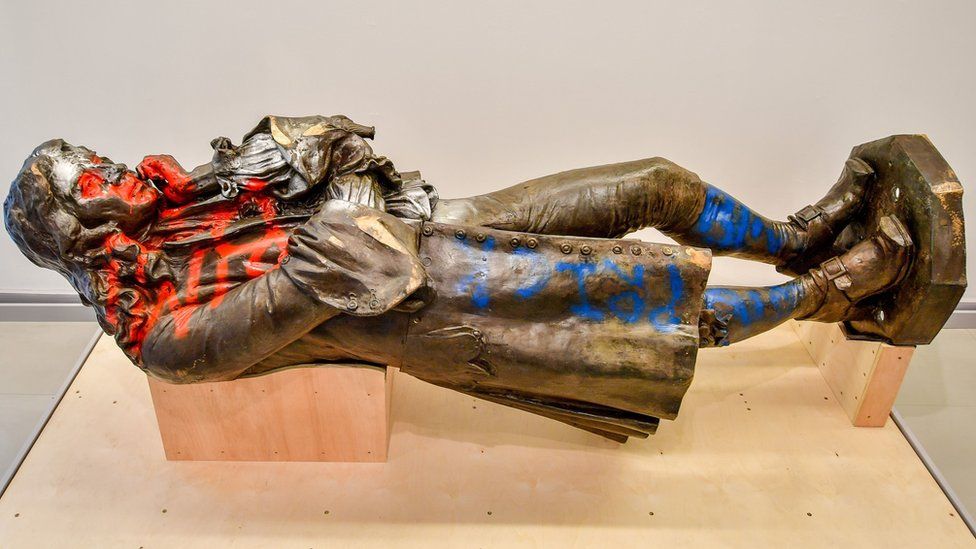
The acquittal of the four defendants for their role in the toppling of Edward Colston in Bristol has created an interesting debate and in some, more right-wing quarters, fury. In an interview following the verdict Boris Johnson stated we cannot seek to “retrospectively change our history“
But what history is he talking about, the one where this country was heavily involved in slavery or some other history around Empire and ‘jolly hockey sticks and all that sort of thing’?
History tells us that this country’s empire, like all empires significantly benefited from its conquests to the detriment of those conquered. Although if you watch the Monty Python film The Life of Brian, the right of the political spectrum might find some comfort in the sketch that starts with ‘What have the Romans ever done for us’? This country’s history is complex more so because it is a shared history with its own inhabits and those of other countries across most of the world. A history of slaves and slave traders. A history of rich and powerful and poor and powerless. A history of remapping of countries, redefining of borders, of the creation of unrest, uncertainty and chaos. A history of theft, asset stripping, taking advantage and disempowerment. As well as a history of standing up to would be oppressors. It is a complex history but not one that is somehow rewritten or removed by the toppling of a statue of a slave trader.
The tearing down of the statue is history. It is a fact that this country’s so called great and good of the time were tarnished by a despicable trade in human misery. The legacy of that lives on to this day. Great and good then, not so now, in fact they never were, were they? It may be questionable whether the circumstances of the removal of the statue were right, hence the charges of criminal damage. It might be questionable whether the verdict given by the jury was right, but surely this isn’t about changing history, it is about making it.
There are suggestions that the verdict may be referred to a higher authority, perhaps the Supreme Court. It appears right that there was a case to answer, and it seems right that the jury were allowed to deliver the verdict they did. There is nothing perverse in this, nothing to challenge, due process has taken place and the people have spoken. The removal of the statue was not criminal damage and therefore was lawful.
If a statue is an affront to the people of a locality, then they should be able to have it removed. If is such an affront to common decency, then the only people guilty of an offence are those that failed to remove it in the first place. Of course, it is more complex than that and perhaps the bigger question is why this didn’t happen sooner?
It would seem fitting to replace the statue with something else. Something perhaps that shows that slowly people of this country are waking up to the country’s past, well at least some of them. A statue that commemorates a new beginning, that acknowledges the country’s true past and points the way to a far more humane future for all. No Mr Johnson, we shouldn’t try to rewrite or obliterate history, we just need to change the way it written and stop ignoring the truth.
Share this:


A microcosm of deviancy

A little over a week ago our university introduced the compulsory wearing of face masks indoors. This included wearing of masks in classrooms as well as common areas and offices. Some may argue that the new rules were introduced a little too late in the day, whilst I’m sure others will point to the fact that government guidance is that the wearing of face masks is advisory and therefore the introduction of the new rules was unwarranted. Let’s be honest the government and their political party haven’t set much of an example regarding the basic safety ideas, let alone rules, as evidenced by the recent Conservative party conference. The new rules at the university, however, are not enforced, instead there is a reliance that students and staff will comply. This of course creates several dilemmas for students and staff where there is a failure to comply and it makes for some interesting observations about general human behaviour and deviance. To that extent, university life might be viewed as a microcosm of life in the general population and this lends itself quite nicely to the analogy of behaviours whilst driving on a road.
Driving behaviours vary, from those drivers that consistently and diligently stick to the speed limit despite what others may be doing, to those that have complete disregard for limits or indeed others including those that police the roads. Let us be quite clear at this stage, speed limits are nearly always there for a reason. There is ample research that speed kills and that reductions in speed limits injuries and saves life. Whilst those drivers that drive over the speed limit will not always be involved in a collision and that a collision will not always result in serious injury or death, there is a much greater potential for this. The risks of course are spread across the population in the locality, the impact is not just felt by the speeding driver but other drivers and pedestrians as well. To some extent we can make the comparison to the risks associated with catching Covid and the wearing of masks and social distancing, failure to comply increases risks to all. As a quick reminder, the wearing of masks is to protect others more so than it is to protect the individual mask wearer.
Observations of behaviours regarding staff and students wearing masks at the university are interesting. There are those that comply, regardless of what others are doing, some of these will have been wearing masks indoors before the new rules came in. Not dissimilar to the careful driver, sticking to the speed limit but also prepared to drive slower where they perceive there is a greater risk. Then there is the well-intentioned mask wearer, the one that knows the rules and will stick to them but through absent mindedness or through some of life’s many distractions, they fail to wear their masks at various points of the day. As with the well-meaning driver, they are easily reminded and often apologetic, even if it is only to themselves. Of course, there is the ‘follow the flock’ wearer, the person that could quite easily be persuaded to not wear their mask by the rest of the flock as they fail to wear theirs. The driver that joins the rest and drives at 40mph in a 30mph limit because the rest of the traffic is doing so. Next is the deviant that has disregard for the rules as long as no one in authority is looking. The person that keeps their mask handy, probably under their chin and then when challenged in some way, perhaps by a disapproving look from a member of staff or by a direct challenge, puts their mask on but only for the duration they are under observation. Not dissimilar to the speedster that slows down when they see a police vehicle or a static speed camera only to speed up again when the danger of being caught and sanctioned has passed. Finally, there is the person that has complete disregard for any rules, they will blatantly fail to wear a mask and wave away with complete disdain any attempt by student ambassadors positioned at the door to offer them a mask. They like the speeding driver that fails to obey any of the rules of the road have complete disregard for the rules or indeed any rules.
Whilst we may lament the fact that some people forget, are distracted but are generally well meaning, we probably wouldn’t want to impose any sanction for their deviance. But what of those that have complete disregard for the rules? It is worth returning here to the general ethos of wearing masks; to protect others. The disregard for the rules is inter alia a disregard for the safety of others. Whilst we might observe that the deviancy is apparent amongst several students (a problem that might be generalised to society), it is somewhat disconcerting that there are a significant number of staff who clearly do not think the rules apply to them. They seem to neither care about their colleagues nor the students and it would seem consider themselves above the rules. Another comparable trait in general society where those in positions of power seem to have a disregard for rules and others. Finally, we might consider how we could police these new rules as clearly our university society of students and staff are unable to do so. I can hear the cries now, haven’t you got anything better to do, this is a sledgehammer to crack a nut and all the usual rhetoric endured by the police across the land. If you make a rule, you must be prepared to enforce it otherwise there’s no point in having it. Imposing an unenforceable rule is simply playing politics and attempting to appease those that question the conditions in which students and staff work. Imagine speed limits on the road but no enforcement cameras, no police and no sanctions for breaches. It will be interesting to see how long the general population at the university follow the new rules, recent observations are that the flock of sheep mentality is starting to come to the fore. As a parting thought, isn’t it amazing how easy it is to study crime and deviance.
Share this:


The pathology of performance management: obscuration, manipulation and power

My colleague @manosdaskalou’s recent blog Do we have to care prompted me to think about how data is used to inform government, its agencies and other organisations. This in turn led me back to the ideas of New Public Management (NPM), later to morph into what some authors called Administrative Management. For some of you that have read about NPM and its various iterations and for those of you that have lived through it, you will know that the success or failure of organisations was seen through a lens of objectives, targets and performance indicators or Key Performance Indicators (KPIs). In the early 1980s and for a decade or so thereafter, Vision statements, Mission statements, objectives, targets, KPI’s and league tables, both formal and informal became the new lingua franca for public sector bodies, alongside terms such as ‘thinking outside the box’ or ‘blue sky thinking’. Added to this was the media frenzy when data was released showing how organisations were somehow failing.
Policing was a little late joining the party, predominately as many an author has suggested, for political reasons which had something to do with neutering the unions; considered a threat to right wing capitalist ideologies. But policing could not avoid the evidence provided by the data. In the late 1980s and beyond, crime was inexorably on the rise and significant increases in police funding didn’t seem to stem the tide. Any self-respecting criminologist will tell you that the link between crime and policing is tenuous at best. But when politicians decide that there is a link and the police state there definitely is, demonstrated by the misleading and at best naïve mantra, give us more resources and we will control crime, then it is little wonder that the police were made to fall in line with every other public sector body, adopting NPM as the nirvana.
Since crime is so vaguely linked to policing, it was little wonder that the police managed to fail to meet targets on almost every level. At one stage there were over 400 KPIs from Her Majesty’s Inspectorate of Constabulary, let alone the rest imposed by government and the now defunct Audit Commission. This resulted in what was described as an audit explosion, a whole industry around collecting, manipulating and publishing data. Chief Constables were held to account for the poor performance and in some cases chief officers started to adopt styles of management akin to COMPSTAT, a tactic born in the New York police department, alongside the much vaunted ‘zero tolerance policing’ style. At first both were seen as progressive. Later, it became clear that COMPSTAT was just another way of bullying in the workplace and zero tolerance policing was totally out of kilter with the ethos of policing in England and Wales, but it certainly left an indelible mark.
As chief officers pushed the responsibility for meeting targets downwards through so called Performance and Development Reviews (PDRs), managers at all levels became somewhat creative with the crime figures and manipulating the rules around how crime is both recorded and detected. This working practice was pushed further down the line so that officers on the front line failed to record crime and became more interested in how to increase their own detection rates by choosing to pick what became known in academic circles as’ low hanging fruit’. Easy detections, usually associated with minor crime such as possession of cannabis, and inevitably to the detriment of young people and minority ethnic groups. How else do you produce what is required when you have so little impact on the real problem? Nobody, perhaps save for some enlightened academics, could see what the problem was. If you aren’t too sure let me spell it out, the police were never going to produce pleasing statistics because there was too much about the crime phenomenon that was outside of their control. The only way to do so was to cheat. To borrow a phrase from a recent Inquiry into policing, this was quite simply ‘institutional corruption’.
In the late 1990s the bubble began to burst to some extent. A series of inquiries and inspections showed that the police were manipulating data; queue another media frenzy. The National Crime Recording Standard came to fruition and with it another audit explosion. The auditing stopped and the manipulation increased, old habits die hard, so the auditing started again. In the meantime, the media and politicians and all those that mattered (at least that’s what they think) used crime data and criminal justice statistics as if they were somehow a spotlight on what was really happening. So, accurate when you want to show that the criminal justice system is failing but grossly inaccurate when you can show the data is being manipulated. For the media, they got their cake and were scoffing on it.
But it isn’t just about the data being accurate, it is also about it being politically acceptable at both the macro and micro level. The data at the macro level is very often somehow divorced from the micro. For example, in order for the police to record and carry out enquiries to detect a crime there needs to be sufficient resources to enable officers to attend a reported crime incident in a timely manner. In one police force, previous work around how many officers were required to respond to incidents in any given 24-hour period was carefully researched, triangulating various sources of data. This resulted in a formula that provided the optimum number of officers required, taking into account officers training, days off, sickness, briefings, paperwork and enquiries. It considered volumes and seriousness of incidents at various periods of time and the number of officers required for each incident. It also considered redundant time, that is time that officers are engaged in activities that are not directly related to attending incidents. For example, time to load up and get the patrol car ready for patrol, time to go to the toilet, time to get a drink, time to answer emails and a myriad of other necessary human activities. The end result was that the formula indicated that nearly double the number of officers were required than were available. It really couldn’t have come as any surprise to senior management as the force struggled to attend incidents in a timely fashion on a daily basis. The dilemma though was there was no funding for those additional officers, so the solution, change the formula and obscure and manipulate the data.
With data, it seems, comes power. It doesn’t matter how good the data is, all that matters is that it can be used pejoratively. Politicians can hold organisations to account through the use of data. Managers in organisations can hold their employees to account through the use of data. And those of us that are being held to account, are either told we are failing or made to feel like we are. I think a colleague of mine would call this ‘institutional violence’. How accurate the data is, or what it tells you, or more to the point doesn’t, is irrelevant, it is the power that is derived from the data that matters. The underlying issues and problems that have a significant contribution to the so called ‘poor performance’ are obscured by manipulation of data and facts. How else would managers hold you to account without that data? And whilst you may point to so many other factors that contribute to the data, it is after all just seen as an excuse. Such is the power of the data that if you are not performing badly, you still feel like you are.
The above account is predominantly about policing because that is my background. I was fortunate that I became far more informed about NPM and the unintended consequences of the performance culture and over reliance on data due to my academic endeavours in the latter part of my policing career. Academia it seemed to me, had seen through this nonsense and academics were writing about it. But it seems, somewhat disappointingly, that the very same managerialist ideals and practices pervade academia. You really would have thought they’d know better.
Share this:


#ReadingForCriminologists: The End Of Policing- Alex S.Vitale

During the past year, like many, I have certainly had more time on my hands, I’ve started a plethora of hobbies (some more successful than others) but a constant past time for me has been reading. In the past I’ve sporadically read a few classic fiction books but this year that I’ve been focusing on nonfiction literature.
This book focuses mainly on the American police force in a historical and contemporary context. The book tackles some of the big topics in current policing such as the school to prison pipeline, the war on drugs, prostitution and mental health. In each chapter, the author critiques current policing strategy and gives recommendations towards effective reform.
My Thoughts
Of course, it is important to note that this book comments on American policing strategies and discusses social issues from a western, North American perspective. However, the book at times, does become relevant to UK topics. Comments about the war on drugs, the criminalisation of the homeless, immigrants and prostitutes and political policing are some examples.
“Tactical equipment with semi-automatic weapons”
Vitale, A., 2018. The end of policing. Verso Books, p.65.
There was one main part in the book that stuck out to me. In the School to Prison Pipeline chapter, the author gives a quote from an annual convention held for police officers based on school sites (known as Resource Officers). The book says it mainly consists of military contractors selling security systems to schools, a keynote speaker, specialising in anti-terrorism describes American schools as all containing ‘the next Columbine’, that every officer must be a ‘one-man fighting force’ and that police officers in schools must always wear full ‘tactical equipment with semi-automatic weapons’.
The author used this example in an extremely effective way, commenting on how the very nature of policing must change. It was written that currently, the police force is inherently a force and that the ethos of policing along with the ‘warrior mentality’ is part of the reason that policing in America is not as effective and beneficial as it could be to its citizens and communities.
With the continuation of social and racial unrest in America, the topics raised in the book could not be more relevant. The most interesting thing about this book was that it presented concepts and opinions I had never thought of before, and whether or not I was in agreement with the points raised, it became an extremely thought provoking read.
I guess that if escapism is more of your reasoning for reading this, perhaps, isn’t the book for you. The author speaks about the harsh reality that certain communities face when it comes to American policing and society.

Some Main Takeaways
Since beginning to take a greater interest in nonfiction books, I’ve realised how beneficial it is to to take note of differing opinions. The beauty in any social science is that one topic can have many opinions attached to it and often, opinions that differ from your own can be the most interesting and thought provoking ones. On the whole, the author presented quite a lot of concepts that I agree with, which made for a passionate read and the opinions I did not agree with, opened up opportunity to research and further understand.
This book has called into question some of my own opinions and thoughts around police reform. Perhaps more police training, more funding and education within the police force cannot fix an institution that was formed to essentially supress and control some of the most marginalised and disadvantaged groups of people.

 Thoughts from the criminology team