
Home » Outsiders
Category Archives: Outsiders

Homelessness: Outsiders and Surviving on the Street: A snapshot of my undergraduate dissertation.

As the wait until graduation dissipates, I thought I may outline my dissertation and share some of the interesting notions I discovered and the events I experienced throughout the process of creating potentially the most extensive research project each of us has conquered so far.
What was my research about?
As we all know, the issue of homelessness is rife throughout the streets of Northampton and across the UK. I wanted to explore two main areas of homelessness that I understood to be important: the Victimisation of the homeless and the Criminalisation of the homeless. Prior research suggested that the homeless were victimised more frequently than the general public; they are more invisible victims, ignored and abused. There is a lack of reporting of the victimisation they face, partially explained by the lack of trust and lack of embracing victim identity, therefore, a lack of understanding of the victimisation this group faces. They are treated as outsiders, so they act as outsiders, the out-group whose behaviour is deemed ‘deviant,’ resulting in exclusionary tactics such as Hostile Architecture and legislation to hinder their ability to survive. Statistics do suggest that a large number of the homeless population have previously engaged in criminal activity, but the reasonings behind the criminality are distinct. There is an understanding that the criminal behaviour engaged in by the homeless population is survival in nature and only conducted to sustain themselves on the street. The crimes they commit may be due to the ‘criminogenic’ situation they find themselves in where they have to conduct these behaviours due to the environment, society and the economy.
What did I do?
My research was conducted in The Hope Centre, a homeless and hardship charity located in Northampton. Within the centre, I conversed with 7 service users about their experiences living on the street, engagement with criminal activity and the events they have faced. I based my research around an interpretivist lens to capture their experiences and ensure they are subjective and connected to that individual.
What did I find?
The conversations produced a multitude of different reoccurring themes, but the three I believe to be the most stand-out and important are Survival, Cynicism and Labelling, and Outsiders.
Within the survival theme, numerous individuals spoke of the criminality that they have engaged in whilst being on the street, from shoplifting to drug dealing. Still, there was a variety of different justifications used to rationalise their behaviour. Some individuals explained that the crime was to be able to sustain themselves, eat, sleep, etc. For some, the criminality was rationalised by softening the victim’s stance by suggesting they were faceless or victimless if they targeted large corporations. For some, the rationale was to purchase drugs, which, although deemed a commodity and a luxury by some, is also a necessity by others, needing a particular substance to be able to live through the night.
Within the Cyclicism theme, a common topic was that of the society that these individuals reside in; the homeless that have sometimes been released from prison are let out into a society with a lack of job opportunities (due to criminal records) and a drug culture that forces them into other money-making ventures such as criminality, resulting in a total loop back into the prison system. Some participants were under the assumption that the prison system was designed this way to create money by pushing them back into it.
One final theme was that of labelling and outsiders, this is the situation whereby individuals the participants were perceived negatively regardless of what they did and how they acted. They suggested that they were seen as ‘dirty’ even if they had showered. Due to this, they were excluded from society for being an outlier and seen as different to the ‘in-group’ with no control over changing that. This led to some participants attempting to change their behaviour and look to fit in with societal norms. There is also a perception from the homeless about other homeless individuals, specifically the divide between those who beg and those who do not. Some believe that those who beg, harass people and give the entire community a ‘bad rep.’
My dissertation did not aim to drive a specific conclusion due to the individual nature of the conversations. However, it is my hope and aim to potentially change the perceptions and actions of each individual who has read my dissertation regarding this neglected group in society.
Share this:


Gypsy Roma Traveller History Month: A Romany Museum
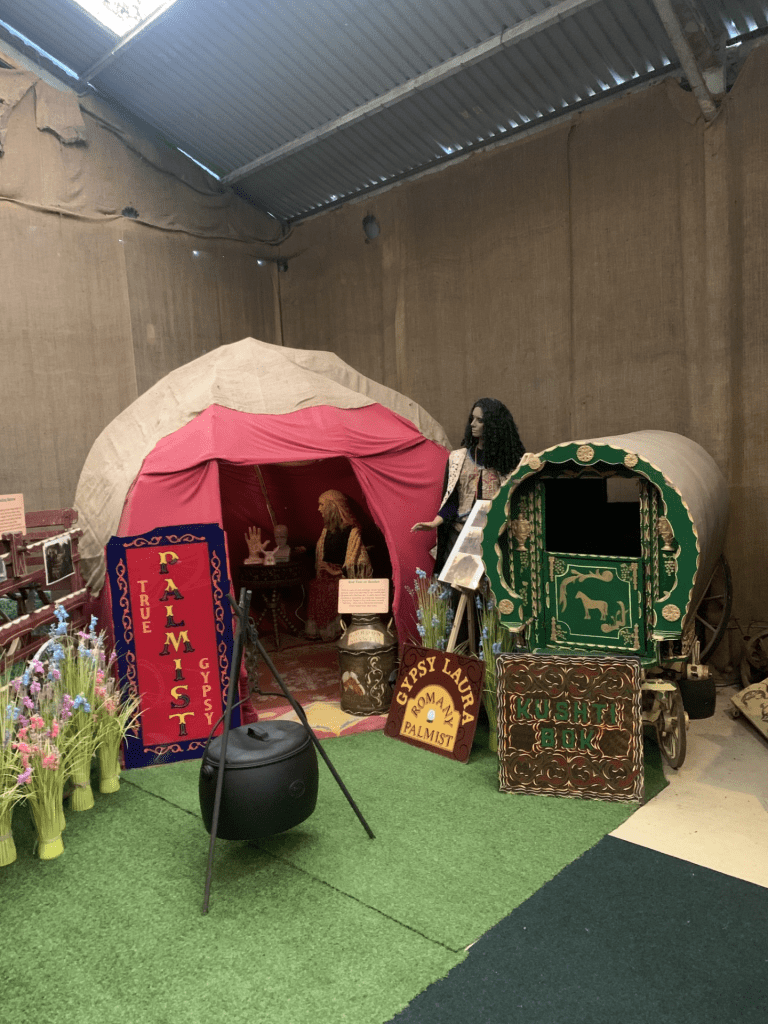
In April I visited the Gordon Boswell Romany Museum, museums in this country tend to operate under the guise of whiteness, but this one is different – it seems to be unapologetically and traditionally Romany.
The museum has an off grid feel to it, it appears after driving miles amongst countryside fields and if you would like to contact the museum staff, apparently telephone is best, not social media or email. This museum is also situated within what seems to be a Romany family home area and working scrapyard business. So even before entering the building, the culture of close family ties for building home and business that is outside of mainstream culture, are there.
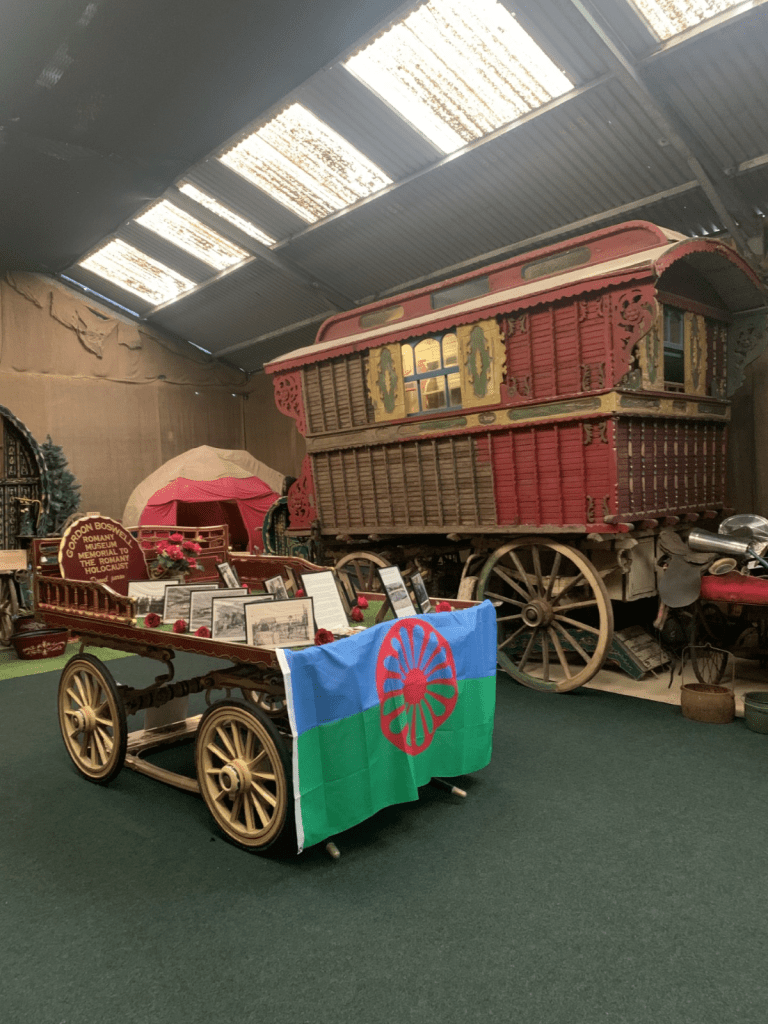
Inside the museum there are a variety of traditional Romany artefacts, which includes wagon, trailers, horse related items and handmade gifts, as well as other wagons curated by the owners and close contacts themselves. You will be pressed to find any written signage here, as in-line with tradition Romany history is passed on through verbal story telling. So if you want to know more about something you will need to ask those running the place, who are keen to have a chat with you.
I was surprised to see that the museum had a decent amount of visitors considering that this was a weekday and located in a lowly populated area in Spalding. The museum seems to be aimed at celebrating and illustrating traditions, instead of being motivated by profit. The visitors that were there also seemed to be touched by their visit, perhaps it is the attempt at preserving a traditional culture that has been under constant pressure, that makes this so meaningful. Or the memories of the past which the museum seems to hold onto.
Upon exiting the museum, seemingly Romany people pull up with a horse and cart near-by. A reminder of a slower paced yet hard working traditional life, where the outside world and mainstream culture does not matter so much as long as there is food on the table and supportive family near by. Although, I was left with more questions after the visit, such as where are the museums/spaces for other groups, such as Traveller culture? Where are the celebrations for more contemporary lives lived by Gypsy Roma and Traveller people?

This year the month in which I celebrated Romany culture the most was in April with a visit to The Gordon Boswell Romany Museum and I really did enjoy the visit. I have not done much to celebrate this month as I wonder – how do you to celebrate these specific History Month in a way that is meaningful and not performative?
Share this:


Witches, Broomsticks and Libraries
My son has been gifted and collected many delightful children’s books since his recent birth. A book which stands out to me on Women’s History Month is: Room on the Broom (2001) by writer Julia Donaldson and Illustrator Axel Scheffler.
Aside from the fabulous use of words and illustrations, the main character of the story is a lovely witch who makes room on her broom for her cat, a dog, bird and frog. The latter part of the story consists of the broom snapping, presumably due to the extra weight of these passengers, then the witch risks being eaten by a dragon. But eventually all is well as the witch creates a new super broomstick with;
seats for the witch
and the cat and the dog,
a nest for the bird and
a shower for the frog.

This book’s depiction of the witch as a morally good character is wonderful but this is not usual. In popular culture, such as fiction, television and film witches seem to have flawed character traits, are morally bad cackling devious women who fly about casting spells on poor and (un/)suspecting folk.
The negative connotations of witches today reflect a long dreadful real-life history of outsiders being accused of being witches – with some being tortured and murdered due to this. The outsiders aka witches tended to be women, women who were providing a service for other women, such as support during childbirth or healing practices, or those that practice spiritualisms that differ to dominant religions. If re-born today some of these women may have been celebrated as midwifes and nurses, although their wages and workloads would still illustrate that predominantly women centered roles tend to be under appreciated.
On International Women’s Day I finished reading Disobedient Bodies (2023) by Emma Dabiri. Disobedient Bodies reminds me about how in a white capitalist cis male world bodies categorised as female and women are constructed as deviant. Proof of being a witch was apparently not just found in practices but on the bodies of women. Emma Dabiri adds to the discussion on witches that I did not consider; that groups of women aka groups of deviant witches were considered to be the most threatening to witch hunters. For a long time women have been pitted against each other, the historical nature of women meeting in groups to support each other as a threat to patriarchal capitalist white systems has added to this.
My son is very privileged to have so many book at the age of 1. Unfortunately I am writing during a time where there are threats to close 25 libraries in Birmingham. Notably, the libraries that me and my son frequent consist of mostly women staff (both paid and volunteers). In addition to the potential for job losses, if this happens there will be babies, children and adults without access to books, artistic classes, warm and safe spaces. To quote my friend and colleague, “soon there will be nothing left”.
Share this:


In Praise of Howard S. Becker (1928-2023)

Three months ago, Howard S. Becker died at the age of 95, some of the Criminology Team reflect below on his impact.
I re-read Becker’s Outsider’s during the covid-19 pandemic. It reminded me of how Becker’s critical take on criminology helped me to understand and articulate the world in which I grew up in. Yes, street crime happens, and yes it causes victims to suffer but street crime seemed to be a survival response from the powerless aka ‘the deviants’ who were oppressed by the disciplining State and its police force. Becker’s work must have been groundbreaking at the time that it was published, and it continues to resonate within more contemporary critical theories surrounding intersectional oppressions that I am most interested in today…what a game changer!
@haleysread
I first encountered Becker’s (1963) Outsiders as an undergraduate, since then I have revisited many times. The book and the ideas within are so well-written, so accessible, allowing the reader to see criminality and criminal justice from an entirely different perspective. Although profound, it is not this Becker text which is closest to my heart, for that we go to 1967 and the publication of his article ‘Whose Side Are We On?‘ It is this succinct piece of writing that allowed me to understand that criminologists can never be neutral, they have to take a side. Furthermore, they must always be on the side of the powerless and never the powerful. The Criminal Justice System [CJS] and all of the agents within it, are working within and for the State and thus have plenty of supporters. Individuals in their engagement with the CJS, do not have the same support or protection, they are always outnumbered and out resourced. If we truly want to gain a holistic understanding of deviance and criminality, Becker (1967) is very helpful.
Alongside, his writing around crime and deviance, Becker also identifies the importance of language and writing style, to research practice. In Writing for Social Scientists (1986) and Tricks of the Trade (1998) and Telling About Society (2007) offers clear, practical guidance and comfort for uncertain scholars (whatever level of study).
Finally, we need to mention Becker’s music, his beloved jazz which provides the soundtrack to a scholarly life well lived, which means you can study his life’s work (both written and aural) simultaneously. A unique man, whose impact will be felt by criminologist and other social scientists for a very long time.
@paulaabowles
In 2006, during my undergraduate studies in sociology, I was introduced to Howard Becker’s labelling theory. While it marked a significant departure from the traditional explanation of deviance, it sparked lively debates among my peers. I distinctly recall vehemently opposing the theory’s practical application in Nigeria, my home country. Some of my peers argued passionately, citing numerous examples of deviance, including instances of crimes of the powerful. They contended that corruption and the misappropriation of public funds in Nigeria were products of eroding social values, driven by immense societal pressure on political officeholders to maintain an image of ‘big men.’ No doubt, Becker had a point on this and despite my initial reservations about labelling theory, Becker’s scholarly contributions have undeniably been influential in shaping both my sociological imagination and my criminological lenses. So long to a respected scholar!
@sallekmusa
It is impossible to list eminent criminologists without at least giving a nod to Howard Becker, although I would suggest a nod is far from sufficient. Becker it seems to me had the ability to write meaningful texts that could be understood by all. Of course his narrative in Outsiders is a product of its time but much of it is still applicable today. I first read Outsiders as part of my undergraduate degree and much of resonated and yet as with all great work, it doesn’t explain everything. What it does though is provide a very different perspective on deviance and society as a whole. In his later work Becker discussed labelling stating it wasn’t a theory. Well worth returning to the book then just to understand that statement alone.
@5teveh
This August 16, 2023, Howard Becker died. He was a 95 years old social scientist/sociologist (depending on who you will ask) with a long and significant legacy on his tome of work. My colleagues above predictably chose Outsiders as representative sample of his work. Not surprising really considering this was one of his seminal pieces of work that articulated the basis of theories that sociologists, criminologists and other social scientists based their own theories and understanding on social reality. His work on labelling theory became a significant influence on criminologists who tried to understand the relationship between postmodernity and deviance. It comes as no surprise that his influence to those who followed him in academia was so important.
What I thought most fitting was to concentrate on one of his latest papers written a few years ago when he was 91. In the midst of the pandemic with the lockdown and the great uncertainty it ensued Howard retreats to what he knows best; to be a social scientist and contextualise his observations the best way he knows. The paper in a praise of neighbourhood spirit and collective consciousness under the guise of urban sociology. Howard Becker is very reflective of his location, the history of the place and its social development and it is a testament of the importance of interactionism and positionality.
Using personal experience his paper “In San Francisco, when my neighborhood experiences pandemics” Becker retains his criticality as a social scientist, using observations and personal narratives to humanise an inhuman and repressive situation. People around him become actors in the crisis especially to those who as more in need and his impressions give us a snapshot of the time. In his own words “Those of us who do social science to be ready to observe life around us” a legacy to all of us that social situations continuously challenge us to explore things differently. That is because “social life does the experiment for us”. One of his last lessons on “life goes on” is so important to the sociology of everyday life.
This paper may not have the significance of some of his earlier work but it is a testament of what a restless mind can produce. He was able to record a situation that in years, decades to come, people will write about it and its impact. Yet, despite his age, his writing remained fresh, current and relevant. In academic terms he was the eternal teenager. Solon of Athens once said “Γηράσκω αεί διδασκόμενος” “I grow old while always learning” projecting that the pursue of knowledge is continuous and lifelong. In Howard Becker this seemed to have been the case. Thank you for your company all those years in the libraries, the seminars, the essays that we read you, thought of your ideas and talk about them. Goodbye to the social scientist, the thinker, the philosopher, the person.
@manosdaskalou

 Thoughts from the criminology team