
Home » Lived experience
Category Archives: Lived experience

What should criminologists talk about?

Recently, Criminology with Psychology graduate, now PhD student @zo3conneely wrote an entry focused on the rise of the Reform Party in British politics, which you can find here. In response, we received a comment via social media, asking what this entry had to do with Criminology. As we always say in Criminology, all questions are welcome and valid, after all, for many of us our mantra is ‘question everything’! From a lay perspective, the question indicates a particular understanding of academic disciplines, it presupposes that Criminology has a very narrow focus. In this view, criminologists should stay in their own lane and focus purely and simply on what is commonly understood as crime, i.e. actions which are against the law.
But hang on, doesn’t that fall under the purview of those who study or practice criminal law, something neither I not Zoe have undertaken? Alternatively, is it the business of those who work in the field of criminal justice, investigating and processing those believed to have been involved in law-breaking? Again, not something either Zoe or I have experience of. If my colleagues in law and criminal justice are the experts in actions against the law, where does Criminology fit in and why include a discussion on political parties such as Reform in a blog dedicated to the discipline?
However, the answer is more complex than the original question would indicate. The answer is also much longer than the question. Criminology has been described as a rendezvous or umbrella discipline, a space where everyone can gather to discuss crime from all perspectives. This includes disciplines as diverse as Drama, History, Literature, Philosophy, Psychology as well as many others, including Politics. It is therefore, expected that those who write for a Criminology blog will be drawn from a diverse range of academic backgrounds, for instance, whilst I have a BA and a PhD in Criminology, my MA is in the History of Medicine. For my fellow bloggers, their academic journeys will also be reflective of their curiosity and their developing academic knowledge and skills. It is therefore anticipated that each academic brings their own unique academic knowledge and personal experiences to the discussion table. It is this which enables Criminology to take a holistic approach, we don’t and should not seek consensus, but incorporate as many diverse views as is possible. Only then can we gain a real understanding of the phenomena we call crime, criminality, victimisation, and of course, the responses to such.
But what of crime itself? Do we all have a shared understanding of what ‘crime’ is? After all, much of the time we don’t see crime, only potentially some evidence that is has occurred. Furthermore, it depends very much on time and space. If we were living in 1960’s Britain, suicide, abortion and homosexuality would all feature heavily in our list of crimes. However, suicide was decriminalised in 1961, and abortion and homosexuality were partially decriminalised in 1967, with the latter further decriminalised in 2003. Likewise, if we were to look further afield we would crimes listed in statute books that we do not have here, for example adultery is a crime in Iran, Pakistan, Saudi Arabia, Somalia and was only repealed in Taiwan in 2020. Thus it is quickly evident that crime is not static, it can change drastically through time and place. We also have to recognise that crime can be decriminalised and recriminalised, for example the overturning of Roe vs Wade in the USA, removes the constitutional right for those pregnant to access abortions. If it taught us nothing else, the Covid-19 pandemic showed us rights can be granted and rights can be taken away, which means that criminologists need to keep a very careful eye on both the past and the present.
Whilst my colleagues in law have as their focus current legislation and how it is practised, and my colleagues in criminal justice seek to ensure that the law is enacted and used to the letter of that law, criminology is much freer. After all, we need to know who is making those laws and why. Whilst we can answer quite simply parliamentarians, this does not tell us very much. We also need to know who, for example only 14% of the current parliament belong to the Global Ethnic Majority, a smaller percentage than the population proportionately. Of these 90, 66 are drawn from the Labour Party, 15 Conservative and 5 Liberal Democrats. Likewise, at the 2024 election 40% of MPs are women, despite women making up over 50% of the UK’s population. Let’s not even get started on the disproportionate number of privately educated MPs, or the lack of visibility of disability, sexuality and so on…. Needless to say, the UK parliament does not look like the vast majority of the British public. Yet these are the people make our laws, and if we don’t understand that as a criminological issue, we will soon come unstuck.
We all need to understand what is happening once those laws have been passed, who is delivering justice for the UK? Whether we look at Judges, Barristers, Solicitors, we find a predominance of white men, only when we look at the magistracy we begin to find some real diversity. But don’t forget magistrates are unpaid, lay members of the judiciary, so it is perhaps unsurprising that women make up 57% of this particular field. So what about criminal justice practitioners? If we look at the police for England and Wales, over 91% are white, 65% are men. In relation to His Majesty’s Prison and Probation Service [HMPPS], over 54% are female, yet these are predominantly based within probation, not the prison service. So we begin to see that the people making, enacting and facilitation legislation and criminal justice do not look very much like the country’s population. Criminologically, this matters, how can we hope to tackle serious social harms like Violence Against Women and Girls [VAWG], homelessness, poverty etc when people have neither knowledge nor experience? Can we really talk achieve just outcomes if the people responsible do not look, sound like us, have very different, often privileged backgrounds which mean we have little shared experience?
Hopefully, this entry has gone a little way towards explaining why the discipline of Criminology (and of course, this blog) maintains an careful eye on politics, among a huge range of other interests. Don’t forget, Criminology is a positive discipline, focused on what could be, what ought to be, a fairer society for all of us.
Share this:


Technology: one step forward and two steps back

I read my colleague @paulaabowles’s blog last week with amusement. Whilst the blog focussed on AI and notions of human efficiency, it resonated with me on so many different levels. Nightmarish memories of the three E’s (economy, effectiveness and efficiency) under the banner of New Public Management (NPM) from the latter end of the last century came flooding back, juxtaposed with the introduction of so-called time saving technology from around the same time. It seems we are destined to relive the same problems and issues time and time again both in our private and personal lives, although the two seem to increasingly morph into one, as technology companies come up with new ways of integration and seamless working and organisations continuously strive to become more efficient with little regard to the human cost.
Paula’s point though was about being human and what that means in a learning environment and elsewhere when technology encroaches on how we do things and more importantly why we do them. I, like a number of like-minded people are frustrated by the need to rush into using the new shiny technology with little consideration of the consequences. Let me share a few examples, drawn from observation and experience, to illustrate what I mean.
I went into a well-known coffee shop the other day; in fact, I go into the coffee shop quite often. I ordered my usual coffee and my wife’s coffee, a black Americano, three quarters full. Perhaps a little pedantic or odd but the three quarters full makes the Americano a little stronger and has the added advantage of avoiding spillage (usually by me as I carry the tray). Served by one of the staff, I listened in bemusement as she had a conversation with a colleague and spoke to a customer in the drive through on her headset, all whilst taking my order. Three conversations at once. One full, not three quarters full, black Americano later coupled with ‘a what else was it you ordered’, tended to suggest that my order was not given the full concentration it deserved. So, whilst speaking to three people at once might seem efficient, it turns out not to be. It might save on staff, and it might save money, but it makes for poor service. I’m not blaming the young lady that served me, after all, she has no choice in how technology is used. I do feel sorry for her as she must have a very jumbled head at the end of the day.
On the same day, I got on a bus and attempted to pay the fare with my phone. It is supposed to be easy, but no, I held up the queue for some minutes getting increasingly frustrated with a phone that kept freezing. The bus driver said lots of people were having trouble, something to do with the heat. But to be honest, my experience of tap and go, is tap and tap and tap again as various bits of technology fail to work. The phone won’t open, it won’t recognise my fingerprint, it won’t talk to the reader, the reader won’t talk to it. The only talking is me cursing the damn thing. The return journey was a lot easier, the bus driver let everyone on without payment because his machine had stopped working. Wasn’t cash so much easier?
I remember the introduction of computers (PCs) into the office environment. It was supposed to make everything easier, make everyone more efficient. All it seemed to do was tie everyone to the desk and result in redundancies as the professionals, took over the administrative tasks. After all, why have a typing pool when everyone can type their own reports and letters (letters were replaced by endless, meaningless far from efficient, emails). Efficient, well not really when you consider how much money a professional person is being paid to spend a significant part of their time doing administrative tasks. Effective, no, I’m not spending the time I should be on the role I was employed to do. Economic, well on paper, fewer wages and a balance sheet provided by external consultants that show savings. New technology, different era, different organisations but the same experiences are repeated everywhere. In my old job, they set up a bureaucracy task force to solve the problem of too much time spent on administrative tasks, but rather than look at technology, the task force suggested more technology. Technology to solve a technologically induced problem, bonkers.
But most concerning is not how technology fails us quite often, nor how it is less efficient than it was promised to be, but how it is shaping our ability to recall things, to do the mundane but important things and how it stunts our ability to learn, how it impacts on us being human. We should be concerned that technology provides the answers to many questions, not always the right answers mind you, but in doing so it takes away our ability to enquire, critique and reason as we simply take the easy route to a ready-made solution. I can ask AI to provide me with a story, and it will make one up for me, but where is the human element? Where is my imagination, where do I draw on my experiences and my emotions? In fact, why do I exist? I wonder whether in human endeavour, as we allow technology to encroach into our lives more and more, we are not actually progressing at all as humans, but rather going backwards both emotionally and intellectually. Won’t be long now before some android somewhere asks the question, why do humans exist?
Share this:


Changing the Narrative around Violence Against Women and Girls

For Criminology at UON’s 25th Birthday, in partnership with the Northampton Fire, Police and Crime Commissioner, the event “Changing the Narrative: Violence Against Women and Girls” convened on the 2nd April. Bringing together a professional panel, individuals with lived experience and practitioners from charity and other sectors, to create a dialogue and champion new ways of thinking. The first in a series, this event focused on language.
All of the discussions, notes and presentations were incredibly insightful, and I hope this thematic collation does it all justice.
“A convenient but not useful term.”
Firstly an overwhelming reflection on the term itself; ‘Violence Against Women and Girls’ – does it do justice to all of the behaviour under it’s umbrella? We considered this as reductionist, dehumanising, and often only prompts thinking and action to physical acts of violence, but perhaps neglects many other harms such as emotional abuse, coercion and financial abuse which may not be seen as, or felt as ‘severe enough’ to report. It may also predominantly suggest intimate partner or domestic abuse which may too exclude other harms towards women and girls such as (grand)parent/child abuse or that which happens outside of the home. All of which are too often undetected or minimised, potentially due to this use of language. Another poignant reflection is that we may not currently be able to consider ‘women and girls’ as one group, given that girls under 16 may not be able to seek help for domestic abuse, in the same way that women may be able to. We also must consider the impact of this term on those whose gender identity is not what they were assigned at birth, or those that identify outside of the gender binary. Where do they fit into this?
To change the narrative, we must first identify what we are talking about. Explicitly. Changing the narrative starts here.
“I do not think I have survived.”
We considered the importance of lived experience in our narratives and reflected on the way we use it, and what that means for individuals, and our response.
Firstly, the terms ‘victim’ and ‘survivor’ – which we may use without thought, use as fact, particularly as descriptors within our professions, but actually these are incredibly personal labels that only individuals with such experience can give to themselves. This may be reflective of where they are in their journey surrounding their experiences and have a huge impact on their experience of being supported. It was courageously expressed that we also must recognise that individuals may not identify with either of those terms, and that much more of that person still exists outside of that experience or label. We also took a moment to remember that some victims, will never be survivors.
Lived experience is making its way into our narratives more and more, but there is still much room for improvement. We champion that if we are to create a more supportive, inclusive, practical and effective narrative, we must reflect the language of individuals with lived experience and we must use it to create a narrative free from tick boxes, from the lens of organisational goals and societal pressure.
Lived experience must be valued for what it is, not in spite of what it is.
“In some cases, we allow content – which would otherwise go against our standards – if its newsworthy.”
A further theme was a reflection on language which appears to be causing an erosion of moral boundaries. For example, the term ‘misogyny’ – was considered to be used flippantly, as an excuse, and as a scapegoat for behaviour which is not just ‘misogynistic’ but unacceptable, abhorrent, inexcusable behaviour – meaning the extent of the harms caused by this behaviour are swept away under a ‘normalised’ state of prejudice.
This is one of many terms that along with things like ‘trauma bond’ and ‘narcissist’ which have become popular on social media without any rigour as to the correct use of the term – further normalises harmful behaviour, and prevents women and girls from seeking support for these very not normal experiences. In the same vein it was expressed that sexual violence is often seen as part of ‘the university experience.’
This use of language and its presence on social media endangers and miseducates, particularly young people, especially with new posting policies around the freedom of expression. Firstly, in that many restrictions can be bypassed by the use of different text, characters and emoji so that posts are not flagged for certain words or language. Additionally, guidelines from Meta were shared and highlighted as problematic as certain content which would, and should, normally be restricted – can be shared – as long as is deemed ‘newsworthy.’
Within the media as a whole, we pressed the importance of using language which accurately describes the actions and experience that has happened, showing the impact on the individual and showing the extent of the societal problem we face… not just what makes the best headline.
“We took action overnight for the pandemic.”
Language within our response to these crimes was reflected upon, in particular around the term ‘non-emergency’ which rape, as a crime, has become catalogued as. We considered the profound impact of this language for those experiencing/have experienced this crime and the effect it has on the resources made available to respond to it.
Simultaneously, in other arenas, violence toward women and girls is considered to be a crisis… an emergency. This not only does not align with the views of law enforcement but suggests that this is a new, emerging crisis, when in fact it is long standing societal problem, and has faced significant barriers in getting a sufficient response. As reflected by one attendee – “we took action overnight for the pandemic.”
“I’ve worked with women who didn’t report rape because they were aroused – they thought they must have wanted it.”
Education was another widely considered theme, with most talk tables initially considering the need for early education and coming to the conclusion that everyone needs more education; young and old – everything in between; male, female and everything in between and outside of the gender binary. No-one is exempt.
We need all people to have the education and language to pass on to their children, friends, colleagues, to make educated choices. If we as adults don’t have the education to pass on to children, how will they get it? The phrase ‘sex education’ was reflected upon, within the context of schools, and was suggested to require change due to how it triggers an uproar from parents, often believing their children will only be taught about intercourse and that they’re too young to know. It was expressed that age appropriate education, giving children the language to identify harms, know their own body, speak up and speak out is only beneficial and this must happen to help break the cycle of generational violence. We cannot protect young people if we teach them ignorance.
Education for all was pressed particularly around education of our bodies, and our bodily experiences. In particular of female bodies, which have for so long been seen as an extension of male bodies. No-one knows enough about female bodies. This perpetuates issues around consent, uneducated choices and creates misplaced and unnecessary guilt, shame and confusion for females when subjected to these harms.
“Just because you are not part of the problem, does not mean you are part of the solution.“
Finally, though we have no intention or illusion of resolution with just one talk, or even a series of them – we moved to consider some ways forward. A very clear message was that this requires action – and this action should not fall on women and girls to protect themselves, but for perpetrators for be stopped. We need allies, of all backgrounds, but in particular, we need male allies. We need male allies who have the education, and the words necessary to identify and call out the behaviour of their peers, their friends, their colleagues, of strangers on the bus. We asked – would being challenged by a ‘peer’ have more impact? Simply not being a perpetrator, is not enough.
Share this:


Exploring the National Museum of Justice: A Journey Through History and Justice

As Programme Leader for BA Law with Criminology, I was excited to be offered the opportunity to attend the National Museum of Justice trip with the Criminology Team which took place at the back end of last year. I imagine, that when most of us think about justice, the first thing that springs to mind are courthouses filled with judges, lawyers, and juries deliberating the fates of those before them. However, the fact is that the concept of justice stretches far beyond the courtroom, encompassing a rich tapestry of history, culture, and education. One such embodiment of this multifaceted theme is the National Museum of Justice, a unique and thought-provoking attraction located in Nottingham. This blog takes you on a journey through its historical significance, exhibits, and the essential lessons it imparts and reinforces about justice and society.
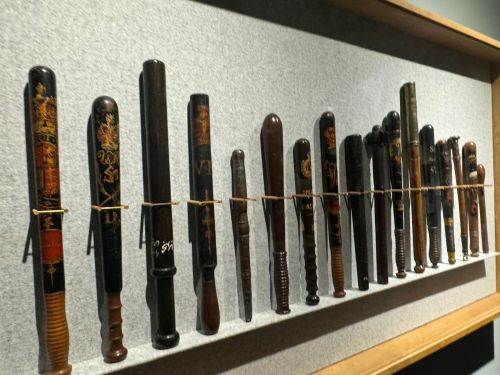
A Historical Overview
The National Museum of Justice is housed in the Old Crown Court and the former Nottinghamshire County Gaol, which date back to the 18th century. This venue has witnessed a myriad of legal proceedings, from the trials of infamous criminals to the day-to-day workings of the justice system. For instance, it has seen trials of notable criminals, including the infamous Nottinghamshire smuggler, and it played a role during the turbulent times of the 19th century when debates around prison reform gained momentum. You can read about Richard Thomas Parker, the last man to be publicly executed and who was hanged outside the building here. The building itself is steeped in decade upon decade of history, with its architecture reflecting the evolution of legal practices over the centuries. For example, High Pavement and the spot where the gallows once stood.
By visiting the museum, it is possible to trace the origins of the British legal system, exploring how societal values and norms have shaped the laws we live by today. The National Museum of Justice serves as a reminder that justice is not a static concept; it evolves as society changes, adapting to new challenges and perspectives. For example, one of my favourite exhibits was the bench from Bow Street Magistrates Court. The same bench where defendants like Oscar Wilde, Mick Jagger and the Suffragettes would have sat on during each of their famous trials. This bench has witnessed everything from defendants being accused of hacking into USA Government computers (Gary McKinnon), Gross Indecency (Oscar Wilde), Libel (Jeffrey Archer), Inciting a Riot (Emmeline Pankhurst) as well as Assaulting a Police Officer (Miss Dynamite).
Understanding this rich history invites visitors to contextualize the legal system and appreciate the ongoing struggle for a just society.
Engaging Exhibits
The National Museum of Justice is more than just a museum; it is an interactive experience that invites visitors to engage with the past. The exhibits are thoughtfully curated to provide a comprehensive understanding of the legal system and its historical context. Among the highlights are:



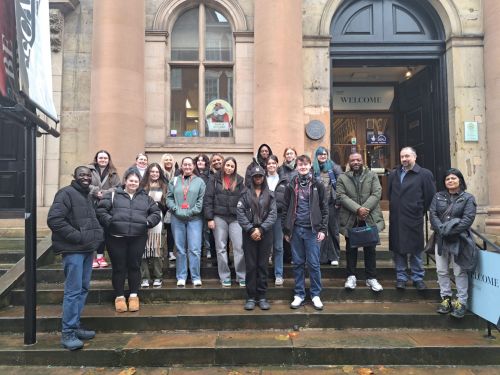
1. The Criminal Courtroom: Step into the courtroom where real trials were once held. Here, visitors can learn about the roles of various courtroom participants, such as the judge, jury, and barristers. This is the same room that the Criminology staff and students gathered in at the end of the day to share our reflections on what we had learned from our trip. Most students admitted that it had reinforced their belief that our system of justice had not really changed over the centuries in that marginalised communities still were not dealt with fairly.
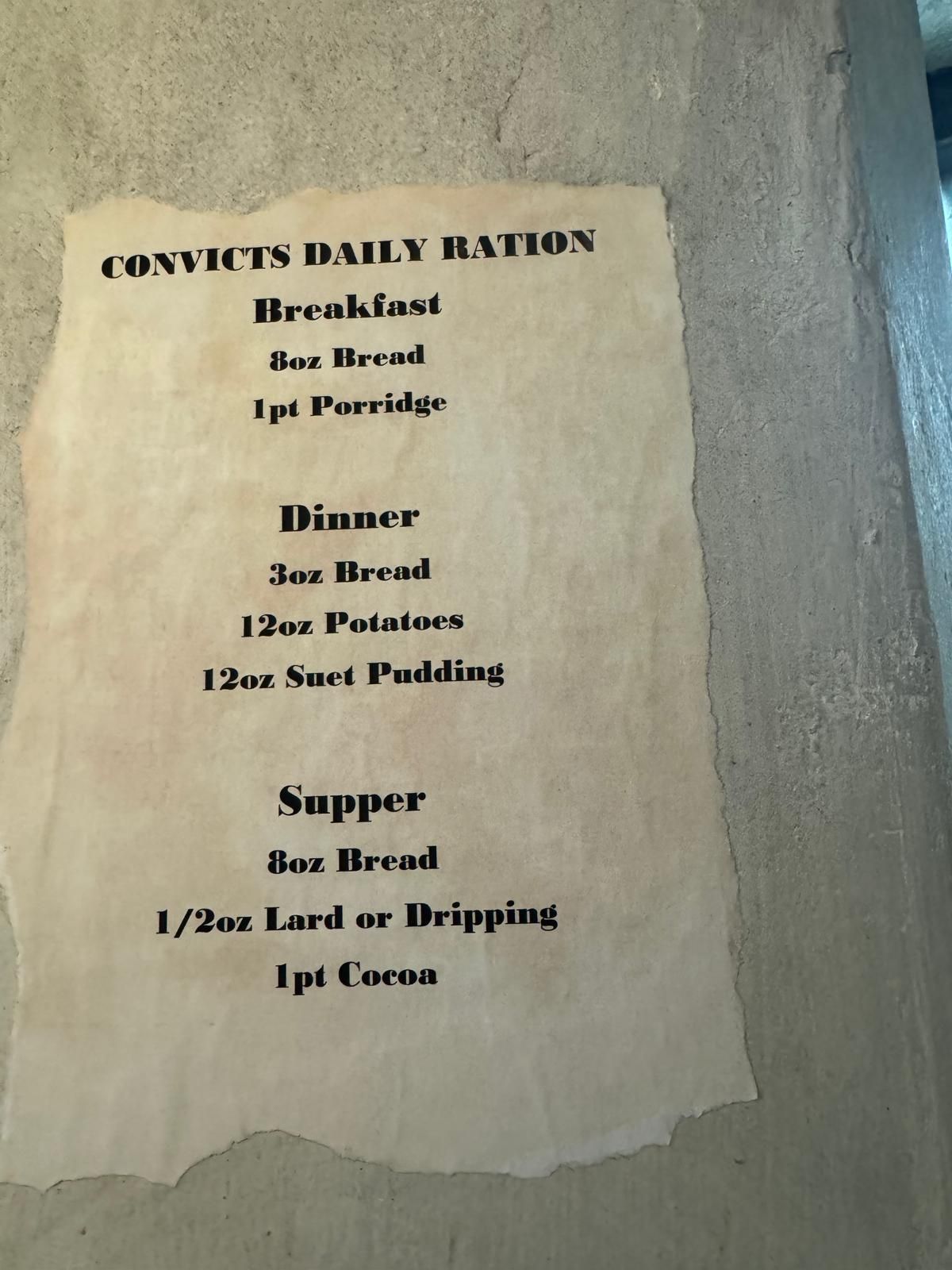
2. The Gaol: We delved into the grim reality of life in prison during the Georgian and Victorian eras. The gaol section of the gallery offers a sobering look at the conditions inmates faced, emphasizing the societal implications of punishment and rehabilitation. For example, every prisoner had to pay for his/ her own food and once their sentence was up, they would not be allowed to leave the prison unless all payments were up to date. The stark conditions depicted in this exhibit encourage reflections on the evolution of prison systems and the ongoing debates surrounding rehabilitation versus punishment. Eventually, in prisons, women were taught skills such as sewing and reading which it was hoped may better their chances of a successful life in society post release. This was an evolution within the prison system and a step towards rehabilitation of offenders rather than punishment.
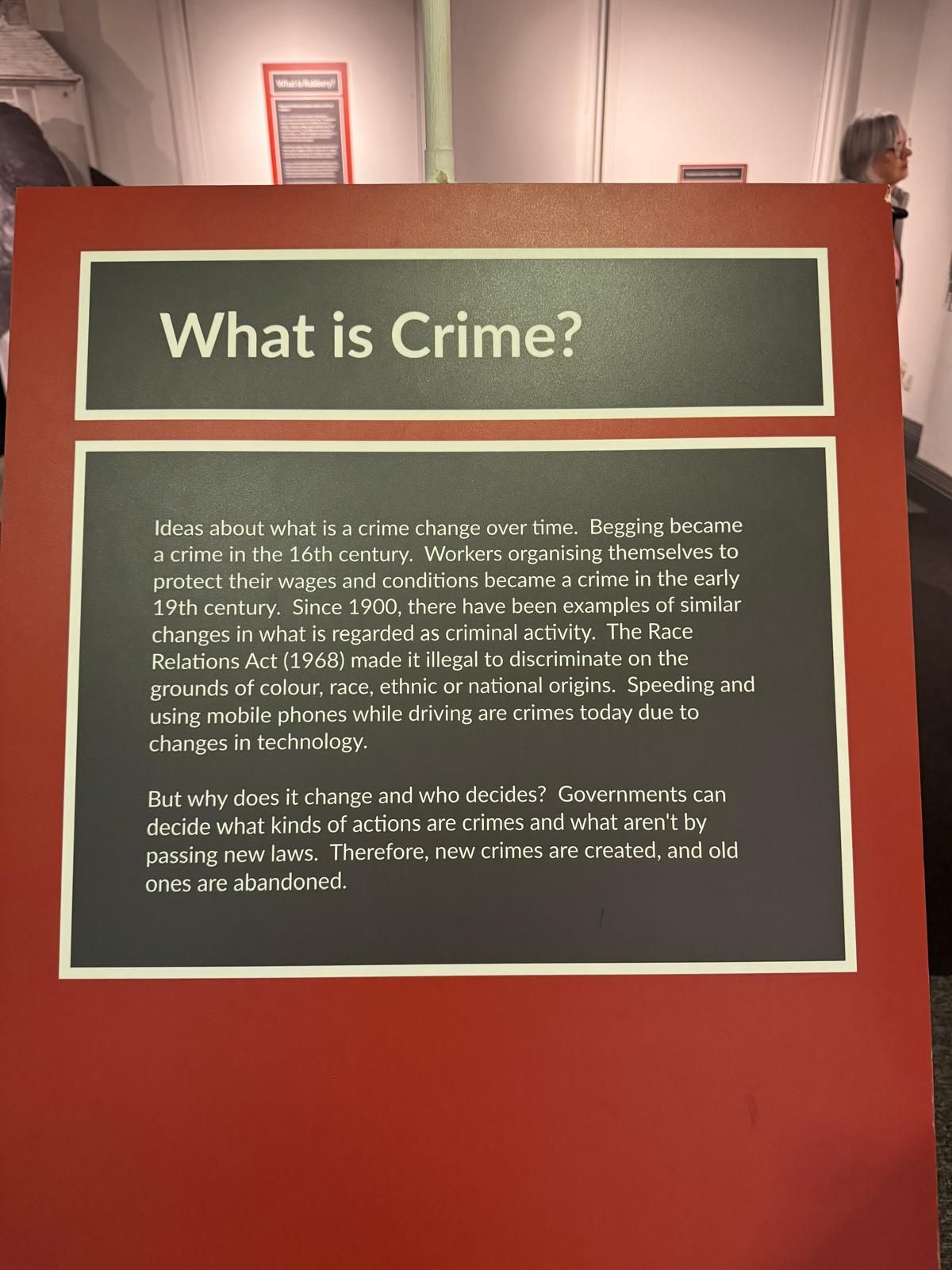
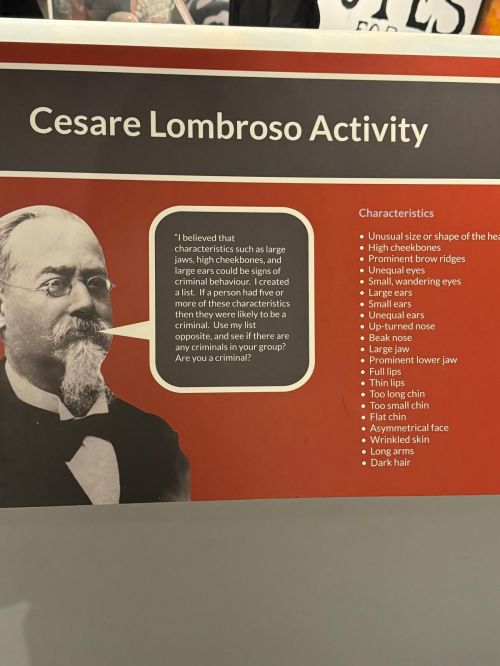
3. The Crime and Punishment Exhibit: This exhibit examines the relationship between crime and society, showcasing the changing perceptions of criminal behaviour over time. For example, one famous Criminologist of the day Cesare Lombroso, once believed that it was possible to spot a criminal based on their physical appearance such as high cheekbones, small ears, big ears or indeed even unequal ears. Since I was not familiar with Lombroso or his work, I enquired with the Criminology department as to studies that he used to reach the above conclusions. Although I believe he did carry out some ‘chaotic’ studies, it really reminded me that it is possible to make statistics say whatever it is you want them to say. This is the same point in relation to the law generally. As a lawyer I can make the law essentially say whatever I want it to say in the way I construct my arguments and the sources I include. Overall, The Inclusions of such exhibits raises and attempts to tackle difficult questions about personal and societal morality, justice, and the impact of societal norms on individual actions. By examining such leading theories of the time and their societal reactions, the exhibit encourages visitors to consider the broader implications of crime and the necessity of reform within the justice system. Do you think that today, deciding whether someone is a criminal based on their physical appearance would be acceptable? Do we in fact still do this? If we do, then we have not learned the lessons from history or really moved on from Cesare Lombroso.
Lessons on Justice and Society
The National Museum of Justice is not merely a historical site; it also serves as a platform for discussions about contemporary issues related to justice. Through its exhibits and programs, our group was invited to reflect on essentially- The Evolution of Justice: Understanding how laws have changed (or not!) over time helps us appreciate the progress (or not!) made in human rights and justice and with particular reference to women. It also encourages us to consider what changes may still be needed. For example, we were incredibly privileged to be able to access the archives at the museum and handle real primary source materials. We, through official records followed the journey of some women and girls who had been sent to reform schools and prisons. Some were given extremely long sentences for perhaps stealing a loaf of bread or reel of cotton. It seemed to me that just like today, there it was- the huge link between poverty and crime. Yet, what have we done about this in over two or three hundred years? This focus on historical cases illustrates the importance of learning from the past to inform present and future legal practices.
– The Importance of Fair Trials: The gallery emphasizes the significance of due process and the presumption of innocence, reminding us that justice must be impartial and equitable. In a world where public opinion can often sway perceptions of guilt or innocence, this reminder is particularly pertinent. The National Museum of Justice underscores the critical role that fair trials play in maintaining the integrity of the legal system. For example, if you were identified as a potential criminal by Cesare Lombroso (who I referred to above) then you were probably not going to get a fair trial versus an individual who had none of the characteristics referred to by his studies.
– Societal Responsibility: The exhibits prompt discussions about the role of society in shaping laws and the collective responsibility we all share in creating a just environment. The National Museum of Justice encourages visitors to think about their own roles in advocating for justice, equality, and reform. It highlights that justice is not solely the responsibility of legal professionals but also of the community at large.
– Ethics and Morality: The museum offers a platform to explore ethical dilemmas and moral questions surrounding justice. Engaging with historical cases can lead to discussions about right and wrong, prompting visitors to consider their own beliefs and biases regarding justice.
Conclusion
The National Museum of Justice in Nottingham is a remarkable destination that beautifully intertwines history, education, and advocacy for justice. By exploring its rich exhibits and engaging with its thought-provoking themes, visitors gain a deeper understanding of the complexities surrounding justice and its vital role in society. Whether you are a history buff, a legal enthusiast, a Criminologist or simply curious about the workings of justice, the National Museum of Justice offers a captivating journey that will leave you enlightened and inspired.
As we navigate the complexities of the modern world, it is essential to remember the lessons of the past and continue striving for a fair and just society for all. The National Museum of Justice stands as a powerful testament to the ongoing quest for justice, inviting us all to be active participants in that journey. In doing so, we honour the legacy of those who have fought for justice throughout history and commit ourselves to ensuring that the principles of fairness and equity remain at the forefront of our society. Sitting on that same bench that Emmeline Pankhurst once sat really reminded me of why I initially studied law.
The main thought that I was left with as I left the museum was that justice is not just a concept; it is a lived experience that we all contribute to shaping.

Share this:


Will Keir Starmer’s plans to abolish NHS England, help to save the NHS?

In a land-mark event, British Prime Minister Keir Starmer has unveiled plans to abolish NHS England, to bring the NHS back into government control. Starmer justifies much of this change with streamlining operations and enhancing efficiency within the NHS, that in recent years has faced a backlash following long queues and an over-stretched staff pool. Moreover, this is part of Starmer’s plan to limit the power of control from bureaucratic systems.
NHS England was established in 2013 and has taken control and responsibility of the NHS’s daily operational priorities. Primarily, NHS England is invested in allocating regional funds to local health care systems and ensuring the smooth delivery of health care across the NHS. However, concerns, particularly in Parliament have been raised in relation to the merging of NHS England and the Department’s of Health and Social care that is alleged by critics to have brought inefficient services and an increase of administrative costs.
Considering this background, the plans to abolish NHS England, for Starmer come under two core priorities. The first is enhancing democratic accountability. This is to ensure that the expenditures of the NHS are contained within government control, thus it is alleged that this will improve efficiency and suitable allocation of spending. The second is to reduce the number of redundancies. This is backed by the idea that by streamlining essential services will allow for more money to be allocated to fund new Doctors and Nurses, who of course work on the front line.
This plan by Starmer has been met with mixed reviews. As some may say that it is necessary to bring the NHS under government control, to eliminate the risks of inefficient services. However, some may also question if taking the NHS under government control may necessarily result in stability and harmony. What must remain true to the core of this change is the high-quality delivery of health care to patients of the NHS. The answer to the effectiveness of this policy will ostensibly be made visible in due course. As readers in criminology, this policy change should be of interest to all of us… This policy will shape much of our public access to healthcare, thus contributing to ideas on health inequalities. From a social harm perspective, this policy is of interest, as we witness how modes of power and control play a huge role in instrumentally shaping people’s lives.
I am interested to hear any views on this proposal- feel free to email me and we can discuss more!
Share this:


The Importance of Lived Experience in Making Change
***There is a content warning for this post as it briefly mentions self-harm***
I am a mature student entering the 3rd year of my degree, joint honours psychology and criminology. My choice in academic study (and hopeful career path) is largely informed by my own life experiences which have and will continue to be one of my biggest strengths. I have been in mental health services as a patient since my pre-teens and I have worked in a variety of mental health settings including inpatient forensic mental health and rehabilitation. My criminological interest was piqued after being a victim to violent crimes as an adult. All of this, as well as some conversations I have had with lecturers and peers over the last 2 years, has me thinking about the influence and importance of lived experiences in our academic and career choices, and the opportunities that lived experiences create for making change and battling adversity.
When we experience anything in life, big or small, positive or negative, we can gain incredible insight about ourselves and the world around us in a way that we would never have done if we didn’t have those experiences. It can change or set the trajectory of our lives. When we are in the correct place in our lives, our recovery, our minds to be able to pour from a cup that isn’t empty, we can find ourselves in an amazing place where we can help others and inspire change for those who have experienced or are likely to experience what we have. Perhaps even the ones who never have and never will. All equally as important.
Every system, service, or organisation needs to have the input from those who have experienced it from the other side. We need to know how the work is being perceived at the other end. It can be really difficult to collate feedback, especially the positive stuff, or see end-to-end results and we find that if no-one speaks up, what will be done is the easy thing, the cheap thing, or the well-intentioned but mismatched thing. Of course, we may be able to go beyond advice and become a part of a service or a voice ourselves and ‘be the change.’ We can inspire change by instilling more trust in others that we truly understand their predicament and that we have moved or are moving through it, showing them that it is possible or that they’re not alone. It can be refreshing and a huge learning experience for others in the service, as a user or provider, who may be stuck, going through the motions unequipped with knowledge of how to make change for the better, especially in sectors that can be particularly challenging day-to-day.
If I may give a personal example from when I worked on a psychiatric ward for forensic rehabilitation. I worked with many patients who felt as though it was staff vs patients, that we couldn’t possibly know what it was like for them, that we were only there because we were paid, and because they were detained against their will, we had to keep them there. I didn’t hide my personal experiences, my real reasons for being there, but no one really asked so I didn’t shout about them either. When the COVID-19 pandemic hit, for reasons of infection control, I had no choice but to obey a rule, ‘‘bare-below-the-elbow.’’ That meant I had to wear short sleeves on the ward. It meant revealing to my patients the scars I bear from self-harm. This prompted lots of questions, some less awkward than others, but it opened up so many wonderful conversations and breakthroughs. I spoke with my patients about knowing how that feels, that I’ve been on the medication they’re struggling with, and I’ve done the therapy they’re reluctant to try. It connected me to my patients and my work in such a wonderful way and meant my patients trusted me more, trusted the process more and engaged in ways they haven’t before. It meant that when decisions were made about patient care or ward processes, I could advocate from a place of empathy and understanding and in cases where people have their rights reduced or taken away, detained against their will, are vulnerable, are disadvantaged, we can’t do it enough.
Being loud about our experiences means raising awareness, breaking down stigma and stereotypes to create more inclusive and accepting societies, building supportive communities, and helping people along their path. It can serve as inspiration for people who may never have even given a thought to their experiences, things they witness or people who experience hardship and keep it under wraps.
Perhaps this even serves as a little nudge to be open to the experiences of others, to recognise and challenge your own biases, the things you may or may not understand. If you find yourself in a position to decide who to hire, interact with, which project to run; find the lived experience, consider the people who just need a little more support and feel like a little risk, because you never know what it could do. We can apply this to healthcare, criminology, charity, or anything that feels like it is our calling.
It can be such a tough and slow process, it won’t always be welcomed, it might not always work out. There may be people, services and societal norms or stigma that have an agenda or goals that don’t align with yours, not everybody likes change or will be willing to put in the effort. We may not always get the answers we are looking for because of the complex world we live in. But that doesn’t mean we shouldn’t try, right?

 Thoughts from the criminology team