
Home » International Law
Category Archives: International Law

Who needs enemies when you have friends like this?
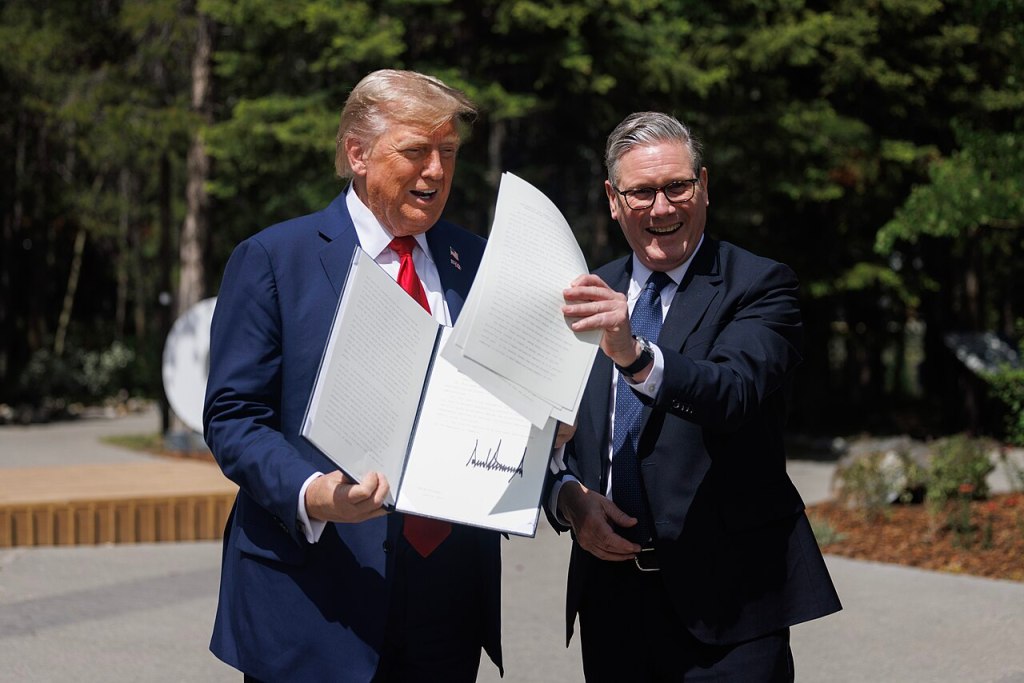
The so called ‘special relationship’ between the United States of America and the United Kingdom is certainly being tested at the moment. It is bizarre how the two leaders, if you can call them that, of two supposedly great nations can have their love/hate relationship played out so publicly. Remember not so long ago that cringe worthy handing over of the King’s invite by the Prime Minister to the President. This amid the fiasco of worldwide tariff hikes imposed by Donald Trump, or the Trump administration at his behest. Remember everyone globally, bar a few, running round in circles kowtowing to Trump whilst trying to get the best deal. Didn’t Trump look pleased with himself at the daily press conferences. And weren’t the United Kingdom falling over themselves with glee that they weren’t part of Europe and could get a better deal. And then we had the Ukraine war fiasco, Trump in his attempt to find peace was prepared to bully and belittle the president of Ukraine publicly. Actually, was it about finding peace or appeasing Putin, it really is quite unclear. Throw in the mix the genocidal attitudes of the Israeli government towards the Palestinians, supported by the USA, I mean what else could you call it if we are being truthful. It certainly wasn’t a measured response to Hamas’ atrocities; it is revenge and population clearance. I say is because that country is still being blockaded. Trump said he would bring peace in the Israel/Palestine conflict, and he would bring peace to Ukraine. Neither were nor could be so easily achieved. The response by Trump and his administration, start a conflict elsewhere. Of course, such a conflict suits Israel and their leader Benjamin Netenyahu. It allows the Israeli despot to continue in power despite allegations of corruption and war crimes. It allows Israel to continue its thinly veiled mission to drive the Palestinians out of the area, to land grab by opening up a second front in Lebanon. And before all this, statements by Trump that he wanted Canada to become another American state, that Greenland should be annexed, by force if necessary, and then of course the regime change in Venezuela, brought about by America’s intervention and let us not forget the murderous attacks on so called drug running boats. Blowing them out of the water seemed to be part of this what can only be described as real life gamification. You only have to listen to the rhetoric to realise this is a game to Trump and parts of his administration but with real life consequences. Eleanor Roosevelt must be turning in her grave as Israel and America attempt to trump each other on Human Rights and International Law violations. And yet nobody seems to be stopping them, nobody seems to dare, something reminiscent of Hitler’s rise in the 1930s. Somewhat Ironic given that the Israeli state was borne out of the atrocities of the Hitler’s regime. So, when Trump asked, nay demanded that the UK and others fall in behind the war game against Iran it is hardly surprising that the answer was no. This of course was met by a tantrum, toys thrown out of the pram stuff, that a two-year-old would have been proud of and some ‘really mean’ name calling with regards to the UK prime minister. Special relationship, more like an infantile friendship? And, when Israel hit Iran’s oil refinery the response from Trump was very much ‘That’s another nice mess you got me into’. As we watch oil prices go up, as Ukraine fears more Russian attacks funded by the lifting of embargoes by the US on Russian oil, as the people of Gaza and Lebanon fight for survival and as countries around the world ask themselves what next, one thing is certain, we don’t need enemies when we have friends like this.
As Donald Trump said, ‘when crazy people have nuclear weapons, bad things happen’. I think we’d all agree with that sentiment. Res ipsa loquitur.
Share this:


Is it time to unleash your criminological imagination?

In this blog entry, I am going to introduce a seemingly disconnected set of ideas. I say seemingly, because at the end, all will hopefully make sense. I suspect the following also demonstrates the often chaotic and convoluted process of my thought processes.
I’ve written many times before about Criminology, at times questioning whether I have any claim to the title criminologist and more recently, what those with the title should talk about. These come on top of hundreds of hours of study, contemplation and reflection which provides the backdrop for why I keep questioning the discipline and my place within it. I know one of the biggest issues for me is social sciences, like Criminology and many others, love to categorise people in lots of different ways: class, race, gender, offender, survivor, victim and so on. But people, including me, don’t like to be put in boxes, we’re complex animals and as I always tell students, people are bloody awkward, including ourselves! There is also a far more challenging issue of being part of a discipline which has the potential to cause, rather than reduce or remove harm, another topic I’ve blogged on before.
It’s no secret that universities across the UK and further afield are facing many serious, seemingly intractable challenges. In the UK these range from financial pressures (both institutional and individual), austerity measures, the seemingly unstoppable rise of technology and the implicit (or explicit, depending on standpoint) message of Brexit, that the country is closed to outsiders. Each of the challenges mentioned above seem to me to be anti-education, rather than designed to expand and share knowledge, they close down essential dialogue. Many years ago, a student studying in the UK from mainland Europe on the Erasmus scheme, said to me that our facilities were wonderful, and they were amazed by the readily available access to IT, both far superior to what was available to them in their own country. Gratifying to hear, but what came next was far more profound, they said that all a serious student really need is books, a enthusiastic and knowledgeable teacher and a tree to sit under. Whilst the tree to sit under might not work in the UK with our unpredictable weather, the rest struck a chord.
The world seems in chaos and war-mongers everywhere are clamouring for violence. Recent events in Darfur, Palestine, Sudan, Ukraine, Venezuela and many other parts of the world, demonstrate the frailty, or even, fallacy of international law, something Drs @manosdaskalou, @paulsquaredd and @aysheaobrien1ca0bcf715 have all eloquently blogged about. But while these discussions are important and pertinent, they cannot address the immediate harm caused to individuals and populations facing these many, varied forms of violence. Furthermore, whilst it’s been over 80 years since Raphäel Lemkin first coined the term ‘genocide’, it seems world leaders are content to debate whether this situation or that situation fits the definition. But, surely these discussions should be secondary, a humanitarian response is far more urgent. After all, (one would hope) that the police would not standby watching as one person killed another, all whilst having a discussion around the definition of murder and whether it applied in this context.
The rise of technology, in particular Generative Artificial Intelligence, has been the focus of blogs from Drs @sallekmusa, @5teveh and myself, each with their own perspective and standpoint. Efforts to combat the harmful effects of Grok enabling the creation of non-consensual pornographic images demonstrate both new forms of Violence Against Women and Girls [VAWG] and the limitations of control and enforcement. Whilst countries are rushing to ban Grok and control the access of social media for children under 16, it is clear that Grok and X are just one form of GAI and social media, there is seemingly nothing to stop others taking their place. And as everyone is well aware, laws are broken on a daily basis (just look at the court backlog and the overflowing prisons) and with no apparent way of controlling children’s access to technology (something which is actively encouraged in schools, colleges and universities) these attempts seem doomed to fail. Maybe more regulation. more legislation isn’t the answer to this problem.
Above I have briefly discussed four seemingly intractable problems. In each arena, we have many thousands of people across the globe trying to solve the issues, but the problems still remain. Perhaps we should ask ourselves the following questions:
- Maybe we are asking the wrong people to come up with the answers?
- Maybe we are constraining discussions and closing down debate?
- Maybe by allowing the established and the powerful to control the narrative we just continue to recycle the same problems and the same hackneyed solutions?
What if there’s another way?
And here we come to the crux of this blog, in Criminology we are challenged to explore any problem from all perspectives, we are continually encouraged to imagine a different world, what ought or could be a better place for all. I have the privilege of running two modules, one at level 4 Imagining Crime and one at Level 6 Violence. In both of these students work together to see the world differently, to imagine a world without violence, a world in which justice is a constant and reflection a continual practice. Walking into one of these classrooms you may well be surprised to see how thoughtful and passionate people can be when faced with a seemingly unsolvable problem when everything on the table is up for discussion. Although often misattributed to Einstein, the statement ‘Insanity is doing the same thing over and over again and expecting different results’ seems apposite. If we want the world to be different, we have to allow people to think about things differently, in free and safe spaces, so they can consider all perspectives, and that is where Criminology comes in.
Be fearless and unleash your criminological imagination, who knows where it might take you!
Share this:


The Caracas Job: International Law and Geo-Political Smash and Grab

So, they actually did it, eh?
It’s January 2026, and I, for one, am still trying to remember my work logins and wondering if this is the year that Aliens invade Earth. Yet, across the pond, the Americans have decided to kick off the New Year with a throwback classic: decapitating a sovereign Latin-American government.
Adiós Maduro. We hardly know yer pal. Well, we all knew you enough to know you were a disastrous authoritarian kleptocrat who managed to bankrupt a country sitting on a lake of oil. But we need to talk about how it happened, because if you listen carefully enough to the wind wuthering through the empty corridors of the UN Building in New York, you can probably hear the death rattle of what I once studied and was quaintly entitled, ‘Rules-Based International Order’-aka International Law.
As one colleague and our very own Dr Manos Daskolou pointed out to me this very day, it’s almost eighty years since 1945. Eight decades of pretending we built a civilised global architecture out of the ashes of World War II. We built tribunals in The Hague, we wrote very sternly worded Geneva Conventions, and we created a Security Council where superpowers could veto each other into paralysis. It was a lovely piece of Geo-Political theatre.
The days-old removal of the Venezuelan head of state by direct US intervention isn’t just a deviation from the norm: it’s a flagrant breach of the foundational prohibition on the ‘use of force’ found in Article 2(4) of The UN Charter. The mask has slipped, and underneath it is just raw, naked power.
As a Brit observing this rigmarole from the very cold and soggy sidelines, it’s hard not to view this from a very specific lens. We invented modern imperialism, after all. Criminologists will often discuss concepts like State Crimes. They will often question who indeed polices the Police?
If I decide to kick down my neighbour’s door because I don’t like the way she runs her household, steal her assets and install her sister as the new head of the family, I’m going to court. I am a burglar, a thug and a violent criminal. If a superpower does the same thing to a sovereign nation, they get a press conference at Mar-a-Lago.
For eighty years, the West has been incredibly successful at labelling its own interventions as ‘police actions’ or ‘humanitarian missions’, all the while labelling acts of rivals as ‘aggression’. The Caracas job is the ultimate expression of this.
Listen to the rhetoric coming out of Washington right now. It’s textbook gaslighting. ‘Maduro was a tyrant’, ‘Other countries do worse’, i.e condemning the condemners. They certainly are not arguing that entry into Caracas was legal under the UN Charter was legal because it most definitely wasn’t. They are arguing that the law should not apply to them because their intentions were pure.
Deja Vu-Iraq
The darkest irony of the Venezuelan decapitation is the crushing sense of deja vu. We cannot talk about removing a dictator in the 2020s without flashbacks to Saddam Hussein and Dr David Kelly entering the scene. The parallels are screaming at us. In 2003, the justification for taking Saddam (and, sadly, Dr Kelly as a direct result) out was a cocktail of WMD lies and dangerous rhetoric. As the Chilcot Report stated years ago, the legal basis for military action against Iraq was ‘far from satisfactory’.
The critical failure in Iraq and the one we are doomed to repeat in Venezuela is that it is terrifyingly easy for a superpower like the USA to smash a second-rate military. The hard part is what on earth comes next?
Perhaps it would have been better for the superpowers to manipulate Maduro’s own people, taking him out, so to speak. Organic change in any situation lends legitimacy that enforced or imported change never does. When you decapitate a state at 30,000 feet, you create a vacuum. The USA may have created a dependency, effectively violating the principle of self-determination, which is enshrined in the Human Rights Convention.
The Iranian Elephant In The Room
Of course, none of this is actually happening in a vacuum. Being a Yorkshire lass with Middle Eastern Heritage, I am keenly aware of the politics of the regions hitting the headlines on an almost daily basis. Yet, no one has to have bloodline ties to any of the countries or regions involved to see the obvious Elephant in the room. It’s that flipping obvious. Maduro wasn’t just an irritant because of his economy-crashing style. It was a strategic flipping of the bird for America’s rivals-Crucially, Iran. This is where the narrative gets even darker. This is gang warfare.
The danger here is escalation. If Tehran decides that the fall of Maduro constitutes a direct challenge to its own deterrence strategy, it will not retaliate in the Caribbean. They are likely (if history has taught us anything) to retaliate in the Strait of Hormuz. The butterfly effect of a regime change in Caracas could easily result in the closure of the Suez Canal. Yes, that old chestnut.
The old guard loved International Law. They loved it because they knew how to manipulate it. They used the UN Council like a skilled Barrister uses a loophole. They built coalitions. The current approach-Let’s call it ‘Act Now Think Later Diplomacy’ dispenses with the formalities and paperwork. It sees International Law NOT as a tool to be manipulated, but as an annoying restraint to be ignored. It confirms the narrative that the Nuremberg trials were merely ‘Victors’ Justice’, a system where legal accountability is the privilege of the defeated.
The difference between Putin invading Ukraine and the USA decapitating Venezuela is rapidly becoming a distinction without a difference.
So, here we go in 2026. The powerful have shown they don’t give a toss about the rules. They’ve shown that ‘sovereignty’ is just a word they use in speeches, not really a word they respect.
When people stop believing in the legitimacy of the law, they usually stop following it. We are about to see what happens when the entire world stops believing in the legitimacy of International Law.
It is going to be a messy few decades. Cheers, mine’s a double.

 Thoughts from the criminology team


