
Home » Institutional Violence (Page 8)
Category Archives: Institutional Violence

“I can’t breathe”: Criminology, Science and Society

Sometimes the mind wanders; the associations it produces are random and odd, but somehow, they connect. In the book of Genesis, there is reference to the first murder. Cain murdered Abel with a stone making it the original murder weapon. After some questioning from God, who acted as an investigating officer, and following a kind-of admission, God then assumed the role of the judge and jury, sentencing him to wander the earth. This biblical tale is recounted by all three main monotheistic religions, a what to do in the case of murder. The murderer is morally fallen and criminally dealt by with a swift punishment.
There is no reason to explore the accuracy of the tale because that is not the point. Religion, in the absence of science, acted as a moral arbitrator, sentencing council and overall the conscience of society. In a society without science, the lack of reason allows morality to encroach on personal choices, using superstition as an investigative tool. As scientific discovery grew, the relevance of religion in investigation was reduced. The complexity of society required complex institutions that cared for people and their issues.
When the Normans landed in England, they brought with them a new way of dealing with disputes and conflict. Their system of arbitration, using the King as a divine representative, was following Roman tradition and theology but it soon became apparent that a roaming court may not be as efficient. The creation of the magistrates and the statutes on legal representation introduced the idea of bringing professionals into justice. The creation of new institutions fostered the age of the scholar, who uses evidence-based practice.
This new approach removed more religious practices, instead favouring the examination of facts, the investigation of testimony and the study of law. It was a long way away from the system we know now as the witch trials can attest to; a number of whom took place in East Anglia (including Northampton). In the end the only thing that has been left from the early religious trials is the oath witness take when they submit their testimony.*
The more we learn the better we become in understanding the world around us. The conviction that science can resolve our problems and alleviate social issues was growing and by the 19th century was firm. The age of discovery, industrialisation and new scientific reasoning introduced a new criminal justice system and new institutions (including the police). Scientific reasoning proposed changes in the penal code and social systems. Newly trained professionals, impervious to corruption and nepotism, were created to utilise a new know-how to investigate people and their crimes.
Training became part of skilling new mandarins in a system that reflected social stratification and professionalism. The training based on secular principles became focused on processes and procedures. The philosophy on the training was to provide a baseline of the skills required for any of the jobs in the system. Their focus on neutrality and impartiality, seemed to reflect the need for wider social participation, making systems more democratic. At least in principle that was the main idea. Over centuries of public conflict and social unrest the criminal justice system was moving onto what people considered as inclusive.
Since then the training was incorporated into education, with the new curriculum including some BTECs, diplomas, foundation studies and academic degrees that take on a variety of professions from investigative fields to law enforcement and beyond. This academic skilling, for some was evidence that the system was becoming fairer and their professionals more educated. Police officers with knowledge of the system, akin to lawyers to the probation service and so on. So far so good…but then how do we explain the killing of George Floyd? Four officers trained, skilled, educated and two of them experienced in the job.
If this was a one, two three, four, -offs then the “bad apple” defence seems to be the most logical extrapolation on what went wrong. If, however this is not the case, if entire communities are frightened of those who allegedly serve and protect them, then there is “something rotten in the state of Denmark”. Whilst this case is American, it was interesting to read on social media how much it resonated, in communities across the globe of those who felt that this was nothing more than their own everyday experience with law enforcement. For them, police is merely a mechanism of repression.
Since the murder I have read a number of analyses on the matter and maybe it worth going a bit further than them. In one of them the author questioned the validity of education, given than two of the officers in the Floyd case hold a criminal justice and a sociology degree respectively. There is a vein of truth there; educators have some responsibility to forge and promote professional conduct and ethical practice among their alumnus. There are however some other issues that have not been considered and it is time for these to be brought to the surface.
Education or training alone is not adequate to address the complexities of our society. Social awareness, cultural acceptance and the opportunity to reflect on the rules using problem solving and insight are equally important. Foucault has long argued that the justice system is inherently unfair because it preserves privileges and blocks anyone outside from challenging it. Reflecting on that, all major constitutional changes took place after a revolution or a war, indicating the truism in his observation.
If we are to continue to train people on procedures and processes the “bad apples” are likely to strike again. The complexity of social situations requires an education that ought to be more rounded, critical and evaluative. If a doctor takes an oath to do no harm, then so should every other professional who works in their community. If the title of the office is more appealing than the servitude, then the officer is not fulfilling their role. If we do not recognise equality among all people, then no training will allow us to be fair. Suddenly it becomes quite clear; we need more education than less, we need knowledge instead of information and we need more criminology for those who wish to serve the system.
*Even that can now be given as an affirmation

Share this:


We are Spartacus: the publishing industry and race
As one of only a handful of non-white authors on the British crime fiction map, I thought it might be worthwhile spending a moment reflecting on the worldwide rebalancing touched off by the George Floyd killing in America. Fear not. There’s no need to put on your tin hats and dive for the trenches. My purpose isn’t to haul anyone over the coals. But there’s little doubt that some of what I say might make for uncomfortable reading. More importantly, I will ask you to reflect, at a personal level, on what we mean by systemic inequality, particularly as it applies to the publishing industry.

First, some background. My parents are from the subcontinent. They came to the UK in the early seventies, lured by the immigrant dream. The streets of London may not have been paved with gold, but they were paved with opportunity. My father, who was not literate, spent his life in honest labour, in an industrial bakery, while my mother raised children, demonstrating the much-lauded immigrant work ethic by slaving away at her sewing machine every hour she wasn’t feeding us or stopping us from poking each other’s eyes out with eraser-tipped pencils. She instilled in us the need, above all else, to study, to educate ourselves, to progress.
So far, so good.
But what if I were to tell you that my parents were, in a broad sense, xenophobes, too? Not overtly. They didn’t oppress anyone; or traffic slaves across the oceans; or pillage defenceless communities for profit. But their attitude towards black people – cultivated by the insular world they had grown up in – was, at best, indifferent, or, at worst, mistrustful.
Here’s a simple, unpalatable truth. Racism, in its most basic form, is a feature of most societies. It shouldn’t be. But it is. A simple example illustrates my point.
The outpouring of angst and handwringing currently gripping the world has seen celebrities across the globe express their views on racism (rightly so), only for some to discover that a seat on this particular bandwagon can be an uncomfortable one. In India, numerous Bollywood stars were called out for the disparity between their #blacklivesmatter tweets and the fact that they had fronted campaigns for skin-lightening creams. Across the subcontinent, lighter skin has traditionally been valued (usually alluded to in matrimonial ads by the rainbow-bending adjective “wheatish”), so much so that white foreigners, especially Brits, are treated with overt deference, while black people are routinely afforded a lesser welcome. An odd perversity, given that it was the whites that pillaged the subcontinent for three centuries while, with those of Afro-Caribbean descent, one might assume Indians would evince a colonial-era solidarity.
Let me be clear: this idea of a sort of universal xenophobic instinct does not in any way excuse or mitigate the horrors of the slave trade, or the enormous, long-term damage done to black people because of that terrible practice. Nor does it justify the entrenched, systemic prejudice that continues to colour western societies, prejudice that culminates in overt racism of the kind that permits white American policemen to routinely kill black men with little fear of reprisal, and prejudice of the less obvious kind that serves to keep black people ‘in their place’. My point was merely to demonstrate that, in the wider, global race equality agenda now under discussion, we all have a part to play.
Part of the issue is that many well-meaning efforts to redress the balance are hampered by a profound lack of insight into how unconscious bias can affect the lives of people of colour, in a million different, small, but, ultimately, debilitating ways. The problem is further hampered by an education system that often fails to properly tackle the ‘race issue’.
Yet, the problem must be addressed. Because the world has become a smaller place. The goldfish bowl has shrunk and we are now all swimming in the same seas. It behoves us to make the effort, not just because it is the right thing to do, but because it is also the most effective means of progressing humanity towards a more equitable, more meritocratic, global society. If the Covid-19 pandemic has proven anything, it is how interdependent we are.
Coming, now, to the publishing industry. Cards on the table. Since my first book was published six years ago, I have received tremendous support from my agent, publisher, critics, bloggers, readers, event organisers, and crime writers. My experience is not typical. A simple look at the statistics tells us what we already know. Any way you slice it and dice it – diversity of publishing staff, published writers of colour, books featuring characters of colour – the industry is dominated by white thought and enterprise. Some of this can be ascribed to the fact that, in terms of population, BAME communities, by definition, are a minority. You wouldn’t expect there to be a 50:50 split along these dimensions. That isn’t the issue. The problem is the entrenched attitudes that make it so damned difficult for writers of colour to break into the industry and then to enjoy the same rewards and freedom of expression that is accorded to their white counterparts.
The world’s most successful crime writer, James Patterson, became famous with a series about a streetwise black detective, Alex Cross. James Patterson is not black. Nothing wrong with that scenario, in my opinion. Authors should not be constrained by artificial constructions of propriety. But, if the industry is being honest with itself, it will acknowledge that a writer of colour attempting to do something similar – trying, as it were, to write outside of their cultural straightjacket – is rarely accorded the same privilege. Questions of ‘authenticity’, ‘voice’ and ‘cultural appropriation’ suddenly come racing to the fore, like Cinderella’s ugly sisters questioning our right to go to the ball. Asian writers, for instance, are often expected to pen literary tomes about colonialism or exposes of the immigrant experience. Again, nothing wrong with that, and, indeed, brilliant writing is regularly published exploring those themes. But there are so many other stories that we would like to tell. White writers can be published writing about matters far outside their experience – wizards, serial killers, aliens. But for non-white writers, the same consideration is much harder to find. A lot of this is not the result of overt racism, but rather the mindset that accepts as perceived wisdom the idea that profitability comes almost entirely from white authors writing white stories, or writers of colour writing stories suited to their ethnic background. This thought is so prevalent in the industry that it may as well be an eleventh commandment.
A terrific article by Laura B. McGrath, associate director of the Stanford University Literary Lab, in a Jan 2019 issue of the Los Angeles Review of Books, entitled “Comping White” identifies the true nature of the problem. Paraphrasing her research, it goes like this: publishers buy new books by comparing them to books that have been successful. Is this the new Harry Potter? Is this the next Gone Girl? Given that the majority of books are white, the process becomes a closed loop, a vicious cycle. The industry buys and promotes white books because they sell. White books sell because they’re the only books the industry buys and promotes. Do you see the problem?
Making the gatekeepers more diverse, McGrath argues, will have only a marginal impact. It’s the system that’s at fault. The same applies to practically any walk of life that you might care to name – hence the reason so few people of colour in boardrooms, or lecturing at top universities, or opening Michelin-starred restaurants. White people have done all those things successfully before, so why take a chance on the unproven?
Until we change this structural, often unconscious, bias, all the current furore around race will do little to improve the prospects of the average BAME person.
Can readers help? Of course! By voting with their feet. By buying books written by authors of colour, readers signal to publishers that they won’t be put off by a ‘funny-sounding’ name on the cover, or a protagonist who doesn’t share their own cultural background. The only bar should be quality.
In an ideal world, a good story, well told, should stand on its own merits.
What else can we do? In my opinion, people shape people. If we want better, more thoughtful attitudes in the industry, we must all stand up and be counted. Solidarity is the name of the game. A solidarity of thought that acknowledges that a genuine change of perspective is needed. From agent to reader, all along the chain. What we need, in other words, is for all of us to stand up and say: ‘We are Spartacus.’
Vaseem Khan, author, Midnight at Malabar House and Baby Ganesh series
London, June 2020
Share this:


How I became an evil man
My love of poetry came in my sleep like a dream, a fever I could not escape and in little hours of the day I would read some poetry from different people who voice the volume of their emotions with words. In one of those poems by Elleni Vakalo How he became a bad man, she introduced me to a new understanding of criminological thinking. The idea of consequences, that lead a seemingly good person to become bad, without the usual motivational factors, other than fear. This was the main catalyst that became the source of this man’s turn to the bad.
This almost surrealistic description of criminal motivation has since fascinated me. It is incredibly focused, devoid of social motivations and personal blame. In fact, it demonstrates a social cognition that once activated is powerful enough to lead a seemingly decent person to behave in uncharacteristic moves of violence. This interesting perspective was forged during the war and the post war turmoil experienced. Like Camus, the act of evil is presented as a matter of fact and the product of thoughts that are originally innocent and even non-threatening.
The realisation in this way of thinking, is not the normalisation of violence, but the simplicity that violence in innate to everyone. The person who commits it, is not born for it, does not carry an elaborate personal story or trauma and has no personal compulsion to do it. In some ways, this violence is more terrifying, as criminality can be the product of any person without any significant predispositions, an everyday occurrence that can happen any time.
The couple that will meet, fall in love, cohabit, and get married, starting a family, follow all the normal everyday stages that millions of people follow or feel socially obliged to follow. In no part of this process do they discuss how he will control her, demean her, call her names, slap her, hit her or kick her. There is no plan or discussion of how terrified she will become, socially isolated and humiliated. At no point in the planning, will she be thinking of ways to exit their home, access helplines or spend a day in court. It happens, as a product of small thoughts and expressed emotions, that convert into micro aggressions, that become overt hostility, that leads to violence. No significant changes, just a series of events that lead to a prolonged suffering.
In some way, this matter of fact violence explains the confusion the victims feel, trapped in a relationship that they cannot recognise as abusive, because all other parts fall under the normality of everyday life. Of course, in these situations, emotion plays a key role and in a way that rearranges logic and reason. We are driven by emotion and if we are to leave criminological theory for a minute a series of decisions, we will make daily take a journey from logic to emotions and back.
This emotional change, the manifestation of thoughts is not always criminal nor destructive. The parents who are willing to fight an entire medical profession so that their newborn has a fighting chance are armed with emotion. Many stories come to mind of those who owe their lives to their determination of their parents who fought logic and against the odds, fought to keep them alive. Friends and partners of people who have been written off by the criminal justice system that assessed them as high risk for society and stuck with them, holding on to emotion as logic departs.
In Criminology, we talk about facts and figures, we consider theories and situations, but above all as a social science we recognise that we deal with people; people without emotions do not exist. So how do you/how do I become a bad man? Simple…the same way you are/I am a good man.
This is the poem by Eleni Vakalo, with my painful translation:
How He Became A Bad Man

I will tell you how it happened
In that order
A good little man met on his way
a battered man
the man was so close from him laying
he felt sad for him
He was so sad
That he became frightened
Before approaching him to bend down to
help him, he thought better
“What do you want, what are you looking for”
Someone else will be found by so many around here,
to assist this poor soul
And actually
I have never seen him
And because he was scared
So he thought
Would he not be guilty, after all no one is hit without being guilty?
And they did him good since he wanted to play with the nobles
So he started as well
To hit him
Beginning of the fairy tale
Good morning
Share this:


Some lessons from the lockdown
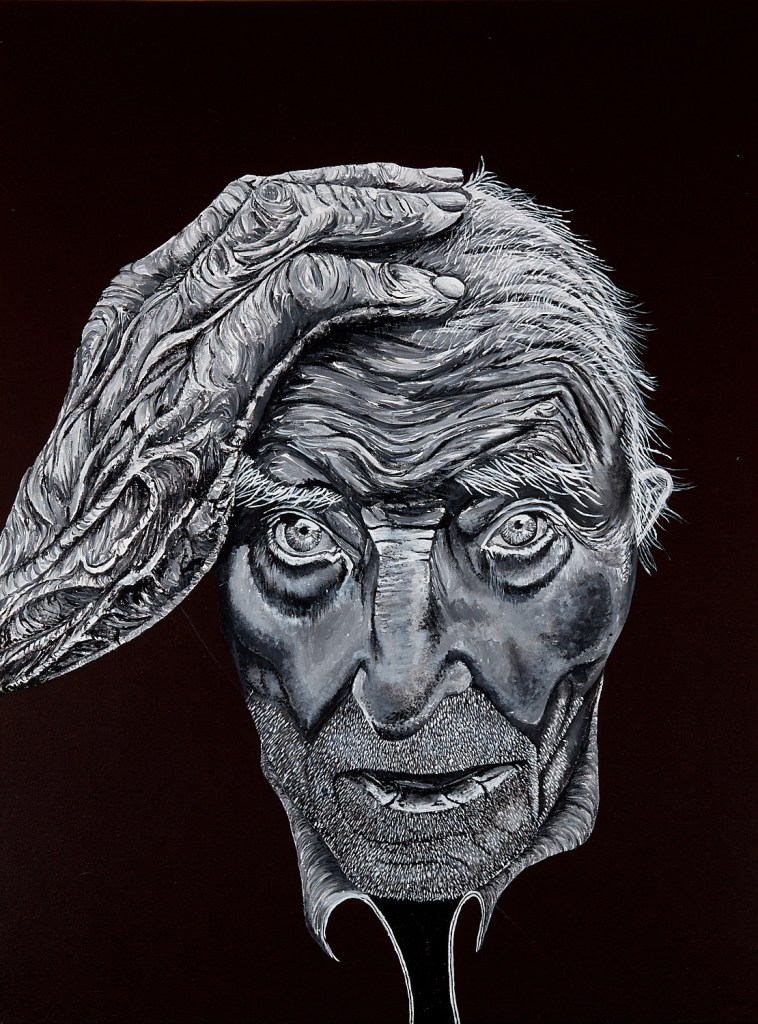
Koestler Arts (2019), Another Me: The Redwoods Centre (secure mental health unit), James Wood QC Silver Award for Portrait, 2019
In March 23, 2020, the UK went into lockdown. The advice given, albeit conflicting in parts, was clear. Do not leave your home unless absolutely necessary, banning all travel and social interactions. This unprecedented move forced people to isolate at home for a period, that for some people will come to an end, when the WHO announces the end of the pandemic. For the rest of us, the use of a face mask, sanitiser and even plastic gloves have become modern day accessories. The way the lockdown was imposed and the threat of a fine, police arrest if found outside one’s home sparked some people to liken the experience with that of detention and even imprisonment.
There was definite social isolation during the pandemic and there is some future work there to be done to uncover the impact it has had on mental health. Social distancing was a term added to our social lexicon and we discovered online meetings and working from home. Schools closed and parents/guardians became de facto teachers. In a previous blog entry, we talked about the issues with home schooling but suffice to say many of our friends and colleagues discovered the joys of teaching! On top of that a number of jobs that in the past were seeing as menial. Suddenly some of these jobs emerge as “key professions”
The first lesson therefore is:
Our renewed appreciation for those professions, that we assumed just did a job, that was easy or straightforward. As we shall be coming back eventually to a new normality, it is worth noting how easy it will be to assign any job as trivial or casual.
As online meetings became a new reality and working from home, the office space and the use of massive buildings with large communal areas seemed to remain closed. This is likely to have a future impact on the way business conduct themselves in the future.
Second lesson:
Given how many things had to be done now, does this mean that the multi occupancy office space will become redundant, pushing more work to be done from home. This will alter the way we divide space and work time.
During the early stages of the lockdown, some people asked for some reflection of the situation in relation to people’s experiences in prisons. The lockdown revealed the inequality of space. The reality is that for some families, space indicated how easy is to absorb the new social condition, whilst other families struggled. There is anecdotal information about an increase on mental health and stress caused from the intensive cohabitation. Several organisations raised the alarm that since the start of the lockdown there has been a surge in incidents of domestic violence and child abuse. The actual picture will become clearer of the impact the lockdown had on domestic violence in future years when comparisons can be drawn. None the less it reveals an important issue.
Third lesson:
The home is not always the safest place when dealing with a global pandemic. The inequality of space and the inequality in relationships revealed what need to be done in the future in order to safeguard. It also exposed the challenges working from home for those that have no space or infostructure to support it.
In the leading up to the lockdown many households of vulnerable people struggled to cope with family members shielding from the virus. These families revealed weaknesses in the welfare system and the support they needed in order to remain in lockdown. Originally the lack of support was the main issue, but as the lockdown continued more complex issues emerged, including the financial difficulties and the poverty as real factors putting families at risk.
Fourth lesson:
Risk is a wider concern that goes beyond personal and family issues. The lockdown exposed social inequality, poverty, housing as factors that increase the vulnerability of people. The current data on Covid-19 fatalities reveal a racial dimension which cannot longer be ignored.
During the lockdown, the world celebrated Easter and commemorated Mayday, with very little interaction whilst observing social distancing. At the end of May the world watched a man gasping for breath that died in police custody. This was one of the many times the term police brutality has related to the dead of another black life. People took to the streets, protested and toppled a couple of statues of racists and opened a conversation about race relations.
Fifth lesson:
People may be in lockdown, but they can still express how they feel.
So, whilst the lockdown restrictions are easing and despite having some measures for the time being, we are stepping into a new social reality. On the positive side, a community spirit came to the surface, with many showing solidarity to those next to them, taking social issues to heart and more people talked of being allies to their fellow man. It seems that the state was successful to impose measures that forced people indoors that borderline in totalitarianism, but people did accept them, only as a gesture of goodwill. This is the greatest lesson of them all in lockdown; maybe people are out of sight, appear to be compliant in general but they are still watching, taking note and think of what is happening. What will happen next is everyone’s guess.
Share this:


“Things you need to know about criminology”: A student perspective – Mary Adams, recent Graduate and mature student.

We are all living in very strange times, not sure when life will return to normal...but if you're thinking about studying criminology, here is some advice from those best placed to know!

The most important module to my understanding of criminology is: I would have to say they are all equally important for understanding different aspects of Criminology. In first year I loved The Science of Crime which showed how things have evolved over time, and that what we now see as funny was actually cutting edge in its day. True Crime also makes you look beyond the sensational headlines and separate fact from fiction. In second year Crime & Justice gave a brilliant grounding in the inner workings, and failings, of the criminal justice system. And in third year, the Violence module explores personal and institutional violence, which is especially relevant in current times

The academic criminology book you must read: Becker’s Outsiders and Cohen’s Folk Devils and Moral Panics are a must. I also found Hopkins-Burke’s An Introduction to Criminological Theory and Newburn’s Criminology essential reading for first year as well as Finch & Fafinski’s Criminological Skills. For second year I recommend Davies, Croall & Tyrer’s Criminal Justice. If you choose the Violence module in third year you will be grateful for Curtin & Litke’s Institutional Violence. And don’t forget Foucault’s Discipline & Punish!

The academic journal article you must read:
There are so many excellent journal articles out there, it’s difficult to choose! Some of my favourites have been:
'Alphonse Bertillon & the measure of man' by Farebrother & Champkin;
'Bad Boys, Good Mothers & the ‘’Miracle’’ of Ritalin by Ilina Singh';
'Detainee Abuse & the Ethics of Psychology' by Kathryn French;
'Attachment, Masculinity & Self-control' by Hayslett-McCall & Bernard;
'Grenfell, Austerity & Institutional Violence' by Cooper & Whyte;
'The Phenomenology of Paid Killing' by Laurie Calhoun;
'A Utilitarian Argument Against Torture Interrogation of Terrorists' by J. Arrigo.

The criminology documentary you must watch:
Without a doubt, a must-see is the Panorama documentary London Tower Fire: Britain’s Shame. I would also highly recommend the movie The Stanford Prison Experiment

The most important criminologist you must read:
Of course you must read Lombroso, Beccaria & Bentham. I also enjoyed reading work by feminist criminologists like Pat Carlen, Carol Smart & Sandra Walklate. And of course, Angela Davis is a must!

Something criminological that fascinates me:
What fascinates me is how the powers that be, and a good proportion of the public, cannot seem to realise that social injustice is one of the major factors behind why people commit crime. And the fact that putting more & more people in prison is seen as a ‘good’ thing is mind-boggling!

The most surprising thing I know about criminology is:
The fact that it is such a diverse subject & incorporates so many other disciplines

The most important thing I've learnt from studying criminology is:
Question everything! Don’t take anything at face-value. Try to look beyond the attention grabbing headlines to find out the real story. Read, read, read!

The most pressing criminological problem facing society is:
Unfortunately I think there are many pressing problems facing society today, the main ones being social injustice & inequality, systemic racism, institutional violence, and mass incarceration


When family and friends ask, I tell them criminology is:
Some people joke that I’m learning how to be a criminal! Others think it’s all about locking people up! I tell them it’s all about looking at the mechanisms in-built in our society that disadvantage & discriminate against whole groups of people, and that, unless we are part of the rich & powerful elite, any one of us could find ourselves in the ‘out’ group at any time. I also tell them to stop reading The Daily Mail, vote Labour, and question everything!!
Share this:


A racist and no solution

I am a white, middle class some might say (well my students anyway), ageing, male. I wasn’t always middle class, I’m from working class stock. I’m a university lecturer now but wasn’t always. I spent 30 years in the police service in a small, ethnically diverse, county in England. I didn’t consider myself a racist when I was in the police service and I don’t consider myself a racist now. Nobody has called me a racist to my face, so why the title? It’s how I’m constantly labelled. Every time someone says the police are racist or the police are institutionally racist, they are stating that about me. Just because I have left the police organisation doesn’t change who I am, my beliefs or my values. So, if the police are racist, then by default, I must be.
I’m not suggesting that some police officers are not racist, of course some are. Nor am I denying that there has been and probably still is some form of institutional racism within the police service, perhaps as a whole or perhaps at a more localised or departmental level. But bad apples and poorly thought-out, naïve or even reckless policies, strategies and procedures are not enough to explain what is going on in policing and policing of ethnic minority groups in particular. I’m talking about policing in this country, not across the pond where policing is very different in so many ways that it is hard to even suggest a realistic comparison. That of course is the first problem, what happens in the United States of America is immediately translated into what happens here.
As a lecturer, I constantly hear from students and read students’ work about the racist and brutal police, often interchanging commentary from the United States with commentary here in the United Kingdom, whilst also failing to recognise that there is different policing in Scotland and Northern Ireland. Institutional racism, as defined by Macpherson, is now part of the lexicon, but it no longer has the meaning Macpherson gave it, it is now just another way of saying the police are and every police officer is racist. Some students on finding out that I was a police officer show an instant dislike and distrust of me and sometimes it can take the whole three years to gain their trust, if at all. Students have been known to request a different dissertation supervisor, despite the fact that their research subject is in policing. This is not a complaint, just a statement of facts, painful as it is.
As I try to make sense of it all, I have so many unanswered questions. What is exactly going on? What is causing this conflict between the police and ethnic minority groups? Why is there a conflict, why is there distrust? More importantly, how can it be fixed? Some of the answers may lay in what the police are asked to do, or at least think they are asked to do. Reiner suggests that policing is about regulating social conflict, but which conflict and whose conflict is it? Other authors have suggested that the police are simply a means to allow the rich and privileged to maintain power. There may be some merit in the argument, but most policing seems to take place in areas of deprivation where the disadvantaged are committing crimes against the disadvantaged. The rich and powerful of course commit crimes but they are nowhere near as tangible or easy to deal with. One the problems might be that the rich and powerful are not particularly visible to policing but the disadvantaged are.
Maybe some of the answers lay in notions of stereotyping, sometimes even unconsciously. Experience or narratives of experiences cause a wariness, even a different stance to one people might normally assume. Being thumped on the nose by a drunk, does tend to make a person wary of the next drunk they encounter. So, could stereotyping be a problem on both sides of the divide? My dissertation student that didn’t want me as a supervisor was later to reveal experiences of racist abuse aimed at the police officers she went out on patrol with. Policing is dominated by white males and despite recruitment drives to address the ethnicity gap, this really hasn’t been that successful. If it was meant to help solve a problem, it hasn’t.
I get the sense though that the problem is much deeper routed than policing. Policing and the problems of policing is just a sub plot in a much wider issue of a divided society and one that is in constant conflict with itself. If the police are guilty of racism, then it is society that has caused this. Our society’s values, our society’s beliefs. An unequal society where the poorest suffer the most and the rich get richer regardless. A society where we are all equal but only because someone somewhere said so at some time, it is not reality. I think of Merton’s ‘American Dream’, I don’t buy into the whole concept, but there is something about not having opportunities, equally when I think of Lea and Young and the concept of relative deprivation, whilst not explaining all crime, it has some merit in that notion that the disenfranchised have no voice.
As I write this I am conscious that I have commentated on a very emotive subject particularly at this time. As I watch the events unfold in America, I fear the worst, action followed by reaction. Both becoming increasingly violent and I see the possibility of it happening in this country. I fear that the term ‘police racism’ will become another convenient label. Convenient in the sense that the problems are seen solely as that of policing. If we examine it through a different lens though, we might just find that policing is simply part of the whole rotten tree, society. Fix society and you fix policing. If the label racist fits, it fits the society we live in.

Share this:


Volunteering Matters

Some people volunteer because they have to, I volunteer because I want to. From a personal perspective I knew that the foodbank was the place that I wanted to be at.
I started volunteering in 2016, doing just 1 day a week and as the years have gone by it has meant more hours spread over a couple of days, especially during the Christmas holidays which are incredibly busy. Proving that many volunteers are necessary and needed to help keep it going.
It is a place that suits me because its local and fits around my studies. I am able to learn new skills and gain insightful knowledge. The volunteers are very welcoming and warm people. However, over the years I’ve noticed a dramatic increase in the use of the foodbank and its diversity. In theory, its usage should be on the decrease.
Within the foodbank, we deal with some very complex individuals who require different approaches. It sounds cliché, but I volunteer to make a difference and eradicate the myth that the foodbank is used for those in society that are labelled as people who can’t budget properly.
I have found that service users are predominantly people living on low incomes. People who are working on zero hours contracts; or have reduced hours and having their wages topped up with benefits like Universal Credit. As a result, they just don’t have enough money coming in; leaving hardly anything for essentials such as food and heat. I found during my research that many families have been without electricity, that means no cooking facilities or warmth! Pushing them further into poverty. In this day and age people should not be without the basics.
In my time as a volunteer I have met some lovely people who have been affected by different adverse life events and it is heartbreaking to witness, but equally by giving something back I can see their eyes light up when they are given their food parcels. I feel I am learning to be more compassionate. However, if the person has no access to electricity how are they supposed to cook or provide a meal for their children without electricity?
On a weekly basis we see many different people from so many backgrounds; from civil servants, to social workers and the homeless. Service users can often be emotional and sometimes defensive, who feel they don’t deserve to be given food because they are working. The foodbank does not discriminate, it sees everyone as equal.
What does that say about the world we live in? That being food poor or food insecure is something that must stay hidden and not be talked about…people living with food insecurity would rather go without, than ask for help. The basic income does not cover the essentials such as food after paying bills.
It makes me mad that poverty is an accepted part of society and service users state they feel undervalued and unaccepted. The question that must be asked ‘Is poverty violence? The answer is a resounding YES, due to the structures within society that prevent people living with food insecurity from accessing food. Therefore, locking them into poverty, preventing them from moving out of the cycle of deprivation.
It is left to charitable organisations to do whatever they can to help that person to be able to eat and survive. But how long can these charities go on for? The Trussell Trust began in 2000 in the UK….
Children and families should not be going without food, as it is a fundamental right that everyone should have access to the basics. Food insecurity is more prominent now than ever with The Trussell Trust (2020) reporting an increase of 81% in emergency food parcels.
The foodbank is available to help people to access a 3 day food parcel to ‘see them through” a difficult period in their lives. During my time spent conducting my dissertation within the foodbank, food poverty was a combination of a variety of reasons such as low income, often together with a contributory factor such as an adverse life event. For example, the loss of employment or breakdown of a relationship which will only add more shame and stigma. The foodbank is not just about giving away free food, it’s about offering a safe place to sit and get warm and service users can relax, tell their stories and feel free for as long as they can, before they have to face more challenges from the world.
Furthermore, some in society see the foodbank as the sticking plaster that holds the poor in society together. I would say that without the foodbank many people would be committing crimes or be starving. Some politicians have stated that food banks are the heart of community cohesion. The only time I have seen the local MP at our foodbank is for a photo opportunity. The poor in society are forgotten and its about time they weren’t!
The service users are people who are neglected by society and the government, who by definition, make them feel they are to blame for their situation. By visiting the foodbank we show them respect and compassion.
Share this:


The victimisation of one

One of the many virtues of criminology is to talk about many different crimes, many different criminal situations, many different deviant conditions. Criminology offers the opportunity to consider the world outside the personal individual experience; it allows us to explore what is bigger than the self, the reality of one.
Therefore, human experience is viewed through a collective, social lens; which perhaps makes it fascinating to see these actions from an individual experience. It is when people try to personalise criminological experience and carry it through personal narratives. To understand the big criminological issues from one case, one face, one story.
Consider this: According to the National Crime Agency over 100K children go missing in the UK each year; but we all remember the case of little Madeleine McCann that happened over 13 years ago in Portugal. Each year approximately 65 children are murdered in the UK (based on estimates from the NSPCC, but collectively we remember them as James Bulger, Holly Wells and Jessica Chapman. Over 100 people lost their lives to racially motivated attacks, in recent years but only one name we seem to remember that of Stephen Lawrence (Institute of Race Relations).
Criminologists in the past have questioned why some people are remembered whilst others are forgotten. Why some victims remain immortalised in a collective consciousness, whilst others become nothing more than a figure. In absolute numbers, the people’s case recollection is incredibly small considering the volume of the incidents. Some of the cases are over 30 years old, whilst others that happened much more recently are dead and buried.
Nils Christie has called this situation “the ideal victim” where some of those numerous victims are regarded “deserving victims” and given legitimacy to their claim of being wronged. The process of achieving the ideal victim status is not straightforward or ever clear cut. In the previous examples, Stephen Lawrence’s memory remained alive after his family fought hard for it and despite the adverse circumstances they faced. Likewise, the McGann family did the same. Those families and many victims face a reality that criminology sometimes ignores; that in order to be a victim you must be recognised as one. Otherwise, the only thing that you can hope for it that you are recorded in the statistics; so that the victimisation becomes measured but not experienced. This part is incredibly important because people read crime stories and become fascinated with criminals, but this fascination does not extend to the victims their crimes leave behind.
Then there are those voices that are muted, silenced, excluded and discounted. People who are forced to live in the margins of society not out of choice, people who lack the legitimacy of claim for their victimisation. Then there are those whose experience was not even counted. In view of recent events, consider those millions of people who lived in slavery. In the UK, the Slavery Abolition Act of 1833 and in the US the Emancipation Proclamation Act of 1863 ostensibly ended slavery.
Legally, those who were under the ownership of others became a victim of crime and their suffering a criminal offence. Still over 150 years have passed, but many Black and ethnic minorities identify that many issues, including systemic racism, emanate from that era, because they have never been dealt with. These acts ended slavery, but compensated the owners and not the slaves. Reparations have never been discussed and for the UK it took 180 years to apologise for slavery. At that pace, compensation may take many more decades to be discussed. In the meantime, do we have any collective images of those enslaved? Have we heard their voices? Do we know what they experience? Some years ago, whilst in the American Criminology Conference, I came across some work done by the Library of Congress on slave narratives. It was part of the Federal Writers’ Project during the great depression, that transcribed volumes of interviews of past slaves. The outcome is outstanding, but it is very hard to read.
In the spirit of the one victim, the ideal victim, I am citing verbatim extracts from two ex-slaves Hannah Allen, and Mary Bell, both slaves from Missouri. Unfortunately, no images, no great explanation. These are only two of the narratives of a crime that the world tries to forget.
“I was born in 1830 on Castor River bout fourteen miles east of Fredericktown, Mo. My birthday is December 24. […] My father come from Perry County. He wus named Abernathy. My father’s father was a white man. My white people come from Castor and dey owned my mother and I was two years old when my mother was sold. De white people kept two of us and sold mother and three children in New Orleans. Me and my brother was kept by de Bollingers. This was 1832. De white people kept us in de house and I took care of de babies most of de time but worked in de field a little bit. Dey had six boys. […] I ve been living here since de Civil War. Dis is de third house that I built on dis spot. What I think ‘bout slavery? Well we is getting long purty well now and I believe its best to not agitate”.
Hannah Allen
“I was born in Missouri, May 1 1852 and owned by an old maid named Miss Kitty Diggs. I had two sisters and three brothers. One of my brothers was killed in de Civil War, and one died here in St. Louis in 1919. His name was Spot. My other brother, four years younger than I, died in October, 1925 in Colorado Springs. Slavery was a mighty hard life. Kitty Diggs hired me out to a Presbyterian minister when I was seven years old, to take care of three children. I nursed in da family one year. Den Miss Diggs hired me out to a baker named Henry Tillman to nurse three children. I nurse there two years. Neither family was nice to me.”
Mary Bell
When people said “I don’t understand”, my job as an educator is to ask how can I help you understand? In education, as in life, we have to have the thirst of knowledge, the curiosity to learn. Then when we read the story of one, we know, that this is not a sole event, a bad coincidence, a sad incident, but the reality for people around us; and their voices must be heard.
References
Nils Christie (1986) The Ideal Victim, in Fattah Ezzat A (eds) From Crime Policy to Victim Policy, Palgrave Macmillan, London
Missouri Slave Narratives, A folk History of Slavery in Missouri from Interviews with Former Slaves, Library of Congress, Applewood Books, Bedford
Share this:


Deniable racism: ‘I’m alright Jack’

Photograph: Bill Orchard/Rex/Shutterstock
I heard on the news a week or so ago that an investigation by ITV news had found that the majority of NHS Trusts have not completed full risk assessments on BAME staff. Considering that BAME groups are impacted disproportionately by COVID-19 I have to ask why? And, probably more importantly, now that the issue has been raised, what are the government doing to make sure that the risk assessments are carried out? Since I heard about it I’ve seen no response, so I guess I can answer my own question ‘nothing’.
But then maybe I shouldn’t be surprised, I read an article on Racism and the Rule of Law and you can’t but be appalled by the number of recommendations from various inquiries and reviews that have failed to be acted upon. The problem is that the action requires more than just the eloquently spoken or written word; to put it very bluntly and maybe crudely, ‘put your money where your mouth is’. It is easy to state that this is wrong or that is wrong in our institutions, the term ‘institutional racism’ trots off the tongue, seized upon by the wronged and more worryingly banded about by the societal racists of the elite who are only too willing to blame someone else. In thinking about this I wonder whether when we use the term racism, we are all talking the same language. The ‘deniable’ racism is easy to identify, ‘we don’t use that sort of language anymore’, ‘we no longer put those signs in our windows’, we have laws that say you can’t act in that way. ‘Actually, I’m not a racist’. But the statistics don’t lie, they can be bent, manipulated to some extent to favour one argument or another but there are some very basic inescapable facts, BAME groups are over represented in the wrong areas of our society and under represented in the right areas. And most of this I dare say does not owe itself to ‘deniable’ racism, it’s more than that, it’s embedded in our society, it’s not institutional racism, it’s societal racism and it’s hidden. The problem with societal racism is that we only see the positive attributes of people that are like us and we promote those that excel in showing those attributes. Hence, we have the elite in business and government that are not ‘deniable’ racists but nonetheless are the epitome of, and lead a racist society.
I want to return to the idea of ‘putting your money where your mouth is’ mantra. They say money makes the world go around, I’m not sure that is entirely true, but it certainly goes a long way to getting things done and conversely the lack of it ensures that nothing happens or in some cases that good things come to an end. A prime example is the austerity measures put in place in 2010 that saw budgets to government agencies and funding to councils cut significantly. Those that suffered were the most deprived. Even worse, was the fact that funding for youth projects in inner cities suffered and those initiatives that were aimed at reducing violent crime amongst young people ground to a halt. Policing saw huge cuts and with it the withdrawal of neighbourhood policing. This link to communities was severed and any good work that was going on was quickly undone. That doesn’t explain all that is wrong with policing, but it certainly doesn’t help in building bridges. Who in their right mind would embark upon fiscal policies with no regard to such outcomes, our elected government did. If we think now about the so-called return to normality post the Covid-19 pandemic, which caring company or institution would suggest that the most impacted by the virus should continue or return to work, or study, or any other activity, without considering their specific risks and needs? Probably those that have more concern for the bottom line than peoples’ lives. ‘I’m alright Jack’ comes to mind or at least I want to make sure I am.
In thinking about policies, procedures, risk assessments or recommendations, managers have an eye to finance. In the NHS, the day to day business still has to happen, in policing, incidents still need to be attended to, so where is the money to do the extra? Everything comes at a cost and every recommendation in every review will cost something. The NHS risk assessments will cost money. The question is whether government and all of us in society really believe that ‘black lives matter’. If we do, then then it’s time to acknowledge the type of society we live in and who we really are and for government to ‘put the money where its mouth is’ so that the recommendations can be acted on. Or of course, we could just have another review and ‘Jack’ will do very nicely out of that as well thank you.
Share this:


“I can’t breathe”

George Floyd’s words: “I can’t breathe”, have awaken almost every race and creed in relevance to the injustice of systematic racism faced by black people across the world. His brutal murder has echoed and been shared virtually on every social media platform – Floyd’s death has changed the world and showed that Black people are no longer standing alone in the fight against racism and racial profiling. The death of George Floyd has sparked action within both the white and black communities to demand comprehensive police reforms in regards to police brutality and the use of unjust force towards ethnic minorities.
There have been many cases of racism and racial profiling against black people in the United Kingdom, and even more so in the United State. Research has suggested that there have been issues with police officers stereotyping ethnic minorities, especially black people, which has resulted in a vicious cycle of the stopping and searching of those that display certain physical features. Other researchers have expounded that the conflict between the police and black people has no correlation with crime, rather it is about racism and racial profiling. Several videos circulating on social media platforms depict that the police force does harbour officers who hold prejudice views towards black people within its ranks.
Historically, black people have been deprived, excluded, oppressed, demonised and brutally killed because of the colour of their skin. As ex-military personnel in Her Majesty’s Armed Forces and currently working as a custody officer, I can say from experience that the use of force used during the physical restraint on George Floyd was neither necessary nor proportionate to the circumstances. In the video recorded by bystanders, George Floyd was choked in the neck whilst fighting for his life repeating the words “I can’t breathe”. Perhaps the world has now noticed how black people have not been able to breathe for centuries.
The world came to halt because of Covid-19; many patients have died because of breathing difficulties. Across the world we now know what it means if a loved one has breathing issues in connection with Covid-19 or other health challenges. But nothing was done by the other police officers to advise their colleague to place Floyd in the recovery position, in order to examine his breathing difficulties as outlined in many restraint guidelines.
Yet that police officer did not act professional, neither did he show any sign of empathy. Breath is not passive, but active, breathing is to be alive. Racial profiling is a human problem, systematic racism has destroyed the world and further caused psychological harm to its victims. Black people need racial justice. Perhaps the world will now listen and help black people breathe. George Floyd’s only crime was because he was born black. Black people have been brutally killed and have suffered in the hands of law enforcement, especially in the United States.
Many blacks have suffered institutional racism within the criminal justice system, education, housing, health care and employment. Black people like my own wife could not breathe at their workplaces due to unfair treatment and systematic subtle racial discrimination. Black people are facing unjust treatment in the workplace, specifically black Africans who are not given fair promotional opportunities, because of their deep African accent. It is so naïve to assume that the accent is a tool to measure one’s intelligence. It is not overt racism that is killing black people, rather the subtle racism in our society, schools, sports and workplace which is making it hard for many blacks to breathe.
We have a duty and responsibility to fight against racism and become role models to future generations. Maybe the brutal death of George Floyd has finally brought change against racism worldwide, just as the unprovoked racist killing of black teenager Stephen Lawrence had come to embody racial violence in the United Kingdom and led to changes in the law. I pray that the massive international protest by both black and other ethnicities’ will not be in vain. Rather than “I can’t breathe” reverberating worldwide, it should turn the wheel of police reforms and end systematic racism.
“Restricting someone’s breath to the point of suffocation is a violation of their Human Rights”.

 Thoughts from the criminology team