
Home » Institutional Violence
Category Archives: Institutional Violence

Who needs enemies when you have friends like this?
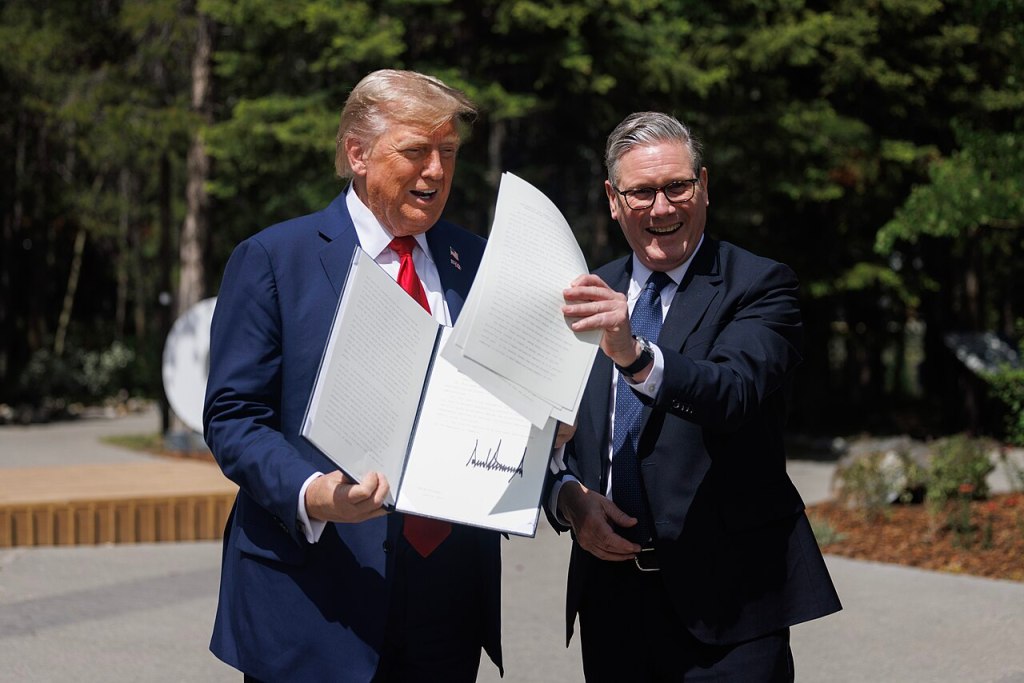
The so called ‘special relationship’ between the United States of America and the United Kingdom is certainly being tested at the moment. It is bizarre how the two leaders, if you can call them that, of two supposedly great nations can have their love/hate relationship played out so publicly. Remember not so long ago that cringe worthy handing over of the King’s invite by the Prime Minister to the President. This amid the fiasco of worldwide tariff hikes imposed by Donald Trump, or the Trump administration at his behest. Remember everyone globally, bar a few, running round in circles kowtowing to Trump whilst trying to get the best deal. Didn’t Trump look pleased with himself at the daily press conferences. And weren’t the United Kingdom falling over themselves with glee that they weren’t part of Europe and could get a better deal. And then we had the Ukraine war fiasco, Trump in his attempt to find peace was prepared to bully and belittle the president of Ukraine publicly. Actually, was it about finding peace or appeasing Putin, it really is quite unclear. Throw in the mix the genocidal attitudes of the Israeli government towards the Palestinians, supported by the USA, I mean what else could you call it if we are being truthful. It certainly wasn’t a measured response to Hamas’ atrocities; it is revenge and population clearance. I say is because that country is still being blockaded. Trump said he would bring peace in the Israel/Palestine conflict, and he would bring peace to Ukraine. Neither were nor could be so easily achieved. The response by Trump and his administration, start a conflict elsewhere. Of course, such a conflict suits Israel and their leader Benjamin Netenyahu. It allows the Israeli despot to continue in power despite allegations of corruption and war crimes. It allows Israel to continue its thinly veiled mission to drive the Palestinians out of the area, to land grab by opening up a second front in Lebanon. And before all this, statements by Trump that he wanted Canada to become another American state, that Greenland should be annexed, by force if necessary, and then of course the regime change in Venezuela, brought about by America’s intervention and let us not forget the murderous attacks on so called drug running boats. Blowing them out of the water seemed to be part of this what can only be described as real life gamification. You only have to listen to the rhetoric to realise this is a game to Trump and parts of his administration but with real life consequences. Eleanor Roosevelt must be turning in her grave as Israel and America attempt to trump each other on Human Rights and International Law violations. And yet nobody seems to be stopping them, nobody seems to dare, something reminiscent of Hitler’s rise in the 1930s. Somewhat Ironic given that the Israeli state was borne out of the atrocities of the Hitler’s regime. So, when Trump asked, nay demanded that the UK and others fall in behind the war game against Iran it is hardly surprising that the answer was no. This of course was met by a tantrum, toys thrown out of the pram stuff, that a two-year-old would have been proud of and some ‘really mean’ name calling with regards to the UK prime minister. Special relationship, more like an infantile friendship? And, when Israel hit Iran’s oil refinery the response from Trump was very much ‘That’s another nice mess you got me into’. As we watch oil prices go up, as Ukraine fears more Russian attacks funded by the lifting of embargoes by the US on Russian oil, as the people of Gaza and Lebanon fight for survival and as countries around the world ask themselves what next, one thing is certain, we don’t need enemies when we have friends like this.
As Donald Trump said, ‘when crazy people have nuclear weapons, bad things happen’. I think we’d all agree with that sentiment. Res ipsa loquitur.
Share this:


A new model for policing: same old rhetoric, same old politics, same old reality

The Home Secretary’s White Paper ‘From Local to National: A New Model for Policing’ promises a complete revamp of policing in England and Wales. The Northamptonshire Police Federation website provides a fairly good synopsis of what the white paper contains. Although one does hope that they didn’t resort to the use of AI to produce it otherwise they may find themselves going the same way as the beleaguered former chief constable of the West Midlands Police.
When listening to the Home Secretary Shabana Mahmood’ address to parliament regarding these reforms, I am reminded of a timeless quote from Robert Reiner regarding a former Home Secretary, Michael Howard’s address to parliament regarding another Home Office police reform White Paper back in the early 1990s. Michael Howard had stated that ‘the job of the police was to catch criminals’ and Robert Reiner, if I remember the quote correctly, stated that this statement was ‘breathtaking in its audacious simple mindedness’.
My bookshelf used to be full of Home Office White papers regarding police reform. If I went through every one of them, I would find almost all the suggestions, in one form or another, being put forward by this Home Secretary. It is like revisiting my former reality, change for change’s sake to detract from a poor performing government. Although no one could have guessed that Lord Mandelson would quickly hog the news and railroad the political landscape.
The police don’t do themselves any favours, you’ve only got to look at the headlines over the decades to know that. But of course, policing is not easy and sometimes hitting the headlines for the wrong reasons is inevitable. Rarely do the police hit the headlines for the right reasons, not because there aren’t plenty of right reasons, they simply aren’t newsworthy. However, every failure or perceived failure is ammunition for the ambitious politician and police reform is always a headline grabbing option and a distraction from other politically difficult and damning matters.
Let’s be clear, policing doesn’t happen in a vacuum. Policing relies on the public; it relies on other institutions within the criminal justice system and outside of it and it relies on good governance. If the police are underfunded, then the service they deliver to the public is substandard and this then dents confidence in the police which in turn impacts public co-operation. If the other institutions within the criminal justice system are poorly funded such as the courts, then it doesn’t matter what the police do, cases do not get to court in a timely manner, the public withdraw their support and cases collapse. If prisons are overcrowded due to lack of funding and other issues, the courts can’t function correctly and the public lose confidence. As an aside remember the furore around the wrong prisoners being released and the number of prisoners wrongly released over a year. Funny how that seems to have disappeared from the news.
But the problems for policing and the rest of the judicial system pale into insignificance when compared to the issues with underfunding in areas of social services, welfare, the NHS, education and so much more. It is easy to point to policing when the key areas that impact the public the most are decimated. People don’t just commit crime because they are greedy, they don’t resort to violence for absolutely no reason. And it doesn’t take a rocket scientist to work out that if you stop supporting young people, stop giving them hope for a future, stop keeping them engaged in meaningful activities when they are out of school then you will see crime and anti-social behaviour spiral out of control. And of course, its not just young people that feel the impact. Not so long ago there was a movement towards defunding the police. The ideas behind the movement were sound but I think perhaps a little naïve. But what was right was the idea of pouring more money into welfare and youth services. Crime is so much more than just policing, and the police have very little control over it, despite all the rhetoric.
As for policing, the white paper is just a rehash of the same old ideas and another way of wasting public money, not dissimilar to that in 2006 when another Home Secretary decided on police mergers which saw millions spent before the idea was shelved as too expensive. The police have adapted to issues identified by HMIC prior to the proposed mergers in 2006. Collaboration between forces works well, saves money and enables smaller forces to deal with large scale issues. There is no evidence anywhere that big is better. In fact there is plenty of evidence to suggest that it may not be.
If the police have retracted from neighbourhood policing it is because of underfunding. Austerity measures introduced in 2010/11 decimated police forces and their ability to deliver both neighbourhood and response policing. Neighbourhood policing became a luxury and coincidentally was also the area where instant savings could be made. Police Community Support Officers could be shed because unlike police officers, they can be made redundant. As for vetting, something that has grabbed the headlines, well what did you expect? Cut the budgets and those important but less immediate functions are also decimated. Add to this the political pressure to recruit 20,000 officers in a short space of time and you have a recipe for disaster.
I do wonder whether those chief officers that support the latest police reform agenda do so because they really understand policing and its history or because they are naïve or ambitious or perhaps a bit of both. To return to Robert Reiner, the reforms are quite simply ‘breathtaking in their audacious simple mindedness’ and the sooner they are shelved the better.
Share this:


Is it time to unleash your criminological imagination?

In this blog entry, I am going to introduce a seemingly disconnected set of ideas. I say seemingly, because at the end, all will hopefully make sense. I suspect the following also demonstrates the often chaotic and convoluted process of my thought processes.
I’ve written many times before about Criminology, at times questioning whether I have any claim to the title criminologist and more recently, what those with the title should talk about. These come on top of hundreds of hours of study, contemplation and reflection which provides the backdrop for why I keep questioning the discipline and my place within it. I know one of the biggest issues for me is social sciences, like Criminology and many others, love to categorise people in lots of different ways: class, race, gender, offender, survivor, victim and so on. But people, including me, don’t like to be put in boxes, we’re complex animals and as I always tell students, people are bloody awkward, including ourselves! There is also a far more challenging issue of being part of a discipline which has the potential to cause, rather than reduce or remove harm, another topic I’ve blogged on before.
It’s no secret that universities across the UK and further afield are facing many serious, seemingly intractable challenges. In the UK these range from financial pressures (both institutional and individual), austerity measures, the seemingly unstoppable rise of technology and the implicit (or explicit, depending on standpoint) message of Brexit, that the country is closed to outsiders. Each of the challenges mentioned above seem to me to be anti-education, rather than designed to expand and share knowledge, they close down essential dialogue. Many years ago, a student studying in the UK from mainland Europe on the Erasmus scheme, said to me that our facilities were wonderful, and they were amazed by the readily available access to IT, both far superior to what was available to them in their own country. Gratifying to hear, but what came next was far more profound, they said that all a serious student really need is books, a enthusiastic and knowledgeable teacher and a tree to sit under. Whilst the tree to sit under might not work in the UK with our unpredictable weather, the rest struck a chord.
The world seems in chaos and war-mongers everywhere are clamouring for violence. Recent events in Darfur, Palestine, Sudan, Ukraine, Venezuela and many other parts of the world, demonstrate the frailty, or even, fallacy of international law, something Drs @manosdaskalou, @paulsquaredd and @aysheaobrien1ca0bcf715 have all eloquently blogged about. But while these discussions are important and pertinent, they cannot address the immediate harm caused to individuals and populations facing these many, varied forms of violence. Furthermore, whilst it’s been over 80 years since Raphäel Lemkin first coined the term ‘genocide’, it seems world leaders are content to debate whether this situation or that situation fits the definition. But, surely these discussions should be secondary, a humanitarian response is far more urgent. After all, (one would hope) that the police would not standby watching as one person killed another, all whilst having a discussion around the definition of murder and whether it applied in this context.
The rise of technology, in particular Generative Artificial Intelligence, has been the focus of blogs from Drs @sallekmusa, @5teveh and myself, each with their own perspective and standpoint. Efforts to combat the harmful effects of Grok enabling the creation of non-consensual pornographic images demonstrate both new forms of Violence Against Women and Girls [VAWG] and the limitations of control and enforcement. Whilst countries are rushing to ban Grok and control the access of social media for children under 16, it is clear that Grok and X are just one form of GAI and social media, there is seemingly nothing to stop others taking their place. And as everyone is well aware, laws are broken on a daily basis (just look at the court backlog and the overflowing prisons) and with no apparent way of controlling children’s access to technology (something which is actively encouraged in schools, colleges and universities) these attempts seem doomed to fail. Maybe more regulation. more legislation isn’t the answer to this problem.
Above I have briefly discussed four seemingly intractable problems. In each arena, we have many thousands of people across the globe trying to solve the issues, but the problems still remain. Perhaps we should ask ourselves the following questions:
- Maybe we are asking the wrong people to come up with the answers?
- Maybe we are constraining discussions and closing down debate?
- Maybe by allowing the established and the powerful to control the narrative we just continue to recycle the same problems and the same hackneyed solutions?
What if there’s another way?
And here we come to the crux of this blog, in Criminology we are challenged to explore any problem from all perspectives, we are continually encouraged to imagine a different world, what ought or could be a better place for all. I have the privilege of running two modules, one at level 4 Imagining Crime and one at Level 6 Violence. In both of these students work together to see the world differently, to imagine a world without violence, a world in which justice is a constant and reflection a continual practice. Walking into one of these classrooms you may well be surprised to see how thoughtful and passionate people can be when faced with a seemingly unsolvable problem when everything on the table is up for discussion. Although often misattributed to Einstein, the statement ‘Insanity is doing the same thing over and over again and expecting different results’ seems apposite. If we want the world to be different, we have to allow people to think about things differently, in free and safe spaces, so they can consider all perspectives, and that is where Criminology comes in.
Be fearless and unleash your criminological imagination, who knows where it might take you!
Share this:


The Caracas Job: International Law and Geo-Political Smash and Grab

So, they actually did it, eh?
It’s January 2026, and I, for one, am still trying to remember my work logins and wondering if this is the year that Aliens invade Earth. Yet, across the pond, the Americans have decided to kick off the New Year with a throwback classic: decapitating a sovereign Latin-American government.
Adiós Maduro. We hardly know yer pal. Well, we all knew you enough to know you were a disastrous authoritarian kleptocrat who managed to bankrupt a country sitting on a lake of oil. But we need to talk about how it happened, because if you listen carefully enough to the wind wuthering through the empty corridors of the UN Building in New York, you can probably hear the death rattle of what I once studied and was quaintly entitled, ‘Rules-Based International Order’-aka International Law.
As one colleague and our very own Dr Manos Daskolou pointed out to me this very day, it’s almost eighty years since 1945. Eight decades of pretending we built a civilised global architecture out of the ashes of World War II. We built tribunals in The Hague, we wrote very sternly worded Geneva Conventions, and we created a Security Council where superpowers could veto each other into paralysis. It was a lovely piece of Geo-Political theatre.
The days-old removal of the Venezuelan head of state by direct US intervention isn’t just a deviation from the norm: it’s a flagrant breach of the foundational prohibition on the ‘use of force’ found in Article 2(4) of The UN Charter. The mask has slipped, and underneath it is just raw, naked power.
As a Brit observing this rigmarole from the very cold and soggy sidelines, it’s hard not to view this from a very specific lens. We invented modern imperialism, after all. Criminologists will often discuss concepts like State Crimes. They will often question who indeed polices the Police?
If I decide to kick down my neighbour’s door because I don’t like the way she runs her household, steal her assets and install her sister as the new head of the family, I’m going to court. I am a burglar, a thug and a violent criminal. If a superpower does the same thing to a sovereign nation, they get a press conference at Mar-a-Lago.
For eighty years, the West has been incredibly successful at labelling its own interventions as ‘police actions’ or ‘humanitarian missions’, all the while labelling acts of rivals as ‘aggression’. The Caracas job is the ultimate expression of this.
Listen to the rhetoric coming out of Washington right now. It’s textbook gaslighting. ‘Maduro was a tyrant’, ‘Other countries do worse’, i.e condemning the condemners. They certainly are not arguing that entry into Caracas was legal under the UN Charter was legal because it most definitely wasn’t. They are arguing that the law should not apply to them because their intentions were pure.
Deja Vu-Iraq
The darkest irony of the Venezuelan decapitation is the crushing sense of deja vu. We cannot talk about removing a dictator in the 2020s without flashbacks to Saddam Hussein and Dr David Kelly entering the scene. The parallels are screaming at us. In 2003, the justification for taking Saddam (and, sadly, Dr Kelly as a direct result) out was a cocktail of WMD lies and dangerous rhetoric. As the Chilcot Report stated years ago, the legal basis for military action against Iraq was ‘far from satisfactory’.
The critical failure in Iraq and the one we are doomed to repeat in Venezuela is that it is terrifyingly easy for a superpower like the USA to smash a second-rate military. The hard part is what on earth comes next?
Perhaps it would have been better for the superpowers to manipulate Maduro’s own people, taking him out, so to speak. Organic change in any situation lends legitimacy that enforced or imported change never does. When you decapitate a state at 30,000 feet, you create a vacuum. The USA may have created a dependency, effectively violating the principle of self-determination, which is enshrined in the Human Rights Convention.
The Iranian Elephant In The Room
Of course, none of this is actually happening in a vacuum. Being a Yorkshire lass with Middle Eastern Heritage, I am keenly aware of the politics of the regions hitting the headlines on an almost daily basis. Yet, no one has to have bloodline ties to any of the countries or regions involved to see the obvious Elephant in the room. It’s that flipping obvious. Maduro wasn’t just an irritant because of his economy-crashing style. It was a strategic flipping of the bird for America’s rivals-Crucially, Iran. This is where the narrative gets even darker. This is gang warfare.
The danger here is escalation. If Tehran decides that the fall of Maduro constitutes a direct challenge to its own deterrence strategy, it will not retaliate in the Caribbean. They are likely (if history has taught us anything) to retaliate in the Strait of Hormuz. The butterfly effect of a regime change in Caracas could easily result in the closure of the Suez Canal. Yes, that old chestnut.
The old guard loved International Law. They loved it because they knew how to manipulate it. They used the UN Council like a skilled Barrister uses a loophole. They built coalitions. The current approach-Let’s call it ‘Act Now Think Later Diplomacy’ dispenses with the formalities and paperwork. It sees International Law NOT as a tool to be manipulated, but as an annoying restraint to be ignored. It confirms the narrative that the Nuremberg trials were merely ‘Victors’ Justice’, a system where legal accountability is the privilege of the defeated.
The difference between Putin invading Ukraine and the USA decapitating Venezuela is rapidly becoming a distinction without a difference.
So, here we go in 2026. The powerful have shown they don’t give a toss about the rules. They’ve shown that ‘sovereignty’ is just a word they use in speeches, not really a word they respect.
When people stop believing in the legitimacy of the law, they usually stop following it. We are about to see what happens when the entire world stops believing in the legitimacy of International Law.
It is going to be a messy few decades. Cheers, mine’s a double.
Share this:


Same shit, different day

I’ve thought long and hard about whether or not to write this blog, it contains nothing new, it adds nothing to the discussion and it is borne of frustration, not just mine. Nevertheless, if the same thing keeps happening, then why not keep shouting about it, even if no-one appears to be listening.
Recently I attended an event supposedly focused on Violence Against Women & Girls [VAWG], the organisers, the venue, the speakers remain anonymous, because this is not about specific individuals or organisations. Instead, as the title indicates, the issues raised below are repeated again and again, across different times and place, involving different people, with different claims to knowledge. Nevertheless, they have far more in common than they would care to acknowledge.
In September 2024, the government announced a commitment to halving VAWG over the next decade. The announcement itself was rather confused, seemingly conflating the term VAWG with Domestic Abuse [DA] whilst simultaneously promising to ‘take back our streets’. The latter horribly reminiscent of the far right’s racists diatribe around taking back our country. But I digress, in the government statement there is no mention of sexual violence, despite Rape Crisis England and Wales’ assertion that 1 in 4 women and girls over 16 have been subjected to sexual assault or rape. Similarly, Refuge suggest that 1 in 4 women will be subjected to forms of domestic abuse across their lifetimes. The statistical data is shaky, the problems with reporting are well documented, but ask any woman, and they will tell you about their own experiences and those of friends and families. A brief glance at the Everyday Sexism Project or Everyone’s Invited will give you some idea of the scale of the violences facing women and girls.
But to return to the latest VAWG event, there have been very many of these, all following the same pattern. Crowds of women in the audience, all experts, some professional, some academic, some through victimisation, some through vicarious victimisation and of course, some of those women encapsulate more than one of those categories, they are not mutually exclusive. So how do we harness and utilise this great body of knowledge, experience and expertise? The sad answer for events like this, is 99% of the time, we don’t. They’re there to sit quietly and listen to the same old narrative from police leaders and officers, saying that the institution has got it wrong in the past, but has learnt lessons and is now doing much better. Noticeably, there are few men in the audience, only those compelled to attend by their employment, after all VAWG explicitly mentions women and girls so it must be a female problem, despite the fact that the violences are predominately carried out by men.
To really drive the message home, we have speakers who can’t be bothered to prepare an accessible presentation for their audience. Relying instead on their white privilege, their charisma and charm (think a poor parody of a 1990’s Hugh Grant in a Richard Curtis film), with their funny little anecdotes of how they met a woman who changed their view on VAWG. Or how primary school teachers are usually women, and that’s where the problems begin, they just don’t do enough to support our little boys and young men on their journeys. Similarly, mothers who don’t pay enough attention which mean their sons go onto to become these violent men. We have white women too, ones that want the audience to focus on women who have been killed by men, but who cannot actually be bothered to find out how to say their names, stumbling over any name that is not anglicised.
In the audience it is notable that there are few Black and Brown women present. Even when they are invited as speakers, they are cut short, talked over, their names forgotten or mispronounced. They are the add-ons, a pathetic attempt at inclusivity, but don’t worry they’re never the main attraction. That spotlight is always reserved for men. No wonder Black and Brown women can’t face attending, or leave part way through, they’re sick and tired of being patronised while they pick up the broken pieces of men’s violences.
So what do women actually learn from these events? They learn to keep quiet, to pretend they’re learning something, but in the breaks they get together and talk about their frustrations, their ongoing exclusion from discussions. They learn that the problem belongs to them. That not only have they got to mop up women’s blood, sweat and tears, using plenty of their own in the process, to support and rebuild women after trauma, they are also responsible for the boys and men.
It really does not have to be this way! In every community there are women of all colours, all religions, all sexualities, all nations, doing the hard work. Building each other up against a maelstrom of never ending male violence, not to mention the additional violences of racism, microaggressions and exclusion. These are the experts, these are the people with whom the solutions lie. The police have had almost 200 years to get it right, they are nowhere near, time for them to move over and let the real experts do the talking, whilst they listen and start to hear and learn!
Share this:


Sabrina Carpenter and Feminist Utopia
I have recently been introduced to Sabrina Carpenter via online media commentary about the image of her new album cover Man’s Best Friend. Whilst some claim the image is playing with satire, the image appears to have been interpreted by others as being hyper-sexual and pandering to the male gaze.

I am not sure why this specific album cover and artist has attracted so much attention given that the hyper-sexual depiction of women is well-represented within the music industry and society more generally. However, because Sabrina’s main audience base is apparently young women under 30 it did leave me thinking about the module CRI1009 and feminist utopia, as it left me with questions that I would want to ask the students like: In a feminist utopia should the hyper-sexualized imagery of women exist?
Some might be quick to point out that this imagery should not exist as it could be seen to contribute towards the misogynistic sexualisation of women and the danger of this, as illustrated with Glasgow Women’s Aid comments about Sabrina’s album cover via Instagram (2025)
‘Sabrina Carpenter’s new album cover isn’t edgy, it’s regressive.
Picturing herself on all fours, with a man pulling her hair and calling it “Man’s Best Friend” isn’t subversion. 😐
It’s a throwback to tired tropes that reduce women to pets, props, and possessions and promote an element of violence and control. 🚩
We’ve fought too hard for this. ✊🏻
We get Sabrina’s brand is packaged up retro glam but we really don’t need to go back to the tired stereotypes of women. ✨
Sabrina is pandering to the male gaze and promoting misogynistic stereotypes, which is ironic given the majority of her fans are young women!
Come on Sabrina! You can do better! 💖’
However, thinking about utopia is always complicated as Sabrina’s brand appears to some a ‘sex-positive feminism’ by apparently allowing women to be free to represent themselves and ‘feel sexy’ rather than being controlled by the rules and expectations of other people. For some this idea of sexual freedom aka ‘sex-positive feminism’ branded via an inequitable capitalistic male dominated industry and represented by an incredibly rich white woman would be a bit of a mythical representation. As while this idea of sexy feminism is promoted by the privileged few this occurs in a societal context where many feel that women’s rights are being/at risk of being eroded and women are being subjected to sexual violence on a daily basis.
I am not sure what a workshop discussion with CRI1009 students would conclude about this, but certainly there would need to be a circling back to more never- ending foundational questions about utopia: what else would exist in this feminist utopia? Whose feminist utopic vision should get priority? Would anyone be damaged in a utopic society that does promote this hyper-sexualization? If so, should this utopia prioritise individual expression or have collective responsibility? In a society without hyper-sexualisation of women would there be rule breakers, and if so, what do you do with them?
Share this:


The future of criminology

If you have an alert on your phone then a new story may come with a bing! the headline news a combination of arid politics and crime stories. Sometimes some spicy celebrity news and maybe why not a scandal or two. We are alerted to stories that bing in our phone to keep ourselves informed. Only these are not stories, they are just headlines! We read a series of headlines and form a quick opinion of anything from foreign affairs, transnational crime, war, financial affairs to death. We are informed and move on.
There is a distinction, that we tend not to make whenever we are getting our headline alerts; we get fragments of information, in a sea of constant news, that lose their significance once the new headline appears. We get some information, but never the knowledge of what really happened. We hear of war but we hardly know the reasons for the war. We read on financial crisis but never capture the reason for the crisis. We hear about death, usually in crime stories, and take notice of the headcount as if that matters. If life matters then a single loss of life should have an impact that it deserves irrespective of origin.
After a year that forced me to reflect deeply about the past and the future, I often questioned if the way we consume information will alter the way we register social phenomena and more importantly we understand society and ourselves in it. After all crime stories tend to be featured heavily in the headlines. Last time I was imagining the “criminology of the future” it was terrorism and the use of any object to cause harm. That was then and now some years later we still see cars being used as weapons, fear of crime is growing according to the headlines that even the official stats have paused surveying since 2017! Maybe because in the other side of the Atlantic the measurement of fear was revealed to be so great that 70% of those surveyed admitted being afraid of crime, some of whom to the extent that changes their everyday life.
We are afraid of crime, because we read the headlines. If knowledge is power, then the fragmented information is the source of ambiguity. The emergence of information, the reproduction of news, in some cases aided by AI have not provided any great insight or understanding of what is happening around us. A difference between information and knowledge is the way we establish them but more importantly how we support them. In a world of 24/7 news updates, we have no ideological appreciation of what is happening. Violence is presented as a phenomenon that emerges under the layers of the dark human nature. That makes is unpredictable and scary. Understandably so…
This a representation of violence devoid of ideology and theory. What is violence in our society does not simply happens but it is produced and managed through the way it is consumed and promoted. We sell violence, package it for patriotic fervour. We make defence contracts, selling weapons, promoting war. In society different social groups are separated and pitted against each other. Territory becomes important and it can be protected only through violence. These mechanisms that support and manage violence in our society are usually omitted. A dear colleague quite recently reminded me that the role of criminology is to remind people that the origins of crime are well rooted in our society in the volume of harm it inflicts.
There is no singular way that criminology can develop. So far it appears like this resilient discipline that manages to incorporates into its own body areas of work that fiercely criticised it. It is quite ironic for the typical criminology student to read Foucault, when he considered criminology “a utilitarian discipline”! Criminology had the last laugh as his work on discipline and punishment became an essential read. The discipline seems to have staying power but will it survive the era of information? Most likely; crime data originally criticised by most, if not all criminologists are now becoming a staple of criminological research methods. Maybe criminology manages to achieve what sociology was doing in the late 20th century or maybe not! Whatever direction the future of criminology takes it will be because we have taken it there! We are those who ought to take the discipline further so it would be relevant in years to come. After all when people in the future asked you what did you do…you better have a good answer!
Share this:


Changing the Narrative around Violence Against Women and Girls

For Criminology at UON’s 25th Birthday, in partnership with the Northampton Fire, Police and Crime Commissioner, the event “Changing the Narrative: Violence Against Women and Girls” convened on the 2nd April. Bringing together a professional panel, individuals with lived experience and practitioners from charity and other sectors, to create a dialogue and champion new ways of thinking. The first in a series, this event focused on language.
All of the discussions, notes and presentations were incredibly insightful, and I hope this thematic collation does it all justice.
“A convenient but not useful term.”
Firstly an overwhelming reflection on the term itself; ‘Violence Against Women and Girls’ – does it do justice to all of the behaviour under it’s umbrella? We considered this as reductionist, dehumanising, and often only prompts thinking and action to physical acts of violence, but perhaps neglects many other harms such as emotional abuse, coercion and financial abuse which may not be seen as, or felt as ‘severe enough’ to report. It may also predominantly suggest intimate partner or domestic abuse which may too exclude other harms towards women and girls such as (grand)parent/child abuse or that which happens outside of the home. All of which are too often undetected or minimised, potentially due to this use of language. Another poignant reflection is that we may not currently be able to consider ‘women and girls’ as one group, given that girls under 16 may not be able to seek help for domestic abuse, in the same way that women may be able to. We also must consider the impact of this term on those whose gender identity is not what they were assigned at birth, or those that identify outside of the gender binary. Where do they fit into this?
To change the narrative, we must first identify what we are talking about. Explicitly. Changing the narrative starts here.
“I do not think I have survived.”
We considered the importance of lived experience in our narratives and reflected on the way we use it, and what that means for individuals, and our response.
Firstly, the terms ‘victim’ and ‘survivor’ – which we may use without thought, use as fact, particularly as descriptors within our professions, but actually these are incredibly personal labels that only individuals with such experience can give to themselves. This may be reflective of where they are in their journey surrounding their experiences and have a huge impact on their experience of being supported. It was courageously expressed that we also must recognise that individuals may not identify with either of those terms, and that much more of that person still exists outside of that experience or label. We also took a moment to remember that some victims, will never be survivors.
Lived experience is making its way into our narratives more and more, but there is still much room for improvement. We champion that if we are to create a more supportive, inclusive, practical and effective narrative, we must reflect the language of individuals with lived experience and we must use it to create a narrative free from tick boxes, from the lens of organisational goals and societal pressure.
Lived experience must be valued for what it is, not in spite of what it is.
“In some cases, we allow content – which would otherwise go against our standards – if its newsworthy.”
A further theme was a reflection on language which appears to be causing an erosion of moral boundaries. For example, the term ‘misogyny’ – was considered to be used flippantly, as an excuse, and as a scapegoat for behaviour which is not just ‘misogynistic’ but unacceptable, abhorrent, inexcusable behaviour – meaning the extent of the harms caused by this behaviour are swept away under a ‘normalised’ state of prejudice.
This is one of many terms that along with things like ‘trauma bond’ and ‘narcissist’ which have become popular on social media without any rigour as to the correct use of the term – further normalises harmful behaviour, and prevents women and girls from seeking support for these very not normal experiences. In the same vein it was expressed that sexual violence is often seen as part of ‘the university experience.’
This use of language and its presence on social media endangers and miseducates, particularly young people, especially with new posting policies around the freedom of expression. Firstly, in that many restrictions can be bypassed by the use of different text, characters and emoji so that posts are not flagged for certain words or language. Additionally, guidelines from Meta were shared and highlighted as problematic as certain content which would, and should, normally be restricted – can be shared – as long as is deemed ‘newsworthy.’
Within the media as a whole, we pressed the importance of using language which accurately describes the actions and experience that has happened, showing the impact on the individual and showing the extent of the societal problem we face… not just what makes the best headline.
“We took action overnight for the pandemic.”
Language within our response to these crimes was reflected upon, in particular around the term ‘non-emergency’ which rape, as a crime, has become catalogued as. We considered the profound impact of this language for those experiencing/have experienced this crime and the effect it has on the resources made available to respond to it.
Simultaneously, in other arenas, violence toward women and girls is considered to be a crisis… an emergency. This not only does not align with the views of law enforcement but suggests that this is a new, emerging crisis, when in fact it is long standing societal problem, and has faced significant barriers in getting a sufficient response. As reflected by one attendee – “we took action overnight for the pandemic.”
“I’ve worked with women who didn’t report rape because they were aroused – they thought they must have wanted it.”
Education was another widely considered theme, with most talk tables initially considering the need for early education and coming to the conclusion that everyone needs more education; young and old – everything in between; male, female and everything in between and outside of the gender binary. No-one is exempt.
We need all people to have the education and language to pass on to their children, friends, colleagues, to make educated choices. If we as adults don’t have the education to pass on to children, how will they get it? The phrase ‘sex education’ was reflected upon, within the context of schools, and was suggested to require change due to how it triggers an uproar from parents, often believing their children will only be taught about intercourse and that they’re too young to know. It was expressed that age appropriate education, giving children the language to identify harms, know their own body, speak up and speak out is only beneficial and this must happen to help break the cycle of generational violence. We cannot protect young people if we teach them ignorance.
Education for all was pressed particularly around education of our bodies, and our bodily experiences. In particular of female bodies, which have for so long been seen as an extension of male bodies. No-one knows enough about female bodies. This perpetuates issues around consent, uneducated choices and creates misplaced and unnecessary guilt, shame and confusion for females when subjected to these harms.
“Just because you are not part of the problem, does not mean you are part of the solution.“
Finally, though we have no intention or illusion of resolution with just one talk, or even a series of them – we moved to consider some ways forward. A very clear message was that this requires action – and this action should not fall on women and girls to protect themselves, but for perpetrators for be stopped. We need allies, of all backgrounds, but in particular, we need male allies. We need male allies who have the education, and the words necessary to identify and call out the behaviour of their peers, their friends, their colleagues, of strangers on the bus. We asked – would being challenged by a ‘peer’ have more impact? Simply not being a perpetrator, is not enough.
Share this:


Will Keir Starmer’s plans to abolish NHS England, help to save the NHS?

In a land-mark event, British Prime Minister Keir Starmer has unveiled plans to abolish NHS England, to bring the NHS back into government control. Starmer justifies much of this change with streamlining operations and enhancing efficiency within the NHS, that in recent years has faced a backlash following long queues and an over-stretched staff pool. Moreover, this is part of Starmer’s plan to limit the power of control from bureaucratic systems.
NHS England was established in 2013 and has taken control and responsibility of the NHS’s daily operational priorities. Primarily, NHS England is invested in allocating regional funds to local health care systems and ensuring the smooth delivery of health care across the NHS. However, concerns, particularly in Parliament have been raised in relation to the merging of NHS England and the Department’s of Health and Social care that is alleged by critics to have brought inefficient services and an increase of administrative costs.
Considering this background, the plans to abolish NHS England, for Starmer come under two core priorities. The first is enhancing democratic accountability. This is to ensure that the expenditures of the NHS are contained within government control, thus it is alleged that this will improve efficiency and suitable allocation of spending. The second is to reduce the number of redundancies. This is backed by the idea that by streamlining essential services will allow for more money to be allocated to fund new Doctors and Nurses, who of course work on the front line.
This plan by Starmer has been met with mixed reviews. As some may say that it is necessary to bring the NHS under government control, to eliminate the risks of inefficient services. However, some may also question if taking the NHS under government control may necessarily result in stability and harmony. What must remain true to the core of this change is the high-quality delivery of health care to patients of the NHS. The answer to the effectiveness of this policy will ostensibly be made visible in due course. As readers in criminology, this policy change should be of interest to all of us… This policy will shape much of our public access to healthcare, thus contributing to ideas on health inequalities. From a social harm perspective, this policy is of interest, as we witness how modes of power and control play a huge role in instrumentally shaping people’s lives.
I am interested to hear any views on this proposal- feel free to email me and we can discuss more!
Share this:


St Valentines Day! Love and other emotions

This blog today is all about love…. or maybe not! As criminologists, we tend to see things slightly different, and our perspective is influenced by functions other than undying declarations of love.
Saint Valentine is associated with love and people celebrate the day with their special romantic person, or by pursuing any person of interest, with romantic cards. Greeting cards, bottles of wine, boxes of chocolates, bunches of flowers, heart shaped jewellery, lovely sonnets, sexy underwear, kinky gifts and over the top romantic gestures! All of the above are anticipated actions on this day. Any of these will act as a demonstration of love. In some ways the more enormous the gesture the greater the demonstration of love and intimacy to the intended special person. Many times, we hear those in a relationship rut complaining that “they don’t even buy me chocolates anymore” a sign that love has fizzled out.
Love is a powerful emotion, and I dare not to challenge it. Artists have created their best work on love! Religion has created its strongest appeal on love. People, the world over, have based their entire lives of how they feel about a person they choose to be their partner and share their lives with. So clearly love is important! Enough for an Austrian psychotherapist to create an entire theory on love and sex. We feel ready to go to war for love and we are completely convinced that love is the force that keeps us going. Love is strong and we feel it every day.
Therefore, it is slightly surprising that the patron saint of romantic love is a rather fictional character! The saint is meant to be a priest who lived in the 3rd century AD and martyred by tortured for his faith. There was no romance involved and there were no love poems written of the time. In fact, the Roman Catholic church did not recognise or mentioned this martyrdom at the time. The first accounts on St Valentine appear in the 6th and later the 9th centuries, some centuries later. Since then, the story of the saint is embellished further, until the 19th century when it becomes connected with romantic love in some tenuous way. For example, the more recent narratives claim that before his execution he would convert and cure the daughter of his jailer. He was also officiating wedding ceremonies between Christians which may have given him the romantic connection. In the 19th century we have the first mass production of love tokens dedicated to the day and in the 20th, century especially post 1960s the celebration was growing in popularity and appeal. Currently the day is a celebration that has a significant capitalist value. It is usually a commercial success midway between Christmas and Easter.
Some religious historians noted that in the Roman calendar in February there have been rituals and celebrations on fertility and cleanliness (physical, spiritual). It was the time presumably when young Romans prepared for sexual relations. Therefore, an amalgamation of the old practices and the then new religion overlap with an obscure Saint to act as the glue to connect them and reaffirm the importance of love. Ironically the Roman citizens of the time, in particular the patricians, would not recognise such acts! They married out of interest, connecting the wealth and power of different factions. In those cycles love was more of a chimera rather than a reality.
Romantic love with knights, towers, dragons and gestures of devotion will appear as fanciful tales. Who hasn’t heard of Odysseus and his beloved wife Penelope who remained faithful to him for 20 years! Her fidelity was not reciprocated, and Odysseus had multiple affairs and fathered several children across the Mediterranean. Not quite the romantic story people would like to believe. Romantic love was always a tale, with vivid twists and turns. Love appears almost pure, undiluted that lifts those in its path. Shakespeare wrote fantastic sonnets on love. Some of the best things ever written in English. Still his contemporaries did not recognise this love. The majority of people at the time died young, malnourished and exhausted. Those who barely survive cannot afford to embrace love. As for those in power their relationship with love can be summed up in the old mnemonic rhyme “divorced, beheaded, died; divorced, beheaded, survived”!
We presume that romantic love is a representation of two people having feelings for one other. That is a nice sentiment but historically weak. Love for women does not exist. Not because women are devoid of emotions; quite the contrary! Because women have been used in social transactions between men who barter and use them as part of their household. A feminist today can recognise, despite all assurances for equality, how unequal life is. Especially in the household! If anyone wants to see why love is not equal only see how domestic and intimate violence is spread between gender lines. Because St Valentine brings flowers and chocolates, but it also brings beatings and abuse. Across the year it is during holidays and significant dates, including St Valentines that violence against women surges. One can unfortunately deduce that love is not for women. Oh…. The irony as romantic novels and movies are presented mostly for women as “chick flicks”!
Earlier in this post, it was said that the bigger the romantic move the better! Who will do this big romantic gesture? A man with chivalrous intent. Our household data reveal that men will spend more than double on what women will spend on the day, making their romantic intent more obvious. Perhaps men are more romantic and feel the need to satisfy that internal need. Or maybe there are other emotions at play. Love is very powerful, but so is possessiveness. In a history of transactions men used women for trading, so their gestures may be a latent act of dominance, a fresh reminder of possession. Instead of giving them chocolates, you may as well urinate all over them. That way your beloved will have your scent and keep other suitors away. So, this is not love but control, jealousy and dominance. Every drop of wine, every piece of chocolate, every flower petal, is yet another link in the chain of ownership. In case this gets misunderstood, the individual who buys flowers isn’t a villain, but the history of this kind of love is pointing in this direction. Your partner may have the best intentions and the greatest love and regard for you, but our society has never really acknowledged the transactional relationship between men and women. It is similar to those who speak of the evils of slavery, but with no recognition of reparations. This love is not pure and clean. It is the darkest form of patriarchy that controls people making them to believe in an adult fairytale once the other story of Santa Claus is not believed any more.
Romantic actions target all incomes and all ages, but of course there is a drive to get younger people, new generations of customers, on the love spending machine. At this stage I shall write…what not to do when you are planning a romantic day! Do not go overboard. Love is something felt in the heart not in the pocket. Heart-shaped products do not say “I love you” more than square or round ones! Red is no more appealing than any other colour and of course if emotions are high, they tend to last more than a day! Ideally do not spend any money! In the unfortunate event that you do, do not cook your romantic meal with a sharp knife. You may pierce the palm of your hand and end up with stitches. Do not spread chocolate on a partner before establishing if they are allergic to any of the ingredients, you may end up in A&E. Do not offer them wine, if they have an intolerance to alcohol, they may vomit all over your pristine bedspread. Do not write something funny or profound if they are thick and unable to comprehend deeper meanings (in that case what are you doing with them???). Love is not an idea, a moment, a day, an instant. It is a lifetime however long or short it is. You will live in love and you will die in love. Even when you are by yourself love is in you and it cannot be defined by the actions of people around you. Finally, love is selfless so do not try to control them, “love is a rebellious bird that nobody can tame”!


 Thoughts from the criminology team


