
Home » Independent learning
Category Archives: Independent learning

To be a keeper of these stories. A collector of trust.
I think this will be somewhat of a poem; I guess.

About all the tears I’ve held space for lately.

There has been quite a lot. Is it any surprise?

Big ones, small ones. Happy and sad ones. Not really sure why ones.

‘cept it’s the happy ones I want to share today.

They’ve got me thinking. Reflecting.

A proper headshake, actually.
It’s not the best space for sensitive conversations but it’s what we’ve got.

I wait and I wait. Sometimes a flurry. Sometimes not.

The enthusiasm is sometimes hard to muster.

If I’m really being honest.

But wait I do. And wait I shall.

Oftentimes it’s a woman, who needs another.

It’s a gift I’ve got, I suppose.

“I’ve never seen her sit and talk with someone like this”

An aura, someone once said.

Lures people in and their story they are compelled to tell.

I’ve tried to teach it. We give and we take from every interaction.

You just have to be aware enough to see it.

There’s been some big ones just lately.

And what a pleasure it’s been.
She’s a ‘do it all’ Black mother.

A woman of incredible resilience.

We’ve been speaking for months now. Bit of this. Bit of that.

A call from the school one day, her son has self-harmed.

What do I say, she asks.

Everything is money. Money I don’t have.

She checks her sugars. Low again.

I can’t afford this canteen food.

Have to make a poster. Sustainable practice or something like that.

All this technology she says, I’m too slow.

I do what I can. Build her up. See her again.

I do what I can. Build her up. See her again.

There’s a little bit more brightness every time I do.

It’s Friday before last, how was your session I ask.

I was in a room with women doctors she says.

Little old me. I could never. Right at the start…and I don’t think I’m going to make it.

Can you believe it? she says. Women…with PhDs. Not me.

“Back home women get no such thing.” No no. Daren’t even dream.

Days roll on until a week's gone by.

She prances across the library. Beaming.

She’s come to share her joy with me.

A 60 she says. A 60!

My boys are so proud of me. Maybe I’ll make it after all.
Another. Working, studying, working, studying.

Mum needs the money. Physio for the cancer in her bones, she says.

She’s avoiding my questions about rest and nourishment.

Surviving on Mum’s joy receiving another ‘Look what I’ve done.’

This is just a flying visit though. Easy fix, I thought.

We’ve been here a while. Lingering.

I think I’ve said something wrong. She’s welling up again.

No. I’m so grateful to be here she says...with all you kind people.

I ask what she needs. Its courage, she says.

I write it out. A post-it note. Just the trick.

What would my most courageous self do?

Stick it to the fridge I say.

Mine is bravery. I share.

An inspiration! she cries. An inspiration? I cry.

I’m going to make it across that stage one day, she says. Yes, I am.
Her story. Quite overwhelming actually.

Though not easily shaken. I’m taken aback.

Intimate partner violence a divorce did not remedy.

A home of her own, apparently not to be.

In the hospital every other week.

The victim of a scam I realise as we speak.

Held up at every angle.

Yet she shows up. She shows up. She shows up.

It’s what we do, isn’t it?

It’s too much. Quitting. she says. Though I can’t say I believe it.

We’re here for 90 minutes. It’s all out on the table.

I hardly say a word really. I’m all ears, kind eyes and the occasional shoulder pat.

A breakthrough.

Look at me here laughing with you now.

What a relief. To be heard.  Maybe I’ll be able to sleep tonight.
Its all stuck with me, a sort of niggle.

I thought I knew what I was doing. I thought I was grateful for it all.

But to be a keeper of these stories. A collector of trust. I realise I was nothing of the sort.

So, on my own journey, I start anew, and that’s thanks to all of you.
This healing thing. Tricky business, really.
Reader, if you find yourself saying I HAVE TO this week.

That meeting, That essay. That commute.

Consider I GET TO

Because not everyone does and some that do give more than we can imagine, even just to be in the room with us.
Share this:

‘Do or do not, there is no try’

The Red Roses are playing in the rugby union world cup final on Saturday and I, amongst thousands, will be watching it on television with a heady mixture of anticipation, trepidation, excitement, fear and expectation. The England Women’s rugby union team is made up of some very talented individuals that come together as a team to produce some of the most electrifying displays of rugby, that is both mystical and awesome to watch. I won’t just be watching, I’ll be dodging every lunge, wincing at every tackle made, running like the wind, dotting down the ball and willing every kick over, I’ll be totally engrossed.
I will be watching elite athletes at the top of their game, and I know, not one of them got there by chance. To be an elite athlete requires hours of training, a strict dietary regime, and dedication. It requires mental agility, physical strength, sacrifice and focus. To get to the pinnacle of their chosen profession, requires total commitment, ‘Do or do not, there is no try’ (Yoda – The Empire Strikes Back).
We can’t all be elite athletes, for a variety for reasons, but what they demonstrate is that achievement is not chance. My life experience, like that of many others, has shown me that there is no such thing as a free lunch. Success, whatever that looks like, requires hard work, sacrifice and commitment. In any walk of life, people that are successful in what they do, have had to put in a lot of effort and make sacrifices. That effort and those sacrifices often started with study. Whether that’s study at school, further education or higher education, or study outside of the educational environment they have been committed to their learning and achieving the best they could. Some may have better opportunities than others but nonetheless, doing nothing, achieving nothing, rarely qualifies an individual to be a top executive in a company, a top lawyer, surgeon, politician, lecturer, sports person or anything else. Top footballers in both the men’s and women’s games don’t just turn up on a Saturday for a kick around. None of them allow themselves to be distracted from what they want to achieve. Some people may not be academically gifted but their success is predicated on hard work and dedication.
This week we welcome new students to the university and next week we will see familiar faces returning. To all our students I would urge you to remember why you are here, what it is you want to achieve? Education is a right but look around the world and you will see that not many can avail themselves of that right. You are privileged and whilst you may not be able to match the commitment shown by the Red Roses, few of us could, it is worth remembering that no one achieves anything without some commitment and sacrifice. Set your sights high and go for it, we are all willing you on. And like the Red Roses we want to rejoice in your success.
Share this:


Technology: one step forward and two steps back
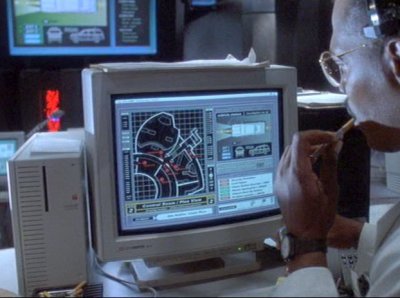
I read my colleague @paulaabowles’s blog last week with amusement. Whilst the blog focussed on AI and notions of human efficiency, it resonated with me on so many different levels. Nightmarish memories of the three E’s (economy, effectiveness and efficiency) under the banner of New Public Management (NPM) from the latter end of the last century came flooding back, juxtaposed with the introduction of so-called time saving technology from around the same time. It seems we are destined to relive the same problems and issues time and time again both in our private and personal lives, although the two seem to increasingly morph into one, as technology companies come up with new ways of integration and seamless working and organisations continuously strive to become more efficient with little regard to the human cost.
Paula’s point though was about being human and what that means in a learning environment and elsewhere when technology encroaches on how we do things and more importantly why we do them. I, like a number of like-minded people are frustrated by the need to rush into using the new shiny technology with little consideration of the consequences. Let me share a few examples, drawn from observation and experience, to illustrate what I mean.
I went into a well-known coffee shop the other day; in fact, I go into the coffee shop quite often. I ordered my usual coffee and my wife’s coffee, a black Americano, three quarters full. Perhaps a little pedantic or odd but the three quarters full makes the Americano a little stronger and has the added advantage of avoiding spillage (usually by me as I carry the tray). Served by one of the staff, I listened in bemusement as she had a conversation with a colleague and spoke to a customer in the drive through on her headset, all whilst taking my order. Three conversations at once. One full, not three quarters full, black Americano later coupled with ‘a what else was it you ordered’, tended to suggest that my order was not given the full concentration it deserved. So, whilst speaking to three people at once might seem efficient, it turns out not to be. It might save on staff, and it might save money, but it makes for poor service. I’m not blaming the young lady that served me, after all, she has no choice in how technology is used. I do feel sorry for her as she must have a very jumbled head at the end of the day.
On the same day, I got on a bus and attempted to pay the fare with my phone. It is supposed to be easy, but no, I held up the queue for some minutes getting increasingly frustrated with a phone that kept freezing. The bus driver said lots of people were having trouble, something to do with the heat. But to be honest, my experience of tap and go, is tap and tap and tap again as various bits of technology fail to work. The phone won’t open, it won’t recognise my fingerprint, it won’t talk to the reader, the reader won’t talk to it. The only talking is me cursing the damn thing. The return journey was a lot easier, the bus driver let everyone on without payment because his machine had stopped working. Wasn’t cash so much easier?
I remember the introduction of computers (PCs) into the office environment. It was supposed to make everything easier, make everyone more efficient. All it seemed to do was tie everyone to the desk and result in redundancies as the professionals, took over the administrative tasks. After all, why have a typing pool when everyone can type their own reports and letters (letters were replaced by endless, meaningless far from efficient, emails). Efficient, well not really when you consider how much money a professional person is being paid to spend a significant part of their time doing administrative tasks. Effective, no, I’m not spending the time I should be on the role I was employed to do. Economic, well on paper, fewer wages and a balance sheet provided by external consultants that show savings. New technology, different era, different organisations but the same experiences are repeated everywhere. In my old job, they set up a bureaucracy task force to solve the problem of too much time spent on administrative tasks, but rather than look at technology, the task force suggested more technology. Technology to solve a technologically induced problem, bonkers.
But most concerning is not how technology fails us quite often, nor how it is less efficient than it was promised to be, but how it is shaping our ability to recall things, to do the mundane but important things and how it stunts our ability to learn, how it impacts on us being human. We should be concerned that technology provides the answers to many questions, not always the right answers mind you, but in doing so it takes away our ability to enquire, critique and reason as we simply take the easy route to a ready-made solution. I can ask AI to provide me with a story, and it will make one up for me, but where is the human element? Where is my imagination, where do I draw on my experiences and my emotions? In fact, why do I exist? I wonder whether in human endeavour, as we allow technology to encroach into our lives more and more, we are not actually progressing at all as humans, but rather going backwards both emotionally and intellectually. Won’t be long now before some android somewhere asks the question, why do humans exist?
Share this:

How to make a more efficient academic
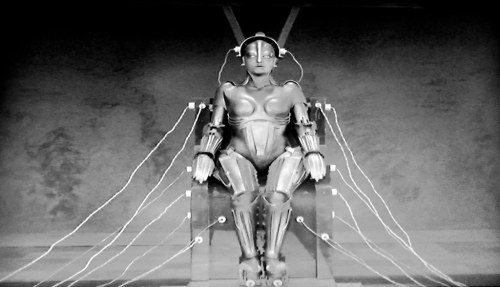
Against a backdrop of successive governments’ ideology of austerity, the increasing availability of generative Artificial Intelligence [AI] has made ‘efficiency’ the top of institutional to-do-lists’. But what does efficiency and its synonym, inefficiency look like? Who decides what is efficient and inefficient? As always a dictionary is a good place to start, and google promptly advises me on the definition, along with some examples of usage.

The definition is relatively straightforward, but note it states ‘minimum wasted effort of expense’, not no waste at all. Nonetheless the dictionary does not tell us how efficiency should be measured or who should do that measuring. Neither does it tell us what full efficiency might look like, given the dictionary’s acknowledgement that there will still be time or resources wasted. Let’s explore further….
When I was a child, feeling bored, my lovely nan used to remind me of the story of James Watt and the boiling kettle and that of Robert the Bruce and the spider. The first to remind me that being bored is just a state of mind, use the time to look around and pay attention. I wouldn’t be able to design the steam engine (that invention predated me by some centuries!) but who knows what I might learn or think about. After all many millions of kettles had boiled and he was the only one (supposedly) to use that knowledge to improve the Newcomen engine. The second apocryphal tale retold by my nan, was to stress the importance of perseverance as essential for achievement. This, accompanied by the well-worn proverb, that like Bruce’s spider, if at first you don’t succeed, try, try again. But what does this nostalgic detour have to do with efficiency? I will argue, plenty!
Whilst it may be possible to make many tasks more efficient, just imagine what life would be like without the washing machine, the car, the aeroplane, these things are dependent on many factors. For instance, without the ready availability of washing powder, petrol/electricity, airports etc, none of these inventions would survive. And don’t forget the role of people who manufacture, service and maintain these machines which have made our lives much more efficient. Nevertheless, humans have a great capacity for forgetting the impact of these efficiencies, can you imagine how much labour is involved in hand-washing for a family, in walking or horse-riding to the next village or town, or how limited our views would be without access (for some) to the world. We also forget that somebody was responsible for these inventions, beyond providing us with an answer to a quiz question. But someone, or groups of people, had the capacity to first observe a problem, before moving onto solving that problem. This is not just about scientists and engineers, predominantly male, so why would they care about women’s labour at the washtub and mangle?
This raises some interesting questions around the 20th century growth and availability of household appliances, for example, washing machines, tumble driers, hoovers, electric irons and ovens, pressure cookers and crock pots, the list goes on and on. There is no doubt, with these appliances, that women’s labour has been markedly reduced, both temporally and physically and has increased efficiency in the home. But for whose benefit? Has this provided women with more leisure time or is it so that their labour can be harnessed elsewhere? Research would suggest that women are busier than ever, trying to balance paid work, with childcare, with housekeeping etc. So we can we really say that women are more efficient in the 21st century than in previous centuries, it seems not. All that has really happened is that the work they do has changed and in many ways, is less visible.
So what about the growth in technology, not least, generative AI? Am I to believe, as I was told by Tomorrow’s World when growing up, that computers would improve human lives immensely heralding the advent of the ‘leisure age’? Does the increase in generative AI such as ChatGPT, mark a point where most work is made efficient? Unfortunately, I’ve yet to see any sign of the ‘leisure age’, suggesting that technology (including AI) may add different work, rather than create space for humans to focus on something more important.
I have academic colleagues across the world, who think AI is the answer to improving their personal, as well as institutional, efficiency. “Just imagine”, they cry, “you can get it to write your emails, mark student assessment, undertake the boring parts of research that you don’t like doing etc etc”. My question to them is, “what’s the point of you or me or academia?”.
If academic life is easily reducible to a series of tasks which a machine can do, then universities and academics have been living and selling a lie. If education is simply feeding words into a machine and copying that output into essays, articles and books, we don’t need academics, probably another machine will do the trick. If we’re happy for AI to read that output to video, who needs classrooms and who needs lecturers? This efficiency could also be harnessed by students (something my colleagues are not so keen on) to write their assessments, which AI could then mark very swiftly.
All of the above sounds extremely efficient, learning/teaching can be done within seconds. Nobody need read or write anything ever again, after all what is the point of knowledge when you’ve got AI everywhere you look…Of course, that relies on a particularly narrow understanding which reduces knowledge to meaning that which is already known….It also presupposes that everyone will have access to technology at all times in all places, which we know is fundamentally untrue.
So, whatever will we do with all this free time? Will we simply sit back, relax and let technology do all the work? If so, how will humans earn money to pay the cost of simply existing, food/housing/sanitation etc? Will unemployment become a desirable state of being, rather than the subject of long-standing opprobrium? If leisure becomes the default, will this provide greater space for learning, creating, developing, discovering etc. or will technology, fueled by capitalism, condemn us all to mindless consumerism for eternity?
Share this:


25 Years of Criminology at UON: Looking Back
This year Criminology at UON is celebrating its 25th Anniversary! Exciting times! In line with the celebrations, the Criminology Team have organised a number of events as part of these celebrations. Ranging from the ‘Changing the Narrative’ VAWG event, organised by Dr @paulaabowles and the Deputy Police, Fire and Crime Commissioner (PFCC), to a school’s event in June offering out miniature taster sessions to interested, local year12 students (more details T.B.C). As well all the exciting events, we have also had reflections from the Team around what it means to them and their journey with Criminology at UON. It is my journey which I would like to share with you now.
My journey begins in 2012 as a bright eyed and bushy tailed first year student moving away from home to Northampton to study Criminology. Having never done any Criminology, Psychology, Sociology, or Law before I was feeling very much out of my depth. However, little did I realise that my A-levels in Philosophy, Ethics and English Language would hold me steady. The first year was quite overwhelming: there were lots of tears and uncertainties. I remember it taking the entire summer between year 1 and year 2 to get my head around Harvard Referencing. But I survived! It was not until the end of year 2 and beginning of year 3 where I would say I began to ‘thrive’ in the discipline. As a student, one of my highlights was doing a research placement in year 2. Academically, I gained skills which prepared me for the dissertation in the final year, but it also brought me out of my shell much more. Pretty sure there were tears here as well- this has been a common feature of my journey with Criminology (as student and staff)!
In 2015 I graduated from UON with a BA in Criminology and in the September of that year began in the role as an Associate Lecturer in Criminology. This was incredibly scary but also incredibly rewarding. It was very interesting to be on ‘the other side’ of academia having so recently graduated and it took a fair amount of time to transition from student to staff (as academics we are also students so the transition is never fully complete)! I was involved on modules I had not had the privilege of studying and was able to work closely with esteemed colleagues I’d looked up to for so long and who had had a large impact in moulding the criminologist I was (and am today). In the September of 2020, after achieving my MSc in Criminology, I became a full-time lecturer and remain so five years later. The course and University has changed a lot in those 5 years, with some fabulous new modules in the BA and BA Criminology with Psychology courses, new colleagues offering a range of expertise and passion for areas within the discipline and some epic trips with a number of the student cohorts we have been blessed to have.
There have been challenges too, and lots of tears (especially from me), but the progress and evolution of Criminology at UON in the 13 years I have been a part of it have been monumental! Hopefully there will be even more positivity to come in the future. I feel incredibly grateful and blessed to have been involved with Criminology at UON for so long, and always look back on my student days with fondness. I’ve enjoyed my role as a member of staff and enjoyed being a part of the events the Team have organised and the new course which we have designed. A huge ‘Thank you’ must be written to the ‘founding father of Criminology at UON’ @manosdaskalou, without whom my, and many others, journey with Criminology at UON might be non-existent! So cheers to 25 years of Criminology at UON, the ‘founding father’, and to many more wonderful years (and hopefully less tears)!
Share this:

25th Year Reflection
I have been part of Criminology at UON as BA Criminology student, then Associate Lecturer then Lecturer in Criminology for about 13 years in total. My last reflection on my Criminology journey was in 2020 as I had just embarked on my new role as a Lecturer in Criminology. Every now and then I reflect on how lucky I am to be able to have a job role which has the potential to encourage a passion for learning, reading, writing, critical thinking as well as other life skills.
When reflecting on the 25th year Criminology anniversary I think mostly of the old Park Campus that I used to frequent and study at as a student. It had quite a nice feel to it and there was also enough surrounding nature for a famous badger to make this place part of its habitat! There were less books available online when I was an undergraduate compared to today so I have fond memories of going to the library often to have a browse and coming away with as many criminology related books that I could fit in my bag at once. Finding places where I could study for hours that were less frequented than the main library also gave me a bit of a buzz. There also used to be a Pavilion bar near to where the majority of exams would take place, one of my favorite past time memories is sipping on a beer in the Pavilion just after the end of my final third year Criminology exam season, (whilst secretly thinking of how I thought the exams went much better than expected).
When reflecting I am also reminded of how lecturers like Dr @manosdaskalou and Dr @paulaabowles can be incredibly inspirational and influential at guiding academic paths (such as my own!). The re-occurring ideas that ‘criminology is everywhere’ and that we should ‘question everything’ has boded well for helping me to make difficult decisions and in thinking about how I interacted with people when I was working within crime related industries.
In more recent years staff and students have moved to a new campus, have worked and studied through the challenges that come with Covid-19 and contextual uncertainties. This year has had some highlights for me, such as working on a new module Imagining Crime. Whereby we used inspiration from the novel 1984 by George Orwell to task students with committing weekly ‘thought crimes’ by seeing/hearing/reading about something criminological and questioning this by using critical thinking. Listening to the development of critical thinking via the ‘thought crime’ method has been a delight. The flexible, creative and multidisciplinary nature of criminology is also quite fabulous for maintaining interest in criminology over a long period of time but also for venturing into new and less explored areas. For instance, staff and students in Imagining Crime had the pleasure of attending a guest speaker session with @saffrongarside about children’s literature and the environment this academic year – at a time when Northampton itself seemed to be struggling to cope with flooding. Of course, this did highlight the importance of seeing environmental issues as criminological issues, but also the importance of considering children’s books as criminologically cultural artifacts, was something completely new and intriguing for me. I also gained a lot from hearing what our students (who are predominantly) young people think about environmental issues outside of the mainstream media angles that I have seen.
To round up, I loved my student life whilst studying BA Criminology and I am sure many others will say ‘ditto to that’. Long may the love for Criminology at UON continue!
Share this:


Criminology in the neo-liberal milieu
I do not know whether the title is right nor whether it fits what I want to say, but it is sort of catchy, well I think so anyway even if you don’t. I could never have imagined being capable of thinking up such a title let alone using words such as ‘milieu’ before higher education. I entered higher education halfway through a policing career. I say entered; it was more of a stumble into. A career advisor had suggested I might want to do a management diploma to advance my career, but I was offered a different opportunity, a taster module at a ‘new’ university. I was fortunate, I was to renew an acquaintance with Alan Marlow previously a high-ranking officer in the police and now a senior lecturer at the university. Alan, later to become an associate professor and Professor John Pitts became my mentors and I never looked back, managing to obtain a first-class degree and later a PhD. I will be forever grateful to them for their guidance and friendship. I had found my feet in the vast criminology ocean. However, what at first was delight in my achievements was soon to be my Achilles heel.
Whilst policing likes people with knowledge and skills, some of the knowledge and skills butt up against the requirements of the role. Policing is functional, it serves the criminal justice system, such as it, and above all else it serves its political masters. Criminology however serves no master. As criminologists we are allowed to shine our spotlight on what we want, when we want. Being a police officer tends to put a bit of a dampener on that and required some difficult negotiating of choppy waters. It felt like I was free in a vast sea but restrained with a life ring stuck around my arms and torso with a line attached so as to never stray too far from the policing ideology and agenda. But when retirement came, so too came freedom.
By design or good luck, I landed myself a job at another university, the University of Northampton. I was interviewed for the job by Dr @manosdaskalou., along with Dr @paulaabowles (she wasn’t Dr then but still had a lot to say, as criminologists do), became my mentors and good friends. I had gone from one organisation to another. If I thought I knew a lot about criminology when I started, then I was wrong. I was now in the vast sea without a life ring, freedom was great but quite daunting. All the certainties I had were gone, nothing is certain. Theories are just that, theories to be proved, disproved, discarded and resurrected. As my knowledge widened and I began to explore the depths of criminology, I realised there was no discernible bottom to knowledge. There was only one certainty, I would never know enough and discussions with my colleagues in criminology kept reminding me that was the case.
Why the ‘neo-liberal milieu’ you might ask, after all this seems to be a romanticised story about a seemingly successful transition from one career to another. Well, here’s the rub of it, universities are no different to policing, both are driven, at an arm’s length, by neo liberal ideologies. The business is different but subjugation of professional ideals to managerialist ideology is the same. Budgets are the bottom line; the core business is conducted within considerable financial constraints. The front-line staff take the brunt of the work; where cuts are made and processes realigned, it is the front-line staff that soak up the overflow. Neo-Taylorism abounds, as spreadsheets to measure human endeavour spring up to aide managers both in convincing themselves, and their staff, that more work is possible in and even outside, the permitted hours. And to maintain control, there is always, the age-old trick of re-organisation. Keep staff on their toes and in their place, particularly professionals.
The beauty of being an academic, unlike a police officer, is that I can have an opinion and at least for now I’m able to voice it. But such freedoms are under constant threat in a neo-liberal setting that seems to be seeping into every walk of life. And to be frank and not very academic, it sucks!
Share this:


A Love Letter to Criminology at UON


In 2002, I realised I was bored, I was a full-time wife and parent with a long-standing part-time job in a supermarket. I first started the job at 15, left at 18 to take up a job at the Magistrates’ court and rejoined the supermarket shortly after my daughter was born. My world was comfortable, stable and dependable. I loved my family but it was definitely lacking challenge. My daughter was becoming increasingly more independent, I was increasing my hours and moving into retail management and I asked myself, is this it? Once my daughter had flown the nest, could I see myself working in a supermarket for the rest of my life? None of this is to knock those those that work in retail, it is probably the best training for criminology and indeed life, that anyone could ask for! I got to meet so many people, from all backgrounds, ethnicities, ages, religions and classes. It taught me that human beings are bloody awkward, including myself. But was it enough for me and if it wasn’t, what did I want?
At school, the careers adviser suggested I could work in Woolworths, or if I tried really hard at my studies and went to college, I might be able to work for the Midland Bank (neither organisation exists today, so probably good I didn’t take the advice!). In the 1980s, nobody was advocating the benefits of university education, at least not to working-class children like me. The Equal Pay Act might have been passed in 1970 but even today we’re a long way from equality in the workplace for women. In the 1980s there was still the unwritten expectation (particularly for working class children from low socio economic backgrounds) that women would get married, have children and perhaps have a part-time job but not really a career….I was a textbook example! I had no idea about universities, knew nobody that had been and assumed they were for other people, people very different from me.
That changed in 2002, I had read something in a newspaper about a Criminology course and I was fascinated. I did not know you could study something like that and I had so many questions that I wanted to answer. As regular readers of the blog will know I’m a long-standing fan of Agatha Christie whose fiction regularly touches upon criminological ideas. Having been born and raised in North London, I was very familiar with HMP Holloway’s buildings, both old and new, which raised lots of questions for a curious child, around who lived there, how did they get in and out and what did they do to the women held inside. Reading suffragette narratives had presented some very graphic images which further fed the imagination. Let’s just say I had been thinking about criminology, without even knowing such a discipline existed.
Once I was aware of the discipline, I needed to find a way to get over my prejudices around who university was for and find a way of getting in! To cut a long story short, I went to an Open Day and was told, go and get yourself an access course. At the time, it felt very blunt and reinforced my view that universities weren’t for the likes of me! Looking back it was excellent advice, without the access course, I would never have coped, let alone thrived, after years out of education.
In 2004 I started reading BA Criminology, with reading being the operant word. I had been an avid reader since early childhood (the subject of an earlier blog) and suddenly I was presented with a license to read whatever and whenever I wanted and as much as I could devour! For the first time in my life, people could no longer insist that I was wasting time with my head always in a book, I had “official” permission to read and read, I did! I got the chance to read, discuss, write and present throughout the degree. I wrote essays and reports, presented posters and talked about my criminological passions. I got the chance to undertake research, both empirical and theoretical, and lawks did I revel in all this opportunity. Of course, by looking back and reflecting, I forget all the stresses and strains, the anxieties around meeting so many new people, the terror of standing up in front of people, of submitting my first assessment, of waiting for grades….but these all pale into insignificance at the end and three years goes so very quickly….
In the summer of 2007, I had a lovely shiny degree in Criminology from the University of Northampton, but what next? By this point, I had the studying bug, and despite my anticipation that university would provide all the answers, I had a whole new set of questions! These were perhaps more nuanced and sophisticated than before but still driving me to seek answers. As I said earlier, human beings are awkward and at this point I decided, despite my earlier passion, I didn’t want to be put in a box labelled “Criminology“. I felt that I had finally cracked my fear of universities and decided to embark on a MA History of Medicine at Oxford Brookes. I wanted to know why Criminology textbooks and courses still included the racist, sexist, disablist (and plenty more) “theories” of Cesare Lombroso, a man whose ideas of the “born criminal” had been discredited soon after they were published.
But again the old fears returned….what did I know about history or medicine? What if the Criminology degree at Northampton hadn’t been very good, what if they just passed everyone, what if I was kidding myself? Everything at Brookes felt very different to Northampton, everyone on the course had studied BA History there. Their research interests were firmly centred on the past and on medicine, nursing, doctoring, hospitals and clinics and there was me, with my ideas around 20th century eugenics, a quasi-scientific attempt to rationalise prejudice and injustice. Along with studying the discipline, I learnt a lot about how different institutions work, I compared both universities on a regular basis. What did I like about each, what did I dislike. i thought about how academics operate and started to think about how I would be in that profession.
I successfully completed the MA and began to think maybe Northampton hadn’t given me good grades out of our pity or some other misplaced emotion, but that I had actually earnt them. I was very fortunate, I had maintained connection with Criminology at UON, and had the opportunity to tip my toe in the water of academia. I was appointed as an Associate Lecturer (for those not familiar with the title, it is somebody who is hourly paid and contribute as little or as much as the department requires) and had my first foray into university teaching. To put it bluntly, I was scared shitless! But, I loved every second in the classroom, I began to find my feet, slowly but surely, and university which had been so daunting began to seep into my very being.
Fast forward to 2025, I have been involved with UON for almost 22 years, first as a student, then as an academic, achieving my PhD in the process It is worth saying that the transition is not easy, but then nothing worth having ever is. I have gained so much from my studies, my relationship with two universities and the experiences I have had along the way. It is fair to say that I have shed many tears when studying, but also had some of my very highest highs, learning is painful, just watch a small child learning to read or write.
Hopefully, over the past decades I have repaid some of the debt I owe to the academics that have taught me, coached me, mentored me and supported me (special mention must go to @manosdaskalou who has been part of my journey since day 1). My life looks very different to 2002 and it is thanks to so many people, so many opportunities, the two universities that have provided me with a home from home and all of the students I have had the privilege to engage with.
I am so delighted to have been part of Criminology at UON’s 25 years of learning and teaching. To my colleagues, old and new, students, graduates and everyone I have met along the way, I raise my glass. Together we have built something very special, a community of people committed to exploring criminological ideas and making the world an equitable place.
Share this:


SUPREME COURT VISIT WITH MY CRIMINOLOGY SQUAD!

Author: Dr Paul Famosaya
This week, I’m excited to share my recent visit to the Supreme Court in London – a place that never fails to inspire me with its magnificent architecture and rich legal heritage. On Wednesday, I accompanied our final year criminology students along with my colleagues Jes, Liam, and our department head, Manos, on what proved to be a fascinating educational visit. For those unfamiliar with its role, the Supreme Court of the United Kingdom stands at the apex of our legal system. It was established in 2009, and serves as the final court for all civil cases in the UK and criminal cases from England, Wales, and Northern Ireland. From a criminological perspective, this institution is particularly significant as it shapes the interpretation and application of criminal law through precedent-setting judgments that influence every level of our criminal justice system

7:45 AM: Made it to campus just in the nick of time to join the team. Nothing starts a Supreme Court visit quite like a dash through Abington’s morning traffic!

8:00 AM: Our coach is set to whisk us away to London!
Okay, real talk – whoever designed these coach air conditioning systems clearly has a vendetta against warm-blooded academics like me! 🥶 Here I am, all excited about the visit, and the temperature is giving me an impromptu lesson in ‘cry’ogenics. But hey, nothing can hold us down!.

Picture: Inside the coach where you can spot the perfect mix of university life – some students chatting about the visit, while others are already practising their courtroom napping skills 😴
There’s our department Head of Departmen Manos, diligently doing probably his fifth headcount 😂. Big boss is channelling his inner primary school teacher right now, armed with his attendance sheet and pen and all. And yes, there’s someone there in row 5 I think, who’s already dozed off 🤦🏽♀️ Honestly, can’t blame them, it’s criminally early!
9:05 AM The dreaded M1 traffic
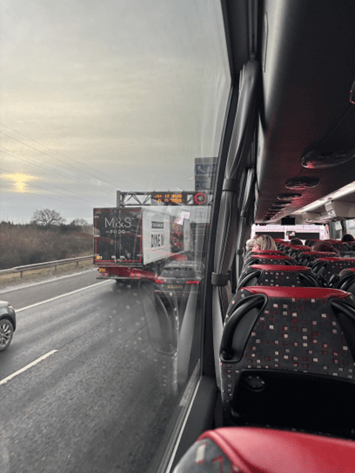
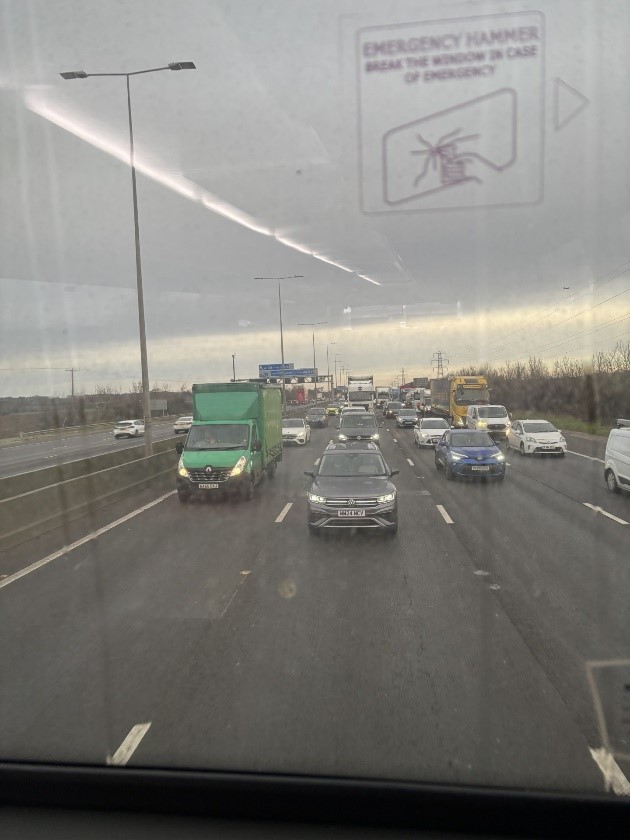
Sometimes these slow moments give us the best opportunities to reflect. While we’re crawling through, my mind wanders to some of the landmark cases we’ll be discussing today. The Supreme Court’s role in shaping our most complex moral and legal debates is fascinating – take the assisted dying cases for instance. These aren’t just legal arguments; they’re profound questions about human dignity, autonomy, and the limits of state intervention in deeply personal decisions. It’s also interesting to think about how the evolution of our highest court reflects (or sometimes doesn’t reflect) the society it serves. When we discuss access to justice in our criminology lectures, we often talk about how diverse perspectives and lived experiences shape legal interpretation and decision-making. These thoughts feel particularly relevant as we approach the very institution where these crucial decisions are made.

The traffic might be testing our patience, but at least it’s giving us time to really think about these issues.
10:07 AM – Arriving London – The stark reality of London’s inequality hits you right here, just steps from Hyde Park.
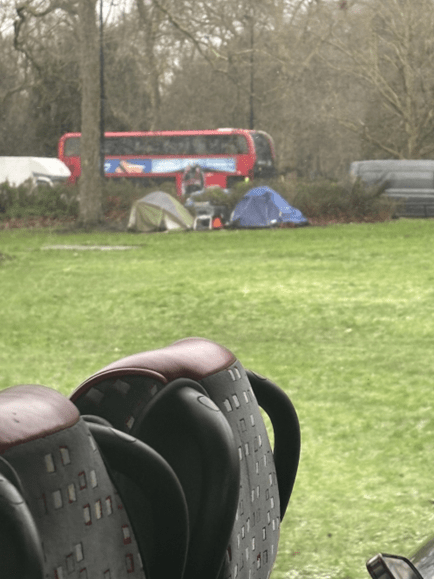
Honestly, this is a scene that perfectly summarises the deep social divisions in our society – luxury cars pulling up to the Dorchester where rooms cost more per night than many people earn in a month, while just meters away, our fellow citizens are forced to make their beds on cold pavements. As a criminologist, these scenes raise critical questions about structural violence and social harms. When we discuss crime and justice in our lectures, we often talk about root causes. Here they are, laid bare on London’s streets – the direct consequences of austerity policies, inadequate mental health support, and a housing crisis that continues to push more people into precarity. But as we say in the Nigerian dictionary of life lessons – WE MOVE!! 🚀
10:31 AM Supreme Court security check time
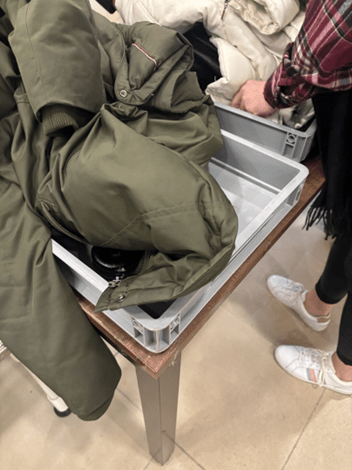
Security check time, and LISTEN to how they’re checking our students’ water bottles! The way they’re examining those drinks is giving: Nah this looks suspicious 🤔

So there I am, breezing through security like a pro (years of academic conferences finally paying off!). Our students follow suit, all very professional and courtroom-ready. But wait for it… who’s that getting the extra-special security attention? None other than our beloved department head Manos! 😂

The security guard’s face is priceless as he looks through his bags back and forth. Jes whispers to me ‘is Manos trying to sneak in something into the supreme court?’ 😂 Maybe they mistook his collection of snacks for contraband? Or perhaps his stack of risk assessment forms looked suspicious? 😂 There he is, explaining himself, while the rest of us try (and fail) to suppress our giggles. He is a free man after all.
10: 44AM Right so first stop, – Court Room 1.


Our tour guide provided an overview of this institution, established in 2009 when it took over from the House of Lords as the UK’s highest court. The transformation from being part of the legislature to becoming a physically separate supreme court marked a crucial step in the separation of powers in the country’s legislation. There’s something powerful about standing in this room where the Justices (though they usually sit in panels of 5 or 7) make decisions. Each case mentioned had our criminology students leaning in closer, seeing how theoretical concepts from their modules materialise in this very room.
10:59 AM Moving into Court 2, the more modern one!


After exploring Courtroom 1, we moved into Court Room 2, and yep, I also saw the contrast! And apparently, our guide revealed, this is the judges’ favourite spot to dispense justice – can’t blame them, the leather chairs felt lush tbh!
Speaking of judges, give it up for our very own Joseph Buswell who absolutely nailed it when the guide asked about Supreme Court proceedings! 👏🏾 As he correctly pointed out, while we have 12 Supreme Court Justices in total, they don’t all pile in for every case. Instead, they work in panels of 3 or 5 (always keeping it odd to avoid those awkward tie situations). 👏🏾 And what makes Court Room 2 particularly significant for public access to justice the cameras and modern AV equipment which allow for those constitutional and legal debates to be broadcast to the nation. Spot that sneaky camera right at the top? Transparency level: 100% I guess!

The exhibition area

The exhibition space was packed with rich historical moments from the Supreme Court’s journey. Among the displays, I found myself pausing at the wall of Justice portraits. Let’s just say it offered quite the visual commentary on our judiciary’s journey towards representation…

Beyond the portraits, the exhibition showcased crucial stories of landmark judgments that have shaped our legal landscape. Each case display reminded us how crucial diverse perspectives are in the interpretation and application of law in our multicultural society.

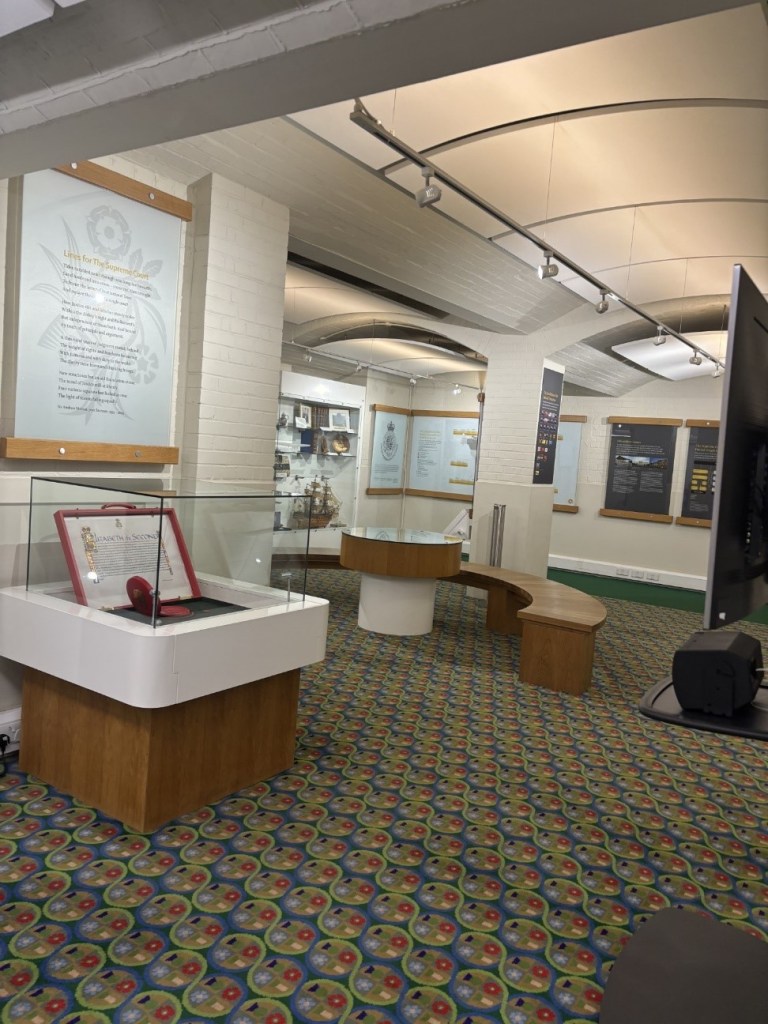

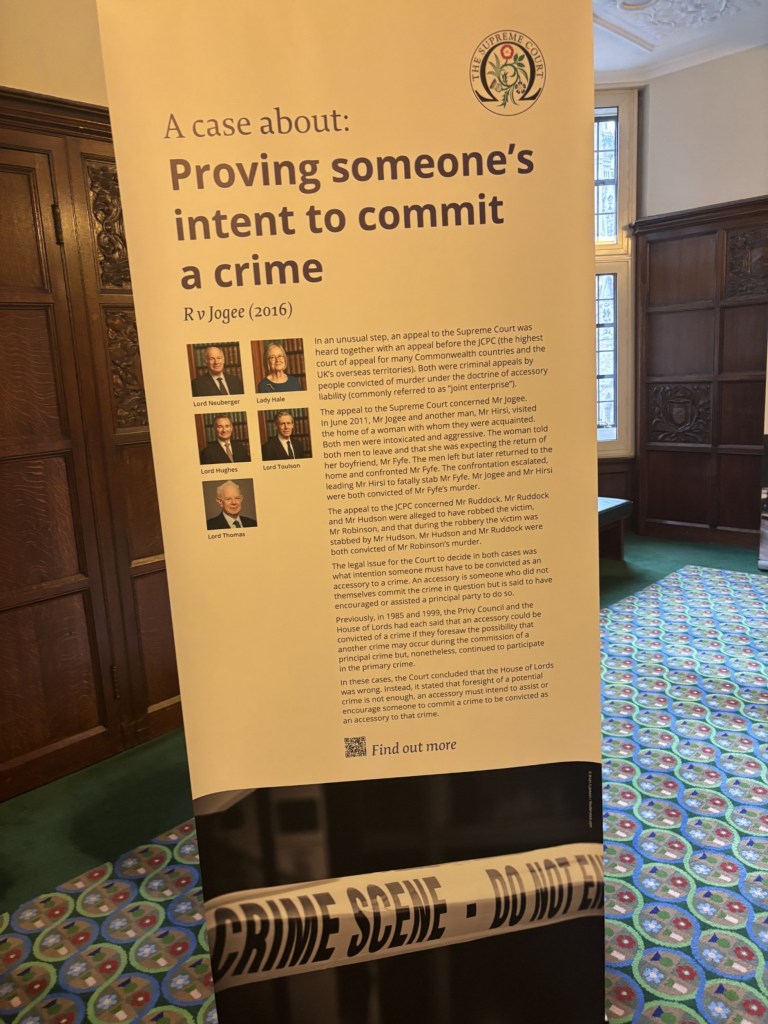
11: 21AM Moving into Court 3, home of the Judicial Committee of the Privy Council (JCPC)

The sight of those Commonwealth flags tells a powerful story about the evolution of colonial legal systems and modern voluntary jurisdiction. Our guide explained how the JCPC continues to serve as the highest court of appeal for various independent Commonwealth countries. The relationship between local courts in these jurisdictions and the JCPC raises critical questions about legal sovereignty and judicial independence and the students were particularly intrigued by how different legal systems interact within this framework – with each country maintaining its own laws and legal traditions, yet looks to London for final decisions.

Breaktime!!!!
While the group headed out in search of food, Jes and I were bringing up the rear, catching up after the holiday and literally SCREAMING about last year’s Winter Wonderland burger and hot dog prices (“£7.50 for entry too? In this Keir Starmer economy?!😱”). Anyway, half our students had scattered – some in search of sustenance, others answering the siren call of Zara (because obviously, a Supreme Court visit requires a side of retail therapy 😉).


But here’s the moment that had us STUNNED – right there on the street, who should come power-walking past but Sir Chris Whitty himself! 😱 England’s Chief Medical Officer was on a mission, absolutely zooming past us like he had an urgent SAGE meeting to get to 🏃♂️. That man moves with PURPOSE! I barely had time to nudge Jes before he’d disappeared. One second he was there, the next – gone! Clearly, those years of walking to press briefings during the pandemic have given him some serious speed-walking skills! 👀
3:30 PM – Group Photo!
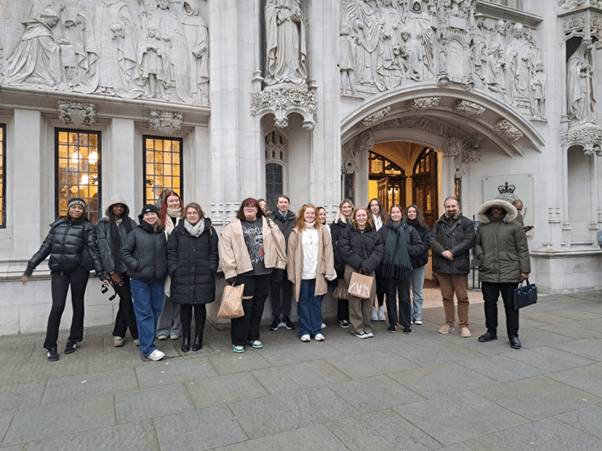
Looking at these final year criminology students in our group photo though! Even with that criminal early morning start (pun intended 😅), they made it through the whole Supreme Court experience! Big shout out to all of them 👏🏾👏🏾👏🏾👏🏾👏🏾👏🏾 Can you spot me? I’m the one on the far right looking like I’m ready for Arctic exploration (as Paula mentioned yesterday), not London weather! 🥶 Listen, my ancestral thermometer was not calibrated for this kind cold today o! Had to wrap up in my hoodie like I was jollof rice in banana leaves – and you know we don’t play with our jollof! 😤
4:55 PM Heading Back To NN

On the journey back to NN, while some students dozed off (can’t blame them – legal learning is exhausting!), I found myself reflecting on everything we’d learned. From the workings of the highest court in our land to the stark realities of social inequality we witnessed near Hyde Park, today brought our theoretical classroom discussions into sharp focus. Sitting here, watching London fade into the distance, I’m reminded of why these field trips are so crucial for our students’ understanding of justice, law, and society.
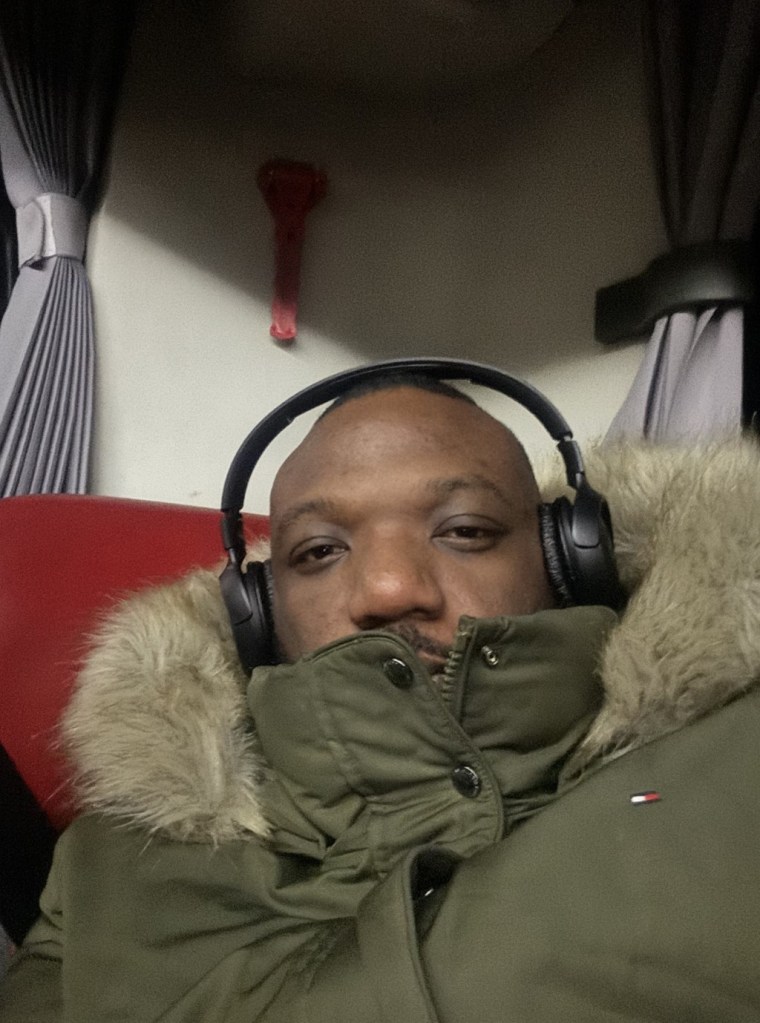

Listen, can we take a moment to appreciate our driver though?! Navigating that M1 traffic like a BOSS, and getting us back safe and sound! The real MVP of the day! 👏🏾👏🏾👏🏾👏🏾👏🏾👏🏾
And just like that, our Supreme Court trip comes to an end. From early morning rush to security check shenanigans, from spotting Chief Medical Officer on the streets to freezing our way through legal history – what a DAY!
To my amazing final years who made this trip extra special – y’all really showed why you’re the future of criminology! 👏🏾 Special shoutout to Manos (who can finally put down his attendance sheet 😂), Jes, and Liam for being the dream team! And to London… boyyyy, next time PLEASE turn up the heat! 🥶
As we all head our separate ways, some students were still chatting about the cases we learned about (while others were already dreaming about their beds 😴), In all, I can’t help but smile – because days like these? This is what university life is all about!
Until our next adventure… your frozen but fulfilled criminology lecturer, signing off! 🙌
Share this:


An annual reflection and a glance to the year ahead!

As we complete the last day before the Christmas break, I encourage you to sit back and reflect on what you have achieved this academic term. Some of you will have started university for the first time and will be getting to grips with the processes, the assessments, the staff and the learning styles of the university. Some of you will be navigating second year and the new expectations of you at this level, learning to move beyond discussion to instead evaluation and being critical, honing your research skills in preparation for your dissertations in the next academic year. For some of you this may have been a hard journey and one that will progress into the second semester, but please know that this will build up your skills and your confidence, turning you into the academic you need to be in order to succeed.
For some of you, you will have moved into your third and final year. With this comes more independence, and some of this may feel uncertain, confusing, and a bit unknown. Please know that again this does not last and you will find your feet. Whether that is a lightbulb moment with your dissertation, or finally finding the right article that helps you to write your essay. For those of you that have exams coming up in January, make sure you can enjoy the festivities and take a well earned break. But when you find those moments where you’re bored and have nothing to do, and you start to think about your criminology course, I think that will be a good indication to pick up a book, to read through your notes, or to practice some exam questions.
On a personal note as I reflect on this year there are things I am definitely proud to have achieved, and things I would like to work on in the future. One of my biggest achievements this year was completing my PhD. It has been a long, difficult journey, spanning over eight years, but the feeling of successfully completing my viva, making those final changes, and the recognition I feel when discussing my research to various people reminds me of its importance. The special moment of my graduation. At my graduation my research title was read aloud, I was applauded, and then welcomed into the academic community onstage to be seated with fellow academics such as my supervisors. This was a special moment I will cherish and having family there was all the more memorable and precious. Whilst the PhD journey has come to an end, new opportunities arise, so keep an eye out in 2025 for further publications!
In addition, this year, I navigated my new job at the University of Northampton. In the 12 months I’ve been here I have learnt a lot from colleagues, from the faculty, and from other departments. Looking ahead, the road is one of change and adjustment, but I am optimistic and ready for whatever changes may come.
I wish everyone a wonderful and restful Christmas. Like myself, I hope you return in the New Year with renewed energy ready to tackle any new adventures with poise and determination. Remember to push yourselves to get to the best version of you!

 Thoughts from the criminology team