
Home » history
Category Archives: history
LET THEM EAT SOUP

Introduction
What is a can of soup? If you ask a market expert, it is a high-profit item currently pushing £2.30 (branded) in some UK shops[i]. If you ask a historian[ii], it is the very bedrock of organised charity-the cheapest, easiest way to feed a penniless and hungry crowd.
The high price of something so basic, like a £2.30 can of soup, is a massive conundrum when you remember that soup’s main historical job was feeding poor people for almost nothing. Soup, whose name comes from the old word Suppa[iii](meaning broth poured over bread), was chosen by charities because it was cheap, could be made in huge pots, and best of all could be ‘stretched’ with water to feed even more people on a budget[iv].
In 2025, the whole situation is upside down. The price of this simple food has jumped because of “massive economic problems and big company greed[v]. At the same time, the need for charity has exploded with food bank use soaring by an unbelievable 51% compared to 2019[vi]. When basic food is expensive and charity is overwhelmed, it means our country’s safety net is broken.
For those of us who grew up in the chilly North, soup is more than a commodity: it is a core memory. I recall winter afternoons in Yorkshire, scraping frost off the window, knowing a massive pot of soup was bubbling away. Thick, hot and utterly cheap. Our famous carrot and swede soup cost pennies to make, tasted like salvation and could genuinely “fix you.” The modern £2.30 price tag on a can feels like a joke played on that memory, a reminder that the simplest warmth is now reserved for those who can afford the premium.
This piece breaks down some of the reasons why a can of soup costs so much, explores the 250-year-old long, often embarrassing history of soup charity in Britain and shows how the two things-high prices and huge charity demand-feed into a frustrating cycle of managed hunger.
Why Soup Costs £2.30
The UK loves its canned soup: it is a huge business worth hundreds of millions of pounds every year[vii], but despite being a stable market, prices have been battered by outside events.
Remember that huge cost of living squeeze? Food inflation prices peaked at 19.1% in 2023, the biggest rise in 40 years[viii]. Even though things have calmed down slightly, food prices jumped again to 5.1% in August 2025, remaining substantially elevated compared to the overall inflation rate of 3.8% in the same month[ix]. This huge price jump hits basic stuff the hardest, which means that poor people get hurt the most.
Why the drama? A mix of global chaos (like the Ukraine conflict messing up vegetable oil and fertiliser supplies) and local headaches (like the extra costs from Brexit) have made everything more expensive to produce[x].
Here’s the Kicker: Soup ingredients themselves are super cheap. You can make a big pot of vegetable soup at home for about 66p a serving, but a can of the same stuff? £2.30. Even professional caterers can buy bulk powdered soup mix for just 39p per portion[xi].
The biggest chunk of that price has nothing to do with the actual carrots and stock. It’s all the “extras”. You must pay for- the metal can, the flashy label and the marketing team that tries to convince you this soup is a “cosy hug”, and, most importantly everyone’s cut along the way.
Big supermarkets and shops are the main culprits. They need a massive 30-50% profit margin on that can for just putting it on the shelf[xii]. Because people have to buy food to live (you can’t just skip dinner) big companies can grab massive profits, turning something that you desperately need into something that just makes them rich.
This creates the ultimate cruel irony. Historically, soup was accessible because it was simple and cheap. Now, the people who are too busy, too tired or too broke to cook from scratch-the working poor are forced to buy the ready-made cans[xiii]. They end up paying the maximum premium for the convenience they need most, simply because they don’t have the time or space to do it the cheaper way.
How Charity Got Organised
The idea of soup as charity is ancient, but the dedicated “soup kitchen” really took off in late 18th century Britain[xiv].
The biggest reasons were the chaos after the Napoleonic wars and the rise of crowded industrial towns, which meant that lots of people had no money if their work dried up. By 1900 England had gone from a handful of soup kitchens to thousands of them[xv].
The first true soup charity in England was likely La Soupe, started by Huguenot refugees in London in the late 17th Century[xvi]. They served beef soup daily-a real community effort before the phrase “soup kitchen” was even popular.
Soup was chosen as the main charitable weapon because it was incredibly practical. It was cheap, healthy and could be made in enormous quantities. Its real superpower was that it could be “stretched” by adding more water allowing charities to serve huge numbers of people for minimum cost[xvii].
These kitchens were not just about food; they were tools for managing poor people. During the “long nineteenth century” they often fed up to 30% of a local town’s population in winter[xviii]. This aid ran alongside the stern rules of the Old Poor Laws which sorted people into “deserving” (the sick or old) and the ‘undeserving’ (those considered lazy).
The queues, the rules, and the interviews at soup kitchens were a kind of “charity performance” a public way of showing who was giving and who was receiving, all designed to reinforce class differences and tell people how to behave.
The Stigma and Shame of Taking The Soup
Getting a free bowl of soup has always come with a huge dose of shame. It’s basically a public way of telling you “We are the helpful rich people and you are the unfortunate hungry one” Even pictures in old newspapers were designed to make the donors look amazing whilst poor recipients were closely watched[xix].
Early British journalists like Bart Kennedy used to moan about the long, cold queues and how staff would ask “degrading questions” just before you got your soup[xx]. Basically, you had to pass a misery test to get a bowl of watery vegetables, As one 19th Century writer noted, the typical soup house was rarely cleaned, meaning the “aroma of old meals lingers in corners…when the steam from the freshly cooked vegetables brings them back to life”[xxi].
For the recipient, the act of accepting aid became a profound assault on their humanity. The writer George Orwell, captured this degradation starkly, suggesting that a man enduring prolonged hunger “is not a man any longer, only a belly with a few accessory organs”[xxii]. That is the tragic joke here, you are reduced to a stomach that must beg.
By the late 19th Century, people started criticising soup kitchens arguing that they “were blamed for creating the problem they sought to alleviate”[xxiii]. The core problem remains today: giving someone a temporary food handout is just a “band-aid” solution that treats the symptom but ignores the real disease i.e. not enough money to live on.
This critique was affirmed during the Great Depression in Britain, when mobile soup kitchens and dispersal centres became a feature of the British urban landscape[xxiv]. The historical lesson is clear: private charity simply cannot solve a national economic disaster.
The ultimate failure of the system as the historian A.J.P. Taylor pointed out is that the poor demanded dignity. “Soup kitchens were the prelude to revolution, The revolutionaries might talk about socialism, those who actually revolted wanted ‘the right to work’-more capitalism, not it’s abolition[xxv]” They wanted a stable job, not perpetual charity.
Expensive Soup Feeds The Food Bank
The UK poverty crisis means that 7.5 million people (11% of the population) were in homes that did not have enough food in 2023/24[xxvi]. The Trussell Trust alone gave out 2.9 million emergency food parcels in 2024/2025[xxvii]. Crucially, poverty has crept deeper into the workforce: research indicates that three in every ten people referred to in foodbanks in 2024 were from working households[xxviii]. They have jobs but still can’t afford the supermarket prices.
The charities themselves are struggling, hit by a “triple whammy” of rising running costs (energy, rent) and fewer donations[xxix]. This means that many charities have had to cut back, sometimes only giving out three days food instead of a week[xxx]. The safety net in other words is full of holes.
The necessity of navigating poverty systems just to buy food makes people feel trapped and hopeless which is a terrible way to run a country[xxxi].
Modern food banks are still stuck in the old ways of the ‘deserving poor.’ They usually make you get a formal referral—a special voucher—from a professional like a doctor, a Jobcentre person, or the Citizens Advice bureau[xxxii].It’s like getting permission from three different people to have a can of soup.
Charity leaders know this system is broken. The Chief Executive of the Trussell Trust has openly said that food banks are “not the answer” and are just a “fraying sticking plaster[xxxiii].” The system forces a perpetual debate between temporary relief and systemic reform[xxxiv]. The huge growth of private charity, critics argue, just gives the government an excuse to cut back on welfare, pretending that kind volunteers can fix the problem for them[xxxv].
The final, bitter joke links the expensive soup back to the charity meant to fix the cost. Big food companies use inflation to jack up prices and boost profits. Then, they look good by donating their excess stock—often the highly processed, high-profit stuff—to food banks.
This relationship is called the “hunger industrial complex”[xxxvi]. The high-margin, heavily processed canned soup—the quintessential symbol of modern pricing failure—often becomes a core component of the charitable food parcel. The high price charged for the commodity effectively pays for the charity that manages the damage the high price caused[xxxvii]. You could almost call it “Soup-er cyclical capitalism.”
Conclusion
The journey from the 18th-century charitable pot to the 21st-century £2.30 can of soup shows a deep failure in our society. Soup, the hero of cheap hunger relief, has become too pricey for the people who need it most. This cost is driven by profit, not ingredients.
This pricing failure traps poor people in expensive choices, forcing them toward overwhelmed charities. The modern food bank, like the old soup kitchen, acts as a temporary fix that excuses the government from fixing the root cause: low income. As social justice campaigner Bryan Stevenson suggests, “Poverty is the parent of revolution and crime”[xxxviii]. No amount of £2.30 soup can mask the fact that hunger is fundamentally an issue of “justice,” not merely “charity”.
Fixing this means shifting focus entirely. We must stop just managing hunger with charity[xxxix] and instead eliminate the need for charity by making sure everyone has enough money to live and buy their own food. This requires serious changes: regulating the greedy markups on basic food and building a robust state safety net that guarantees a decent income[xl]. The price of the £2.30 can is not just inflation: it’s a receipt for systemic unfairness.
[i]Various Contributors, ‘Reddit Discussion on High Soup Prices’ (Online Forum, 2023) https://www.reddit.com/r/CasualUK/comments/1eooo3o/why_has_soup_gotten_so_expensive
[ii] Philip J Carstairs, ‘A generous helping? The archaeology of Soup Kitchens and their role in post-medieval philanthropy 1790-1914 (PhD Thesis, University of Leicester 2022) https://figshare.le.ac.uk/articles/thesis/A_generous_helping_The_archaeology_of_soup_kitchens_and_their_role_in_post-medieval_philanthropy_1790-1914/21187117?file=37564186
[iii] Soup – etymology, origin & meaning[iii] https://www.etymonline.com/word/soup
[iv] Philip J Carstairs, ‘A generous helping? The archaeology of soup kitchens and their role in post-medieval philanthropy 1790–1914’ (Summary, University of Leicester 2022)(https://figshare.le.ac.uk/articles/thesis/A_generous_helping_The_archaeology_of_soup_kitchens_and_their_role_in_post-medieval_philanthropy_1790-1914/21187117)
[v] ONS, ‘Food Inflation Data, UK: August 2025’ (Trading Economics Data) https://tradingeconomics.com/united-kingdom/food-inflation
[vi] The Trussell Group-End Of Year Foodbank Stats
https://www.trussell.org.uk/news-and-research/latest-stats/end-of-year-stats
[vii] GlobalData, ‘Ambient Soup Market Size, Growth and Forecast Analytics, 2023-2028’ (Market Report, 2023) https://www.globaldata.com/store/report/uk-ambient-soup-market-analysis/
[viii] ONS, ‘Consumer Prices Index, UK: August 2025’ (Summary) https://www.ons.gov.uk/economy/inflationandpriceindices
[ix] Food Standards Agency, ‘Food System Strategic Assessment’ (March 2023) https://www.food.gov.uk/research/food-system-strategic-assessment-trends-and-issues-impacted-by-uk-economic-condition
[x] Wholesale Soup Mixes (Brakes Foodservice) https://www.brake.co.uk/dry-store/soup/ambient-soup/bulk-soup-mixes
[xii] A Semuels, ‘Why Food Company Profits Make Groceries Expensive’ (Time Magazine, 2023) https://time.com/6269366/food-company-profits-make-groceries-expensive/
[xiii] Christopher B Barrett and others, ‘Poverty Traps’ (NBER Working Paper No. 13828, 2008) https://www.nber.org/system/files/chapters/c13828/c13828.pdf
[xiv] Philip J Carstairs, ‘A generous helping? The archaeology of soup kitchens and their role in post-medieval philanthropy 1790–1914’ (Summary, University of Leicester 2022)(https://figshare.le.ac.uk/articles/thesis/A_generous_helping_The_archaeology_of_soup_kitchens_and_their_role_in_post-medieval_philanthropy_1790-1914/21187117
[xv] Philip J Carstairs, ‘A generous helping? The archaeology of soup kitchens and their role in post-medieval philanthropy 1790–1914’ (Summary, University of Leicester 2022)(https://figshare.le.ac.uk/articles/thesis/A_generous_helping_The_archaeology_of_soup_kitchens_and_their_role_in_post-medieval_philanthropy_1790-1914/21187117
[xvi] The Soup Kitchens of Spitalfields (Blog, 2019) https://spitalfieldslife.com/2019/05/15/the-soup-kitchens-of-spitalfields/
[xvii] Birmingham History Blog, ‘Soup for the Poor’ (2016) https://birminghamhistoryblog.wordpress.com/2016/02/04/soup-for-the-poor/
[xviii] [xviii] Philip J Carstairs, ‘A generous helping? The archaeology of soup kitchens and their role in post-medieval philanthropy 1790–1914’ (Summary, University of Leicester 2022)(https://figshare.le.ac.uk/articles/thesis/A_generous_helping_The_archaeology_of_soup_kitchens_and_their_role_in_post-medieval_philanthropy_1790-1914/21187117
[xix] Journal Panorama, ‘Feeding the Conscience: Depicting Food Aid in the Popular Press’ (2019) https://journalpanorama.org/article/feeding-the-conscience/
[xx] Journal Panorama, ‘Feeding the Conscience: Depicting Food Aid in the Popular Press’ (2019) https://journalpanorama.org/article/feeding-the-conscience/
[xxi] Joseph Roth, Hotel Savoy (Quote on Soup Kitchens) https://www.goodreads.com/quotes/tag/soup-kitchens
[xxii] Convoy of Hope, (Quotes on Dignity and Poverty) https://convoyofhope.org/articles/poverty-quotes/
[xxiii] Philip J Carstairs, ‘A generous helping? The archaeology of soup kitchens and their role in post-medieval philanthropy 1790–1914’ (Summary, University of Leicester 2022)(https://figshare.le.ac.uk/articles/thesis/A_generous_helping_The_archaeology_of_soup_kitchens_and_their_role_in_post-medieval_philanthropy_1790-1914/21187117
[xxiv] Science Museum Group, ‘Photographs of Poverty and Welfare in 1930s Britain’ (Blog, 2017) https://blog.scienceandmediamuseum.org.uk/photographs-of-poverty-and-welfare-in-1930s-britain/
[xxv] AJ P Taylor, (Quote on Revolution) https://www.goodreads.com/quotes/tag/soup-kitchens
[xxvi] House of Commons Library, ‘Food poverty: Households, food banks and free school meals’ (CBP-9209, 2024) https://commonslibrary.parliament.uk/research-briefings/cbp-9209/
[xxvii] Trussell Trust, ‘Factsheets and Data’ (2024/25) https://www.trussell.org.uk/news-and-research/latest-stats/end-of-year-stats
[xxviii] The Guardian, ‘Failure to tackle child poverty UK driving discontent’ (2025) https://www.theguardian.com/society/2025/sep/10/failure-tackle-child-poverty-uk-driving-discontent
[xxix] Charity Link, ‘The cost of living crisis and the impact on UK charities’ (Blog) https://www.charitylink.net/blog/cost-of-living-crisis-impact-uk-charities
[xxxi] The Soup Kitchen (Boynton Beach), ‘History’ https://thesoupkitchen.org/home/history/
[xxxii] Transforming Society, ‘4 uncomfortable realities of food charity’ (Blog, 2023) https://www.transformingsociety.co.uk/2023/12/01/4-uncomfortable-realities-of-food-charity-power-religion-race-and-cash
[xxxiii] The Trussell Group-End Of Year Foodbank Stats
https://www.trussell.org.uk/news-and-research/latest-stats/end-of-year-stats
[xxxiv] The Guardian, ‘Food banks are not the answer’ (2023) https://www.theguardian.com/society/2023/jun/29/food-banks-are-not-the-answer-charities-search-for-new-way-to-help-uk-families
[xxxv] The Guardian, ‘Britain’s hunger and malnutrition crisis demands structural solutions’ (2023) https://www.theguardian.com/uk-news/commentisfree/2023/dec/27/britain-hunger-malnutrition->
[xxxvi] Jacques Diouf, (Quote on Hunger and Justice, 2007) https://www.hungerhike.org/quotes-about-hunger/
[xxxvii] Borgen Magazine, ‘Hunger Awareness Quotes’ (2024) https://www.borgenmagazine.com/hunger-awareness-quotes/
[xxxviii] he Guardian, ‘Failure to tackle child poverty UK driving discontent’ (2025) https://www.theguardian.com/society/2025/sep/10/failure-tackle-child-poverty-uk-driving-discontent
[xxxix] Charities Aid Foundation, ‘Cost of living: Charity donations can’t keep up with rising costs and demand’ (Press Release, 2023) https://www.cafonline.org/home/about-us/press-office/cost-of-living-charity-donations-can-t-keep-up-with-rising-costs-and-demand
[xl] The “Hunger Industrial Complex” and Public Health Policy (Journal Article, 2022) https://pmc.ncbi.nlm.nih.gov/articles/PMC9437921/
Share this:


The colour of my skin

In recent weeks one politician, let’s call him “Doug” questioned the colour of another politician, let’s call her “Karen”. According to Doug, Karen decided to change the colour of her skin from brown to black. The way the colour change took place was presented as capricious and confusing. This little discussion took place in an event organised by the National Association of Black Journalists and it raised some very negative reactions namely on Doug’s audacity to interfere with the right of another person, in this case Karen, to self-identify and chose her own racial identity.
Perhaps these comments will be remembered or forgotten, but regardless they resonate with me because racial profiling and race identification is still a highly contested term in judicial processes namely law enforcement. It is even more controversial when considering the origins of these racial profiling and attribution. One word: colonialism! I appreciate that this is something that we converse about when we are talking about historical events, on empire expansion and exploitation, that led to genocide and slavery, but this is when I actually think that is partially the picture. Maybe because the roots on colonialism live with us and they still influence our social reality.
Colonialism turned skin colour into a commodity. It became part of the empire’s structure and all European and European influenced empires (i.e. USA or Australia) stand accused of their influence in criminalising skin and racial features. This influence is long lasting and its indelibly connected with the glorious past of all empires. Colourism and racial profiling were exploited to justify some of the most heinous crimes in human history.
To explain; colonialism sounds like an act that happened and eventually ended in time of British abolition of slavery and in US the Emancipation proclamation. After that, the world fought against it and all forms of it internationally entering article 4 of the UN convention. All is well! On the contrary! My point is that colonialism is far more insidious and deceitful. People presume that skin colour is a description of attributes and for millennia it was; the intensity of imperial exploitation of people used the colour of the skin as an obvious demarcation of racial separation. That allowed the imperial powers to keep different populations under control. Colour became the vehicle of oppression and subjugation. Empires thrived in dividing the population, utilising race and colour as a wedge that will make it difficult to understand their connected history of repression, making it difficult for people to rise against the tyranny of imperialism.
Consider the following. A fourth or fifth child of a Scottish labourer back in the early 19th century. Barely educated in reading and writing in a village in the highlands from a family that is hardly making ends meet. At age 17 he will join the British red coats or scarlet tunics, to be sent anywhere in the empire. This young man with hardly any life experience will be travelling across the world, using the privilege of his uniform to take, steal and do whatever he wants with impunity.[1] Years after he will return back to the village he came from with wealth and loot. His contemporaries will hail him as a success. In a garage sale today, a delightful old lady is holding a precious tea cup left by her beloved great-grandfather.
She holds it in her trembling hands as if the tea cup is talking to her, giving her meaning. Who can dare to tell this lovely old lady the history of this cup; the blood and pain that it contained long before it travelled across continents? This is why colonialism is so insidious because it’s subversive making people of the present and the future, custodians of that past, even unbeknown to them.
Of course, in the original instance between Doug and Karen, what is left out is the biggest and most challenging facet. That purity of race is a great read for those studying ethnology in the early 20th century, but we now know that people’s colours and races are a mixture of transgenerational journeys. People who identify as mixed race, a constituency of people, largely ignored by colonialism because it did not fit into their absurd sense of race classification, is rising.
Empire with its tales of heroism and greatness makes people yearn for a past that never existed, from a partial perspective that benefited the oppressors, minimising the impact it had on those who they oppressed. People, their cultures and most importantly their physiology become the casualties of said greatness. Years and years ago, in conversation with a dear Persian friend I realised that Alexander was Great for me but for Darius, my friend, he was Alexander the Accursed. If we can see beyond the “greatness” of our own past, perhaps we can read human history more accurately, where human attributes are just that and the colour of the skin should bear no consequences on people’s life or death.

[1] Similarly to the actions of a Scottish nobleman who stripped off the sculptures of a national monument; something akin to a sport of plunder among the European empires.
Share this:


Gypsy Roma Traveller History Month: A Romany Museum
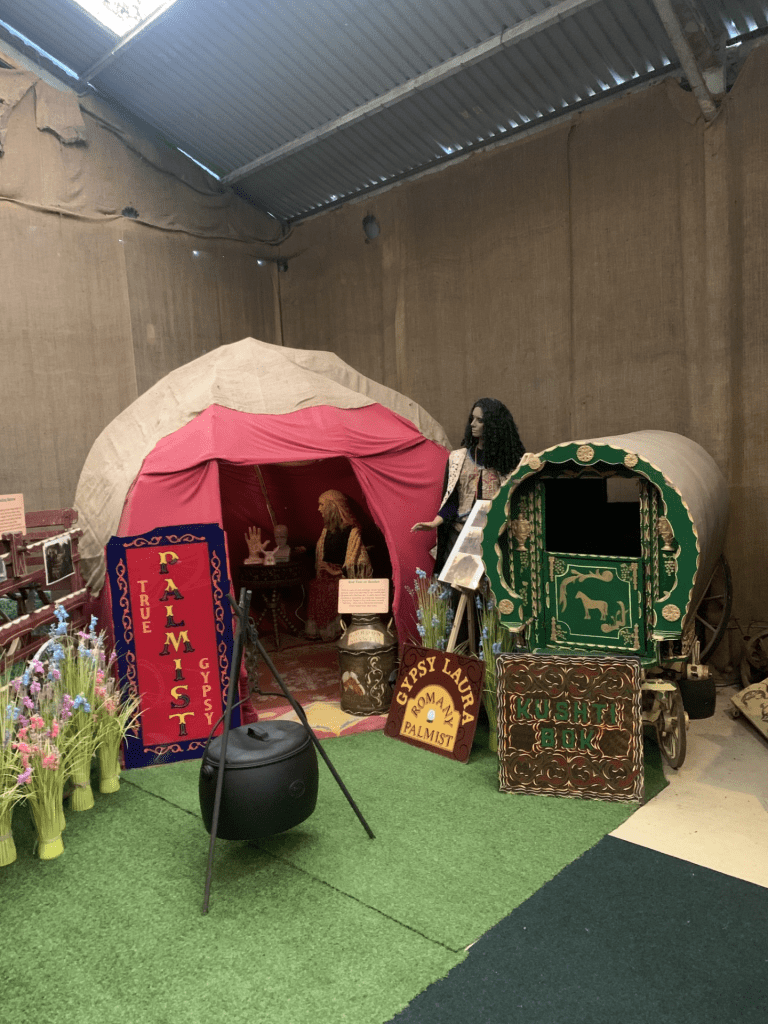
In April I visited the Gordon Boswell Romany Museum, museums in this country tend to operate under the guise of whiteness, but this one is different – it seems to be unapologetically and traditionally Romany.
The museum has an off grid feel to it, it appears after driving miles amongst countryside fields and if you would like to contact the museum staff, apparently telephone is best, not social media or email. This museum is also situated within what seems to be a Romany family home area and working scrapyard business. So even before entering the building, the culture of close family ties for building home and business that is outside of mainstream culture, are there.
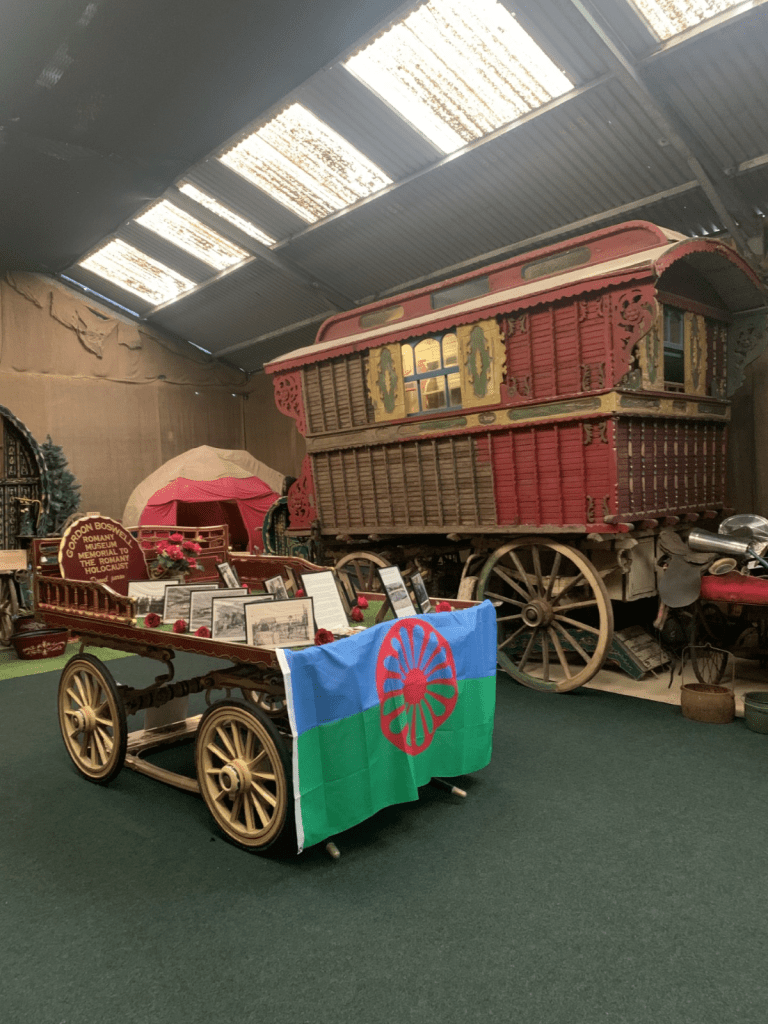
Inside the museum there are a variety of traditional Romany artefacts, which includes wagon, trailers, horse related items and handmade gifts, as well as other wagons curated by the owners and close contacts themselves. You will be pressed to find any written signage here, as in-line with tradition Romany history is passed on through verbal story telling. So if you want to know more about something you will need to ask those running the place, who are keen to have a chat with you.
I was surprised to see that the museum had a decent amount of visitors considering that this was a weekday and located in a lowly populated area in Spalding. The museum seems to be aimed at celebrating and illustrating traditions, instead of being motivated by profit. The visitors that were there also seemed to be touched by their visit, perhaps it is the attempt at preserving a traditional culture that has been under constant pressure, that makes this so meaningful. Or the memories of the past which the museum seems to hold onto.
Upon exiting the museum, seemingly Romany people pull up with a horse and cart near-by. A reminder of a slower paced yet hard working traditional life, where the outside world and mainstream culture does not matter so much as long as there is food on the table and supportive family near by. Although, I was left with more questions after the visit, such as where are the museums/spaces for other groups, such as Traveller culture? Where are the celebrations for more contemporary lives lived by Gypsy Roma and Traveller people?

This year the month in which I celebrated Romany culture the most was in April with a visit to The Gordon Boswell Romany Museum and I really did enjoy the visit. I have not done much to celebrate this month as I wonder – how do you to celebrate these specific History Month in a way that is meaningful and not performative?
Share this:


Festive messages, a legendary truce, and some massacres: A Xmas story

Holidays come with context! They bring messages of stories that transcend tight religious or national confines. This is why despite Christmas being a Christian celebration it has universal messages about peace on earth, hope and love to all. Similar messages are shared at different celebrations from other religions which contain similar ecumenical meanings.
The first official Christmas took place on 336 AD when the first Christian Emperor declared an official celebration. At first, a rather small occasion but it soon became the festival of the winter which spread across the Roman empire. All through the centuries more and more customs were added to the celebration and as Europeans “carried” the holiday to other continents it became increasingly an international celebration. Of course, joy and happiness weren’t the only things that brought people together. As this is a Christmas message from a criminological perspective don’t expect it to be too cuddly!
As early as 390 AD, Christmas in Milan was marked with the act of public “repentance” from Emperor Theodosius, after the massacre of Thessalonica. When the emperor got mad they slaughtered the local population, in an act that caused even the repulson of Ambrose, Bishop of Milan to ban him from church until he repented! Considering the volume of people murdered this probably counts as one of those lighter sentences; but for people in power sentences tend to be light regardless of the historical context.
One of those Christmas celebrations that stand out through time, as a symbol of truce, was the 1914 Christmas in the midst of the Great War. The story of how the opposing troops exchanged Christmas messages, songs in some part of the trenches resonated, but has never been repeated. Ironically neither of the High Commands of the opposing sides liked the idea. Perhaps they became concerned that it would become more difficult to kill someone that you have humanised hours before. For example, a similar truce was not observed in World War 2 and in subsequent conflicts, High Commands tend to limit operations on the day, providing some additional access to messages from home, some light entertainment some festive meals, to remind people that there is life beyond war.
A different kind of Christmas was celebrated in Italy in the mid-80s. The Christmas massacre of 1984 Strage Di Natale dominated the news. It was a terrorist attack by the mafia against the judiciary who had tried to purge the organisation. Their response was brutal and a clear indication that they remained defiant. It will take decades before the organisation’s influence diminishes but, on that date, with the death of people they also achieved worldwide condemnation.
A decade later in the 90s there was the Christmas massacre or Masacre de Navidad in Bolivia. On this occasion the government troops decided to murder miners in a rural community, as the mine was sold off to foreign investors, who needed their investment protected. The community continue to carry the marks of these events, whilst the investors simply sold and moved on to their next profitable venture.
In 2008 there was the Christmas massacre in the Democratic Republic of Congo when the Lord’s Resistance Army entered Haut-Uele District. The exact number of those murdered remains unknown and it adds misery to this already beleaguered country with such a long history of suffering, including colonial ethnic cleansing and genocide. This country, like many countries in the world, are relegated into the small columns on the news and are mostly neglected by the international community.
So, why on a festive day that commemorates love, peace and goodwill does one talk about death and destruction? It is because of all those heartfelt notions that we need to look at what really happens. What is the point of saying peace on earth, when Gaza is levelled to the ground? Why offer season’s wishes when troops on either side of the Dnipro River are still fighting a war with no end? How hypocritical is it to say Merry Christmas to those who flee Nagorno Karabakh? What is the point of talking about love when children living in Yemen may never get to feel it? Why go to the trouble of setting up a festive dinner when people in Ethiopia experience famine yet again?
We say words that commemorate a festive season, but do we really mean them? If we did, a call for international truce, protection of the non-combatants, medical attention to the injured and the infirm should be the top priority. The advancement of civilization is not measured by smart phones, talking doorbells and clever televisions. It is measured by the ability of the international community to take a stand and rehabilitate humanity, thus putting people over profit. Sending a message for peace not as a wish but as an urgent action is our outmost priority.
The Criminology Team, wishes all of you personal and international peace!
Share this:

Refugee Week 2023

Monday 19th June commences the 2023 Refugee Week and this year’s theme is compassion, a quality we have seen little of in Fortress Europe policy and practice this year. As many of you will know, Jessica James and I founded the Northampton Freedom From Torture local supporter’s group earlier this year. Part of the reason for setting up the group was to help foster compassion towards people seeking safety in our local area. Admittedly, we’ve been pretty quiet so far (workloads, life etc. – we welcome volunteers to help organise events) but for Refugee Week we have organised a film screening of MATAR and The First Drop of Rain: Making MATAR.
MATAR is a WaterBear Original following the story of an asylum seeker in England who, when confronted with the hostile immigration system in the UK, is forced to live on the fringes of society and rely on his bike to survive.
A powerful and poignant story of resilience and perseverance, based on the lived experience of co-writer Ayman Alhussein. MATAR stars actor Ahmed Malek (The Swimmers) in the titular role, with BAFTA-nominated actor Youssef Kerkour (Home) and Elmi Rashid Elmi (The Swimmers). This docu-fiction short film is directed by BAFTA-winning Hassan Akkad and produced by Deadbeat Studios in association with Choose Love.
The event will be hosted on Wednesday 21st June 2023 from 5.30pm in the Morley Room at the University of Northampton. Tickets are free and can be booked here but we welcome donations and sponsorship for @jesjames50’s forthcoming half marathon.
In October, Jes will be running the Royal Parks Half Marathon to fundraise for Freedom From Torture. Running is one of Jes’ favourite hobbies and is enjoyed by millions across the globe as a popular pastime and fitness activity. However, running in this capacity is a privilege. For some it is forced upon them to flee harm, torture and unlawful prosecution. Freedom For Torture is a charity which is dedicated to helping, healing and protecting people who have survived torture. The half marathon is 13.1miles and has raised nearly £60million for over 1000 charity partners since 2008, and in 2023 we are aiming to contribute to this! Watch this space for more details about the upcoming fundraising activities and sponsoring Jes take on her longest run ever for survivors of torture. You can find Jes’ Just Giving page here.

Now we have the promotion out of the way, let’s talk about why compassion matters. The UK government is intent on ‘stopping the boats’, yet the policies they propose to achieve this do not include opening safe and legal routes to those seeking safety here. Instead, governments throughout much of Europe opt for deterrent measures, the results of which mean border deaths as we have seen in the tragedy off the coast of Greece this week. The omission of opening safe routes contributes to the structural violence of immigration policy and practice in Europe and means that deaths at the border are, as Shahram Khosravi argues, an acceptable consequence of border practices. There exists a gaping chasm where the compassion should be.
Meanwhile, those who do show compassion such as those volunteering to help refugees, protesters and even refugees themselves risk criminal prosecution. Sara Mardini is among a group of volunteers who faced prosecution in Greece earlier this year for a number of charges relating to their voluntary work with refugees. Although acquitted of a number of charges, some of the volunteers still face investigation for people smuggling and other offences. Meanwhile in the UK protesters are routinely arrested for protesting inhumane deportation and the Nationality and Borders Act 2022 allows maximum sentences of life imprisonment for those piloting small boats to smuggle migrants into the UK, not considering that many of these people will be refugees themselves who have paid smugglers and been forced to pilot boats, or who have agreed to pilot a boat in return for their passage. The stakes are high for acts of compassion.
As a border criminologist and activist, the refugee ‘crisis’, political, media and public responses to people seeking safety can feel overwhelming at times. It is difficult to comprehend what one person can do, yet there is power where lots of individuals stand up against injustice. Just over a year ago, I was at a protest outside an immigration removal centre on the day the first flight to Rwanda was due to take place. There were others there and at various locations around the country, and even more mobilised on social media. Campaign groups, charities and lawyers worked together to bring a court case against the UK government. While the war is ongoing, we won the battle that day and the plane was not allowed to leave.
We can all do something to spread compassion towards people seeking safety. Actions could be as simple as learning about refugees by watching a film or reading a book. It could mean sharing your thoughts in conversations and viA social media platforms. You could write to your MP and ask them to show some compassion or volunteer with a group like our Freedom From Torture local group or participate in a protest.
Share this:


Cash Strapped, Vote-Buying, Petroleum Scarcity, and the Challenge of a 21st Century Election
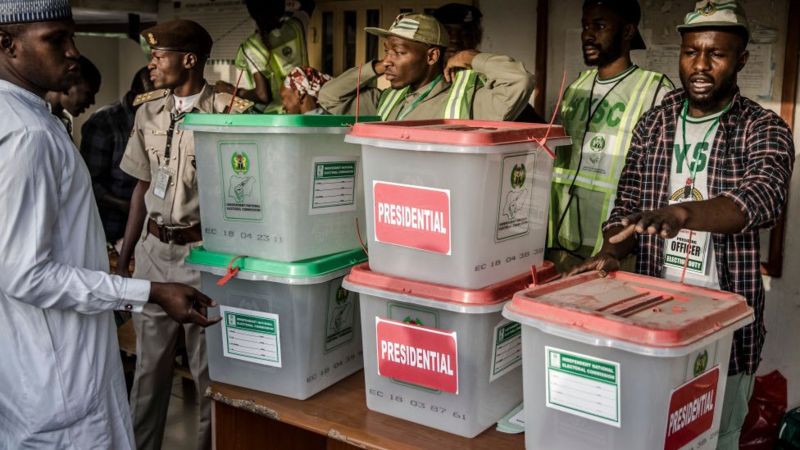
Democratic elections are considered an important mechanism and a powerful tool used to choose political leaders. However, the level of transparency and the safety of votes, the electorates, and the aspirants as recent elections in supposed strong democracies indicate is not a given. Even more, in weak and fragile states, voters grapple with uncertainties including the herculean task of deciding on whom or perhaps what to pledge allegiance to?
Nigerians face such uncertainties as over 93 million voters are set to decide the new leadership of the most populous country in Africa in less than 24 hours. Three contestants: Ahmed Bola Tinubu of the ruling All Progressive Congress (APC); Peter Obi of the Labour Party(LP); and Atiku Abubakar of the Peoples Democratic Party (PSP) are considered the major contestants of the coveted seat of the presidency. All 3 contestants are neither strangers to political power nor free of controversies. Nevertheless, a plethora of problems awaits the successful candidate, including a spiking impatience with government policies from the populace.
Since assuming office in 2015, President Muhammadu Buhari has consciously implemented numerous policies aimed at changing the tide of the crippling economy of Nigeria. One of this was tightening control of foreign exchange and forex restrictions to minimise pressure on the weak exchange rate of the naira against other currencies, and to encourage local manufacturing. Furtherance to this, the government implemented more restrictions including closing all its land borders in August 2019 to curtail smuggling contrabands and to boost agricultural outputs. These policies have been criticised for increasing the hardship of the mostly poor masses and failing to yield desired goals, despite its resulting in an increase in local production of some agricultural products.
The aviation sector and multinational companies were also heavily impacted by the forex restrictions. International airliners were unable to access and repatriate their business funds and profits. As a result, some suspended operations while some multinationals closed down completely. Flawed policy articulation and implementation and a slow or total failure to respond to public disenchantment has been the bane of the 8 years of Buhari regime which ends in a few months. While the masses grappled with surviving movement restrictions during the Covid-19 lockdown, palliative meant for to ease their suffering were hoarded for longer than necessary, thereby provoking series of mass looting and destruction of the storage warehouses.
Demands for action and accountability over police reform also assumed a painful dimension. On 20 October 2020, peaceful protesters demanding the abolishment of a notoriously corrupt, brutal, rogue, and stubborn police unit called SARS were attacked by government forces who killed at least 12 protesters. Incidents as this supports Nigeria’s ranking as an authoritarian regime on the democratic index. Unsurprisingly, the regime appears numb to the spate of violence, insecurity, and recurring killings perpetrated by a complex mix of militias, criminal groups, terrorists, and state institutions as the #EndSARS massacre demonstrates. Thus, a wave of migration among mainly skilled and talented young Nigerians now manifests as a #Japa phenomenon. The two most impacted sectors, health and education ironically supply significant professionals in nations where the political class seek medical treatment or educate their children while neglecting own sectors.
Certainly, the legacy of the Buhari regime would be marred by these challenges which his party presidential candidate and prominent party stalwarts have distanced from. Indeed, they fear electorates would vote against the party as a protest over their suffering. Suffice it that Nigerians lived through the previous year in acute scarcity and non-availability of petroleum products, which further deepened inflation. Currently, cash scarcity is causing untold hardship due to the implementation of a currency redesign and withdrawal limits policy. The timing of the implementation of the policy coincides with the election and is thought to aim at curtailing vote-buying as witnessed in party primary elections. However, there is no guarantee that bank officials would effectively implement the policy.
Thus, as Nigeria decides, the 3 contestants present different realities for the country. For some, voting in the ruling APC candidate who has a questionable history could mean a continuation of the woes endured during the Buhari regime. The PDP candidate who was instrumental in the 2015 election of Buhari has severally been fingered for numerous controversies and corruption, despite having not been prosecuted for any. Similarly, allegations levelled against the LP candidate who has found wide popularity and acceptance amongst the young population has not resulted in any prosecution. However, while the candidate is popular for his anti-establishment stance and desire to change the current system, it is unclear if his party which has no strong political structure, serving governors, or representatives can pull the miracle his campaign has become associated with to win the coveted seat.
Share this:


Colston, the toppling of a pejorative narrative

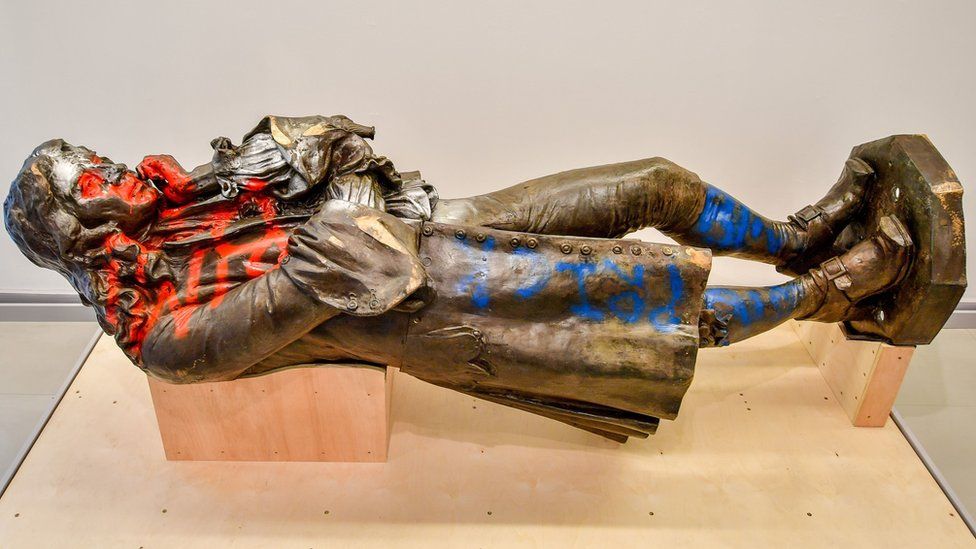
The acquittal of the four defendants for their role in the toppling of Edward Colston in Bristol has created an interesting debate and in some, more right-wing quarters, fury. In an interview following the verdict Boris Johnson stated we cannot seek to “retrospectively change our history“
But what history is he talking about, the one where this country was heavily involved in slavery or some other history around Empire and ‘jolly hockey sticks and all that sort of thing’?
History tells us that this country’s empire, like all empires significantly benefited from its conquests to the detriment of those conquered. Although if you watch the Monty Python film The Life of Brian, the right of the political spectrum might find some comfort in the sketch that starts with ‘What have the Romans ever done for us’? This country’s history is complex more so because it is a shared history with its own inhabits and those of other countries across most of the world. A history of slaves and slave traders. A history of rich and powerful and poor and powerless. A history of remapping of countries, redefining of borders, of the creation of unrest, uncertainty and chaos. A history of theft, asset stripping, taking advantage and disempowerment. As well as a history of standing up to would be oppressors. It is a complex history but not one that is somehow rewritten or removed by the toppling of a statue of a slave trader.
The tearing down of the statue is history. It is a fact that this country’s so called great and good of the time were tarnished by a despicable trade in human misery. The legacy of that lives on to this day. Great and good then, not so now, in fact they never were, were they? It may be questionable whether the circumstances of the removal of the statue were right, hence the charges of criminal damage. It might be questionable whether the verdict given by the jury was right, but surely this isn’t about changing history, it is about making it.
There are suggestions that the verdict may be referred to a higher authority, perhaps the Supreme Court. It appears right that there was a case to answer, and it seems right that the jury were allowed to deliver the verdict they did. There is nothing perverse in this, nothing to challenge, due process has taken place and the people have spoken. The removal of the statue was not criminal damage and therefore was lawful.
If a statue is an affront to the people of a locality, then they should be able to have it removed. If is such an affront to common decency, then the only people guilty of an offence are those that failed to remove it in the first place. Of course, it is more complex than that and perhaps the bigger question is why this didn’t happen sooner?
It would seem fitting to replace the statue with something else. Something perhaps that shows that slowly people of this country are waking up to the country’s past, well at least some of them. A statue that commemorates a new beginning, that acknowledges the country’s true past and points the way to a far more humane future for all. No Mr Johnson, we shouldn’t try to rewrite or obliterate history, we just need to change the way it written and stop ignoring the truth.
Share this:


Black History Month: A Final Thought

As we come to the end of Black History Month it is important to shine a light on the Black Lives Matters Movement and highlight the historical significance to the problematic discourse of racialisation.
Black history month is an opportunity for people from the various pockets of the Black community to learn about our own history and educate those who are not from the Black community, in order to decolonise our institutions and our society. As Black people we have our own history formed by systemic oppressions and great triumphs. While it is easy (and lazy) for institutions to use terms such as BAME and People of Colour (POC) these problematic uses of language oppress blackness. We are not a monolith of coloured people. Different racialised groups have and will experience, and uphold difference, harms and achievements within society. Furthermore, it would be naïve to ignore the narrative of anti-blackness that people from racialised groups uphold. Therefore, it is important for us and people that look like us, to continue to have the space to talk about our history and our experiences.
For many people in the UK and indeed around the world BLM became a mainstream topic for discussion and debate following the murder of George Floyd. While the term BLACK LIVES MATTER is provocative and creates a need for debate, it signifies the historical ideology that black lives haven’t mattered in historical and in many ways, contemporary terms.
While it is easy to fall into the trap of describing the Black experience as an experience of victimhood, Black history months allows us to look deep at all our history and understand why and where we are as a society.
The UK is one of the most diverse places in the world, yet we continue to fall prey to the Eurocentric ideology of history. And while it is important to always remember our history, the negativity of only understanding black history from the perspective of enslavement needs to be questioned. Furthermore, the history of enslavement is not just about the history of Black people, we need to acknowledge that this was the history of the most affluent within our society. Of course, to glaze over the triangle trade is problematic as it allows us to understand how and why our institutions are problematic, but it is redundant to only look at Black history from a place of oppression. There are many great Black historical figures that have contributed to the rich history of Britain, we should be introducing our youth to John Edmonstone, Stuart Hall, Mary Prince and Olive Morris (to name a few). We should also be celebrating prominent Black figures that still grace this earth to encourage the youth of today to embrace positive Black role models.
Black history for us, is not just about the 1st-31st of October. We are all here because of history we need to start integrating all our history into our institutions, to empower, educate and to essentially make sense of our society.
Share this:


#CriminologyBookClub: The Hundred-Year-Old Man Who Climbed Out of the Window and Disappeared

As you know by now, a small group of us decided the best way to thrive in lockdown was to seek solace in reading and talking about books. Hence the creation of #CriminologyBookClub! Building on on what has quickly become standard practice, we’ve decided to continue with all eight bloggers contributing! This title was the second chosen by @paulaabowles and is our 13th book. Read on to find out what we thought….
I chose this book on the strength of its quirky title. In terms of quirkiness, it didn’t disappoint. What’s not to like about the adventures of a centenarian? Part history lesson, part Forrest Gump, the cast of characters includes Stalin, Chiang Kai-shek and Harry Truman, alongside Allan, Beauty and an elephant called Sonya (seems Criminology Book Club cannot escape elephants from our reading diet…)! The story, despite including all manner of improbable deaths, is a gentle read. In many ways, it reminded me of Leslie Thomas’ The Adventures of Goodnight and Loving and I do have to say I prefer that story. Nevertheless, it was lovely to see the representation of older characters in an adventurous tale.
@paulaabowles
A centenarian is the most unlikely hero! Their mortality alone makes them too frail and fragile to be featured in a movie where villains end up dead in a path of carnage. In this book, the title is not a metaphor but most literal. A century old man is running away in his slippers dragging a stolen suitcase; somehow the story of what happens next, becomes compelling in this fast-paced action-packed adventure. The old man is carrying with him also a century of stories involving “who’s who” of the 20th century! At some point you are wondering if this is a comedy of errors, a farce or a spy thriller. The old man, in his back and forth stories, is bringing to light the absurdity of the 20th century, the political and ideological conflict of the time. This part of the story becomes a bit of a parody and the flashbacks become a bit tiresome as they seem to take us away from the main story, as you are left wondering will the old man live another day?
@manosdaskalou
I found this book an absolute joy to read, laughing out loud throughout. The book was about a centenarian who gets into all kinds of adventures and has done throughout his life. Each story of how he accidentally fell into situations with various historical political figures made me chuckle. What I also liked was that the book was devoid of any emotion. The love stories were quite clinical, the life and death situations fearless but this is just what I needed, and I think it made the book even more funny. More slapstick humour than romcom, it was completely ridiculous and an unlikely tale but because of this I could laugh at the dinners with murderous war mongers and the protagonist’s penchant for blowing stuff up.
@amycortvriend
We’ve come full circle in relation to book choices: it is Paula’s choice once again! And in all fairness, this book was more enjoyable than the Yellow Room. The Hundred-Year-Old Man Who Climbed Out the Window and Disappeared, was a book of two halves for me. The first half was witty, quick paced, and not like anything I had read before. However the second half of the book, was repetitive and without giving away any spoilers, the characters did not develop into the loveable rogues I thought they were. They remained quite stagnant. Nevertheless, I did really enjoy the book and found myself chuckling away at various points. Something which none of the other choices (excluding Inspector Chopra) have done. Good choice, @paulaabowles: I wonder how @manosdaskalou’s second choice will fare?
@jesjames50
The 100 Year Old Man was a novelty for me. Prior to this I had never encountered a book where the main character at 100 years old gets up to all kinds of unintended mischief. The sense of adventure included within the book was something that I needed at the time, although I found that the appeal of the book began to wear off at the half-way point. I also found some descriptions to be problematic from my own point of view, but overall I enjoyed the book!
@haleysread
I don’t suppose you get to be a hundred years old without having a few tales to tell. Allan’s life appears to have been a little more adventurous than most and his absconding from an old people’s home seems to be a continuation of mishaps and mayhem. A delightfully funny book, cleverly written to incorporate some historic characters into the narrative. The chapters jump from the past to the present and back again, sometimes leaving you wanting to skip a chapter to continue the narrative of the past or to find out what happens next in this tale of murder and destruction. Its amazing what you can get away with when you are a hundred years old. I can’t wait to get my hands on the next book.
@5teveh
I haven’t read a book like this before and really enjoyed the whole concept of a much older than average ‘hero’ and their adventures both past and present. The glimpses into his colourful past and the famous faces from throughout history that he met along the way gave this book an interesting sense of time and place – both completely fictional and yet almost plausible in the real world. The writing style was also different from the other books we have read as a group and I found it very funny in places. Overall I found the book slightly too long – the novelty began to wear off and I found myself a little fed up with the alternating chapters between past and present ( I preferred those set in the present, though I know others in the group preferred those set in the past) but am still excited to find out what happens to him and his friends in the next book!
@saffrongarside
I was not expecting what I was going to read….elephants, gangsters and men locked in freezers. This book is a light and easy read. It centres around the very colourful life of 100 year old Alan Karlsson. Throughout the book Alan takes you on a journey to meet some interesting historical figures such as Stalin and President Truman. In many ways Alan influences these characters, which in essence shapes events that have happened in history.
We also follow Alan’s life in present day, in which we follow outlandish characters through a very humorous story. Overall, I really enjoyed this book. It kept me entertained and wanting more. Although some parts of the book were about some dark things, such as Eugenics and abuse under the guise of ‘medicine’ the humorous present-day story of Alan’s journey balanced this book out, making it a light hearted tale.
@svr2727
Share this:


Gypsy, Roma, Traveller History Month: #MakeSomeSpace

When I reflect upon my childhood, I recall the fondness that I have towards the Romany culture. I am reminded of the wonderful bond that my family had with horses, of good people, of the older generations of my family telling stories and singing Romany songs around tables at parties, of a strong sense of tight-knit togetherness and resilience when times got tough. I remember being educated about life from a young age and being taught the skills needed to be able to earn a living when it became difficult to do so. I am also reminded of the generosity involved in giving all that you can to your family and friends despite not having much. I especially think of this generosity in relation to the Irish Travellers that welcomed my brothers into their homes and provided for them when they were in times of need.
My instant thoughts about Gypsy, Romany Travellers (GRT) is that of fondness, but living in our society I have learnt that this is not the typical thoughts of the dominant public, media or government. When considering dominant media, public and government attitudes towards travellers, I am reminded of the GRTs that live in a society where people are prejudice because of long-standing stereotypes that have been created about their culture. I am also reminded of the lack of understanding and/or empathy that others have about the disproportionate amounts of social harm that those within the GRT families will encounter.
Since the recent Black Lives Matter protests there has been an explosion of anti-racist efforts, which I am hopeful of, yet, even some of those who are passionately ‘anti-racist’ continue to either project prejudice towards GRT people or deny that prejudice towards GRT is a problem. Adding to this, anti-racist messages communicated via the media do not seem to apply to GRT. A recent example of this is Dispatches: The Truth About Traveller Crime which is like a thorn in my side. This documentary discusses GRT as though they are a group of ‘dangerous criminals’. With an ‘expert’ criminologist present within the documentary it becomes difficult for the public to understand the stereotypes and lack of understanding that the documentary includes.
This year I have been able to incorporate GRT into the modules that I teach. I am pleased that some students have been able to navigate themselves to information about GRT from organisations like Traveller Movement and Friends Families and Travellers as these provide me with some hope in terms of GRT awareness and inclusion. However, it seems that these organisations will continue to have many pressing concerns to deal with, especially as the recent government proposals included within the Police, Crime, Sentencing and Courts Bill seem to be nothing more than another attack on the more traditional way GRT of life.

There is a worry for some GRT that upon moving into housing these cultures will decline. In terms of my own family my Nan was my idol, she was born in the 1920s in a traditional horse drawn wagon. Since moving into housing my Nan remained proud of her Romany heritage and she instilled this within my Dad’s upbringing. I only ever practiced aspects of the Romany culture in a marginal sense, and the decline of this part of my own heritage is connected to the social harm that my own family have experienced.
With GRT month I hope that more people question the prejudices that they have about others, I hope that people also question the media, government and supposed ‘experts’. You could begin by attempting to put yourself in the shoes of others, try to imagine how you would feel if society collectively judged yourself or your family despite knowing little to nothing about who you/they are. After all, this kind of overt prejudice that GRT encounter would not be acceptable in many situations if this was aimed at other groups, so why should it be acceptable when aimed at GRT?

 Thoughts from the criminology team