
Home » Higher Education (Page 3)
Category Archives: Higher Education

Complaint! (For Sara Ahmed)
This poem comes inspired from the recent UCU strikes, and also the underpinning arguements of Complaint by Sara Ahmed. The institution protects itself, while removing those who complain (or in many cases, they remove themselves). It is also inspired by ‘Testimony’ by Irish poet Seamus Heaney.
As higher education burns,
they blame white lecturers who picket,
and the Black and Brown lecturers
no longer willing to be ‘paid in exposure’
to the hull of slave ships. Colonialism’s hot mouth
at the nucleus of HE’s epistemes,
so senior leaders blame lecturers
for neglect. Meanwhile, the upper echelons
play Monopoly with staff pay checks
students left to grieve assignment
work revolving around conveyer belts
like undead corpses between indenture and slavery
it’s a Tuesday morning
a fever of claret runs riot
across picketing lines
turn cloaks to justice and equality,
there’s just ice behind the scab
where hearts used to beat. Back in the 80s,
gay and lesbian activists stood in solidarity
with the miners; and Arthur Scargill
and co scurried to Jayaben Desai at Grunwick
from the main road, you can still hear the screams
of comradery, and ‘we see yous’ …
yet behind picket tea and biscuits,
there are teary smiles –
death behind the bags,
and behind the pyre …
smoke could be seen for miles.
Share this:

UCU Strike 28 February-2 March 2022

More information around the University and College University [UCU] and the Four Fights Dispute can be found here.
Information about the Northampton branch of UCU can be found here and here.
You can also find out why striking is a criminological issue here: https://thoughtsfromthecriminologyteam.blog/2021/12/10/striking-is-a-criminological-matter/ and here: https://thoughtsfromthecriminologyteam.blog/2022/02/18/united-nations-un-world-day-of-social-justice/
Share this:

UCU Strike 21-22 January 2022
More information around the University and College University [UCU] and the Four Fights Dispute can be found here.
Information about the Northampton branch of UCU can be found here and here.
You can also find out why striking is a criminological issue here: https://thoughtsfromthecriminologyteam.blog/2021/12/10/striking-is-a-criminological-matter/ and here: https://thoughtsfromthecriminologyteam.blog/2022/02/18/united-nations-un-world-day-of-social-justice/
Share this:


Striking is a criminological matter

You may have noticed that the University and College Union [UCU] recently voted for industrial action. A strike was called from 1-3 December, to be followed by Action Short of a Strike [ASOS], in essence a call for university workers to down tools for 3 days, followed by a strict working to contract. For many outside of academia, it is surprising to find how many hours academics actually work. People often assume that the only work undertaken by academics is in the classroom and that they spend great chunks of the year, when students are on breaks, doing very little. This is far from the lived experience, academics undertake a wide range of activities, including reading, writing, researching, preparing for classes, supervising dissertation students, attending meetings, answering emails (to name but a few) and of course, teaching.
UCU’s industrial action is focused on the “Four Fights“: Pay, Workload, Equality and Casualisation and this campaign holds a special place in many academic hearts. The campaign is not just about improving conditions for academics but also for students and perhaps more importantly, those who follow us all in the future. What kind of academia will we leave in our wake? Will we have done our best to ensure that academia is a safe and welcoming space for all who want to occupy it?
In Criminology we spend a great deal of time imagining what a society based on fairness, equity and social justice might look like. We read, we study, we research, we think, and we write about inequality, racism, misogyny, disablism, homophobia, Islamophobia and all of the other blights evident in our society. We know that these cause harm to individuals, families, communities and our society, impacting on every aspect of living and well-being. We consider the roles of individuals, institutions and government in perpetuating inequality and disadvantage. As a theoretical discipline, this runs the risk of viewing the world in abstract terms, distancing ourselves from what is going on around us. Thus it is really important to bring our theoretical perspectives to bear on real world problems. After all there would be little point in studying criminology, if it is only to see what has happened in the past.

Criminology is a critique, a question not only of what is but might be, what could be, what ought to be. Individuals’ behaviours, motivations and reactions and institutional and societal responses and actions, combine to provide a holistic overview of crime from all perspectives. It involves passion and an intense desire to make the world a little better. Therefore it follows that striking must be a criminological matter. It would be crass hypocrisy to teach social justice, whilst not also striving to achieve such in our professional and personal lives. History tells us that when people stand up for themselves and others, their rights and their future, things can change, things can improve. It might be annoying or inconvenient to be impacted by industrial action, it certainly is chilly on the picket line in December, but in the grand scheme of things, this is a short period of time and holds the promise of better times to come.
Share this:




Prison education: why it matters?

Five year ago, Dame Sally Coates released an independent report on prison education. Recently the Chief Inspector for Ofsted, Amanda Spielman and The HM Inspectorate of Prisons, Charlie Taylor, made a joint statement reflecting on that report. Their reflections are critical on the lack of implementation of the original report, but also of the difficulties of managing education in prison especially at a time of a global pandemic. The lack of developing meaningful educational provision and delivering remote teaching led to many prisoners without sufficient opportunity to engage with learning.
In a situation of crisis such as the global pandemic one must wonder if this is an issue that can be left to one side for now, to be reviewed at a later stage. At the University of Northampton, as an educational institution we are passionate about learning opportunities for all including those incarcerated. We have already developed an educational partnership with a local prison, and we are committed to offer Higher Education to prisoners. Apart from the educational, I would add that there is a profound criminological approach to this issue. Firstly, I would like to separate what Dame Coates refers to as education, which is focused on the basic skills and training as opposed to a university’s mandate for education designed to explore more advanced ideas.
The main point to both however is the necessity for education for those incarcerated and why it should be offered or not. In everyday conversations, people accept that “bad” people go to prison. They have done something so horrible that it has crossed the custody threshold and therefore, society sends them to jail. This is not a simple game of Monopoly, but an entire criminal justice process that explores evidence and decides to take away their freedom. This is the highest punishment our society can bestow on a person found guilty of serious crimes. For many people this is appropriate and the punishment a fitting end to criminality. In criminology however we recognise that criminality is socially constructed and those who end up in prisons may be only but a specific section of those deemed “deviant” in our society. The combination of wrongdoing and socioeconomic situations dictate if a person is more or less likely to go to prison. This indicates that prison is not a punishment for all bad people, but some. Dame Coates for example recognises the overrepresentation of particular ethnic minorities in the prison system.
This raises the first criminological issue regarding education, and it relates to fairness and access to education. We sometimes tend to forget that education is not a privilege but a fundamental human right. Sometimes people forget that we live in a society that requires a level of educational sophistication that people with below basic levels of literacy and numeracy will struggle. From online applications to job hunting or even banking, the internet has become an environment that has no place for the illiterate. Consider those who have been in prison since the late 1990s and were released in the late 2010s. People who entered the prison before the advancement of e-commerce and smart phones suddenly released to a world that feels like it is out of a sci-fi movie.
The second criminological issue is to give all people, regardless of their crimes, the opportunity to change. The opportunity of people to change, is always incumbent on their ability to change which in turn is dependent on their circumstances. Education, among other things, requires the commitment of the learner to engage with the learning process. For those in prison, education can offer an opportunity to gain some insight that their environment or personal circumstances have denied them.
The final criminological issue is the prison itself. What do we want people to do in them? If prison is to become a human storage facility, then it will do nothing more than to pause a person’s life until they are to be released. When they come out the process of decarceration is long and difficult. People struggle to cope and the return to prison becomes a process known as “revolving doors”. This prison system helps no one and does nothing to resolve criminality. A prison that attempts to help the prisoners by offering them the tools to learn, helps with the process of deinstitutionalisation. The prisoner is informed and aware of the society they are to re-join and prepares accordingly. This is something that should work in theory, but we are nowhere there yet. If anything, it is far from it, as read in Spielman and Taylor’s recent commentary. Their observations identify poor quality education that is delivered in unacceptable conditions. This is the crux of the matter, the institution is not really delivering what it claims that is does. The side-effect of such as approach is the missed opportunity to use the institution as a place of reform and change.
Of course, in criminological discourse the focus is on an abolitionist agenda that sees beyond the institution to a society less punitive that offers opportunities to all its citizens without discrimination or prejudice. This is perhaps a different topic of conversation. At this stage, one thing is for sure; education may not rehabilitate but it can allow people to self-improve and that is a process that needs to be embraced.
References
Coates, S. (2016), Unlocking Potential: A review of education in prisons, https://www.gov.uk/government/publications/unlocking-potential-a-review-of-education-in-prison
Spielman, A. and Taylor, C. (2021), Launching our Prison Education Review, https://www.gov.uk/government/speeches/launching-our-prison-education-review
Originally published here
Share this:


The UK is not Innocent: “Babylon, for True” #SubnormalABritishScandal
Last December I watched the final entry of Small Axe entitled ‘Education‘, the best entry in my opinion and thus I delivered a blog on the film too. The finale articulated the history behind the schools for the ‘Educationally Subnormal’ [ESN] or ‘special schools’, and it took me back to when I was a nine year-old boy being treated as if I was intellectually inferior or incapable, by my White teachers in comparison to the White children. It turns out I was dyspraxic. The story of Maisie Barrett, however, in the recent documentary Subnormal: A British Scandal resonated. My schooling experience differs from most Black children in Britain today (since I was at private, not state) but the story of Maisie Barrett resonates because she was dyslexic (word blindness in the 1960s/1970s) and simply, like my teachers with my dyspraxia, they did not know how to teach her or me. She was placed in one of those ‘special schools’ really because she happened to be Black and her dyslexia translated as “difficult” to the teachers of the time.
In the 1960s and 1970s, hundreds of Black children in Britain were caught in an education scandal where many were sent to schools designed for the ‘educationally subnormal’. Some children were labelled as “subnormal” by the state, as they were seen to have low intelligence and not fit for the mainstream school system. A decision by the state that would see many (if not all) of these children to grow into adults traumatised by their experience with that childhood trauma impacting their adult lives. What happened in the 1960s and 1970s disproportionately to Black British children of Caribbean descent has an enduring legacy today, where battles are still being fought in the name of race and racism, from Early Years all the way up to higher education [HE] in universities. In the 1944 Education Act, the term “educationally subnormal” entered British lexicon to describe children that the state deemed intellectually deficient.
The people that we now know in the colloquial sense as the Windrush Generation (Caribbeans that came here between 1948-1970), came here to work. This scandal impacted their children and is really an aftershock of the hostility to Caribbean arrival in 1948. My own great-grandparents themselves came to this country from the Caribbean in the late 1950s, early 1960s with some of their children (including my grandmother) coming on her parents’ passports. And I know my maternal great-grandparents were factory workers when they first came. I’m told they went to work at Long and Hambly, a Northamptonshire-based plastics manufacturer. However, these ESN schools should not be relegated to history as the education sector continues to fail Black and Brown students at every level. Whilst back then the state called them ‘special schools’, now we have Pupil Referral Units [PRU] where Black students in schools continue to be placed when they become “too difficult” for the mainstream system of education.
Watching Subnormal, it struck me that whilst it claims this scandal started in the 1960s with the arrival of the Windrush Generation and whilst I earlier claimed it as an aftershock of 1948, I would take this back further. Why were / are Black students being treated as if they were / are less intelligent? In the documentary, Prof. Gus John states “there were many academics who were equating race with lack of intellectual ability [with] the reason for Black underachievement as those children were Black” … academics like Professor Hans Eysenck, a key figure in discourses around race and intelligence in the 1970s. He believed genetics played a role in influenceing intelligence and that “entire racial groups might be genetically condemned to lower intelligence” (Subnormal). These ideas lead to beliefs that Black children were not as capable of academic success as White children. With people like Prof. Eysenck leading on this, it made ESNs not really a national scandal but justifiable … essentially justifying racism with “science.”
Yet, going back to the 18th and 19th centuries we also know that similar ‘race science’ was used to used to justify colonialisms and also enslavement as well as the subjugation of Black people in the Caribbean and the African continent. In her book Superior, Angela Saini traces the origins of race really showing the racial hierachies that existed in that era with White European people at the top and Black people of African descent at the bottom and “what Europeans saw as cultural shortcomings in other populations in the early nineteenth century soon become conflated with how they looked” (p11). So-called ‘race scientists’ drew on physical differences to emphasise us and them and I believe the ideas perpetuated by the Government in constructing the ESNs do not sound too far from the pseudoscientific racial theories that underpinned colonial racial thinking of the 18th and 19th century. Very much followed by the Nazis themselves, inspired by UK-US eugenics creating policies also discriminating based on disabilities, that would have included neurodivergent conditions like dyslexia (or as they called it in the 1970s … word blindness).
Black people being seen as intellectually inferior is a stereotype that goes back to the days of White masters and Black enslaved people. The justifications made for the ESNs were simply an afterthought of the “academic reasonings” made to subjugate Black people on slave plantations. Simply, the UK government were standing on the shoulders of old stereotypes created in the slave polity. When you link this with the hostility to Caribbean arrival, we can then see that the conditions of anti-Blackness have been in Britain since the 16th century. In watching the film, what we saw is ‘race science’ playing out in a contemporary context, as well as eugenics, which was also pioneered by men like Winston Churchill, who the British public saw fit to vote as the Best Briton in 2002, and then have on the £5-note in 2016.
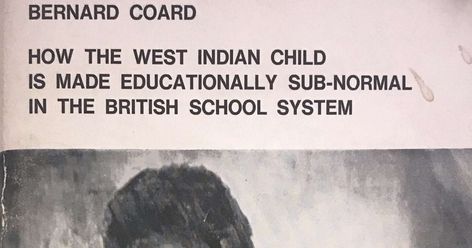
In British schools and universities, we continue to see these same stereotypes playing out (the return of race science, to put it bluntly) but more importantly, this is White supremacy in action. Whilst I enjoyed (if that’s the term), the documentary as it had lots to take away, I felt it was not critical enough. Much alike lots of the documentaries we have received from especially the BBC since the George Floyd killing, they go as far as to say ‘racism is bad and we need to talk about it’ but fall short in naming White supremacy as a social and political system (Mills, 2004). Further to the fact of how institutional Whiteness (White Spaces) allows our structures to continue to centre and frame the emotions of White people in dealing with racist incidents. The scandal that culminated in Bernard Coard’s book How the West Indian Child is Made Educationally Sub-normal in the British School System, was well articulated by the BBC as well as showing the role of Black parents, community leaders and activists, but falls short at showing the overarching system leading us to believe this as an isolated tragedy and not part of complex system that was orchestrated from dot.
We had lots of testimony from the victims as well as parents, community leaders, activists and the like but much akin to so much of the trauma narratives of late, the people that helped facilitate these crimes are nowhere to be seen … we have a victim-focussed narrative with no analysis on the mechanics of the oppression itself. 50 years on, more awareness for sure … but no accountability. The BBC is the establishment broadcaster and it shows. Babylon, for true!
References
Coard, B. (1971) How the West Indian Child is Made Educationally Subnormal in the British School System. In: Richardson, B. Tell it like it is: How our schools fail Black children. Stoke-on-Trent: Trentham Books.
Mills, C (2004) Racial Exploitation and the Wages of Whiteness. In: Yancy, G (ed). What White Looks Like: African American Philosophers on the Whiteness Question. Abingdon: Routledge.
Saini, Angela (2019) Superior: The Return of Race Science. London: 4th Estate.
Ventour, T (2021) The Alternative History Behind the Windrush Scandal. Medium [online]
White Spaces. Institutional Witnesses. White Spaces [online].
Share this:


Helpfully unhelpful: The pathology of being too supportive

When I first arrived in London, I needed to find my way across the city to the now former site of the Home Office at St Anne’s Gate. I didn’t have a clue about how to get there so I asked a member of staff at St Pancras railway station. He helpfully pointed me in the direction of the London Underground. I was swept along by a torrent of people, all going about their business with a purpose, I however, didn’t have a clue where I was going. Finding sanctuary in a quiet eddy and desperately looking around I spotted a member of staff across the concourse. Fighting against the current I scrambled to where the member of staff was and implored upon them to rescue me. Thankfully the underground staff had all been briefed, not specifically about me, I should hasten to add, but about how by being super helpful they could increase customer satisfaction, reduce complaints and attract even more customers. And having explained my dilemma, I was very helpfully led through the ticket barriers, now struggling to hold back the surge, and down the escalator to the platform below. I was told to get on the next train and to get off at St James’ Park. Having arrived at my destination I became confused as to which exit to use and once again found a very helpful staff member who led me part way to the exit, where I spilled out into the sunlight a matter of yards away from my destination.
The following week I once again plunged into the torrent and confident that I knew which underground line to take I allowed myself to be swept along to the barriers and through, and then panic. Which platform and am I sure that was the right line? Once again, a beacon of hope shone across the dark morass, a member of underground staff. Once again, I was led to the platform in a super helpful way and got on the first train. But this time I didn’t arrive at my destination for some, I have to say, traumatic hours. The problem was the first train was not the train to catch, it was the second that I needed; I will most definitely have to complain about that member of staff being unhelpful.
This pattern of visits to London and assistance rendered by sometimes grumpy but always super helpful members of underground staff continued for some weeks. Often, I would stay in London for a week at a time before returning home outside of the metropolis at the weekend. During my stays I visited numerous police stations as part of my work and every time I used the underground, I sought out a helpful member of staff to assist me. Sometimes, if they rather unhelpfully simply pointed me in the right direction, I would set off and then return to them explaining that I didn’t understand their instructions. Armed with more information I would again purposefully set off and then duly return until the succumbed and rather reluctantly but helpfully led me to the correct platform.
Then in a fortnight, two things happened. Firstly, the underground staff went on strike and on arriving at the gates of St James’ Park underground station I found the gates closed. There were a couple of members of staff there, but they weren’t very helpful. ‘What should I’ do I asked, ‘Dunno’, was the reply. Now that was not very helpful, complaint forthcoming I feel. I didn’t make my appointments that day and the following day had to use taxis to get around. Much easier to use taxis you might say, yes but not really justifiable in terms of cost, my boss told me when I suggested I would forego using the underground altogether. After three days the underground opened up again but for some reason there were no staff around to ask for help. I became increasingly anxious and found myself avoiding the underground, using taxis at my own expense, and walking long distances. I was exhausted I can tell you.

The next week I ventured into the underground again, I couldn’t avoid it forever. I found a member of staff and duly asked them, in an almost ritualistic fashion, how to get across London to another underground station near yet another police station. Instead of pointing me in the right direction, which we all know by now is a rather fruitless, time wasting and unhelpful exercise, or super helpfully taking me to the correct platform, they took me to a rather large underground map on the wall. ‘This is where we are’, the very nice lady said, ‘and this is where you want to be’, she added. She then continued to explain how to use the map, how to follow the signs dotted around the stations, how to look for the signs before entering the platforms so as to work out which platform to be on and how to ensure I get on the correct train. I was nervous following her instructions as I made my way to the platform, but I got to my destination and I made my own way back, with help of the wall map of course. From that point onwards, I made my way around London on the underground with increased confidence, I wouldn’t say with consummate ease, but confidently. I made mistakes but because I knew how to read the map, I was able to rectify them and if I couldn’t I knew that I could ask. Of course, now that I drive, I use maps, I would probably have been pestering police officers and random members of the public otherwise and we know how the rare the sight of the former are on our streets. Anyway, I don’t think they’ve had the ‘super helpful’ briefing. Lately though I’ve been using my satnav, and sometimes getting into a right pickle. It seems you can’t beat good old-fashioned map reading.
What’s the point of this nonsensical tale? Well the clue is in the title. As educators we need to consider the purpose of what we are doing and how this will add value to students’ learning and knowledge. We can give students the answers to the essay questions, how to structure a particular essay, what arguments to include, what books and journal articles to read. We can supply them with reading lists that contain links to the books and journal articles, we can coach them to such an extent that their journey is in fact our journey, just as my journey to the underground platform was the staff member’s journey. We can repeat this many times over so that students are capable of completing that essay, but like me on my journey through the underground, they will need the same coaching for every piece of assessment and whilst they may complete each journey as I did, they have learnt very little and become increasingly disempowered and crippled by our helpfulness and their increasing reliance on it. Our jobs as educators is not to provide answers but to equip students with the tools to find the answers themselves. That process requires a willingness to learn, to discover and to take risks. Super helpfulness should not be an organisational strategy to ensure each part of the journey is easily manoeuvred and completed, it should be about ensuring that people can complete any journey independently and confidently. Sometimes by appearing to be super helpful we are simply being very unhelpful and disempowering people at the same time.
Share this:


Reflecting on reflection

For some years now students taking the third year Critiquing Criminalistics module on our criminology course at the university have had an assessment relating to a reflective diary. Most educators and those in other professions will be aware of and understand the advantage of reflection and reflective diaries so it is probably not necessary to revisit the well-rehearsed arguments about benefits to learning and personal development. Each year, I have found that over the course of the module, the students have come to recognise this and have intimated how they have enjoyed reflecting on what they have learnt in the class or how reflecting on personal experiences has been beneficial. And they comment on how they have sought out further information to gain additional knowledge or to put what they have learnt in some form of perspective. It is of course what we as educators would want and expect from a reflective diary assessment that after all counts towards their marks for the module.
What has surprised me though is how much reviewing these modules has benefited me. I have learnt from and continue to learn my students. We all recognise or at least should the old saying ‘the more I know, the more I realise I don’t know’ or similar. My students prove that is the case often with each round of diary entries I review. The diaries can provide an insight into students lives and thoughts. For some of them it may be a cathartic release to capture their feelings on paper, for me it is enlightening and provides a greater understanding of some of the challenges they face not only as students but also as predominately young adults in a challenging and at times hostile social and economic environment. Perhaps what is equally as enlightening is the additional knowledge that students provide about the subject area being discussed and taught. It is almost like sending out my own little army of literature reviewers with a challenge to advance their knowledge and ipso facto, mine. I am clear that part of the reflection process is about taking what you have learnt further and as this an assessment, demonstrating this additional knowledge with some academic rigor. And so, I find that in some cases what I have stated in the class (currently online) is challenged and that challenge is supported by academic reading. When I read some of these little gems, I smile but alongside this is the additional work created as I review the journal article they have referenced and then decide whether to revisit my lectures to add in the additional information. Even if I don’t, it all adds to my knowledge and, on reflection as my students are proving, there is plenty of scope to find out more.
Share this:


Education, education, education: We’ve lost the plot

Some of you might remember Tony Blair’s speech introducing the Labour party’s education manifesto in 2001. In it he proclaimed that education was at the forefront of government policy. Education is often high on government’s agenda even if it is only to berate previous administrations for failing our youngsters. I have watched with interest the current government’s farcical approach to education and in particular the attainment of qualifications during the first period of Covid lockdown and to some extent even felt sorry for them as they grappled with what were not insignificant problems. My benevolence, however, has long been drained as I watch the news more recently only to see the same farce emerging. But what really intrigues me is the conflation of the notion of qualifications and education. It seems to me the clamber to get children back into school is only right given that they are missing out on education and other social aspects. However, I cannot see how the dealing with the qualifications issue can ignore the fact that the students have not received all of their education.
In a previous blog I have used the analogy of a driving instructor giving lessons to a pupil. In that blog the point being made was that the education of the pupil was a two-way enterprise. If the pupil didn’t engage or didn’t turn up for their lessons, then the instructor could not be held responsible for the pupil’s failure in the driving test. But what of the test itself, what is that designed to achieve? It is not simply to provide a person with a driving licence, what would be the point of that? It is to ensure that the person taking the test can drive to a satisfactory standard that would help ensure the roads were safe for all users. So, the point of the driving lessons is to provide the education in ‘road craft’ and the point of the driving test is to test knowledge and ability in that ‘road craft’ to ensure it meets satisfactory standards. The driving licence is a form of certificate that states the driver has achieved the knowledge and skills required.
So, what of education? Surely GCSEs, A levels, BTec and so on are a test of the knowledge and skills acquired. A degree is the same, is it not? How then could we reasonably expect students to pass any of these tests if they have lost significant periods of tutorship or teaching? The suggestion, dumb down the tests in some way by only testing what they have been taught, or as in the case of university students suggestions, be more lenient with the marking. Now as I understand it, that would be akin to saying to a learner driver that because through no fault of their own, they could not engage in all of their lessons, they will only be tested on their ability to park and not on their ability to carry out an emergency stop as they hadn’t been taught the latter. How ridiculous would that be? Imagine then that the very same driver, who now has a driving licence, goes onto some advanced motoring course. A course that starts with the premise that they have all the skills tested in a ‘full’ driving test.
Whilst, I can understand students’ preoccupation with tests and qualifications, I somehow think that government and teaching establishments should be more concerned with education and the knowledge gap. How will they ensure that students have the requisite skills and knowledge? Tony Blair may have said ‘Education, Education, Education’ and subsequent governments might well nod in agreement, but somehow I think they’ve all lost the plot.


