
Home » Graduate entry
Category Archives: Graduate entry

The Journey of a University of Northampton Criminology Graduate

On this Jubilee year, I ponder and reflect on my 3 years as a joint honours Criminology student, and where my life journey has taken me since
In 2012-2015, I did joint honours Criminology and Education studies, and later did the LLM in International Criminal Law and Security at from 2015-2017.
My journey as a Criminology Student alumni has lead me to all sorts of unique pathways.
Having a background in notetaking and student support at different universities, I worked for 6 1/2 years as a Co-op Member Pioneer (8th January 2018-10th August 2024), where, in the community I served, I supported the local police with crime related issues, and mediated between them and the public on crime issues that mattered to them and helped to support the police, as blogged about here ‘As a Member Pioneer Supporting the Police’ . Whilst this role was about connecting communities, supporting charities, causes and local people, I saw the opportunity to help the police and the community on crime related issues.
From December 2019-June 2020, I worked for 6 months in an addiction recovery unit. Here, I learned about addiction on a more deeper and personal level. I was one of 2 members of staff who were not addicts, and so the experience was eye-opening! The staff who had ‘come clean’ from their addictions would talk about their lives before becoming clean, and how they would resort to crime to fund their addictions. It was a vicious cycle for them as they were fighting traumatic battles which lead them down the route of addiction, and could not find their way out.
I was trained on taking phone calls, and spoke with so many devasted individuals who had lost their sons, daughters, husbands and wives to addiction, and were desperate to get them the help they needed. Seeing families torn apart by addiction, and meeting with new clients who had come in to get help and learning about their stories revealed deep sufferings and traumas, some of which were life-changing events, and harrowing cries for help.
I audited medication on a daily basis, worked with the Addiction specialist doctor to make sure all new clients had been seen to, and prepared folders for each client which the support team used in their care plans. I would also create certificates for all clients who had completed their time at the unit, and celebrated in their success.
When COVID struck, I was put on furlough, and later made redundant – such is life XD – Onto my next adventure!
Where am I now?
Fast forward to March 2021; after completing a lengthy job application and job interview, I landed myself a job in the Civil Service working for the Ministry of Justice! I do casework, work with the Judges on progressing cases, I clerked a few hearings previously too. Everyday is different, and every case I work on is different.
I process new claims and with the support of the Legal Officers, issue directions to the parties if any other information is required. I oversee the progress of cases and ensure all correspondence is up to date, all orders have been issued, and the case is ready to be heard.
Each day is different, and I love everything that I do working for the justice system.
Share this:


Meet the FBL Student Experience Assistant Team – Kayleigh
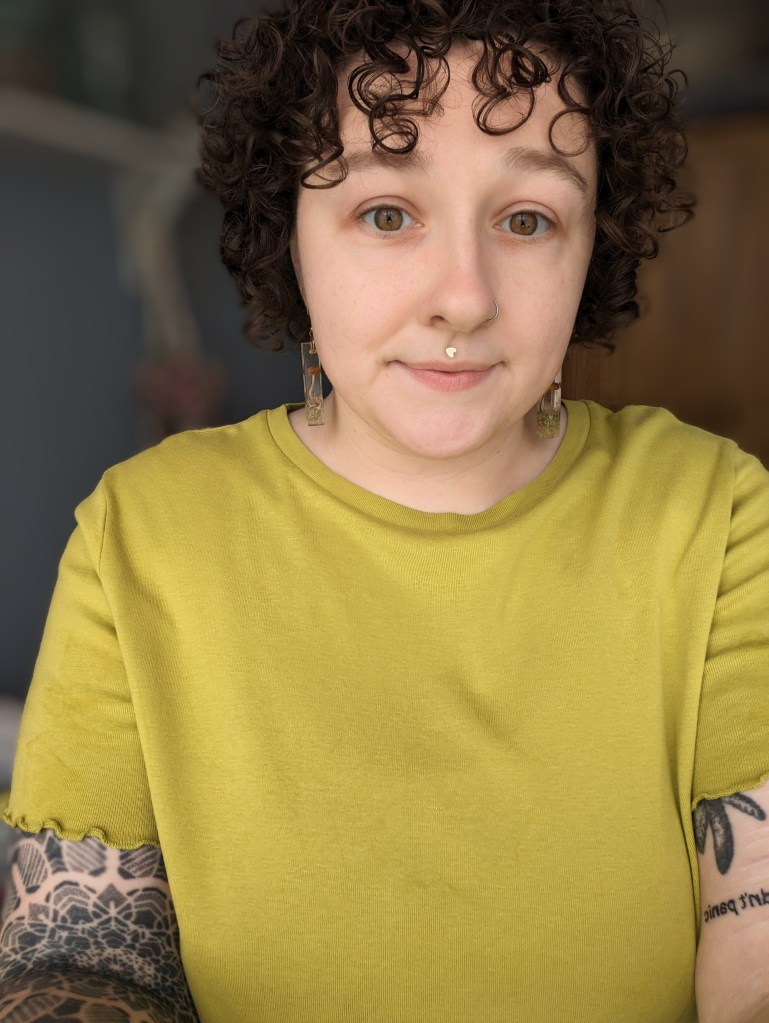
My name is Kayleigh, and I am one of the Student Experience Assistants (SEAs) for the Faculty of Business and Law at UON.
I graduated from UON in 2024 with a BA in Psychology with Criminology, and alongside this role I have just started a Master of Research degree. I also work in mental health for the NHS at the weekends. My academic and professional interests are largely around peer support, diversity and inclusion; particularly around the value of lived and living experience, forensic mental health, and neuroscience.
I came to UON in 2021 as a mature student having worked and volunteered within various forensic mental health settings, and I assumed this would be the area I went back into when I finished my degree, but now I’m not so sure… Despite a lot of adversity, university was overall a hugely positive and pivotal experience for me and so I am currently exploring a more academic path. I have a lot of experience to call upon and to share and I’m hopeful that I can support you so that your time at university is positive too.
I am here to support both students and staff in the Faculty of Business and Law by meeting with teams to identify their needs and ensuring students get the right help. As a recent UON graduate, I understand the challenges you might be facing and can offer guidance, connect you with the right people, or just have an informal chat. I have been assigned to support Criminal Justice Studies and Strategy & International Business teams, but support to students is not necessarily limited to these subjects. You can reach out to any of the SEAs for help.
Contact the team at fblseat@northampton.ac.uk, or me directly at kayleigh.willis@northampton.ac.uk. We also hold a drop-in outside LH201, Monday to Friday, 10am-4pm, no booking needed.
Share this:


Meet the FBL Student Experience Assistant Team – Kezia

Hello everyone! My name is Kezia Asante, and I’m part of the Student Experience Assistance Team [SEAT]. I’ll be working with the Criminology and Law departments and am looking forward to meeting you all and providing necessary support wherever it’s needed.
My primary objective in this role is to enhance your overall student experience, and as a recent graduate of the university myself, I understand how overwhelming student life can be. Challenges like balancing coursework, managing deadlines, and navigating university resources can feel daunting, but I’m here to help guide and support you through all of it. Feel free to reach out whenever you need assistance or just a friendly chat!
Choosing criminology to study was a great decision, and if you allow yourself to, you can gain a wealth of knowledge and a fresh perspective on the world. I’ve developed a genuine passion for the subject, particularly because I believe it encourages us to examine the complexities in grey areas that others might view as simply black and white. Criminology has so many different aspects that stem from various fields such as sociology, psychology, law, policing, and forensics. It delves into the root causes of crime, the workings of the criminal justice system, and the societal impacts of crime and punishment and much much more! Moreover, pursuing a degree in criminology can lead you down numerous career paths. For instance, I will be starting my MSc in Cyber Security and Forensics in January, inspired by my interest in the digital realm initiated by my criminology studies.
Overall, what I’m trying to say is to make the most of your criminology studies. Immerse yourself in the subject, engage with your peers and professors, and take advantage of all the resources available to you. Attend workshops, research, and read up on areas of the subject you enjoy and participate in relevant events to deepen your understanding and broaden your perspective. The more actively you engage, the more you’ll get out of it.
Please don’t navigate the university experience on your own. There are many people like me and various support systems available to help you and make your journey easier.
Look forward to meeting you all!
Kezia Asante
kezia.asante-nkansa@northampton.ac.uk
Share this:


Highlights and Hindsight: Reflections from a Final Year Student

Whilst I hope to continue writing beyond graduation, for my last blog post as a UON student, I’d like to share, for those at the beginning or early stages of their degree, some of the things I’m glad I did, and the things I wish I had done, maybe something will resonate with you.
I’m glad I…
Found opportunities to prove myself: Although I worked before doing my degree, being course representative, student voice as well as a research assistant have helped me build confidence and skills and given me so much more to talk about when I’m selling myself in both professional and academic applications.
Maintained my routine: I’ve never pulled an all-nighter or found myself regularly submitting at 11:58pm (just one exception!) I knew I couldn’t give my best when stressfully counting down the minutes to midnight and being sleep deprived. I tried different ways and routines of studying and found something that was sustainable. As far as possible I maintained boundaries so as not to put myself in a position where sacrificing sleep was a necessity.
Didn’t compare myself (often!): It’s easy to see other people getting higher grades, doing more things, doing ‘harder’ topics, and to feel inferior. We’re all on our own journeys, have our own interests, our own barriers and limitations and that’s ok. I never have been and probably never will be a ‘straight A’ student, but I’ve worked incredibly hard for the grades I have got. And truly, in all the interviews I’ve done in the last 4 months (lots), they’ve been more interested my grit and compassion than everything else!
I wish I had…
Connected more: I wish I’d pushed a little harder to make some friends or some more familiar faces. University can be really lonely, for so many reasons, and I think lots of students feel this way! Perhaps pushing through that fear of the unknown, and the social anxiety to talk to people on my course, having joined a society or attended more events might have alleviated some of this.
Taken what I needed: I spent years one and two determined not to use extensions, mitigating circumstances or office hours, anything that I perceived to be a setback or a silly question. This resulted in me running out of an exam before finishing, and completing a timed assignment the day after discharge from psychiatric hospital. I turned this around in year three and used what I needed, used extensions, booked in to office hours even if it was just for reassurance and actually felt like I had given my work my best (and this reflected in higher grades!)
Last Nuggets of Advice
Pay attention to what you enjoy: It’s easy to see it all as just hard work, rush to get it done and then feel lost in the end. I’ve now started on a masters degree towards a career path I never thought I’d pursue, focussing on something that isn’t even my strongest skill, but I’ve decided its worth the challenge for something I’m going to enjoy.
Reflect, reflect, reflect: I’ve learned so much by taking the time to reflect on what I’m experiencing or learning, how it makes me feel and why, why I do or don’t want to do it, where my thoughts are coming from. I wholeheartedly recommend regularly thinking about these things (or writing about them!) The ability to be reflective is assessed more than you might think, and you never know what it might reveal to you.
You are more than this: No matter what grades you get, how you handle uni life, if you make friends or not, do ‘extra’ stuff or not, do a masters, or not. You’re still… you, with so many good qualities, values and goals that are not tied to your achievements, it may or may not always be the life changing experience you hoped it would be. This is an important time, sure, but it’s not more important than your health, your values, your sense of self.
Remember, you can only do what you can, with what you have at the time. Take care.
Share this:


Liberalism, Capitalism and Broken Promises

With international conflict rife, imperialism alive and well and global and domestic inequalities broadening, where are the benefits that the international liberal order promised?
As part of my masters, I am reading through an interesting textbook named Theories of International Relations (Burchill, 2013). Soon, I’ll have a lecture speaking about liberalism within the realm of international relations (IR). The textbook mentions liberal thought concerning the achievement of peace through processes of democracy and free trade, supposedly, through these mechanisms, humankind can reach a place of ‘perpetual peace’, as suggested by Kant.
Capitalism supposedly has the power to distribute scarce resources to citizens, while liberalist free trade should break down artificial barriers between nations, uniting them towards a common goal of sharing commodities and mitigating tensions by bringing states into the free trade ‘community’. With this, in theory, should bring universal and democratic peace, bought about by the presence of shared interest.
Liberal capitalism has had a long time to prove its worth, with the ideology being adopted by the majority of the west, and often imposed on countries in the global south through coercive trade deals, political interference and the establishment of dependant economies. Evidence of the positives of liberal capitalism, in my opinion are yet to be seen. In fact, the evidence points towards a global and local environment entirely contrary to the claims of liberal capitalism.
The international institutions, constructed to mitigate against the anarchic system we live under become increasingly fragile and powerless. The guarantee of global community and peace seems further and further away. The pledge that liberalism will result in the spread of resources, resulting in the ultimate equalisation is unrealised.
Despite all of this, the global liberal order seems to still be supported by the majority of the elite and by voters alike. Because with the outlined claims comes the promise that one day, with some persistence, patience and hard work, you too could reap the rewards of capitalism just like the few in society do.
Share this:


Feminism, Security and Conflict

Content warning: this blog post mentions feminist theory in relation to issues of rape, genocide and war.
Recently I had the opportunity to do a deep dive into feminist contributions to the field of international relations, a discipline which of course has many parallels and connections to criminology. Feminism as a broad concept often is viewed from a human rights perspective, which makes sense as this is probably the area that is most visible to most people through progressions in the field of political participation, reproductive and sexual rights and working rights. A lesser known contribution is feminist theory to international relations (IR), specifically, its practical and theoretical contribution to security and conflict. This blog post will give a whistle stop tour through the exploration I conducted concerning the themes of security, conflict and feminism. Hopefully I can write this in a way everyone finds interesting as it’s a fairly heavy topic at times!
Security
Within IR, security has usually been defined on a more state-centric level. If a state can defend itself and its sovereign borders and has adequate (or more than adequate) military power, it is seen to be in a condition of security according to realist theory (think Hobbes and Machiavelli). Realism has taken centre stage in IR, suggesting that the state is the most important unit of analysis therefore meaning security has generally taken a state-centric definition.
Feminism has offered a radical rejuvenation of not only security studies, but also the ontological principles of IR itself. While the state is preoccupied with providing military security, often pooling resources towards this sector during times of international fragility, welfare sectors are usually plunged into a state of underfunding- even more so than they usually are. This means that individuals who depend on such sectors are often left in a state of financial and/or social insecurity. Feminism focuses on this issue, suggesting women are often the recipients of various welfare based services. The impact of wartime fiscal policy would not have been uncovered without feminism paying attention to the women typically side-lined and ignored in international politics. So while the state is experiencing a sense of security, its citizens (quite often women) are in a feeling of insecurity.
This individualisation of security also challenges the merit of using such a narrow, state-centric definition of security, ultimately questioning the validity of the dominant, state-focused theory of realism which in IR, is pretty ground-breaking.
Conflict
I’d say that in nearly all social science disciplines, including politics, economics, sociology, IR and criminology, conflict and war is something that is conceptualised as inherently ‘masculine’. Feminist theory was one of the first schools to document this and problematise it through scholarship which interrogated hegemonic masculinity, ‘masculine’ institutions and the manifestations of these things in war zones.
Wartime/ genocidal rape is unfortunately not a rare behaviour to come across in the global arena. The aftermath of the Yugoslav wars and the Rwandan genocide is probably some of the most reported cases in academic literature, and this is thanks to feminist theory shining a light on the phenomena. Feminism articulates wartime/ genocidal rape as constitutive of the dangerous aspects of culturally imbedded conceptions of masculinity being underscored by power and domination and being legitimised by the institutions which champion dangerous elements of masculinity.
Practically, this new perspective provided by feminism has altered the way sexual violence is viewed by the mainstream; once a firmly domestic problem, sexual violence has been brought into foreign policy and recognised as a tactic of war. This articulation by feminist theory is absolutely ground breaking in the social science world as it shifts the onto-epistemological focus that other more conventional schools have been unable to look past.
Share this:


A Snapshot of My Dissertation: Portuguese Drug Decriminalisation and Some Other Things
I submitted my dissertation back in April, and now the dust has settled I thought it would be good to share the most interesting parts of my research, think of this blog post as an abridged version of my dissertation. Towards the end I’ve also included some tips for completing a dissertation, along with some reading you might like to do if you found this interesting.
What Was my Research About?
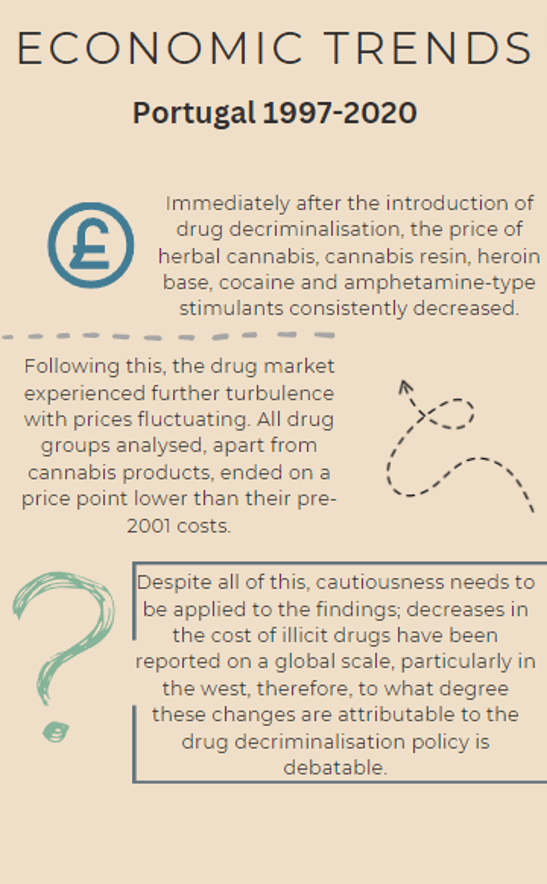
My research was about two main areas; Firstly, I wanted to assess the effects of Portugal’s 2001 drug policy whereby all illicit drugs were decriminalised, meaning drug offences relating to personal possession result in a civil punishment rather than a criminal punishment. I assessed key indicators within Portuguese society, gathering data from international, European and national databases which measured public health trends, criminal justice trends and economic trends. Some fields of data I looked at included prices of drugs at market level, drug seizure data, HIV/ AIDS rates among people who inject drugs and the Portuguese prison population.
The second part of my research involved understanding whether a drug decriminalisation policy similar to Portugal’s could currently happen in the UK. I researched this by performing a discourse analysis on drug related House of Commons debate occurring between the years 1970- 2023, selecting roughly one debate every two years. By doing this, I was able to analysis common themes across the years, understanding the political barriers which may mean drug decriminalisation is not a feasible policy idea at the moment given the political attitude and climate within the House of Commons when it comes to illicit drug policy.
What Did I Find Out?
Look through the slideshow below to view summaries of my findings.



Some Final Comments and Conclusions:
Generally, my research found that Portuguese drug decriminalisation correlated with effects that can be seen as positives. Of course, my research needs to be looked at critically, I don’t claim that all of the societal indicators are directly attributable to the drug decriminalisation policy, however, the correlations that were found are promising. Policy is always a really complex, multi-faceted topic and it would be simplistic to suggest otherwise.
So is a drug decriminalisation policy likely to happen in the UK? The short answer is probably not very likely at all. My discourse analysis pointed towards five decades of debate which was hyper focused on a law and order approach to drug use, a fixation on low level cannabis use and an insistence on the idea that deterrence measures and the war on drugs is actually working. The debates felt stagnant, with new and progressive approaches being hindered by penal populism and ‘tough on crime’ stances.
During my research I found some really interesting reads and different points of view that I hadn’t considered before. I’ve listed some of my favourite pieces below if you’d like to have a read further into this subject.
- Cebral T.S. (2017) “The 15th anniversary of the Portuguese Drug Policy: Its history, its success and its future,” Drug Science, Policy and Law, 3. https://doi.org/10.1177/2050324516683640
- Eastwood, N., Fox, E. and Rosmarin, A. (2016) “Portugal,” in A quiet revolution: Drug decriminalisation across the Globe. London, UK: Release drugs the law and human rights. https://www.release.org.uk/sites/default/files/pdf/publications/A%20Quiet%20Revolution%20-%20Decriminalisation%20Across%20the%20Globe.pdf
- Goldstein, P.J. (1985) “The drugs/violence nexus: A Tripartite Conceptual Framework,” Journal of Drug Issues, 15(4). https://doi.org/10.1177/002204268501500406
- Jacques, S. and Allen, A. (2015) “Drug market violence: Virtual anarchy, police pressure, predation, and retaliation,” Criminal Justice Review, 40(1). https://doi.org/10.1177/0734016814553266
All of the data used is available from The Hansard Archives, European Monitoring Centre for Drugs and Drug Addiction, European Centre for Disease Prevention and Control and The World Prison Brief. Also, I used Taguette to analyse my qualitative data, it’s totally free and it was so useful.

Share this:


The True Crime Genre and Me

I have always enjoyed the true crime genre, I enjoyed the who dunnit aspect that the genre feeds into, I also enjoyed “learning” about these crimes, and why people committed them. I grew up with an avid interest in homicide, and the genre as a result. So, studying criminology felt like it was the best path for me. Throughout the three years, this interest has stayed with me, resulting in me writing my dissertation on how the true crime genre presents homicide cases, and how this presentation influences people’s engagement with the genre and homicides in general.
With this being my main interest within the field of criminology, it was natural that True Crime and Other Fictions (CRI1006) module in first year caught my attention. This module showed me that my interest can be applied to the wider study of criminology, and that the genre does extend into different areas of media and has been around for many years. Although this module only lasted the year, and not many other modules- at least of the ones that I took- allowed me to continue exploring this area, the other modules taught me the skills I would need to explore the true crime genre by myself. Something- in hindsight- I much prefer.
I continued to engage with the wider true crime genre in a different way than I did before studying criminology- using the new skills I had learnt. Watching inaccurate and insensitive true crime dramas on Netflix, watching YouTubers doing their makeup whilst talking about the torture of a young girl, podcasts about a tragic loss a family suffered intercut with cheery adverts. This acts as a small snapshot of what the genre is really like, whereas when I originally engaged with it, it was simple retellings of a range of cases, each portrayed in slightly different ways- but each as entertaining as the next. To me, I think this is where the genre begins to fall apart, when the creators see what they are producing as entertainment, with characters, rather than retellings of real-life events, that affects real people.
Having spent so much time engaging with the genre and having the skills and outlook that comes with studying criminology, you can’t help but to be critical of the genre, and what you are watching. You begin to look at the reasoning behind why the creators of this content choose to present it in such ways, why they skip out on key pieces of information. It all makes a bit more sense. Its just entertainment. A sensationalist retelling of tragic events.
Although studying criminology may have ruined how I enjoy my favourite genre of media, it also taught me so many skills, and allowed me to develop my understating in an area I’ve always been interested in. These skills can be applied in any area, and I think that is the biggest take away from my degree. Considering I now work as the Vice President of Welfare at the Students Union– and getting some odd looks when I say what my degree was- I have no regrets. Even if I walk away from my time at university and never use the knowledge I gained from my studies, I can walk away and know that my time was not wasted, as the skills I have learnt can be applied to whatever I do moving forward.
Share this:


Growth comes from discomfort

Getting closer to 30 has been really difficult. I had set goals for myself and I have not accomplished most of them.
I thought I had everything all planned out and I knew what I wanted. However, life comes at you fast. I honestly wonder how our parents made this look so easy.
The pandemic has also knocked us back a couple of years. Instead of focussing on goals and thinking about the future; we are simply trying our hardest to stay sane and survive each day. Remembering to breathe became the new main task. Making our mental health a priority has become the most important thing.
Trying to balance ‘living in the moment’ and thinking about the future is hard. My plans have changed so much over the last couple of years. I have more questions than answers. But I’m slowly learning not every question has to be answered straightaway.
The pressure I feel being a first generation immigrant is enormous. I believe that every generation has to show a level of socioeconomic improvement. Finding a way to achieve this, whilst in a foreign land is extremely overwhelming. You are constantly reminded close to each day that you are an outsider and you do not belong here.
Nonetheless, my mother did not work two jobs and not have any days off for me not to make it. This has always been my driving force. My mom always tells me I am being too hard on myself. She had the support from her relatives when she was home in our home country (Zimbabwe) and I don’t have the same luxury, as such I shouldn’t penalise myself for not achieving everything I want to achieve… yet. (The key word is ‘yet’). Just because it has not happened yet doesn’t mean it will not happen in the future. Delay does not mean denial.
Facing career challenges based on your race is a hard pill to swallow. Not knowing who to turn to for advice is even more frustrating. I used to think all women regardless of race would empathise and they would want to help. As we all have one struggle in common; being a woman. At least that should unify us… (so you would think). However, I have realised at times your level of ambition can be deemed as a threat. The same people might have experienced a glass ceiling can be the very same ones who add to your oppression because you are seen as ‘competition’. One of my mentors recently told me to relax in relation to my job searching as all institutions are not used to “aggressive job searches”. I find it pretty funny that the term “aggressive” will always be the main word used to describe Black people. How can a job search ever be aggressive?! Unless I’m standing outside your office threatening you to give me a job then yes, that’s aggressive. However, sending an email reminding a company to send me the new job specification they stated over the phone is not aggressive. In that moment, I knew she is an enemy of my progress.
I used to calculate my career progression based on if I have moved up to a certain level or my pay grade has increased. But I am starting to learn the skills I have acquired over the years are far more valuable. My confidence has grown incredibly. I have found my voice. That is something that cannot be taken from me. I am proud of my level of courage and perseverance. These are qualities not a lot of people have.
I am excited to see what 30 has in store for me. I have learnt so much. But there are a lot of skills I look forward to gaining in the upcoming years. I am slowly learning not to be so hard on myself.
Note to self – do not forget who you are… You are destined for greatness. Everything you want is coming. Do not compare your journey to others. Even if others are not willing to help you; there is always a way forward. Go back to the drawing board and restrategise. No one owes you anything. So do not expect anything from anyone.
“Remember diamonds are created under pressure so hold on, it will be your time to shine soon.” – Sope Agbelisi
Share this:


Lockdown and Locked In

The COVID-19 pandemic has caused a whole range of issues for so many people. Everything from job losses, businesses closing down, people being unable to leave the house, people panic buying and stock piling. There has also been a sharp increase in mental health issues, loneliness, isolation, and fears about what the future holds.
However, one thing that has been reported on, is the increase in domestic violence that has occurred across the country. In April 2020, phone calls to the charity Refuge were up by 49%, (1) and people accessing their website seeking help had increased by 417% (2). As more people are working from home, abusers are at home too, making it harder for survivors of domestic abuse to get away from their partners.
In an effort to combat domestic abuse, and to provide confidential help to survivors, the government launched the ‘Ask for ANI‘ codeword scheme (Action Needed Immediately) whereby a survivor of abuse can go to their local pharmacy and get private and confidential help. Survivors can ask if they want to get help from a domestic violence refuge, or to get the police involved. Everything will be led by the survivor who will be in the private consultation room with the pharmacist helping the survivor (3)
References
(1) Home Office (2021) ‘Domestic Abuse and Risks of Harm Within the Home’ Available online at: https://publications.parliament.uk/pa/cm5801/cmselect/cmhaff/321/32105.htm#_idTextAnchor000 Accessed on 19/02/2021
(2) House of Commons (2020) ‘Home Affairs Committee’ Available online at: https://publications.parliament.uk/pa/cm5801/cmselect/cmhaff/correspondence/HASC-transcript-15-April.pdf – page 24. Accessed on 19/02/2021
(3) HM Government (2020) ‘Guidance for Pharmacies Implementing the Ask for ANI Domestic Abuse Codeword Scheme’ Available online at: https://assets.publishing.service.gov.uk/government/uploads/system/uploads/attachment_data/file/940379/Training_information_-_Ask_for_ANI.pdf Accessed on 19/02/2021
Other Sources
Unlisted (2020) ‘Domestic Abuse Codeword Pharmacy Training Video’ Available online at: https://www.youtube.com/watch?v=OOs3awxx5YU&feature=youtu.be Accessed on 19/02/2021

 Thoughts from the criminology team