
Home » Equality
Category Archives: Equality

A Love Letter to Criminology at UON


In 2002, I realised I was bored, I was a full-time wife and parent with a long-standing part-time job in a supermarket. I first started the job at 15, left at 18 to take up a job at the Magistrates’ court and rejoined the supermarket shortly after my daughter was born. My world was comfortable, stable and dependable. I loved my family but it was definitely lacking challenge. My daughter was becoming increasingly more independent, I was increasing my hours and moving into retail management and I asked myself, is this it? Once my daughter had flown the nest, could I see myself working in a supermarket for the rest of my life? None of this is to knock those those that work in retail, it is probably the best training for criminology and indeed life, that anyone could ask for! I got to meet so many people, from all backgrounds, ethnicities, ages, religions and classes. It taught me that human beings are bloody awkward, including myself. But was it enough for me and if it wasn’t, what did I want?
At school, the careers adviser suggested I could work in Woolworths, or if I tried really hard at my studies and went to college, I might be able to work for the Midland Bank (neither organisation exists today, so probably good I didn’t take the advice!). In the 1980s, nobody was advocating the benefits of university education, at least not to working-class children like me. The Equal Pay Act might have been passed in 1970 but even today we’re a long way from equality in the workplace for women. In the 1980s there was still the unwritten expectation (particularly for working class children from low socio economic backgrounds) that women would get married, have children and perhaps have a part-time job but not really a career….I was a textbook example! I had no idea about universities, knew nobody that had been and assumed they were for other people, people very different from me.
That changed in 2002, I had read something in a newspaper about a Criminology course and I was fascinated. I did not know you could study something like that and I had so many questions that I wanted to answer. As regular readers of the blog will know I’m a long-standing fan of Agatha Christie whose fiction regularly touches upon criminological ideas. Having been born and raised in North London, I was very familiar with HMP Holloway’s buildings, both old and new, which raised lots of questions for a curious child, around who lived there, how did they get in and out and what did they do to the women held inside. Reading suffragette narratives had presented some very graphic images which further fed the imagination. Let’s just say I had been thinking about criminology, without even knowing such a discipline existed.
Once I was aware of the discipline, I needed to find a way to get over my prejudices around who university was for and find a way of getting in! To cut a long story short, I went to an Open Day and was told, go and get yourself an access course. At the time, it felt very blunt and reinforced my view that universities weren’t for the likes of me! Looking back it was excellent advice, without the access course, I would never have coped, let alone thrived, after years out of education.
In 2004 I started reading BA Criminology, with reading being the operant word. I had been an avid reader since early childhood (the subject of an earlier blog) and suddenly I was presented with a license to read whatever and whenever I wanted and as much as I could devour! For the first time in my life, people could no longer insist that I was wasting time with my head always in a book, I had “official” permission to read and read, I did! I got the chance to read, discuss, write and present throughout the degree. I wrote essays and reports, presented posters and talked about my criminological passions. I got the chance to undertake research, both empirical and theoretical, and lawks did I revel in all this opportunity. Of course, by looking back and reflecting, I forget all the stresses and strains, the anxieties around meeting so many new people, the terror of standing up in front of people, of submitting my first assessment, of waiting for grades….but these all pale into insignificance at the end and three years goes so very quickly….
In the summer of 2007, I had a lovely shiny degree in Criminology from the University of Northampton, but what next? By this point, I had the studying bug, and despite my anticipation that university would provide all the answers, I had a whole new set of questions! These were perhaps more nuanced and sophisticated than before but still driving me to seek answers. As I said earlier, human beings are awkward and at this point I decided, despite my earlier passion, I didn’t want to be put in a box labelled “Criminology“. I felt that I had finally cracked my fear of universities and decided to embark on a MA History of Medicine at Oxford Brookes. I wanted to know why Criminology textbooks and courses still included the racist, sexist, disablist (and plenty more) “theories” of Cesare Lombroso, a man whose ideas of the “born criminal” had been discredited soon after they were published.
But again the old fears returned….what did I know about history or medicine? What if the Criminology degree at Northampton hadn’t been very good, what if they just passed everyone, what if I was kidding myself? Everything at Brookes felt very different to Northampton, everyone on the course had studied BA History there. Their research interests were firmly centred on the past and on medicine, nursing, doctoring, hospitals and clinics and there was me, with my ideas around 20th century eugenics, a quasi-scientific attempt to rationalise prejudice and injustice. Along with studying the discipline, I learnt a lot about how different institutions work, I compared both universities on a regular basis. What did I like about each, what did I dislike. i thought about how academics operate and started to think about how I would be in that profession.
I successfully completed the MA and began to think maybe Northampton hadn’t given me good grades out of our pity or some other misplaced emotion, but that I had actually earnt them. I was very fortunate, I had maintained connection with Criminology at UON, and had the opportunity to tip my toe in the water of academia. I was appointed as an Associate Lecturer (for those not familiar with the title, it is somebody who is hourly paid and contribute as little or as much as the department requires) and had my first foray into university teaching. To put it bluntly, I was scared shitless! But, I loved every second in the classroom, I began to find my feet, slowly but surely, and university which had been so daunting began to seep into my very being.
Fast forward to 2025, I have been involved with UON for almost 22 years, first as a student, then as an academic, achieving my PhD in the process It is worth saying that the transition is not easy, but then nothing worth having ever is. I have gained so much from my studies, my relationship with two universities and the experiences I have had along the way. It is fair to say that I have shed many tears when studying, but also had some of my very highest highs, learning is painful, just watch a small child learning to read or write.
Hopefully, over the past decades I have repaid some of the debt I owe to the academics that have taught me, coached me, mentored me and supported me (special mention must go to @manosdaskalou who has been part of my journey since day 1). My life looks very different to 2002 and it is thanks to so many people, so many opportunities, the two universities that have provided me with a home from home and all of the students I have had the privilege to engage with.
I am so delighted to have been part of Criminology at UON’s 25 years of learning and teaching. To my colleagues, old and new, students, graduates and everyone I have met along the way, I raise my glass. Together we have built something very special, a community of people committed to exploring criminological ideas and making the world an equitable place.
Share this:


Labour’s Winter Fuel Allowance Cut: Austerity 2.0 and the need for De-commodification?

Last week, the Government voted as an overwhelming majority to scrap the winter fuel allowance. This has been met with fierce backlash from critics, particularly Labour MP Zara Sultana who stated her removal of taking part in ‘Austerity 2.0’. Meanwhile, in Prime Minister Questions, Kier Starmer defended the decision by referring to the ’22-billion-pound black hole’ that was left by the former Conservative Government (See Amos, 2024). This policy decision will mean that pensioners and vulnerable social groups across the UK will face a loss of financial support to pay for the ever-rising energy costs, particularly over the coming winter months. The health implications and fears onto those who will be affected were reported widely by critics. For example, Labour MP Rosie Duffield represented her constituents, some of whom were cancer patients who were severely worried about keeping warm this coming winter and relied on the winter fuel allowance as a reliable source of financial support (Lavelle, 2024).
This latest move initiated by Starmer’s Labour Government is primarily justified through the need for temporary acts of austerity, to balance the books and reduce the national debt and deficit which according to Starmer’s speech at the latest Prime Minister’s Questions now sits at over twenty billion.
A fundamental question here is not of the need for action to reduce the national deficit…. rather the question is- who should foot the bill? Latest figures show that within the same time as when the country scraps the winter fuel allowance, According to Race and Jack (2024), major energy companies such as British Gas announced its profits for 2023 has increased ten-fold to £750 million with the profits forecast to soar higher at the end of this year. There are calls by some politicians, including Zara Sultana to introduce a windfall tax that will put a cap on the gross profits gained by energy companies and large-scale businesses, through which these taxes can be put into public infrastructure, services, and spending. A common counterargument here however is how these businesses and corporations will remove themselves from the UK and situate themselves in alternative global markets, that through globalisation and free-market economy principles has become easier.
The scrapping of the winter fuel allowance demonstrates how under economic crisis, it is communities who foot the bill and suffer the consequences of government failure to protect public infrastructure and avoid generating a deficit and national debt. This policy also represents a balancing act between keeping corporations and businesses active players in the free-market economy versus protecting the countries most vulnerable and providing sufficient public infrastructure and utilities. Perhaps there is an alternative way between preserving the markets and re-orienting their purpose back to a public good…
Capitalist markets are led by profiteering… however, through the process of de-commodification, these markets are brought back under state(s) control and are re-oriented to serve a greater public good and social need (Soron & Laxer, 2006; Hilary, 2013). De-commodification turns the modes of production and consumption towards serving a greater public need. Whilst there is profit opportunities for those on the supply side, this is met with serving a greater public need. Essentially, de-commodification removes acts of disempowerment and the dependency of people from the markets and restores the power, much of which is placed back into state control. Perhaps, the model of de-commodification might not work in all contexts, particularly when one considers the intensification of globalisation and geopolitical insecurity, however there should be discussions on de-commodification…. As otherwise, the markets will continue to over-rule the state and communities will continue to pay the price…
References
Amos, O (2024) Starmer and Sunak clash on winter fuel payments at PMQs. BBC News. 11th September. Available at https://www.bbc.co.uk/news/live/c303gm7qz3pt {Accessed 13th September 2024}.
Hilary, J (2013) The Poverty of Capitalism: Economic Meltdown and the struggle for what comes next. London: Pluto Press.
Lavelle, D (2024) Winter fuel pay decision ‘brutal’ and could lead to deaths, says Labour MP. The Guardian, 7th September. Available at https://www.theguardian.com/politics/article/2024/sep/07/winter-fuel-pay-decision-brutal-labour-mp-rosie-duffield {Accessed 13th September 2024}.
Race, M., and Jack, S (2024) British Gas sees profits increase ten-fold. BBC News. 15th February. Available at https://www.bbc.co.uk/news/business-68303647#:~:text=British%20Gas%20has%20announced%20its,of%20Russia’s%20invasion%20of%20Ukraine {Accessed 13th September 2024}.
Soron, D., and Laxer, G (2006) De-commodifying Public Life. Peterborough: Broadview Press.
Share this:


Zemiological Perspective: Educational Experiences of Black Students at the University of Northampton

As a young Black female who has faced many challenges within the education system, particularly related to behavioral issues, I noticed how the system can unintentionally harm black students. I observed that Black children’s experiences in the education system are not always viewed from a deviant perspective, because they are not inherently deviant. The institutional harm faced by Black students is not always a ‘crime’ nor is it illegal, yet it is profoundly damaging.
This realisation prompted me to adopt a zemiological perspective, drawing upon the work of Hillyard et al. (2004) to highlight the subtle yet impactful harms faced by Black students in the educational system. My primary objective was to uncover the challenges these students face, as outlined in my initial research question: ‘To what extent can the experiences of Black students in higher education be understood as a form of social harm?’ To achieve this, I analysed the educational experiences of Black students at the University of Northampton. This involved reviewing the university’s access and participation plans, which detail the performance, access, and progression of various demographics within the institution, with a particular focus on BAME students.
Critical race theory (CRT) was the guiding theoretical framework for this research study. CRT recognises the multifaceted nature of racism, encompassing both blatant acts of racial discrimination and subtler, systemic forms of oppression that negatively impact minority ethnic groups (Gillborn, 2006). This theoretical approach is directly correlated to my research and was strongly relevant. This allowed me to gain insight into the underlying reasons behind the disparities faced by Black students in higher education. As well as enabling me to unpack the complexities of racism and discrimination, providing a comprehensive understanding of how these issues manifest and persist within the educational landscape.
Through conducting content analysis on the UON Access and Participation Plan document and comparing it to sector averages in higher education, four major findings came to light:

Access and Recruitment: The University of Northampton has made impressive progress in improving access and recruitment for BAME students, fostering diversity and inclusivity in higher education, and surpassing sector standards. Yet, while advancements are apparent, there remains a need for more comprehensive approaches to tackle systemic barriers and facilitate academic success across the broader sector.
Non-Continuation: Alarmingly, non-continuation rates among BAME students at the University of Northampton have surpassed the sector average, indicating persistent systemic obstacles within the education system. High non-continuation rates perpetuate cycles of disadvantage and limit opportunities for personal and professional growth.
Attainment Gap: Disparities in academic attainment between White and BAME students have persisted and continue to persist, reflecting systemic inequalities and biases within the academic landscape. UON is significantly behind the sector average when it comes to attainment gaps between BAME students and their white counterparts. Addressing the attainment gap requires comprehensive approaches that tackle systemic difficulties and provide targeted support to BAME students.
Progression to Employment or Further Study: UON is also behind the sector average in BAME students progression in education or further study. BAME students face substantial disparities in progression to employment or further study, highlighting the need for collaborative efforts to promote diversity and inclusivity within industries and professions. Addressing entrenched biases in recruitment processes is essential to fostering equitable opportunities for BAME students.
Contributions to Research: This research deepens understanding of obstacles within the educational system, highlighting the effectiveness of a zemiological perspective in studying social inequalities in education. By applying Critical Race Theory, the study offers insights that can inform policies aimed at fostering equity and inclusion for Black students.
The findings hold practical implications for policy and practice, informing the development of interventions to address disparities and create a more supportive educational environment. This research significantly contributes to our understanding of the experiences of Black students in higher education and provides valuable guidance for future research and practice in the field.
Aside from other limitations in my dissertation, the main limitation was the frequent use of the term ‘BAME.’ This term is problematic as it fails to recognise the distinct experiences, challenges, and identities of individual ethnic communities, leading to generalisation and overlooking specific issues faced by Black students (Milner and Jumbe, 2020). While ‘BAME’ is used for its wide recognition in delineating systemic marginalisation (UUK 2016 cited in McDuff et al., 2018), it may conceal the unique challenges Black students face when grouped with other minority ethnic groups. The term was only used throughout this dissertation as the document being analysed also used the term ‘BAME’.
This dissertation was a very challenging but interesting experience for me, engaging with literature was honestly challenging but the content in said literature did keep me intrigued. Moving forward, i would love Black students experiences to continue to be brought to light and i would love necessary policies, institutional practises and research to allow change for these students. I do wish i was more critical of the education system as the harm does more so stem from institutional practices. I also wish i used necessary literature to highlight how covid-19 has impacted the experiences of black students, which was also feedback highlighted by my supervisor Dr Paula Bowles.
I am proud of myself and my work, and i do hope it can also be used to pave the way for action to be taken by universities and across the education system. Drawing upon the works of scholars like Coard, Gillborn, Arday and many others i am happy to have contributed to this field of research pertaining to black students experiences in academia. Collective efforts can pave the way for a more promising and fairer future for Black students in education.
References
Gillborn, D. (2006). Critical Race Theory and Education: Racism and anti-racism in educational theory and praxis. Discourse: Studies in the Cultural Politics of Education, 27 (1), 11–32. [Accessed 21 April 2024]
Hillyard, P., Pantazis, C., Tombs, S. and Gordon, D., (Eds), (2004). Beyond Criminology: Taking Harm Seriously, London: Pluto Press.
Milner, A. and Jumbe, S., (2020). Using the right words to address racial disparities in COVID-19. The Lancet Public Health, 5(8), pp. e419-e420
Mcduff, N., Tatam, J., Beacock, O. and Ross, F., (2018). Closing the attainment gap for students from Black and minority ethnic backgrounds through institutional change. Widening Participation and Lifelong Learning, 20(1), pp.79-101.
Share this:


I’m not Black; my Friends and I are Brown, not Black

I recently began the process of preparing my child for the imminent transition to a new school situated in a diverse community. Despite being born into a similarly diverse environment, his early educational exposure occurred in an ethnically varied setting. Venturing into this new chapter within a racially diverse community has sparked a keen interest in him.
My child soon articulated a perspective that challenged conventional racial labels. He asserted that he and his friend Lucien are not accurately described as ‘black,’ rather he believes they are ‘brown.’ He went further to contest the classification of a lady on TV, who was singing the song “Ocean” by Hillsong, as ‘white.’ According to him, his skin is not black like the trousers he was wearing, and the lady is not white like the paper on my lap. This succinct but profound statement held more critical significance than numerous conversations I’ve encountered in my over five years of post-PhD lecturing.
The task at hand, guiding an under seven-year-old questioning the conventional colour-based categorisation, proved challenging. How do I convince an under seven-year-old that his knowledge of colours should be limited to abstract things and that persons with brown toned skin are ‘black’ while those with fair or light toned skinned are ‘white’? I found myself unprepared to initiate this complex conversation, but his persistent curiosity and incessant ‘why prompts’ compelled me to seek creative ways to address the matter. Even as I attempted to distract myself with a routine evening shower and dinner, my mind continued to grapple with the implications of our conversation.
Post-dinner, my attempt to engage in my usual political news catch-up led me to a YouTube vlog by Adeola titled ‘How I Almost Died!’ where she shared her pregnancy challenges. One statement she made struck a chord: ‘if you are a black woman and you are having a baby in America, please always advocate for yourself, don’t ever keep quiet, whatever you are feeling, keep saying it until they do something about it’ (18:39). This sentiment echoed similar experiences of tennis star Serena Williams, who faced negligence during childbirth in 2017.
The experiences of these popular ‘black’ women not only reminds me that the concept ‘black’ and ‘white’ are not only symbolic, but a tool for domination and oppression, and disadvantaging the one against the other. Drawing inspiration from Jay-Z’s ‘the story of O.J’, the song drew attention to the experiences of race, success, and the complexities of navigating the world as a ‘black’ individual. In the song, two themes stood out for me, the collective vulnerability to prejudice and the apparent bias in the criminal justice system towards ‘black’ people. In the UK, both proportional underrepresentation in staff number and proportional overrepresentation of minoritized groups in the criminal justice system and the consequences therefrom is still topical.
Jay-Z’s nuanced understanding of ‘black’ identity rejects simplistic narratives while emphasising its multifaceted nature. The verse, “O.J. ‘like I’m not black, I’m O.J.’ Okay” underscores the challenges even successful ‘black’ individuals face within racial systems. As criminologists, we recognize the reflection of these issues in daily experiences, prompting continuous self-reflexivity regarding our values, power positions, and how our scholarly practice addresses or perpetuates these concerns. Ultimately, the question persists: Can a post-racially biassed world or systems truly exist?
Share this:


When will these issues be addressed?

In the realm of education, inclusivity and accessibility should be the foundation of any society aspiring for progress. However, in the case of special education schools in the United Kingdom, there exists a troubling narrative of systemic failings. Despite efforts to provide tailored education for students with diverse needs, the British educational system’s shortcomings in special education have cast a shadow over the pursuit of equal opportunities for all.
One of the main challenges facing special education schools in the UK is inadequate funding. These institutions often struggle with limited resources, hindering their ability to provide the necessary support for students with special educational needs. Insufficient funding results in larger class sizes, fewer specialized staff, and a lack of essential resources, all of which are detrimental to the quality of education these schools can offer. Furthermore, the heavy reliance on the UKs crumbling social care services and the overstretched NHS within special education settings exasperate poor outcomes for children and young people.
Special education students require a range of support services tailored to their individual needs. However, the inconsistency in the provision of support services across different regions of the UK is a glaring issue. Disparities in access to speech therapists, occupational therapists, and other essential services create an uneven educational landscape, leaving some students without the critical support they require to thrive.
Effective collaboration and communication between educators, parents, and support professionals are vital for the success of any special education school. Unfortunately, there is often a lack of seamless coordination. The lack of collaboration can and has result in fragmented support for the students, hindering their overall development and thus making it difficult to implement cohesive and effective educational plans.
The success of special education programs relies heavily on well-trained and empathetic educators. Unfortunately, the British educational system falls short in providing comprehensive training for teachers, working in special education schools. Many teachers express a lack of preparation to address the unique challenges posed by students with diverse needs, leading to a gap in understanding and effective teaching strategies. It is also important to note that many staff members that work within special education settings are not trained teachers, although they have been given the title of teachers. This further leads to inadequate education for children and young people. Moreover, post-covid has seen a high staff turnover within these settings. There have been many reports that have alluded to the notion that British schools are failing our children, but it seems that children from special education provisions are ignored, and families are dismissed when concerns are raised about the lack of education and preparation for the ‘real world’.
I am also critical of the overreliance of labelling students with specific disabilities. While categorization can be useful for designing targeted interventions, it can also lead to a narrow understanding of a student’s capabilities and potential. This labelling approach inadvertently contributes to stereotypes and stigmas, limiting the opportunities available to students with special needs….. There tends to be a focus on the troubling history of the way people with disabilities in the UK have been treated, but what I find interesting is there is a sense of disregard for the issues that are occurring in the here and now.
There is also a lack of special education provisions in the UK. This has led to many children with additional needs without a school place. And while a specific figure of the number of children being excluded from education has not been disclosed, West Northamptonshire, has awarded families over £49,000 over special education failings in 2023 (ITV, 2023). Furthermore, Education health care plan recommendations (EHCP) have not been followed within schools. These are legally binding documents that have been continuously dismissed which has led to further legal action against West Northants council in recent years (Local Government and Care Ombudsman, 2023).
The failings in special education schools have repercussions that extend beyond the classroom. Many students who leave these schools face challenges in transitioning to higher education, entering the workforce or living independently. The lack of adequately tailored support for post-education opportunities leaves these individuals at a disadvantage, perpetuating a cycle of limited prospects, which inevitably pull people with disabilities into a cycle of poor health and poverty (Scope, 2023). The disability employment gap in the UK is 29% and the average disabled household faces a £975 a month in extra costs (Scope, 2023) access to employment and financial independence is out of reach for disabled people due to failings within education because lack of preparation for life beyond school.
There needs to be reform in British schools from mainstream to special education. There are failings across the board. Adequate funding, improved teacher training, consistent support services, enhanced collaboration, and a shift away from overreliance on labelling are all crucial steps toward creating an inclusive educational environment. It is difficult to draw on optimism when the UK government continues to ignore age old concerns. This blog entry is to bring awareness to an issue, that may not be on your radar, but will hopefully get you to reflect on the copious barriers that people with disabilities face. Childhood should be a time when there is a fence built to protect children is schools. As we get older and face the challenges of the wider world, we should be equipped with some skills. Special education schools should not be used as a holding place until a child comes of age. There should be provisions put in place to give all young people an equitable chance.
Share this:


Pregnancy and Lavender Fields

If being a women means that you will experience harm due to your socially constructed sex/gender, being pregnant and a mother certainly adds to this. The rose-tinted view of pregnancy implies that pregnancy is the most wonderful of experiences. There is imagery of the most privileged of mothers with their pregnancy ‘glow’, in fields of [insert flower here] holding their bumps with the largest of smiles. Outside of smiles and lavender field imagery, judgment is reserved for pregnant women who do not enjoy pregnancy. In a world of ‘equality gone mad’, it seems that whilst some pregnant women may have a variety of hurdles to face, it is presumed that they should carry on living in the exact same way as those who are not pregnant.
Maybe you lose your job upon becoming pregnant and your workplace does not provide you with sick pay when needed. Maybe it is harder for you to access healthcare and screenings due to racism and xenophobia. Perhaps it is a Covid-19 pandemic, your boss is a bit disgruntled that you are pregnant and despite the legal guidance stating that pregnant people should isolate you are told that you need to work anyway. Or perhaps you are quite ill during your pregnancy, you must try to cope and continue to work regardless, but must also hide this sickness from your customers and colleagues. Whilst at the same time it is unlikely that there are places for you to rest or be sick/ill in peace. If any time is taken off work you may then be considered as being work-shy by some. Despite it being well documented that some pregnancy related ill-health conditions, like hyperemesis, have serious consequences, such as the termination of pregnancy, death and mothers taking their own lives (with or without suitable interventions).
Before labour, if you go to the triage room screaming in pain, maybe you will need to wait some time at the reception for staff to assist you, and perhaps you may be asked to ‘be quiet’ so as to not disturb the equilibrium of the waiting room. Maybe your labour is incredibly painful but apparently you must ‘take it like a champ’ and pain relief medication may be withheld. Maybe you will receive a hefty bill from the NHS for their services due to your undocumented migrant status, refused asylum application or have no recourse to public funds. If experiencing pain post-labour, maybe your pain is disregarded, and you face life-threatening consequences due to this.
Once you become a mother maybe you are more exhausted than your partner, maybe your partner is a abusive, maybe they cannot push a pram, change nappies, calm a crying baby because of toxic masculinity. If your baby becomes upset (as they do sometimes) whilst out and about you may need a quite low sensory place to feed them, or for them to relax but there is nowhere suitable to go. If looking flustered or a bit dishevelled whilst out maybe you are treated as a shop-lifting suspect by security and shop assistants.
If you have the privilege of being able to return to work, ensure that you return within the optimum time frame as having too much or too little time off work is not viewed as desirable. Also, make sure you have some more babies but not too many as both would be deemed selfish. Whether you breastfeed or provide formula both options are apparently wrong, in different ways. If you do breastfeed and need to use a breast pump whilst returning to work you may find that there are no/or a limited amount of suitable rooms available on public transport, at transport hubs, in public venues and workplaces for using a breast pump. This, among with other factors, such as the state of the economy, the lack of/a poor amount of maternity pay, and childcare costs, make the ability to both maintain formal employment and be present as a healthy mother difficult. Notably, the differences, extent and severity of harmful experiences differ depending on power, your status and identity attributes, if your gender does not neatly fit into the white privileged/women/female/mother box you will face further challenges.
It seems that society, its institutions and people want babies to be produced but do not want to deal with the realities that come with pregnancy and motherhood.
Share this:


Welcome to class. What’s your name?
Often when I ask my newest students to introduce themselves in class – to say and hear their names called out loud – I am reminded that this part of the classroom experience is a fresh opening-up of the classroom as a learning space. I share my full name and invite students to address me as they please. First-year university students often arrive with the weight of their own names – and identities – from their school days. There are often unseen wounds, perhaps unknown. They often arrive in “our” classrooms primed to refashion their own professional personae. A great introduction is their most important networking tool.
On the first day of second grade at my new school, our teacher said my name was so complicated that she nicknamed me by my initials, D.K., which I was called until I decided otherwise. That happened precisely, and abruptly, in the summer between middle and high school, culminating in September 1989. I remember begging my aunt to take me to the music store so I could buy the new Rhythm Nation 1814 cassette.
By then, most of us had attended this same, small school the whole time, so we all knew one another well. I decided to return as a high schooler, and asked folks to call me Diepiriye, no longer D.K. All did, seamlessly.
What’s more, when we’d have a substitute teacher, several of my classmates would yell out my name when they stumbled in taking the roster. They’d always stumble. I’d memorised the roster early on in elementary school; I knew I came between J. King and M. Love. I’d wait.
Caldwell, Cannon, Cummings, Dunbar, Eubanks, Friedman, Gage, Howard (getting closer). While waiting for my name, I’d even write sentences in my mind’s eye using the last names of the kids sandwiching mine – King, Kuku, Love. I could see our names lined-up on the printed page, put together in this order – for years – by the hands of fate. I’d manoeuvre the words around in space, hear how they fit together differently, or in phrases. Stevie Wonder would have a field day with these three words.
I wouldn’t understand this until decades later, but this is one of the typical sorts of imagination that comes along with dyslexia. It’s not just that we mix-up letters and words, rather, our imaginations are less fixed to any simple meaning like in neurotypical people’s minds. Love, King Kuku could have many deeper endings than last names, depending on how you see it. I’m depending on you to use your imagination, here, too. Depending on how you see it, the ship is free, or it is sinking.
McConnell, McGimsey, Montgomery, O’Neil, Palma, Palmer…Todd, Trimmer… Watkins, Welsch, Williams.
It seemed like all but I and one of my classmates’ last names were not English (or Anglicised). Not only that, both our two dads were actually from Nigeria, and our were mothers were best friends from college. Not only that, both our parents grew up on the east and west sides of their respective communities/countries. While I have a funny African name – according to kids – my friend had a Christian first name, and his last name is recognisably Yoruba.
Of course, there was never any civil war between the east and west ends of Louisville, Kentucky – both had black ghettos. Also, both our mothers had ‘desegregated’ every classroom they’d ever entered since elementary in that era’s culture wars. Kids were placed on the frontlines of that war, as author Toni Morrison was quick to remind us.
Both our dads had ended up in America on government scholarships at the University of Louisville, in the aftermath of the chaos of the Nigerian Civil War, albeit through radically differing paths. My dad was a Biafran child soldier. His mother rescued him from a camp, and whisked him out of the country. She named me.
Now, as an educator, I hold the roster. Today, in the UK, roster power is even tied to enforcing national borders. Also of critical value, students’ names will be called many times in class: Called upon to read or respond to text; comment on images; offer perspective or analysis; share lived experience; and crucially, pose critical questions to instructors and peers. The classroom is a busy place.
Call me by my Name.
Too often, in the business of running the classroom, we may overlook simply honouring one another by name, to make the effort to call, recall, and call upon one another in the learning space. As educators, we are called upon to continually demonstrate good practice, shows of good faith.
Everyone uses nicknames in the American South, and uniquely at my school, we called our teachers by their first names. This was one of many ways our ‘liberal’ school broke away from traditional power hierarchies. My second-grade teacher gave me a nickname as a way to shield myself, so I could enter and participate in the learning community untethered. I used this shield until I was strong enough to fly in my own right/light.
University students are in the unique position of fashioning their authentic professional selves. Our students need space to practice calling their names as they wish to be called, professionally. We can share our own curiosity with the stories of all our names, yes, even when we have to be reminded a million times. Yes, even when they have funny African names like Doctor Kuku. Yes, it’s also the proverbial ‘you’re a name not a number’. Sharing is the ethos of community… and crucially, learning. Call me by my Name.
It’s not just my ‘magination, but, we’ve all seen someone respond to an unfamiliar name with the ugly, squished-up face. No one should have their name responded to with what looks like disgust, let alone a child…let alone any student, at any level, in any learning community.
Calling students by name is an important first step in building trust. “Trust,” bell hooks reminds us in Conflict, the 15th the 32 short chapters of her Engaged Pedagogy guide, Teaching Critical Thinking, “must be cultivated in the classroom if there is to be open dialectical exchange and positive dissent.” Trust provides space for students to allow themselves to be known.
Trust also reifies mutual respect. In turn, mutual respect forms the needed basis for the rigorous inquiry, discussion, and crucially, dissent and debate which enlivens and enriches each collective learning experience.
As Badu says: I think y’ betta call Tyrone. Call him! And tell him c’mon … let his voice be heard in class. Call Keisha, Tasha, Joanne, Sian, and Jo, Joey, Joachim, Jane, Paul, Precious, Jean-Paul, Ali, Aliyah, Amadou, Kalliah and Khalil … all of “they and them,” too. And, teachers, let students know stories of your name, too. For example, I wasn’t born Dr. Kuku, but now you can certainly call me by my name!

Pictured here during my first year at college. A high school classmate & I honouring Lyman T. Johnson, a civil rights leader/educator we’d interviewed for our 12th grade oral history project.
Share this:


The Problem is Bigger than Tate
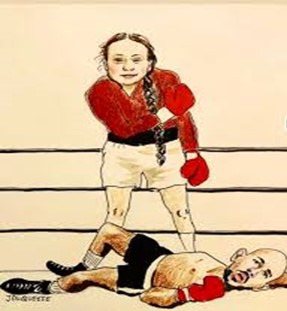
While there are many things that have got under my skin lately, it seems that every time I go on social media, turn on the television, or happen to have a conversation, the name Andrew Tate is uttered. His mere existence is like a virus, attacking not only my brain and soul but it seems a large population of the world. His popularity stems from his platform followed by thousands of men and young boys (it’s known as the ‘Real World’).
His platform ‘educating’ men on working smarter not harder has created a ‘brotherhood’ within the manosphere that celebrates success and wealth. Tate is framed as a man’s man, physically strong, rich and he even has a cigar attached to his hand (I wonder if he puts it down when he goes to the bathroom). It seems many of his aspiring followers want to mimic his fast rich lifestyle.
This seems to be welcomed, especially now when the price of bread has significantly risen (many of his followers would sell the closest women in their life for a whiff of his cigar, and of course to be deemed to have an Insta-desirable lifestyle). While this ideology has gained hype and mass traction in recent years (under the Tate trademark) it seems that his narcissistic, problematic image and what he stands for has only just been deemed a problem … due to his recent indiscretions.
There is now outrage in UK schools over the number of young boys following Tate and his misogynistic ideology. But I cannot help but ask … why was this not an issue before? I am aware of rape culture, victim blaming, sexual harassment, and systems of silence at every level of the UK education establishment. The launch of ‘Everyone’s Invited’ shone a light on the problematic discourse, so why are we only seeing that there is a problem now?
There are many reasons why there’s a delayed outrage, and I would be here all day highlighting all the problems. So, I will give you a couple of reasons. The first is the Guyland ideology: many Tate supporters who fall into the cultural assumption of masculinity expect to be rewarded for their support, in ways of power and material possession (this includes power over women and others deemed less powerful). If one does not receive what they believe they are owed or expected, they will take what they believe they are owed (by all means necessary).
There is also a system of silence within their peer group which is reinforced by parents, female friends, the media, and those that are in administrative power. The protection of toxic behavior has been continuously put under the umbrella of ‘boys will be boys’ or the idea that the toxic behavior is outside the character of the individual or not reflective of who they truly are.
I will go one step further and apply this to the internalised patriarchy/misogyny of the many women that came out and supported Jeremy Clarkson when he callously attacked Meghan. While many of the women have their individual blight with Meghan for reasons I do not really care to explore, by supporting the rhetoric spewed by Clarkson, they are upholding systemic violence against women.
The third point is that capitalism overthrows humanity and empathy in many ways. All you need to do is to look at a history books, it seems that lessons will never be learned. The temptation of material possessions has overthrown morality. The media gives Tate a platform and in turn Tate utters damaging ideology. This brings more traffic to the platforms that he is on and thus more money and influence….after all he is one of the most googled people in the world.
The awareness of the problematic behaviour and the total disregard for protecting women and girls from monsters like Tate shows, how the outrage displayed by the media about harms against victims such as Sabina Nessa and Sarah Everard is performative. The news coverage and the discussion that centred on the victimisation of these two women have easily been forgotten. If the outrage is real then why are we still at a point where we are accepting excuses and championing misogyny under the guise of freedom of speech, without challenging the harm it really does.
It seems that society is at a point of total desensitization where there is more interest in Tate losing an argument with Greta Thunberg, posing with a cigar on an exotic beach for likes, than really acknowledging the bigger picture. Andrew Tate has been accused of rape and human trafficking. The worst thing is, this is not the first time that he has been accused of horrific crimes – and with the audio evidence that was released to the press recently, he should be in prison. But with the issues that permeate the Met police there is no surprise as to why he has been given the green light to continue his violent behaviour. But this is not just a UK issue. There has been a large amount of support overseas with young men and boys marching in masses in support of Tate, so I cannot be surprised that he was able to and continues to build a platform that celebrates and promotes horrendous treatment of women.
For many the progression of a fair and equal society is an aspiration, but for the supporters of the Tate’s in the world they tend to lean on the notion that they are entitled to more, and to acquire what they think they are owed, and will behave to the extreme of toxicity. While it is easy to fixate on a pantomimic villain like Tate to discuss his problematic use of language and how this translates in schools, the bigger picture of institutionalised patriarchy is always being missed.
It is important to unpick the toxic nature of our society, to understand the contributing factors that have allowed Andrew Tate and others like him to be such influential figures.
Share this:


Mundial: Why I won’t be watching the World Cup this time

It has been called the beautiful game; in the past even during war the opposing sides played a game; it has made some of its players stars and household names, football or soccer has a global appeal. From the townships in South Africa, to the Brazilian Favelas, the makeshift pitches the world over to the highly pristine pitches in academies, kids the world over learn to kick a ball, and play the game that requires speed, agility, and dexterity in the feet. Kids who just play for fun in an after-school club or to bond with friends. The appeal of this game has been intertemporal.
Generations of kids, begged their parents to stay longer out to play with their friends, asked for another ball, shoes or shorts and each family responded according to their means. After all, football is/was a working-class game. The relative low cost makes it accessible; it allows plenty of kids to play together and build relationships. Football was an equaliser that did not care who you are or where you come from.
I remember as a kid, year after year playing in the summer with the same kids in teams between Greek and Yugoslavians. We were keeping score and the losing side was buying the other side ice-creams. Not quite the golden ornate cup but a wager worth playing 10 games across the summer. We called each other’s teams with the name of the country we came from. My lasting memory was the last time we played together before the civil war in Yugoslavia erupted. The Yugoslavians won and they were chanting “Yugoslavia, Yugoslavia”. Those kids did not come the following summer. In the next summer, the same kids would be carrying the flag and arms of one of the opposing sides armed to kill each other. When football is not the game, disputes are resolved in brutality.
In the past decades, football’s appeal made it the game to watch. The transition to professional football made the game lucrative, some clubs acquired big budgets and of course attracted a finer audience. The pundits, as a former footballer put it, started eating “prawn sandwiches” an indication of their more expensive tastes. Still people stick with the sport because of their own memories and experiences. My first ever game was with my grandfather. We went to the stadium of the club that was to become the team I support for life. The atmosphere, the emotional roller coaster and most importantly a shared experience with someone very dear, that even when they are gone, you carry the sounds, the emotions with you forever.
Some footballers started earning enormous fees for playing the game; the club colours became trademarked and charged over the odds for a simple scarf or a top. The rights to the games sold to private companies requiring people to pay subscriptions to watch a simple game. People objected but continued still to support, although some people were priced out of the game altogether. The game endures because it still resonates with people’s experiences.
In particular, the national games have kept some of their original appeal of playing for your country, playing for your colours! Football is an unpredictable sport and in international events you can have an outsider taking the cup against the odds! Like Greece winning the UEFA Euro in 2004! The games in international tournaments leads to knock out games, with the drama of extra time and of course the penalty shootout. Nail biting moments shared with family and friends. These magical moments of personal and collective elevation, as if you were there with the players, part of their effort, part of their victory.
When the host country was announced some years ago that will be hosting this year’s world cup there were already calls for investigation into the voting process raising concerns. Since then, there have been concerns about the safety of those who work on the infrastructure. Thousands of migrant workers, many of whom are/were undocumented have worked in building the stadiums that the games will be played in. There are accusations of numerous deaths of migrant workers (an estimate from The Guardian comes to a staggering 6,500 deaths). This has raised a significant question about priorities in our world. It is unthinkable to put a game above human life. This was later followed by “the guidelines” to teams and visitors that alternative sexualities will not be tolerated. Calls about respecting the host’s culture adding to the numbers of people calling for a boycott. So why I won’t be watching this time around?
We have been talking for years about inclusivity and tolerance. Women’s rights, LGBTQ+, immigrant rights, worker rights and all of them being trampled for the sake of a competition. Those who have been asked about the issues from the football federation, former footballers and even governments have played down all these concerns. In some cases, they opted for a tokenistic move like rainbow-coloured planes or include the rainbow on national team logo. Others will be issuing rainbow bracelets and some saying that they will raise issues if/when given the opportunity. This sounds too little considering what has happened so far especially all the fatalities caused building all the constructions. If we are not to uphold civil rights and if we are not ready to act on them, why talk about them?
I remember the game for being inclusive and serving to get people together; this competition is setting an incredibly horrible precedent that human life is cheap and expendable; that people’s rights are negotiable and that you can stop being who you are momentarily, because the game matters more than any of the above. It does not! Without rights, without respect, without life there is no game, there is nothing, because there is no humanity. These games do not bother me, they offend me as a human being. If people died to build this stadium then this space is not fit for games; it’s a monument to vanity and greed; hardly sportsmanlike qualities.
Share this:


The Good Doctor has me thinking…

Recently I have begun watching ABC’s The Good Doctor, which is a medical drama based in the fictional, yet prestigious, San Jose St Bonaventure Hospital and follows the professional and personal journeys of a number of characters. The show is based on a South Korean tv medical drama called Good Doctor and is produced by Daniel Dae Kim and developed by David Shore (creator of House). The main character is Dr Shaun Murphy who has Autism. He is a surgical resident in the early seasons and the show focuses on how Dr Murphy navigates his professional and personal life, as well as how the hospital and other doctors, surgeons, nurses and patients navigate Dr Murphy’s style of communication and respond to him. As a medical drama, in my humble opinion, it is highly entertaining with the usual mix of interesting medical cases and personal drama required. The characters are also relatable in a number of different areas. As a springboard for a platform to talk about equality, equity and fairness, it is accessible and thought-provoking.
A key focus of the programme is the difficulty Dr Murphy has with communication. Well, I say difficulty in communicating, but in actuality I would say he communicates differently to what is recognised as an ‘accepted’ or ‘normal’ form of communication. Dr Murphy struggles to express emotions and becomes overwhelmed when things change and are not within his controlled environment. A number of his colleagues adapt their responses and ways of interacting with him in order to support and include him, whereas others do not and argue that despite his medical brilliance, and first-rate surgical skills, he should not be treated differently to the other surgical residents, as this is deemed unfair.
Whilst watching, the claims of treating all surgical residents equally, and ensuring the hospital higher-ups are being fair; notions of John Rawls’ writing scream out at me. Students who have studied Crime and Justice should be familiar with Rawls’ veil of ignorance, liberty principles and difference principle, in particular with its reference to ‘justice’. But the difference principle weighs heavily when looking at how Dr Murphy functions within the hospital institution with its rules, procedures and power dynamics which clearly benefit and align with some people more so than others. Under the veil of ignorance, maybe an empathetic doctor or surgeon is not required, but a competent and successful one is? Maybe being empathetic is a personal circumstance rather than an objective trait? For Rawls, it is important that the opportunity to prosper is equal for all: and this might mean the way this opportunity is presented is different for different individuals. Rawls asks us to consider a parallel universe and what could be (a popular stance to take within the philosophical realm): why can’t people with autism be given the chance to save lives and perform surgeries just because they cannot communicate in a way deemed ‘the norm’ when dealing with patients.
It is possible that I am over-thinking this. And when I ask my partner about it, they raise questions about why Dr Murphy should be given different opportunities to the other residents and the harm Dr Murphy’s communication barriers could and do cause within the series. But I feel they are missing the point: it is not about different opportunities, its about different methods to ensure they all have the same opportunity to succeed as surgeons. It is not about treating everyone the same, which might on the surface appear to be fair, it is about recognising that equal treatment involves taking account for the differences. Why should Dr Murphy be measured against norms and values from an institution which is historically white, non-disabled, male, and cis-gendered? This might appear to be a lot of thought for a fictional medical drama, but to reiterate it’s an excellent programme with plenty to think about…
Bibliography:
Rawls, J. (1971) A Theory of Justice. Oxford: Oxford University Press.
Ryan, A. (1993) Justice. Oxford: Oxford University Press.

 Thoughts from the criminology team