
Home » Engagement
Category Archives: Engagement

Meet the FBL Student Experience Assistant Team – Kayleigh

My name is Kayleigh, and I am one of the Student Experience Assistants (SEAs) for the Faculty of Business and Law at UON.
I graduated from UON in 2024 with a BA in Psychology with Criminology, and alongside this role I have just started a Master of Research degree. I also work in mental health for the NHS at the weekends. My academic and professional interests are largely around peer support, diversity and inclusion; particularly around the value of lived and living experience, forensic mental health, and neuroscience.
I came to UON in 2021 as a mature student having worked and volunteered within various forensic mental health settings, and I assumed this would be the area I went back into when I finished my degree, but now I’m not so sure… Despite a lot of adversity, university was overall a hugely positive and pivotal experience for me and so I am currently exploring a more academic path. I have a lot of experience to call upon and to share and I’m hopeful that I can support you so that your time at university is positive too.
I am here to support both students and staff in the Faculty of Business and Law by meeting with teams to identify their needs and ensuring students get the right help. As a recent UON graduate, I understand the challenges you might be facing and can offer guidance, connect you with the right people, or just have an informal chat. I have been assigned to support Criminal Justice Studies and Strategy & International Business teams, but support to students is not necessarily limited to these subjects. You can reach out to any of the SEAs for help.
Contact the team at fblseat@northampton.ac.uk, or me directly at kayleigh.willis@northampton.ac.uk. We also hold a drop-in outside LH201, Monday to Friday, 10am-4pm, no booking needed.
Share this:


Meet the FBL Student Experience Assistant Team – Kezia

Hello everyone! My name is Kezia Asante, and I’m part of the Student Experience Assistance Team [SEAT]. I’ll be working with the Criminology and Law departments and am looking forward to meeting you all and providing necessary support wherever it’s needed.
My primary objective in this role is to enhance your overall student experience, and as a recent graduate of the university myself, I understand how overwhelming student life can be. Challenges like balancing coursework, managing deadlines, and navigating university resources can feel daunting, but I’m here to help guide and support you through all of it. Feel free to reach out whenever you need assistance or just a friendly chat!
Choosing criminology to study was a great decision, and if you allow yourself to, you can gain a wealth of knowledge and a fresh perspective on the world. I’ve developed a genuine passion for the subject, particularly because I believe it encourages us to examine the complexities in grey areas that others might view as simply black and white. Criminology has so many different aspects that stem from various fields such as sociology, psychology, law, policing, and forensics. It delves into the root causes of crime, the workings of the criminal justice system, and the societal impacts of crime and punishment and much much more! Moreover, pursuing a degree in criminology can lead you down numerous career paths. For instance, I will be starting my MSc in Cyber Security and Forensics in January, inspired by my interest in the digital realm initiated by my criminology studies.
Overall, what I’m trying to say is to make the most of your criminology studies. Immerse yourself in the subject, engage with your peers and professors, and take advantage of all the resources available to you. Attend workshops, research, and read up on areas of the subject you enjoy and participate in relevant events to deepen your understanding and broaden your perspective. The more actively you engage, the more you’ll get out of it.
Please don’t navigate the university experience on your own. There are many people like me and various support systems available to help you and make your journey easier.
Look forward to meeting you all!
Kezia Asante
kezia.asante-nkansa@northampton.ac.uk
Share this:


What’s stopping us from rehabilitating mentally ill offenders?

I wanted to share with you some key takeaways from the findings of my dissertation; “Understanding Positive Risk-Taking and Barriers to Implementation in Forensic Mental Health.”
For context, positive risk taking is the process of supporting recovery and rehabilitation by actively and carefully engaging service users in decisions and activities that have previously posed a risk, in full acknowledgement of that risk, in the hope it has a positive outcome and builds new skills.
My thematic structure from 5 interviews with forensic healthcare professionals is below for reference.
| Theme | Subtheme |
| Engaging the Service User | – Offering, Accepting, Assessing – Staffing Safe Opportunities |
| Professional Development and Confidence in Practice | – Specialised Training and Professional Development – Confidence in Practice and Taking Responsibility – Challenging Anti-Progressive Attitudes |
| Navigating the Unique Needs of the Service User Group | – Acknowledging and Communicating Risk – Severe, Enduring and Fluctuating Conditions – Stuck in the System – The Juxtaposition of Justice |
Engaging the service user is around the safe engagement of the service user within this process:
- Service users are not being engaged in their own risk assessment which would allow them to build up skills in identifying and managing their own risk.
- Seclusion is being used for more ‘difficult’ to manage service users to compensate for low staffing which is detrimental to service user progress and a huge ethical problem.
Professional Development and Confidence in Practice discussed the complexities of training to work in forensic care and the fear around being responsible for decisions that could go very wrong.
- My participants expressed concerns that primarily clinical practitioners (i.e. clinical psychologists over forensic psychologists) may not be able to work as sufficiently with forensic clients as their training backgrounds and treatment models may favour either the judicial process or the therapeutic outcome, and whilst both are needed, it is unlikely to be available.
- Healthcare professionals also battle with colleagues who are not on board with the approach of offering positive risks, sometimes due to fear, others to not believing that the experience should positive due to the reasons a person is there.
Navigating the Unique Needs of the Service User Group discusses the nuances of forensics and what makes this service different to others.
- It is identified that some professionals find it more difficult to engage in and justify positive risks when it involves certain (overrepresented) conditions, such as psychosis, and certain offenses (sexual), particularly if there are vulnerable victims, which may impact treatment opportunities regardless of other ‘good’ factors.
- Information handed over from the criminal justice system to healthcare system is often dehumanising, reductionist and causes exaggerated risk levels which increases fear and safety behaviours from healthcare staff.
- Service users are subject to the conditions and restrictions of both the healthcare services and the criminal justice system which can present conflicting interests and outcomes from each institution. Additionally, the decisions made by the criminal justice system are often done so despite caseworkers never having met or worked directly with the service user, inhibiting healthcare professionals from using their professional judgement to offer positive risk-taking opportunities.
- Service users are very often ‘in the system’ for a long time, so much so that they may begin to fear life outside of an institution and may sabotage their own progress in order to stay within a familiar institution and possibly even to go back to prison.
Much more needs to be done, and needs to change to improve this increasingly prevalent service. It is my hope that more research within this area will help to support the recovery and rehabilitation of those who are cared for in forensic mental health settings and that my findings might inspire anyone who goes on to work with mentally ill offenders to make improvements to what they find in their workplace. Whilst my study was primarily within the secure healthcare space, much is transferrable to other areas of the criminal justice system.
Share this:


Meet the Team: Helen Trinder, Associate Lecturer in Criminology

My Academic Journey
Two weeks ago, I attended a university reunion. My cohort are now in our late 40s or early 50s but it is remarkable how little we had all changed. Being back in the place where we all studied together put me in reflective mood and that (combined with some timely prompting from Paula) inspired me to share my academic journey.
I was one of those annoying kids who did well at school and knew exactly what they wanted to do. As a small child, I wanted to be a nurse but I later developed an aversion to bodily fluids which made that career choice untenable. I briefly flirted with the idea of being an English teacher, but both of my parents were in education and strenuously tried to dissuade me. So, at the age of about 14, I decided that I wanted to be a prison psychologist. I was in a careers lesson at school, and we had a big green plastic box filled with cards on which were written descriptions of different jobs. I announced that I wanted to be a psychiatrist (I think I was just being provocative) but I couldn’t find “psychiatrist” in the box, so I picked the closest one that I could find: “psychologist”. I read the card and it sounded really interesting, so I decided to find out more about psychology. The more I read, the more interesting I found it, and when I looked into the sorts of settings where I could work as a psychologist, prisons called out to me.
I was very lucky to secure a place to read Experimental Psychology at University College, Oxford in 1990. People have an image of ancient universities as being elitist, but what struck me was the huge diversity of people who were there. They were all clever and had studied hard to achieve their places, but beyond that they came from an enormous range of backgrounds – a far greater variety than I had encountered in my Shropshire comprehensive school. Our tutors worked us extremely hard. We had weekly tutorials, either in pairs or one-to-one, in two modules every term and we had to prepare an essay for each tutorial (two essays a week). In tutorials, we read out, discussed and analysed our essays and the reading on which they were based. There were lectures and practical classes on top of that and we had exams at the beginning of each term to make sure that we hadn’t forgotten anything over the vacations! That’s why I’m sometimes not very sympathetic to students who struggle to read one paper in preparation for a seminar!
At the end of my undergraduate studies, I still wanted to work in prisons but I knew very little about them. My degree had given me an excellent grounding in psychology but I knew little about the study of crime. So I applied to do an M.Phil. at the Institute of Criminology in Cambridge. This gave me an extra year as a full-time student and I thoroughly enjoyed it! I was privileged to be taught by such eminent criminologists as Loraine Gelsthorpe, Alison Liebling and David Farrington. I particularly enjoyed the penology seminars with Nigel West, which I attended just out of interest – I wasn’t taking the assessment in that module! The assessments were all coursework (extended essays and a dissertation) and had to be submitted at the start of each term, so I studied hard in the vacations, and I attended my seminars in term time, but there was also plenty of time for sport and socialising and making the most of my last year as a student!
At that time, HM Prison Service recruited new psychologists once a year through a national assessment centre. I applied in 1994, just after I had submitted my M.Phil. dissertation but I was unsuccessful. I got a job instead at the University of Wales, Swansea, as a research assistant in the Department of Social Policy and Applied Social Studies. I was involved in an evaluation of drug and alcohol treatment centres, funded by the Welsh Office, which employed both quantitative measures and participant observation. When that contract ended, I obtained another contract with Swansea City Council to compile a community profile of a “problem” estate. This required knocking on doors to interview residents, and participant observation in community settings such as the youth club, old people’s bingo sessions and the local pub. It was considered a rather intimidating environment to drop a well-educated 24-year-old English girl into, but I found the residents to be remarkably warm and welcoming and it was a highly rewarding piece of work.
By the time I finished the community profile, I had re-applied to the Prison Service and passed the assessment centre – the interpersonal skills I had developed through my action research had served me well. I had, however, joined the Prison Service at an unfortunate time. There was a recruitment ban in force which meant that although I had passed the psychologist assessment centre, I couldn’t actually secure a job. I was eventually given a temporary contract to collect data at HMP Littlehey for a large-scale research project analysing effective prison regimes. After 10 months of doing this, the recruitment ban was lifted and I was taken on as a prison psychologist, sharing my time between HMP Littlehey and HMP Wellingborough. The Prison Service used to fund a part-time M.Sc. at Birkbeck University, which all newly recruited psychologists undertook. Obtaining a suitably accredited M.Sc., along with completing a satisfactory period of supervised practice, is an essential requirement of becoming a fully qualified “Chartered” psychologist. In another piece of unfortunate timing, the Birkbeck M.Sc. ceased to run just as I joined the service. At first, there was nothing to take its place. However, other universities soon noticed the gap in the market. I, and others in my prison psychology cohort, were relieved when the University of Leicester set up an M.Sc. in Forensic and Legal Psychology by Distance Learning. The Prison Service agreed to pay my fees and my manager allowed a small amount of study leave when assignments were due. Completing a post-graduate degree while working full-time in a demanding job was hard work and I vowed I would never do it again!
I moved to HMP Woodhill in 1998, completed my M.Sc. in 1999 and became a Chartered Psychologist in 2001. At some point after that, I remember receiving a phone call at work from someone called “@manosdaskalou” at, what was then, University College Northampton! I don’t know where he got my number from, but he wanted someone to talk to his third year Forensic Psychology students about the work that psychologists do in prisons. My parents had not completely succeeded in knocking a desire to teach out of me (in fact I probably inherited my urge to educate from them), and my Dad had taught at Northampton when it was Nene College, so I was keen to fulfil the request. The talk became a regular fixture and, after a few years (by which time I was Head of Psychology at HMP Woodhill), we extended it from a single guest lecture to a series of four, to allow me to cover topics such as risk assessment and offending behaviour interventions in more detail.
My son was born in 2008 and I took 12 months maternity leave from the Prison Service. At the end of that time, I didn’t feel ready to go back, so I negotiated a further 12 months career break. I wasn’t ready to return to the full intensity of managing a team in a high security prison, but I did want to keep my brain active. I asked Manos if there were any opportunities to expand my teaching commitments. The University was in the process of setting up a foundation degree in Offender Management, which was aimed primarily at custodial officers at HMP Rye Hill but was also delivered to a small cohort of full-time students. They were short of lecturers to deliver the modules and my offer to help out was eagerly accepted. The terms of my career break meant that I couldn’t earn money from another employer, but a couple of hours a week teaching suited me very well, so I gave my services for free and taught a module on Professional Practice alongside a lecturer with a background in probation, from another university, called Keith Davies.
After a year of this arrangement, HMP Woodhill were unwilling to have me back part-time, so I resigned from the Prison Service and joined the Parole Board as a part-time psychologist member. This allowed me to work much more flexibly and, with a toddler in the family, it suited me well. It also meant that I could have a proper contract with the University of Northampton and I became an associate lecturer in September 2010. Keith had moved to a different job but I continued to teach Professional Practice on the Offender Management degree. There was also a module in Offender Management on “The Psychology of Crime and Criminal Behaviour”. The person who taught this left after a couple of years and I took it over. Returning to basic psychology and teaching it every week was daunting at first, but I really enjoyed going back to what I had learned as an undergraduate and re-discovering how relevant it was to real-life criminal justice.
The arrangement with HMP Rye Hill had never really taken off and the Offender Management degree only ever attracted small numbers of full-time students, so in 2014 the course closed. Manos was keen, however, to incorporate more psychology into the B.A. Criminology course, so we adapted “The Psychology of Crime and Criminal Behaviour” into a first-year criminology module and I’ve been teaching it ever since! I’ve also taught a module on violence and I’ve covered maternity leave and sickness absence in other modules too. My students will have heard me banging on about forensic psychologists being “scientist-practitioners” and I feel that teaching at the University of Northampton has allowed me to fulfil this role. As a practitioner, I have lots of interesting real-life examples to use to illustrate points to my students, but teaching also keeps me up-to-date with research and theory which I can use to inform my practice.
My academic journey continues to take me to new places. My position on the Parole Board was a public appointment with a fixed tenure that came to an end in September 2020. I decided at that point to start a part-time Ph.D. with the University of Birmingham. I had not wanted to go into research straight from my M.Phil. because I felt that, in order to understand people who committed offences, I really needed some direct experience of working with them, but after 24 years as a practitioner, the time seemed right. I am now 18 months into a 6-year part-time degree. I am exploring the role of empathy deficits in violent and sexual offending. Trying to undertake research (which ideally requires access to prisoners) has not been easy during a pandemic and I have faced a number of obstacles but nothing insurmountable yet.
I am still keen to maintain a scientist-practitioner balance, and I need to pay my university fees and make a contribution to the family income, so in February of last year I started working as a Forensic Psychologist at St Andrew’s hospital. I am primarily based on a medium-secure ward for men with learning disabilities. Forensic mental health is a new area of practice for me and, although I have plenty of transferable skills from my previous roles, I have had to adapt to a different approach to the people we work with and a completely new set of jargon.
Reflecting on my academic journey, it is the people that stand out. I think that the most profound learning has taken place when I have been able to engage with experts who have shared their enthusiasm. In this respect, my undergraduate tutorials and M.Phil. seminars contrast with my distance learning M.Sc., which was a means of obtaining a qualification rather than an immersive learning experience. I hope that, as a practitioner who also teaches, I have been able to share some of my enthusiasm for forensic psychology with my own students. In order to benefit from this, however, students need to take up the opportunity to engage fully with teaching and not just see their university experience as a means to a qualification. Of course, COVID has not helped this, and the university’s penchant for remote learning placed it in a good position to maintain teaching when the pandemic struck. But it is very difficult to engage students when they are just names on a screen. I hope that, as we return to more face-to-face teaching, I can once again inspire my students, not just to pass their exams but to develop a life-long fascination for understanding criminal behaviour and the people that perpetrate it.
Helen Trinder, M.A., M.Phil., M.Sc., C.Psychol.
Forensic Psychologist and Associate Lecturer

Share this:

Technology and Learning: A baby and the bathwater moment

I recently shared some thoughts about the problems with technology and working from home. I suppose the nub of the matter was twofold firstly, if I have problems with technology, why would this not also impact some of my colleagues and students, thus limiting what can be delivered online. Secondly, whatever is delivered online does not suit everyone and whilst as educators we need to adapt to circumstances and new ways of working, we should be cognisant that simply imposing the new ways on students does not always suit what they want or more importantly, what they need. If we acknowledge that everyone learns in different ways at different times, then a one size fits all approach is not delivering anything like a premium learning environment.
In writing my previous blog, I also started to think about how difficult it is to be motivated whilst working from home and how my experiences have at least partially prepared me for this. I say partially because past experiences did not encompass being in lockdown.
When I was 15, I returned from overseas and went to the local college to study for my ‘O’ levels (GCSE now) rather than a school. It was far more relaxed in respect of attending classes. This was a time when at 16 people could leave school, so the college was full of students who were 16 and essentially independent from the school regime. I turned 16 whilst at college. I remember not going to every class, sometimes perhaps because I preferred to spend time playing football in the sunshine and at other times because there was some casual work somewhere that would earn me a bit of money. There were no distractions such as computers and mobile phones so actually attending college was in the main better than being bored outside of it. That was one incentive to engage in my education, I had others such as friends being at college but probably above all I recognised I needed some qualifications. I think my parents might also have been a little peeved if I’d not done anything. I had a structure to my life and a major part of it was getting up in the morning and attending college on my bicycle; rain or shine, for the most part I was there.
At an early point in my policing career, I decided I would like to take the promotion exam to sergeant. An annual exam which incorporated, as I recall, three two-hour papers, one relating to crime, one traffic and one general police duties. An awful lot of legislation and procedure was to be tested and all of it could be found in the regularly updated promotion manual. A tome, if ever there was one, divided into various sections that covered everything a would-be sergeant needed to know and in addition, legislation for the inspector’s exam. Years went by with well intentioned attempts to study, followed by a lack of action. I just couldn’t get my head round how to do this, despite trying to answer the questions in the promotion section of the Police Review magazine.
I can’t remember exactly when it was but there was an announcement that the promotion process was to change, the exam which gave you a ticket to a promotion board, was to be replaced with an assessment centre. This new way involved not only an exam, but scenario based assessments. That year I decided I really needed to pass the promotion exam to avoid the new process, so I purchased access to a correspondence course. It wasn’t cheap, and it was before computers as we know them. I received a plethora of books each divided up into various chapters and each requiring me to answer questions that were then sent by mail to someone to mark and provide feedback. What this required was organisation and commitment. I was lucky, I was working in a very disciplined job, organisation and commitment were to some extent, if I set my mind to it, second nature. And two added incentives, an easier passage to promotion as I saw it, and I’d paid out a lot of money that I wasn’t going to waste. That year I passed the sergeants and the inspector’s exam, two in the bank although it was still some time before I was promoted.
When I embarked on my degree, I had to apply the same self-discipline. Despite it being part-time, attendance for lectures and seminars was difficult, there was no way I could attend everything whilst doing shift work, but I tried my best. I even had to take time out because I was involved in a major investigation that took me away from home for 6 months. By this time, I had a very young family, so every assignment was a challenge to complete and there was no online Google access to papers and blogs and the like. It was library based work, sometimes the university library, other times local libraries and often late nights in the office at work. What it needed was self-discipline, commitment and a structure to each day, well as best as possible given the demands of shift work, major enquiries and long working hours. Every time I faltered I reminded myself that I’d done a lot of work, put a lot into this and I wasn’t about to throw all of that away.
When I embarked on my Ph.D. my commitment and self-discipline was sorely tested at times. Tragedy and life altering events pushed me to the limits, but I managed to maintain that commitment and self-discipline, sometimes aided by others at work who tried to make things a little easier. The office at work provided space for both my day job and my Ph.D. The two morphing into one at times.
Why tell you all of this, well its simply this. I ask myself what makes a student engage in their course and more importantly, what inhibits them? Firstly, they need self-discipline. When I went to college, there were a number of things that ensured I would turn up; my parents wouldn’t have countenanced my staying in bed or around the house all day; day time telly was rubbish (only three channels) and there wasn’t an awful lot else to do. My friends were either at school, at college or working and there were no mobile phones, so contact was either at college or in the evenings and weekends. Learning could only be done at college, no recorded lectures or Collaborate or e-books. I also recognised I needed qualifications to get on in life.
When I embarked on my promotion exams I recognised the need to have a structure to my learning. This was partly provided by the correspondence course and the way it was set up and partly provided by discipline I learnt in my work. It did though need a structure provided by the course and an incentive to do it at that moment in time.
My degree also needed self-discipline, nobody chased me to turn up and nobody chased me for assignments. Not being there, meant missing out on discussions and learning from other students, not just the lecturers. I’d paid for this as well so another incentive to succeed, this was not some loan to be possibly paid in the future, this was real money, my money up front. And the more I did the more determined I became that I wasn’t going to waste my efforts.
Anyone will tell you that a Ph.D. is challenging and that for the most part, the achievement is not about knowledge or brilliance but about gritted determination to complete it. That determination requires self-discipline and that self-discipline for me was aided by tagging the Ph.D. onto my job. My office at work was my sanctuary, it was easier to stop working on one thing and then seamlessly move onto writing up the Ph.D. I had a structure to my studying and my work.
So, I begin to wonder, do recorded lectures, Collaborate, ebooks, the internet, social media and a plethora of other advances really help students? Why get up in the morning to attend lectures if you can watch a recorded version of it later, ‘a must get round to it moment’? Why bother to go to the library when you can Google stuff and read, well at least skim’ e-books? Why bother with classes when you can chat with your mates and so called ‘friends’ on Facebook or the plethora of other social media apps. There is no financial incentive when the payment for the course is made on your behalf and whilst you have a massive debt on paper, the reality is that you will never pay it back (If you don’t believe me, have a look at the Martin Lewis website). There are no parents to get you up in the morning or to scorn your lethargy, at worst any failure will be chided sometime in the misty future. All that students can rely on is self-discipline and their own belief in commitment. A hard ask when you don’t have all the anchors you had at school and college. I was lucky, I grew up in an era of much fewer distractions. I was employed in a job that required a high degree of disciple, so self-discipline was much easier. I was also a mature student so could call on a vast amount of experience.
I’ll leave you with a thought. The year 1840 saw the introduction of the first stamp, the Penny Black. Despite the advent of emails, texts and the internet, nearly two hundred years later, Royal Mail are still delivering letters and packages. Whilst you can get your bank statements online, you can still have paper copies. Whilst you can read books on Kindle and other contraptions, book stores still exist, and hard copy books are still sold by the millions. Whilst, music can now be delivered in so many different electronic formats, there is still a clamour for vinyl records. Whilst films are available at home in so many different ways, people still go to see films at the cinema.
Technology is wonderful and is a great enabler in so many ways. That doesn’t give us licence though to ignore the value of what by some may be seen as ‘old fashioned, stick in the mud’ structures, processes and transactions. Sometimes things are the way they are for a reason, change them and there are at times problematic unintended consequences. Making changes through the use of technology and ignoring tried and trusted methods might actually be akin to ‘throwing out the baby with the bathwater’.
Share this:


Teaching, Technology, and reality
I’m not a fan of technology used for communication for the most part, I’d rather do things face to face. But, I have to admit that at this time of enforced lockdown technology has been to a large extent our saviour. It is a case of needs must and if we want to engage with students at all, we have to use technology and if we want to communicate with the outside world, well in the main, its technology.
However, this is forced upon us, it is not a choice. Why raise this, well let me tell you about my experiences of using technology and being shut at home! Most, if not all my problems, probably relate to broadband. It keeps dropping out, sometimes I don’t notice, that is until I go to save my work or try to add the final comment to my marking. I know other colleagues have had the same problem. Try marking on Turnitin only to find that nearly all of your feedback has just disappeared in a flash. Try talking to colleagues on Webex and watch some of them disappearing and reappearing. Sometimes you can hear them, sometimes you can’t. And isn’t it funny when there is a time lag, a Two Ronnies moment when the question before the last is answered. ‘You go, no you go’, we say as we all talk over each other because the social cues relied on in face to face meetings just aren’t there. I’ve tried discussion boards with students, it’s not like WhatsApp or Messenger or even text. It is far more staid than that. Some students take part, but most don’t and that in a module where attendance in class before the shutdown was running at over seventy per cent. I’m lucky to get 20% involved in the discussion board. Colleagues using Collaborate tell me a similar tale, a tale of woe where only a few students, if any appear. Six hours of emptiness, thumb twiddling and reading, that’s the lecturer, not the students.
Now I don’t know whether my problems with the internet are resultant of the increased usage across the country, or just in my area. I suspect not because I had problems before the lockdown. I live in a village and whilst my broadband package promises me, and delivers brilliant broadband speed at times, it is inconsistent, frequently inexplicably dropping out for a minute or two. It is frustrating at times, even demoralising. I have a very good laptop (supplied by the university) and it is hardwired in, so not reliant on Wi-Fi, but it makes little difference. I suspect the problems could be anywhere in the broadband ether. It could be at the other end, the university, it could be at Turnitin for instance or maybe its somewhere in a black hole in the middle. Who knows, and I increasingly think, who cares? When my broadband disappeared for a whole day, a colleague suggested that I could tether my phone. A brilliant idea I thought as our discussion became distorted and it sounded like he was talking to me from a goldfish bowl. I guess the satellite overhead moved and my signal gradually disappeared. I can tell you now that my mobile phone operator is the only one that provides decent coverage in my area. Tethered to a goldfish bowl, probably not a solution, but thanks anyway.
If I suffer from IT issues, then what about students? We are assured that those that live on campus have brilliant Wi-Fi but does this represent the majority of our student body? Not usually and certainly not now. Do they all have good laptops; do they all have a decent Wi-Fi package? I hazard a guess, probably not. But even if what they have is on par with what I have available to me could they not also be encumbered with the same problems? We push technology as the way forward in education but don’t bother to ask the end user about their experience in using it. I can tell you from student feedback that many don’t like Collaborate, find the discussion boards difficult to engage with and some are completely demotivated if they cannot attend physical classes. That’s not to say that all students feel this way, some like recorded lectures as it gives them the opportunity to watch it at their leisure, but many don’t take that final step of actually watching it. They intend to, but don’t for whatever reason. Some like the fact that they can get books electronically, but many don’t, preferring to read from a hard copy. Even browsing the shelves in the library has for some, a mystical pleasure.
I’ll go back to the beginning, technology has undoubtedly been our saviour at this time of lockdown, but wouldn’t it be a real opportunity to think about teaching and technology after this enforced lockdown? Instead of assuming all students are technology savvy or indeed, want to engage with technology regardless of what it is, should we not ask them what works for them. Instead of telling staff what they can do with technology, e.g. you can even remotely mark students’ work on a Caribbean island, should we not ask staff what works? Let’s change the negative narrative, “you’re not engaging with technology”, to the positive what works in teaching our students and how might technology help in that. Note I say our students, not other students at other universities or some pseudo student in a theoretical vacuum. We should simply be asking what is best for our students and a starting point might be to ask them and those that actually teach them.
Share this:


Criminology Society!
President: Natalie Humphrey
Secretary: Maisie Storr
Treasurer: Megan Petford
As many of you are aware, back at the beginning of the year, the Criminology was set up. However, I will admit we have been very lacking with content. I am writing this blog to try and get the word out and become proactive. This society could be something that bring all students studying criminology, joint and single honours, together. We have a few ideas in the works, with our first meet up being a movie night. This will be happening in the next few weeks, where we will be watching the new Ted Bundy film, with Zac Efron. Our other ideas include, visiting a court, an escape room and we are hoping for an abroad trip at some stage. However, we need many more suggestions from those who are part of the society. Please feel free to add our social media which I will leave at the end of this blog. We will be posting mainly on our Instagram where we have polls for you to partake in, asking you what you want from the society. If you haven’t already, and are interested, please visit Northampton’ Student Union website where you can officially join the society. Any suggestions would be really appreciated, so just contact us through social media to get your voice heard!
Twitter: @uon_criminology
Instagram: criminologysociety_uon
Share this:


How to prepare for a year in University

In our society consumerism seems to rain supreme. We can buy stuff to make us feel better and we can buy more stuff to express our feeling to others and mark almost most events around us. Retail and especially all the shops have long been aware of this and so they have developed their seasonal material. These seasonal promotions may have become consumer events now although they do signify something incredibly important to culture and our collective consciousness. There is time for Christmas decorations and festive foods, Easter time and chocolate eggs, mother’s day and nauseating cards father’s day for equally grinchworthy cards. There is valentine’s day to say I love you in full fat chocolates, Halloween to give little kids rotten teeth and a red poppy to remember some of our dead. To those add the summer season with the disposable BBQs and of course the back to school season!
The back to school is one of the interesting ones. Geared to prepare pupils and parents for going back to school and plan ahead. From ordering the uniforms to getting all the stationery and books required. I remember this time of the year with some rather mixed emotions. It was the end of my summer holidays, but it was also the time to get back to school. Until one day I finished school and I went to university. Education is seen as part of a continuous process that we are actively involved from the first day at school to the last day in high school and more recently for more people also involve the first day of going to university. Every year is more challenging than the next, but we move up and continue. For those of us who enjoy education we continue the journey further to further or high education.
There is something to said about the preparation process coming to University; it is interesting seeing advertisements on education this time of the year on the tv and social media promoting stuff for this transition; from the got to have smartphone to the best laptop, the fastest printer scanner all in one thingy to the greatest sound system and many more stuff that would get you ready for the year ahead. Do they really help us out and if not, what do we got to do to prepare for coming to university?
Unfortunately, there is no standard formula here but there is a reason for that. Higher education is adult education. This is the first time in our educational journey that we are sitting firmly on the driving seat. We choose to study (or ought to) what we wish to study. It is an incredibly liberating process to have choice. This however is only the beginning. We make plans of our time. In higher education the bulk of the time required is independent study, and as such we got to negotiate how we will plan our time. We got to decide which reading we are going to do first which notes to read what seminar we shall prepare and what assignment we will make a draft of.
There will be days spent in the library looking for a book, days in a coffee shop talking to fellow students about the seminar reading, days in the learning hub working on an assignment. There are highs, lows and everything in between. But regardless of the emotion at every stage thee will be a sense of ownership of knowledge.
In the first couple of sessions, the bulk of the students keep quiet expecting the correct answer to be given. One interpretation or one truth that describes all. It takes a few times before the realisation emerges that the way we analyse, and project knowledge can be different provided we go through the same processes of scrutiny and analysis. Then conversation emerges and the more reading the better the quality of the ideas that shall emerge.
The first year at University is definitely a declaration of independence and the realisation that we all have a voice. Getting on to the road on empowerment. This is a long journey, and on occasions arduous but incredibly rewarding because it leads to an insight greater than before that removes ignorance and lifts the veil of the unfamiliar.
To our newest students – Welcome to the University and to our returning 2 and 3 years – Welcome back!
Share this:


Thinking “outside the box”
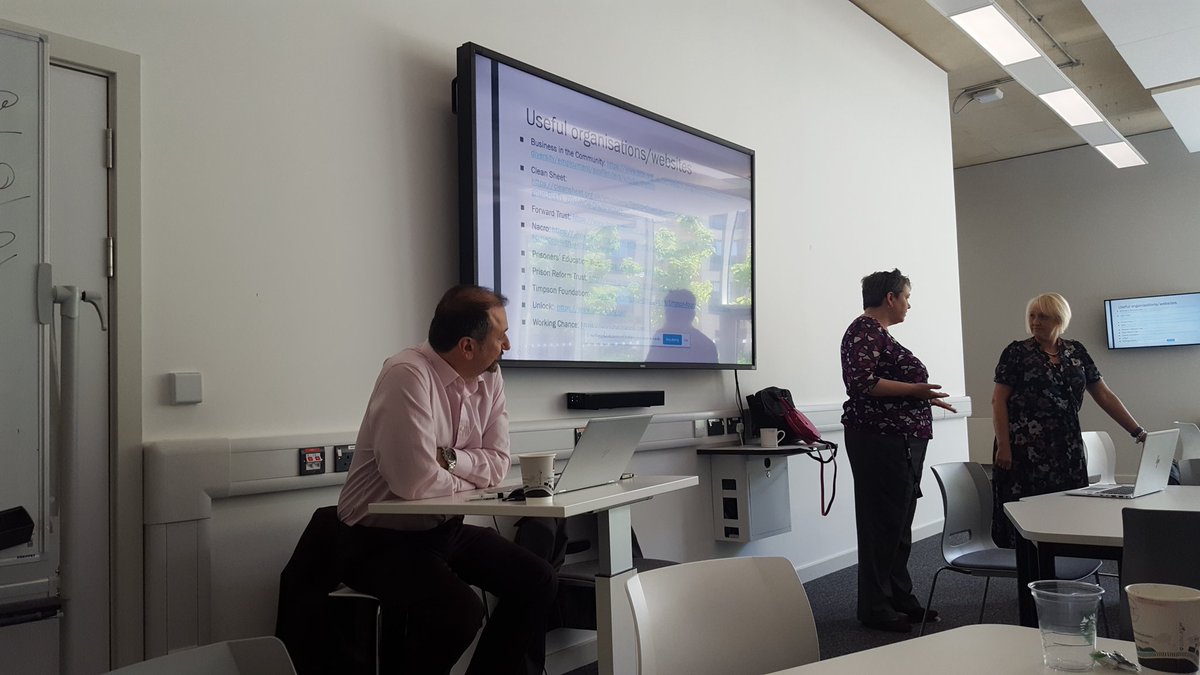
Having recently done a session on criminal records with @paulaabowles to a group of voluntary, 3rd sector and other practitioners I started thinking of the wider implications of taking knowledge out of the traditional classroom and introducing it to an audience, that is not necessarily academic. When we prepare for class the usual concern is the levelness of the material used and the way we pitch the information. In anything we do as part of consultancy or outside of the standard educational framework we have a different challenge. That of presenting information that corresponds to expertise in a language and tone that is neither exclusive nor condescending to the participants.
In the designing stages we considered the information we had to include, and the session started by introducing criminology. Audience participation was encouraged, and group discussion became a tool to promote the flow of information. Once that process started and people became more able to exchange information then we started moving from information to knowledge exchange. This is a more profound interaction that allows the audience to engage with information that they may not be familiar with and it is designed to achieve one of the prime quests of any social science, to challenge established views.
The process itself indicates the level of skill involved in academic reasoning and the complexity associated with presenting people with new knowledge in an understandable form. It is that apparent simplicity that allows participants to scaffold their understanding, taking different elements from the same content. It is easy to say to any audience for example that “every person has an opinion on crime” however to be able to accept this statement indicates a level of proficiency on receiving views of the other and then accommodating it to your own understanding. This is the basis of the philosophy of knowledge, and it happens to all engaged in academia whatever level, albeit consciously or unconsciously.
As per usual the session overran, testament that people do have opinions on crime and how society should respond to them. The intriguing part of this session was the ability of participants to negotiate different roles and identities, whilst offering an explanation or interpretation of a situation. When this was pointed out they were surprised by the level of knowledge they possessed and its complexity. The role of the academic is not simply to advance knowledge, which is clearly expected, but also to take subjects and contextualise them. In recent weeks, colleagues from our University, were able to discuss issues relating to health, psychology, work, human rights and consumer rights to national and local media, informing the public on the issues concerned.
This is what got me thinking about our role in society more generally. We are not merely providing education for adults who wish to acquire knowledge and become part of the professional classes, but we are also engaging in a continuous dialogue with our local community, sharing knowledge beyond the classroom and expanding education beyond the campus. These are reasons which make a University, as an institution, an invaluable link to society that governments need to nurture and support. The success of the University is not in the students within but also on the reach it has to the people around.
At the end of the session we talked about a number of campaigns to help ex-offenders to get forward with work and education by “banning the box”. This was a fitting end to a session where we all thought “outside the box”.
Share this:

The Unbreakable Bond of Criminology

Every student has a different experience in their studies, be it through what they have studied, who they studied with or even where they studied. “Team Cops and Robbers” studied the same degree, the same modules at UON, yet we had different experiences. However what we share (and are all very fond of) is how positive the experience was, tackling the stresses (and joys) of the degree as a trio. We each offer a brief overview of our experience as a member of “Team Cops and Robbers”, who graduated in 2015 and still remain very involved in each other’s lives…
Jes: I was a late comer to Team Cops and Robbers, as Emma and Leona had already bonded without me (rude I know!). We were thrown together in Drew’s 2nd year History module, where there were only a few Crim students – so they didn’t get much of a choice with regards to me joining, the then, duo. And the rest as they say is history! What stemmed from there is quite remarkable; we all had own our strengths when it came to Crim. My recollection is Emma knew everything about everything, Leona kept us all motivated and on top of our seminar preparation and I kept us glued to the library and bossed us around -especially with group work (my car Geoffrey was an unofficial member of the gang taking us to and from Park campus). Although we took the same modules, due to our differing interests, we all did different assignment questions and had very different ways of writing and tackling assessments. In my third year, I distinctly remember Emma and Leona reminding me to take time to myself and to not live 24/7 in the library; and had they not been there to encourage me to breathe, it is likely I would have burned out! They were not afraid to question my views, or understanding, or challenge my bossy attitude when it came to group work, for which I am very grateful! And still today, even though we are no longer studying together, they keep me motivated with the MSc, sending me motivational gifts as a reminder that even though they are not studying with me, I am not alone! My academic journey would have been very different had it not been for our trio, and likely would not have been as successful.
Leona: Sometimes being in class with friends can be detrimental as you end up spending so much time having fun, you end up forgetting the work side of uni. However when you meet friends who are so determined to do well and hard-working, it can really motivate you to push yourself. Myself, Jes and Emma became a power trio; encouraging each other, motivating each other and always making sure we were working together for group projects. We are all completely different when it comes to learning but I think these differences really helped us. Learning from them really helped me to improve my own standard of work, and having the girls’ input and guidance throughout, really encouraged me and helped me gain confidence in my own voice. Plus it made doing all the studying we did much more bearable. I’m sure sometimes it took us longer to get through everything as we would be half working, half chatting, but as a trio it meant we could help each other if we got stuck or go for coffee breaks if we were bored or unmotivated. Having Jes and Emma there with me meant there was always someone there to go through notes with, always someone to explain something in a different way if I didn’t fully understand something, always someone to motivate me when I was exhausted and didn’t feel like working any more. It meant that my viewpoint expanded as I learned from their experiences and that once we had all finished writing our essays we could share them with each other to check, critique and make suggestions for improvement. But more than all that, it meant there was always someone there to help you balance the workload, someone to tell you when to take a break, and to “day drink” in the SU, explore winter wonderland, or have a Disney film day. During my time at uni these girls inspired me to work harder, and to really challenge myself to improve on everything I was doing. Without them there to encourage me and spur me on, I don’t think I would have come out with the grade I did, and I am certain that my uni experience wouldn’t have been half as memorable.
Emma: Meeting Jes and Leona was one of the best things about university. Not just because they are now two very dear friends of mine, but because we were vital to each other’s sanity at uni. I met Leona first in welcome week with a very interesting exchange asking if I was at the right seminar and proceeding to tell her my name, that I was from the south west and that I liked reading about serial killers. Leona reciprocated with the main difference being that she was from the north and from there our friendship blossomed. Jes was some girl who sat with another group of people. It wasn’t until 2nd year that Jes really came into our friendship group and “Cops and Robbers” was formed. We all had strengths and weaknesses that helped us when it came to group work. Jes was always super, super organised, having her essays completed with weeks to go. Leona was always bubbly and would follow Jes with completing her essay with time to spare. Me… I would research and collect quotes and references and then write my essays with 48-24hrs to go, as I liked the time pressure. This changed in my 3rd year though as being around Leona and Jes, they moulded me and proof read my concepts and challenged me back on things. Any time we had group work, I knew we would do well because as a trio we kicked ass! We did not always have the same views in our seminars and would often debate but we would always leave as friends. Best advice for getting through university sane, is to find people who are fun, you get on with and drive you to be the best.
Hopefully what is clear from each of our perspectives is how important we were to keeping each other (relatively) sane! Your friendship groups during your studies are essential to keeping you happy, but also keeping you motivated! Whilst it is independent studies, and at the end of the day is YOUR degree; the input from friends and family will shape your own ability and attitude. If you find the right group, hopefully you will find that they push you, support you and challenge you!

 Thoughts from the criminology team