
Home » Education (Page 8)
Category Archives: Education
What are Universities for?

As we go through another welcome week it becomes quite apparent in conversations with new students that their motivation for coming to University and joining a course is not singular. Of course there are some very clear objectives that are shared across like the interest for the subject and the employability afterwards for underlying those there are so many different personal motivations and aspirations attached.
In the eyes of our new cohort, I can see a variety of responses, the eagerness to learn the joy of studying, the expectation of belonging and the anticipation of ordering their lives across the University life, just to name but a few.
In conversation, I see these attributes in a different light. “I want to belong but I am shy”, “I wish to learn but I am worried about learning” “I want to engage but I am concern with my writing”. This is the soft underbelly of becoming a student; because in education our own insecurities are playing up. These little devils, who rest on the back of the head of many people who doubt themselves and worry them.
One of the greatest fears I hear and see been rehearsed before me is that of intellectual ability. This is one of those issues that becomes a significant barrier to many people’s fear when joining a University course. Of course the intellectual level of study is high. There are expectations of the degree of knowledge a student will build on and the way they will be able to utilise that level of knowledge. After all a University is an institution of High Learning. The place where disciplines are explored in totality and subjects are taught holistically. Nevertheless the University is not the end of one’s education but rather the door to a new dimension of learning.
For myself and many of my colleagues what makes this process incredibly exciting is to see those eyes of the new students across the years brighten up, as they “get it” as the penny drops and they connect different parts of knowledge together. Once people reach that part of their educational journey realise that coming to University was not simply an means to an end but something beyond that; the joy of lifelong learning.
As this is a early session, I shall address the intellectual fear. The greatest skills that any student need to bring with them in class is patience and passion. Passion for the subject; this is so important because it will sustain during the long cold winter days when not feeling 100%. Patience is equally important; to complete the course, needs plenty of hours out of class and a level of concentration that allows the mind to focus. Any successful student can testify to the long hours required to be in the library or at home going over the material and making sense of some challenging material. This ultimately unravels the last of the requirements, that of perseverance. It is through trial and error, rising up to a challenge that each student thrives.
So for those who joined us this year, welcome. The door to an exciting new world is here, to those returning, we shall pick up from where we left off and those who completed, hopefully University has now opened your eyes to a new world.
Share this:


Reflection: From student to professional

I graduated in July 2017 with a Criminology BA from the University of Northampton with a 2:2. In university I did two research placements at youth offending services and from there realised that this is what I wanted a career in.
I applied for a job in the Youth Offending Service with little belief that I could get the job. However I was offered the job and started working from September. As it nears to my first year being completed I have reflected on the transition from student to professional.
The past year has been a rollercoaster and I have a steep learning curve through this. University life especially all the deadlines and time management required only scratched the surface for what awaited me in the world of work.
One thing I wasn’t fully prepared for was the difficulties faced as a young professional. particularly when you’re the youngest member of staff by around 8 years. Many people do not take you seriously when you first start and it takes a while to ‘prove yourself’ as a professional to colleagues, other agencies and to the service users. I have even been mistaken for a young person when out on reparation (like community service) so it has been hard overcoming these barriers.
A positive is working with young people and I am enjoying this immensely. My job role means I work with low level offenders and prevention work with young people and this seems to be successful for most young people to avoid the criminal justice system. However I support those on higher orders as well as assisting on Reparation; so doing things like gardening, painting and decorating, to indirectly repair the harm caused. It’s great fun!
Restorative justice, something I learnt about at university, is something that as a youth offending service we try to incorporate with every young person we work with. Restorative justice is not at the forefront of all professionals however I’ve seen the benefits it can bring to both offender, victim and those indirectly affected by this.
I think the main points I’ve learnt over this past year is even after university you are constantly learning and that education doesn’t finish once you graduate. Alongside this is to go for it… no matter whether you think you will achieve it or not, we all have to start somewhere.
Share this:

The Criminology Toolbox

Whilst sitting at my desk at work recently I realised just how much I took away with me in my toolbox from my time studying Criminology. I wanted this blog to be about exactly how this discipline has helped me in my personal and working life and the transferable skills I acquired without even realising I was using them.
In 2011 I came to University an 18 year old with a very closed and one sided mind set and this is something I will openly admit to! A memory that I feel will stick with me forever is from a Crime and Society seminar in the first year with @manosdaskalou. I remember openly saying to him that I felt prisoners should not be allowed to have televisions whilst in prison and that they were there to do their sentence and not watch this week’s Hollyoaks (@manosdaskalou you may remember that sour faced girl sat in front of you, although the sour face is still very much there!). I am sure those of you reading will be cursing BUT my self-righteous opinions did change and the more I attended various lectures and seminars, the more I became open to listening to and respecting the opinions of my peers and became further educated about the impact rehabilitation and second chances have on lives.
In my second year I volunteered for an organisation focusing primarily on helping individuals who had been in the Criminal Justice System with gaining employment and education. As soon as I walked through those doors I saw first-hand the positive impact this organisation had on the lives of those using the service.
I had an opportunity to assist on a healthy living course for individuals recovering from drug and alcohol addictions. Some of those attending the course had never taken an exam before or even been in an educational setting and others struggled with reading. I quickly realised the privileged position I was in to be able to even be at University and do things I feel we all take for granted sometimes such as reading. I also provided some advice to a young female who completely freaked out at the idea of taking a multiple choice test. I gave her some tips before that I had acquired from my own experiences. She was so very thankful to me and I will always remember her.
In terms of the other skills I now have in my toolbox, the thought of standing up and presenting in front of my peers at University terrified me, however in doing that I can now confidently stand up in front of my colleagues and bosses to present information and contribute in meetings. I can also provide evidence in court thanks to learning about the criminal process.
Having the opportunity to debate certain issues within the criminological world and society has taught me to have a voice and provide my point in a professional manner whilst listening to others. From the assignments set, to working within a timetable, it has all enabled me to build upon my time management and organisational skills. Working to tight deadlines also does not daunt me especially when I now have work to them daily.
I think we can all be truthful here and say we did groan a little bit when we were given extra reading to do at home and to critically analyse various pieces of text for the next seminar (heaven forbid!). However, being able to analyse a piece of text is a skill I use every day in my job with Northamptonshire Police especially when building court files and reading the fibs and fairy tales that some of our customers can provide. Criminology taught me to be critical of everything around me, take on board criticism and ask questions. I now ensure I stick my head above the parapet and often put the police officers in their place, as they do need it sometimes!
On the whole, I am thankful for the transferable skills I acquired from studying Criminology despite using them daily and not realising until my desk epiphany! I graduated in 2014 with a toolbox of skills ready for the big wide world and I will cherish them always. Who knows, it may even help me with becoming a parent in November!
Share this:

The Other Side of Intelligence

After I graduated I had a bit of tunnel vision of what I wanted to do. I wanted to either work with young offenders or work with restorative justice. Many opportunities actually came up for me to do several different things, but nothing really worked out and nothing felt right.
I carried on working in retail till February 2018; I was honestly starting to lose hope that I would find something that I would enjoy. I started working for a security company that does many things; from employment vetting to gaining intelligence of various kinds. Although the role is not focused on the criminality side entirely, the theme is very much apparent. I find myself thinking about all the different concepts of criminology and how it ties in to what I am doing.
A big part of my role is intelligence and at first, I didn’t think I would enjoy it because I remember in third year in the module, Violence: Institutional Perspectives*; we looked at the inquiry Stockwell 1; an inquiry into the metropolitan police force following the death of Jean Charles de Menezes. Jean Charles was mistaken by intelligence officers for Hussain Osman, one of the terrorists responsible for the failed bomb attacks in London. This particular inquiry frustrated me a lot, because I just felt like, how is it possible for the police to mistake an individual for an innocent person. I just couldn’t accept when we were going through this case how trained officers were able to fail to identify the correct person, regardless of all the other factors that pointed to Jean Charles being the culprit. However, now being in a similar position I understand more how difficult it actually is to identify an individual and being 100% sure. There have been times in my line of work that I have had to question myself 2, 3, even 8 times if the person I found was really who I was looking for.
I do think I question it a lot more because I know how much my job can affect a person’s life and/or future. I do think criminology has been one of the best decisions I made. I know that I view things differently from other people I work with, even my family. Just little things that people tend not to notice I see myself. Thinking, but could it be because of this, or could it be because of that. Criminology really is part of everyday life, it is everywhere, and knowing everything I know today I wouldn’t have it any other way.
*Now CRI3003 – Violence: From Domestic To Institutional
Share this:


Funding Higher Education – consider the bigger picture

There have been plenty of blogs on this site and others promoting the value of knowledge, scientific endeavour, progressing our understanding, and more recently, finding ways to counteract the phenomenon of fake news and alternative facts. It seems we need to value education even more, so, when I see the headline ‘University chief wants to bring back maintenance grants’ (BBC News 2018) my initial thinking is, yes, absolutely we must. However, this is soon followed by a sense of despondency, knowing there will be plenty of people who will assume the country cannot afford it, taxpayers should not foot the bill and we should just muddle along and hope students just accept this is how the world works now. Well, I find this difficult to accept, in light of the wealth of evidence against this notion that funding higher education from the public purse is unthinkable. After all, we used to, and plenty of other countries do this. What is also clear, are the benefits this brings, that this is about investing in the future, ensuring a skills base for jobs which need this level of education and knowledge. To see this as an investment means valuing the fact that there are school pupils who have the opportunity, drive and ambition for a career which requires a degree, possibly postgraduate training and vocational training. This should not be hindered by their class, their parents’ occupation, and experiences of poverty and exclusion. We must also equally value those who want to build our houses, cars, offer vital services which require a very different form of ambition and aspiration. One must not be held as more value over the other, they both need to be supported, grants are part of this, but so are training bursaries, decent wages, secure jobs and valuing investment in the arts. Instead, what we have created is a climate of competitiveness, we see it in increased levels of social anxiety among young people, including students, and we see it in the rise of the gig economy. Grants would offer freedoms for students from a wider range of backgrounds to make choices based on their own ambitions, and not be held back by their circumstances. They would allow students of any background to choose to study from the arts, humanities, social sciences, science, medicine, law and business – without weighing this choice up in the context of which will guarantee a well paid job.
The current Conservative government have been openly and proudly advocating for privatisation and placing the burden of the cost not on the tax payer, but on those accessing the service. This is a very attractive political promise – to pay less tax creates the perception that people have more of their own wages, and are not supplementing those who don’t work as hard. It also presents privatisation as placing the provision of services with corporations who are more efficient, innovative and can invest money back into the service. Yet, the Community Rehabilitation Companies at the heart of the Transforming Rehabilitation Agenda have been bailed out to the tune of £342m (and counting?) (see https://www.theguardian.com/society/2018/jan/17/private-probation-companies-face-huge-losses-despite-342m-bailout). Our NHS is under threat from providers such as Virgincare and US companies, and our rail services are constantly in the news for poor service and rising prices. All we need to do is look to our European neighbours to see how different it can be, if we just let go of this notion that paying more tax is a burden, especially as we face this burden in a different form – rising costs and stagnant wages, expensive travel costs compared to other countries, threats to job security, pensions and to our system of free healthcare.
The language used when fees for degrees were introduced by the then Chancellor George Osborne was that grants had become “unaffordable” and there was a “basic unfairness in asking taxpayers to fund grants for people who are likely to earn a lot more than them” (BBC News, 2018). There was plenty of criticism raised at the time, and concern about prospective students being put off. This was quelled by the promise to reduce debt, to have the country live within its means and that young people would simply have to accept debt as part of their future. Yet, as predicted, it has led to greater polarisation of students from lower classes accessing HE, especially among the Russell Group universities, as well as disparities in admittance from BAME groups, indicating once again a level of disadvantage which continues in this arena. It doesn’t seem altogether fair to place the responsibility on HE to widen access and increase diversity if the cost of attending is simply prohibitive and becomes an insurmountable barrier. There is only so much universities, just like schools, hospitals, police services and others can do within a system which creates and perpetuates inequality, and doesn’t support those who aspire to improve their circumstances.
It baffles me that so many people continue to accept this idea that low tax is a benefit, when it simply displaces the costs to citizens in other ways, and it also means governments can support corporations and individuals who seek to pay less and less tax, to increase profits for shareholders. There is something wrong also with an economic system which politicians themselves benefit from financially and, therefore, seek to maintain the status quo. The same can be said for privatisation and introduction of student fees – despite all the evidence which shows this is not a good idea, someone somewhere is getting rich, is influencing decision makers in parliament to maintain this policy, and neither of these parties is concerned about what is best for the country and its future.
Susie Atherton
Senior Lecturer in Criminology
BBC NEWS (2018) University chief wants to bring back maintenance grants, see https://www.bbc.co.uk/news/education-45079654.
Share this:

An Officer’s Perspective

Northampton University…. In 2011, I first moved up to Northampton to study criminology and sociology. At the time I had never moved away from home before and it was a somewhat daunting experience. However, now looking back at this, it was one of the best decisions I have made.
Before I set out to go to university I had always said to my family I wanted to join the police force. I chose to study criminology as I believed this was going to help me with joining the police and also provide me with an insight as to what I was potentially going to be letting myself in for.
From studying criminology for three years I learnt about various ideas surrounding police and their interactions with communities, portrayal within the media and about the history of the police and how it has developed into the service we have today.
I remember, in particular, being interested in the way in which the media portrayed the police and the impact this had on how young people, and whether this influenced their opinions on police, so much to the point I completed a dissertation on this topic. This interest came about from a module called YOUTH CRIME AND MEDIA. Ultimately, I found that young people, in particular those aged between 18-25, were influenced by the media and this helped them form their opinions of the police.
Whilst I was at Northampton University, I was a Special Constable for the Metropolitan Police having joined them in 2013, my third year at uni. This began to give me some experience into what the police dealt with on a day to day basis. Although I was only doing this for 16 hours per month, I would recommend this to anybody who is considering joining the police.
Since graduating from Northampton University, I joined the Metropolitan Police as a PC and I have been with the Met now for 2 years. I can honestly say that, when people say this is a job like no other, they are all correct. I go to work not knowing what I am going to encounter from one call to the next. The one thing which has really stood out for me since joining as a PC, and having graduated from university, is how misunderstood the role of police appears to have become. When I was growing up I remember thinking that the role of police was to chase criminals and drive fast cars. However, this nowadays is a small proportion of the work we do and the role of police officers is a lot more diverse and changing daily. We have a lot of interactions with people who are suffering a mental health crisis who may need our assistance because they are feeling suicidal, investigate the disappearance of missing people and even attend calls where someone is suffering a cardiac arrest and a defibrillator is required, as police officers now carry these in their vehicles.
However. I feel the biggest thing that my criminology degree has assisted me with in relation to my job is how I analyse situations. Criminology was largely centred around different theories and analysing these perspectives. On a day to day basis I regularly find myself analysing information provided to me and trying to understand different accounts people provide me with and trying to use these accounts to decide what action needs to be taken. Overall criminology has allowed me to take a step back from somewhat stressful situations and analyse what has happened. This has given me the confidence to present different viewpoints to people and also challenge people at times on controversial topics or viewpoints they may have.
I do think that I took the right path to becoming a police officer; criminology did equip me with various different skills that I utilise in my day-to-day role. I wouldn’t change the path I took. I enjoyed every bit of my degree, and the lecturers were always supportive.
Share this:


“Στον πατέρα μου χρωστώ το ζην, στον δάσκαλό μου το ευ ζειν” To my father I owe living, to my teacher I owe my wellbeing (Alexander the Great)

I remember this phrase from school, among with other ones about the importance of education in life. Since then there have been several years but education is something that we carry with us and as such we take little memories of knowledge like pieces of a gigantic jigsaw that is our lives and put them together. Experience is that glue that makes each piece of knowledge to stick at the right time whenever you want to find the words or feelings to express the world around us. Education plays such an immense part in this process because it give us these words that explain our world a little more clearly, precisely, deeply
This phrase had great resonance with me as I have never known my father and therefore I had no obvious person to relate this to or to have a way to express gratitude for living to anyone (obviously from my paternal family branch). So for a very long time, I immerse myself in education. Teachers in and out of the classroom, living or dead, have left a trail of knowledge with me that defined me, shaped my thoughts and forge some intense memories that is now is my turn to share with my students.
Education has been my refuge, my friend and a place of great discovery. Knowledge has that power to subvert injustice and challenge ignorance. Arguably education comes in different guises and a formal school curriculum sometimes restricts the student into normatives of performance that relegates knowledge into bitesize information, easily digestible and reproduced. The question, of a fellow student of mine who asked, “sir, why do I need algebra?” could have only be met from the bemused teacher’s response…”for your education”! Maybe I am romanticizing my own education and potentially forget that formal compulsory education is always challenging and challenged because of the purpose it is called to play.
Maybe this is why, what I consider of value in education, I have always attributed to my own journey, things that I read without being in any curriculum, or discussions I had with my teachers that took us away from the strict requirements of a lesson plan. The greatest journey in education can start with one of the most basic of observations, situations, words that lead to an entire discussion on many complex ideas, theories and perspectives. These journeys were and are the most rewarding because you realise that behind a question is the accumulated human curiosity spanning the entire history of life.
One of the greatest places for anyone to quench this thirst for learning is the University. In and out of the classroom knowledge is there, ready to become part of a learners’ experience. It is not bestowed in the latest gadget or the most recent software and other gimmicky apparatus but in the willingness to dwell into knowledge, whether it is reading late in the library or having a conversation with fellow students or a tutor (under a tree as one of my students, once professed). Perhaps my trust in education is hyperbolic even obstinate but as I see it, those of us who have the choice, can choose to live or to live well. For the first, we can carry on existing, but for the latter the journey of knowledge is neither a short one nor one that comes easy but at least it will be rewarding.
Share this:


The Ever Rolling Stream Rolls On
Professor Nick Petford is the Vice Chancellor of the University of Northampton.
As we gear up to leave Park Campus for Waterside it is only natural to feel a sense of loss. Park has been a great place to work and play and will hold a special place in many hearts, as summarised nicely by Bethany Davies from the Criminology team in a recent Blog.
When I took up post as VC in September 2010 I inherited a draft master plan for the University Estate. It was clear that the split campus was a concern to the previous management team and that both estates were starting to look tired. There were several options on the table. One was to move Avenue to Park. The other was expansion of Avenue and closer physical integration with Newton. The showcase element was a huge glass dome, bigger than the one at the British Museum, enclosing most of the courtyard space at Avenue under one roof. Both were impractical. Building Avenue on Park would have consumed most of the sports fields and greenery that makes it what it is. And the disruption of turning Park into a building site for 36 months would do little to improve the student or staff experience. But it would have achieved a single university site, unlike the Avenue plan that would have entrenched the status quo (with a big window cleaning bill to boot!). Not long after my arrival, and with a change in the way government wanted to drive the regional growth agenda, the newly established SEMLEP created in Northampton a 16 mile stretch of brownfield land bordering the River Nene as an Enterprise Zone. The rest, as they say, is history.
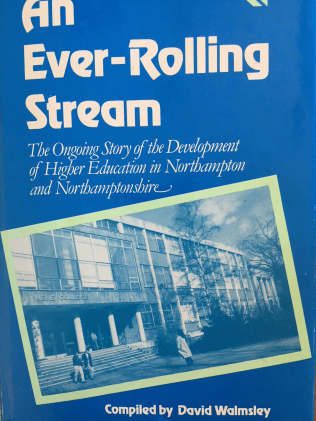
An enduring aspect of higher educational institutions is change. Depending on timing, from a personal viewpoint it can be a slow, almost glacial process. For others, caught up in periods of rapid transition, as we are now, the hurly burley can feel almost overwhelming. But change is always there. And Northampton is no exception. For those suspicious this is more spin than substance I can recommend The Ever Rolling Stream, a book compiled and printed in 1989 by the 567th Mayor of Northampton, David Walmsley, that charts the history of Higher Education in Northampton. In short, the key events culminating in the present University are:
1260: Ancient University
1867: Mechanics Institute
1932: Northampton Technical College (St George’s Avenue)
1967: University of Leicester University Centre, Northampton
1972: Northampton College of Education (Park Campus)
1975: Nene College of Higher Education
1978: The National Leathersellers Centre
1982: Sunley Management Centre
1989: Release from local authority control
1999: University College Northampton
2005: The University of Northampton
2018: Waterside.
The picture is one of periods of relative stability (including a c. 700 year sabbatical!), punctuated by mergers and consolidation. Our most rapid phase of change took place in the six years between 1972 and 1978 and involved the relocation, merger and subsequent closure of four separate educational establishments that ultimately comprise Park Campus as we know it today. Each of these phases would have been a unique cause of excitement, stress, resignations, hope and probable despair! But together they have two things in common – they happened mostly outside our working experience, and (ancient university excepted), ended in success. In our history of relocations and mergers, the inevitable conversations between doubters and advocates are lost in time, one exception being the amalgamation in 1937 of the School of Art in Abington Street, with the Technical College, which seems particularly vexed. Against this backdrop we see Waterside simply as the next stage in our evolution.
The title for Ever Rolling Stream comes from the hymn ‘O God our Help in Ages Past’. It sums up brilliantly the feeling of loss and the inevitability of change:
Time, like an ever-rolling stream,
Bears all its sons away;
They fly forgotten as a dream
Dies at the opening day.
Yes, think kindly of Park, and Avenue, mourn even as others will have done over those antecedents that culminated in our present estate. But don’t think you are the first to do so. Who knows, at some time in the future, staff and students not yet born will be contemplating a move from Waterside to a new horizon, as the ever rolling stream rolls on.
Share this:

Divided States of America

Nahida is a BA (Hons) Criminology graduate of 2017, who recently returned from travelling.
Ask anyone that has known me for a long time, they would tell you that I have wanted to go to America since I was a little girl. But, at the back of my mind, as a woman of colour, and as a Muslim, I feared how I would be treated there. Racial discrimination and persecution is not a contemporary problem facing the States. It is one that is rooted in the country’s history.
I had a preconceived idea, that I would be treated unfairly, but to be fair, there was no situation where I felt completely unsafe. Maybe that was because I travelled with a large group of white individuals. I had travelled the Southern states, including Louisiana, Texas, Tennessee and Virginia and saw certain elements that made me uncomfortable; but in no way did I face the harsh reality that is the treatment of people of colour in the States.
Los Angeles was my first destination. It was my first time on a plane without my family, so I was already anxious and nervous, but on top of that I was “randomly selected” for extra security checks. Although these checks are supposedly random and indiscriminate, it was no surprise to me that I was chosen. I was a Muslim after all; and Muslim’s are stereotyped as terrorists. I remember my travel companion, who was white, and did not have to undergo these checks, watch as I was taken to the side, as several other white travellers were able to continue without the checks. She told me she saw a clear divide and so could I.
In Lafayette, Louisiana, I walked passed a man in a sandwich café, who fully gawked at me like I had three heads. As I had walked to the café, I noticed several cars with Donald Trump stickers, which had already made me feel quite nervous because several of his supporters are notorious for their racist views.
Beale Street in Downtown Memphis is significant in the history of the blues, so it is a major tourist attraction for those who visit. It comes alive at night; but it was an experience that I realised how society has brainwashed us into subliminal racism. The group of people I was travelling with were all white and they had felt uncomfortable and feared for their safety the entire time we were on Beale Street. The street was occupied by people of colour, which was not surprising considering Memphis’ history with African-Americans and the civil rights movement. That night, the group decided to leave early for the first time during the whole trip. I asked, “Do you think it’s our subconscious racist views, which explains why we feel so unsafe?” It was a resounding yes. As a woman of colour, I was not angry at them, because I knew they were not racist, but a fraction of their mind held society’s view on people of colour; the view that people of colour are criminals, and, or should be feared. That viewpoint was clearly exhibited by the heavy police presence throughout the street. It was the most heavily policed street I had seen the entire time I was in the States. Even Las Vegas’ strip didn’t seem to have that many police officers patrolling.
It was on the outskirts of Tennessee, where I came across an individual whose ignorance truly blindsided me. We had pulled up at a gas station, and the man approached my friends. I was inside the station at this point. The man was preaching the bible and looking for new followers for his Church. He stumbled upon the group and looked fairly displeased with the way they were dressed in shorts and skirts. He struck a conversation with them and asked generic questions like “Where are you from?” etcetera. When he found out the group were from England, he asked if in England, they spoke English. At this point, the group concluded that he wasn’t particularly educated. I joined the group outside, post this conversation, and the man took one look at me and turned to my friend who was next to him, and shouted “Is she from India?” The way he yelled seemed like an attempt to guage if I could understand him or not. Not only was that rude, but also very ignorant, because he made a narrow-minded assumption that a person of my skin colour, could not speak English, and were all from India.
I was completely taken aback, but also, I found the situation kind of funny. I have never met someone so uneducated in my entire life. In England, I have been quite privileged to have never faced any verbal or physical form of racial discrimination; so, to meet this man was quite interesting. This incident took place in an area populated by white individuals. I was probably one of the very few, or perhaps the first Asian woman he had ever met in his life; so, I couldn’t make myself despise him. He was not educated, and to me, education is the key to eliminating racism.
Also, the man looked be in his sixties, so his views were probably set, so anything that any one of us could have said in that moment, would never have been able to erase the years of discriminatory views he had. The bigotry of the elder generation is a difficult fight because during their younger days, such views were the norm; so, changing such an outlook would take a momentous feat. It is the younger generation, that are the future. To reduce and eradicate racism, the younger generation need to be educated better. They need to be educated to love, and not hate and fear people that have a different skin colour to them.
Share this:

White and Male: the diversity of the judiciary
My name is Anita and I graduated with a Criminology degree in 2016. I did have a great time at the University of Northampton. The course was challenging and intense however this meant that it provided me with the opportunity to overcome my barriers and develop myself both academically and personally. I miss going to lectures and seminars, revising for exams and even writing the dissertation. If you are reading this and you are in your third year, you are probably thinking that I am mad but I do miss it. I can’t help it! I can honestly say that going to University was the best decision I ever made and I would love to go back and do a postgraduate course. My advice to all students is enjoy it because time goes by so fast.
Before we start, please stop and think…… What percentage of court judges would you guess are women? How many members of the judiciary are from ethnic minorities?
If your guess is that we have a substancial amount of women and members from ethnic minorities in the judiciary, then this blog post might dissapoint you.
Let’s define the judiciary before we progress any further. The judiciary can be defined as ‘the judges of a country or a state, when they are considered as a group’ (Hornby, 2000, p.700).
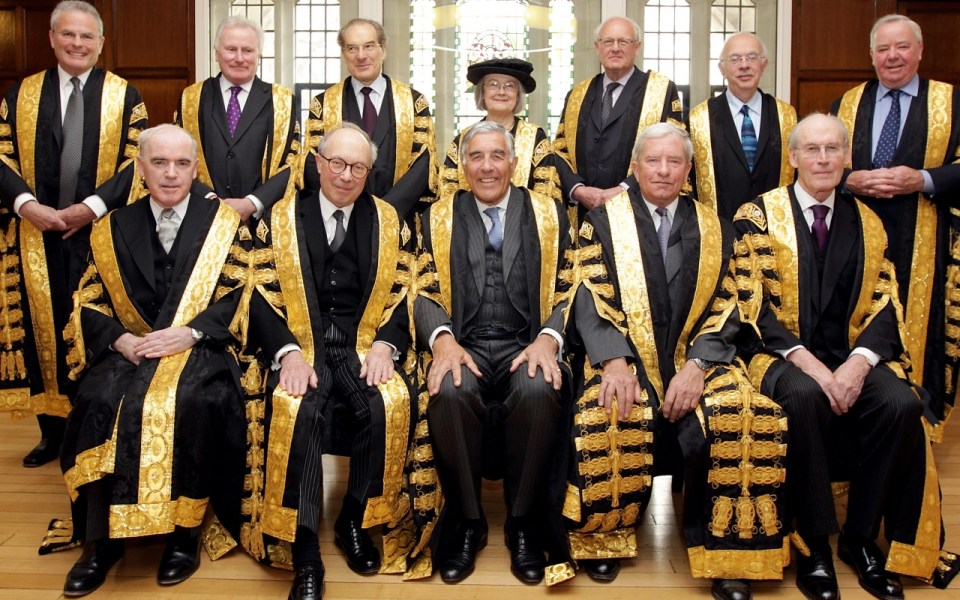
The judiciary in the UK is dominated by Oxbridge educated white middle-class men. It is estimated that three quarters of all judges in England and Wales are male and 95% are white (Lieven, 2017). The gender imbalance can be well illustrated by looking at the Supreme Court. There is only one woman among the 12 Justices on the Supreme Court. Lady Hale is the only woman ever to serve on the Court and all of the judges are and have always been white. Only Armenia and Azerbaijan have lower proportions of women in their judiciary than the UK (Lieven, 2017). This is unacceptable in 2018, changes must be made to address this gender imbalance.
In terms of race, as at 1 April 2017, only 7% of court judges were Black, Asian or Minority Ethnic (BAME). Of these Asian and Asian British accounted for 3% and the remaining three groups, Black and Black British, Mixed Ethnicity and Other Ethnic Group at around 1% each (Ministry of Justice, 2017).
This shows that judges are not reflective of wider society. This is a significant problem because the public should be confident that the judiciary delivers justice fairly. The lack of diversity means that concerns about the legitimacy and objectivity of judgements may be raised.
There are three main explanations for the continuing lack of diversity. The first explanation is that there are not enough women, BAME people and people from less privileged backgrounds who would be suitable for appointment. However, I would question the validity of this argument. This explanation seems to suggest that women or BAME people might be lacking lacking adequate knowledge or experience. There is no evidence to support this argument.
The second explanation given is that women and BAME candidates do not apply for appointment. However, it could be argued that the issue is more complicated than simply failing to apply. For example, Allen (2009) found that when BAME candidates and solicitors do apply for appointment they are significantly less likely to be successful than white candidates or barristers. This shows that the issue is not the lack of applications received from women or BAME candidates but perhaps the discriminatory recruitment process.
The third explanation is that the key principle governing our appointments to judicial office is merit. Unfortunately, the term ‘merit’ is not defined, but the implication is that achieving merit and diversity are at odds.
In conclusion, the lack of diversity in the judicial system is very concerning and should be addressed as soon as possible. This needs to be done to ensure that our justice system is fair, accessible and efficient. It is in our interest to produce a judiciary of the highest quality that reflects the make-up of our nation. Difference should be valued and not feared.
References
Allen, A (2009) Barriers to Application for Judicial Appointment Research. London: Judicial Appointments Commission.
Hornby, A.S (2000) Oxford Advanced Learner’s Dictionary. 6th ed. Oxford: Oxford University Press.
Lieven, N (2017) Increasing judicial diversity. London: Justice.
The Ministry of Justice (2017) Judicial Diversity Statistics 2017. London: MOJ.

 Thoughts from the criminology team