Home » Education (Page 3)
Category Archives: Education

“Over-policed and under-protected”- School children and policing: some criminological discussions

During the first week of Semester 2, the Criminology team put on a number of small sessions designed around topic areas to encourage some ‘radical’ discussion. Topic areas were designed to deliberately encourage debate and critical consideration. Due to the increasing use of police in schools, and relatively recent (within the past few years) issues around police stop and search in schools, disproportionately being used in schools with a majority Black and Brown cohort, often framed as ‘urban’ schools: it is an area of great interest for both Stephanie and myself. We were expecting some lively discussions around whether the Police should be in schools, and if so, in what capacity: and whilst the students did not disappoint in relation to this matter, they also raised some excellent points around the policing of school children and the control the school forces upon them. It is this area of the discussions that I would like to share with you.
Policing as a form of social control, exerted by schools, not necessarily the Police force, is rife within schools: something the students were quick to draw attention to. This was raised in relation to the policing of Black children’s hair. They are told to alter their appearances based on white standards, have been sent home for not conforming to the school dress code, sent to the back of classrooms for having distracting hair: in both primary and secondary school settings. This power over Black children’s hair, stands in contrast to the idea that children have no say over their hair, and are held to white westernised standards, yet can be held criminally responsible and subject to the force of the law as they are recognised as mature enough to understand crime and its consequences.
This baffling, controlling narrative is also evident in the use of school uniforms. Students raised the inappropriateness of some of the school uniforms in relation to the length of skirts, banning trainers, and piercings, which was a method of control which removed all sense of individuality and identity. It was recognised that children are encouraged to ‘grow up’ and ‘mature’ and ‘figure out’ what they want to do, but they had the methods of exploring this, especially in relation to their identity, restricted and policed. The limited autonomy over hair, clothes, piercings and children’s bodies stands in stark contrast to the legal discourse of children being criminally responsible at the age of 10years old in England and Wales. This was baffling to us!
A further way of policing students in school was through the surveillance the schools exerted over children. The use of CCTV, fingerprints as a method of purchasing lunch was originally considered as a form of security: the all seeing eye of big brother, oops sorry the school, and the attempt to reduce bullying by removing the carrying of cash was originally framed as a way of protecting children. However, the students were very critical of whether this surveillance was intended as protection, or rather as control. The idea of being deterred from delinquency through the use of CCTV, and preventing bullying by removing the possibility of money was considered, but again this refers back to the controlling of children’s behaviour.
There isn’t enough space to include all areas of the 2 hour discussion, and the time flew by quickly as the students and staff lost themselves in considering the role police play in schools, and the role schools play in policing children. The session concluded with us considering the school as an institution and whether its primary role was that of education, or of the creation of obedient bodies. I won’t tell you where we settled, but it is worth a ponder…
With thanks to all those who attended and stimulated the critical discussions around over-policed and under-protected: school children and policing: Gloria, Lucy, Kayode, Uche, Christivie, Joseph, Rosemary, Katya, Kayleigh, Chrissy, Diamante, Shola-Renee, Ellie, Sarah, Zoe, Stephanie and Jessica.
Share this:


Don’t know what to do with your Criminology degree….meet Demi King

A very warm welcome to all of you wonderful Criminology students! My name is Demi King, your dedicated Careers Consultant here at UON. You will hear my name and be sick of the sight of me in no time! But, within good reason as I am here to help you help yourself. That’s right, I’m not here to do it for you but I will give you 100% in supporting you throughout your time here at UON and for life!! You heard it… for life!! Crazy right??? Nope… Here at UON we promise life long careers support. How awesome is that! Especially if you complete the Employability Plus Award whilst you’re here as if it comes to it we will find you a paid internship 12 months after you’ve left if you’re struggling. One to bear in mind!
Anyway, where were we… Ah yes! So as a fellow Criminology graduate myself, I know the feeling…. You could see me as your fairy god mother, who is here to put you in the right direction which I most certainly wish I had throughout my Uni experience.
I’m not here to scare you or anything but when you come to University, your careers starts then, not in final year when its all panic stations! If you stick with me, you’ll be sweet! I aim to raise your aspirations and uncover your skills/talents/interests by landing you that job you’ve always wanted or help you understand what job you even want to do! There is so much I can help you with, such as getting that CV looking sharp, applying for jobs, the hidden job market, where to look for volunteering & internships.. the list really does go on!
No goal or ambition is too big, and you will be incredibly surprised what you can really do with your degree. I mean look at me! Again, it’s fine if you don’t have a clue right now either but please don’t leave it until the last moment as you will miss out on some fantastic opportunities.
See you around guys, come say hello, book an appointment with me! Don’t be shy. You didn’t pay all this money to not use me! You can contact me demi.king@northampton.ac.uk or book an appointment with me here
Share this:


ASUU vs The Federal Government

It will be 8 months in October since University Lecturers in Nigeria have embarked on a nationwide strike without adequate intervention from the government. It is quite shocking that a government will sit in power and cease to reasonably address a serious dispute such as this at such a crucial time in the country.
As we have seen over the years, strike actions in Nigerian Universities constitute an age-long problem and its recurring nature unmasks, quite simply, how the political class has refused to prioritise the knowledge-based economy.
In February 2022, the Academic Staff Union of Universities (ASUU) leadership
(which is the national union body that represents Nigerian University Lecturers during disputes) issued a 4-week warning strike to the Nigerian government due to issues of funding of the public Universities. Currently, the striking University Lecturers are accusing the government of failing to revitalise the dilapidated state of Nigerian Universities, they claim that the government has refused to implement an accountability system called UTAS and that representatives of the government have continued to backtrack on their agreement to adequately fund the Universities.
The government on the other hand is claiming that they have tried their best in negotiating with the striking lecturers – but that the lecturers are simply being unnecessarily difficult. Since 2017, several committees have been established to scrutinize the demands and negotiate with ASUU, but the inability of these committees to resolve these issues has led to this 8-month-long closure of Nigerian Universities. While this strike has generated multiple reactions from different quarters, the question to be asked is – who is to be blamed? Should the striking lecturers be blamed for demanding a viable environment for the students or should we be blaming the government for the failure of efforts to resolve this national embarrassment?
Of course, we can all understand that one of the reasons why the political class is often slow to react to these strike actions is because their children and families do not attend these schools. You either find them in private Universities in Nigeria or Universities abroad – just the same way they end up traveling abroad for medical check-ups. In fact, the problems being faced in the educational sector are quite similar to those found within the Nigerian health sector – where many doctors are already emigrating from the country to countries that appreciate the importance of medical practitioners and practice. So, what we find invariably is a situation where the children of the rich continue to enjoy uninterrupted education, while the children of the underprivileged end up spending 7 years on a full-time 4-year program, due to the failure of efforts to preserve the educational standards of Nigerian institutions.
In times like these, I remember the popular saying that when two elephants fight, it’s the grass that suffers. The elephants in this context are both the federal government and the striking lecturers, while those suffering the consequences of the power contest are the students. The striking lecturers have not been paid their salaries for more than 5 months, and they are refusing to back down. On the other hand, the government seems to be suggesting that when they are “tired”, they will call off the strike. I am not sure that strike actions of the UK UCU will last this long before some sort of agreement would have been arranged. Again, my heart goes out to the Nigerian students during these hard times – because it is just unimaginable what they will be going through during these moments of idleness. And we must never forget that if care is not taken, the idle hand will eventually become the devil’s workshop!
Having said this, Nigerian Universities must learn from this event and adopt approaches through which they can generate their income. I am not inferring that they do not, but they just need to do more. This could be through ensuring large-scale investment programs, testing local/peculiar practices at the international level, tapping into research grant schemes, remodeling the system of tuition fees, and demonstrating a stronger presence within the African markets. As a general principle, any institution that wishes to reap the dividends of the knowledge-based economy must ensure that self-generated revenues should be higher than the government’s grants – and not the other way. So, Universities in Nigeria must strive to be autonomous in their engagements and their organisational structure – while maintaining an apolitical stance at all times.
While I agree that all of these can be difficult to achieve (considering the socio-political dynamics of Nigeria), Universities must remember that the continuous dependence on the government for funds will only continue to subject them to such embarrassments rather than being seen as respected intellectuals in the society. Again, Nigerian Universities need a total disruption; there is a need for a total overhaul of the system and a complete reform of the organisational structure and policies.
Share this:


Stop strip searching children!

The Metropolitan Police are under constant criticism, more than any other police force, for at least as long as I have been a criminologist. Their latest scandal began with the case of Child Q, a 15 year old girl who was strip searched in school while she was menstruating after being suspected of carrying cannabis. No drugs were found and Child Q was extremely traumatised, resulting in self-harm and a suicide attempt. Tré Ventour recently wrote a blog about Child Q, race and policing in education here but following this week’s Children’s Commissioner report, there’s so much more to discuss.
The report focussed on the Metropolitan Police who strip searched 650 children in 2 years, many (23%) of whom were searched without the presence of an appropriate adult and as we criminologists would expect, the children were disproportionately Black boys. These findings were not surprising or shocking to me, and I also know that the Metropolitan Police force are not just one bad apple in this respect. The brutal search of Child Q occurred in 2020 but incidences such as these have been happening for years.
A teenage boy aged 17 was subject to an intimate search in 2019 where the police breached a number of clauses of PACE, ultimately resulting in the boy receiving an apology and £10,000 damages for the distress caused by the unlawful actions. These actions started with basic information being withheld such as the police officer failing to identify himself and informing the boy of his rights and ended with the strip search being undertaken without an appropriate adult present, in the presence of multiple officers, without authorisation from a senior officer and with no justification for the search recorded in the officer’s pocket book. Now I understand that things may be forgotten in the moment when a police officer is dealing with a suspect but the accumulation of breaches indicates a more serious problem and a disregard to the rights of suspects in general but children more specifically.
These two cases are the cases of children who were suspected of carrying cannabis, an offence likely to be dealt with via a warning or on the spot fine. Hardly the crime of the century warranting the traumatising strip searching of children. And besides, we criminologists know that the war on drugs is a failed project. Is it about time we submit and decriminalise cannabis, save police time and suspect trauma?
What happens next is a slightly different story. Strip searching in custody is different because as well as searching for contraband, it can also be justified as a protective measure where there is a risk of self-harm or suicide. Strip searching of children by the police has risen in a climate of fear surrounding deaths in custody, and it has been reported that there could be an overuse of the practice as a result of this. When I read the report, I recalled the many conversations I have had over the years with my friend Rosie Flatman who is a practitioner who specialises in working with victims of Child Sexual Exploitation (CSE) and other forms of abuse. Rosie has worked with many girls who have been subject to strip searches when in custody. She told me how girls would often perceive the search as punishment for being what the police believed was disruptive. That is not to say that the police were using strip searches as punishment, but that is how girls would experience it.
Girls in custody are often particularly vulnerable. Like Rosie’s clients, many are victims and have a number of compounding vulnerabilities such as mental ill health or they may be looked after children. Perhaps then, we need to look at alternatives to strip searching but also custody for children, particularly for those who have suffered trauma. Rosie, who has delivered training to various agencies, suggests only undertaking strip searches where absolutely necessary and even then, using a trauma informed approach. She argues that even the way the procedure and justification is explained can make a big difference to the amount of harm caused to vulnerable children in police custody.
Share this:


UCU Strike 21-25 March 2022

More information around the University and College University [UCU] and the Four Fights Dispute can be found here.
Information about the Northampton branch of UCU can be found here and here.
You can also find out why striking is a criminological issue here: https://thoughtsfromthecriminologyteam.blog/2021/12/10/striking-is-a-criminological-matter/ and here: https://thoughtsfromthecriminologyteam.blog/2022/02/18/united-nations-un-world-day-of-social-justice/
If you want to know why the Criminology Team is prepared to stand outside in the cold and rain please read here: https://thoughtsfromthecriminologyteam.blog/2022/03/02/higher-education-the-strikes-and-me/ and here: https://thoughtsfromthecriminologyteam.blog/2022/03/09/higher-education-students-the-strikes-and-me/

Share this:


Higher education, the strikes and me

I joined the UCU last year, the first time I’d ever been a member of a union in my 43 years of working life. Admittedly, thirty years of that working life was spent in policing where membership of a union was unlawful. Yes, there was the Police Federation but to be honest it was a bit of a toothless tiger. During my career I saw successive governments hack away at pay and conditions in policing, sometimes only to be halted from catastrophic changes when they thought there might be an all-out mutiny, an example of which was the reaction to the Sheehy Inquiry in the early 1990s. In that policing career I was called upon to be involved in policing of pickets, sometimes peaceful, sometimes not. I never thought about joining a union or being part of a picket and when I started a second career in Higher Education, I didn’t think about it then. But my experiences in higher education over the last few years has driven me to join a union, mismanagement in various guises, has driven me to join.
I thought it somewhat ironic when I first saw the UCU posters declaring ‘we are at breaking point’; too late I thought, I’ve already been broken, and whilst I may have recovered, the scars are still there. Thirty years of policing, with all the horrors, the stresses and the strains didn’t break me, but 7 years of higher education managed to do so.

A couple of years ago, having been ill, resulting a short stay in hospital, I found myself on a farcical fast track of phased return to work. I managed to get back to some form of normality with the help of my colleagues, who took the brunt of my workload; I will return to that later. The new normality was however short lived, Covid hit, and we all went into lockdown and teaching online. It seemed that we might weather the storm and later the same year, amidst reported complaints from students about lockdowns, teaching online and mental health, our institution like nearly every other university in the country vowed there would be face-to-face teaching. And of course, if you promise it, you have to deliver it, particularly if you are under pressure from national student bodies about refunds and the like. As Covid took hold in earnest, as reports came in about people dying in the thousands, as the proliferation of news suggested who were the most vulnerable, and as we saw 50% of our team leave to join other institutions, our managers continued to insist that we do face to face teaching. Three members of staff could work 5 days a week, teaching over 250 students. The maths was confounding, the incredibility of it all was only surpassed by the staggering management determination to ensure that at least 2 hours of face-to-face teaching took place. The breath-taking simple-mindedness saw suggestions of cramming students, 40 at time into hired, poorly ventilated, venues. The risks were quite simply ignored, government guidelines were side-lined as were the university’s promises of a Covid secure environment. It was apparent, nobody cared; all that mattered was delivery of 2 hours of face-to-face teaching. The university had decreed it and so it had to be done.
If that wasn’t bad enough, our team had to endure machinations around how many new staff to advertise for. Three had left to be replaced by two because of the uncertainty around student recruitment. Even when we had ridden the wave of Covid, if we survived it unscathed, we were to be worked to the bone. The fifty to sixty odd hours a week would have to be increased. Nobody cared, just do what you are told and get on with it. Make use of associate lecturers, we were told, when we had very few and they were threatening to leave. Recruit more, from where we asked and what about their training? Such trivial matters were met with stony silence, face to face teaching, that was the mantra.
I remember one meeting, my colleagues will tell you about one meeting, where enough was enough. I was done and I couldn’t do anymore, I didn’t argue, I didn’t get cross, I just stopped, numbed by the sheer callousness and stupidity of it all. Signed off sick with work related stress I was told I was mentally burnt out. I was asked whether I ever switched off from work, the answer was no. Not because I didn’t want to, of course I did. But with lectures to prepare and deliver, with modules to manage, with Blackboard sites to build, with expectations of visiting schools and working open days, with expectations of helping with validations, with the incessant marking and second marking with dissertation tutorials and personal academic tutorship and the myriad of other tasks, I couldn’t switch off. Working evenings and weekends to keep up has been the norm, working even harder to buy space to take annual leave became unmanageable. Hollow words from management suggesting we have to take our annual leave. Hollow because they do not give you the time to do it. An extra closed day was the reward for our hard work, thank you, I worked that day as well. And after my absence from work, another attempt at fast tracking my phased return. And a return to full time work just meant a continuation of the fifty hours plus working week. My colleagues took a lot of work, too much work, to try to help manage workloads. So not just a return to challenging workloads for me but a guilt trip as well, as I felt I hadn’t been pulling my weight. On the one hand the institution makes the right noises, Covid safe environments and occupational health assistance and on the other its managers give scant regard for the human beings that work for them. Utilising outdated and unfathomable workload management tools, they manipulate data to provide a thin veneer of logic and fairness. If ever there were a good example of neo-Taylorism, look no further than higher education.
I’ve been on strike because of what happened to me and because of what is happening to my colleagues across the country. A failure to acknowledge working conditions, a failure to treat staff with dignity and respect and a failure to provide equal opportunity shows how little managers care for higher education vis-a-vis profit. I’ve been on strike because I don’t want my colleagues to be burnt out. I’ve been on strike because I don’t know how else to try to change the future for those that work in higher education. I don’t want to strike, I don’t want to impact my student’s education, but my colleagues are at breaking point, what else should we do?
Share this:


UCU Strike 28 February-2 March 2022
More information around the University and College University [UCU] and the Four Fights Dispute can be found here.
Information about the Northampton branch of UCU can be found here and here.
You can also find out why striking is a criminological issue here: https://thoughtsfromthecriminologyteam.blog/2021/12/10/striking-is-a-criminological-matter/ and here: https://thoughtsfromthecriminologyteam.blog/2022/02/18/united-nations-un-world-day-of-social-justice/
Share this:

UCU Strike 21-22 January 2022
More information around the University and College University [UCU] and the Four Fights Dispute can be found here.
Information about the Northampton branch of UCU can be found here and here.
You can also find out why striking is a criminological issue here: https://thoughtsfromthecriminologyteam.blog/2021/12/10/striking-is-a-criminological-matter/ and here: https://thoughtsfromthecriminologyteam.blog/2022/02/18/united-nations-un-world-day-of-social-justice/
Share this:


Striking is a criminological matter

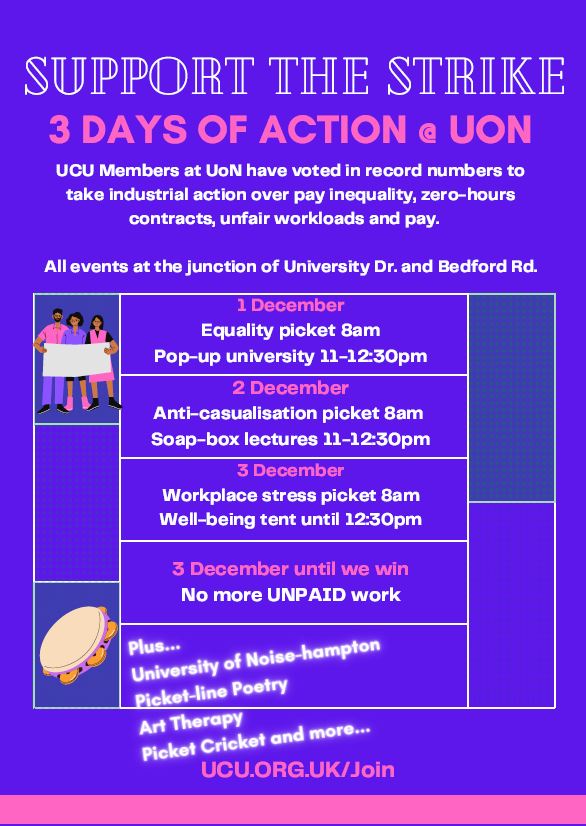
You may have noticed that the University and College Union [UCU] recently voted for industrial action. A strike was called from 1-3 December, to be followed by Action Short of a Strike [ASOS], in essence a call for university workers to down tools for 3 days, followed by a strict working to contract. For many outside of academia, it is surprising to find how many hours academics actually work. People often assume that the only work undertaken by academics is in the classroom and that they spend great chunks of the year, when students are on breaks, doing very little. This is far from the lived experience, academics undertake a wide range of activities, including reading, writing, researching, preparing for classes, supervising dissertation students, attending meetings, answering emails (to name but a few) and of course, teaching.
UCU’s industrial action is focused on the “Four Fights“: Pay, Workload, Equality and Casualisation and this campaign holds a special place in many academic hearts. The campaign is not just about improving conditions for academics but also for students and perhaps more importantly, those who follow us all in the future. What kind of academia will we leave in our wake? Will we have done our best to ensure that academia is a safe and welcoming space for all who want to occupy it?
In Criminology we spend a great deal of time imagining what a society based on fairness, equity and social justice might look like. We read, we study, we research, we think, and we write about inequality, racism, misogyny, disablism, homophobia, Islamophobia and all of the other blights evident in our society. We know that these cause harm to individuals, families, communities and our society, impacting on every aspect of living and well-being. We consider the roles of individuals, institutions and government in perpetuating inequality and disadvantage. As a theoretical discipline, this runs the risk of viewing the world in abstract terms, distancing ourselves from what is going on around us. Thus it is really important to bring our theoretical perspectives to bear on real world problems. After all there would be little point in studying criminology, if it is only to see what has happened in the past.

Criminology is a critique, a question not only of what is but might be, what could be, what ought to be. Individuals’ behaviours, motivations and reactions and institutional and societal responses and actions, combine to provide a holistic overview of crime from all perspectives. It involves passion and an intense desire to make the world a little better. Therefore it follows that striking must be a criminological matter. It would be crass hypocrisy to teach social justice, whilst not also striving to achieve such in our professional and personal lives. History tells us that when people stand up for themselves and others, their rights and their future, things can change, things can improve. It might be annoying or inconvenient to be impacted by industrial action, it certainly is chilly on the picket line in December, but in the grand scheme of things, this is a short period of time and holds the promise of better times to come.