
Home » Drugs
Category Archives: Drugs

25 years is but a drop in time!

If I was a Roman, I would be sitting in my comfortable triclinium eating sweet grapes and dictating my thoughts to a scribe. It was the Roman custom of celebrating a double-faced god that started European celebrations for a new year. It was meant to be a time of reflection, contemplation and future resolutions. It is under these sentiments that I shall be looking back over the year to make my final calculations. Luckily, I am not Roman, but I am mindful that over 2025 years have passed and many people, have tried to look back. Since I am not any of these people, I am going to look into the future instead.
In 25 years from now we shall be heading to the middle of the 21st century. A century that comes with great challenges. Since the start of the century there has been talk of economic bust. The banking crisis slowed down the economy and decreased real income for people. Then the expectation was that crime will rise as it did before; whilst the juries may still be out. the consensus is that this crime spree did not come…at least not as expected. People became angry and their anger was translated in changes on the political map, as many countries moved to the right.
Prediction 1: This political shift to the right in the next 25 years will intensify and increase the polarisation. As politics thrives in opposition, a new left will emerge to challenge the populist right. Their perspective will bring another focus on previous divisions such as class. Only on this occasion class could take a different perspective. The importance of this clash will define the second half of the 21st century when people will try to recalibrate human rights across the planet. Globalisation has brought unspeakable wealth to few people. The globalisation of citizenship will challenge this wealth and make demands on future gains.
As I write these notes my laptop is trying to predict what I will say and put a couple of words ahead of me. Unfortunately, most times I do not go with its suggestions. As I humanise my device, I feel sorry for its inability to offer me the right words and sometimes I use the word as to acknowledge its help but afterwards I delete it. My relationship with technology is arguably limited but I do wonder what will happen in 25 years from now. We have been talking about using AI for medical research, vaccines, space industry and even the environment. However currently the biggest concern is not AI research, but AI generated indecent images!
Prediction 2: Ai is becoming a platform that we hope will expand human knowledge at levels that we could have not previously anticipated. One of its limitations comes from us. Our biology cannot receive the volume of information created and there is no current interface that can sustain it. This ultimately will lead to a divide between people. Those who will be in favour of incorporating more technology into their lives and those who will ultimately reject it. The polarisation of politics could contribute to this divide as well. As AI will become more personal and intrusive the more the calls will be made to regulate. Under the current framework to fully regulate it seems rather impossible so it will lead to an outright rejection or a complete embrace. We have seen similar divides in the past during modernity; so, this is not a novel divide. What will make it more challenging now is the control it can hold into everyday life. It is difficult to predict what will be the long-term effects of this.
During the late 20th and early 21st centuries drug abuse and trafficking seemed to continue to scandalise the public and maintain attention as much as it did back in the 1970s and 80s. Drugs have been demonised and became the topic of media representation of countless moral panics. Its reach in the public is wide and its emotional effect rivals only that of child abuse. Is drugs abuse an issue we shall be considering in 25 years from now?
Prediction 3: People used substances as far back as we can record history. Therefore, there will be drugs in the future to the joy of all these people who like to get high! It is most likely that the focus will be on synthetic drugs that will be more focused on their effects and how they impact people. The production is likely to change with printers being able to develop new substances on a massive scale. These will create a new supply line among those who own technology to develop new synthetic forms and those who own the networks of supply. In previous times a takeover did happen so it is likely to happen again, unless these new drugs emerge under formal monopolies, like drug companies who will legalise their recreative use.
One of the biggest tensions in recent years is the possibility of another war. Several European politicians have already raised it pretending to be making predictions. Their statements however are clear signs of war preparation. The language is reminiscent of previous eras and the way society is responding to these seems that there is some fertile ground. Nationalism is the shelter of every failed politician who promises the world and delivers nothing. Whether a citizen in Europe (EU/UK) the US or elsewhere, they have likely to have been subjected to promises of gaining things, better days coming, making things great…. only to discover all these were empty vacant words. Nothing has been offered and, in most cases, working people have found that their real incomes have shrunk. This is when a charlatan will use nationalism to push people into hating other people as the solution to their problems.
Prediction 4: Unfortunately, wars seem to happen regularly in human history despite their destructive nature. We also forget that war has never stopped and elusive peace happens only in parts of the world when different interests converge. There is a combination of patriotism, national pride and rhetoric that makes people overlook how damaging war is. It is awfully blindsided not to recognise the harm war can do to them and to their own families. War is awful and destroys working people the most. In the 20th century nuclear armament led to peace hanging by a thread. This fear stupidly is being played down by fraudsters pretending to be politicians. Currently the talk about hybrid war or proxy war are used to sanitise current conflicts. The use of drones seems to have altered the methodology of war, and the big question for the next 25 years is, will there be someone who will press THAT button? I am not sure if that will be necessary because irrespective of the method, war leaves deep wounds behind.
In recent years the discussion about the weather have brought a more prevailing question. What about the environment? There is a recognised crisis that globally we seem unable to tackle, and many make already quite bleak predictions about it. Decades ago, Habermas was exploring the idea of “colonization of the lifeworld” purporting that systemic industrial agriculture will lead to environmental degradation. Now it seems that this form of farming, the greenhouse gasses and deforestation are becoming the contributing factors of global warming. The inaction or the lack of international coordination has led calls for immediate action. Groups that have been formed to pressure political indecision have been met with resistance and suspicion, but ultimately the problem remains.
Prediction 5: The world acts when confronted with something eminent. In the future some catastrophic events are likely to shape views and change attitudes. Unfortunately, the planet runs on celestial and not human time. When a prospective major event happens, no one can predict its extent or its impact. The approach by some super-rich to travel to another planet or develop something in space is merely laughable but it is also a clear demonstration why wealth cannot be in the hands of few oligarchs. Life existed before them and hopefully it will continue well beyond them. On the environment I am hopeful that people’s views will change so by the end of this century we will look at the practices of people like me and despair.
These are mere predictions of someone who sits in a chair having read the news of the day. They carry no weight and hold no substantive strength. There is a recognition that things will change at some level and we shall be asked to adapt to whatever new conditions we are faced with. In 25 years from now we will still be asking similar questions people asked 100 years ago. Whatever happens, however it happens, life always finds a way to continue.
Share this:

A Criminal Called Bob

It was years ago that Bob was born in St. Mary’s Hospital. His mum delivered a relatively healthy baby that she called Robert, after her father despite kicking her out when he found out that she was pregnant from a casual encounter. Bob’s early memory was of a pain in the arm in a busy place he could not remember what it was. His mother was grabbing his arm an early sign that he was unwanted. He would remember many of these events becoming part of everyday life. He remembers one day a stern looking woman came to the place he was living with his mother and take him away. This was the last time he would ever see his mother; he was 5 or 6. A few years afterwards his mother will die from a bad heart. Later, he would find out it was drugs related.
The stern looking lady will take him to another place to live with a family. One of many that he would be placed in. At first, he tried to get to know the hosts but soon it became difficult to keep track. He also lost track of how many times he moved around. There were too many to count but the main memory was of fear going into a place he did not know to stay with people who treated him as an inconvenience. He owned nothing but a bin bag with a few clothes and people will always comment on how scruffy he looked. He remembers discovering some liquorice allsorts in a drawer with the kid he was sharing the room with. He cannot forget the beating he got for eating some of them. The host was very harsh, and they used the belt on him.
School was hell for Bob. As he moved from place to place the schools also changed. The introduction to the class was almost standard. Bob is joining us from so and so and although he lives in foster care, I hope you will be making him feel welcomed…and welcomed he was. The bullying was relentless so was the name calling and the attacks. On occasion he would meet an aloof man who was his “designated tutor”. His questions were abrupt and focused only if he was behaving, if he was making any trouble, if he did as was told. It was hardly ever about education or any of his needs. He remembers going to see him once with a bruised eye to be asked “what did you do?”
And he did a lot! Early on he learned that in order not to go hungry he must hide food away. If he was to meet a new person, he had to show them that he is cannot be taken for granted, he needed to show them he can handle himself. Sometime during his early teenage years his greeting gesture was a headbutt. Violence was a clear vehicle for communication. One person is down the other is up. This became a language he became prolific in. He could read a room quickly and in later years be able to assess the person opposite. If he can take him or not!
The truth that others kept talking about around him became a luxury and an unnecessary situation. Lying about things got him to avoid punishment and any consequences to any of his actions. The only problem was when he was get caught lying. The consequences were dire. So, what he needed to do was to become very good at it. He did. He could lie looking people straight in the eye and not even blink about it.
Later in life he discovered this was an amazing talent to possess. It was useful when he was stealing from shops, it was good when people asking him for the truth, it was profitable when his lies covered other people’s crimes. Before he turned 18, he was an experienced thief and a creative liar. His physique allowed him to take to violence should anyone was to question his “honesty”. When he was 15, he discovered that a combination of cider and acid gives him such a buzz. To mute his brain and to relax his body even for little was so welcomed. This habit became one of his most loyal relationships in his life.
In prison he didn’t go until he was 22 but he went to a young offender’s institution at the age of 17 for GBH. The “victim” was a former friend who stole some of his gear. That really angered him; even days after the event in court he was still outraged with the theft. He was still making threats that he will find him and kill him, in some very graphic descriptions! The court sought no other way but to send him away. From the age of 22 he would become a “frequent flyer” of the prison estate! A long list of different sentences ranging from everything on offer. Usually repeated in pattern; fine, community sentence, prison….and back again! By the time he was 35 he had been in prison for more than 8 years collectively. He did plenty of offender management courses and met a variety of probation and prison officers, well-meaning and not so good. Some tried to help, and others couldn’t care but all of them fade in the background.
Now at the ripe age of 45 he is out of the prison, and he is sofa surfing and claiming universal credit. He gets nothing because he has unpaid fines, so he is struggling financially. In prison he did a barista apprenticeship, but he cannot find any work. As it stands, he is very likely to be recalled back to prison, if the cold weather doesn’t claim him first.
In context, there are some lives that are never celebrated or commemorated. There are people who exist but virtually no one recognises their existence. Their lives are someone else’s inconvenience and in a society that prioritises individual achievement and progression they have none. Bob is a fictional character. His name and circumstances are made up but form part of a general criminological narrative that identifies criminality through the complexity of social circumstance.
Share this:


The Journey of a University of Northampton Criminology Graduate

On this Jubilee year, I ponder and reflect on my 3 years as a joint honours Criminology student, and where my life journey has taken me since
In 2012-2015, I did joint honours Criminology and Education studies, and later did the LLM in International Criminal Law and Security at from 2015-2017.
My journey as a Criminology Student alumni has lead me to all sorts of unique pathways.
Having a background in notetaking and student support at different universities, I worked for 6 1/2 years as a Co-op Member Pioneer (8th January 2018-10th August 2024), where, in the community I served, I supported the local police with crime related issues, and mediated between them and the public on crime issues that mattered to them and helped to support the police, as blogged about here ‘As a Member Pioneer Supporting the Police’ . Whilst this role was about connecting communities, supporting charities, causes and local people, I saw the opportunity to help the police and the community on crime related issues.
From December 2019-June 2020, I worked for 6 months in an addiction recovery unit. Here, I learned about addiction on a more deeper and personal level. I was one of 2 members of staff who were not addicts, and so the experience was eye-opening! The staff who had ‘come clean’ from their addictions would talk about their lives before becoming clean, and how they would resort to crime to fund their addictions. It was a vicious cycle for them as they were fighting traumatic battles which lead them down the route of addiction, and could not find their way out.
I was trained on taking phone calls, and spoke with so many devasted individuals who had lost their sons, daughters, husbands and wives to addiction, and were desperate to get them the help they needed. Seeing families torn apart by addiction, and meeting with new clients who had come in to get help and learning about their stories revealed deep sufferings and traumas, some of which were life-changing events, and harrowing cries for help.
I audited medication on a daily basis, worked with the Addiction specialist doctor to make sure all new clients had been seen to, and prepared folders for each client which the support team used in their care plans. I would also create certificates for all clients who had completed their time at the unit, and celebrated in their success.
When COVID struck, I was put on furlough, and later made redundant – such is life XD – Onto my next adventure!
Where am I now?
Fast forward to March 2021; after completing a lengthy job application and job interview, I landed myself a job in the Civil Service working for the Ministry of Justice! I do casework, work with the Judges on progressing cases, I clerked a few hearings previously too. Everyday is different, and every case I work on is different.
I process new claims and with the support of the Legal Officers, issue directions to the parties if any other information is required. I oversee the progress of cases and ensure all correspondence is up to date, all orders have been issued, and the case is ready to be heard.
Each day is different, and I love everything that I do working for the justice system.
Share this:


Homelessness: Outsiders and Surviving on the Street: A snapshot of my undergraduate dissertation.

As the wait until graduation dissipates, I thought I may outline my dissertation and share some of the interesting notions I discovered and the events I experienced throughout the process of creating potentially the most extensive research project each of us has conquered so far.
What was my research about?
As we all know, the issue of homelessness is rife throughout the streets of Northampton and across the UK. I wanted to explore two main areas of homelessness that I understood to be important: the Victimisation of the homeless and the Criminalisation of the homeless. Prior research suggested that the homeless were victimised more frequently than the general public; they are more invisible victims, ignored and abused. There is a lack of reporting of the victimisation they face, partially explained by the lack of trust and lack of embracing victim identity, therefore, a lack of understanding of the victimisation this group faces. They are treated as outsiders, so they act as outsiders, the out-group whose behaviour is deemed ‘deviant,’ resulting in exclusionary tactics such as Hostile Architecture and legislation to hinder their ability to survive. Statistics do suggest that a large number of the homeless population have previously engaged in criminal activity, but the reasonings behind the criminality are distinct. There is an understanding that the criminal behaviour engaged in by the homeless population is survival in nature and only conducted to sustain themselves on the street. The crimes they commit may be due to the ‘criminogenic’ situation they find themselves in where they have to conduct these behaviours due to the environment, society and the economy.
What did I do?
My research was conducted in The Hope Centre, a homeless and hardship charity located in Northampton. Within the centre, I conversed with 7 service users about their experiences living on the street, engagement with criminal activity and the events they have faced. I based my research around an interpretivist lens to capture their experiences and ensure they are subjective and connected to that individual.
What did I find?
The conversations produced a multitude of different reoccurring themes, but the three I believe to be the most stand-out and important are Survival, Cynicism and Labelling, and Outsiders.
Within the survival theme, numerous individuals spoke of the criminality that they have engaged in whilst being on the street, from shoplifting to drug dealing. Still, there was a variety of different justifications used to rationalise their behaviour. Some individuals explained that the crime was to be able to sustain themselves, eat, sleep, etc. For some, the criminality was rationalised by softening the victim’s stance by suggesting they were faceless or victimless if they targeted large corporations. For some, the rationale was to purchase drugs, which, although deemed a commodity and a luxury by some, is also a necessity by others, needing a particular substance to be able to live through the night.
Within the Cyclicism theme, a common topic was that of the society that these individuals reside in; the homeless that have sometimes been released from prison are let out into a society with a lack of job opportunities (due to criminal records) and a drug culture that forces them into other money-making ventures such as criminality, resulting in a total loop back into the prison system. Some participants were under the assumption that the prison system was designed this way to create money by pushing them back into it.
One final theme was that of labelling and outsiders, this is the situation whereby individuals the participants were perceived negatively regardless of what they did and how they acted. They suggested that they were seen as ‘dirty’ even if they had showered. Due to this, they were excluded from society for being an outlier and seen as different to the ‘in-group’ with no control over changing that. This led to some participants attempting to change their behaviour and look to fit in with societal norms. There is also a perception from the homeless about other homeless individuals, specifically the divide between those who beg and those who do not. Some believe that those who beg, harass people and give the entire community a ‘bad rep.’
My dissertation did not aim to drive a specific conclusion due to the individual nature of the conversations. However, it is my hope and aim to potentially change the perceptions and actions of each individual who has read my dissertation regarding this neglected group in society.
Share this:


Navigating the Realm of Harm Reduction in the Midst of Chaos
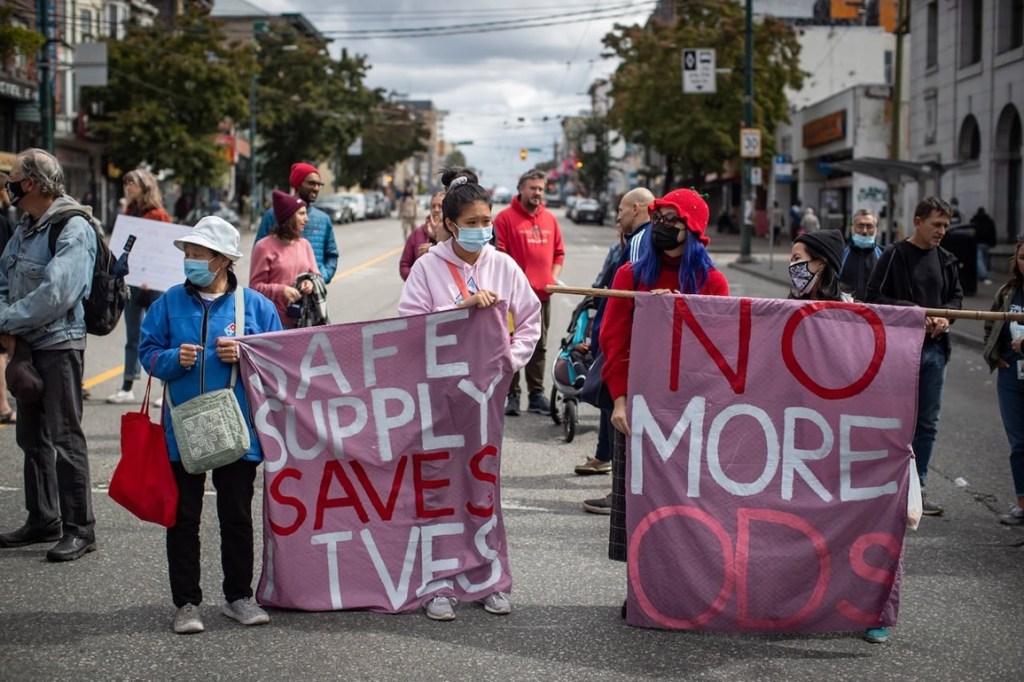
In recent years, Canada has emerged as a trailblazer in progressive drug policy by embracing a bold approach to decriminalization. This paradigm shift represents a departure from the traditional punitive stance toward drug offenses, instead prioritizing harm reduction strategies. As the nation navigates the complex terrain of drug policy reform, it becomes evident that this move holds the promise of addressing public health issues more effectively.
The decriminalization of drugs in Canada is rooted in a recognition of the failure of punitive measures to curb substance abuse. Rather than treating drug addiction as a criminal issue, the emphasis is now on approaching it as a public health concern. By lifting criminal penalties for possession of small amounts of drugs, the Canadian government aims to break the cycle of imprisonment and provide individuals struggling with addiction access to the help they need.
At the core harm reduction is a guiding principle in Canada’s evolving drug policy. Instead of focusing solely on preventing drug use, the emphasis has shifted to minimizing the negative consequences associated with it. This approach includes the distribution of clean needles, supervised injection sites, and access to overdose-reversing medications. By adopting harm reduction strategies, Canada aims to protect the well-being of both individuals using drugs and the broader community.
The decision to decriminalize drugs draws inspiration from the success of Portugal’s approach. In 2001, Portugal decriminalized the possession and use of all drugs, opting for a health-focused model. Over the years, Portugal has witnessed a decline in drug-related deaths, HIV infections, and problematic drug use. Canadian policymakers are eager to replicate these positive outcomes and shift the narrative around drug use from punishment to rehabilitation.
Despite the potential benefits, the decriminalization of drugs in Canada has sparked debates and concerns. Many people have argued that lenient drug policies may contribute to increased drug use, while others worry about the potential strain on public resources for addiction treatment. Furthermore, investigative reporter Tyler Oliveira has demonstrated the damaging effects of drug misuse and homelessness in Vancouver. From watching his investigation, I wonder whether the Canadian government could better use their resources to tackle issues pertaining to homelessness, rather than creating a wider problem of social ills. While there are calls to treat people with issues of addiction more humanely in Canada, Oliveira’s documentary is shocking and, in many ways, frightful. With images of large amounts of methamphetamine users unable to walk and becoming extremely violent to healthcare workers and the general public I wonder if this more towards progressive policy has gone too far (I don’t know how I would feel inhaling meth fumes on my way to my local shop).
Striking a balance between personal freedom and public welfare remains a challenge, but advocates believe that the emphasis on harm reduction will ultimately lead to better outcomes for everyone….
Decriminalization opens the door for more community involvement in addressing drug-related issues. Local initiatives, grassroots organizations, and community outreach programs gain significance as they become crucial players in the broader strategy of harm reduction. By empowering communities, Canada aims to foster a collaborative and compassionate approach to tackling the complex issue of drug addiction.
Canada’s journey toward the decriminalization of drugs represents a paradigm shift in the global war on drugs. By embracing harm reduction as a cornerstone of its strategy, the nation aims to prioritize the health and well-being of its citizens over punitive measures. The lessons learned from Portugal and other progressive models underpin the potential for positive change. As Canada continues to navigate the complexities of drug policy reform, the emphasis on harm reduction holds the promise of transforming the narrative around drug use and addiction. Only time will tell if this bold approach will lead to a healthier, more compassionate society.
Share this:


A Snapshot of My Dissertation: Portuguese Drug Decriminalisation and Some Other Things
I submitted my dissertation back in April, and now the dust has settled I thought it would be good to share the most interesting parts of my research, think of this blog post as an abridged version of my dissertation. Towards the end I’ve also included some tips for completing a dissertation, along with some reading you might like to do if you found this interesting.
What Was my Research About?
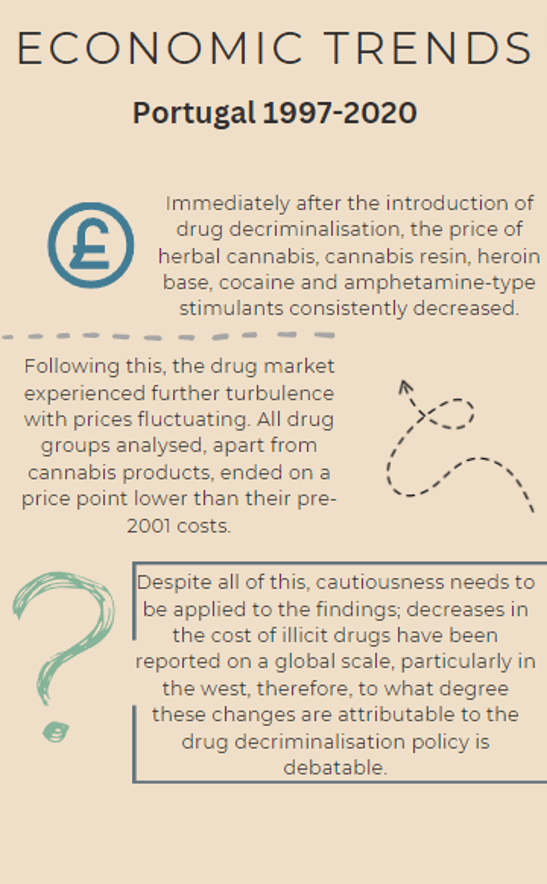
My research was about two main areas; Firstly, I wanted to assess the effects of Portugal’s 2001 drug policy whereby all illicit drugs were decriminalised, meaning drug offences relating to personal possession result in a civil punishment rather than a criminal punishment. I assessed key indicators within Portuguese society, gathering data from international, European and national databases which measured public health trends, criminal justice trends and economic trends. Some fields of data I looked at included prices of drugs at market level, drug seizure data, HIV/ AIDS rates among people who inject drugs and the Portuguese prison population.
The second part of my research involved understanding whether a drug decriminalisation policy similar to Portugal’s could currently happen in the UK. I researched this by performing a discourse analysis on drug related House of Commons debate occurring between the years 1970- 2023, selecting roughly one debate every two years. By doing this, I was able to analysis common themes across the years, understanding the political barriers which may mean drug decriminalisation is not a feasible policy idea at the moment given the political attitude and climate within the House of Commons when it comes to illicit drug policy.
What Did I Find Out?
Look through the slideshow below to view summaries of my findings.



Some Final Comments and Conclusions:
Generally, my research found that Portuguese drug decriminalisation correlated with effects that can be seen as positives. Of course, my research needs to be looked at critically, I don’t claim that all of the societal indicators are directly attributable to the drug decriminalisation policy, however, the correlations that were found are promising. Policy is always a really complex, multi-faceted topic and it would be simplistic to suggest otherwise.
So is a drug decriminalisation policy likely to happen in the UK? The short answer is probably not very likely at all. My discourse analysis pointed towards five decades of debate which was hyper focused on a law and order approach to drug use, a fixation on low level cannabis use and an insistence on the idea that deterrence measures and the war on drugs is actually working. The debates felt stagnant, with new and progressive approaches being hindered by penal populism and ‘tough on crime’ stances.
During my research I found some really interesting reads and different points of view that I hadn’t considered before. I’ve listed some of my favourite pieces below if you’d like to have a read further into this subject.
- Cebral T.S. (2017) “The 15th anniversary of the Portuguese Drug Policy: Its history, its success and its future,” Drug Science, Policy and Law, 3. https://doi.org/10.1177/2050324516683640
- Eastwood, N., Fox, E. and Rosmarin, A. (2016) “Portugal,” in A quiet revolution: Drug decriminalisation across the Globe. London, UK: Release drugs the law and human rights. https://www.release.org.uk/sites/default/files/pdf/publications/A%20Quiet%20Revolution%20-%20Decriminalisation%20Across%20the%20Globe.pdf
- Goldstein, P.J. (1985) “The drugs/violence nexus: A Tripartite Conceptual Framework,” Journal of Drug Issues, 15(4). https://doi.org/10.1177/002204268501500406
- Jacques, S. and Allen, A. (2015) “Drug market violence: Virtual anarchy, police pressure, predation, and retaliation,” Criminal Justice Review, 40(1). https://doi.org/10.1177/0734016814553266
All of the data used is available from The Hansard Archives, European Monitoring Centre for Drugs and Drug Addiction, European Centre for Disease Prevention and Control and The World Prison Brief. Also, I used Taguette to analyse my qualitative data, it’s totally free and it was so useful.

Share this:


Stop strip searching children!

The Metropolitan Police are under constant criticism, more than any other police force, for at least as long as I have been a criminologist. Their latest scandal began with the case of Child Q, a 15 year old girl who was strip searched in school while she was menstruating after being suspected of carrying cannabis. No drugs were found and Child Q was extremely traumatised, resulting in self-harm and a suicide attempt. Tré Ventour recently wrote a blog about Child Q, race and policing in education here but following this week’s Children’s Commissioner report, there’s so much more to discuss.
The report focussed on the Metropolitan Police who strip searched 650 children in 2 years, many (23%) of whom were searched without the presence of an appropriate adult and as we criminologists would expect, the children were disproportionately Black boys. These findings were not surprising or shocking to me, and I also know that the Metropolitan Police force are not just one bad apple in this respect. The brutal search of Child Q occurred in 2020 but incidences such as these have been happening for years.
A teenage boy aged 17 was subject to an intimate search in 2019 where the police breached a number of clauses of PACE, ultimately resulting in the boy receiving an apology and £10,000 damages for the distress caused by the unlawful actions. These actions started with basic information being withheld such as the police officer failing to identify himself and informing the boy of his rights and ended with the strip search being undertaken without an appropriate adult present, in the presence of multiple officers, without authorisation from a senior officer and with no justification for the search recorded in the officer’s pocket book. Now I understand that things may be forgotten in the moment when a police officer is dealing with a suspect but the accumulation of breaches indicates a more serious problem and a disregard to the rights of suspects in general but children more specifically.
These two cases are the cases of children who were suspected of carrying cannabis, an offence likely to be dealt with via a warning or on the spot fine. Hardly the crime of the century warranting the traumatising strip searching of children. And besides, we criminologists know that the war on drugs is a failed project. Is it about time we submit and decriminalise cannabis, save police time and suspect trauma?
What happens next is a slightly different story. Strip searching in custody is different because as well as searching for contraband, it can also be justified as a protective measure where there is a risk of self-harm or suicide. Strip searching of children by the police has risen in a climate of fear surrounding deaths in custody, and it has been reported that there could be an overuse of the practice as a result of this. When I read the report, I recalled the many conversations I have had over the years with my friend Rosie Flatman who is a practitioner who specialises in working with victims of Child Sexual Exploitation (CSE) and other forms of abuse. Rosie has worked with many girls who have been subject to strip searches when in custody. She told me how girls would often perceive the search as punishment for being what the police believed was disruptive. That is not to say that the police were using strip searches as punishment, but that is how girls would experience it.
Girls in custody are often particularly vulnerable. Like Rosie’s clients, many are victims and have a number of compounding vulnerabilities such as mental ill health or they may be looked after children. Perhaps then, we need to look at alternatives to strip searching but also custody for children, particularly for those who have suffered trauma. Rosie, who has delivered training to various agencies, suggests only undertaking strip searches where absolutely necessary and even then, using a trauma informed approach. She argues that even the way the procedure and justification is explained can make a big difference to the amount of harm caused to vulnerable children in police custody.
Share this:


There’s no I in teamwork but maybe there’s space for me and you?


Teamwork is often promoted as a valuable transferable skill both by universities and employers. However, for many the sheer mention of this type of group activity is enough to fill them with dread. This is a shame, and I want to use this blog to explain why.
I’m definitely not one for sports, but even I cannot avoid the discourse around women’s football and Euro 2022. Much has been written about the talents and skill of England’s Lionesses, of which I know very little. Equally there has been disquiet around the overwhelming whiteness of the team, an inequality I am very familiar with throughout my studies of crime, criminality and criminal justice. Nevertheless this blog isn’t about inclusion and exclusion, but about teamwork. Football, like many activities is not a solo enterprise but a group activity. All members need to be able to rely upon their team mates for support, encouragement and ultimately success. If a player doesn’t turn up for training, doesn’t engage in sharing space, passing the ball and so on, the team will fail in their endeavours. Essentially, the team must be on the same page and be willing to sacrifice individuality (at times) for the good of the team. But football isn’t the only activity where teamwork is crucial.
One only has to imagine the police, another overwhelmingly white institution, but with a very different mandate and different measures of success. Here a lack of support from team mates could be a matter of life and death. Even if not so severe, the inability to work closely with other officers in a team can make professional and person life extraordinarily difficult to maintain. It has repercussions for individual offices, the police force itself and indeed, society.
Whilst I’ve the made the case for teamwork, it is not clear what makes a good team, or how it could be maintained. Do all teams work? Personal experience tells me that when members have very different agendas and lose sight of the main objective, team work can be very challenging, if not impossible. There has to be a buy in from all members, not just some. There has to be space for individuals to develop themselves as well as the wider team. However, when the individual aims continue to take priority over the collective, cracks emerge. The same experiences suggest that teamwork cannot be accomplished instantly regardless of intent. Teams take a long time to build rapport, to bond, to gain trust across members and this cannot be hurried. Furthermore, this process requires continuing individual and collective reflection and development. So where can we find an example of such excellence (outside of the wonderful Criminology Team, of course)?
I recently watched the BBC 4-part documentary My Life as a Rolling Stone. Produced to mark 60 years of the band, the documentary explores the lives of Mick Jagger, Keith Richards, Ronnie Wood and the late, Charlie Watts. There were lots of interesting aspects to each part, but the most striking to me was the sense of belonging. That the Rolling Stones are a cohesive team, with each member playing very different parts, but all essential to not only the success of the band, but also to the well-being of the four men. Alongside discussions around creativity, musicality and individual skills, they describe drug taking, alcohol abuse, romantic relationships, fights, falling out and making up. There were periods of silence, of discord and distrust and periods of celebration and sheer personal and collective joy. Working together they provide each other with exactly what they need to thrive individually and collectively.
These men have made more money than most of us can dream of. They have been to parts of the world and seen things that most of us will never see. All of them are heading toward 80 but keep writing and performing. More importantly for this blog, they seem to illustrate what teamwork looks like, one where communication is key, where disputes must be resolved one way or another, regardless of who was right and who was wrong and where the sheer sense of needing one another, belonging remains paramount. I could use a dictionary definition of teamwork, but it seems to me the Rolling Stones say it better than I ever could:
“You can’t always get what you want
But if you try sometime
You’ll find
You get what you need”
(Jagger and Richards, 1969).
Share this:


Protect international law

In criminological discourses the term “war crime” is a contested one, not because there are no atrocities committed at war, but because for some of us, war is a crime in its own right. There is an expectation that even in a war there are rules and therefore the violation of these rules could lead to war crimes. This very focused view on war is part of a wider critique of the discipline. Several criminologists including, Ruggiero, DiPietro, McGarry and Walklate, to name a few, have argued that there is less focus on war as a crime, instead war is seen more as part of a metaphor used in response to social situations.
As far back as the 1960s, US President Johnson in his state of the union address, announced “The administration today here and now declares unconditional war on poverty in America”. What followed in the 1964 Economic Opportunity Act, was seen as the encapsulation of that proclamation. In some ways this announcement was ironic considering that the Vietnam war was raging at the time, 4 years before the well documented My Lai massacre. A war crime that aroused the international community; despite the numbers of soldiers involved in the massacre, only the platoon leader was charged and given a life sentence, later commuted to three and a half years incarceration (after a presidential intervention). Anyone can draw their own conclusion if the murder of approximately 500 people and the rape of women and children is reflected in this sentence. The Vietnam war was an ideological war on communism, leaving the literal interpretation for the historians of the future. In a war on ideology the “massacre” was the “collateral damage” of the time.
After all for the administration of the time, the war on poverty was the one that they tried to fight against. Since then, successive politicians have declared additional wars, on issues namely drugs and terror. These wars are representations of struggles but not in a literal sense. In the case of drugs and terrorism criminology focused on trafficking, financing and organised crimes but not on war per se. The use of war as a metaphor is a potent one because it identifies a social foe that needs to be curtailed and the official State wages war against it. It offers a justification in case the State is accused being heavy handed. For those declaring war on issues serves by signalling their resolve but also (unwittingly or deliberately) it glorifies war as an cleansing act. War as a metaphor is both powerful and dangerous because it excuses State violence and human rights violations. What about the reality of war?
As early as 1936, W.A Bonger, recognised war as a scourge of humanity. This realisation becomes ever more potent considering in years to come the world will be enveloped in another world war. At the end of the war the international community set up the international criminal court to explore some of the crimes committed during the war, namely the use of concentration camps for the extermination of particular populations. in 1944 Raphael Lemkin, coined the term genocide to identify the systemic extermination of Jews, Roma, Slavic people, along with political dissidents and sexual deviants, namely homosexuals.
In the aftermath of the second world war, the Nuremberg trials in Europe and the Tokyo trials in Asia set out to investigate “war crimes”. This became the first time that aspects of warfare and attitudes to populations were scrutinised. The creation of the Nuremberg Charter and the outcomes of the trials formulated some of the baseline of human rights principles including the rejection of the usual, up to that point, principle of “I was only following orders”. It also resulted in the Nuremberg Code that set out clear principles on ethical research and human experimentation. Whilst all of these are worthwhile ideas and have influenced the original formation of the United Nations charter it did not address the bigger “elephant” in the room; war itself. It seemed that the trials and consequent legal discourses distanced themselves from the wider criminological ideas that could have theorised the nature of war but most importantly the effects of war onto people, communities, and future relations. War as an indiscriminate destructive force was simply neglected.
The absence of a focused criminological theory from one end and the legal representation as set in the original tribunals on the other led to a distinct absence of discussions on something that Alfred Einstein posed to Sigmund Freud in early 1930s, “Why war?”. Whilst the trials set up some interesting ideas, they were criticised as “victor’s justice”. Originally this claim was dismissed, but to this day, there has been not a single conviction in international courts and tribunals of those who were on the “victors’” side, regardless of their conduct. So somehow the focus changed, and the international community is now engaged in a conversation about the processes of international courts and justice, without having ever addressed the original criticism. Since the original international trials there have been some additional ones regarding conflicts in Yugoslavia and Rwanda. The international community’s choice of countries to investigate and potentially, prosecute has brought additional criticism about the partiality of the process. In the meantime, international justice is only recognised by some countries whilst others choose not to engage. War, or rather, war crimes become a call whenever convenient to exert political pressure according to the geo-political relations of the time. This is not justice, it is an ad hoc arrangement that devalues the very principles that it professes to protect.
This is where criminology needs to step up. We have for a long time recognised and conceptually described different criminalities, across the spectrum of human deviance, but war has been left unaccounted for. In the visions of the 19th and 20th century social scientists, a world without war was conceptualised. The technological and social advancements permitted people to be optimistic of the role of international institutions sitting in arbitration to address international conflicts. It sounds unrealistic, but at the time when this is written, we are witness to another war, whilst there are numerous theatres of wars raging, leaving a trail of continuous destruction. Instead of choosing sides, splitting the good from the bad and trying to justify a just or an unjust war, maybe we should ask, “Why war”? In relation to youth crime, Rutherford famously pondered if we could let children just grow out of crime. Maybe, as an international community of people, we should do the same with war. Grow out of the crime of war. To do so we would need to stop the heroic drums, the idolisation of the glorious dead and instead, consider the frightened populations and the long stain of a violence which I have blogged about before: The crime of war
Share this:


The Maid: A Few Thoughts

Last week featured my first weekend of rest in a long time and I was desperate to do nothing. In conversation with a friend I mentioned that I had not binge-watched anything in a long time and she suggested The Maid (streaming on Netflix) with a warning that it was brilliant but that I might find it traumatic. I consumed the entire season over the weekend, even after I messaged said friend to inform her after episode two that it was a difficult watch and I would need a break. I did not take a break and powered through. If you have ever been through, witnessed or supported someone through abuse, this will be a difficult watch but I also found it quite therapeutic because it was realistic.
The series is about domestic abuse and focuses on emotional abuse, addressing some of the stigma and contested victimhood of those who suffer non-physical abuse. Although based in the US, it addresses the lack of recognition in the legal system for abusive relationships that do not feature physical violence. The show highlighted that many in society do not recognise non-physical domestic abuse as ‘real’ or ‘enough’, and for a while the female lead (Alex) herself did not perceive herself to be victimised enough to warrant support from a refuge or seek help from the police. She later moves through her denial after getting flashbacks as a symptom of PTSD. She realised that having witnessed her father perpetrate violence towards her mother as a child, her daughter was now impacted in exactly the same way, despite this ‘lesser’ form of abuse.
Much of the series showed the struggles of single mothers leaving abusive relationships, often with nothing but the clothes on their backs. Forcibly displaced, they slowly try to rebuild their lives, applying for state benefits, social housing and childcare. Alex quickly finds a job and still finds it difficult to find a place to live because she needs state support to supplement her rent and deposit. There are few landlords who accept tenants receiving state support, both in the US and the UK. She is repeatedly facing the barriers of an unjust system, stacked against her because of the type of victimisation she suffered.
While facing structural barriers, the maid found help in the most unlikely people: women in the shelter, a social worker helping her to fight the system, a wealthy woman she worked for. Her relationships changed with some people to access support. She was forced to seek help from her father and another male friend when she was left homeless which had difficult gendered dynamics. The father had been abusive to her mother and when she recalled this, it caused conflict in her relationship and she left his home, despite this leaving her homeless once again. Her male friend appeared to be helpful and kind but did so with the expectation she would start a relationship with him and when this did not materialise she was again asked to leave with nowhere to go so she returns to her ex-partner.
The maid does not as much get back into a relationship with him than coexists with him. The relationship he thinks they have is not what her reality is. He thinks she has come home, she is there because she is homeless with nowhere else to go. They live parallel lives. After returning to the ‘family home’, Alex falls into depression and suffers PTSD. Some of the imagery here is intense. In one scene the sofa swallows her up, as if she wished to sink into the cracks of the furniture, not wanting to be seen, wanting to escape but with no means to flee or places to flee to. In other scenes, she tries to go for a walk in the forest, but the trees close in around her, visually representing the isolation her abuser has forced upon her.
My main criticism is in the final episode when Sean tells the maid he will get sober but getting sober will not fix this. Alcohol is not the problem. He was abusive during his sober phases. Quitting alcohol does not transplant men’s attitudes, values and beliefs towards women. Being sober does not remove the need for abusive men to control women. This sends the wrong message to the audience, and it is a dangerous message to send. I would have liked to see the series end with Sean admitting he was a controlling, abusive man and that he would get help for this. Instead he blamed his behaviour on alcohol.
I’m going to play the tape forward and imagine a season 2 because I have witnessed this scenario a few times over the years. He cleans up, gets sober and appears to look like he is doing well. He may have been to rehab or AA where he was taught that he probably should not punch walls or throw objects at people’s heads. He gets in a new relationship and it looks like all is well for a while but he still has not admitted or addressed why he was abusive so his behaviours are there, they are just more subtle. He gaslights, manipulates, controls. But he isn’t outwardly aggressive so he gets away with it for a while. Until he doesn’t.

 Thoughts from the criminology team