
Home » Critical Race Theory
Category Archives: Critical Race Theory

25 years of Criminology

When the world was bracing for a technological winter thanks to the “millennium bug” the University of Northampton was setting up a degree in Criminology. Twenty-five years later and we are reflecting on a quarter of a century. Since then, there have been changes in the discipline, socio-economic changes and wider changes in education and academia.
The world at the beginning of the 21st century in the Western hemisphere was a hopeful one. There were financial targets that indicated a raising level of income at the time and a general feeling of a new golden age. This, of course, was just before a new international chapter with the “war on terror”. Whilst the US and its allies declared the “war on terror” decreeing the “axis of evil”, in Criminology we offered the module “Transnational Crime” talking about the challenges of international justice and victor’s law.
Early in the 21st century it became apparent that individual rights would take centre stage. The political establishment in the UK was leaving behind discussions on class and class struggles and instead focusing on the way people self-identify. This ideological process meant that more Western hemisphere countries started to introduce legal and social mechanisms of equality. In 2004 the UK voted for civil partnerships and in Criminology we were discussing group rights and the criminalisation of otherness in “Outsiders”.
During that time there was a burgeoning of academic and disciplinary reflection on the way people relate to different identities. This started out as a wider debate on uniqueness and social identities. Criminology’s first cousin Sociology has long focused on matters of race and gender in social discourse and of course, Criminology has long explored these social constructions in relation to crime, victimisation and social precipitation. As a way of exploring race and gender and age we offered modules such as “Crime: Perspectives of Race and Gender” and “Youth, Crime and the Media”. Since then we have embraced Kimberlé Crenshaw’s concept of intersectionality and embarked on a long journey for Criminology to adopt the term and explore crime trends through an increasingly intersectional lens. Increasingly our modules have included an intersectional perspective, allowing students to consider identities more widely.
The world’s confidence fell apart when in 2008 in the US and the UK financial institutions like banks and other financial companies started collapsing. The boom years were replaced by the bust of the international markets, bringing upheaval, instability and a lot of uncertainty. Austerity became an issue that concerned the world of Criminology. In previous times of financial uncertainty crime spiked and there was an expectation that this will be the same once again. Colleagues like Stephen Box in the past explored the correlation of unemployment to crime. A view that has been contested since. Despite the statistical information about declining crime trends, colleagues like Justin Kotzé question the validity of such decline. Such debates demonstrate the importance of research methods, data and critical analysis as keys to formulating and contextualising a discipline like Criminology. The development of “Applied Criminological Research” and “Doing Research in Criminology” became modular vehicles for those studying Criminology to make the most of it.
During the recession, the reduction of social services and social support, including financial aid to economically vulnerable groups began “to bite”! Criminological discourse started conceptualising the lack of social support as a mechanism for understanding institutional and structural violence. In Criminology modules we started exploring this and other forms of violence. Increasingly we turned our focus to understanding institutional violence and our students began to explore very different forms of criminality which previously they may not have considered. Violence as a mechanism of oppression became part of our curriculum adding to the way Criminology explores social conditions as a driver for criminality and victimisation.
While the world was watching the unfolding of the “Arab Spring” in 2011, people started questioning the way we see and read and interpret news stories. Round about that time in Criminology we wanted to break the “myths on crime” and explore the way we tell crime stories. This is when we introduced “True Crimes and Other Fictions”, as a way of allowing students and staff to explore current affairs through a criminological lens.
Obviously, the way that the uprising in the Arab world took charge made the entire planet participants, whether active or passive, with everyone experiencing a global “bystander effect”. From the comfort of our homes, we observed regimes coming to an end, communities being torn apart and waves of refugees fleeing. These issues made our team to reflect further on the need to address these social conditions. Increasingly, modules became aware of the social commentary which provides up-to-date examples as mechanism for exploring Criminology.
In 2019 announcements began to filter, originally from China, about a new virus that forced people to stay home. A few months later and the entire planet went into lockdown. As the world went into isolation the Criminology team was making plans of virtual delivery and trying to find ways to allow students to conduct research online. The pandemic rendered visible the substantial inequalities present in our everyday lives, in a way that had not been seen before. It also made staff and students reflect upon their own vulnerabilities and the need to create online communities. The dissertation and placement modules also forced us to think about research outside the classroom and more importantly outside the box!
More recently, wars in Europe, the Middle East, Africa and Asia have brought to the forefront many long posed questions about peace and the state of international community. The divides between different geopolitical camps brought back memories of conflicts from the 20th century. Noting that the language used is so old, but continues to evoke familiar divisions of the past, bringing them into the future. In Criminology we continue to explore the skills required to re-imagine the world and to consider how the discipline is going to shape our understanding about crime.
It is interesting to reflect that 25 years ago the world was terrified about technology. A quarter of a century later, the world, whilst embracing the internet, is worriedly debating the emergence of AI, the ethics of using information and the difference between knowledge and communication exchanges. Social media have shifted the focus on traditional news outlets, and increasingly “fake news” is becoming a concern. Criminology as a discipline, has also changed and matured. More focus on intersectional criminological perspectives, race, gender, sexuality mean that cultural differences and social transitions are still significant perspectives in the discipline. Criminology is also exploring new challenges and social concerns that are currently emerging around people’s movements, the future of institutions and the nature of society in a global world.
Whatever the direction taken, Criminology still shines a light on complex social issues and helps to promote very important discussions that are really needed. I can be simply celebratory and raise a glass in celebration of the 25 years and in anticipation of the next 25, but I am going to be more creative and say…
To our students, you are part of a discipline that has a lot to say about the world; to our alumni you are an integral part of the history of this journey. To those who will be joining us in the future, be prepared to explore some interesting content and go on an academic journey that will challenge your perceptions and perspectives. Radical Criminology as a concept emerged post-civil rights movements at the second part of the 20th century. People in the Western hemisphere were embracing social movements trying to challenge the established views and change the world. This is when Criminology went through its adolescence and entered adulthood, setting a tone that is both clear and distinct in the Social Sciences. The embrace of being a critical friend to these institutions sitting on crime and justice, law and order has increasingly become fractious with established institutions of oppression (think of appeals to defund the police and prison abolition, both staples within criminological discourse. The rigour of the discipline has not ceased since, and these radical thoughts have led the way to new forms of critical Criminology which still permeate the disciplinary appeal. In recent discourse we have been talking about radicalisation (which despite what the media may have you believe, can often be a positive impetus for change), so here’s to 25 more years of radical criminological thinking! As a discipline, Criminology is becoming incredibly important in setting the ethical and professional boundaries of the future. And don’t forget in Criminology everyone is welcome!

Share this:


Black History Month 2024
We have entered Black History Month (BHM), and whilst to some it is clear that Black history isn’t and shouldn’t be confined to one month a year, it would be unwise not to take advantage of this month to educate, raise awareness and celebrate Blackness, Black culture.
This year the Criminology department is planning a few events designed to be fun, informative and interesting.
One event the department will hold is a BHM quiz, designed to be fun and test your knowledge. Work individually or in groups, the choice is yours. The quiz will be held on the 17th October in The Hide (4th floor) in the Learning Hub from 4.30-6pm.
The second event will draw on the theme of this year’s BHM which is all about reclaiming narratives. In the exhibition area (ground floor of the Learning Hub) we will be presenting a number of visual narratives. I will be displaying a series of identity trees from Black women that I interviewed as part of my PhD research on Black women in English prisons. With a focus on race and gender, these identity trees represent a snapshot of the lives and lived experiences of these women prior to imprisonment. The trees also highlight the hopes and resilience of these women. This event will be held on the 31st October between 4.30-6pm. Please do walk through and have a look at the trees and ask questions. The event is designed for you to spend as little or as much time as you would like, whether it is a brief look or a longer discussion your presence is much welcomed!
If you would like to be part of this event, whether that is sharing your own research (staff and students), or if you would like to use the space to share your own narrative as a Black individual please get in contact by the 21st October by emailing angela.charles@northampton.ac.uk or criminology@northampton.ac.uk
Lastly, I would like to put a spotlight on a few academics to maybe read up on this month and beyond:
A few suggestions for important discussions on Black feminism and intersectionality:
A few academics with powerful and interesting research that proved very important in my PhD research:
- Maria Adams
- Angela Davis
- Beth Richie
- Corretta Phillips
- Ruth Chigwada-Bailey
- Jason Warr
- Julia Chinyere-Oparah (previously Julia Sudbury)
Share this:


Starting a new school year
What makes university unique?
Unlike school, students make the choice to come to university. What’s more, it is often a student’s first-time experiencing independence from caregivers, e.g. outside the purview of their own parents. For many, this may mean learning how to shop, cook, budget, clean and take care of their own stuff. This is an entirely new series of decisions leading to the person you will become. Never shy away from seeking help, support and advice, and use every resource at hand, including and especially people.
Build relationships. You will undoubtedly be tempted to spend lots of time on your digital devices – alone – but this will most certainly lead you down a dark path towards isolation, loneliness and the false feeling of control. Instead, accept that you must fashion a new independent self. Who are you outside your caregivers/parent’s home? Put the phone down and give yourself a fighting chance to find out!
Find kinship beyond superficial similarities, and sow the seeds for happiness in your new environment. At our university, the biggest mistake I’ve consistently seen students make is failing to create community here. Often, for example, UK-based students are anxious to spend the weekend at home with their parents or school friends. International students may either indulge in regional tourism, indulge their homesickness, and/or only seek to build relationships within their own ethno-linguistic group. Again, this all feeds a false sense of control.
This mirrors my experiences at Hanoi University of Science and Technology, where I taught during my sabbatical year in Vietnam (see featured image). There, I had to not only learn from my students how to navigate the local environment, but crucially, learn local classroom norms from both them and colleagues so that I could teach more effectively.
With that said: Build relationships right here through the university community. Join a club, explore and develop your interests and cultivate support networks. These may overlap or be three different ventures. If you work, then find employment that anchors you here in Northampton. Use every job experience as A) An opportunity to improve your communication skills, and B) As building blocks towards your own goals.
Within the first few weeks of starting university 30 years ago, I met a student who quickly became my best friend. He came from a country I couldn’t have pointed out on a map, was from a different religion, and studied something far from my own interests. As our friendship blossomed, we easily discovered that we had far more in common than not, which in turn fed my own curiosity and confidence to get to know more about this planet we all call home. Even though he’s passed away, our friendship still sustains me to this day (Rest in Power, dear Numair).
On the mentor/disciple relationship between students and teachers
At university, there is no separation between staff/students, adults/youth like in school. Please find opportunities to develop mentor/mentee relationships with your tutors*. Find a tutor with whom you can share your new world and reflect upon your growth. Ask them exactly what excellence looks like in their classroom and on assessments so you can foster the right study skills.
Yes, find mentors and become one, too! Learn from others who are further along the journey you now tread. At the same time, find ways to work with youth to inspire those who follow your path. This not only develops your own confidence and communication skills, but collectively contributes to a vibrant university community.
As someone who has studied and practiced Buddhism my whole life, I am convinced that what we give, we get in return. Cultivate a spirit of generosity and feed your own open-mindedness. This support and tolerance will be returned to you ten-fold.
*hooks, bell (2003). Teaching Community: A pedagogy of hope. New York ; Routledge.
Share this:


Zemiological Perspective: Educational Experiences of Black Students at the University of Northampton

As a young Black female who has faced many challenges within the education system, particularly related to behavioral issues, I noticed how the system can unintentionally harm black students. I observed that Black children’s experiences in the education system are not always viewed from a deviant perspective, because they are not inherently deviant. The institutional harm faced by Black students is not always a ‘crime’ nor is it illegal, yet it is profoundly damaging.
This realisation prompted me to adopt a zemiological perspective, drawing upon the work of Hillyard et al. (2004) to highlight the subtle yet impactful harms faced by Black students in the educational system. My primary objective was to uncover the challenges these students face, as outlined in my initial research question: ‘To what extent can the experiences of Black students in higher education be understood as a form of social harm?’ To achieve this, I analysed the educational experiences of Black students at the University of Northampton. This involved reviewing the university’s access and participation plans, which detail the performance, access, and progression of various demographics within the institution, with a particular focus on BAME students.
Critical race theory (CRT) was the guiding theoretical framework for this research study. CRT recognises the multifaceted nature of racism, encompassing both blatant acts of racial discrimination and subtler, systemic forms of oppression that negatively impact minority ethnic groups (Gillborn, 2006). This theoretical approach is directly correlated to my research and was strongly relevant. This allowed me to gain insight into the underlying reasons behind the disparities faced by Black students in higher education. As well as enabling me to unpack the complexities of racism and discrimination, providing a comprehensive understanding of how these issues manifest and persist within the educational landscape.
Through conducting content analysis on the UON Access and Participation Plan document and comparing it to sector averages in higher education, four major findings came to light:

Access and Recruitment: The University of Northampton has made impressive progress in improving access and recruitment for BAME students, fostering diversity and inclusivity in higher education, and surpassing sector standards. Yet, while advancements are apparent, there remains a need for more comprehensive approaches to tackle systemic barriers and facilitate academic success across the broader sector.
Non-Continuation: Alarmingly, non-continuation rates among BAME students at the University of Northampton have surpassed the sector average, indicating persistent systemic obstacles within the education system. High non-continuation rates perpetuate cycles of disadvantage and limit opportunities for personal and professional growth.
Attainment Gap: Disparities in academic attainment between White and BAME students have persisted and continue to persist, reflecting systemic inequalities and biases within the academic landscape. UON is significantly behind the sector average when it comes to attainment gaps between BAME students and their white counterparts. Addressing the attainment gap requires comprehensive approaches that tackle systemic difficulties and provide targeted support to BAME students.
Progression to Employment or Further Study: UON is also behind the sector average in BAME students progression in education or further study. BAME students face substantial disparities in progression to employment or further study, highlighting the need for collaborative efforts to promote diversity and inclusivity within industries and professions. Addressing entrenched biases in recruitment processes is essential to fostering equitable opportunities for BAME students.
Contributions to Research: This research deepens understanding of obstacles within the educational system, highlighting the effectiveness of a zemiological perspective in studying social inequalities in education. By applying Critical Race Theory, the study offers insights that can inform policies aimed at fostering equity and inclusion for Black students.
The findings hold practical implications for policy and practice, informing the development of interventions to address disparities and create a more supportive educational environment. This research significantly contributes to our understanding of the experiences of Black students in higher education and provides valuable guidance for future research and practice in the field.
Aside from other limitations in my dissertation, the main limitation was the frequent use of the term ‘BAME.’ This term is problematic as it fails to recognise the distinct experiences, challenges, and identities of individual ethnic communities, leading to generalisation and overlooking specific issues faced by Black students (Milner and Jumbe, 2020). While ‘BAME’ is used for its wide recognition in delineating systemic marginalisation (UUK 2016 cited in McDuff et al., 2018), it may conceal the unique challenges Black students face when grouped with other minority ethnic groups. The term was only used throughout this dissertation as the document being analysed also used the term ‘BAME’.
This dissertation was a very challenging but interesting experience for me, engaging with literature was honestly challenging but the content in said literature did keep me intrigued. Moving forward, i would love Black students experiences to continue to be brought to light and i would love necessary policies, institutional practises and research to allow change for these students. I do wish i was more critical of the education system as the harm does more so stem from institutional practices. I also wish i used necessary literature to highlight how covid-19 has impacted the experiences of black students, which was also feedback highlighted by my supervisor Dr Paula Bowles.
I am proud of myself and my work, and i do hope it can also be used to pave the way for action to be taken by universities and across the education system. Drawing upon the works of scholars like Coard, Gillborn, Arday and many others i am happy to have contributed to this field of research pertaining to black students experiences in academia. Collective efforts can pave the way for a more promising and fairer future for Black students in education.
References
Gillborn, D. (2006). Critical Race Theory and Education: Racism and anti-racism in educational theory and praxis. Discourse: Studies in the Cultural Politics of Education, 27 (1), 11–32. [Accessed 21 April 2024]
Hillyard, P., Pantazis, C., Tombs, S. and Gordon, D., (Eds), (2004). Beyond Criminology: Taking Harm Seriously, London: Pluto Press.
Milner, A. and Jumbe, S., (2020). Using the right words to address racial disparities in COVID-19. The Lancet Public Health, 5(8), pp. e419-e420
Mcduff, N., Tatam, J., Beacock, O. and Ross, F., (2018). Closing the attainment gap for students from Black and minority ethnic backgrounds through institutional change. Widening Participation and Lifelong Learning, 20(1), pp.79-101.
Share this:


Still holding Black women to European beauty standards

Many of you, like me will be enjoying the 2024 Olympic games in Paris: from the sheer amount of dedication, talent, and passion, to the ups and downs, the shocks and surprises and everything else in-between. However, it was something outside of the games that struck me. Simone Biles, the most decorated gymnast in history, received negative criticism online about her hair being unkempt on a video that she uploaded of herself and teammates on a bus. Simone then felt the need to address the comments and remind the public about overstepping the mark.
At first, Simone justified why her hair may have looked ‘messy’, explaining that it had been done prior to the bus journey, and that it was the heat and the long bus ride that had led to her hair falling out of place. She followed up these justifications with another post that reminded the public to kindly not mention a Black woman’s hair. This brought me back to discussions within my research where I highlight the European beauty standards that Black women are held to (Charles, 2024). Black women’s hair has for a long time been seen as unprofessional, messy and problematic. On the other spectrum, Black women’s natural hair has been marvelled at and touched without permission, causing Black women to feel hyper-visible and uncomfortable. Whichever encounter, it can lead to many Black women feeling the need to change their hair or mould it into something that looks more European (Charles, 2024; Patton, 2006). European beauty ideals and standards create further challenges and judgement that Black women face in society. Black women are scrutinised against racialised beauty ideals they cannot achieve, and they are perceived to be failing to measure up to the normative standard (Patton, 2006).
It should be a woman’s choice to style her hair how she wants, without external factors influencing or determining these choices. Additionally, Black hair needs to stop being compared to European hairstyles, in which such comparisons put European hairstyles on a pedestal. Speaking from experience, for many Black women, learning to love your hair for what it is rather than lament over what it is not can sometimes be a process. It can be a process of confusion, growth, trial and error, liberation, empowerment and pride. Moreover, it can be an important part of someone’s identity. I hope Simone Biles’ courage to challenge such comments can act as a springboard for others to do the same with power and resilience, and I hope we can start to normalise Black hair and hairstyles for future generations.
References
Charles, A. (2024) Black Women in Prison: Exploring the Intersection of Race and Gender in Experiences of Imprisonment. Unpublished PhD Thesis. Milton Keynes: The Open University.
Patton, T. O. (2006) ‘Hey Girl, Am I More than My Hair?: African American Women and Their Struggles with Beauty, Body Image, and Hair’, NWSA Journal, 18(2), pp. 24-51. Available at: http://www.jstor.org/stable/4317206
Share this:


I’m not Black; my Friends and I are Brown, not Black

I recently began the process of preparing my child for the imminent transition to a new school situated in a diverse community. Despite being born into a similarly diverse environment, his early educational exposure occurred in an ethnically varied setting. Venturing into this new chapter within a racially diverse community has sparked a keen interest in him.
My child soon articulated a perspective that challenged conventional racial labels. He asserted that he and his friend Lucien are not accurately described as ‘black,’ rather he believes they are ‘brown.’ He went further to contest the classification of a lady on TV, who was singing the song “Ocean” by Hillsong, as ‘white.’ According to him, his skin is not black like the trousers he was wearing, and the lady is not white like the paper on my lap. This succinct but profound statement held more critical significance than numerous conversations I’ve encountered in my over five years of post-PhD lecturing.
The task at hand, guiding an under seven-year-old questioning the conventional colour-based categorisation, proved challenging. How do I convince an under seven-year-old that his knowledge of colours should be limited to abstract things and that persons with brown toned skin are ‘black’ while those with fair or light toned skinned are ‘white’? I found myself unprepared to initiate this complex conversation, but his persistent curiosity and incessant ‘why prompts’ compelled me to seek creative ways to address the matter. Even as I attempted to distract myself with a routine evening shower and dinner, my mind continued to grapple with the implications of our conversation.
Post-dinner, my attempt to engage in my usual political news catch-up led me to a YouTube vlog by Adeola titled ‘How I Almost Died!’ where she shared her pregnancy challenges. One statement she made struck a chord: ‘if you are a black woman and you are having a baby in America, please always advocate for yourself, don’t ever keep quiet, whatever you are feeling, keep saying it until they do something about it’ (18:39). This sentiment echoed similar experiences of tennis star Serena Williams, who faced negligence during childbirth in 2017.
The experiences of these popular ‘black’ women not only reminds me that the concept ‘black’ and ‘white’ are not only symbolic, but a tool for domination and oppression, and disadvantaging the one against the other. Drawing inspiration from Jay-Z’s ‘the story of O.J’, the song drew attention to the experiences of race, success, and the complexities of navigating the world as a ‘black’ individual. In the song, two themes stood out for me, the collective vulnerability to prejudice and the apparent bias in the criminal justice system towards ‘black’ people. In the UK, both proportional underrepresentation in staff number and proportional overrepresentation of minoritized groups in the criminal justice system and the consequences therefrom is still topical.
Jay-Z’s nuanced understanding of ‘black’ identity rejects simplistic narratives while emphasising its multifaceted nature. The verse, “O.J. ‘like I’m not black, I’m O.J.’ Okay” underscores the challenges even successful ‘black’ individuals face within racial systems. As criminologists, we recognize the reflection of these issues in daily experiences, prompting continuous self-reflexivity regarding our values, power positions, and how our scholarly practice addresses or perpetuates these concerns. Ultimately, the question persists: Can a post-racially biassed world or systems truly exist?
Share this:


Catalog of Negores, mules, carts and wagons to be sold
In September 2021, I visited the newly expanded Equal Justice Initiative’s Legacy Museum: From Enslavement to Mass Incarceration, in my maternal grandparents’ hometown, Montgomery, Alabama. I was struck by the range of artifacts used to chronicle each era. Consider these1854 slave market advertisements from the Montgomery Advertiser and Gazette – still the local newspaper!
Catalog of Negroes, mules, carts, wagons and Co., to be sold in Montgomery. Headlines included: Wenches and bucks, quality Negroes for sale.
Nancy – about 26, fieldhand, cannot recommend her particularly, complains of indisposition, but probably a proper master might cure her.
Ben – A strong and hearty man, about 30 years old, an excellent field hand, and a remarkably handy boy, in any use, being usually quick and intelligent; a No. 1 Negro.
Suckey, A remarkably intelligent Negro girl about 15 years of age, understands General house work well for her age; can sew tolerably, and is a most excellent nurse and attendant for children; has remarkable strength of constitution, and never known to have been complaining even for a moment; a pretty good field hand, and would make an excellent one.
Allison – about 15, fine body and house servant, carriage driver and Ostler, honest, steady, handy, healthy, smart, intelligent, and in all respects a choice and desirable boy.
Mary Jane – about 11.
Martha – about 10.
Louisa – about 7.
Old George – as faithful and honest an old African as ever lived.
His wife Judy, the same sort of character.
Henrietta – about 24… First-rate cotton picker.
One of the humans being trafficked recounted:
“To test the soundness of a male or female slave… They are handled in the grossest manner, and inspected with… disgusting minuteness… in the auction room where the dealer is left alone with the ‘chattels’ offered… God has recorded the wickedness that is done there, and punishment will assuredly fall upon the guilty.” -J. Brown.
The ebb and flow of freedom.
Each exhibit in the ‘Enslavement to Mass Incarceration’ museum takes visitors seamlessly through the Atlantic slave trade, past Jim and Jane Crow segregation, to a recorded face-to-face visit with a real-life, modern-day inmate. As you enter what seems like the final hall, you are confronted with an array of individual seats at a glass window/screen projecting an inmate calmly sitting, waiting. Like a real prison visit, there’s a telephone, which once lifted, the prisoner does the same, introduces themselves, and recounts their story. History confronts you in the present: The confederacy surrendered on April 9, 1865. By 1898, 73% of state revenue came from convict leasing. Now?
One explicit goal of the EJI project, reflected and reinscribed in the exhibits’ descriptions, is a shift in language from slavery and slaves to human trafficking and enslavement. Surely, one can feel the sublingual, subliminal shift from victimology to responsibility, and that implies accountability. To be clear, the entire economy centered around usurping land, driving-out or exterminating the indigenous people, human trafficking and slave labor, shredding the natural environment into farmland to produce cotton, cane and tobacco, manufacturing a range of commodities from these raw materials, trading around the world. Who got rich? Whose labor was exploited?
Who is accountable for giving birth to Jim Crow, if slavery died with ole Abe Lincoln’s Emancipation Proclamation? Who is accountable for cultivating chronic poverty and voter intimidation, if we’d exterminated white lynch mobs through the Civil Rights codes of the sixties? Who indeed is responsible for mass incarceration? The exhibits challenge language that focuses on the victim and remains hush about the status quo, masking the ensuing abuse of power needed for its maintenance, especially hidden from abusers who may themselves be exploited by the myth of meritocracy.
As a side note, perhaps people will not actually be able to reckon with this cognitive dissonance of heroic CONfederate generals and their cause to uphold each state’s right to let white men traffic and enslave Blacks. I’d truly like to see public statues of say, the valiant General Lee, standing next to two or three statues of enslaved people, and a few statues of the white people charged with the quotidian physical labor of enslavement, e.g., driving labor (whip crackers), capturing and punishing escapees (slave catchers, the original law-enforcement force), breaking in new arrivals (torture), breeding ((gang)rape), and general humiliation throughout these duties (sadomasochism). Perhaps the museum just needs to add another exhibit with busts of them.
With stark population stats posted big and bold as visitors transition from room to room, the exhibits chronologically shift through significant eras. Today in the prison industrial complex there are 8 million incarcerated. 10 million were segregated under Jim and Jane Crow until the Civil Rights movement. 9 million terrorized by lynching, accelerating the erosion of Reconstruction. The nation was born and raised with 12 million kidnapped and enslaved Africans. Dear reader, right now I ask, what precisely has our nation done to upend caste?
Share this:

DIE in Solidarity with Diversity-Inclusion-Equality
As an associate lecturer on a casual contract, I was glad to stand in solidarity with my friends and colleagues also striking as part of UCU Industrial Action. Concurrently, I was also glad to stand in solidarity with students (as a recent former undergrad and masters student … I get it), students who simply want a better education, including having a curriculum that represents them (not a privileged minority). I wrote this poem for the students and staff taking part in strike action, and it comes inspired from the lip service universities give to doing equality while undermining those that actually do it (meanwhile universities refuse to put in the investment required). This piece also comes inspired by ‘This is Not a Humanising Poem’ by Suhaiymah Manzoor-Khan, a British author-educator from Bradford in Yorkshire.
Some issues force you to protest
the way oppression knocks on your front door
and you can’t block out the noise
“protest peacefully, non-violently”
I have heard people say
show ‘the undecided’, passive respectability
be quiet, leave parts of yourself at home
show them you’re just as capable of being liked
enough for promotion into the canteen,
protest with kindness and humour
make allusions to smiling resisters in literature
they’d rather passive images of Rosa Parks all honestly
but not her politics against racism, patriarchy, and misogyny
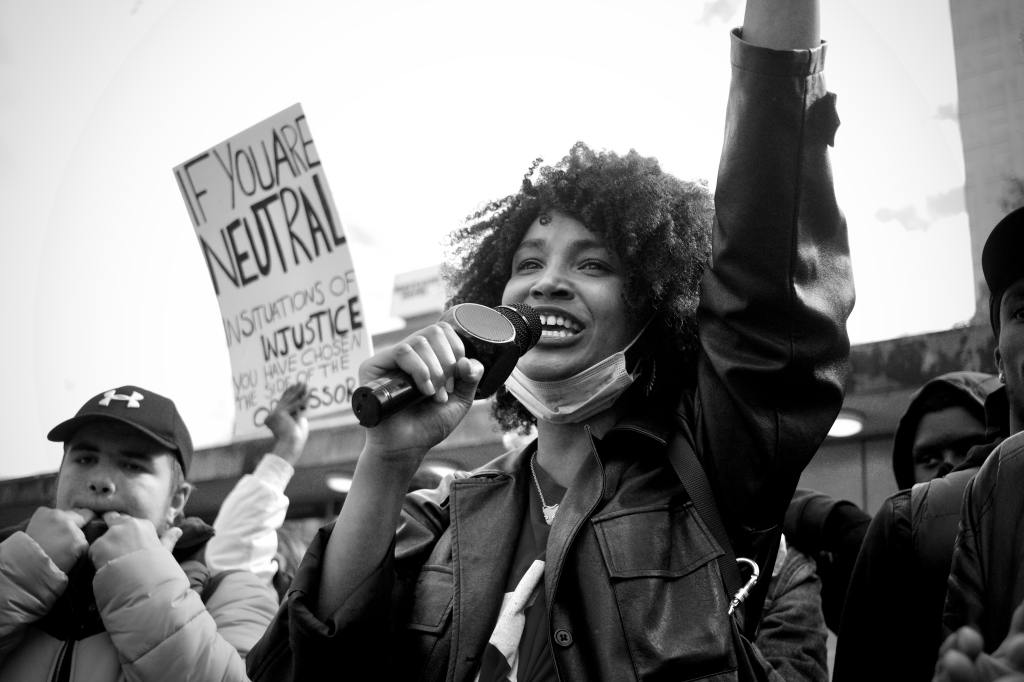
but I wanna tell them about British histories of dissent
the good and the bad – 1919 Race Riots
the 1926 general strikes, and the not so quiet
interwar years of Caribbean resistance to military conscription
I wanna talk about how Pride was originally a protest
I wanna talk about the Grunwick Strike and Jayaben Desai
and the Yorkshire miners that came to London in solidarity
with South Asian migrant women in what was 1980s austerity
I want to rant about Thatcherism as the base
for the neoliberal university culture we work in today
I want to talk about the Poll Tax Riots of 1990
and the current whitewashing of the climate emergency
they want protesters to be frugal in activism,
don’t decolonise the curriculum
they say decolonise
they mean monetise, let’s diversify …
but not that sort of diversity
nothing too political, critical, intellectual
transform lives, inspire change?
But no,
they will make problems out of people who complain
it’s your fault, for not being able to concentrate
in workplaces that separate the work you do
from the effects of Black Lives Matter and #MeToo
they make you the problem
they make you want to leave
unwilling to acknowledge that universities
discriminate against staff and students systemically
POCs, working-class, international, disabled, LGBT
but let’s show the eligibility of staff networks
while senior leaders disproportionately hire TERFs

staff and students chequered with severe floggings
body maps of indenture and slavery
like hieroglyphics made of flesh
but good degrees, are not the only thing that hold meaning
workers rights, students’ rights to education
so this will not be a ‘people are human’ poem
we are beyond respectability now
however, you know universities will DIE on that hill
instead,
treat us well when we’re tired
productive, upset, frustrated
when we’re in back-to-back global crises
COVID-19, Black Lives Matter, femicide,
failing in class, time wasting, without the right visas,
the right accents; Black, white, homeless, in poverty,
women, trans, when we’re not A-Grade students, when we don’t
have the right last name; when we’re suicidal
when people are anxious, depressed, autistic
tick-box statistics within unprotected characteristics
all permeates through workers’ and student rights
When you see staff on strike now,
we’re protesting things related to jobs yes,
but also, the after-effects
as institutions always protect themselves
so sometimes I think about
when senior management vote on policies…
if there’s a difference between the nice ones ticking boxes
and the other ones that scatter white supremacy?
I wonder if it’s about diversity, inclusion, and equality [DIE],
how come they discriminate in the name of transforming lives
how come Black students are questioned (under caution) in disciplinaries
like this is the London Met maintaining law and order …
upholding canteen cultures of policing
Black and Brown bodies. Decolonisation is more
than the curriculum; Tuck and Yang
tell us decolonisation is not a metaphor,
so why is it used in meetings as lip service –

why aren’t staff hired in
in critical race studies, whiteness studies, decolonial studies
why is liberation politics and anti-racism not at the heart of this
why are mediocre white men failing upwards,
they tell me we have misunderstood
but promotion based on merit doesn’t exist
bell hooks called this
imperialist heteropatriarchal white supremacy
you know Free Palestine, Black Lives Matter, and the rest
we must protest how we want to protest
we must never be silenced; is this being me radical, am I radical
Cos I’m tired of being called a “millennial lefty snowflake”, when I’m just trying not to DIE?!
Further Reading
Ahmed, Sara (2012) On Being Included: Racism and Diversity in Institutional Life. London: Duke.
Ahmed, Sara (2021) Complaint. London: Duke.
Bhanot, Kavita (2015) Decolonise, Not Diversify. Media Diversified [online].
Double Down News (2021) This Is England: Ash Sakar’s Alternative Race Report. YouTube.
Chen, Sophia (2020) The Equity-Diversity-Inclusion Industrial Complex Gets a Makeover. Wired [online].
Puwar, Nirmal (2004) Space Invaders: Race, Gender and Bodies Out of Place. Oxford: Berg.
Read, Bridget (2021) Doing the Work at Work What are companies desperate for diversity consultants actually buying? The Cut [online].
Ventour, Tré (2021) Telling it Like it is: Decolonisation is Not Diversity. Diverse Educators [online].
Share this:


If we could empathize with all life, we… [fill in the blank]
In Honour of my two teachers’ passing (seen together here). Rest In Power, bell hooks (d. 15/12/21) and Thich Nhat Hanh (d. 22/01/22).
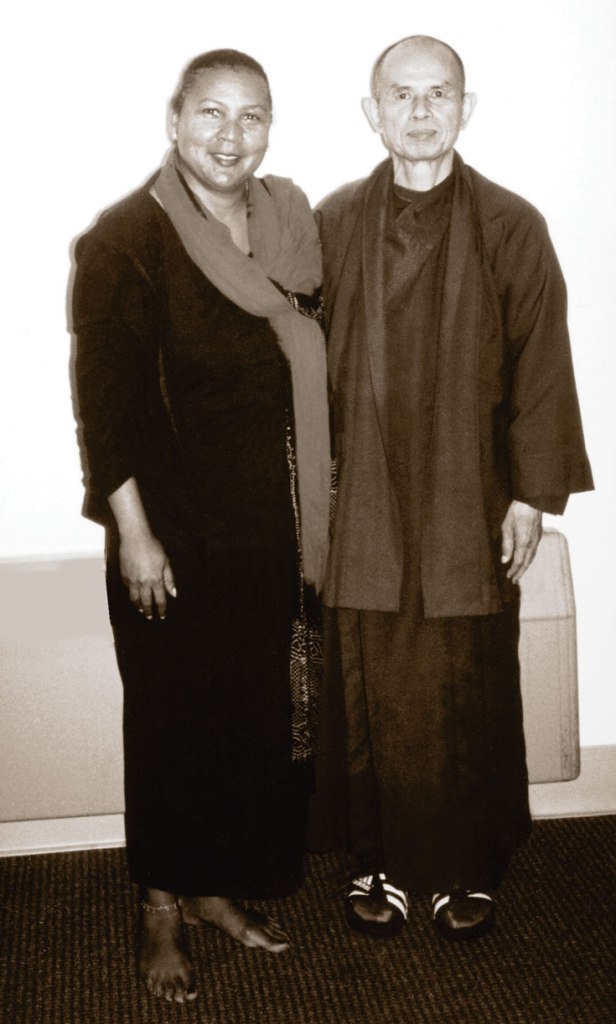
If we could empathize with all life, we…
… wouldn’t treat all animals as either food or fodder.
… wouldn’t develop nuclear technology into bombs.
…would never show an interest in making so many guns and ways of destroying life.
…would more genuinely aim to achieve mutual understanding between individuals.
…wouldn’t have so much intergenerational trauma within families, communities, nations.
…would be more neighborly in all our affairs.
…wouldn’t treat trade like a sport, a winner-takes-all competition over natural resources.
…would harness the power of the sun for it shines on all life collectively.
…would cultivate care, and be kinder as a general rule.
… would teach kindness in school, a required class on every campus.
…would not build entire ideologies, systems of government, religions, arts, and culture around patriarchy.
… would not be reduced to binaries, not just in gender, but ‘black or white’ in our overall thinking, because that’s where it came from: A false yet powerful and enduring dichotomy.
Binary thinking produced gender binaries, not the other way around. Knowing this is key to its undoing. Please know that capitalism produced racism, and greed crafted classism. A2 + B2 = C2, still. Racism is exponentially untamed greed; and patriarchy an inferiority complex run rampant and amok. Such cultures of greed can’t be conquered by competition; greed can’t be beat! We need a new dimension.
If we could empathize with all life, we would aspire to be far more fair.
If we could empathize with all life, we would love more.
Your turn.
Fill in the blank.
Share this:


At The Mouth of ‘Bloody Sunday’ #Travel #Prose #History
At the Mouth of Bloody Sunday
I know the one thing we did right, was the day we started to fight. Keep your eyes on the prize…hold on. Hold on.
Bloody Sunday in Selma only highlighted the bloody Mondays, Tuesdays, Wednesdays, Thursdays, Fridays, and Saturdays that Black people in America have faced from the first time we laid eyes on these shores. It took people to gather and protest to change. In December ’64, the good Rev. Dr. King was awarded the Nobel Peace Prize for this movement. That spring in Selma, people marched across a bridge in order to highlight the normal voter suppression practices still happening throughout the south – and still in 2021.
“If you can’t vote, you ain’t free. If you ain’t free, well then you a slave.” –Intro interview to Eyes on the Prize part 6/8.
According to the National Park Service, who oversees the important civic monument now:
“On “Bloody Sunday,” March 7, 1965, some 600 civil rights marchers headed east out of Selma on U.S. Route 80. They got only as far as the Edmund Pettus Bridge six blocks away, where state and local lawmen attacked them with billy clubs and tear gas and drove them back into Selma.”
From my 7th grade social studies class circa ‘87, I would also add: The good white citizens of Selma gathered at the mouth of the bridge for the spectacle, to witness or probably participate in the oppression. We see them in the footage, films, pictures and media coverage of the events, and we know many are likely still alive. Black-n-white news footage of the days leading to Bloody Sunday show the sheriff and his angry henchmen prodding people with their clubs, plenty of ‘regular’ people watching in joy.
The people prodded? Well-dressed and behaved Black citizens of Selma and activists who’d come to support them. According to the footage, white citizens came out in droves for what they knew would be a bloody suppression of simple voting rights. As spectators, their presence made the massacre spectacular.

I’ve visited the National Voter Rights Museum and Institute at the mouth of the bridge, and there they have an actual jar of jellybeans used to test Black people coming to sign up to vote at the local government office. Yes, sitting behind that booth was a white man who demanded that a black person – any citizen of the darker complexion – accurately guess the number of jellybeans in a jar in order to be allowed – in order for him to allow them – to register to vote. I feel like I have to repeat that, or say it in different ways because it is so unbelievable.
This September, I visited a museum at the edge of the Edmund Pettus bridge in Selma, Alabama, on the way to Montgomery, the state capital. This historical museum marks local efforts to contest voter restriction practices. These practices were heinous in tone and texture, yet creative and cringe-worthy in nurture and nature. For example, consider the ingenious of these jellybean-counting white men in DC who created the separate-n-unequal space to inspire a variety of voter suppression taxes, tests and clauses throughout the south. It is these sorts of mad men who make decisions that impact the entire world as we have come to know and understand it now.
Yes, it is these sorts of men who send politicians to the state houses, and sent/send senators to Washington DC, to cajole politicians of every hue to compromise on their values. Now, we also know they send mobs to storm the capitol on the very day all the legislators gather to confirm the election results.
I know the one thing we did right, was the day we started to fight. Keep your eyes on the prize…hold on. Hold on.

Imagine yourself standing there in a museum, looking at a shelf, and there is a jar of jellybeans. There’s nothing spectacular about the jar, nor its contents. For any of us have seen something like this in virtually any kitchen, or supermarket. My granny grew, harvested and canned vegetables, so growing up I got to handle many mason jars first hand.
In fact, I love jellybeans. I used to visit the gourmet jellybeans shop in the mall after school when I was a kid. You could pick out any flavour that you liked, and I always went for blueberry, and cherry. I loved the contrast between the royal blue and Corvette red. It is a childhood fascination that my dentists still adore me for to this day. Naturally, these gourmet jellybeans were a little more expensive than the ones you get in the supermarkets, but I liked to save my money and treat myself sometimes. Plus, it felt very special being able to pick out the ones you like, and not have to discard the disgusting ones – who ever thought licorice or cola belonged on a jelly bean!?!
As a candy, jellybeans are so visually enticing. As you enter the shop, the walls are covered from floor to ceiling with all sorts of bright neon colors. Every shade of the rainbow grabs your eyes, calls to you. Between stacks of plastic bags and scoops, you are awed by the massive jars of each individual jellybean color ready for you to pick-and-mix. There are also tables with stacks of both empty and pre-filled jars. There are jars of all sizes filled with colorful patterns of jellybeans with matching ribbons tied in bows around the lids. Of course, the entire shop smells like fruit, all kinds of fruits, sweet, succulent fruits that you cannot even imagine. You are the customer, you are king. By virtue of entering the fancy shop, this is your kingdom.
Now take all of that and put it in a jar. To get to this jar, you have to enter an official government building in the town center. Next to the entrance stands an armed, uniformed white man who gives you a disgruntled look as you enter, signaling that he’s not there for your safety but aggravation. Now, as you approach, you see the jar, sitting on a counter, and behind it sits another white man. Try to imagine this white man, probably with a gun next to him or somewhere nearby, with nothing better to do than to threaten your life. Because the town is so small, he knows your last name, and may know of your family.
Since this is a small town, he knows your employer, he knows where you live as you’ve just written this down. He may even know your family, as the local history is so insidious, his family may have even owned or overseen yours at one time. Or, at that very moment, you or a family member may work for him or his kin. Your kids might play together. You may have played with him as a kid when, for example, your mother was his nanny (read-and-said-in-the-south: Mammy). Yet now, here in a free democracy, it is his job to register citizens to vote.
It is his prerogative, the birthright of this individual, plain (white) man on the other side of the glass to demand that you count the number of jellybeans in the goddamn jar. It is a privilege that no one anywhere near here has ever questioned. So, with a smile, he plops a big red “DENIED” stamp on your registration form. Of course yo’cain’t! A “killing rage” surges. Be glad you don’t have a gun with you.


 Thoughts from the criminology team
%3Amax_bytes(150000)%3Astrip_icc()%3Afocal(749x0%3A751x2)%2Fsimone-biles-hair-paris-heatwave-073024-tout-52887c1302ff465d8797f003c452ecba.jpg&imgrefurl=https%3A%2F%2Fpeople.com%2Fsimone-biles-claps-back-people-commenting-hair-amid-2024-paris-olympics-heatwave-8685988&docid=8zbppZtCkxUTxM&tbnid=VEKrr21i-NVrWM&vet=12ahUKEwj_0LS80-WHAxV2UkEAHZ8GAGkQM3oECF0QAA..i&w=1500&h=1000&hcb=2&ved=2ahUKEwj_0LS80-WHAxV2UkEAHZ8GAGkQM3oECF0QAA)