
Home » Criminology (Page 23)
Category Archives: Criminology

Complaint! (For Sara Ahmed)
This poem comes inspired from the recent UCU strikes, and also the underpinning arguements of Complaint by Sara Ahmed. The institution protects itself, while removing those who complain (or in many cases, they remove themselves). It is also inspired by ‘Testimony’ by Irish poet Seamus Heaney.
As higher education burns,
they blame white lecturers who picket,
and the Black and Brown lecturers
no longer willing to be ‘paid in exposure’
to the hull of slave ships. Colonialism’s hot mouth
at the nucleus of HE’s epistemes,
so senior leaders blame lecturers
for neglect. Meanwhile, the upper echelons
play Monopoly with staff pay checks
students left to grieve assignment
work revolving around conveyer belts
like undead corpses between indenture and slavery
it’s a Tuesday morning
a fever of claret runs riot
across picketing lines
turn cloaks to justice and equality,
there’s just ice behind the scab
where hearts used to beat. Back in the 80s,
gay and lesbian activists stood in solidarity
with the miners; and Arthur Scargill
and co scurried to Jayaben Desai at Grunwick
from the main road, you can still hear the screams
of comradery, and ‘we see yous’ …
yet behind picket tea and biscuits,
there are teary smiles –
death behind the bags,
and behind the pyre …
smoke could be seen for miles.
Share this:

UCU Strike 28 February-2 March 2022

More information around the University and College University [UCU] and the Four Fights Dispute can be found here.
Information about the Northampton branch of UCU can be found here and here.
You can also find out why striking is a criminological issue here: https://thoughtsfromthecriminologyteam.blog/2021/12/10/striking-is-a-criminological-matter/ and here: https://thoughtsfromthecriminologyteam.blog/2022/02/18/united-nations-un-world-day-of-social-justice/
Share this:

Why I am on strike


Technically, I’m not on strike today because I don’t work today. I am employed as a senior lecturer in history on a 0.6 contract, and this semester that means I work – at least in theory – Wednesday – Friday, 9am to 5.30pm.
The reality of course is quite different. Keeping on top of admin and teaching preparation, attending meetings, marking assignments and actually delivering teaching (the core part of my job!) takes up that time. If I do research, it’s usually in time that’s not paid for by my university, even though it makes up 20% of my contractual hours.
In a lot of ways I’ve been fortunate. I was initially hired on a one year contract, on a 0.5 basis. That I’ve been made permanent, had my paid time increased slightly, and I’ve been promoted is hopefully testament to the…
View original post 397 more words
Share this:

UCU Strike 21-22 January 2022
More information around the University and College University [UCU] and the Four Fights Dispute can be found here.
Information about the Northampton branch of UCU can be found here and here.
You can also find out why striking is a criminological issue here: https://thoughtsfromthecriminologyteam.blog/2021/12/10/striking-is-a-criminological-matter/ and here: https://thoughtsfromthecriminologyteam.blog/2022/02/18/united-nations-un-world-day-of-social-justice/
Share this:


United Nation’s (UN) World Day of Social Justice

Achieving justice through formal employment
This Sunday 20th February marks the United Nation’s (UN) World Day of Social Justice. The theme this year is ‘achieving justice through formal employment’. The focus is on the informal economy, in which 60% of the world’s employed population participate. Those employed in the informal economy are not protected by regulations such as health and safety or employment rights and are not entitled to employment benefits such as sickness and holiday pay. People who work in the informal economy are much more likely to be poor, in which case housing and unsanitary conditions can compound the impact of working in the informal economy.
When we in the global North talk about the informal economy, there is often an assumption that this occurs in poorer, less developed countries (it is semantics – here in the UK we use the preferred term of the ‘gig economy’). However, this is a global problem and often the richest industries and countries engage in abusive employment practices that form part of the problem of the informal economy. Let’s take Qatar as an example. Qatar has one of the highest GDP per capita in the world, but it also has an extremely high level of income inequality. I heard Natasha Iskandar recently discussing the case of migrant workers in Qatar during construction for the football world cup. Migrant workers are vulnerable to the informal economy due to various labour and visa restrictions throughout the world. In Qatar migrant workers were needed to build the stadia, however this came at a cost to employment conditions including wage theft, forced overtime, debt bondage and intimidation. At the time in Qatar, it was illegal for such workers to withhold labour and they could not voluntarily leave the country without the consent of their employers. The often-abusive employment conditions within the Kafala system of sponsored migrant labour would push people into the informal economy. Having come under some criticism, Qatar has since reformed the Kafala system to improve social protections for migrant workers and were the first of the Gulf countries to do so.
The informalisation of the education economy
On a global scale, the problem of the informal economy is vast there are unique challenges to different groups and social contexts. It will take a large-scale effort to make changes needed to abolish the informal economy globally if it ever can be abolished. Perhaps though we can start by looking a little closer to home and see if we can make a difference there. Academia has traditionally been perceived by those outside of it as a sector of elite institutions, the ‘ivory towers’, where highly paid, highly skilled academics talk from their parapets in a language those outside of it cannot understand. There is a perception that academics are highly paid, highly skilled workers with job security, good pensions, and a comfortable working life. Higher education management in some institutions have been known to refer to academics using derogatory terms such as ‘slackademics’. As every hard-working academic will tell you, this cannot be further from the truth.
What used to be a place of free thinking, sharing of ideas, and encouraging students to do the same (note: I’m told academics used to have time to think and read) has become a place where profit and business ethos overrides such niceties. The marketisation of education, which can be traced back to the early 1990s has seen a growth in informal employment putting paid to the myths of job security inter alia, lecturing staff well-being. As Vicky Canning put it in the below Tweet, this constitutes institutional violence, something we criminologists are charged with speaking up against.
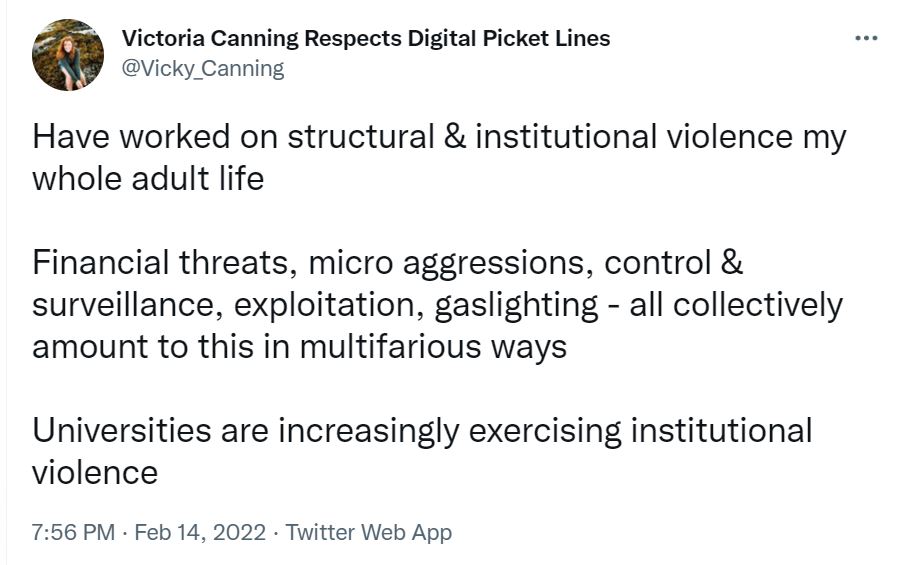
The university industry has become increasingly reliant on casualised contracts leading to staff not being able to get mortgages or tenancies. During my time at a previous institution, I worked on fixed term contracts as a teaching assistant. The teaching contracts would typically last for 10-12 weeks, there were constant HR errors with contracts, which were often not confirmed until the week before teaching or even after teaching had started. Each semester there would be at least a few teaching assistants who got paid incorrectly or did not get paid at all. These are the people delivering teaching to students paying at least £9,250 per year for their education. Is this value for money? Is this fair? In a previous round of strikes at that institution I let my students know that after all the work they put into writing, I only got paid for 20 minutes to mark one of their 3,500-word essays. They did not seem to think this was value for money.
While I was working under such contracts, I had to move to a new house. I visited many properties and faced a series of affordability checks. As the contracts were short term, landlords would not accept this income as secure, and I was rejected for several properties. I eventually had to ask a friend to be a guarantor but without this, I could easily have ended up homeless and this has happened to other university teaching staff. It was reported recently in the Guardian that a casualised lecturer was living in a tent because she was not able to afford accommodation. All this, on top of stressful, unmanageable workloads. These are the kinds of things casualised university staff must contend with in their lives. These are the humans teaching our students.
This is just one of the problems in the higher education machine. The problems of wage theft, forced overtime, debt bondage and intimidation seen in Qatar are also seen in the institutionally violent higher education economy, albeit to a lesser (or less visible) extent. Let’s talk about wage theft. A number of universities have threatened 100% salary deductions for staff engaging in action short of strike, or in simple terms, working the hours they are contracted to do. Academics throughout the country are being threatened with wage theft if they cannot complete their contractual duties within the hours they are paid for. Essentially then, some higher education establishments are coercing staff to undertake unpaid overtime, not dissimilar to the forced overtime faced by exploited migrant workers building stadia in Qatar.
Academics across the country need to see change in these academic workloads so we can research the exploitation of migrants in the informal labour market, to work towards UN sustainability goals to help address the informal economy, to engage in social justice projects within the informal economy in our local area, and to think about how we can engage our students in such projects. In effect academics need to work in an environment where they can be academics.
How can we begin to be critical of or help address global issues such as the informal economy when our education system is engaging in questionable employment practices, the kind of which drive people into the informal economy, the kind of employment practices that border the informal economy. Perhaps higher education needs to look inwards before looking out
Share this:


Who’s to blame, Jimmy Carr or the system that feeds him?

NB: The term ‘white’ in this blog is being used to describe those racialised as white within the dominant culture of the UK, and those that benefit the most from white privilege. Though Gypsy Roma Traveller [GRT] communities may in cases be racialised as white, their culture sits juxtaposed to the dominant thus ‘not white enough’, so may not always be seen as white by white British people (see Bhopal, 2018: 29-47).
“Extending the gaze to whiteness enables us to observe the many shades of difference that lie within this category – that some people are ‘whiter’ than others, some are not white enough and many are inescapably cast beneath the shadow of whiteness” (Nayak, 2007).
Following Haley’s excellent blog on the Jimmy Carr debacle, I would like to bring another perspective. For those of us racialised outside of whiteness, I know I do not need to describe the litany of examples where those racialised as white portray racist hatred as humour on and off social media. Haley continues in writing, “Jimmy Carr’s [His] Dark Material stand-up comedy is the latest in a long line of everyday racism that has been subjected to a trial by Twitter.” When we challenge these “jokes”, at least in my experience I was told iterations of “stop being so sensitive”; “it’s just a joke”; “lighten up” and so on …
In her long-essay What White People Can Do Next: From Allyship to Coalition, Irish author-academic Emma Dabiri (2021) writes:
“I grew up in a culture of bantering and, ngl, I love a caustic riposte. And while in certain ways I resent the current policing of language, there is a distinction. I hate to break it to you, but a “joke” in which the gag is that the person is black isn’t a joke, it’s just racism disguised as humor. A joke told to a white audience where the punch line is a racist stereotype isn’t a joke, again it’s just racism; if there is only one black person present, it’s also cowardly and it’s bullying. Jokes of this nature probably aren’t funny for black people.”
Emma Dabiri (2021: 98)

Whilst in my time writing for Thoughts I have engaged with many issues, one I have not yet written on is the ‘canteen culture’ of bantering I grew up in amid the English private school system. So, I am quite familiar with the culture of private schools having gone to them myself (aged 5-16) where racism (specifically anti-Blackness) against me was passed off as “a ‘joke’ in which the gag is … just racism disguised as humour”(Dabiri, 2021: 98). As a boy, Carr went to sixth form at Royal Grammar School, a selective boys’ school in High Wycombe in the image of a posh state school famous for projecting its boys into Oxbridge. Thus Jimmy Carr passed into Gonville and Caius College, Cambridge.
If there was to be a culture of ‘banter’ where Carr learned such behaviours, these selective schools and universities are a good place to start. For people not racialised as white, these places can be a new-kind of hell very much in the image of colonial-style racism. At school, in my experience there existed a toxic human concotion of racism (as banter) which infected not only the students but also the staff. It’s this sort of thing that may sit under the thinking behind Carr’s “joke”, and why he thought it was okay to make it in the first place. However, as much as I would like make this about him, this isn’t really about him at all.
Carr has had a very successful career of punching down on the marginalised and historically excluded, profiting from their suffering. For me, this is more about how large institutions like Netflix give platforms to people they know are bad news and let them espouse hatred anyway. Professor Sunny Singh tweeted how it is a “reminder that Jimmy Carr’s joke went through a whole production process in order to appear on @netflix.” When we consider how any piece of media goes through a rigorous editing / production process, the fact nobody questioned a Holocaust “joke” about Roma and Sinti people is a stark reminder of how white supremacy functions in media.
Here a white man makes a “joke” to an audience of mostly white people backed by a production team (largely white, let’s be honest) at a white institution Netflix … with ‘institutional whiteness’ hardening (Ahmed 2006; 2007; 2012; 2014; Hunter, 2015; 2019; White Spaces). Simply affirming what the late Charles Mills (2004) wrote where “… white supremacy implies the existence of a system that not only privileges whites but is run by whites, for white benefit” (p31).
The uproar to Jimmy Carr’s “joke” follows #ClanchyGate where author-schoolteacher Kate Clanchy was criticised for perpetuating racism and ableism in her 2019 memoir Some Kids I Taught and What They Taught Me. She used descriptions like “chocolate-coloured skin” and “almond-shaped eyes.”Moreover, she referred to autistic children as “unselfconsciously odd” and “probably more than an hour a week” around them “would irriate me, too, but for that hour I like them very much.”
Like Netflix, her publisher Picador did not spot these in the editing process. Or they did spot them, and said nothing … reiterating the ableism, racism, and white supremacy that exists in publishing where rather than hold Kate Clanchy accountable, her colleagues like Philip Pullman berated women of colour who challenged her taking to Twitter and comparing them to the Taliban. The same three women of colour who have been erased from this discourse. The issue with Picador is a reminder of how predominantly white artists (not always … like Dave Chappelle in his Netflix special The Closer) with power are then platformed with no accountability when they cause harm (intended or not). Kate Clanchy has since gone on to find another publisher for her book after she was required to rewrite!!
Jimmy Carr follows Chapelle, Clanchy as well as Joe Rogan and his racist rhetoric. Not only is Carr’s just horrific, but it also reinforces the the discrimination Gypsy, Roma, and Traveller [GRT] people face in Britain where their cultures will be erased should the government’s crime, policing and sentencing bill reach fruition. The conversation around Carr’s “joke” reminds me how general opinion is still comfortable with racism so long as it is wrapped in ‘humour’. With the ‘free speech’ champions following behind. It’s also showing me the number of people that think racism only happens to those racialised as Black or Brown.
It is not so simple. The way we define racism is worthy of further discussion and analysis when we consider the racism that happens because of cultural belongings. As Emma Dabiri writes:
“The myth of a unified white ‘race’ makes white people, from what are in truth distinct groups, better able to identify common ground with each other and to imagine kinship and solidarity with others racialized as ‘white’, while at the same time withholding the humanity of racialized others. The ability of whiteness to create fictive kinships where differences might outweigh similarities, or where one ‘white’ group thrives and prospers through the exploitation of another ‘white’ group, all united under the rubric of whiteness constructs at the same time a zone of exclusion for racialized ‘others’, where in fact less expected affinities and even cultural resonances might reside.
In truth, this is the work of whiteness, who invention was to serve that function. Saying that all “white” people are the same irrespective of say, culture, nationality, locatioin, and class literally does the work of whiteness for it. But despite the continuities of whiteness – the sense of superiority that is embedded in its existence – we cannot disregard the differences that exist. This demands a truthful reckoning with the fact that the particulars of whiteness, as well as the nature of the relationship between black and white, will show up differently in different countries and require the crafting of different responses.”
(Dabiri, 2021: 45-46)
Emma Dabiri’s What White People Can Do Next (2021) follows David Roediger’s Wages of Whiteness (1991), Noel Ignatiev’s How the Irish Became White (1995), Matthew Jacobson’s Whiteness of a Different Color (1998) and Nell Irvin Painter’s The History of White People (2010), all of which in some way show how different white groups have modifiers attached when talking about “white people.” This must be discussed interlocking with other factors including culture, place/geography, and class. Through Roediger, Ignatiev, Jacobson, Painter, Dabiri, and other scholars, we can see how whiteness splits and mutates to serve its purpose of divide and rule, and really how white supremacy may also negatively impact against those read as white and ‘not white enough’ in different ways.

The late archbishop Desmond Tutu believed that our quest for liberating the oppressed must also come with liberating the oppressor too. He saw how white South Africans during Apartheid had become bitter and hateful as a result of the racism that pervaded through their lives on a daily basis. Visiting Israel as well, he saw the same thing in the Israeli state’s dehumanisation of the Palestinian people. As Tutu himself states:
“Part of my own concern for what is happening there [Israel] is in fact not what is happening to the Palestinians, but is what the Israelis are doing to themselves. When you go to those checkpoints and you see these young soldiers behaving abominably badly, they are not aware when you carry out dehumanising policies, whether you like it or not those policies dehumanise the perpetrator.”
Demond Tutu
That ‘dehumanisation of the Other’ is central to any system of oppression, and we see this again in Britain with the police’s treatment of Black people going all the way back to 1919. However, we also see it in the state’s treatment of GRT people, compounded by the policing and sentencing bill. On a local level, the dehumanisation of GRT communities can be seen again when we observe the comments sections of local news. The comments of everyday people reflect the racist policymaking of politicians. In the continuous persecution of racialised minorities more generally in Britain, we must also consider what racism does to the perpetrators and what this ‘dehumanisation of the Other’ has done to the cultural majority. Even scarier, what has this dehumanisation done to the people that do not even realise they are racist?
When that ‘dehumanising’ appears on big public platforms like stand-up “comedy” shows, we have a problem – essentially giving racism the green light underpinned by violent policymaking in government. So, the discussions around Jimmy Carr not only show me that there needs to be more conversation about how whiteness impacts those read as Black or Brown, but also how whiteness impacts those read as white or not white enough (GRT, Eastern Europeans and so forth). We have work to do and lots of it.
Share this:


Jimmy Carr and Acceptable Racism
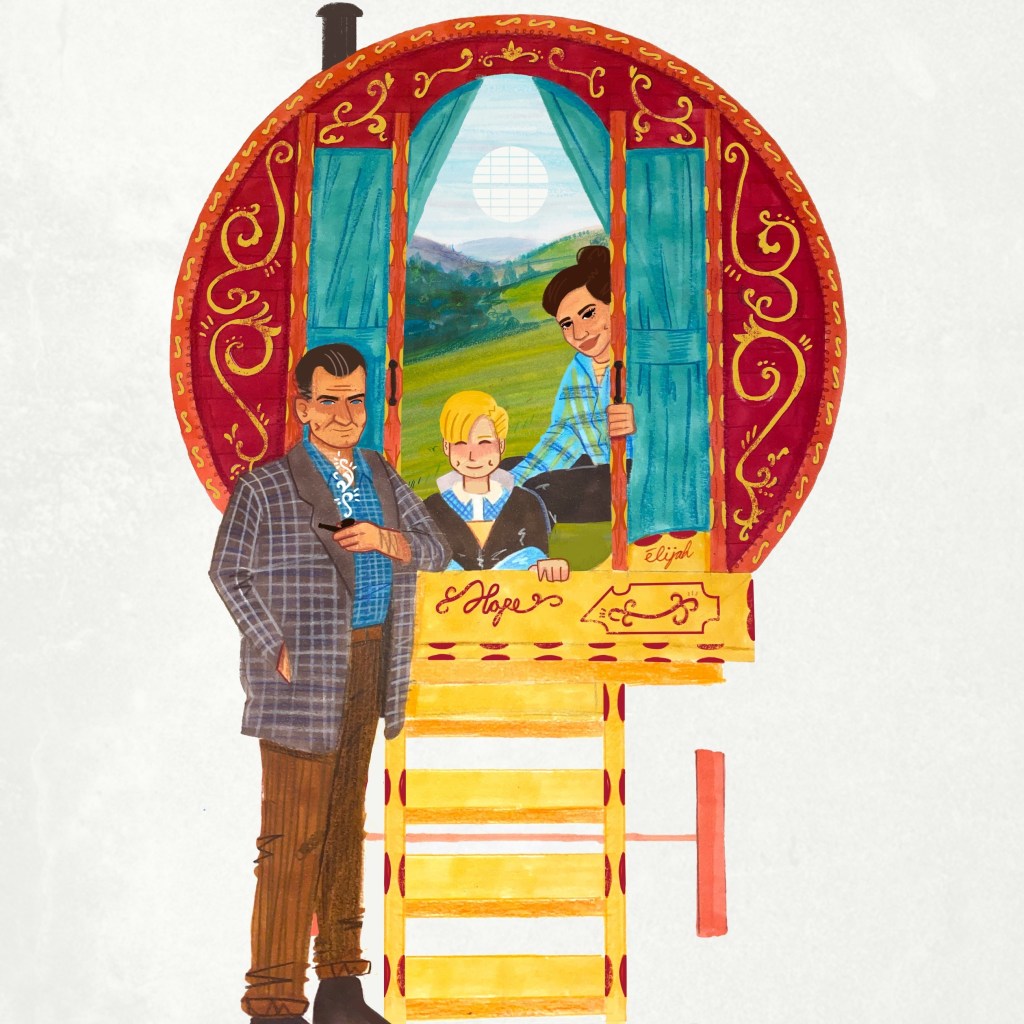
Jimmy Carr’s Dark Material stand-up comedy is the latest in a long line of everyday racism that has been subjected to a trial by Twitter. The context in which the joke is told is as follows:
A wealthy white gorger man mocks Roma and Sinti people because of who they are. His mostly white gorger audience than laughs and finds this hilarious. This man’s stand-up is so successful that it is endorsed by Netflix, of which the CEO appears to be a rich white gorger man. Both Jimmy Carr and Netflix profit from dehumanising a marginalised group of people.
If the joke had been delivered to audiences which were predominantly Gypsy Roma and Traveller people this would not have been viewed as funny. To adapt Emma Dabiri’s (2021, p. 98) work, ‘a ‘joke’ in which the gag is that the person is [a Gypsy, Roma or Traveller] isn’t a joke, it’s just racism disguised as humour’ (2021, p. 98).
Carr’s joke should not be surprising as he prides himself on his use of homophobic, racist and misogynistic ‘career ending’ jokes and these jokes are enjoyed by many.
The anti-racist Twitter reactions to this joke could provide some hope that many people are becoming more willing to challenge racism. Some Tweets were aimed at increasing the awareness and calling-out racism. Many Tweets were kind, and others were asking for Jimmy to provide a genuine apology. Although, Carr’s words (plus the support of the audience and Netflix) are a symptom of a racist society, so does the focus on Carr’s interpersonal actions mean that people are being distracted from the broader structural issues of racism and white supremacy?
After scrolling though Twitter there was a clear divide between those claiming to be ‘anti-racist’ and those claiming that ‘the freedom of speech’ is more important than combating racism. This left me thinking,
How do we get to a point where people are willing to recognise that oppressive systems impact us all, but differently, in some way shape or form?
And;
How could people be encouraged to fight against unequal and damaging systems in a way that encourages social change and forgiveness rather than hate and division?
It seems that online activism might be useful for raising awareness and giving voices to those pushed out of mainstream media. However, if focused on just ‘calling out’ individual acts of racism whilst online there is a danger of being caught up in an online culture war and not actually doing much to change structural issues in the offline world.
Whilst the Jimmy Carr Twitter debates continue, the Police, Crime, Sentencing and Courts Bill which could further damage Gypsy Roma and Traveller lives is in the final stages of Bill passage. As well as this, inequality and misery is set to become further entrenched with the impending surge in energy bills. All of this is thanks to a government which is a mess, corrupt and devoid of any sense of morality. Even so, maybe Jimmy Carr should stick to making jokes about his own experiences of upper class tax avoidance next time.
Note: Thank you to Emma Dabiri’s What White People Can Do Next (2021) for helping me to articulte my frustrations with online Twitter debates.
Share this:


Auschwitz – secrets of the ground
Indifference is not a beginning; it is an end. And, therefore, indifference is always a friend to the enemy, for it benefits the aggressor – never his victim
Elie Wiesel
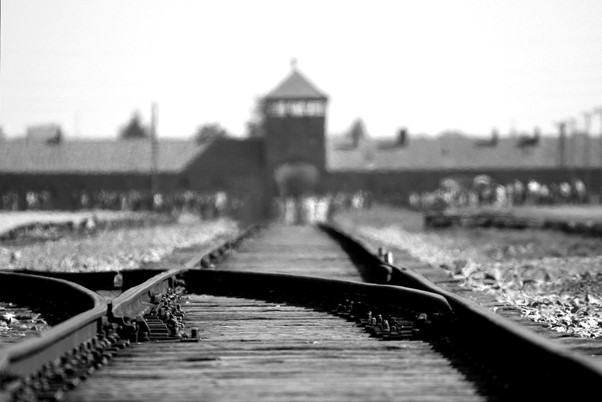
I have been fortunate enough in my life to have been able to live and travel abroad, a luxury you should never take for granted. Having traveled in every continent there are plenty of things I will never forget, mostly good but one thing that will stay with me will be Auschwitz. It is hard to get excited about visiting Auschwitz, but it is also hard to not get excited about visiting Auschwitz. The day I visited Auschwitz, on the journey there a flurry of strange thoughts went through my head, perhaps ones you would only have when attending a funeral where you are supposed to be in grief. What do you wear, should I smile, what do you talk about, essentially you are creating a rule book inside your head of how not to be offensive. It’s a strange thought process and perhaps completely irrational, one of which I will probably never go through again. If I had to describe Auschwitz in one word, that word would be haunting and I could write for hours about Auschwitz without ever being able to get across the feeling of visiting it, but instead, I am going to share with you a poem I wrote on the journey back from Auschwitz, this poem has never seen the light of day and has been in my diary for over a decade, until now, but it feels like a perfect time to finally share, it’s called secrets of the ground.
Dark skies and tearful eyes,
only God knows the secrets this ground hides.
The flowers mask the crimes of old,
the walls are chipped by bullet holes.
Haunting sounds drowned out by hymns,
the shoes of children too scared to blink.
A cold wind howls in these Polish fields,
one million people how can this be real.
A train stands alone on the blackened track,
barb wire fences to hold them back.
The secrets out, the grounds have spoken,
we must never forget the lives that were taken.
Share this:


Rule makers, rule breakers and the rest of us
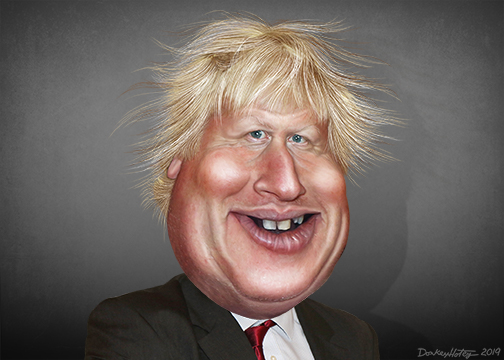
There are plenty of theories about why rules are broken, arguments about who make the rules and about how we deal with rule breakers. We can discuss victimology and penology, navigating our way around these, decrying how victims and offenders are poorly treated within our criminal justice systems. We think about social justice, but it seems ignore the injustice perpetrated by some because we can somehow find an excuse for their rule breaking or point out some good deed somewhere along the line. And we lament at how some get away with rule breaking because of their status or power. But what is to be done about people that break the rules and in doing so cause or may cause considerable harm to others; to the rest of us?
Recently, Greece imposed a new penalty system upon those over 60 that are not vaccinated against Covid. Pensioners who have had real reductions in their pensions are now to be hit with a fine, a rolling fine at that, if they do not get vaccinated. This is against a backdrop of poor vaccination rates which seem to have improved significantly since the announcement of what many see as draconian measures by a right-wing government. There are those that argue that vaccination ought to be a choice, and this has been brought into focus by the requirements for health workers and those in the care profession to be vaccinated in this country. And we’ve heard arguments from industry against vaccination passports which would allow people to get into large venues and a consistent drip-drip effect of how damaging the covid rules are to the leisure industry and aviation, as well as the young people in society.
So, would it have been far more acceptable to have no rules at all around Covid? Should we have simply carried on and hoped that eventually herd immunity would kick in? Let’s not forget of course that the health service would have been so overwhelmed that many people will have died from illnesses other than Covid (they undoubtedly have to some extent anyway). The fittest will have survived and of course, the richest or most resourceful. Businesses will have been on their knees as workers failed to turn up for work, either because they were too ill or have moved on from this life and few customers will have thought about quaffing pints, clubbing, or venturing off to some faraway sunny place (not that they’d be particularly welcome there coming from plague island). It would have felt more like some Darwinian evolutionary experiment than civilised society.
It seems that making some rules for the good of society is necessary. Of course, there will be those that break the rules and as a society, we struggle to determine what is to be done with them. Fines are too harsh, inappropriate, draconian. Being caring, educating, works for some but let’s be honest, there are those that will break the rules regardless. Whilst we can argue about what should be done with those that break the rules, about the impact they have on society, about victims and crimes, perhaps the most pressing argument is about equality of justice. The rest of us, those that didn’t break the rules, might question how draconian the rules were (are) and we might question the punishments meted out to those that broke the rules. But what really hurts, where we really feel hard done by, let down, angry is to see that those that made the rules, broke the rules and for them we don’t get to consider whether the punishment is draconian or too soft. There are no consequences for the rule makers even when they are rule breakers. It seems a lamentable fact that we have a system of governance, be that situated in politics or business, that advocates a ‘do as I say’ rather than ‘do as I do’ mentality. The moral compass of those in power seems to be seriously misaligned. As the MP David Davis calls for the resignation of Boris Johnson and says that he has to go, he should look around and he might realise, they all need to go. This is not a case of one rotten apple, the whole crop is off, and it stinks to high heaven.
Share this:


Yanking the Lion’s tail: Sir-Prized, not

With the announcement of the Queen’s New Years Honours, it’s that time of year where I do my (sometimes) twice yearly blog on the Honours system. In this round (like every round), we have seen many recieve accolades simply for being famous! Yet, a gong for former-PM Tony Blair is something that upset many, with over half a million people signing a petition to revoke it. However, is Tony Blair’s appointment as a ‘Knight Companion of the Most Noble Order of the Garter’ so terrible? When we look at the sorts of people that have recieved this historically, his name sits alongside the likes of Sir Winston Churchill. And whilst he was voted the Greatest Briton by the British public in 2002, his name is tainted against histories of colonial brutality in the Global South. As Shashi Tharoor writes:
“… by the time [The Bengal Famine] ended, nearly 4 million … starved to death … Nothing can excuse the odious behaviour of Winston Churchill, who deliberately ordered the diversion of food from starving Indian civilians to well-supplied British soldiers and even to top up European stockpiles in Greece and elsewhere. ‘The starvation of anyway underfed Bengalis is less serious’ than that of ‘sturdy Greeks’, he argued. Grain for the Tommies, bread for home consumption in Britain (27 million tonnes of imported grains, a wildly excessive amount), and generous buffer stocks in Europe (for yet-to be-liberated Greeks and Yugoslavs) were [his] priorities, not the life or death of his Indian subjects. When reminded of the suffering of his victims his response was typically Churchillian: The famine was their own fault, he said, for ‘breeding like rabbits’ . When officers of conscience pointed out in a telegram to the prime minister the scale of the tragedy caused by his decisions, Churchill’s only reaction was to ask peevishly: ‘why hasn’t Gandhi died yet?'” (p160).
Extracted from: Inglorious Empire by Shashi Tharoor
King Leopold II of Belgium most famous for using Congo as his own private playground (violently so with an estimated 5-15 million dead Congolese), recieved the same knighthood. Rewarding statesmen, diplomats and the like who have violently checkered pasts is completely and unequivocally in character for the British state. However, while I do understand the outrage to Blair’s knighthood, I question why there is not as much outrage to the system at large that glorifies the British Empire and colonialism? Sure, be outraged, but the same anger is a little quiet at the Honours system in general.
Concurrently, the arrival of COVID-19 and the allocation of senior COVID jobs is a reminder to me of how power is transferred in the UK. The shredding of the NHS by the government in favour of an American-style system that puts profit ahead of access to healthcare is unshocking when we see the relationship between Honours and big jobs, and who gets projected into them. For example, at the start of the pandemic former-TalkTalk CEO Dido Harding was tasked by PM Boris Johnson to lead the Track-and-Trace system. Harding was a good friend of former-PM David Cameron who made her a life peer in 2014, and her grandfather Sir John Harding was knighted for quashing anti-colonial insurgencies in the 1950s.
An acceptance or declination of a state honour will always be politicised, but it warrants saying that numerous legitimate achievements are also interlocked with an alleged corrupt system of merit. For Global Majority people, in my opinion, it still feels that being included into the establishment is an indicator of how our Britishness is temporary – while being included into white proximities of power is viewed as the ‘magnum opus’ of achievement. And for people like me with immigrant grandparents and great-grandparents that moved from those English colonies (as they were at the time), colonial honourifics allow whiteness to harden. As Guilaine Kinouani writes:
“Although [respectability and assimilation] may provide temporary escape and possibly material gain and conditional access to structures of power, they produce white supremacy and such breed further shame and self-alienation. Self-contempt, disdain and scorn were not merely accidental by-products of colonialism – they were manufactured, deliberate colonial weapons to fortify whiteness and reduce resistance” (p56).
Extracted from: Living White Black by Guilaine Kinouani (2021)
While there is the fact of ordinary people’s social investment into the monarchy and empire via Honours, the rewarding of people like Tony Blair revisits how colonial footsoldiers have been rewarded by the British state. Historically, Blair sits alongside not only King Leopold II and Churchill, but also … Lord Kitchener following his ‘services‘ during the Boer conflict in South Africa. Further to Sir Evelyn Baring who was Governor of Kenya during the Mau Mau Uprisings in the 1950s. Baring is the grandfather-in-law of PM Boris Johnson’s former-aid Dominic Cummings. Thus when I think about Honours, Blair’s knighthood is very in character for a country that has rewarded those that serve the inhumanity of the state.

In a broadcast for Double Down News, Byline Times editor Peter Jukes said “it is illegal to solicit Honours / peerages in return for donations but … you are highly likely to get [one] – in fact 55% of those who donated more than £1.5m [to the Conservative Party] get an honour or a peerage.” Meanwhile both Tony Blair and David Cameron were previously challenged for tapping their mates for Honours, showing this system is intertwined with political dynamics across parties. And while educators that have taken empire medals pontificate about whiteness, decolonising the curriculum, and the rest (ahem), one must ask if we will ever have lasting change. What was it Audre Lorde said about masters’ tools and masters’ houses?
So, I think equity would be to go further than curriculum. That means ordinary folks will need to let go of some of those privileges … including honourifics to those days of pillage and plunder. Are we ready for that?

 Thoughts from the criminology team