
Home » Criminology (Page 14)
Category Archives: Criminology

A Snapshot of My Dissertation: Portuguese Drug Decriminalisation and Some Other Things
I submitted my dissertation back in April, and now the dust has settled I thought it would be good to share the most interesting parts of my research, think of this blog post as an abridged version of my dissertation. Towards the end I’ve also included some tips for completing a dissertation, along with some reading you might like to do if you found this interesting.
What Was my Research About?
My research was about two main areas; Firstly, I wanted to assess the effects of Portugal’s 2001 drug policy whereby all illicit drugs were decriminalised, meaning drug offences relating to personal possession result in a civil punishment rather than a criminal punishment. I assessed key indicators within Portuguese society, gathering data from international, European and national databases which measured public health trends, criminal justice trends and economic trends. Some fields of data I looked at included prices of drugs at market level, drug seizure data, HIV/ AIDS rates among people who inject drugs and the Portuguese prison population.
The second part of my research involved understanding whether a drug decriminalisation policy similar to Portugal’s could currently happen in the UK. I researched this by performing a discourse analysis on drug related House of Commons debate occurring between the years 1970- 2023, selecting roughly one debate every two years. By doing this, I was able to analysis common themes across the years, understanding the political barriers which may mean drug decriminalisation is not a feasible policy idea at the moment given the political attitude and climate within the House of Commons when it comes to illicit drug policy.
What Did I Find Out?
Look through the slideshow below to view summaries of my findings.

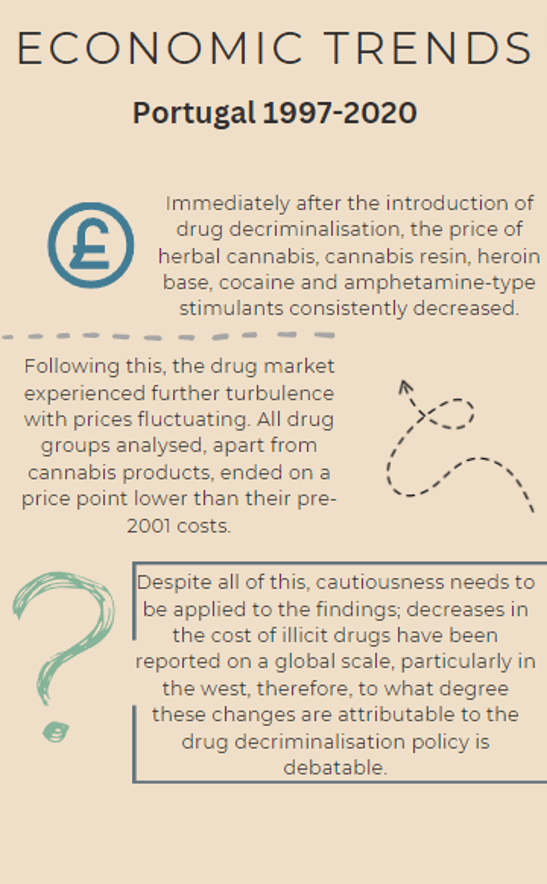


Some Final Comments and Conclusions:
Generally, my research found that Portuguese drug decriminalisation correlated with effects that can be seen as positives. Of course, my research needs to be looked at critically, I don’t claim that all of the societal indicators are directly attributable to the drug decriminalisation policy, however, the correlations that were found are promising. Policy is always a really complex, multi-faceted topic and it would be simplistic to suggest otherwise.
So is a drug decriminalisation policy likely to happen in the UK? The short answer is probably not very likely at all. My discourse analysis pointed towards five decades of debate which was hyper focused on a law and order approach to drug use, a fixation on low level cannabis use and an insistence on the idea that deterrence measures and the war on drugs is actually working. The debates felt stagnant, with new and progressive approaches being hindered by penal populism and ‘tough on crime’ stances.
During my research I found some really interesting reads and different points of view that I hadn’t considered before. I’ve listed some of my favourite pieces below if you’d like to have a read further into this subject.
- Cebral T.S. (2017) “The 15th anniversary of the Portuguese Drug Policy: Its history, its success and its future,” Drug Science, Policy and Law, 3. https://doi.org/10.1177/2050324516683640
- Eastwood, N., Fox, E. and Rosmarin, A. (2016) “Portugal,” in A quiet revolution: Drug decriminalisation across the Globe. London, UK: Release drugs the law and human rights. https://www.release.org.uk/sites/default/files/pdf/publications/A%20Quiet%20Revolution%20-%20Decriminalisation%20Across%20the%20Globe.pdf
- Goldstein, P.J. (1985) “The drugs/violence nexus: A Tripartite Conceptual Framework,” Journal of Drug Issues, 15(4). https://doi.org/10.1177/002204268501500406
- Jacques, S. and Allen, A. (2015) “Drug market violence: Virtual anarchy, police pressure, predation, and retaliation,” Criminal Justice Review, 40(1). https://doi.org/10.1177/0734016814553266
All of the data used is available from The Hansard Archives, European Monitoring Centre for Drugs and Drug Addiction, European Centre for Disease Prevention and Control and The World Prison Brief. Also, I used Taguette to analyse my qualitative data, it’s totally free and it was so useful.

Share this:


What cost justice? What crisis?
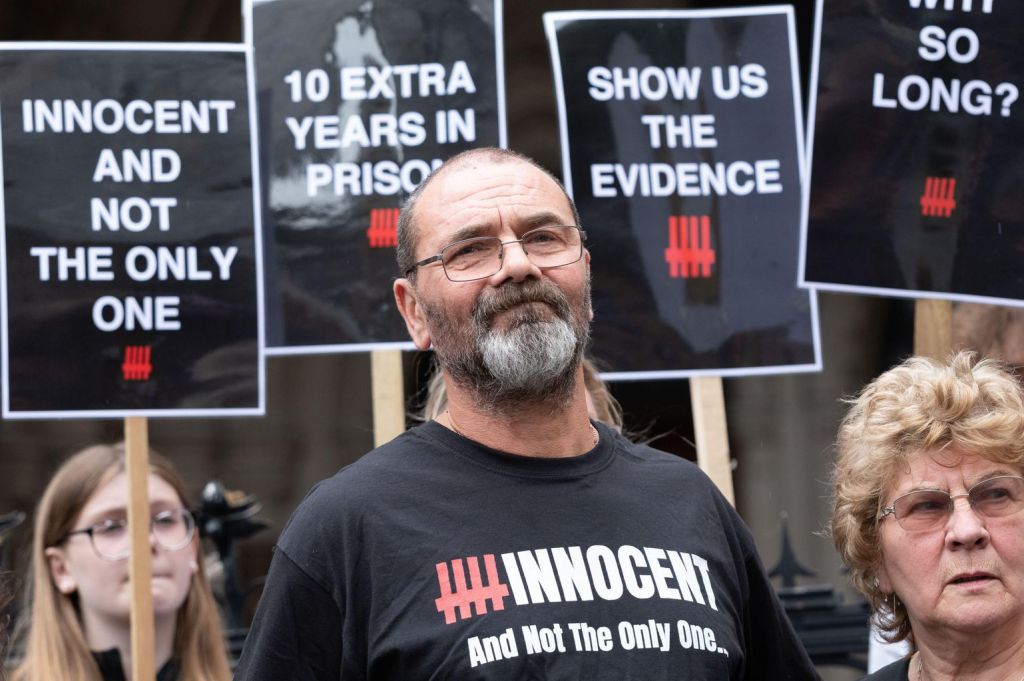
The case of Andrew Malkinson represents yet another in the long list of miscarriages of justice in the United Kingdom. Those that study criminology and those practitioners involved in the criminal justice system have a reasonable grasp of how such cases come about. More often than not it is a result of police malpractice, negligence, culture and error. Occasionally it is as a result of poor direction in court by the trial judge or failures by the CPS, the prosecution team or even the defence team. The tragic case of Stefan Kiszko is a good example of multiple failures by different bodies including the defence. Previous attempts at addressing the issues have seen the introduction of new laws such as the Police and Criminal Evidence Act 1984 and the Criminal Procedure and Investigations Act 1996. The former dealing in part with the treatment of suspects in custody and the latter with the disclosure of documents in criminal proceedings. Undoubtedly there have been significant improvements in the way suspects are dealt with and the way that cases are handled. Other interventions have been the introduction of the Crown Prosecution Service (CPS), removing in part, charging decisions from the police and the introduction of the Criminal Cases Review Commission (CCRC) to review cases where an appeal has been lost but fresh evidence or information has come to light.
And yet, despite better police training regarding interviews and the treatment of suspects, better training in investigations as a whole, new restrictive laws and procedures, the independence of the CPS, the court appeal system and oversight by a body such as the CCRC, miscarriages of justice still occur. What sets the Malkinson case aside from the others appears to be the failure of the CCRC to take action on new information. The suggestion being that the decision was a financial one, with little to do with justice. If the latter is proved to be true, we will of course have to wait for the results of the inquiry, then how can anyone have any confidence in the justice system?
Over the years we have already seen swingeing cuts in budgets in the criminal justice system such that the system is overloaded. Try to pop into the local police station to make a complaint of a crime, you won’t find a station open to the public. Should you have been unfortunate enough to have been caught for some minor misdemeanour and need to go to magistrates’ court for a hearing, you’ll be lucky if you don’t have to travel some considerable distance to get there, good luck with that if you rely on public transport. Should you be the victim of a more serious crime or indeed charged with a more serious offence, triable in crown court, then you’ll probably wait a couple of years before the trial. Unfortunate if you are the alleged offender and on remand, and if you are the victim, you could be forgiven for deciding that you’d rather put it all behind you and disengage with the system. But even to get to that stage, there has to be sufficient evidence to secure a prosecution and it has to be in the public interest to do so. Your day in court as a victim is likely to be hang on the vagaries of the CPS decision making process. A process that has one eye on the court backlog and another on performance targets. Little wonder the attrition rate in sex offences is so high. Gone are the days of letting a jury decide on occasions where the evidence hangs on little more than one person’s word against the other.
Andrew Malkinson and his legal representative have called for a judicial review, a review where witnesses can be compelled to attend to give evidence and documentary evidence can be demanded to be produced. Instead, the government has said there will be an independent inquiry. On a personal note, I have little faith in such inquiries. My experience is that they are rarely independent of government direction and wishes. Andrew Malkinson’s case is a travesty and the least that can be done is to have a proper inquiry. I suspect though that the Malkinson case might just be the tip of the iceberg. The Criminal Justice System is in crisis but budgetary restraint and political whim seem to be far more important than justice. We can look forward to more finger pointing and yet more reorganisation and regulation.
Share this:


Can Barbie ever be Feminist?

Barbie certainly has people talking, the commentary surrounding the film takes a variety of angles. A quick google search shows that Barbie’s ironic take on the patriarchy appears to have ruffled the fragility feathers with some viewers describing it as ‘man-hating’. I could not help but chuckle at a YouTube video titled; Barbie Bombs Innocent Families with Feminist Propaganda…because apparently, equality is such a bad idea.
There have been some superficial and tokenistic attempts to ‘diversify’ the brand. Yet, at its core the imagery of Barbie still appears to be an obvious symbol of oppressive white feminism. The Barbie doll could be seen to project the white feminine beauty ideal, and the main character within the film, Margot Robbie, appears to embody this ideal. I.e., the appearance of a white, cis-gender, heterosexual women with the wealth to be able to afford all sorts of powdery pink capitalist goods and a body type which is impossible to achieve.
In the contemporary era this ideal continues to be damaging. Even for the most privileged of women, it promotes the spending of much more of women’s income than men on items such as beauty, food and lifestyles, and encourages restrictive dieting practices, which can be damaging to physical and mental health (Naomi Wolf, 1990). For marginalised women there is damage caused due to living in a world which promotes the white privileged as normative. Some examples include, the advertising and selling of skin bleaching products to achieve this white or ‘light’ beauty ideal, to schools excluding Black and Brown school children for having afro textured hair (Emma Dabiri, 2019 and Ibram X. Kendi, 2019).
Whilst the Barbie film apparently has a dig at capitalism, the film and the merchandise sold will produce huge profits by selling this particular brand of feminism. So those interested can buy into feminism and make the capitalists happy rather than being political or radical.
Apparently, the film depicts a comedic take on the patriarchy, with Ken’s toxicity and Barbie having to deal with microaggressions when entering the ‘real world’. How far does the film go with illustrating patriarchal oppression? Is the intersectional oppression experienced by the most marginalised of women present? Does Barbie and Co have issues with femicide, police brutality, poverty, mental ill health, rape, incarceration, immigration detention, homelessness or drowning whilst in a boat whilst trying to seek refuge? Or is the patriarchy in film only palatable and profitable if it presents itself in the form of privileged women experiencing comedic microagressions?
Maybe Barbie will lead to some (probably white and privileged) people thinking more critically or feeling empowered but it doesn’t seem to be a type of feminism ‘for all people’, so perhaps it’s not feminism at all (bell hooks, 1982).
I wonder what will happen to the profits made from the film…
Note* I have not watched the Barbie film so apologies for the vague analysis and sketchy details*
References:
Dabiri, Emma. (2020) Don’t touch my hair. United Kingdom: Penguin Books.
hooks, bell. (1982) Ain’t I a Woman : Black women and feminism. London: Pluto.
Kendi, Ibram. X. (2019) How to be an antiracist. London: The Bodley Head.
Wolf, Naomi. (1991) The Beauty Myth : How images of beauty are used against women. New York: William Morrow and Company.
Share this:


The True Crime Genre and Me

I have always enjoyed the true crime genre, I enjoyed the who dunnit aspect that the genre feeds into, I also enjoyed “learning” about these crimes, and why people committed them. I grew up with an avid interest in homicide, and the genre as a result. So, studying criminology felt like it was the best path for me. Throughout the three years, this interest has stayed with me, resulting in me writing my dissertation on how the true crime genre presents homicide cases, and how this presentation influences people’s engagement with the genre and homicides in general.
With this being my main interest within the field of criminology, it was natural that True Crime and Other Fictions (CRI1006) module in first year caught my attention. This module showed me that my interest can be applied to the wider study of criminology, and that the genre does extend into different areas of media and has been around for many years. Although this module only lasted the year, and not many other modules- at least of the ones that I took- allowed me to continue exploring this area, the other modules taught me the skills I would need to explore the true crime genre by myself. Something- in hindsight- I much prefer.
I continued to engage with the wider true crime genre in a different way than I did before studying criminology- using the new skills I had learnt. Watching inaccurate and insensitive true crime dramas on Netflix, watching YouTubers doing their makeup whilst talking about the torture of a young girl, podcasts about a tragic loss a family suffered intercut with cheery adverts. This acts as a small snapshot of what the genre is really like, whereas when I originally engaged with it, it was simple retellings of a range of cases, each portrayed in slightly different ways- but each as entertaining as the next. To me, I think this is where the genre begins to fall apart, when the creators see what they are producing as entertainment, with characters, rather than retellings of real-life events, that affects real people.
Having spent so much time engaging with the genre and having the skills and outlook that comes with studying criminology, you can’t help but to be critical of the genre, and what you are watching. You begin to look at the reasoning behind why the creators of this content choose to present it in such ways, why they skip out on key pieces of information. It all makes a bit more sense. Its just entertainment. A sensationalist retelling of tragic events.
Although studying criminology may have ruined how I enjoy my favourite genre of media, it also taught me so many skills, and allowed me to develop my understating in an area I’ve always been interested in. These skills can be applied in any area, and I think that is the biggest take away from my degree. Considering I now work as the Vice President of Welfare at the Students Union– and getting some odd looks when I say what my degree was- I have no regrets. Even if I walk away from my time at university and never use the knowledge I gained from my studies, I can walk away and know that my time was not wasted, as the skills I have learnt can be applied to whatever I do moving forward.
Share this:


Reproductive Healthcare Ramblings

Reproductive health in England and Wales is a shambles: particularly for women and people who menstruate. The failings start early, where, as with most things, stereotypes and ‘norms’ are enforced upon children from GPs, schools, from parents/guardians who have experienced worse, or who do not know any different, which keep children from speaking up. These standards and stereotypes come from a male dominated health care system especially in relation to gynaecology, and our patriarchal society silences children without the children even realising they are being silenced. As a child, you are expected to go about your daily routine, sit your exams, look after your siblings, represent the school at the tournament of the week, and do all this while, for some, bleeding, cramping, being fatigued but not be expected to talk about it. After all, you are told time and time again: it’s normal.
Moving through life, women and people who menstruate face similar stigma, standards, assumptions during adulthood as they faced during childhood. There is more awareness now of endometriosis, adenomyosis, uterine fibroids, Polycystic Ovary Syndrome Condition (PCOS) to name but a few. But women and people who menstruate report feelings of being gaslighted by [male] gynaecologists, encouraged to have children in order to regulate their hormones (pregnancy and childbirth comes with a whole new set of healthcare problems and conditions), to take the contraceptive pill and deal with the migraines, mood swings, weight gain and depression which many women and girls report. Some of the above chronic illnesses impact fertility, so ‘try for a baby’ is not an easy, or even a wanted path. Diagnosis is also complex: for example a diagnosis for endometriosis takes on average 8 years (Endometriosisuk, 2023), and can only be confirmed with surgery. That relies on women and people who menstruate going to their GP, reporting their symptoms, listening to the ‘have you tried the pill’ or ‘having a baby will help manage your symptoms’: which relies on trust. Not everyone trusts the NHS, not everyone feels comfortable being dismissed by a nurse, or GP or then their gynaecologist. Especially when a number of these illnesses are framed and seen as a white-woman illness. Communities of women and people who menstruate remain hidden, dealing with the stigma and isolation that our reproductive health system carries in England and Wales. And this is not a new issue.
The reproductive healthcare for women and people who menstruate is dire. Just ask anyone who has experienced it. What then is it like for women in prison? The pains of imprisonment are well documented: deprivation of goods, loss of liberty, institutionalisation, no security, depreciation of mental health (Sykes, 1958; Carlen, 1983). The gendered pains, fears and harms less so, but we know women in prison are fearful about the deterioration of relationships (especially with children), lack of facilities to support new mothers, physical and sexual abuse, and poor mental and physical health support including reproductive health. The poor reproductive healthcare available to women and people who menstruate within society, is a grade above what is available in prisons. These women are quite literally isolated, alone and withdrawn from society (through the process of imprisonment), and for some, they will become further isolated and withdrawn via the pains of their chronic illness.
There isn’t really a point to this blog: more like a rambling of frustrations towards all the children who will journey through our subpar reproductive healthcare system, who will navigate the stigma and assumptions littered within society. To all the women and people who menstruate who are currently wading through this sh*t show, educating themselves, their family, their friends and in some cases their GPs, those people unable to speak out, not knowing how or simply not wanting to. And to those in the Secure Estate, grappling with the pains of imprisonment and having their reproductive healthcare needs ignored, overlooked or missed.
I haven’t even mentioned menopause…
References:
Carlen, P. (1983) Women’s Imprisonment, Abingdon: Routledge.
Corston, Baroness J. (2007) The Corston Report: A Review on Women with Particular Vulnerabilities in the Criminal Justice System, London: Home office.
Endometriosis UK (2023) Endometriosis Facts and Figures [online] Available at: https://www.endometriosis-uk.org/endometriosis-facts-and-figures#:~:text=Endometriosis%20affects%201.5%20million%20women,of%20those%20affected%20by%20diabetes.&text=On%20average%20it%20takes%208,symptoms%20to%20get%20a%20diagnosis. [Accessed 24th August 2023]
Sykes, G. (1958/2007) The Society of Captives: A Study of a Maximum Security Prison, Princeton: Princeton University Press.

Share this:


Navigating Clearing: What’s next?

Today marks the second day of clearing at our prestigious University of Northampton. Firstly, I’d like to congratulate those who have secured a place in the university to study their dream course, and to other applicants that are currently navigating their way through clearing, I wish you the best of luck.
Clearing may seem quite overwhelming – many of us have been there – but as you may know, it provides an alternative route for first-time applicants, those who may have missed out on offers, and those that may have missed their required grades or other reasons. For those at this stage, this blog is to provide some tips on how you can make the most of clearing:
- First, try not to panic if you have not met the grade threshold. Panic will only cause more anxiety – so relax. Remember, clearing offers plenty of opportunities – so when you make that call – ask as many questions as possible. Remember the saying, closed mouths don’t get fed. Ask for your options, think it through before you decide, and ensure a plan B.
- Make sure to have done your research about the course you are applying for. Demonstrate enthusiasm, passion, and motivation for the course during your interview (if any). Look at the university websites and academic staff profiles to see what they offer and where graduate testimonies are.
- I’m sure this is no news to you – but remember that popular courses like Criminology, Psychology, Law and others fill up fast through clearing. Wake up early, get on the call queue and maximise your choices. The admissions team at the University of Northampton is one of the quickest when it comes to processing applicants’ offers. These emails are sent within an hour after you have made your call – so ensure to set up email alerts so you don’t miss communications.
- You may find it beneficial to keep an open mind about other courses. This is so because you don’t get disappointed if you don’t get a place on your desired course or if what you are looking for is not for you after speaking to an academic. Again, ask questions.
- As I pointed out earlier, the university website should be your first call, where you will find all the necessary information regarding clearing. On the website, there is lots of support available – so make the most out of it.
- Generally, clearing often turns into a great university experience. Focus on the opportunity ahead; your effort will pay off with time, and don’t give up if your first plans don’t work out. Remain optimistic, be thorough, and embrace this next step towards your future.
Remember that the transition into higher education takes time and adjustment. Overcoming obstacles will build resilience. Progress may feel slow, but your growth is constant. Embrace uncertainty, connect with others, and take chances. By doing so, you will gain skills, knowledge, memories, and relationships to last a lifetime. Your adventure begins now – enjoy it!
Share this:


Unravelling the Niger Coup: Shifting Dynamics, Colonial Legacies, and Geopolitical Implications

On July 26, the National Council for Safeguarding the Homeland (CNSP) staged a bloodless coup d’état in Niger, ousting the civilian elected government. This is the sixth successful military intervention in Africa since August 2020, and the fifth in the Sahel region. Of the six core Sahelian countries, only Mauritania has a civilian government. In 2019, it marked its first successful civilian transition of power since the 2008 military intervention, which saw the junta transitioning to power in 2009 as the civilian president.
Military intervention in politics is not a new phenomenon in Africa. Over 90% of African countries have experienced military interventions in politics with over 200 successful and failed coups since 1960 – 1, (the year of independence). To date, the motivation of these interventions revolves around insecurity, wasteful and poor management of state resources, corruption, and poor and weak social governance. Sadly, the current situation in many African countries shows these indicators are in no short supply, hence the adoption of coup proofing measures to overcome supposed coup traps.
The literature evidences adopting ethnic coup proofing dynamics and colonial military practices and decolonisation as possible coup-proofing measures. However, the recent waves of coups in the Sahel defer this logic, and are tilting towards severing ties with the living-past neocolonial presence and domination. The Nigerien coup orchestrated by the CNSP has sent shockwaves throughout the region and internationally over this reason. Before the coup, Mali and France had a diplomatic row. The Malian junta demanded that France and its Western allies withdraw their troops from Mali immediately. These troops were part of Operation Barkhane and Taskforce Takuba. A wave of anti-French sentiments and protests resulted over the eroding credibility of France and accusation of been an occupying force. Mohamed Bazoum, the deposed Nigerien president, accepted the withdrawn French troops and its Western allies in Niger. This was frowned at by the Nigerien military, and as evidenced by the bloodless coup, similar anti-French sentiments resulted in Bazoum’s deposition.
The ousting of President Bazoum resulted in numerous reactions, including a decision by the Economic Community of West African States (ECOWAS), of which Niger is a member and is currently chaired by Nigerian President Bola Ahmed Tinubu. ECOWAS demanded the release and reinstatement of President Bazoum, imposed economic sanctions, and threatened military intervention with a one-week ultimatum. Some argued that the military intervention is unlikely, and some member states pledged support to the junta. At the end of the ultimatum, ECOWAS activated the deployment of its regional standby force but it remains unclear when it will intervene and what the rules of engagement will be. Nonetheless, the junta considers any such act as an aggression, and in addition to closing its airspace, it is understood to have sought support from Wagner, the Russian mercenary.
Amongst the citizenry, while some oppose the military intervention, there is popular support for both the intervention and the military with thousands rallying support for the junta. On 6 August, about 30,000 supporters filled the Niamey stadium chanting and applauding the military junta as they parade the crowd-filled stadium. Anti-French sentiments including a protest that led to an attack on the French embassy in Niger followed the declaration of the coup action. In the civil-military relations literature, when a military assumes high political roles yet has high support from society over such actions, it is considered as a popular praetorian military (Sarigil, 2011, p.268). While this is not a professional military attribute (Musa and Heinecken, 2022), it is nonetheless supported by the citizenry.
In my doctoral thesis, I argued that in situations where the population is discontent and dissatisfied with the policies of the political leadership, a civil-military relations crisis could result. I argued that “as citizens are aware that the military is neither predatory nor self-serving, they are happy trusting and supporting the military to restore political stability in the state. It is possible that in situations where political instability becomes intense, large sections of the citizenry could encourage the military to intervene in politics” (Musa, 2018, p.71). The recent waves of military intervention in Africa, together with anti-colonial sentiments evidences this, and further supports my argument on the role of the citizenry in civil-military relations. For many Nigeriens including Maïkol Zodi who leads an anti-foreign troops movement in Niger, the coup symbolises the political independence and stability that Francophone Africa has long desired.
Thus, as the events continue to unfold, I would like to end this blog with some questions that I have been thinking about as I try to make sense of this rather complex military intervention. The intervention is affecting international relations and has the potential to destabilise the current power balance between the major powers. It could also lead to a military conflict in Africa, which would be a disaster for the continent.
- How have recent coups in the Sahel region signalled a shift away from colonial legacies, and how are these sentiments reshaping political dynamics?
- What is the significance of the diplomatic tensions between Mali and France, and how might they have influenced the ousting of President Bazoum and the reactions to it?
- Given the surge in military interventions in politics across the Sahel region, how does this trend reflect evolving dynamics within the affected countries, and does this has the potential to spur similar interventions in other African States?
- What lessons can be drawn from Mauritania’s successful transition from military to civilian rule in 2019, and how might these insights contribute to diplomatic discussions around possible transition to civilian rule in Niger?
- Are the decisions of ECOWAS influenced by external pressures, how effective is ECOWAS’s approach to addressing coups within member states, and how does the Niger coup test the regional organization’s capacity for conflict resolution?
- To what extent do insecurity, mismanagement of resources, corruption, and poor governance collectively contribute to the susceptibility of African nations to military interventions?
- How can African governments strike a balance between improving the quality of life and coup-proofing measures, and which is most effective for preventing or mitigating the risk of military interventions?
- What are the potential ramifications of the coup on the geopolitical landscape, especially in terms of altering power dynamics among major players?
- What are the implications of the coup for regional stability, and how might it contribute to the potential outbreak of conflict and could it destabilize ongoing counterterrorism efforts and impact cooperation among countries in addressing common security threats?
- Why do widespread demonstrations of support for the junta underscore the sentiments of political independence and stability that resonate across Francophone Africa?
- Given the complexities of the situation, what measures can be taken to ensure long-term stability, governance improvement, and democratic progress in Niger?
- Ultimately, is the western midwifed democracy in Africa serving its purpose, and given the poor living conditions of the vast populace in African countries as measured against all indices, can these democracies serve Africans?
Navigating these questions is essential for comprehending the implications of the coup and the potential outcomes for Niger and its neighbours. In an era where regional stability and international relations are at stake, a nuanced understanding of these multifaceted issues is imperative for shaping informed responses and sustainable solutions.
References
Musa, S.Y. (2018) Military Internal Security Operations in Plateau State, North Central Nigeria: Ameliorating or Exacerbating Insecurity? PhD, Stellenbosch University. Available from: https://scholar.sun.ac.za/handle/10019.1/104931. [Accessed 7 March 2019].
Musa, S.Y., Heinecken, L. (2022) The Effect of Military (Un)Professionalism on Civil-Military Relations and Security in Nigeria. African Security Review. 31(2), 157–173.
Sarigil, Z. (2011) Civil-Military Relations Beyond Dichotomy: With Special Reference to Turkey. Turkish Studies. 12(2), 265–278.
Share this:


Behind the Filter: Navigating the Fine Line Between Genuine Parenting and Child Exploitation in the World of Influencers

As the world of social media influencers continues to expand, certain high-profile cases have brought the issue of mum influencers exploiting their children into the spotlight. These cases serve as cautionary tales, highlighting the potential dangers and ethical pitfalls that come with blurring the lines between personal family life and commercial partnerships. It is important to note that while the spotlight has indeed centred on ‘mum’ influencers this discussion cannot go forward without acknowledging, that we should be shaping the discussion on the way PARENTS create content online.
Mum influencers have become a powerful force in the influencer landscape. They provide a glimpse into the daily lives of mothers, discussing topics such as parenting tips, family dynamics, and the challenges of balancing work and family life. Initially, many followers were drawn to these influencers for their relatability and authenticity. This has created an opportunity for dads to also partake in the ‘business’ of family influencing as many people yearn for the whole family picture, which brings a non-traditional demographic of followers and thus an expansion of interest and growth of followers, and thus bringing the allure of financial opportunities.
As followers increase, family influencers often receive offers from brands seeking to collaborate. This is where the ethical dilemma arises – how far is too far when it comes to integrating children into sponsored content? While some collaborations may involve innocent and genuine family moments, others might push the boundaries, putting children in situations that prioritize profit over their well-being. It is essential to differentiate between content that genuinely celebrates parenthood/ family and content that exploits it. Sharing heartfelt stories, documenting milestones, and discussing the challenges of parenthood and family dynamics can be informative and supportive for other parents. However, the line blurs when children are consistently used to endorse products and/ or services in a way that feels forced or invasive.
Children of influencers often have their lives documented from birth, which raises concerns about their privacy. As they grow older, they might not consent to having their childhood experiences permanently etched into the online realm. The potential impact on their mental and emotional well-being as they come to grips with their digital footprint is a significant consideration. We all have that embarrassing childhood picture that parents have on the wall or in a photo album, however that is in the confines of their home and whose eyes view them can be monitored. The tricky nature of the internet removes that possibility. With visibility comes risk. Publicly showcasing one’s life includes exposure to not only praise but also criticism and negativity. Children that have an online presence in the capacity of being influencers can become targets of online trolls or even predators, who might misuse their images or information. Protecting children from these potential dangers should be a priority for any parent, online or offline.
My previous point made on children of influencers being documented from birth begs reflection on the concept of consent. This can be viewed in many ways; however, the notion of consent becomes murky when children are too young to understand the implications of their online presence. While some influencers argue that their children enjoy being part of the content creation process, it is challenging to gauge how much choice a young child truly has. Blurring the lines between what is a personal family moment and what is a scripted advertisement can complicate this matter further.
As family influencers grapple with this dilemma, there’s an increasing call for responsible content creation, and thus drawing clear boundaries between what is acceptable and what crosses the line into exploitation. Making conscious decisions about the type and frequency of content involving children and avoiding situations that compromise their well-being for the sake of likes, shares, and sponsorship should be paramount, but in many ways, this does not always seem to be considered. There are many examples that come to mind, but for this blog entry I will use a particularly shocking case. In 2020 YouTubers Myka and James Stauffer faced backlash after publicly announcing the decision to “rehome” their adopted son with autism. The Stauffer family, known for their parenting content, had initially garnered support for their adoption journey. The family seemed like any other online family that people aspired to be like. They had four biological children and presented their happy loving family for all to see. However, the revelation that they had monetized the adoption process through sponsored content and merchandise raised concerns about the child’s well-being and whether he was being exploited for financial gain. The backlash following their announcement saw them lose thousands of followers. While there were numerous followers and news outlets that spoke out against the Stauffer’s actions, there was little commentary that focused on the impact that the ‘rehoming’ of their adopted son had on him or their other children. The children should have been at the centre of this story but instead they were pushed to the side.

This blog entry servers as poignant reminders of the potential pitfalls in the world of family influencers and their children. While some cases may involve genuine oversight, it’s essential for influencers and brands to exercise caution and ethical responsibility when involving children in their content.
As influencers strive to maintain authenticity while navigating commercial opportunities, it is crucial that they strike a balance between sharing genuine family moments and protecting the well-being, privacy, and dignity of their children. In a landscape where the line between public and private blurs, parent influencers must remember that their children’s well-being is paramount. Instead of exploiting their children for financial gain, fame and clout.
Share this:


Don’t I know you from somewhere? Online trolls and other fairytales

Recently there has been a discussion if the owner of one of the social media platforms will be changing its logo. The “iconic” image is to be replaced with something new; undoubtedly this will also change in due course for as long as the medium is still relevant. Whilst people feel strong about brand representation that is something peripheral to what social media represent in recent years. Social media for a long time have been accused of harboring the worst of human interaction, tolerating intolerable actions from hate speech to incitement to violence. Is this however a fair representation of social media?
We build/cultivate and imagine in social media. They are the key to our online identity and in some ways will explain our conduct with others. Some link different media together, so that you can check Facebook to get an idea of who they are, can check their LinkedIn on education and work experience, you can read their tweets/retweets, you can follow their conversations on yammer, you can get updates of their lives on Snapchat, check their Instagram to see their photos and for the more active ones TikTok where communication is encapsulated within small video fragments. If you were to combine these social media together you can get a very good idea about a person without ever knowing them in person. Social media have ushered the era of virtual representation and people becoming clearer of how this representation works. Clearly there are those who thrive in these and others who struggle.
The ones who manage to use social media effectively can develop a personal brand and even become “social influencers”. A person that has influence over others to promote goods and services…to do so they have to build a reputation and social media works towards establishing just that. Connecting different parts of social media works to their advantage as their profile works towards their credibility of being a “real” person. The people who make it become the protagonists assuming the role of a hero, a modern-day prince/princess with a back story that is endearing. Whilst they drip feed their story of adversity with personal details of some private aspects of their lives, they also provide their followers with the commodities that they promote. I lost someone important to me, had a terrible experience at school, faced health problems but look at my stylish hat. These are the cargo trousers I left an abusive relationship in, and my cropped t-shirt is a strong statement to being environmentally
sensitive. Obviously, I deliberately exaggerate the statements here and in fairness no one will be (at least I hope) so deliberate in their product placement. What is very clear is that our social media influencers spend a significant amount of time building content and by devoting more time to that they need the necessary financial support. The top influencers have millions of people following them, a reach that
very few people have ever had before. Never before, a young person offering make-up tips, a reality star or a dancer had so many people interested in their lives. The very top of them have more than 500 million followers and we are close to the point that some of them will be reaching over a billion! What started as a personal (cottage) industry of one topic issue, has evolved into an all-consuming enterprise. The more the followers, the greater the demand for additional information. The more information, the more exposed the influencer becomes. Then marketing follows as the reward. The heroes of social media have to find ways to make an income and endorsing products seems to be the main way to do so.
The kingdom of social media doesn’t only contain heroes; there are also villains in the story. The people whose profile is not personal, doesn’t include any private details and who seem to have as their main focus to attack others. The term troll appeared in the early 90s when online identities seemed to be separate from our social ones. It was expected in a new domain that people will assume roles and whilst some went for the hero of the community others took a different turn. The early trolls under the protection of cyber identities hid their frustrations and brought to the community something we have in the real world, bullying. The evolution of social media that requires a different presence and the rules the internet community tried to deal with them meant that some of the original forms of trolling started disappearing, but were never extinguished. In fact, they became an equally useful commodity, almost equal to the influencers. Our heroes play the part of the product promoter; they look good and provide us with goodwill stories; on occasion when the appeal of the hero wanes, and people try to use social media to mobilise on social issues or promote alternative stories that’s when the trolls come in!
Out of their caves they come, trying to shut down conversations, mislead people and even intimidate people into silencing them.
This brings me to the main point of this blog; originally the internet seemed to be a worldwide phenomenon that was all inclusive and slightly anarchical. People found on the internet a companion, an ally, an adversary. It became a foundation for a virtual ecumenical community. Well, that was until big business moved in and brought in their usual tactics. The cyber world became more like our physical world and the cyber identities were quickly replaced by professional ones. At this point the internet is much more regulated and monitored than ever before. Which begs the question; how come there are so many accusations of misinformation, and intimidation now? How come such a regulated medium allows bullying and intimidation to continue? I am astounded even now to see on social media reactions on social medial about stories that do not simply lack social sensitivity they are intentionally inflammatory to coax reactions and offend people. I am still astounded to see the political alliances of the troll army and their reactions to open conversations. Therefore, it is not surprising that several minority groups have accused social media of doing very little to protect them from attacks and the use of pejorative language that has its place in a history of shame. Maybe because social media provides a fairytale with princesses and trolls, they do not have the space for those who do not promote a marketed lifestyle. Life is surprisingly diverse, and marketing is only one side of it. Ignoring some of the bigger social issues, using
trolls to shut down the conversations our global community needs, will not do. In academia the sign of a good debate lies in the ability to bring in evidence and support all claims with accurate and relevant information. Some of our colleagues are trying to take some of their knowledge outside the classroom into social media; I salute them, as we have been trying to engage as much as we can, but I also worry that the actual model that social media is built upon also at fault. Maybe it needs some rethink; there is no question that we are all equal, but we do not all have the same knowledge.

Share this:


Reflecting on Research Access

I am currently undertaking a part-time PhD and, as part of my qualitative research project, I need to keep a reflexivity diary, reflecting on my own position in relation to the subjects of my research. My first entry reflects on the process of negotiating access, and I thought it might make an interesting subject for a criminology blog!
As a reflexive qualitative researcher it is important constantly to reflect on my own position in relation to my research and my participants. I am about to start collecting data but only after a very lengthy process of negotiating access (12 months). This process was one in which my own position and history had a significant influence.
For my first project, I am conducting detailed qualitative interviews with serving prisoners. This required approval from the HMPPS National Research Committee (NRC). As a former HMPPS employee, I thought that my inside knowledge would be helpful – indeed at a later stage, in negotiating access to specific prisons, I think it has been. However, at the stage of submitting my application for national approval my prior experience added emotional baggage.
I worked for the Prison Service for nearly 12 years. I really enjoyed working with prisoners and I also enjoyed the camaraderie of working within the tight community of a prison. I worked with some lovely individuals who were dedicated to helping people and who supported me personally in my career. However, the Prison Service is a large, unwieldy organisation and large unwieldy organisations do not always treat individuals well. There were several times in my career when I felt that the organisation had treated me badly: when a recruitment freeze was introduced just after I passed the assessment centre so that I was stuck in limbo without a permanent job; when the in-house MSc was abolished (with no replacement) just before I was due to start it; when I ended up taking on my boss’ responsibilities as well as my own with no promotion or increase in pay; when my request to work part-time after maternity leave was declined; when my post was put on the “surplus list” during a phase of job cuts. It was not all negative – as I say, I enjoyed the work very much, I was proud to be a prison psychologist and there were times when the organisation was good to me (I eventually had a different distance learning MSc funded by the Prison Service, and I was able to take a 12 month career break following my maternity leave) but those negative incidents felt like personal insults when I was working hard. The biggest kick in the teeth came more recently in 2020 when I applied to re-join HMPPS when my tenure on the Parole Board came to an end. I had an unremarkable remote interview and was then turned down. I knew that HMPPS advertised for qualified psychologists every month, so there were plenty of vacancies – that they didn’t want me when I knew I was a good psychologist and had already given them the best years of my career really hurt.
Since then, I have started my PhD and secured a great job with St Andrew’s Healthcare which suits me better and has taken me in a new direction. The memory of the rejection was still lingering, however, when my initial research application to the HMPPS NRC was rejected. I felt like they were kicking me in the teeth again. My initial application was for a piece of research with both a quantitative and a qualitative element. The feedback in relation to the quantitative project was so devastating that I scrapped this part of the research altogether and focused on the qualitative part only. To be fair, the feedback was justified and the re-written proposal is for a much more methodologically sound piece of research, but it still felt personal at the time.
Conducting research during a pandemic is not easy. By the time I had responded to the NRC feedback and was ready to re-submit, there was a resurgence in COVID-19 cases and the NRC were not accepting any further applications. I was advised not to re-submit until applications were being accepted again, otherwise I would have been rejected with no chance to re-submit again. This caused a three-month delay and I had to chase to find out when applications re-opened. When I finally re-submitted, my application was not rejected, but I did receive a long list of requests for further information. Some of these seemed very petty. Responding to them was a significant piece of work and the sense of personal rejection and being made to jump through hoops returned. I was very grateful to one of my supervisors who read my responses before I submitted them and helped to remove the irritation that was evident!
Having submitted the answers to these further questions I waited for ages for a reply. By this stage, I was on first name terms with the reviewer on the NRC. She had sent my application for further feedback from the HMPPS Interventions Team (one of whom I had worked closely with in the past). I was given further questions to answer (which seemed to miss the point of what I was trying to achieve). I tried my hardest to remain positive and to suppress the irritation. HMPPS had the power and were entitled to it. They had every right to reject my research application. Just because I had been a good employee in the past, did not oblige them to give me research access. I resigned myself to receiving a final rejection and started to think of other ways to explore my research questions. And as I reached this point of acceptance, I finally received a positive response saying that my application had been accepted!
Since then, things have moved quickly. I revised my University ethics application in the light of all the amendments I had made following the HMPPS feedback and this was quickly approved. I approached individual prisons for specific access and received positive responses from HMP Grendon and HMP Onley – in these cases possibly reaping the benefits of personal connections from my time in the Prison Service. I will be going into HMP Grendon in early January to start to recruit participants. I no longer work for HMPPS or for the Parole Board, but my status as a Forensic Psychologist and as a former HMPPS employee and Parole Board member will have an influence on my relationships with participants. They will have had experiences with psychologists (and may have had experiences with the Parole Board) which may be positive or negative and which may facilitate or hinder trust in me as a researcher. I will need to look out for these influences and reflect on them as the research progresses.

 Thoughts from the criminology team