
Home » Criminology (Page 13)
Category Archives: Criminology

Meet the Team: Angela Charles, Senior Lecturer in Criminology

I would like to take this opportunity to say a warm hello to my colleagues and to the students at the University of Northampton.
I am Angela Charles, a senior lecturer in criminology. I have a passion and deep interest in this discipline for a number of reasons. Firstly, criminology is such a fascinating and thought-provoking subject that is constantly evolving and expanding. Secondly, criminology is a subject where I believe social justice can be fought for and in many cases achieved, through researching and gaining evidence to push for change, and through perseverance. Thirdly, criminology requires us to discuss, debate, analyse and build on what has been previously argued and discussed; thereby strengthening, tweaking or dismantling and rebuilding previous theoretical knowledge and criminological concepts.
My research interests are within prisons and penology, and race and gender. My most recent research explored and analysed the experiences of Black women in English prisons, paying particular attention to the intersections of race, class and gender. Black women are at the margins of society and face multiple intersecting oppressions. The prison is arguably a microcosm of society and perpetuates the same oppressive structural inequalities. It is often these racialised and gendered pains of imprisonment that are rarely discussed or mentioned both within scholarly literature and the public realm more widely. I hope to disseminate my research in the coming years and amplify some of the voices of Black women in UK prisons.
I’m also keen to explore research methods that arguably move away from traditional research methods and instead aim to decolonise research methods. Criminologists need to adapt the methods they use to suit the differing backgrounds and cultures of the participants that we research, and we need to incorporate different cultural aspects into the research process. I believe this not only will create richer data, but will also increase participant engagement as they become co-producers of knowledge.
Lastly, I look forward to working closely with my colleagues to learn about their research interests, passions and to collaborate on ensuring that studying criminology is enjoyable, rewarding and insightful at the University of Northampton!

Share this:


Journeys Through Time: From British Empire’s Transportation Punishment to Contemporary Immigration Challenges
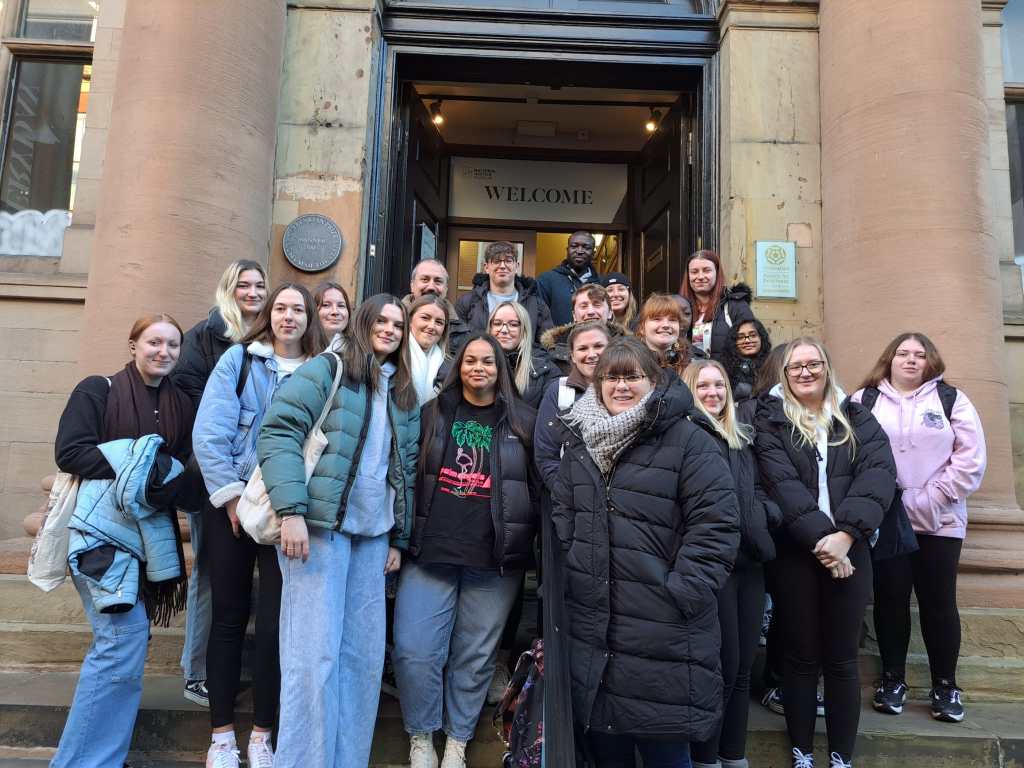
On November 29, 2023, our level 5 criminology students embarked on a visit to the National Museum of Justice in Nottingham. The trip had multiple objectives, including providing students with an out-of-classroom understanding of archives, immersing them in the crime and justice model in Britain from the 1840s to the 1940s, exposing them to rich historical records, deepening their understanding of archival research materials, and offering them first-hand experience on the treatment and conditions of suspected and convicted individuals in the past.
The museum, a vital historical site, not only facilitates reflection on the history of crime and justice in Britain but also offers an opportunity to ponder the trends and trajectory of changes since 1614.
Among the myriad opportunities for learning and research, transportation stood out for me. This form of punishment, prevalent in the British Empire from the 17th to the mid-19th centuries, forcibly removed convicted individuals from Britain to penal colonies, primarily in North America and later in Australia. This severe punishment involved separating convicts from their families and homeland, subjecting them to harsh and unfamiliar environments. Notably, individuals as young as nine were sent to America in 1614, with sentences ranging from 7 to 14 years or life. In addition to its punitive aspect, transportation provided forced cheap labour for the British government in exploited colonies, contributing to the expansion of the British Empire.
The deplorable conditions during transportation, its impact on the history of Australia and other colonies, and its role in the development of a unique convict society underscore its harsh and brutal nature. Despite its significant role, transportation was gradually abolished in the mid-19th century due to growing unpopularity and expense.
The historical context of transportation as a punitive measure serves as a backdrop for understanding current immigration and eviction plans in the UK, particularly concerning refugees and asylum seekers arriving in small boats. Though transportation was phased out in the mid-19th century, the echoes of forcibly moving individuals can be juxtaposed with contemporary immigration policies.
The British Empire’s transportation punishment, involving forced removal to distant penal colonies, parallels the challenges faced by today’s refugees and asylum seekers. While historical transportation was driven by criminality, current immigration plans involve vulnerable populations seeking refuge and safety, raising uncertainties about the safety they can find in Rwanda.
Examining the deplorable conditions of transportation provides a lens to scrutinize the humanitarian aspects of current immigration policies, emphasizing the toll on human life, challenges during migration, and impacts on indigenous populations.
Both transportation and the Rwanda plan share a common objective of removing unwanted individuals from British society, albeit for different reasons. Transportation aimed to punish criminals, while the Rwanda plan intends to deter dangerous journeys across the English Channel.
However, both policies face criticism from human rights groups, asserting their cruelty and violation of international law. Despite this, steps to implement the Rwanda plan are underway, indicating a willingness to sacrifice the well-being of vulnerable individuals for political expediency. The parallels between transportation and the Rwanda plan serve as a stark reminder of the dark side of British history, with asylum seekers and refugees sent to Rwanda facing the prospect of indefinite detention and potential persecution upon return to their countries of origin.
While transportation was abolished in the mid-19th century, exploring its historical significance encourages reflection on the complexities of modern immigration and eviction plans. This analysis highlights how punitive measures, whether historical or contemporary, shape societies, impact individuals, and contribute to a nation’s broader narrative.
Share this:


A visual walk around a panopticon prison in the city of “Brotherly Love”
Conferences…people even within academia have views on them. This year the American Society of Criminology hosted its annual meeting in Philadelphia. In the conference we had the opportunity to talk about course development and the pedagogies in criminology. Outside the conference we visited Eastern State Penitentiary one of the original panopticon prisons…now a decaying museum on penal philosophy and policy.

The bleak corridors of a panopticon prison

the walls are closing in and there is only light from above

these cells smell of decay; they were the last residence of those condemned to death
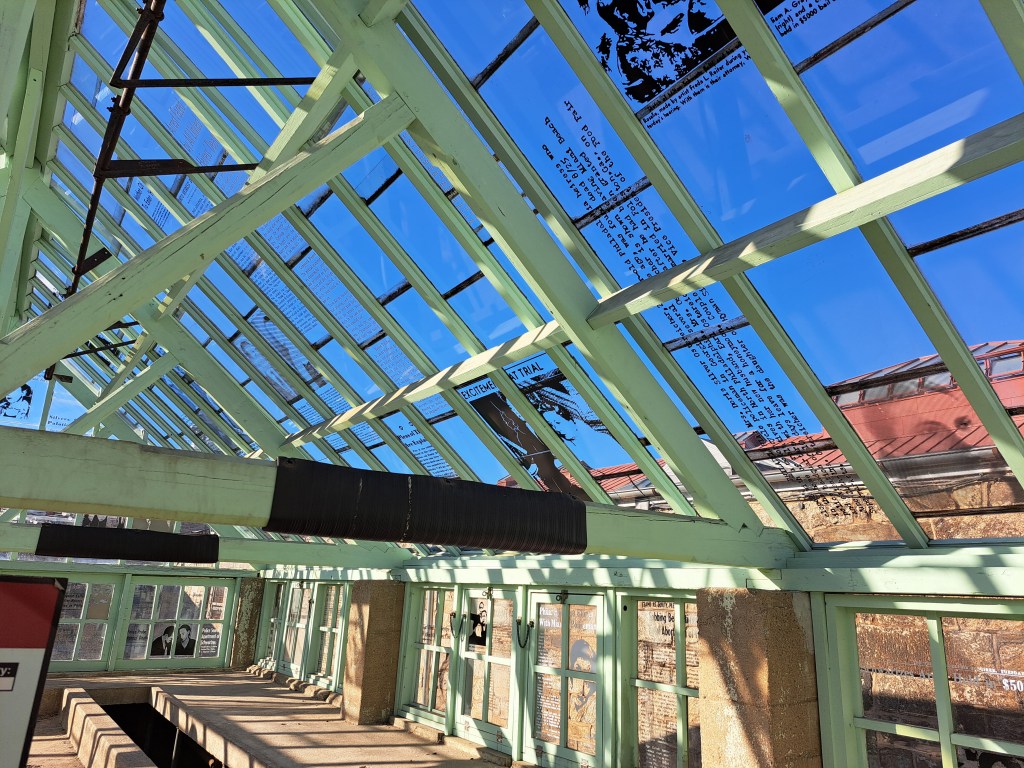
the old greenhouse; now a glass/concrete structure…then a place to plant flowers. Even in the darkest places life finds a way to persevere

isolation: a torture within an institution of violence. The people coming out will be forever scared as time leaves the harshest wounds

a place of worship: for some the only companion to abject desperation; for those who did not lose their minds or try to end their lives; faith kept them at least alive.

the yard is monitored by the guards at the core; the chained prisoners will walk outside or get some exercise but only if they behave. To be outside in here is a privilege

the corridors look identical; you become disoriented and disillusioned

everything here conjures images of pain

an ostentatious building, build back in the 19th century to lock in criminals. It housed a new principled idea, a new system on penal reform. the first penitentiary of its kind. Nonetheless it never stopped being an institution of oppression…it closed in 1970.
The role of the criminologist (among others) is to explain, analyse and discuss our responses to crime, the systems we use and the strategies employed. So before a friendly neighbour tells you that sending people to an island or arming the police with guns or giving juveniles harsher penalties, they better talk to a criminologist first.
As a final thought, I leave you with this…there are people who left the prison broken but there are those who died in this prison. Eleven people tried to escape but were recaptured. Once you are sent down, the prison owns you.
Share this:


In Praise of Howard S. Becker (1928-2023)

Three months ago, Howard S. Becker died at the age of 95, some of the Criminology Team reflect below on his impact.
I re-read Becker’s Outsider’s during the covid-19 pandemic. It reminded me of how Becker’s critical take on criminology helped me to understand and articulate the world in which I grew up in. Yes, street crime happens, and yes it causes victims to suffer but street crime seemed to be a survival response from the powerless aka ‘the deviants’ who were oppressed by the disciplining State and its police force. Becker’s work must have been groundbreaking at the time that it was published, and it continues to resonate within more contemporary critical theories surrounding intersectional oppressions that I am most interested in today…what a game changer!
@haleysread
I first encountered Becker’s (1963) Outsiders as an undergraduate, since then I have revisited many times. The book and the ideas within are so well-written, so accessible, allowing the reader to see criminality and criminal justice from an entirely different perspective. Although profound, it is not this Becker text which is closest to my heart, for that we go to 1967 and the publication of his article ‘Whose Side Are We On?‘ It is this succinct piece of writing that allowed me to understand that criminologists can never be neutral, they have to take a side. Furthermore, they must always be on the side of the powerless and never the powerful. The Criminal Justice System [CJS] and all of the agents within it, are working within and for the State and thus have plenty of supporters. Individuals in their engagement with the CJS, do not have the same support or protection, they are always outnumbered and out resourced. If we truly want to gain a holistic understanding of deviance and criminality, Becker (1967) is very helpful.
Alongside, his writing around crime and deviance, Becker also identifies the importance of language and writing style, to research practice. In Writing for Social Scientists (1986) and Tricks of the Trade (1998) and Telling About Society (2007) offers clear, practical guidance and comfort for uncertain scholars (whatever level of study).
Finally, we need to mention Becker’s music, his beloved jazz which provides the soundtrack to a scholarly life well lived, which means you can study his life’s work (both written and aural) simultaneously. A unique man, whose impact will be felt by criminologist and other social scientists for a very long time.
@paulaabowles
In 2006, during my undergraduate studies in sociology, I was introduced to Howard Becker’s labelling theory. While it marked a significant departure from the traditional explanation of deviance, it sparked lively debates among my peers. I distinctly recall vehemently opposing the theory’s practical application in Nigeria, my home country. Some of my peers argued passionately, citing numerous examples of deviance, including instances of crimes of the powerful. They contended that corruption and the misappropriation of public funds in Nigeria were products of eroding social values, driven by immense societal pressure on political officeholders to maintain an image of ‘big men.’ No doubt, Becker had a point on this and despite my initial reservations about labelling theory, Becker’s scholarly contributions have undeniably been influential in shaping both my sociological imagination and my criminological lenses. So long to a respected scholar!
@sallekmusa
It is impossible to list eminent criminologists without at least giving a nod to Howard Becker, although I would suggest a nod is far from sufficient. Becker it seems to me had the ability to write meaningful texts that could be understood by all. Of course his narrative in Outsiders is a product of its time but much of it is still applicable today. I first read Outsiders as part of my undergraduate degree and much of resonated and yet as with all great work, it doesn’t explain everything. What it does though is provide a very different perspective on deviance and society as a whole. In his later work Becker discussed labelling stating it wasn’t a theory. Well worth returning to the book then just to understand that statement alone.
@5teveh
This August 16, 2023, Howard Becker died. He was a 95 years old social scientist/sociologist (depending on who you will ask) with a long and significant legacy on his tome of work. My colleagues above predictably chose Outsiders as representative sample of his work. Not surprising really considering this was one of his seminal pieces of work that articulated the basis of theories that sociologists, criminologists and other social scientists based their own theories and understanding on social reality. His work on labelling theory became a significant influence on criminologists who tried to understand the relationship between postmodernity and deviance. It comes as no surprise that his influence to those who followed him in academia was so important.
What I thought most fitting was to concentrate on one of his latest papers written a few years ago when he was 91. In the midst of the pandemic with the lockdown and the great uncertainty it ensued Howard retreats to what he knows best; to be a social scientist and contextualise his observations the best way he knows. The paper in a praise of neighbourhood spirit and collective consciousness under the guise of urban sociology. Howard Becker is very reflective of his location, the history of the place and its social development and it is a testament of the importance of interactionism and positionality.
Using personal experience his paper “In San Francisco, when my neighborhood experiences pandemics” Becker retains his criticality as a social scientist, using observations and personal narratives to humanise an inhuman and repressive situation. People around him become actors in the crisis especially to those who as more in need and his impressions give us a snapshot of the time. In his own words “Those of us who do social science to be ready to observe life around us” a legacy to all of us that social situations continuously challenge us to explore things differently. That is because “social life does the experiment for us”. One of his last lessons on “life goes on” is so important to the sociology of everyday life.
This paper may not have the significance of some of his earlier work but it is a testament of what a restless mind can produce. He was able to record a situation that in years, decades to come, people will write about it and its impact. Yet, despite his age, his writing remained fresh, current and relevant. In academic terms he was the eternal teenager. Solon of Athens once said “Γηράσκω αεί διδασκόμενος” “I grow old while always learning” projecting that the pursue of knowledge is continuous and lifelong. In Howard Becker this seemed to have been the case. Thank you for your company all those years in the libraries, the seminars, the essays that we read you, thought of your ideas and talk about them. Goodbye to the social scientist, the thinker, the philosopher, the person.
@manosdaskalou
Share this:


What value life in a far-off land?

Watching the BBC news and for that matter any other news broadcast has become almost unbearable. Over the last three weeks or so the television screen has been filled with images of violence, grief, and suffering. Images of innocent men, women and children killed or maimed or kidnapped. Images of grieving relatives, images of people with little or no hope. And as I watch I am consumed by overwhelming sadness and as I write this blog, I cannot avoid the tears welling up. And I am angry, angry at those that could perpetuate such crimes against humanity. I will not take sides as I know that I understand so little about the conflict in Israel, Gaza, and the surrounding area, but I do feel the need to comment. It seems to me that there is shared blame across the countries involved, the region, and the rest of the world.
As I watch the news, I see reports of protest across many countries, and I see a worrying development of Islamophobia and Antisemitism. The conflict is only adding fuel to the actions of those driven by hatred and it provides plenty of scope for politicians in the West and other countries, to pontificate, and partake in political wrangling and manoeuvring before showing their abject disregard for morality and humanity. The fact that Hamas, as we are constantly reminded by the BBC, is a proscribed terrorist organisation, proscribed by most countries in the west, including the United Kingdom, seems to give carte blanche to western politicians to support crimes against humanity, to support murder and terrorism. How else can we describe what is going on?
The actions of Hamas should and quite rightly are to be condemned, any action that sees the killing of innocent lives is wrong. To have carried out their recent attacks in Israel in such a manner was horrendous and is a reminder of the dangers that the Israeli people face daily. But the declaration by Israel that it wants to remove Hamas from the face of the earth would, and could, only lead to one outcome, that being played out before our very eyes. The approach seems to be one of vengeance, regardless of the human cost and regardless of any rules of war or conflict or human dignity. How else can the bombing and shelling of a whole country be explained? How else can the blockading of a country to bring it to the brink of disaster be justified? How do we explain the forced migration of innocent people from one part of a country to another only to find that the edict to move led them into as dangerous a place as that they moved from? There seems to be a very sad irony in this, given the historical perspectives of the Israeli nation and its people.
We don’t know what efforts are going on behind the scenes to attempt to bring about peace but the outrageous comments and actions or omissions by some western politicians beggar belief. From Joe Biden’s declaration ‘now is not the time for a ceasefire’ to our government’s and the opposition’s policy that a pause in the conflict should occur, but not a ceasefire, only demonstrates a complete lack of empathy for the plight of Palestinian people. If not now, at what time would it be appropriate for a ceasefire to occur? It seems to me, as a colleague suggested, politicians and many others seem to be more concerned about accusations of antisemitism than they are about humanity. Operating in a moral vacuum seems to be par for the government in the UK and unfortunately that seems to extend to the other side of the house. Just as condemning the killing of innocent people is not Antisemitic nor too are the protests about those killings a hate crime. Our home secretary seems to have nailed her colours to the mast on that one but I’m not sure if its xenophobia, power lust or something else being displayed. Populism and a looming general election seems to be far more important than innocent children’s lives in a far off land.
The following quote seems so apt:
‘…. politicians must shoulder their share of the blame. And individuals too. Those ordinary citizens who allowed themselves to be incited into hatred and religious xenophobia, who set aside decades, sometimes centuries of friendship, who took up sword and flame to terrorise their neighbours and compatriots, to murder men, women, and children in a frenzy of bloodlust that even now is difficult to comprehend (Khan, 2021: 323).’[1]
If you are not angry, you should be, if you do not cry, then I ask why not? This is not the way that humanity should behave, this is humanity at its worst. Just because it is somewhere else, because it involves people of a different race, colour or creed doesn’t make it any less horrendous.

Khan, V. (2021) Midnight at Malabar House, Hodder and Stoughton: London.
[1] Vaseem Khan was discussing Partition on the Indian subcontinent, but it doesn’t seem to matter where the conflict is or what goes on, the reasons for it are so hard to comprehend.
Share this:


The Importance of Lived Experience in Making Change
***There is a content warning for this post as it briefly mentions self-harm***
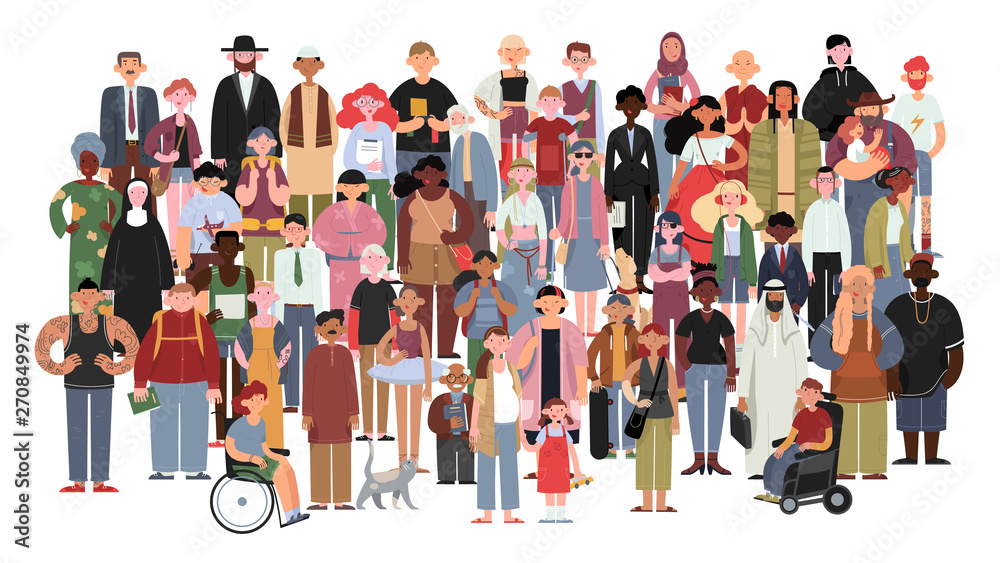
I am a mature student entering the 3rd year of my degree, joint honours psychology and criminology. My choice in academic study (and hopeful career path) is largely informed by my own life experiences which have and will continue to be one of my biggest strengths. I have been in mental health services as a patient since my pre-teens and I have worked in a variety of mental health settings including inpatient forensic mental health and rehabilitation. My criminological interest was piqued after being a victim to violent crimes as an adult. All of this, as well as some conversations I have had with lecturers and peers over the last 2 years, has me thinking about the influence and importance of lived experiences in our academic and career choices, and the opportunities that lived experiences create for making change and battling adversity.
When we experience anything in life, big or small, positive or negative, we can gain incredible insight about ourselves and the world around us in a way that we would never have done if we didn’t have those experiences. It can change or set the trajectory of our lives. When we are in the correct place in our lives, our recovery, our minds to be able to pour from a cup that isn’t empty, we can find ourselves in an amazing place where we can help others and inspire change for those who have experienced or are likely to experience what we have. Perhaps even the ones who never have and never will. All equally as important.
Every system, service, or organisation needs to have the input from those who have experienced it from the other side. We need to know how the work is being perceived at the other end. It can be really difficult to collate feedback, especially the positive stuff, or see end-to-end results and we find that if no-one speaks up, what will be done is the easy thing, the cheap thing, or the well-intentioned but mismatched thing. Of course, we may be able to go beyond advice and become a part of a service or a voice ourselves and ‘be the change.’ We can inspire change by instilling more trust in others that we truly understand their predicament and that we have moved or are moving through it, showing them that it is possible or that they’re not alone. It can be refreshing and a huge learning experience for others in the service, as a user or provider, who may be stuck, going through the motions unequipped with knowledge of how to make change for the better, especially in sectors that can be particularly challenging day-to-day.
If I may give a personal example from when I worked on a psychiatric ward for forensic rehabilitation. I worked with many patients who felt as though it was staff vs patients, that we couldn’t possibly know what it was like for them, that we were only there because we were paid, and because they were detained against their will, we had to keep them there. I didn’t hide my personal experiences, my real reasons for being there, but no one really asked so I didn’t shout about them either. When the COVID-19 pandemic hit, for reasons of infection control, I had no choice but to obey a rule, ‘‘bare-below-the-elbow.’’ That meant I had to wear short sleeves on the ward. It meant revealing to my patients the scars I bear from self-harm. This prompted lots of questions, some less awkward than others, but it opened up so many wonderful conversations and breakthroughs. I spoke with my patients about knowing how that feels, that I’ve been on the medication they’re struggling with, and I’ve done the therapy they’re reluctant to try. It connected me to my patients and my work in such a wonderful way and meant my patients trusted me more, trusted the process more and engaged in ways they haven’t before. It meant that when decisions were made about patient care or ward processes, I could advocate from a place of empathy and understanding and in cases where people have their rights reduced or taken away, detained against their will, are vulnerable, are disadvantaged, we can’t do it enough.
Being loud about our experiences means raising awareness, breaking down stigma and stereotypes to create more inclusive and accepting societies, building supportive communities, and helping people along their path. It can serve as inspiration for people who may never have even given a thought to their experiences, things they witness or people who experience hardship and keep it under wraps.
Perhaps this even serves as a little nudge to be open to the experiences of others, to recognise and challenge your own biases, the things you may or may not understand. If you find yourself in a position to decide who to hire, interact with, which project to run; find the lived experience, consider the people who just need a little more support and feel like a little risk, because you never know what it could do. We can apply this to healthcare, criminology, charity, or anything that feels like it is our calling.
It can be such a tough and slow process, it won’t always be welcomed, it might not always work out. There may be people, services and societal norms or stigma that have an agenda or goals that don’t align with yours, not everybody likes change or will be willing to put in the effort. We may not always get the answers we are looking for because of the complex world we live in. But that doesn’t mean we shouldn’t try, right?
Share this:


Pregnancy and Lavender Fields

If being a women means that you will experience harm due to your socially constructed sex/gender, being pregnant and a mother certainly adds to this. The rose-tinted view of pregnancy implies that pregnancy is the most wonderful of experiences. There is imagery of the most privileged of mothers with their pregnancy ‘glow’, in fields of [insert flower here] holding their bumps with the largest of smiles. Outside of smiles and lavender field imagery, judgment is reserved for pregnant women who do not enjoy pregnancy. In a world of ‘equality gone mad’, it seems that whilst some pregnant women may have a variety of hurdles to face, it is presumed that they should carry on living in the exact same way as those who are not pregnant.
Maybe you lose your job upon becoming pregnant and your workplace does not provide you with sick pay when needed. Maybe it is harder for you to access healthcare and screenings due to racism and xenophobia. Perhaps it is a Covid-19 pandemic, your boss is a bit disgruntled that you are pregnant and despite the legal guidance stating that pregnant people should isolate you are told that you need to work anyway. Or perhaps you are quite ill during your pregnancy, you must try to cope and continue to work regardless, but must also hide this sickness from your customers and colleagues. Whilst at the same time it is unlikely that there are places for you to rest or be sick/ill in peace. If any time is taken off work you may then be considered as being work-shy by some. Despite it being well documented that some pregnancy related ill-health conditions, like hyperemesis, have serious consequences, such as the termination of pregnancy, death and mothers taking their own lives (with or without suitable interventions).
Before labour, if you go to the triage room screaming in pain, maybe you will need to wait some time at the reception for staff to assist you, and perhaps you may be asked to ‘be quiet’ so as to not disturb the equilibrium of the waiting room. Maybe your labour is incredibly painful but apparently you must ‘take it like a champ’ and pain relief medication may be withheld. Maybe you will receive a hefty bill from the NHS for their services due to your undocumented migrant status, refused asylum application or have no recourse to public funds. If experiencing pain post-labour, maybe your pain is disregarded, and you face life-threatening consequences due to this.
Once you become a mother maybe you are more exhausted than your partner, maybe your partner is a abusive, maybe they cannot push a pram, change nappies, calm a crying baby because of toxic masculinity. If your baby becomes upset (as they do sometimes) whilst out and about you may need a quite low sensory place to feed them, or for them to relax but there is nowhere suitable to go. If looking flustered or a bit dishevelled whilst out maybe you are treated as a shop-lifting suspect by security and shop assistants.
If you have the privilege of being able to return to work, ensure that you return within the optimum time frame as having too much or too little time off work is not viewed as desirable. Also, make sure you have some more babies but not too many as both would be deemed selfish. Whether you breastfeed or provide formula both options are apparently wrong, in different ways. If you do breastfeed and need to use a breast pump whilst returning to work you may find that there are no/or a limited amount of suitable rooms available on public transport, at transport hubs, in public venues and workplaces for using a breast pump. This, among with other factors, such as the state of the economy, the lack of/a poor amount of maternity pay, and childcare costs, make the ability to both maintain formal employment and be present as a healthy mother difficult. Notably, the differences, extent and severity of harmful experiences differ depending on power, your status and identity attributes, if your gender does not neatly fit into the white privileged/women/female/mother box you will face further challenges.
It seems that society, its institutions and people want babies to be produced but do not want to deal with the realities that come with pregnancy and motherhood.
Share this:


Proud to be kind
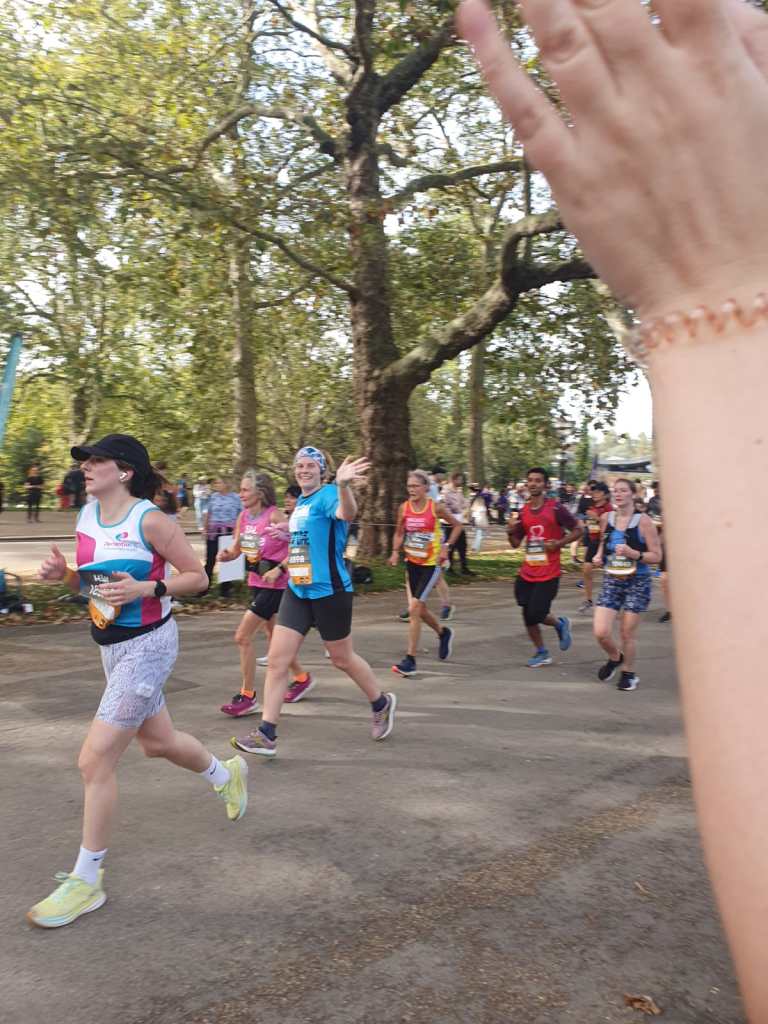
On Sunday 8th October 2023, I ran the Royal Parks Half Marathon to raise money for Freedom From Torture. It took 2hrs 11mins and 56 secs in 24 degree heat; 27 supporters who donated to Freedom From Torture to sponsor me; 5 friends who were with me on the day and kept my dehydrated spirits up; 30+ individual messages of support and encouragement on and before race day; countless well wishes and congratulations after the race; and £705 raised to rehabilitate and treat torture survivors.
The humanity and kindness shown by those who donated, checked in on me, wished me well and trained with me was overwhelming. £705 is an extraordinary amount of money and is going to make a huge difference to people’s lives who have run from torture, harm and unlawful persecution. Freedom From Torture offers, people who have experienced torture, safety and provides them with skills to be able to manage and overcome their trauma. Rooted in the foundations of this charity, and individuals that support it, is the notion of kindness, caring and wanting to live in a better world were our identities as humans are what transcends all conflict, hostility and harm in the world.
Sunday 8th October was an emotional day. Because of the focus on training (actually reaching 13.1miles/21.097km), my reasons for running and raising money for Freedom From Torture became, sort of, an afterthought- something that snuck up on me now and then rather than the focal fuel powering my legs! Even the steady influx of donations didn’t quite have the gravatas to let the reality sink in. That my silly (albeit very long) run is going to be positively impacting people’s lives! People who have experienced grave harms, displacement and social injustice. It wasn’t until the race began, where other charities and organisations were visible, being surrounded by other runners in their tops signifying who they were running for, where the enormity of the event, distance and possible impact this could have, hit home! Tears as the race begins.
Tears also followed after the race. Not to be too boastful but: I ran a half marathon! On a week where my chronic illness had seriously kicked my butt! Flash back to Thursday that week and I was concerned I wouldn’t make it to the race, let alone finish it! Once that wave of overwhelmingness passed, the next wave was not far behind. People I know and care for, and people I do not know, have banded together to support survivors of torture. Their donations will provide therapy, counselling, support for survivors of torture to manage their trauma and to be able to rebuild lives which had been destroyed. The people who donated and supported in all capacities have demonstrated incredible kindness, and the reality of what this money is going towards reduced me to yet another round of tears. But this time, tears of joy. Look what we can achieve! Look what we can do with kindness! Look what we can do when we lean on those around us!
Sunday 8th October 2023 will be a day I shall not forget. It is a day which I am immensely proud of. Not just of my running achievement, but the achievement of all those committed to making a change and providing support to those that need it. Thank you to everyone who has been with me on this journey to raise money to support survivors of torture: it couldn’t have been done without you!
Share this:

In the spirit of Black History Month

In the UK, Black History Month is celebrated annually throughout the month of October. 4 weeks are allocated to reflect on the incredible achievements and contributions of Black trailblazers throughout history, and it is a period when their remarkable works are most recognised. Of course, I do share the argument that celebrating the remarkable works of Black leaders should not be limited to one month, but to every month. I also believe that Black History Month provides a unique opportunity to focus our attention on those who have helped shape our world in their various areas of strength.
This year’s theme is “Saluting our Sisters!” and I could not be more excited to use this medium to salute and highlight some of the important Black figures who are often overlooked, ignored or unnoticed. Firstly, I’d like to salute Professor Olivette Otele, the first female Black professor of history in Britain who has continued to use her platform to expose the legacies of the past and redefining the social perception of Black women. I salute our very own Asisat Oshoala, a professional footballer who holds an outstanding 5x record of the African Women’s Footballer of the Year, and an exceptional role model for the younger generation. I salute Ramla Ali, the first female ever in history to compete in the Kingdom of Saudi Arabia in a professional boxing competition, a role model for the younger generation and has continued to use her platform to champion female empowerment. I salute Kym Oliver and Jumoke Abdullahi, who have also campaigned and shaped our thinking about the multiple layers of discrimination that Black disabled women face in societies, and to all the sisters who are breaking barriers in all aspects of their lives – I salute you all.
Education has always been an integral part of Black History Month. Through education, we manage to share awareness where, regardless of ethnicity, everyone can gain a deeper appreciation of the contributions of Black communities in many spheres of life. As part of this momentous occasion, the Black Criminology Network, in partnership with the criminology team at the University of Northampton, will host a series of webinars to celebrate Black History Month. This is a yearly practice at UON criminology, and the line-up for this year’s webinar couldn’t be stronger.
I salute our sister, Dr Leah Cleghorn from Nottingham Trent University, who on Wednesday, provided a sharp analysis of the many legacies of colonialism in the Caribbean, with a particular focus on punishment and penal systems. While deconstructing the issues of colonial-era punitive policies, Dr Cleghorn reminded us eloquently that much of the Penal Code and criminal law in Trinidad and Tobago derives from British colonial laws and in some ways, rehabilitation and reforms have been slower to take hold. Dr Cleghorn aptly called for the enhancement of therapeutic jurisprudence – as the current penal system continues to fail to meet its aims. There was so much to unpack from that lecture, and I would like to thank Dr Cleghorn for that comprehensive narrative.
I would also like to salute our sisters, Angela Charles, from Open University who will be leading another webinar on the experiences of Black women in prison on Wednesday the 18th of October, as well as Dr Janeille Zorina Matthews from the University of the West Indies, Barbados who will be exploring the recently published data on incarceration in the Anglophone Caribbean. Please follow the links to book a free space.
Apart from these webinars, the University of Northampton will also be hosting a series of other events, from Black academics and authors in celebration of Black History Month. Click here to learn more about Black History Month 2023 at UON.
Though these conversations happen year-round, Black History Month amplifies them. And while there’s still progress to be made, honouring history and showcasing Black excellence at the University of Northampton reminds us of the remarkable potential of diversity. The stories, experiences, struggles, excellence and creativity, emanating from Black History Month continue to make our community more aware, wiser, more just, and more united.
Salute to all our sisters.
| |
Share this:


Saluting Our Sisters: A Reflection on the Living Ghost of the Past
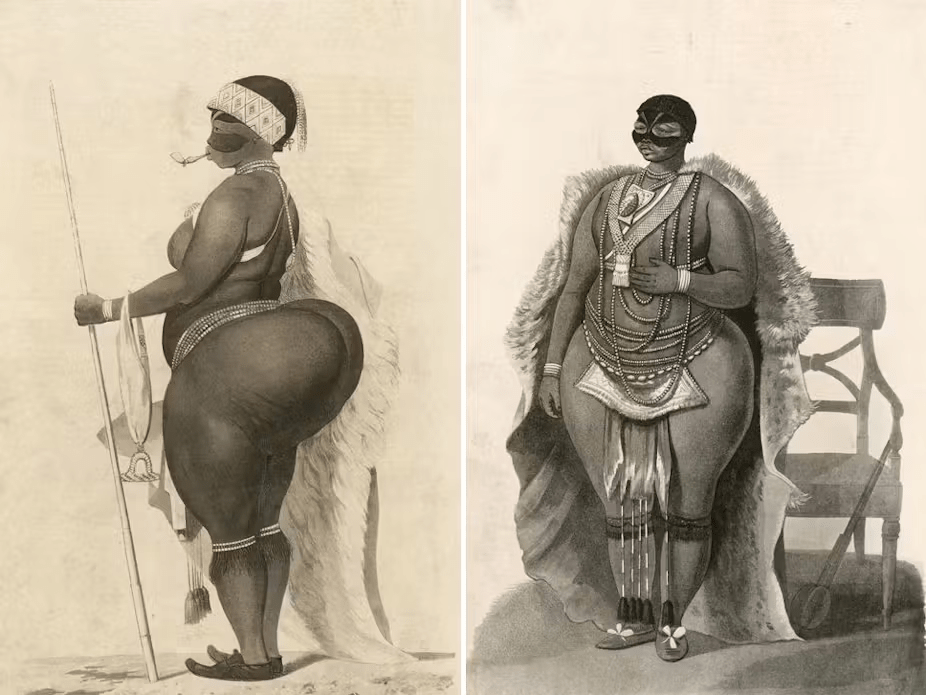
Sarah Baartman. Image source: https://shorturl.at/avLO4
In the 20th century, many groups of people who had been overpowered, subdued, and suppressed by imperialist expansionist movements under arbitrary boundaries began challenging their subjugation. These emancipation struggles resulted in the emergence of quasi-independent, self-governed African nation-states. However, avaricious socio-economic opportunists were aided into political leadership and have continued to perpetuate imperial interests while crippling their own emerging nations. Decades later, it has become clear that these ‘new states’ have become shackled under the grips of strong and powerful men who lead a backward and dysfunctional system with the majority of people impoverished while they enervate justice and political institutions.
Prior to this, the numerous nation states now recognised as African states had developed their distinct social, political, and economic systems which emerged from and reflected their distinctive norms and cultural values. Barring communal disputes and conflicts, robust inter-communal associations, interaction, and commerce subsisted amongst the nations, and paced socio-economic developments were occurring until external incursions under different guises began. Notably, the tripartite monsters of transatlantic slave trade, pillage of natural resources, and colonisation which not only lasted for centuries, disrupted the steady pace and development of these nations. It destroyed all existing social fabric and capital of the people, and forcefully installed a religious, socio-political, and economic systems that are alien to the people.
Ironically, while the transatlantic slave trade and colonialism were perpetuated under the guise of a “civilizing mission,” it took over three centuries for the “civilised” to realise that these abhorrent incursions were far from being civilising, and that they themselves required the civilisation they purported to be administering. However, while one might imagine that this awareness would lead to remorse and guilt-tripped sincere repentance for the pillage, pain, and atrocities, the abolition and relinquishing of political power to natives, the following events symbolized the contrary. Neo-colonialism was born, and international systems and conglomerates have continued the pillage on different fronts as aided by the greedy political class. Thus, it is unsurprising that yet again, strong, and powerful men are revolting against and deposing the self-perpetuating, avaricious socio-economic opportunists who wield political power against the interests of their nations in series of military coup d’état.
It is clear that the legacy of exploitation and subjugation has brought about a new set of challenges. Leaders entrusted with the responsibility of fostering prosperity in their nations often succumbed to personal gain, perpetuating a cycle of exploitation reminiscent of the imperialist era. This grim reality creates a stark contrast: while the majority of citizens are trapped in poverty, a powerful minority wields disproportionate influence, eroding the foundations of justice, economic prosperity, and political stability. As a result, for the vulnerable, seeking safety, economic freedom, and escaping from dysfunctional systems through deadly and illegal migration to other parts of the world becomes the only viable option. However, unbeknownst to many, the lands they risk everything to reach are grappling with their own challenges, including issues of acceptance and association with once labelled ‘uncivilized’ peoples.
Black History Month sheds light on these challenges faced by the black community and other marginalized ethnic groups globally. This year, the theme ‘Saluting our Sisters’ invites us to reflect on the contributions of Black women to society and the challenges they continue to face. It is also important to reflect deeply on how we consciously or unconsciously perpetuate rather than disprove, discourage, and distance ourselves from sustaining and growing the living ghost of the past. As Chimamanda urges, perhaps considering a feminist perspective in our actions, practices, and behaviour can be a powerful step toward recognizing and acknowledging how we perpetuate these problems. Dear Sister, I admire and salute you for your resilience and tenacity in making the world a better place.

 Thoughts from the criminology team