
Home » Crime and Punishment (Page 12)
Category Archives: Crime and Punishment

Criminology for Children

Helen is an Associate Lecturer teaching on modules in years 1 and 3.
Last term, my 9-year-old son’s class topic was “Crime and Punishment”. They took a historical perspective, comparing punishments across different periods of time and they began their topic with a “creative kickstart”: a visit to the National Museum of Justice in Nottingham (albeit two weeks later than planned because the bus failed to turn up!). They had a whale of a time! They were photographed with a range of gruesome artefacts and they took part in a mock trial (a re-enactment of a genuine historical case). My son’s group acquitted the defendant, Isabella, who was accused of stealing clothes, on the basis of insufficient evidence, but the other group from his school found her guilty.
Part of the class’s enthusiasm for this topic undoubtedly stems from the fascination of 9-year-old children with blood and guts. The teacher reported that they were particularly excited to learn about criminals who had been hung, drawn and quartered (although she refrained from playing them the clips from Gunpowder which depicted what this actually looked and sounded like!!). My son drew great pleasure from thinking about what it would be like if he was actually allowed to impose mediaeval punishments on his arch enemy. However, exploration of issues of crime and punishment has value far beyond satisfying a fascination for the gory.
Thinking about crime and punishment requires critical reasoning skills. What is fair? What is reasonable? How much evidence do I need? How good is this evidence? Why do we do things differently now? And critical reasoning skills are essential for navigating a world of social media, peer pressure, advertising and fake (or at least dubious) news that these children will soon be entering. My son’s class had a debate on the death penalty. When I asked him his views later, over tea, he thought carefully and told me that the death penalty was a good thing because if someone had done something really bad, they deserved a really serious punishment. It was a very good example of level two moral reasoning (Kohlberg, 1964): what you would expect from a reasonably well-adjusted 9-year-old. But the class vote at the end of the debate was split equally for and against, demonstrating a range of views. As we ate our tea, I explained my own position on the death penalty (formulated much later, when I was a post-graduate student), that there are some things that a good society just should not do and killing its own citizens, for whatever reason, is one of those things. That argument might have been a bit abstract for my son to take on board, but it is exactly through discussion and debate and exposure to different views that we develop and improve our critical and moral reasoning skills. It’s never too early to start!
Reference
Kohlberg, L. (1964) Development of moral character and moral ideology. In M. Hoffman and L. Hoffman (Eds.) Review of Child Development Research, Vol. 1. (pp. 381-343). New York: Russell Sage Foundation.
Share this:


Is education more fun than building a Lego Yellow Submarine? Discuss

This week some students, independently and across the years, introduced me to the novel idea that education should be “enjoyable” and “fun”. Furthermore, if it wasn’t enjoyable, it wasn’t being done right. Given Criminology’s subject matter is often grim, dark, focusing on the worst aspects of humankind, enjoyable and fun are not descriptions that often appear in relation to the discipline. Certainly, such a perspective is not one that I personally recognise; a day at an art gallery, playing Hungry Hippos with two little people, a nice bottle of wine, lunch with friends, building a Lego Yellow Submarine etc are things that I would say are enjoyable, perhaps even fun. But education……I’m not convinced! What follows are my vague ramblings around a subject which is very close to my heart (you are warned!).
All of the enjoyable activities I have described above are ones that I spend very little of my time doing and that to me, is part of their enjoyability (if such a word exists). They are attractive because they are rare and unusual, in my life at least. But education, learning, knowledge are part and parcel of my everyday existence, and dare I say fundamental to who am I. However, does any of this preclude education from being fun? Maybe, I just take for granted my thirst for knowledge in the same way as my thirst for water, just everyday appetites that need to be fed to maintain equilibrium and optimal performance.
I love considering new ideas and new perspectives, particularly if they challenge my thinking and jolt me out of complacency, so I want to consider this concept of enjoyable education. I’ve always been a curious person, there’s lots of questions that I want to know the answer to and they generally begin with “why”? Like all children, I expect I drove my parents mad with the constant questions; never fully satisfied with the answer. I can trace my first early, tentative steps into criminological thinking to when I was a child and regularly had to pass HMP Holloway[1] on the way to various hospital appointments. I used to wonder who lived in this huge, forbidding building, why they were there, what had they done, when would they get out and where would they go? Some decades on, I have answers to some of those questions but I’m still actively searching for the others. This, of course, is experiential learning and children’s books (at that time) offered little by way of answers to such profound criminological questions.

At school, the type of learning I liked best was when I could explore for myself. An experienced and knowledgeable teacher or lecturer explaining complex ideas could open the door so far, but I wanted to find out for myself as much as possible. For me, the best educationalists are those that gently guide and enable, not those who deliver information on demand. They also engender self-confidence and self-discipline encouraging the scholar to take control of their own intellectual journey. All of this leads me to the conclusion that learning is intrinsically neither enjoyable nor fun, although both may be by-products. Education, knowledge, learning, all of these are painful, challenging, at times they appear almost impossible. But! The level of personal satisfaction, achievement and growth means that ‘some kind of happiness is’, not as the Beatles suggest ‘measured out in miles’, but through intellectual endeavour (Lennon and McCartney, 1969). And to answer the essay question I set in the title, Lego has many charms but independent, self-direction is not one of them. Provided you follow the step-by-step illustrated instructions you will have your very own Yellow Submarine, but there are no surprises, whether positive or negative, which means I have no intellectual investment in the process. Furthermore, take the instructions away and I would not be able to recreate this “masterpiece”. Having said that, it does look rather lovely on my book case 🙂
Lennon, John and McCartney, Paul, (1969), Hey Bulldog, [LP]. Recorded by The Beatles in Yellow Submarine, Northern Songs: Apple
[1] HMP Holloway closed its doors for the final time in July 2016.
Share this:


The true message of Christmas

One of the seasonal discussions we have at social fora is how early the Christmas celebrations start in the streets, shops and the media. An image of snowy landscapes and joyful renditions of festive themes that appear sometime in October and intensify as the weeks unforld. It seems that every year the preparations for the festive season start a little bit earlier, making some of us to wonder why make this fuss? Employees in shops wearing festive antlers and jumpers add to the general merriment and fun usually “enforced” by insistent management whose only wish is to enhance our celebratory mood. Even in my classes some of the students decided to chip in the holiday fun wearing oversized festive jumpers (you know who you are!). In one of those classes I pointed out that this phenomenon panders to the commercialisation of festivals only to be called a “grinch” by one of the gobby ones. Of course all in good humour, I thought.
Nonetheless it was strange considering that we live in a consumerist society that the festive season is marred with the pressure to buy as much food as possible so much so, that those who cannot (according to a number of charities) feel embarrassed to go shopping; or the promotion of new toys, cosmetics and other trendy items that people have to have badly wrapped ready for the big day. The emphasis on consumption is not something that happened overnight. There have been years of making the special season into a family event of Olympic proportions. Personal and family budgets will dwindle in the need to buy parcels of goods, consume volumes of food and alcohol so that we can rejoice.
Many of us by the end of the festive season will look back with regret, for the pounds we put on, the pounds we spent and the things we wanted to do but deferred them until next Christmas. Which poses the question; What is the point of the holiday or even better, why celebrate Christmas anymore? Maybe a secular society needs to move away from religious festivities and instead concentrate on civic matters alone. Why does religion get to dictate the “season to be jolly” and not people’s own desire to be with the ones they want to be with? If there is a message within the religious symbolism this is not reflected in the shop-windows that promote a round-shaped old man in red, non-existent (pagan) creatures and polar animals.
According to the religious message about 2000 years ago a refugee family gave birth to a child on their way to exile. The child would live for about 33 years but will change the face of modern religion. He promised to come back and millions of people still wait for his second coming but in the meantime millions of refugee children are piling up in detention centers and hundreds of others are dying in the journey of the damned. “A voice is heard in Ramah, mourning and great weeping, Rachel weeping for her children, because her children are no more” (Jeremiah 31:15). This is the true message of Christmas today.
Happy Holidays to our students and colleagues.
FYI: Ramah is a town in war torn Middle East
Share this:


“Letters from America”: III
 For those of you who follow The Criminology Team on Facebook you might have caught @manosdaskalou and I live from Eastern State Penitentiary [ESP]. In this entry, I plan to reflect on that visit in a little more depth.
We first visited ESP in 2011 when the ASC conference was held in Washington, DC. That visit has never left me for a number of reasons, not least the lengths societies are prepared to go in order to tackle crime. ESP is very much a product of its time and demonstrates extraordinarily radical thinking about crime and punishment. For those who have studied the plans for Jeremy Bentham’s panopticon there is much which is familiar, not least the radial design (see illustration below).
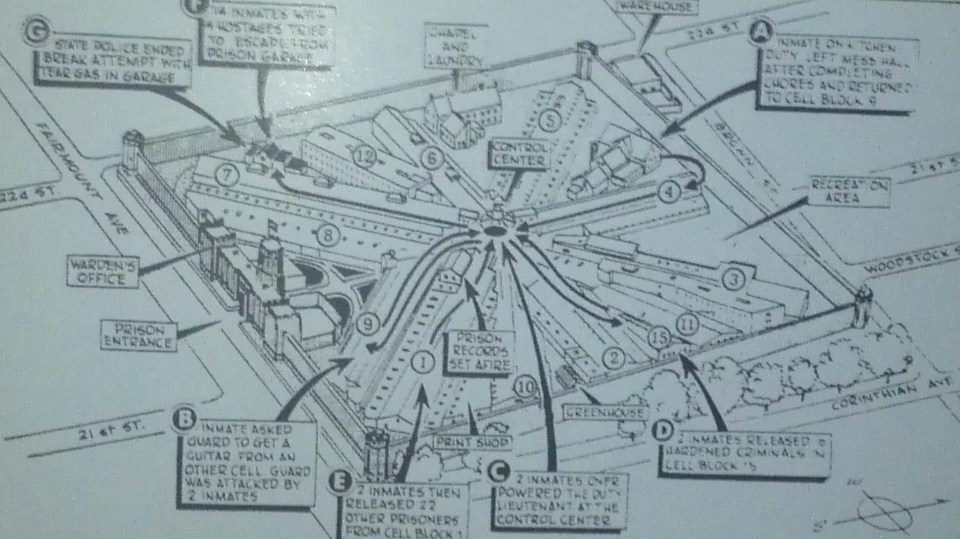
This is an institution designed to resolve a particular social problem; crime and indeed deter others from engaging in similar behaviour through humane and philosophically driven measures. The Philadelphia Society for Alleviating the Miseries of Public Prisons* was philanthropic and guided by religious principles. This is reflected in the term penitentiary; a place for sinners to repent and In turn become truly penitent.
This philosophy was distinct and radical with a focus on reformation of character rather than brutal physical punishment. Of course, scholars such as Ignatieff and Foucault have drawn attention to the inhumanity of such a regime, whether deliberate or unintentional, but that should not detract from its groundbreaking history. What is important, as criminologists, is to recognise ESP’s place in the history of penology. That history is one of coercion, pleading, physical and mental brutality and still permeates all aspects of incarceration in the twenty-first century. ESP have tried extremely hard to demonstrate this continuum of punishment, acknowledging its place among many other institutions both home and abroad.
For me the question remains; can we make an individual change their behaviour through the pains of incarceration? I have argued previously in this blog in relation to Conscientious Objectors, that all the evidence suggests we cannot. ESP, as daunting as it may have been in its heyday, would also seem to offer the same answer. Until society recognises the harm and futility of incarceration it is unlikely that penal reform, let alone abolition, will gain traction.
*For those studying CRI1007 it is worth noting the role of Benjamin Rush in this organisation.
Share this:


Do you consent to read on?

The more eagle-eyed amongst you may have spotted that @manosdaskalou and I are due to present during ‘I Heart Consent’ Week (still plenty of time to book a space!). The topic – ‘Consent in the Classroom’ is one that is close to our hearts and something we have discussed in different environments with different people. In this week’s entry I want to consider why the subject of consent is particularly important for criminologists.
An obvious area to start is research; ethics are fundamental to all of the projects we do from undergraduate all the way through to seasoned academic. Discussions around ensuring participants are able to fully engage in the process of gaining informed consent are imperative. At times this may be viewed as procedural; simply going through the motions but given the sensitivity of much criminological research it has a primacy and an urgency necessary to avoid harm.
The last few weeks have seen a flurry of accusations directed at Hollywood’s “finest” (cf. Harvey Weinstein, Kevin Spacey, Ed Westwick et al.) and government ministers and MPs (cf. Michael Fallon, Stephen Crabb, Kelvin Hopkins et al.). These often, light on factual evidence and heavy on prurient judgement, throw the spotlight once more on the issue of sexual consent. These cases are concerning on many levels and it is apparent from much of the discussion which often ensues whether on television, radio, in the newspapers or on social media, that many people are confused around the very nature of consent. Attempts have been made to counteract these lack of knowledge, often in creative ways; for example ‘Consent: It’s as simple as tea’ but looking at many of the comments, there is still a great deal of work to do. There are also wider issues in relation to consent; the absence of the victims’ consent to have their information paraded to feed the public’s desire for detail Likewise, the nature of summary justice being dispensed (e.g. expulsion from organisations, cancellation of contracts and resignations) deprives suspects of their right to defend themselves in court; there is no option for those suspected to opt for a trial by media.
Notwithstanding, the imperative to understand sexual consent, for Criminology, there is a further complication. When much, if not all crime, criminality and criminal justice, is predicated on the absence of consent, the issue becomes even more tenacious. If we consider that victims don’t consent, offenders may not consent to what ensues; certainly the criminal justice system’s [CJS] apparatus deliberately and meticulously removes consent throughout the process. Even when it comes to the professionals who work within the CJS, they may not consent, rather they are obeying guidance/policy/instructions/orders (delete as appropriate). After all, it cannot be consent if derived at the barrel of a gun, or in a police interview suite or a prison cell or when the economic situation is so bleak you are terrified of losing your job. When there is no room for manoeuvre, there can be no consent. Institutions and individuals may decide that this is a necessary price to pay in respect of crime and punishment, but that decision should never be taken without reflection.
All of the above shows the importance of consent, not only between the sheets, but in all aspects of criminology. Whatever side of criminal justice you might find yourself on, an understanding of consent is essential.
Share this:


Leave my country

One image, one word, one report can generate so much emotion and discussion. The image of the naked girl running away from a napalm bombed village, the word “paedo” used in tabloids to signal particular cases and reports such as the Hillsborough or the Lamy reports which brought centre stage major social issues that we dare not talk about.*
Regardless of the source, it is those media that make a cultural statement making an impact that in some cases transcends their time and forms our collective consciousness. There are numerous images, words and reports, and we choose to make some of these symbols that explain our theory of the world around us.
It was in the news that I saw a picture of a broken window, a stone and a sign next to it: “Leave my country”. The sign was held by an 11 year old refugee with big brown eyes asking why. This is not the only image that made it to the news this week; some days ago following the fatal car crash in New York the image of a 29 year old suspect from Uzbekistan appeared everywhere. These two images are of course unconnected across continents and time but there is some semiology worth noting.
We make sense of the world around us by observing. It is the media that are our eyes helping us to explore this wider world and witness relationships, events and situations that we may never considered possible. It must have been a very different world when over a century ago news of the sinking of the Titanic came through. We store images and words that help us define the way our world functions. In criminology, words are always attached to emotion and prejudice.
I deliberately chose two images: a victimised child and an adult suspect of an act of terror. They have nothing in common other than both appear foreign in the way I understand those who are not like me. Of course neither of these images is personally relatable to me but their story is compelling for different reasons. Then of course as I explore both stories and images, I wonder what is that remains of my understanding of the foreigner?
Last year, the satirical magazine Charlie Hebdo produced a caricature of what would little Aylan would have done if he was to grow up, presented as a sex pest. The caricature caused public outcry but at the time, like this week, I started considering the images and their meanings. Do we put stories together based on the images we see around us? If that is a way of defining and explaining our social world then the imagery of good and bad foreigners, young and old, victims and villains may merge in a deconstruction of social reality that defines the foreigner. In that case and at that point the sign next to the 11 year old may not be voiced but it can become an implicit collective objective.
*At this stage I would like to mention that I was considering to write about the media’s “surprise” over the abuse allegations following revelations for a Hollywood producer but decide not to, due to the media’s attempt to saturate one of the most significant social issues of our times with other studies with varying levels of credibility. We observed a similar situation after the Jimmy Saville case.
Share this:


We all saw it coming: Reflections on the Transforming Rehabilitation Agenda

The recent reforms to the probation service were examined in the BBC Panorama programme ‘Out of Jail: Free to Offend Again?’ The title of the programme struck me with a clear sense of ‘we told you so’ given the warnings and concerns raised by those working within the probation service and colleagues in criminology departments. Just look at #faillinggrayling on twitter – there you can chart the anxiety as the reforms were proposed and then implemented.
The programme began with the case of Connor Marshall who on a night out with friends was attacked by a stranger, David Braddon who had a history of violent offending, along with alcohol and drug misuse. Sadly, Connor died in hospital a few days after the attack and then, the details of David Braddon’s circumstances were revealed, during the review into Connor’s death. David was on probation, under the supervision of ‘Working Links’, a private consortium who took over running of probation for most of Wales, under the new Transforming Rehabilitation (TR) arrangements in 2015. TR promised radical reforms which would privatise the probation service for low and medium risk offenders, with high risk offenders still being managed under the National Probation Service (NPS). Ian Lawrence, General Secretary of the National Association of Probation Officers (NAPO) spoke on the programme about how they warned the government about the risks, due to the extensive re-organisation, costs to the taxpayer and crucially, the impact on public safety. In addition, an internal memo from the Ministry of Justice (MoJ) gave explicit warnings about the danger of the TR failing, citing that an ‘unacceptable drop in operational performance which might lead to delivery failure and reputational damage.’
Connor’s case was described in the programme as an ‘early failure.’ The phrase reminded me of the cold and calculated response when we are told the casualties of war are ‘collateral damage.’ There was a sense of acceptance of failures, given the extent of the reforms. David Braddon had a catalogue of missed appointments and non-compliance, along with becoming increasingly withdrawn, all of which should have been flagged up by those supervising him, and action taken. This reminded me of another pivotal case in probation, which highlighted the impact of over-loading probation officers and not responding properly to those offenders who are clearly at risk and not complying with their supervision. In 2008, Dano Sonnex and Robert Falmer killed two French students in south east London, in a violent attack. The Serious Case Review, focusing on Dano Sonnex, revealed a catalogue of errors, resulting in part from caseworkers in probation being overloaded and inexperienced in dealing with someone with such complex needs as Sonnex. The fact that this occurred in London was worrying when the presenter presented the views of a whistle-blower, working for MTC Novo, a company who was now delivering probation services for low and medium risk cases in London. The premise of TR was that ‘Community Rehabilitation Companies’ (CRCs) would take on expanded caseloads from widening the net for supervision to those on short term sentences, where re-offending rates are particularly high. MTC Novo and Working Links are just two examples of new CRCs now responsible for low and medium risk offenders. The programme then examined the experiences of probation, from the perspective of a service user, probation officers and those involved in inspecting the service.
Sean Grant, out of prison and living with friends reported he had very little contact with MTC Novo, his first appointment took 3 weeks to set up after his release and he had no support to get stable housing in place. He also reported his view was that the service had not improved, compared to his previous contact, and later in the programme, it transpired he was at risk of recall, due to missed appointments which he knew nothing about. This was particularly galling since he had secured work and seemed to be doing everything he needed to do to prevent re-offending, albeit with little help from the probation service.
This experience chimed with the views then given by a ‘whistle-blower’ from within MTC Novo, who reported that the company was now employing fewer fully qualified probation officers, and his caseload had risen from 50 to 76, including some vulnerable offenders who were not getting the intervention they needed. They also cited the problems associated with not having time to build a rapport, with monthly meetings of 20 minutes, asking ‘how will you open up? I don’t know them, they don’t trust me.’ It seems the long held and valued principles of the probation service to ‘advise, assist and befriend’, already eroded by risk management and efficiency drives, were now being further undermined by TR. More worryingly, the probation service as an effective means to reduce re-offending was also undermined, when the same whistle-blower referred to an ‘explosion in re-offending’, including violent offences. For others outside London, probation had become a service which staff described as a ‘mess’ and time spent with clients had fallen from 15 to 2 hours a week, and was also characterised by division and in-efficiency.
Dr Lawrence Burke, Ian Lawrence and Dame Glenys Stacey all agreed that the calls for a rethink on TR were growing louder, the service was in danger of becoming de-stabilised and of putting lives at risk. This feels very much like reform which was imposed on a service which was functioning relatively well – not perfectly – but which is now facing significant issues, all of which were meant to be addressed by TR. The harrowing cases, while still rare events, can cite the failings of probation as contributing to the serious crimes which occurred and therefore, the key aim of the service, to protect the public, is not being met. The rising prison population and especially the continued use of short term prison sentences means the service will continue to be overloaded, while CRC managers continue to cut costs to keep solvent. Therein lies a fundamental problem – making a profit through the management of offenders is not viable, sustainable, advisable or safe. The probation service, much like the NHS, the police and other public services can deliver well and do good work when it is not diverted by concerns over cost savings and trying to deal with increasing workloads.
Susie Atherton
Senior Lecturer in Criminology
Share this:


Corrosive substances – A knee-jerk reaction or a sensible solution?

Following the apparent growth in acid attacks the suggestion from Amber Rudd on a potential means of tackling the problem has all the markings of another knee-jerk policy that lacks careful planning and application. The proposal is to restrict the sales of corrosive substances and introduce new, specific legislation for possession and use of such substances against another person. The justification for these suggestions is based on the doubling of attacks between 2012 and 2016-17. Furthermore a 6 month review by National Police Chiefs Council (NPCC) report 400 acid or corrosive substance attacks between October 2016 and April 2017. The impact of such attacks is long lasting and without question, a horrific life changing experience, however is this reaction the right one for all concerned?
The plan to ban the sale of corrosive substances to under 18s in itself may be a sensible idea, if there is careful consultation on what substances are to be included in this blanket approach. A similar approach already exists with the sale of knives, tobacco and alcohol yet the extent to which these policies are a success is a moot point. Policing such an approach will also be considerably challenging because there is currently no clear outline of what the government intends to class as a corrosive substance. If the suggestions that bleach will be on the list then this may prove very difficult, if not impossible to police. Many of the corrosive substances being used today are household names readily available in most local shops and supermarkets, not to mention the internet. When purchasing items subject to restriction on the internet, the only check of age is you clicking a button to confirm it and maybe adding a date of birth, neither of which are particularly secure.
Taking this a step further the other suggestion is the creation of a new offence; possession of a corrosive substance in a public place. Such legislation is modelled on legislation already used to tackle knife offences and offensive weapons whereby a prison sentence of upto 4 years can be issues for possession, with intent to carry out an attack. However, why is such an approach necessary when perpetrators of acid attacks can already receive a life sentence under existing legislation. Is it because of the tremendous success of the approach taken to knife crime? Unlikely, if you consider the resistance by the judiciary to use such an approach which would inevitably lead to much higher prison numbers than we already have. In short, the ‘do it again…threat’ is highly unlikely to act as a deterrence when deterrence as a reason for punishment has long been questionable.
Is this another knee-jerk reaction to media hype? Evidence of another poorly considered policy response driven by political self-interest and the desire to be ‘seen to be doing something’. Many of these attacks have been linked to societies folk devils; youth or personal vendetta’s therefore rather than creating new policy, why not focus on existing measures using them to their full force and improving the services offered to the victims of these heinous crimes. Under existing legislations those convicted of an acid attack can receive a life sentences so why new legislation. Survivors also get a life sentence so surely the more appropriate response is to focus on victim’s needs (physical and psychological) rather than the creation of unnecessary legislation
Share this:


Reading is dead, long live the book

The first week of teaching is always a bit of a culture shock. The transition at the end of term from teaching to other activities and vice versa marks a change of tempo and a change of focus. For me, the summer is a time of immersion in reading, thinking and writing. All of these activities continue throughout the year but far less intensively. It’s is perhaps ironic then, that this week’s blog post has left me struggling for ideas…
Previously, I have blogged about the stresses and strains of writing, so this week I thought I might turn my attention to reading; a far more pleasurable personal experience. The first questions is why read? The simple answer is to accumulate knowledge, to find the answer to a question and to educate and entertain. Arguably, all of these purposes can be achieved far more easily by looking on the internet, getting a quick (if not always correct) answer. Why bother learning things when the internet can provide information 24 hours a day? Furthermore, who can fail to find something to entertain and amuse on the television, in the cinema or on the internet? Perhaps the death knell for the old-fashioned art of reading books is sounding with increasing urgency and volume? I disagree!
I learnt to read at around the age of 5 and very quickly I was hooked. Throughout my childhood I was teased for my seeming inability to put a book down even with eating or walking. This never dissuaded me away from the book and even when that one was finished, there would always be another one to take its place. This reading “addiction” has never left me and has meant that I have been able to explore mythical places such as Eastasia, Erewhon, Gilead, Lilliput, Manderley, Narnia and Utopia and without even leaving my armchair. I have explored America, Australia, Botswana, Germany, India, the Netherlands and South Africa to a name a few, not to mention my home city, both over ground and underground. In my reading life, I have travelled on the Orient Express, fought in the American Civil War, WWI and WWII, hidden from Nazis, as well as served prison sentences in Reading Gaol and Robben Island. I have solved crimes with Mikael Blomkvist, Scout Finch, the Famous Five and Hercule Poirot. I have felt the pains of Lady MacBeth, Jane Eyre and the second Mrs de Winter, been left unmoved by Flora Poste and Jay Gatsby and felt terrorised with Joanna Eberhart, Offred and Gregor Samsa.
Whilst the above may illustrate my love of reading, it does not really explain why it is so important to me and my career. For one, it is the only activity that really holds my concentration, particularly for extended periods of time. In the twenty-first century, where life seems so fast-paced and we jump from screen to screen, triggered by notifications as if we are one of Pavlov’s dogs, such a skill requires protection and cultivation. Second, it is intensely independent and personal; I can share stories with others, I can even discuss books in detail, but my reading is my own. Thirdly, and probably the most important for criminology is the opportunity to try someone else’s life for size. The famous line from Harper Lee; that ; ‘[y]ou never really understand a person until you consider things from his point of view – until you climb into his skin and walk around in it’ sums this up beautifully (1960/2006: 30). By reading accounts of crime, criminality, victimisation and criminal justice; even if fictionalised, we have an opportunity to test out ideas, to find out how comfortable we are with responses, actions and penalties. In particular, dystopic novels offer the unique potential to imagine the world differently. Whilst on the surface such texts, as with criminology, are presented as negative; dealing with uncomfortable, frightening and disturbing behaviours and responses, they are ultimately full of hope. The potential for change is both explicit and implicit in dystopic fiction and criminology; all is never lost, hope remains no matter what.
If you still need to be persuaded by my argument for reading everything and anything that can get your hands on, perhaps Beccaria’s words of wisdom will help ‘I should have everything to fear, if tyrants were to read my book, but tyrants never read’ (1872: 18).
And after all, who wants to be a tyrant? Not me!
Beccaria, Cesare, (1872), An Essay on Crimes and Punishments, (Albany: W. C. Little Co.), [online]. Available from: http://oll.libertyfund.org/index.php?option=com_staticxt&staticfile=show.php%3Ftitle=2193&Itemid=27 [Last accessed 24 March 2012]
Lee, Harper, (1960/2006), To Kill A Mockingbird, (London: Arrow Books)
Share this:


The black hole of danger aka online dating

Like so many other singles in the world I decided to join the realms of online dating. Little did I know what I would encounter and the subsequent conversations that would unfold in the office. So, this week’s blog is a reflection on some of those criminogenic discussions that have both amused and appalled us over the last couple of week. I have to start by saying that, on the whole, there are a lot of nice genuine people out there just looking for ‘the one’. That said, this perspective was put into question on Tuesday when I received my first ‘dick pic’. Not being someone who takes this sort of thing too seriously I giggled and deleted the person, however it raised a number of questions about behaviour and our responses to it. For example, on a personal level why was I not offended? Has this type of behaviour become the norm? Is it something that women now expect or at least accept? It’s a big step up from a wolf whistle in the street or the honking horn and leery comment shouted from the window of a passing car.
In essence this is a sex crime, whether you class it as distribution of pornographic material or indecent exposure it is a crime and therefore raises the question of whether I have a moral and or legal obligation to protect other women by reporting it. Yet here in lies the problem, firstly the most the site can or will do is to delete the user who will ultimately just create another profile, secondly in the grand scheme of things the police have neither the resources nor inclination to investigate. Whilst these are pertinent considerations, the fact that I didn’t report it but instead deleted him (and his picture I might add) has, upon reflection, little to do with the potential response and more to do with the perception of risk. The lack of physical proximity provides a sense of security, albeit tenuous, that you wouldn’t have if this happened to you in the street.
In the online world I have a relatively safe profile and I can delete or block those who cause me offence. Whilst it is true that nothing we do online is truly anonymous, there is a sense of detachment created by the lack of proximity and direct risk which can turn deviant behaviour into something abstract. Is that why someone who is otherwise a law-abiding citizen or at least not a sexual predator feels that it is appropriate to send a relative stranger such images? I do wonder whether they actually make the link between physical actions and virtual ones. I suspect that if confronted most of them would not see their behaviour as criminal or even comparable to someone who exposes himself in public.
The more concerning aspect of this is the potential emotional and psychological damage that could be done. While I spent my youth working in clubs and pubs, exposed to a range of male behaviours and thus gained the experience to navigate this terrain, can the same be said for today’s younger population for whom the internet and online dating may be the norm. This led me to consider my daughters and how to prepare them for this online version of the world that I experienced in the physical. How do I explain why guys would send such pictures to an unknown woman when I can’t even begin to fathom that out myself? How do I prepare them for the emotional roller coaster of online dating where a text message lacks the physical prompts needed to decipher it and can easily lead to confusion, misinterpretation, sexual exploitation and psychological harm. Where parenting is concerned the internet and online dating presents a black hole of danger and one which I’ll have to navigate with care if I want to protect my daughters from the ‘dick pic’ senders of the world.

 Thoughts from the criminology team