
Home » Coronavirus (COVID-19) (Page 3)
Category Archives: Coronavirus (COVID-19)

#CriminologyBookClub: Dying in Brighton
As you know by now, a small group of us decided the best way to thrive in lockdown was to seek solace in reading and talking about books. Hence the creation of #CriminologyBookClub! Building on on what has quickly become standard practice, we’ve decided to continue with all eight bloggers contributing! This title was the second chosen by @manosdaskalou and is our 14th book. Read on to find out what we thought….
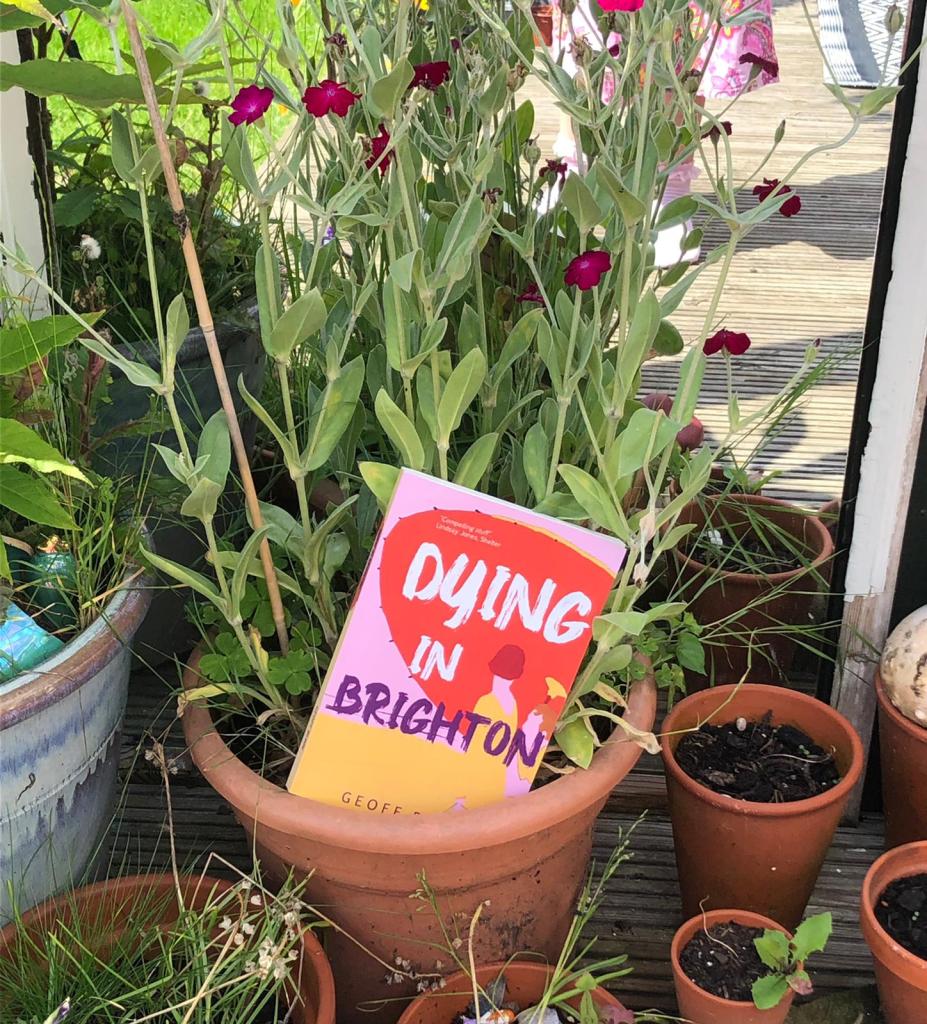
I have no profound objection to self-published books but have read only one other. The rationale for reading the first one was to proof-read/copy edit for the author. That can’t really be called reading, because you miss the story by studying the text so closely. However, I digress. The blurb for this book sounded fascinating, individual narratives heading toward one place: Brighton. Unfortunately, whilst the idea for the book was clever, the writing was overly descriptive and at times, turgid. There is no space for the reader to imagine the characters or the places, everything is told in minute detail. There is a clear attempt to be inclusive with the choice of characters, but they are largely one-dimensional and lack authenticity. The final character talks about his supposed lack of representation as a white man in Brighton (with a white population of 90%) and at that point, I lost what little interest remained. In feminist circles, the question “what would a mediocre white man do?” is prevalent, a possible response could be; write this book. The only positive I have to offer is the support offered by sales to Shelter.
@paulaabowles
The format and style of the book was unlike anything I had read before: and I really liked it. The characters were full of life: a life riddled with inequalities, harm and pain. Unlike other reads where I have failed to feel anything for the characters (or anything other than a serious dislike), Dying in Brighton evoked a number of emotions from myself towards the people in the book. However these emotions were left in a sort of vacuum, with myself feeling very ‘meh’ at the end of the book. I was disappointed with the final chapter. Whilst I can appreciate the ending and the manner in which it is told, I did not like it. I wanted to know more about how Akeem, Nicola, Wasim, Lori and Paul got to the end they got to. Considering the ‘end result’ and my emotions from the previous chapters, I feel I should have had a more powerful response to the end: but I did not. The short snippets were not enough for me: and I feel that the last chapter does not do their stories or their lives justice. Despite this, I would recommend!
@jesjames50
The title Dying in Brighton does not leave much to the imagination. I am glad that the purchase of this book supports a charity. Unfortunately, I found this book to be problematic. I did not understand his selection of characters or how their stories linked. The book reads as though a heterosexual white man who is not disabled is congratulating the white men characters within the book for being friends with people who are migrants or LGBT. There is even a point where a character feels ‘underrepresented’ as a white man…I skimmed the book as I am sick of hearing similar to this in reality.
@haleysread
This is a book that definitely divided the book club and I have to say the comments were by far more negative than positive. For my part, I found the narrative interesting in a strange sort of way. I didn’t find myself labouring on the description and attributes of the characters but rather took in an overall sense of ordinary people that were troubled and in trouble for some reason or another and therefore found themselves gravitating to Brighton; in fairness they could have gone anywhere. The book didn’t take long to read, and the narrative ends rather abruptly but I think that is probably the point. The book left me with a sense of sadness, and it reminded me that homeless people are real people with real lives and yet are very often invisible in our society. Would I read something from the same author again, probably not? Would I recommend the book, probably not, but it did hit a mark somewhere along the line?
@5teveh
This book was a very quick read. Each chapter presented a very stereotypical view of a member of every marginalised group you can think of – a refugee, a trans woman, a troubled teenage girl. The book ended with a chapter about a rich white man with houses all over the world, finding himself feeling like he wasn’t represented. It turns out – spoiler alert – that all the marginalised people went to Brighton, became homeless and died. At the end a woman was selling craftwork with each of the dead, marginalised homeless person’s face. Now I can see how, to a critical criminologist, all this is problematic to say the least. However, the book carried a message that homeless people are invisible. People walk past them every day without a second glance. The author also donated profits of the book to Shelter so it was for a good cause. So, although the book was heavily criticised during our discussion, for people in many walks of life I’d like to think the book would quite literally open their eyes and say hello to a person living on the streets.
@amycortvriend
This book centres around 5 different characters and their life experiences and choices that lead them to Brighton. When I first read the blurb, I assumed this book would take me on a thought-provoking journey about individuals that could be seen as outsiders within society, and how their stories are interwoven. What was thought provoking for me was how the representation of individuals can be so wrong. Throughout the book I was distracted by the problematic ways in which the characters were portrayed. I didn’t like the hyper sexualisation of Lori, I felt like this was an attempt to explore transgender issues without any understanding of transgender issues… it was tasteless and done from a male gaze. I also didn’t like the lack of context and understanding of refugees, this exploration was very tone deaf and seemed informed by how the ‘Western world’ views refugees. Usually when reading a book I have some emotion to the characters, however I felt far removed from all the characters and their stories. At the end of the book I also felt like the stories of the five individuals were rushed, there was no back story to why or how they had died in Brighton just that they were dead. I don’t know what angle the author was going for but for me the ending fell flat.
@svr2727
This book sounded very promising and I usually really enjoy short stories about very different characters and their experiences and how they converge but this book was disappointing in so many ways. Obviously being self-published meant that it wasn’t as polished as it could’ve been and I find little mistakes to spelling and punctuation really distracting from a story. I wish this was my only complaint! The characters were badly written caricatures – you got the sense that the author had never spent any time with anyone from those backgrounds and that perhaps he wasn’t the right person to be telling these stories. The most authentic chapter of the book was the final one where the narrator (a successful white man) feels that he isn’t represented! Easily the worst book I’ve ever read.
@saffrongarside
This is an anthology of different stories of people in very adverse circumstances all of whom are heading to Brighton. In most cases it is not clear why they are heading that way and what they hope from their move there. The short stories are independent from each other and there is no obvious connection between them. Each story explores a different character faced with different issues from abuse, sexuality and substance use. It sends out a signal of some of the social vulnerabilities people are exposed; this however is done as a matter of fact not exploring the social dimensions of the situation. The end brings the stories together but for me this was unsatisfactory. This book has a great idea, an interesting layout but its execution does not meet the goal. The stories are interesting but some of them feel a bit rushed; more character development would have allowed the reader to get closer to the situation and the social issues the author wants to alert people to. As I read it, I thought that some of the stories read more like vignettes that we use in exercises or training for making people aware of certain problems. In terms of literary merit, these are not quite there.
@manosdaskalou

Share this:


A microcosm of deviancy

A little over a week ago our university introduced the compulsory wearing of face masks indoors. This included wearing of masks in classrooms as well as common areas and offices. Some may argue that the new rules were introduced a little too late in the day, whilst I’m sure others will point to the fact that government guidance is that the wearing of face masks is advisory and therefore the introduction of the new rules was unwarranted. Let’s be honest the government and their political party haven’t set much of an example regarding the basic safety ideas, let alone rules, as evidenced by the recent Conservative party conference. The new rules at the university, however, are not enforced, instead there is a reliance that students and staff will comply. This of course creates several dilemmas for students and staff where there is a failure to comply and it makes for some interesting observations about general human behaviour and deviance. To that extent, university life might be viewed as a microcosm of life in the general population and this lends itself quite nicely to the analogy of behaviours whilst driving on a road.
Driving behaviours vary, from those drivers that consistently and diligently stick to the speed limit despite what others may be doing, to those that have complete disregard for limits or indeed others including those that police the roads. Let us be quite clear at this stage, speed limits are nearly always there for a reason. There is ample research that speed kills and that reductions in speed limits injuries and saves life. Whilst those drivers that drive over the speed limit will not always be involved in a collision and that a collision will not always result in serious injury or death, there is a much greater potential for this. The risks of course are spread across the population in the locality, the impact is not just felt by the speeding driver but other drivers and pedestrians as well. To some extent we can make the comparison to the risks associated with catching Covid and the wearing of masks and social distancing, failure to comply increases risks to all. As a quick reminder, the wearing of masks is to protect others more so than it is to protect the individual mask wearer.
Observations of behaviours regarding staff and students wearing masks at the university are interesting. There are those that comply, regardless of what others are doing, some of these will have been wearing masks indoors before the new rules came in. Not dissimilar to the careful driver, sticking to the speed limit but also prepared to drive slower where they perceive there is a greater risk. Then there is the well-intentioned mask wearer, the one that knows the rules and will stick to them but through absent mindedness or through some of life’s many distractions, they fail to wear their masks at various points of the day. As with the well-meaning driver, they are easily reminded and often apologetic, even if it is only to themselves. Of course, there is the ‘follow the flock’ wearer, the person that could quite easily be persuaded to not wear their mask by the rest of the flock as they fail to wear theirs. The driver that joins the rest and drives at 40mph in a 30mph limit because the rest of the traffic is doing so. Next is the deviant that has disregard for the rules as long as no one in authority is looking. The person that keeps their mask handy, probably under their chin and then when challenged in some way, perhaps by a disapproving look from a member of staff or by a direct challenge, puts their mask on but only for the duration they are under observation. Not dissimilar to the speedster that slows down when they see a police vehicle or a static speed camera only to speed up again when the danger of being caught and sanctioned has passed. Finally, there is the person that has complete disregard for any rules, they will blatantly fail to wear a mask and wave away with complete disdain any attempt by student ambassadors positioned at the door to offer them a mask. They like the speeding driver that fails to obey any of the rules of the road have complete disregard for the rules or indeed any rules.
Whilst we may lament the fact that some people forget, are distracted but are generally well meaning, we probably wouldn’t want to impose any sanction for their deviance. But what of those that have complete disregard for the rules? It is worth returning here to the general ethos of wearing masks; to protect others. The disregard for the rules is inter alia a disregard for the safety of others. Whilst we might observe that the deviancy is apparent amongst several students (a problem that might be generalised to society), it is somewhat disconcerting that there are a significant number of staff who clearly do not think the rules apply to them. They seem to neither care about their colleagues nor the students and it would seem consider themselves above the rules. Another comparable trait in general society where those in positions of power seem to have a disregard for rules and others. Finally, we might consider how we could police these new rules as clearly our university society of students and staff are unable to do so. I can hear the cries now, haven’t you got anything better to do, this is a sledgehammer to crack a nut and all the usual rhetoric endured by the police across the land. If you make a rule, you must be prepared to enforce it otherwise there’s no point in having it. Imposing an unenforceable rule is simply playing politics and attempting to appease those that question the conditions in which students and staff work. Imagine speed limits on the road but no enforcement cameras, no police and no sanctions for breaches. It will be interesting to see how long the general population at the university follow the new rules, recent observations are that the flock of sheep mentality is starting to come to the fore. As a parting thought, isn’t it amazing how easy it is to study crime and deviance.
Share this:


Criminology First Week Activity (2020)

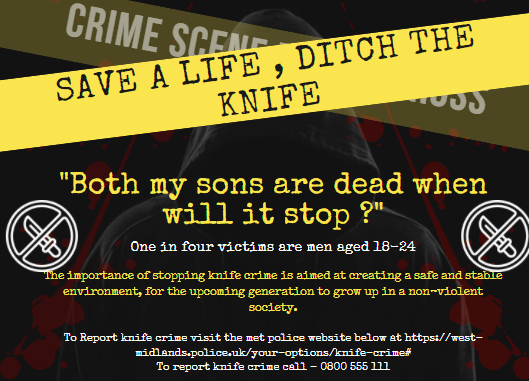
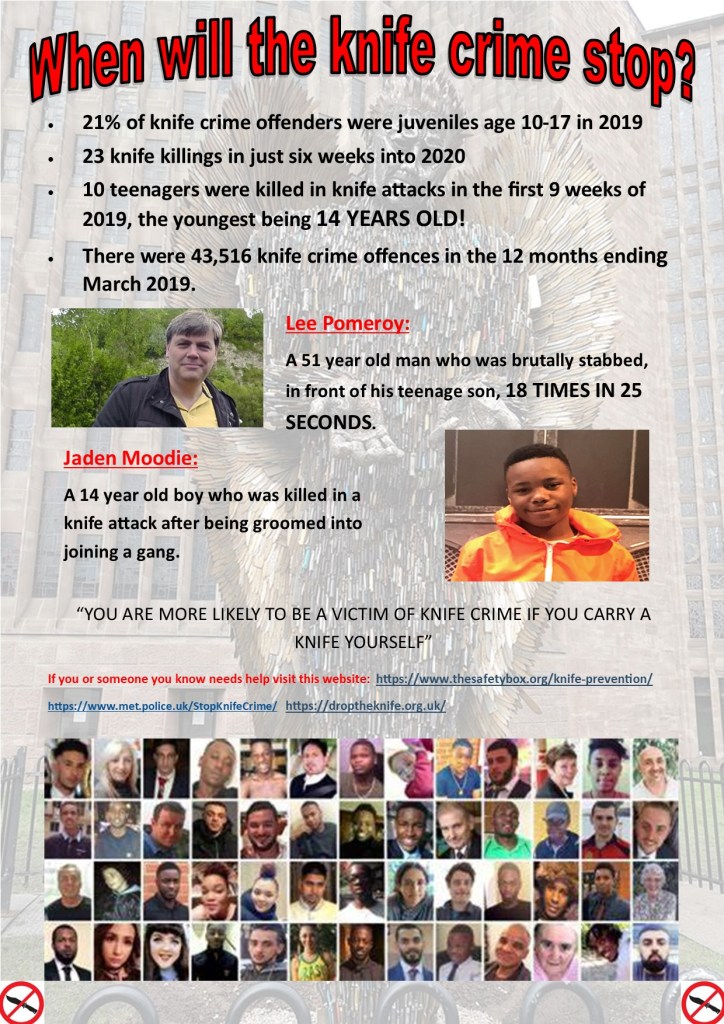
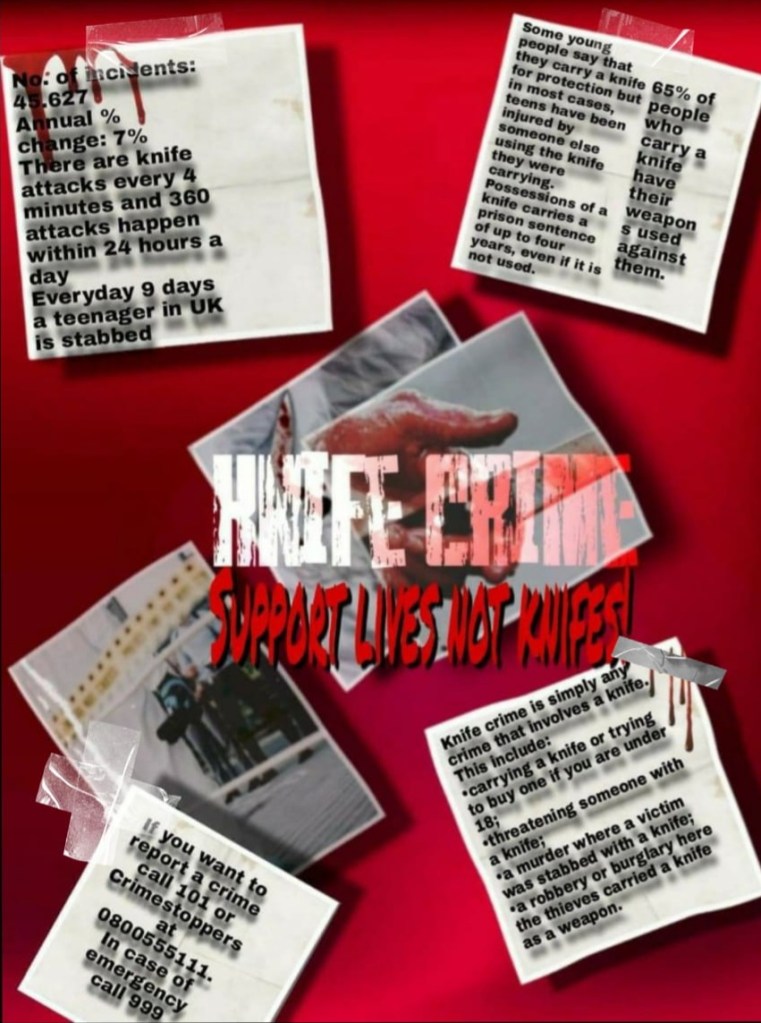
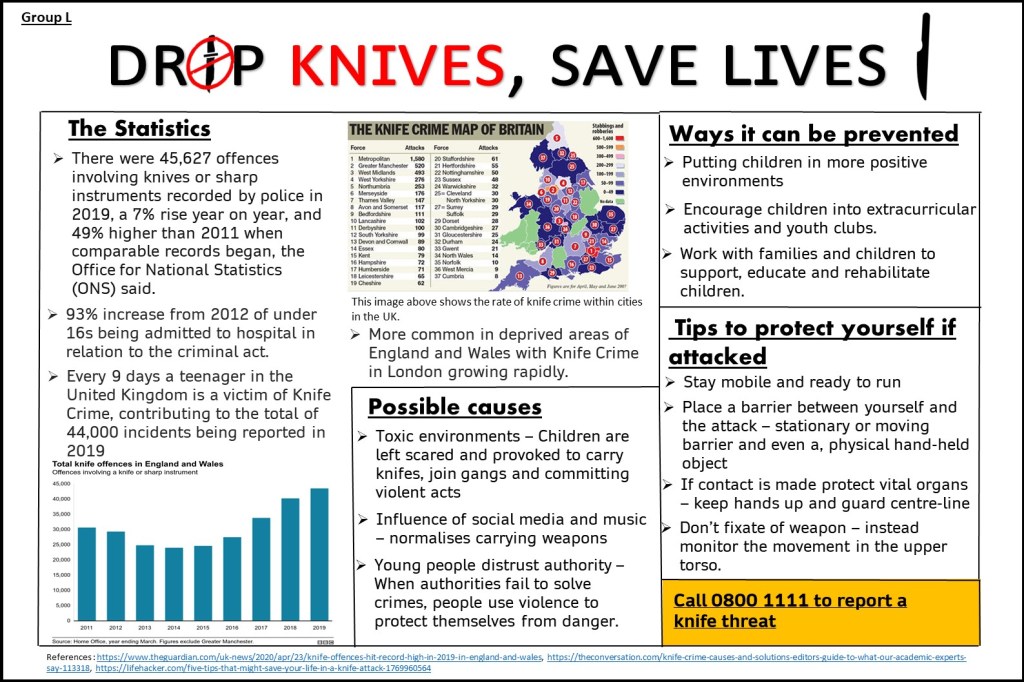
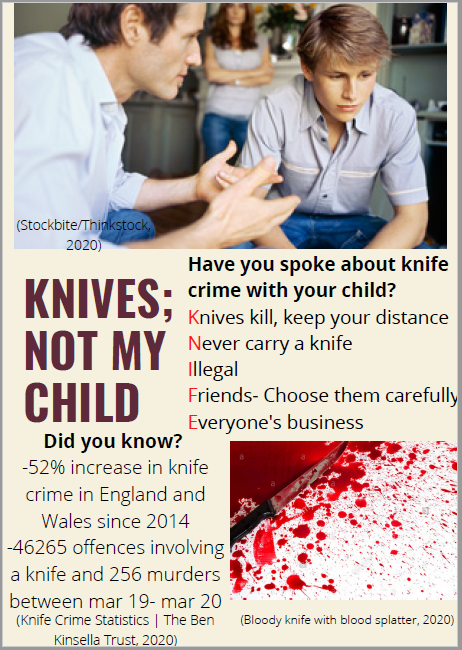
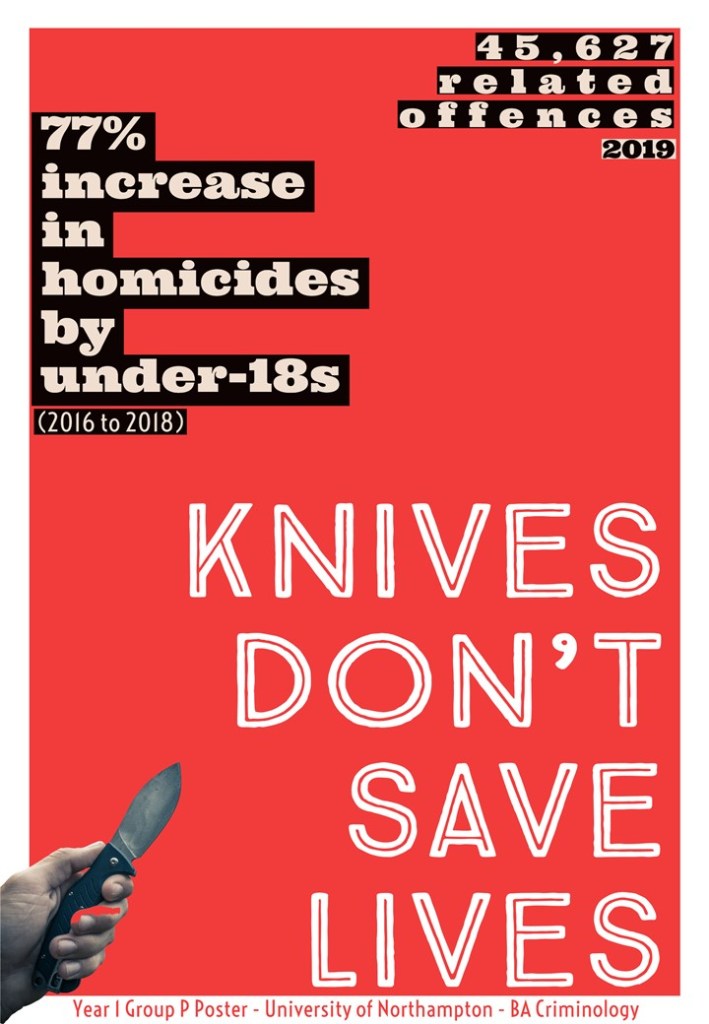
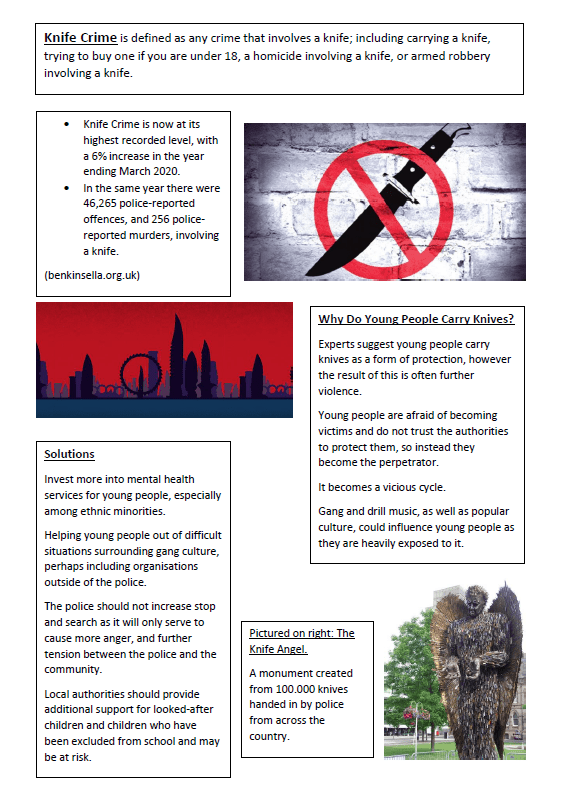
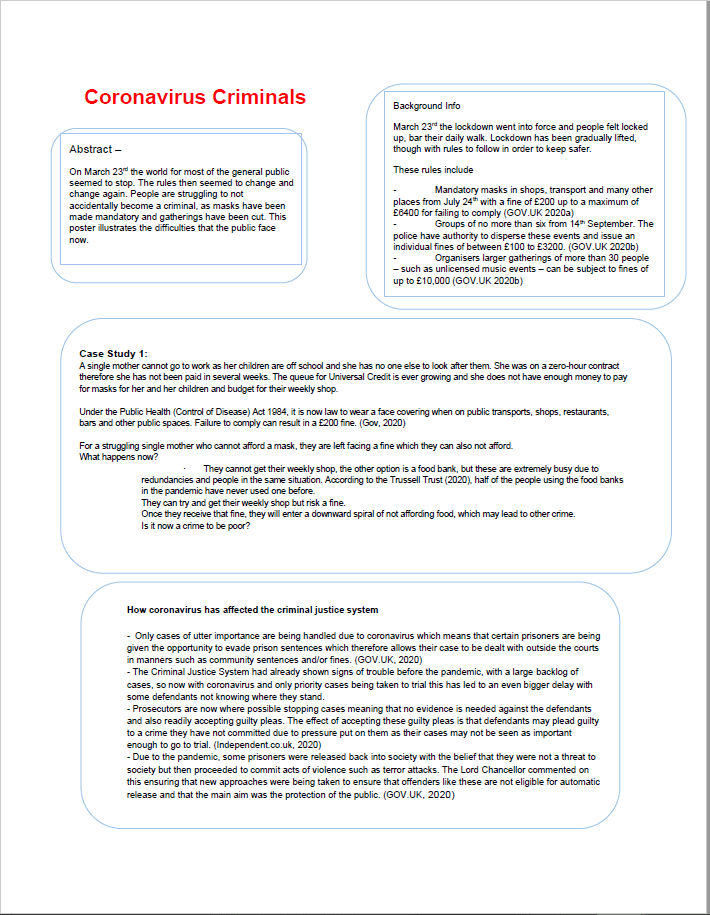
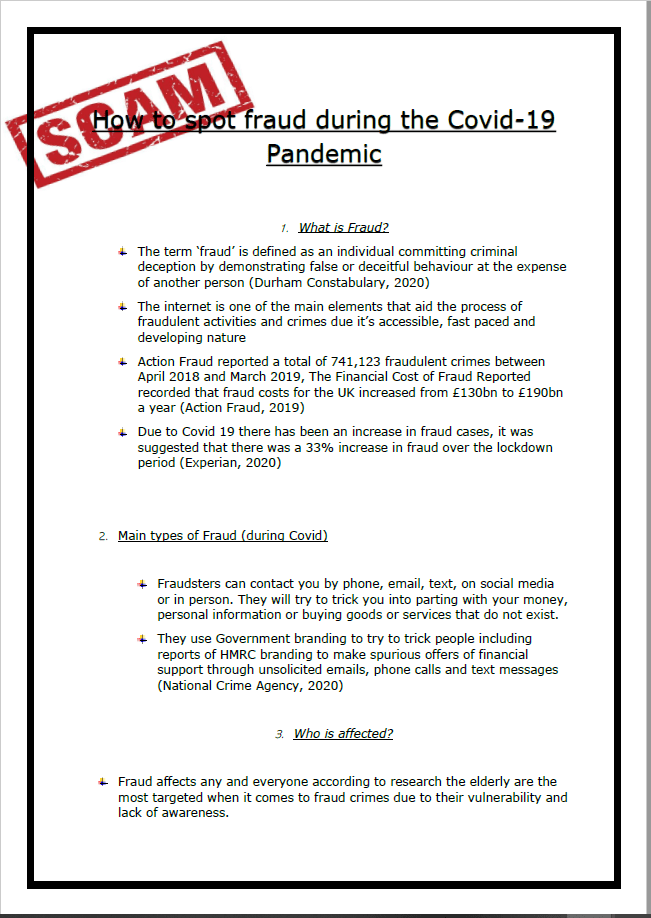
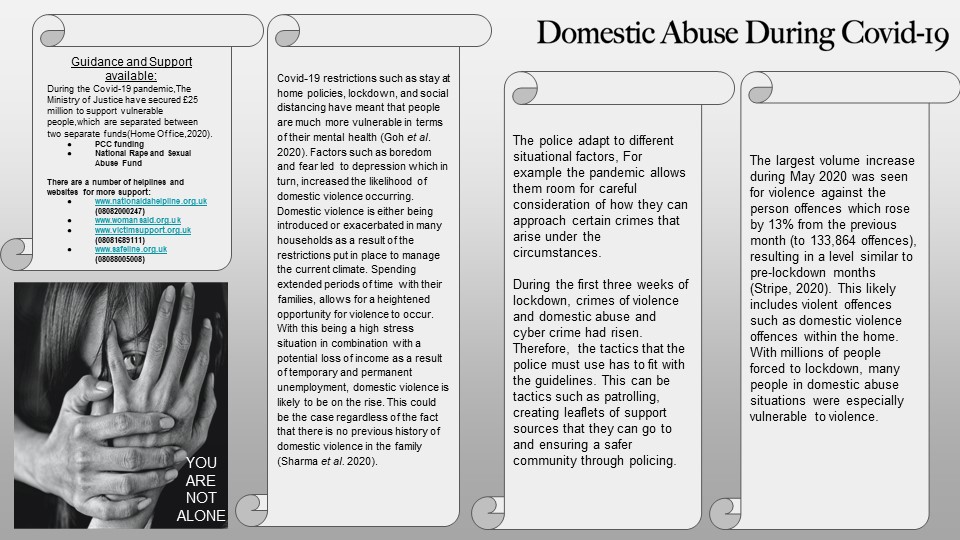
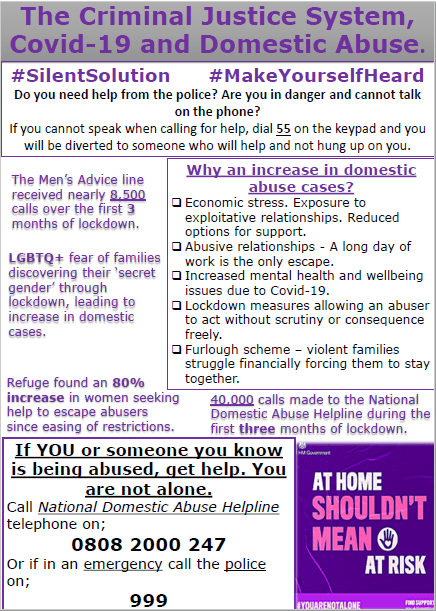
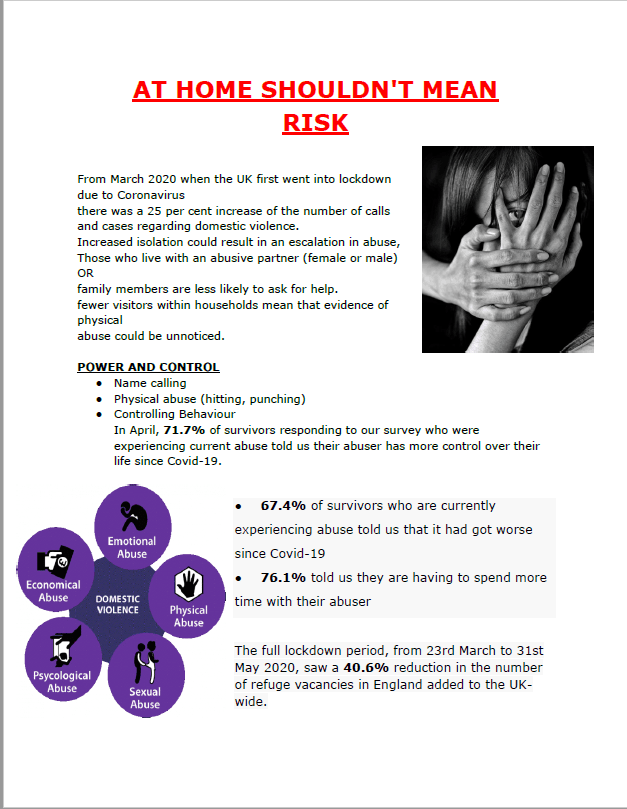
As we prepare to start the new academic year, it is worth reflecting on the beginning of the last one. In 2020 we began the academic year with a whole cohort activity designed to explore visual criminology and inspire the criminological imagination. Students were placed into small (socially distanced) groups, provided with a very short prompt and limited guidance as to how best to tackle the project. The prompts were as follows:
Year 1: Knife Crime
Year 2: Policing Protest (e.g. Black Lives Matter, Extinction Rebellion and so on)
Year 3: Creating Criminals: the CJS during the Covid-19 pandemic
Many of the students had never physically met, yet managed to come together in the midst of a pandemic, negotiate a strategy, carry out the work and produce well designed and thoughtful, criminological posters.
As can be seen from the collage below, everyone involved embraced the challenge and created some remarkable posters. Some of these have been shared previously across social media but this is the first time they have all appeared together in one place.
I am sure everyone will agree our students demonstrated knowledge, understanding, resilience and stamina. We will be running a similar activity for the first week of the academic year 2021-2022, with different prompts to provoke thought and encourage dialogue and team work. Who knows what exciting ideas and posters will be demonstrated this time, but one thing is for sure Criminology students have the opportunity to campaign for social justice becoming real #Changemakers.

















Share this:


Prison education: why it matters?

Five year ago, Dame Sally Coates released an independent report on prison education. Recently the Chief Inspector for Ofsted, Amanda Spielman and The HM Inspectorate of Prisons, Charlie Taylor, made a joint statement reflecting on that report. Their reflections are critical on the lack of implementation of the original report, but also of the difficulties of managing education in prison especially at a time of a global pandemic. The lack of developing meaningful educational provision and delivering remote teaching led to many prisoners without sufficient opportunity to engage with learning.
In a situation of crisis such as the global pandemic one must wonder if this is an issue that can be left to one side for now, to be reviewed at a later stage. At the University of Northampton, as an educational institution we are passionate about learning opportunities for all including those incarcerated. We have already developed an educational partnership with a local prison, and we are committed to offer Higher Education to prisoners. Apart from the educational, I would add that there is a profound criminological approach to this issue. Firstly, I would like to separate what Dame Coates refers to as education, which is focused on the basic skills and training as opposed to a university’s mandate for education designed to explore more advanced ideas.
The main point to both however is the necessity for education for those incarcerated and why it should be offered or not. In everyday conversations, people accept that “bad” people go to prison. They have done something so horrible that it has crossed the custody threshold and therefore, society sends them to jail. This is not a simple game of Monopoly, but an entire criminal justice process that explores evidence and decides to take away their freedom. This is the highest punishment our society can bestow on a person found guilty of serious crimes. For many people this is appropriate and the punishment a fitting end to criminality. In criminology however we recognise that criminality is socially constructed and those who end up in prisons may be only but a specific section of those deemed “deviant” in our society. The combination of wrongdoing and socioeconomic situations dictate if a person is more or less likely to go to prison. This indicates that prison is not a punishment for all bad people, but some. Dame Coates for example recognises the overrepresentation of particular ethnic minorities in the prison system.
This raises the first criminological issue regarding education, and it relates to fairness and access to education. We sometimes tend to forget that education is not a privilege but a fundamental human right. Sometimes people forget that we live in a society that requires a level of educational sophistication that people with below basic levels of literacy and numeracy will struggle. From online applications to job hunting or even banking, the internet has become an environment that has no place for the illiterate. Consider those who have been in prison since the late 1990s and were released in the late 2010s. People who entered the prison before the advancement of e-commerce and smart phones suddenly released to a world that feels like it is out of a sci-fi movie.
The second criminological issue is to give all people, regardless of their crimes, the opportunity to change. The opportunity of people to change, is always incumbent on their ability to change which in turn is dependent on their circumstances. Education, among other things, requires the commitment of the learner to engage with the learning process. For those in prison, education can offer an opportunity to gain some insight that their environment or personal circumstances have denied them.
The final criminological issue is the prison itself. What do we want people to do in them? If prison is to become a human storage facility, then it will do nothing more than to pause a person’s life until they are to be released. When they come out the process of decarceration is long and difficult. People struggle to cope and the return to prison becomes a process known as “revolving doors”. This prison system helps no one and does nothing to resolve criminality. A prison that attempts to help the prisoners by offering them the tools to learn, helps with the process of deinstitutionalisation. The prisoner is informed and aware of the society they are to re-join and prepares accordingly. This is something that should work in theory, but we are nowhere there yet. If anything, it is far from it, as read in Spielman and Taylor’s recent commentary. Their observations identify poor quality education that is delivered in unacceptable conditions. This is the crux of the matter, the institution is not really delivering what it claims that is does. The side-effect of such as approach is the missed opportunity to use the institution as a place of reform and change.
Of course, in criminological discourse the focus is on an abolitionist agenda that sees beyond the institution to a society less punitive that offers opportunities to all its citizens without discrimination or prejudice. This is perhaps a different topic of conversation. At this stage, one thing is for sure; education may not rehabilitate but it can allow people to self-improve and that is a process that needs to be embraced.
References
Coates, S. (2016), Unlocking Potential: A review of education in prisons, https://www.gov.uk/government/publications/unlocking-potential-a-review-of-education-in-prison
Spielman, A. and Taylor, C. (2021), Launching our Prison Education Review, https://www.gov.uk/government/speeches/launching-our-prison-education-review
Originally published here
Share this:


#CriminologyBookClub: The Hundred-Year-Old Man Who Climbed Out of the Window and Disappeared

As you know by now, a small group of us decided the best way to thrive in lockdown was to seek solace in reading and talking about books. Hence the creation of #CriminologyBookClub! Building on on what has quickly become standard practice, we’ve decided to continue with all eight bloggers contributing! This title was the second chosen by @paulaabowles and is our 13th book. Read on to find out what we thought….
I chose this book on the strength of its quirky title. In terms of quirkiness, it didn’t disappoint. What’s not to like about the adventures of a centenarian? Part history lesson, part Forrest Gump, the cast of characters includes Stalin, Chiang Kai-shek and Harry Truman, alongside Allan, Beauty and an elephant called Sonya (seems Criminology Book Club cannot escape elephants from our reading diet…)! The story, despite including all manner of improbable deaths, is a gentle read. In many ways, it reminded me of Leslie Thomas’ The Adventures of Goodnight and Loving and I do have to say I prefer that story. Nevertheless, it was lovely to see the representation of older characters in an adventurous tale.
@paulaabowles
A centenarian is the most unlikely hero! Their mortality alone makes them too frail and fragile to be featured in a movie where villains end up dead in a path of carnage. In this book, the title is not a metaphor but most literal. A century old man is running away in his slippers dragging a stolen suitcase; somehow the story of what happens next, becomes compelling in this fast-paced action-packed adventure. The old man is carrying with him also a century of stories involving “who’s who” of the 20th century! At some point you are wondering if this is a comedy of errors, a farce or a spy thriller. The old man, in his back and forth stories, is bringing to light the absurdity of the 20th century, the political and ideological conflict of the time. This part of the story becomes a bit of a parody and the flashbacks become a bit tiresome as they seem to take us away from the main story, as you are left wondering will the old man live another day?
@manosdaskalou
I found this book an absolute joy to read, laughing out loud throughout. The book was about a centenarian who gets into all kinds of adventures and has done throughout his life. Each story of how he accidentally fell into situations with various historical political figures made me chuckle. What I also liked was that the book was devoid of any emotion. The love stories were quite clinical, the life and death situations fearless but this is just what I needed, and I think it made the book even more funny. More slapstick humour than romcom, it was completely ridiculous and an unlikely tale but because of this I could laugh at the dinners with murderous war mongers and the protagonist’s penchant for blowing stuff up.
@amycortvriend
We’ve come full circle in relation to book choices: it is Paula’s choice once again! And in all fairness, this book was more enjoyable than the Yellow Room. The Hundred-Year-Old Man Who Climbed Out the Window and Disappeared, was a book of two halves for me. The first half was witty, quick paced, and not like anything I had read before. However the second half of the book, was repetitive and without giving away any spoilers, the characters did not develop into the loveable rogues I thought they were. They remained quite stagnant. Nevertheless, I did really enjoy the book and found myself chuckling away at various points. Something which none of the other choices (excluding Inspector Chopra) have done. Good choice, @paulaabowles: I wonder how @manosdaskalou’s second choice will fare?
@jesjames50
The 100 Year Old Man was a novelty for me. Prior to this I had never encountered a book where the main character at 100 years old gets up to all kinds of unintended mischief. The sense of adventure included within the book was something that I needed at the time, although I found that the appeal of the book began to wear off at the half-way point. I also found some descriptions to be problematic from my own point of view, but overall I enjoyed the book!
@haleysread
I don’t suppose you get to be a hundred years old without having a few tales to tell. Allan’s life appears to have been a little more adventurous than most and his absconding from an old people’s home seems to be a continuation of mishaps and mayhem. A delightfully funny book, cleverly written to incorporate some historic characters into the narrative. The chapters jump from the past to the present and back again, sometimes leaving you wanting to skip a chapter to continue the narrative of the past or to find out what happens next in this tale of murder and destruction. Its amazing what you can get away with when you are a hundred years old. I can’t wait to get my hands on the next book.
@5teveh
I haven’t read a book like this before and really enjoyed the whole concept of a much older than average ‘hero’ and their adventures both past and present. The glimpses into his colourful past and the famous faces from throughout history that he met along the way gave this book an interesting sense of time and place – both completely fictional and yet almost plausible in the real world. The writing style was also different from the other books we have read as a group and I found it very funny in places. Overall I found the book slightly too long – the novelty began to wear off and I found myself a little fed up with the alternating chapters between past and present ( I preferred those set in the present, though I know others in the group preferred those set in the past) but am still excited to find out what happens to him and his friends in the next book!
@saffrongarside
I was not expecting what I was going to read….elephants, gangsters and men locked in freezers. This book is a light and easy read. It centres around the very colourful life of 100 year old Alan Karlsson. Throughout the book Alan takes you on a journey to meet some interesting historical figures such as Stalin and President Truman. In many ways Alan influences these characters, which in essence shapes events that have happened in history.
We also follow Alan’s life in present day, in which we follow outlandish characters through a very humorous story. Overall, I really enjoyed this book. It kept me entertained and wanting more. Although some parts of the book were about some dark things, such as Eugenics and abuse under the guise of ‘medicine’ the humorous present-day story of Alan’s journey balanced this book out, making it a light hearted tale.
@svr2727
Share this:


Taking a short break….back soon

The Covid-19 pandemic has taken its toll on everyone in a myriad of different ways. Nobody has escaped the impact of the last 16 months and we’re not out of the woods yet. Here at the Thoughts From the Criminology Team we’re no different. All of us are beginning to run out of steam and need a little break. Never fear, we’ll be back with lots of interesting entries from September. In the meantime, there’s plenty on the site to explore.
Enjoy your August whatever you are up to!
Share this:

#CriminologyBookClub: The Guest List
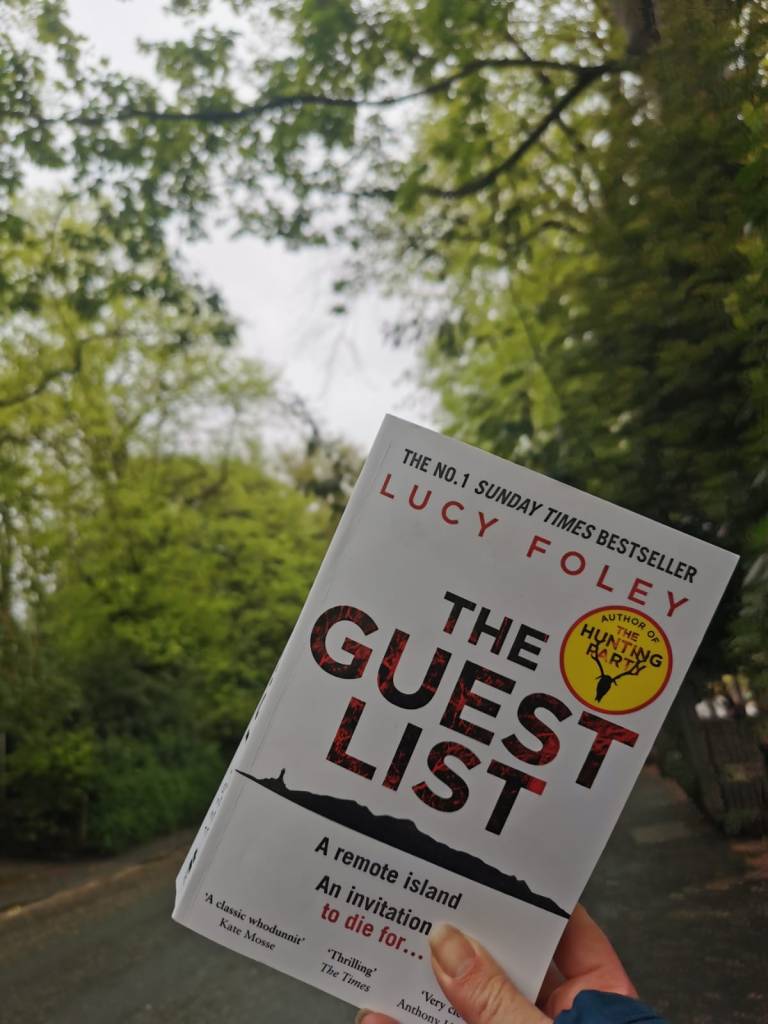
As you know by now, a small group of us decided the best way to thrive in lockdown was to seek solace in reading and talking about books. Hence the creation of #CriminologyBookClub! Building on on what has quickly become standard practice, we’ve decided to continue with all eight bloggers contributing! This title was chosen by @svr2727and is our 12th book. Read on to find out what we thought….
I took one look at the cover and didn’t think the book would be for me. The cover gave the impression it would be scary, and I don’t do scary. One of the reasons for book club is to read things we wouldn’t ordinarily go for so I started reading – and couldn’t stop. The bitesize chapters not only enabled me to pick the book up more frequently, but they also made me want to keep reading. I would tell myself ‘just one more, another, last one now, this is definitely the last one then I’ll make tea/go to sleep/get out of bed. The second thing I liked about it was that the narrative viewpoint changed each chapter, flitting between the perspectives of each character. However, what was odd that I felt no strong connection to any of the characters. I am a pacifist and would not wish anyone dead in real life, but I desperately wanted Will to be the one to die. It was quite obvious he was a wrong ‘un early on. Each of the characters had been victimised in one way or another by Will at some point in their lives but it was almost as if the author wrote in barriers to building empathy with them, either in their personality or their actions. Jules was stuck up and pretentious, her sister wouldn’t tell us what was wrong with her for a long time, Johnno was complicit in the death of a child and we didn’t know about Aoife’s connection until the end. I liked this. It ties in nicely with one of my favourite concepts in victimology, Christie’s (1986) theory of the ‘Ideal Victim’, the idea that people will not fully be accepted as a victim unless they exhibit particular characteristics and behaviours. The book therefore tied right into my criminological interests. They say never judge a book by its cover and in this case the phrase could not be more accurate.
Christie, N., 1986. The Ideal Victim. In: Fattah, E. (Ed.), 1986. From Crime Policy to Victim Policy: Reorienting the Justice System. Basingstoke: Macmillan
@amycortvriend
The most recent read for Book Club was very hard to put down, and equally difficult to pick up. Let me explain. Once reading, the story is interesting, swapping between narratives is ingenious but also frustrating as you don’t ever get a full picture. The characters are vile, so once the book was put down, I wasn’t in a hurry to get back to them: I did not warm to any of them, even the ones I think I was supposed to like. However the story was well worked, I did not see the many twists coming and I was exceptionally satisfied with who the unfortunate ‘victim?’ was. Overall it was a brilliant, fast-past read: I just wished I liked the characters! Looking forward to reading more of her work!
@jesjames50
The Guest List is a good book for those that enjoy reading books of the thriller genre. Whilst reading this book you really feel that anticipation that you get from wanting to know what will happen next. The book illustrates some interesting themes about wealth and privilege. This is not really a book that is suited to my own tastes, as I tend to read books where the characters are likeable. Although, with a thriller, disliking the characters means that its feels ok if any of these dreadful characters are then brutally murdered.
@haleysread
The story is told from the point of view of several different characters and has some clever twists that keep the reader guessing until near the end. Whilst I liked the style of writing, I wasn’t as enamoured with the storyline or the characters who seemed to display some very stereotypical traits. An enjoyable book but it just wasn’t different enough for me to consider it a ‘must read’.
@5teveh
This is a proper old school “whodunnit”, reminiscent of Agatha Christie, particularly in terms of tying up most of the loose ends. The atmospheric island, full of dangerous hazards and damaged people takes you on a journey. Clues aplenty abound and you get the chance to explore each of the characters in terms of their back story. Like many of the others in the Criminology Book Club, I didn’t like the individual characters, far too reminiscent of the Bullingdon Club. and other arrogant influencers…. Nevertheless, I enjoyed using my wits to follow the clues and work out who was going to be murdered and who did the deed. Ideal reading for holidays, or during a pandemic lockdown!
@paulaabowles
I really enjoyed losing myself in this story and read it very quickly. It was very atmospheric and I could really picture the island and the venue and the stormy weather. It all added up to create a real sense of foreboding. I enjoyed the way the story was paced – the flashes of the present interspersed with the back stories and leading up to the conclusion. It was also interesting to be trying to solve the crime and figure out who was the victim simultaneously (I didn’t solve it, I’m terribly bad at whodunnits but I still really enjoy them anyway!). I didn’t feel much empathy towards any of the characters however, and so by the end I didn’t really mind who did it!
@saffrongarside
This was an enjoyable read. We follow a group of characters that are going on a very secluded island, off the coast of Ireland to attend a super exclusive and lavish wedding. The groom is portrayed as handsome charismatic man and he is also a reality TV star. The bride is portrayed as a smart, successful, and rich women……It appears they have everything one would desire.
The story is regressive as it starts with a murder at their wedding, but then you are quickly thrust back to the events leading up to the point of the murder. Each chapter is written as a point of view from the guests at the wedding. This is a great addition, as you see the development of the characters and the secrets, mysteries, and tensions between them. I would like to point out that none of the characters were particularly likeable. I won’t give away any spoilers, but based on their behaviour throughout the book, I would not have felt sad if any of them were the victims of the murder and it seemed they were all capable of being the murderer. However, you will be kept guessing, and you won’t find out until the last few chapters of the book.
I loved that you are pulled in the weary atmosphere of the story, and at times I could almost feel the cold air and hear the waves crashing on the rocks. This mystery thriller definitely whisks you away.
If you are looking for some light summer reading, I would highly recommend, you will not be disappointed.
@svr2727
You are invited to a friend’s wedding in a remote island off the cost of Ireland and with the group of people that one is more obnoxious than the other, would you consider going? This was the question playing at the back of my head whilst I am reading this fast-moving whodunit thriller. The scenery is very pulpable and quite reminiscent of the Victorian crime novels; the mist that covers everything allowing crimes to happen whilst the guests look on terrified. Is this an accident or one of many to come? This is a tried and tested recipe brought into the 21st century, although I wonder if anyone can survive this long anymore without Wi-Fi! The story for the fans of the genre is culminating to an expected end with some interesting twists and turns. In the end I was just left wondering, why I did not care for any of the characters!
@manosdaskalou
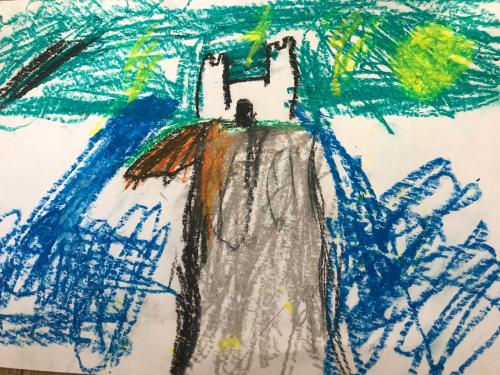
In case you struggle to imagine the island at the centre of The Guest List…thanks to Quinn and Paisley for their fabulous works of art.

Share this:


Vaccine day
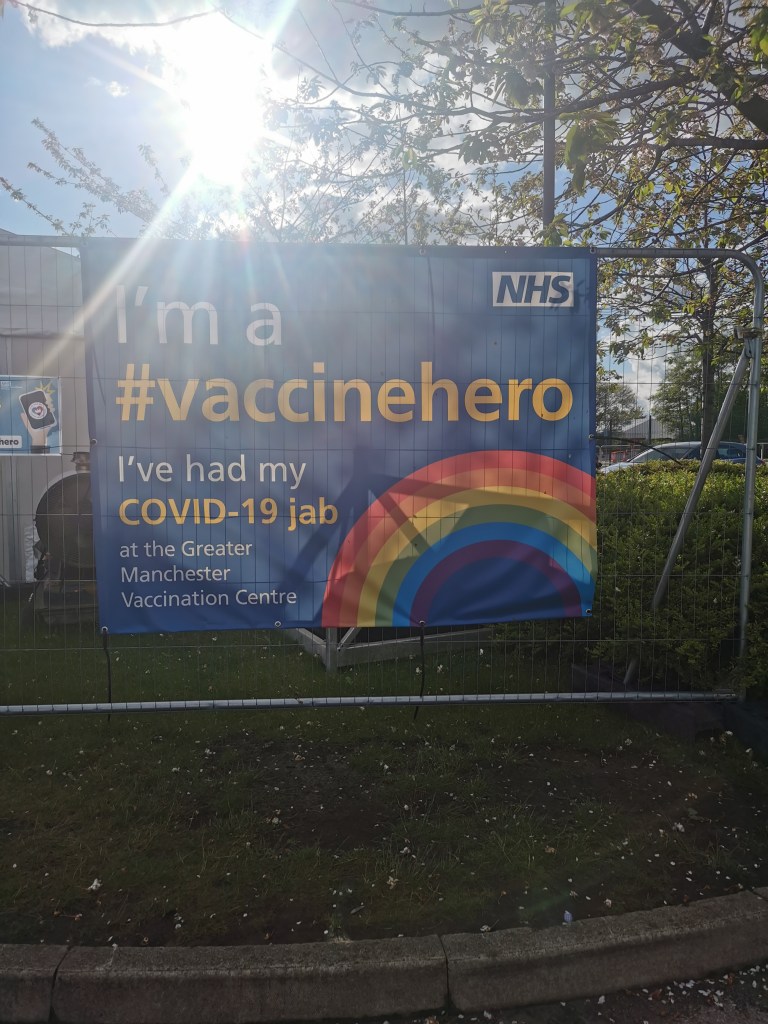
I had my first Covid-19 vaccine recently and the day was emotional, to say the least. I am 99% compliant with Covid-19 restrictions, partly because it is the law but primarily because I believe it is the right thing to do to protect others. In fact, there have been many times over the last 15 months where I have avoided the news for my own sanity so half the time, I do not exactly know what the latest rules are. I am guided by my own risk assessments and am probably more restrictive than the law in most scenarios. Up until vaccine day I thought that I wasn’t scared of contracting Covid-19, that I was complying as an act of altruism and that I would not be able to live with myself if I unwittingly passed the virus on to somebody vulnerable to severe illness and death.
Back in March 2020 when infections then the death toll started to rise, and the NHS became increasingly overwhelmed I would watch what my daughter and I called ‘the Boris show’ where the Prime Minister and the scientists would recall the daily death data, hospitalisations and cases. Each ‘next slide please’ bringing more bad news. Each day I would think about the families of every single one of those people who had died. It was quite overwhelming, and I eventually had to limit the information I ingested, living in both a physical and informational bubble. I recall the death toll announcements were met with responses from the covid-deniers, ‘but they’re old or ill anyway’, and ‘but they could have been hit by a bus and still counted as a covid death’. As a victimologist, this infuriated me. Who were these people to flippantly dismiss right to life based on age or health? It frustrated me that people with no knowledge of statistics, medicine or science were making assumptions based on anecdotal evidence from Bob on Facebook. But then again perhaps these are the tales people told themselves to get through. If they deny it, they have nothing to fear.
A few months later in June 2020, my somebody close to me contracted Covid-19. I was told they were doing well and seemed to be recovering from the virus. They died more than 28 days after having first being diagnosed with Covid-19, but it was Covid-19 that killed them. I know because I saw them to say goodbye a couple of hours before they died. This person who was always so full of life, love and who saw the good in everyone and everything, was now fading away. But what haunts me to this day was the sound of their lungs. The sound I’d heard people talk about on the news. Crisp packet lungs. And it was that sound that was like an earworm in my head on my way to the vaccination centre.
I’ve been looking forward to getting vaccinated since vaccines were on the horizon so I was excited when I received the text invitation. I booked to attend the Greater Manchester vaccination centre at the Etihad stadium, the home of Manchester City Football Club. It was well organised, despite the large numbers of people coming through. First, I was required to check in and was allocated the Moderna vaccine and a green sticker which ensured staff could direct me to the correct queue. Then I checked in at another desk where I was given some information, asked some health questions and, most importantly, I was asked, ‘do you want the vaccine?’. Those who have sat one of the research methods modules I have taught this year will have heard me discuss the importance of informed consent and this also applies to real life situations such as this. After this I joined another queue and finally reached the vaccination point, had the jab, waited for 15 minutes and left. Just like that. The whole thing took about an hour and given the volume of people being vaccinated (the site is a mass vaccination hub for a large area), I found it to be incredibly efficient. Every staff member I met was informative and did what they could to put people at ease.
From the moment I left home to go to the vaccination centre, to the moment my head hit the pillow that evening, I couldn’t help reflecting on the last 15 months. I felt a wave of emotions. I felt extreme sadness and sorrow at all the lives lost and all the families and friends left behind. It has been a traumatic time for so many of us. Getting the vaccine, I felt some sort of release from this, like it was nearly over. I have worked from home throughout and have had little social interaction, except when the gyms have been open or I have undertaken caring responsibilities for various friends and family. There were also a few weeks towards the end of lockdown 1 where my sister came to stay after returning from India. Overall, I have been alone with a teenager at a desk in my living room. It’s been awful. I’m tired and I need a break. I am well overdue a mum-cation. I felt some hope that sometime soon I might be able to get a parenting break and that my daughter can also get a break from me. I said earlier how I believed I had not feared contracting covid but having the vaccine and the relief I felt made me realise that I was more scared than I would care to admit. I am young(ish) and extremely healthy and I would probably be at low risk of developing serious symptoms but what if I was an unlucky one?
Aside from my personal experiences, I felt a collective relief. The global pandemic has created global trauma. There are still countries being ravished by the virus without the resources to operate mass vaccination of entire populations. I worry for the world and wonder what borders will look like after, if there ever is an after but I’ll ponder this further in another blog later. Getting vaccinated and being part of a mass vaccination programme made me feel cautiously optimistic. However, a few weeks on and we are now in a situation where the Delta variant is spreading like wildfire. Deaths have risen by 42.5% in the last week and hospital admissions by 44.7%. The numbers are still incredibly low in comparison to the first and second wave but every one of those deaths and hospitalisations matter. They are not a number on a presentation slide. They are people who have families and friends, who are cared for by the NHS. Every one of the deaths is a loss to these people, and has a butterfly effect in terms of the impact each death has.
Restrictions are set to lift imminently I believe (still avoiding the news) and it makes me feel uneasy to say the least. I’ve seen experts whom I trust argue on both sides of the fence. Some say this is dangerous, others suggest summer is the best opportunity to lift restrictions. It sometimes feels like we are living in some kind of twisted experiment. Regardless, I will continue to assess and manage the risk to myself and those around me. I’ll probably wear masks way after it is legal to do so and expect I will still be cautious about who I am physically close to and how I socialise. There’s things that I love and miss such as the theatre, cinema and the occasional gig but I don’t feel ready. I have a feeling this pandemic is far from over.
Share this:

#CriminologyBookClub: Bad Day at the Vulture Club
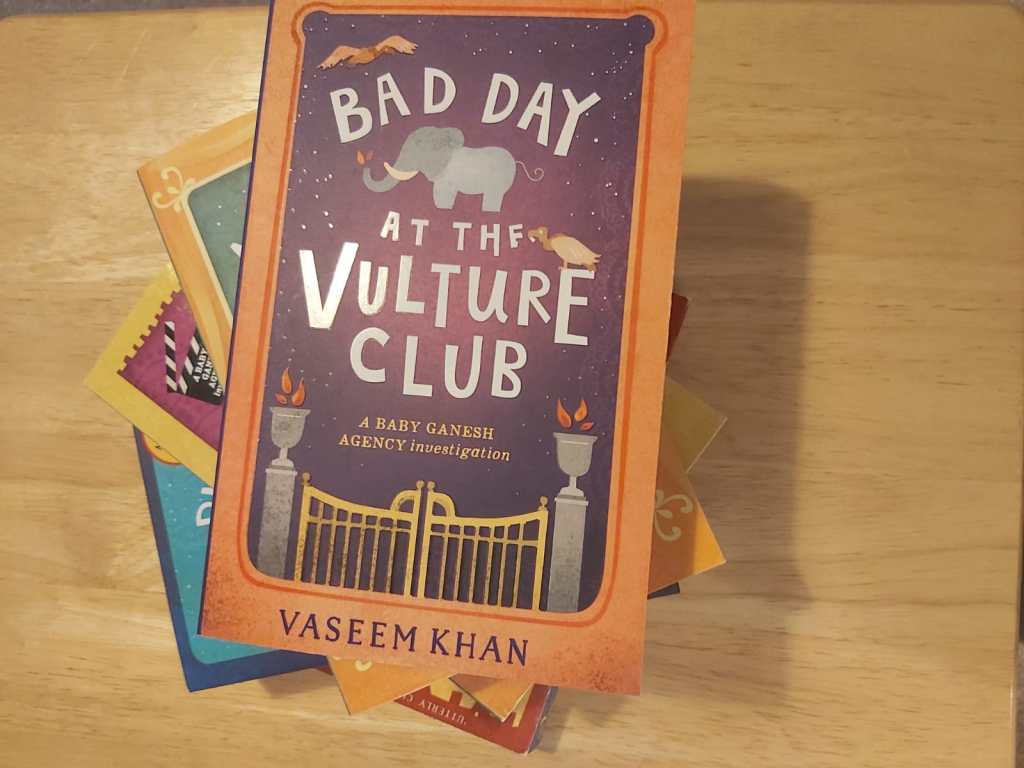
As you know by now, a small group of us decided the best way to thrive in lockdown was to seek solace in reading and talking about books. Hence the creation of #CriminologyBookClub! Building on on what has quickly become standard practice, we’ve decided to continue with all eight bloggers contributing! Our latest book was chosen by all of us (unanimously) after we fell in love with the first instalment. Without more ado, let’s see why we all adore Inspector Chopra (retired) et al. and why we’re all so very sad to reach the (temporary, we hope!) end of @vaseemk2‘s wonderful series:
The final of the Chopra series was delightful. As with the previous books, the story is a crime novel but there is a continuance of a broader (and arguably) more damaging topic, social harm. I found this book so interesting to read as Vaseem shines a light on Parsee culture that was unknown to myself until reading this book. Although this is a series of fictional books, parts of these books are based on real life events and I think this allows for a lot of reflection. I finished the book thinking about the plight of the vultures and the impact that this has on humans. Book Club is yet to find another book that we all collectively enjoy, let alone a series. This series is wonderful.
@haleysread

The fifth book of the series introduces us to the community of the Parsees. Inspector Chopra is exploring a world full of secrecy, hidden messages and innuendos. Is it a family dispute gone wrong or an attack on a small community that is flickering away? The victim is powerful, well respected and without any obvious foes. Maybe the death is an accident or one of those unfortunate events? Chopra doesn’t think so! With the help of his pet elephant he uncovers the truth, despite the authorities’ incompetence collecting evidence and the need of many in the circle of suspects to withhold information. This is a more mature outing of the detective as the case makes him question his own mortality when he is faced with ancient customs. The team remains the same although the addition of a recovering vulture makes the group as surreal as ever. The dialogues are lively and the exchanges are sharp but in the end, what is the truth? Who is going to crack when Inspector Chopra reveals “whodunit”?
@manosdaskalou
As a latecomer to book club, this was my second of the Chopra series and once again I loved it. @vaseemk2 writes in such a way that he brings everything to life with vibrancy. This book featured a vulture who developed a personality of its own and just like the previous book, I enjoy the characters of the animals. Aside from the characters, the author is very good at introducing real life events or people. This book introduced the Parsee community which I had not heard of and it encouraged me to go away and learn more. I am looking forward to playing Chopra catch up over summer.
@amycortvriend
I approached this book with mixed feelings. I desperately wanted to immerse myself into the sunshine and colour of India. However, I also was very aware this was the (current!) last book in Vaseem Khan’s awesome series (I am seriously hoping for many more, take note @vaseemk2!). Fortunately, I forgot the latter, as I immersed myself in the former. As with previous Inspector Chopra cases there is the theme of institutional violence, of ordinary people, elephants and vultures subjected to the vagaries of powerful people. In 1967, Howard Becker asked “whose side are we on? and answered, the powerless. Vaseem’s series takes the same approach, there is a sense of camaraderie and empathy towards those who are different, those who are outside of mainstream society, the underdogs. Whether they are eunuchs, Parsees or even vultures, compassion is present in Chopra et al.’s responses and actions. Although gutted that the series has come to a (temporary!) halt, this book was a joy to read. I’m going to miss all the characters but will simply pretend they’ve gone on a holiday!
@paulaabowles
Bad Day at the Vulture Club was yet another wonderful investigation involving the Book Club’s favourite motley crew! The story was intriguing, the characters charming (although some of them not so much), scenery vivid and as always, overall utterly brilliant! This is the last book in the Inspector Chopra series, so far, and if I’m being overly critical it did not feel like an ending. Maybe there will be more to come? Hint Hint @vaseemk2!
@jesjames50
Having read the previous books in the series and having become embroiled in the Baby Ganesh Agency’s quirky and endearing machinations, I picked up this final book with eagerness, anticipation and dread in equal measure. Why dread, well it’s the last in the series (I know I’ve already said that but its worth restating), no more Insp. Chopra (Retd), no more Ganesha, Poppy, Irfan or the erstwhile Rangwalla. As we have become accustomed to, the book paints a colourful and wonderful picture of Mombai and its inhabitants whilst also providing saddening detail of the darker side of corruption and desperate poverty. With the usual twists and turns, injections of humour and triumph coupled with some interesting historical backdrops the story line is both intriguing and captivating. Another page turner, but as each page disappears, so too is the recognition that it is all going to come to an end. Whilst all the characters deserve a well-earned rest, it would seem a travesty for the redoubtable Insp. Chopra and his less than ordinary sidekick Ganesha to permanently retire
@5teveh
Goodbye for now, Inspector…….
Another great addition to the inspector Chopra series. More wacky characters, great comedy, and a great mysterious plot. I have also learned some interesting things about India’s culture, which has encouraged me to do further reading.
Reflecting on my time reading this series, I have enjoyed every single book. Like the other 4 books prior, Bad Day at the Vulture Club gives you delightful excitement and adventure which is far from what has been present in real life. During uncertain times and difficult lockdowns these books have provided much need escapism. During the final chapters I did feel a wave of sadness, as I knew this was the last book in the series. But I hopeful we will see a return of baby Ganesh, Poppy and Inspector Chopra, as we have still not unlocked the mystery of Ganesh. I recommend the complete series, if you like courageous elephants and want a light hearted page turner.
@svr2727
It goes without saying that I loved this book. I’ve so enjoyed following the exploits of Chopra and Ganesha over the last year and a half and there’s definitely a bit of a hole in my life now! I’ll admit that I read it with trepidation – worried that something awful would befall the characters I had come to care about, given that it’s the final book in the series. But I needn’t have worried! I found myself once again immersed in a mystery and following the threads through India – learning loads about the country and the culture on the way. I almost loved the vulture as much as I love the elephant. I really hope this isn’t the last we hear from these characters!
@saffrongarside
We shall leave the final thought to some younger fans of Baby Ganesha and the Vulture….thanks to Quinn and Paisley for their fabulous artistry

Vulture (Quinn Age 8) 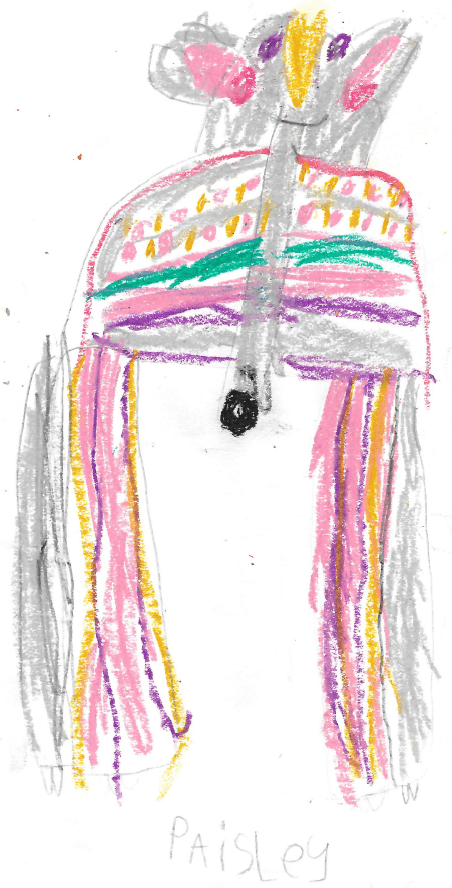
Baby Ganesha (Paisley (Age 6) 
Vulture (Paisley Age 6) 
Baby Ganesh (Quinn Age 8)
Share this:


Fifty Pounds Per Child Per Year

Usually I consume my news through the BBC app, although occasionally I enjoy getting the run down of political affairs from the horses mouth, so to speak. Often I watch the Prime Ministers Questions, getting riled up at the majority of topics raised. However, yesterday (9/06/21), I found myself getting particularly outraged and passionate at a certain issue that has also been highly reported in the news.
Earlier last week, the Prime Minister outlined his Covid recovery package for schools, he pledged £1.4bn to enable students to catch up on the work, education and socialisation that has been missed. The controversy appears when comparing this figure to £13.5bn, originally suggested by Education Policy Institute (Education Policy Institute, 2021). To put it into perspective, £1.4bn equates to about £50 per child, per year- apparently you certainly can put a price on children’s education. Even with Johnson’s additional £1bn funding that will stretch across the next three years, the ‘recovery’ package is frankly laughable, it was a move that saw the education recovery commissioner, Kevan Collins, resign in protest.
Putting funding and economics aside, I think that this was a prime example of how the importance of education is once again, being forgotten. The potential power of the education system is not being utilised by any means. Politicians are still not realising that education reform doesn’t have to mean tougher discipline and it doesn’t have to mean more Ofsted checks and it certainly doesn’t have to mean more stressful, ‘rigorous testing’ of students, something which former education secretary Michael Gove pushed for in 2013 (Adams, 2013).
“Simply making exams harder does not guarantee higher standards nor mean that students will be prepared for a job.”
~ Brian Lightman (Adams, 2013)
Forcing misbehaved children out of school through punitive disciplinary actions, suspensions and exclusions simply puts them on the road to loosing faith in the education system and increases their likely hood of antisocial behaviour, which can lead to criminal careers later in life. The importance of creating an educational environment that students actually want to be a part of cannot be understated.
Furthermore, the importance of altering the current curriculum is completely overlooked. School has the potential to give children and teenagers the ability to have more autonomy over so many aspects of their later life; adequate lessons about political ideology, history and the voting system, done in an accessible way, has the potential to raise more politically aware, inclined individuals that feel equipped to engage and participate in the democratic process on a local and national scale.
Appropriate finance and law classes could eventually go on to raise a higher number of adults who feel able to handle their money situations in a better, healthier way; they could also begin to understand their rights and the court processes better. Finally, focusing on the decolonisation of the curriculum could allow ethnic minorities and other marginalised demographics to learn about their ancestors, history and culture in a more mainstream, impartial way. The impacts of restructuring the standard and the content of the schooling curriculum could have an abundance of benefits, not only to individuals but to society itself.
However, with no clear moves for the education secretary to explore theses benefits further and implement any changes, along with the promised £50 per pupil, per year, it is evident that the potential power of the education system has once again been understated and that, education is, indeed, not a priority for the current government.
Adams, R., 2013. GCSEs to become more demanding and rigorous, says Michael Gove. [online] The Guardian. Available at: <https://www.theguardian.com/education/2013/jun/11/gcse-demanding-rigorous-michael-gove>
Education Policy Institute. 2021. EPI responds to the government’s new education recovery package – Education Policy Institute. [online] Available at: <https://epi.org.uk/comments/epi-responds-to-the-governments-new-education-recovery-package/>
A link for the Prime Minister’s Questions episode: https://m.youtube.com/watch?v=zQkiEAZ2oh0&feature=youtu.be
A link for the Prime Minister’s Question with BSL: https://youtu.be/ZgcnQqbChZs

 Thoughts from the criminology team