
Home » Austerity
Category Archives: Austerity

A new model for policing: same old rhetoric, same old politics, same old reality

The Home Secretary’s White Paper ‘From Local to National: A New Model for Policing’ promises a complete revamp of policing in England and Wales. The Northamptonshire Police Federation website provides a fairly good synopsis of what the white paper contains. Although one does hope that they didn’t resort to the use of AI to produce it otherwise they may find themselves going the same way as the beleaguered former chief constable of the West Midlands Police.
When listening to the Home Secretary Shabana Mahmood’ address to parliament regarding these reforms, I am reminded of a timeless quote from Robert Reiner regarding a former Home Secretary, Michael Howard’s address to parliament regarding another Home Office police reform White Paper back in the early 1990s. Michael Howard had stated that ‘the job of the police was to catch criminals’ and Robert Reiner, if I remember the quote correctly, stated that this statement was ‘breathtaking in its audacious simple mindedness’.
My bookshelf used to be full of Home Office White papers regarding police reform. If I went through every one of them, I would find almost all the suggestions, in one form or another, being put forward by this Home Secretary. It is like revisiting my former reality, change for change’s sake to detract from a poor performing government. Although no one could have guessed that Lord Mandelson would quickly hog the news and railroad the political landscape.
The police don’t do themselves any favours, you’ve only got to look at the headlines over the decades to know that. But of course, policing is not easy and sometimes hitting the headlines for the wrong reasons is inevitable. Rarely do the police hit the headlines for the right reasons, not because there aren’t plenty of right reasons, they simply aren’t newsworthy. However, every failure or perceived failure is ammunition for the ambitious politician and police reform is always a headline grabbing option and a distraction from other politically difficult and damning matters.
Let’s be clear, policing doesn’t happen in a vacuum. Policing relies on the public; it relies on other institutions within the criminal justice system and outside of it and it relies on good governance. If the police are underfunded, then the service they deliver to the public is substandard and this then dents confidence in the police which in turn impacts public co-operation. If the other institutions within the criminal justice system are poorly funded such as the courts, then it doesn’t matter what the police do, cases do not get to court in a timely manner, the public withdraw their support and cases collapse. If prisons are overcrowded due to lack of funding and other issues, the courts can’t function correctly and the public lose confidence. As an aside remember the furore around the wrong prisoners being released and the number of prisoners wrongly released over a year. Funny how that seems to have disappeared from the news.
But the problems for policing and the rest of the judicial system pale into insignificance when compared to the issues with underfunding in areas of social services, welfare, the NHS, education and so much more. It is easy to point to policing when the key areas that impact the public the most are decimated. People don’t just commit crime because they are greedy, they don’t resort to violence for absolutely no reason. And it doesn’t take a rocket scientist to work out that if you stop supporting young people, stop giving them hope for a future, stop keeping them engaged in meaningful activities when they are out of school then you will see crime and anti-social behaviour spiral out of control. And of course, its not just young people that feel the impact. Not so long ago there was a movement towards defunding the police. The ideas behind the movement were sound but I think perhaps a little naïve. But what was right was the idea of pouring more money into welfare and youth services. Crime is so much more than just policing, and the police have very little control over it, despite all the rhetoric.
As for policing, the white paper is just a rehash of the same old ideas and another way of wasting public money, not dissimilar to that in 2006 when another Home Secretary decided on police mergers which saw millions spent before the idea was shelved as too expensive. The police have adapted to issues identified by HMIC prior to the proposed mergers in 2006. Collaboration between forces works well, saves money and enables smaller forces to deal with large scale issues. There is no evidence anywhere that big is better. In fact there is plenty of evidence to suggest that it may not be.
If the police have retracted from neighbourhood policing it is because of underfunding. Austerity measures introduced in 2010/11 decimated police forces and their ability to deliver both neighbourhood and response policing. Neighbourhood policing became a luxury and coincidentally was also the area where instant savings could be made. Police Community Support Officers could be shed because unlike police officers, they can be made redundant. As for vetting, something that has grabbed the headlines, well what did you expect? Cut the budgets and those important but less immediate functions are also decimated. Add to this the political pressure to recruit 20,000 officers in a short space of time and you have a recipe for disaster.
I do wonder whether those chief officers that support the latest police reform agenda do so because they really understand policing and its history or because they are naïve or ambitious or perhaps a bit of both. To return to Robert Reiner, the reforms are quite simply ‘breathtaking in their audacious simple mindedness’ and the sooner they are shelved the better.
Share this:


How to make a more efficient academic

Against a backdrop of successive governments’ ideology of austerity, the increasing availability of generative Artificial Intelligence [AI] has made ‘efficiency’ the top of institutional to-do-lists’. But what does efficiency and its synonym, inefficiency look like? Who decides what is efficient and inefficient? As always a dictionary is a good place to start, and google promptly advises me on the definition, along with some examples of usage.

The definition is relatively straightforward, but note it states ‘minimum wasted effort of expense’, not no waste at all. Nonetheless the dictionary does not tell us how efficiency should be measured or who should do that measuring. Neither does it tell us what full efficiency might look like, given the dictionary’s acknowledgement that there will still be time or resources wasted. Let’s explore further….
When I was a child, feeling bored, my lovely nan used to remind me of the story of James Watt and the boiling kettle and that of Robert the Bruce and the spider. The first to remind me that being bored is just a state of mind, use the time to look around and pay attention. I wouldn’t be able to design the steam engine (that invention predated me by some centuries!) but who knows what I might learn or think about. After all many millions of kettles had boiled and he was the only one (supposedly) to use that knowledge to improve the Newcomen engine. The second apocryphal tale retold by my nan, was to stress the importance of perseverance as essential for achievement. This, accompanied by the well-worn proverb, that like Bruce’s spider, if at first you don’t succeed, try, try again. But what does this nostalgic detour have to do with efficiency? I will argue, plenty!
Whilst it may be possible to make many tasks more efficient, just imagine what life would be like without the washing machine, the car, the aeroplane, these things are dependent on many factors. For instance, without the ready availability of washing powder, petrol/electricity, airports etc, none of these inventions would survive. And don’t forget the role of people who manufacture, service and maintain these machines which have made our lives much more efficient. Nevertheless, humans have a great capacity for forgetting the impact of these efficiencies, can you imagine how much labour is involved in hand-washing for a family, in walking or horse-riding to the next village or town, or how limited our views would be without access (for some) to the world. We also forget that somebody was responsible for these inventions, beyond providing us with an answer to a quiz question. But someone, or groups of people, had the capacity to first observe a problem, before moving onto solving that problem. This is not just about scientists and engineers, predominantly male, so why would they care about women’s labour at the washtub and mangle?
This raises some interesting questions around the 20th century growth and availability of household appliances, for example, washing machines, tumble driers, hoovers, electric irons and ovens, pressure cookers and crock pots, the list goes on and on. There is no doubt, with these appliances, that women’s labour has been markedly reduced, both temporally and physically and has increased efficiency in the home. But for whose benefit? Has this provided women with more leisure time or is it so that their labour can be harnessed elsewhere? Research would suggest that women are busier than ever, trying to balance paid work, with childcare, with housekeeping etc. So we can we really say that women are more efficient in the 21st century than in previous centuries, it seems not. All that has really happened is that the work they do has changed and in many ways, is less visible.
So what about the growth in technology, not least, generative AI? Am I to believe, as I was told by Tomorrow’s World when growing up, that computers would improve human lives immensely heralding the advent of the ‘leisure age’? Does the increase in generative AI such as ChatGPT, mark a point where most work is made efficient? Unfortunately, I’ve yet to see any sign of the ‘leisure age’, suggesting that technology (including AI) may add different work, rather than create space for humans to focus on something more important.
I have academic colleagues across the world, who think AI is the answer to improving their personal, as well as institutional, efficiency. “Just imagine”, they cry, “you can get it to write your emails, mark student assessment, undertake the boring parts of research that you don’t like doing etc etc”. My question to them is, “what’s the point of you or me or academia?”.
If academic life is easily reducible to a series of tasks which a machine can do, then universities and academics have been living and selling a lie. If education is simply feeding words into a machine and copying that output into essays, articles and books, we don’t need academics, probably another machine will do the trick. If we’re happy for AI to read that output to video, who needs classrooms and who needs lecturers? This efficiency could also be harnessed by students (something my colleagues are not so keen on) to write their assessments, which AI could then mark very swiftly.
All of the above sounds extremely efficient, learning/teaching can be done within seconds. Nobody need read or write anything ever again, after all what is the point of knowledge when you’ve got AI everywhere you look…Of course, that relies on a particularly narrow understanding which reduces knowledge to meaning that which is already known….It also presupposes that everyone will have access to technology at all times in all places, which we know is fundamentally untrue.
So, whatever will we do with all this free time? Will we simply sit back, relax and let technology do all the work? If so, how will humans earn money to pay the cost of simply existing, food/housing/sanitation etc? Will unemployment become a desirable state of being, rather than the subject of long-standing opprobrium? If leisure becomes the default, will this provide greater space for learning, creating, developing, discovering etc. or will technology, fueled by capitalism, condemn us all to mindless consumerism for eternity?
Share this:


Cost of Living Crisis: Don’t worry it’s the Sovereign’s Birthday!*

On Saturday 31st May 2025, on Wellington Arch there was an increased presence of police. It was a sunny, albeit windy day in central London, and lots of people (tourists and locals) raised questions around why there appeared to be an increased police presence on this final Saturday of the May half term. At around 1pm approximately, what appeared to be hundreds of uniformed royal officers on horseback paraded through Wellington Arch into Hyde Park. They appeared to have come from Buckingham Palace. It was quite a sight to see! Every Sunday, there is a small parade, known as Changing of the Guard, but this was a substantially bigger ordeal. There is usually 2/3 police bikes that escorts the parade on the Sunday but not the numbers of Police (vans, bikes and officers) out on this sunny Saturday. It is over quickly, but the amount of people power, and I would imagine money, this has used seems quite ridiculous.
It turns out the large parade on May 31st was a ‘practice run’ for the Trooping of the Colour, which will occur on Saturday 15th June 2025. The Trooping of the Colour marks the ‘official’ birthday of the British Soverign and has done so for over 260years (Royal Household, 2025). It involves “Over 1400 parading soldiers, 200 horses and 400 musicians […] in a great display of military precision, horsemanship and fanfare to mark the Sovereign’s official birthday” (Royal Household, 2025). Having seen this every year, it is quite a spectacle and it does generate a buzz and increase in tourism to the area every year. I know the local small businesses in the surrounding areas are grateful for the increase in people, and it draws tourists in globally to view which generates money for the economy. But given the poverty levels visibly evident in London (not to mention those which are hidden), is this a suitable spend of money? Add on the more alarming issues with the monarchy and what it represents steeped in the clutches of empire and fostering hierarchies and inequalities, should this ‘celebration’ still be occurring? It’s the ‘Official’ Birthday of the Sovereign, but how many Birthdays does one need?
According to a Freedom of Information Request, the Ministry of Defence claimed in 2021, the Trooping of the Colour cost taxpayers around £60,000 (not the cost of the event, as there would have been other monies attached to funding this). Imagine what good this money could do: the people it could feed, the people it could provide shelter for, the medical treatment or research it could fund! Given this was 2021, I am going to hazard a guess that in 2025 this is going to cost significantly more. And for what? The Monarchy is the visual embodiment of empire, and according to the National Centre of Social Research, support for and interest in the Monarchy has been steadily declining for the past decade (NCSR, 2025). So even if people choose to ignore the horrific past of the British Sovereigns, it would appear that many are not interested in the Monarchy, regardless of its history (NCSR, 2025). I am aware the Royal family, and these ‘celebrations’, bring in income and generates global interest which translates to the argument that having a Monarchy is ‘economically viable’, but when you look at the disadvantage elsewhere, especially in London, its hard not to question clinging on to such traditions and the expense of meeting people’s basic needs. There is no critical consideration of what maintaining these traditions might suggest, or how they might impact those most effected by the British Empire and Colonialism. So why are these ‘celebrations’ persisting, and why are they having a practice run when steps away from them, in the underpass by Hyde Park Tube station there are people sleeping rough and begging for food? It feels as though there is a serious disconnect between what society needs (affordable homes, food, reasonable living wage, rehabilitation programmes, support and care) and what society will get (a glorified Birthday party for the ‘British Sovereign’).
*Note: the title of the blog should be read dripping in sarcasm.
References:
The National Centre for Social Research (2024) British Social Attitudes: Support for the Monarchy Falls [online]. Available at: https://natcen.ac.uk/news/british-social-attitudes-support-monarchy-falls-new-low [Accessed 4th June 2025].
The Royal Household (2025) What is Trooping the Colour? [Online]. Available at: https://www.royal.uk/what-is-trooping-the-colour#:~:text=The%20Trooping%20of%20the%20Colour,mark%20the%20Sovereign’s%20official%20birthday [Accessed 4th June 2025].
Share this:


Extortionate Concert Tickets and the Cost of Access

In the realm of live music, few things can compare to the amazing feeling of a packed venue, a beloved band, and the shared energy of thousands of fans singing in unison. But for many, especially those from lower socio-economic backgrounds, this dream remains frustratingly out of reach not due to lack of passion, but because of skyrocketing ticket prices driven by monopolized ticketing systems. Using the example of the band Oasis and their upcoming tour.
The recent announcement of Oasis’ long-awaited reunion concerts sent shockwaves through the music world; particularly for fans who have waited over a decade to hear some of their classic songs sung live again. The excitement was quickly tempered by the reality of ticket prices and the process of getting tickets. Standard Oasis tickets before any premium charges were reportedly being resold for upwards of £300, with official prices starting around £75. For a band rooted in working-class Manchester, the irony is stark: the people who Oasis originally resonated with most are now priced out of seeing them live. Oasis is just an example of this, this can be seen with many different artists globally, and it raises a question of should something be done, and if so, who needs to make the first step and what should that first step be?
At the heart of this issue are ticketing giants who dominate the live event landscape. These companies often employ dynamic pricing models similar to airline pricing where ticket prices fluctuate based on demand. In theory, this aims to reflect market value. In practice, it frequently drives up costs to exploit fan enthusiasm, creating a system that prioritizes profit over accessibility. Worse still, these companies allow and often profit from reselling schemes that further inflate prices. It is only recently where some sites have now put procedures in place for tickets to be resold at the same value to which they were purchased. Additionally, there is the issue of bots buying hundreds of tickets during presales then relisting them on other sites for extortionate prices.
Now to put it into perspective, are there more pressing issues globally that need to be addressed, the answer is yes. However, in the world of criminology where we are constantly thinking about harm, what should be a crime or criminalised, it poses an interesting question and debate. The consequences are significant, particularly for lower-income individuals. Live music, once a unifying and accessible cultural experience, has become a luxury. For a working-class fan, spending £300 on a single concert excluding travel, accommodation, and other costs is unlikely. Add to this the current economic constraints they may be facing elsewhere, and it makes it even more unlikely.
In a world where there are so many pressures, restrictions, worries and concerns, music can be a form of escape and enjoyment. So, should ticket companies be held more accountable? Should there be stronger regulations to prevent price gouging and limit resale abuses? Governments could enforce price caps, mandate transparent pricing structures, or require a certain percentage of tickets to be sold at accessible prices. Additionally, artists themselves may have a role to play; by partnering with ethical ticket vendors or pushing for more equitable ticket distribution. I managed to get tickets at face value price after trying for the third time recently, this was through a process of receiving a unique code via email as a result of being identified as one of the many who had failed on previous occasions. In this sense, I may be classed as one of the lucky ones.
Oasis, a band that once embodied the voice of working-class Britain, now symbolizes a broader issue: the commercialisation of joy. Music should transcend economic boundaries rather than reinforcing them.
Share this:


25 years of Criminology

When the world was bracing for a technological winter thanks to the “millennium bug” the University of Northampton was setting up a degree in Criminology. Twenty-five years later and we are reflecting on a quarter of a century. Since then, there have been changes in the discipline, socio-economic changes and wider changes in education and academia.
The world at the beginning of the 21st century in the Western hemisphere was a hopeful one. There were financial targets that indicated a raising level of income at the time and a general feeling of a new golden age. This, of course, was just before a new international chapter with the “war on terror”. Whilst the US and its allies declared the “war on terror” decreeing the “axis of evil”, in Criminology we offered the module “Transnational Crime” talking about the challenges of international justice and victor’s law.
Early in the 21st century it became apparent that individual rights would take centre stage. The political establishment in the UK was leaving behind discussions on class and class struggles and instead focusing on the way people self-identify. This ideological process meant that more Western hemisphere countries started to introduce legal and social mechanisms of equality. In 2004 the UK voted for civil partnerships and in Criminology we were discussing group rights and the criminalisation of otherness in “Outsiders”.
During that time there was a burgeoning of academic and disciplinary reflection on the way people relate to different identities. This started out as a wider debate on uniqueness and social identities. Criminology’s first cousin Sociology has long focused on matters of race and gender in social discourse and of course, Criminology has long explored these social constructions in relation to crime, victimisation and social precipitation. As a way of exploring race and gender and age we offered modules such as “Crime: Perspectives of Race and Gender” and “Youth, Crime and the Media”. Since then we have embraced Kimberlé Crenshaw’s concept of intersectionality and embarked on a long journey for Criminology to adopt the term and explore crime trends through an increasingly intersectional lens. Increasingly our modules have included an intersectional perspective, allowing students to consider identities more widely.
The world’s confidence fell apart when in 2008 in the US and the UK financial institutions like banks and other financial companies started collapsing. The boom years were replaced by the bust of the international markets, bringing upheaval, instability and a lot of uncertainty. Austerity became an issue that concerned the world of Criminology. In previous times of financial uncertainty crime spiked and there was an expectation that this will be the same once again. Colleagues like Stephen Box in the past explored the correlation of unemployment to crime. A view that has been contested since. Despite the statistical information about declining crime trends, colleagues like Justin Kotzé question the validity of such decline. Such debates demonstrate the importance of research methods, data and critical analysis as keys to formulating and contextualising a discipline like Criminology. The development of “Applied Criminological Research” and “Doing Research in Criminology” became modular vehicles for those studying Criminology to make the most of it.
During the recession, the reduction of social services and social support, including financial aid to economically vulnerable groups began “to bite”! Criminological discourse started conceptualising the lack of social support as a mechanism for understanding institutional and structural violence. In Criminology modules we started exploring this and other forms of violence. Increasingly we turned our focus to understanding institutional violence and our students began to explore very different forms of criminality which previously they may not have considered. Violence as a mechanism of oppression became part of our curriculum adding to the way Criminology explores social conditions as a driver for criminality and victimisation.
While the world was watching the unfolding of the “Arab Spring” in 2011, people started questioning the way we see and read and interpret news stories. Round about that time in Criminology we wanted to break the “myths on crime” and explore the way we tell crime stories. This is when we introduced “True Crimes and Other Fictions”, as a way of allowing students and staff to explore current affairs through a criminological lens.
Obviously, the way that the uprising in the Arab world took charge made the entire planet participants, whether active or passive, with everyone experiencing a global “bystander effect”. From the comfort of our homes, we observed regimes coming to an end, communities being torn apart and waves of refugees fleeing. These issues made our team to reflect further on the need to address these social conditions. Increasingly, modules became aware of the social commentary which provides up-to-date examples as mechanism for exploring Criminology.
In 2019 announcements began to filter, originally from China, about a new virus that forced people to stay home. A few months later and the entire planet went into lockdown. As the world went into isolation the Criminology team was making plans of virtual delivery and trying to find ways to allow students to conduct research online. The pandemic rendered visible the substantial inequalities present in our everyday lives, in a way that had not been seen before. It also made staff and students reflect upon their own vulnerabilities and the need to create online communities. The dissertation and placement modules also forced us to think about research outside the classroom and more importantly outside the box!
More recently, wars in Europe, the Middle East, Africa and Asia have brought to the forefront many long posed questions about peace and the state of international community. The divides between different geopolitical camps brought back memories of conflicts from the 20th century. Noting that the language used is so old, but continues to evoke familiar divisions of the past, bringing them into the future. In Criminology we continue to explore the skills required to re-imagine the world and to consider how the discipline is going to shape our understanding about crime.
It is interesting to reflect that 25 years ago the world was terrified about technology. A quarter of a century later, the world, whilst embracing the internet, is worriedly debating the emergence of AI, the ethics of using information and the difference between knowledge and communication exchanges. Social media have shifted the focus on traditional news outlets, and increasingly “fake news” is becoming a concern. Criminology as a discipline, has also changed and matured. More focus on intersectional criminological perspectives, race, gender, sexuality mean that cultural differences and social transitions are still significant perspectives in the discipline. Criminology is also exploring new challenges and social concerns that are currently emerging around people’s movements, the future of institutions and the nature of society in a global world.
Whatever the direction taken, Criminology still shines a light on complex social issues and helps to promote very important discussions that are really needed. I can be simply celebratory and raise a glass in celebration of the 25 years and in anticipation of the next 25, but I am going to be more creative and say…
To our students, you are part of a discipline that has a lot to say about the world; to our alumni you are an integral part of the history of this journey. To those who will be joining us in the future, be prepared to explore some interesting content and go on an academic journey that will challenge your perceptions and perspectives. Radical Criminology as a concept emerged post-civil rights movements at the second part of the 20th century. People in the Western hemisphere were embracing social movements trying to challenge the established views and change the world. This is when Criminology went through its adolescence and entered adulthood, setting a tone that is both clear and distinct in the Social Sciences. The embrace of being a critical friend to these institutions sitting on crime and justice, law and order has increasingly become fractious with established institutions of oppression (think of appeals to defund the police and prison abolition, both staples within criminological discourse. The rigour of the discipline has not ceased since, and these radical thoughts have led the way to new forms of critical Criminology which still permeate the disciplinary appeal. In recent discourse we have been talking about radicalisation (which despite what the media may have you believe, can often be a positive impetus for change), so here’s to 25 more years of radical criminological thinking! As a discipline, Criminology is becoming incredibly important in setting the ethical and professional boundaries of the future. And don’t forget in Criminology everyone is welcome!

Share this:


SUPREME COURT VISIT WITH MY CRIMINOLOGY SQUAD!

Author: Dr Paul Famosaya
This week, I’m excited to share my recent visit to the Supreme Court in London – a place that never fails to inspire me with its magnificent architecture and rich legal heritage. On Wednesday, I accompanied our final year criminology students along with my colleagues Jes, Liam, and our department head, Manos, on what proved to be a fascinating educational visit. For those unfamiliar with its role, the Supreme Court of the United Kingdom stands at the apex of our legal system. It was established in 2009, and serves as the final court for all civil cases in the UK and criminal cases from England, Wales, and Northern Ireland. From a criminological perspective, this institution is particularly significant as it shapes the interpretation and application of criminal law through precedent-setting judgments that influence every level of our criminal justice system

7:45 AM: Made it to campus just in the nick of time to join the team. Nothing starts a Supreme Court visit quite like a dash through Abington’s morning traffic!

8:00 AM: Our coach is set to whisk us away to London!
Okay, real talk – whoever designed these coach air conditioning systems clearly has a vendetta against warm-blooded academics like me! 🥶 Here I am, all excited about the visit, and the temperature is giving me an impromptu lesson in ‘cry’ogenics. But hey, nothing can hold us down!.

Picture: Inside the coach where you can spot the perfect mix of university life – some students chatting about the visit, while others are already practising their courtroom napping skills 😴
There’s our department Head of Departmen Manos, diligently doing probably his fifth headcount 😂. Big boss is channelling his inner primary school teacher right now, armed with his attendance sheet and pen and all. And yes, there’s someone there in row 5 I think, who’s already dozed off 🤦🏽♀️ Honestly, can’t blame them, it’s criminally early!
9:05 AM The dreaded M1 traffic
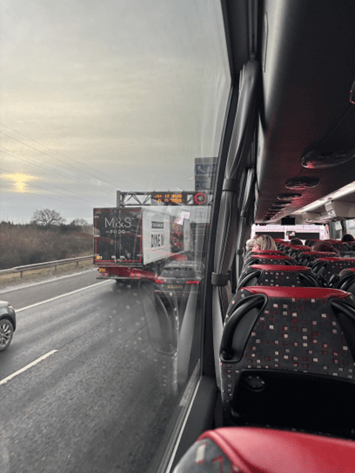
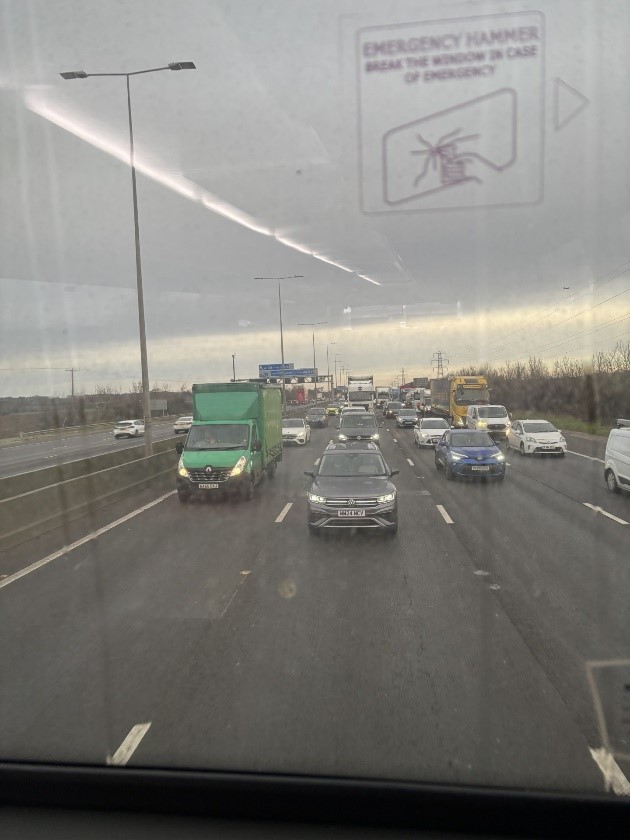
Sometimes these slow moments give us the best opportunities to reflect. While we’re crawling through, my mind wanders to some of the landmark cases we’ll be discussing today. The Supreme Court’s role in shaping our most complex moral and legal debates is fascinating – take the assisted dying cases for instance. These aren’t just legal arguments; they’re profound questions about human dignity, autonomy, and the limits of state intervention in deeply personal decisions. It’s also interesting to think about how the evolution of our highest court reflects (or sometimes doesn’t reflect) the society it serves. When we discuss access to justice in our criminology lectures, we often talk about how diverse perspectives and lived experiences shape legal interpretation and decision-making. These thoughts feel particularly relevant as we approach the very institution where these crucial decisions are made.

The traffic might be testing our patience, but at least it’s giving us time to really think about these issues.
10:07 AM – Arriving London – The stark reality of London’s inequality hits you right here, just steps from Hyde Park.
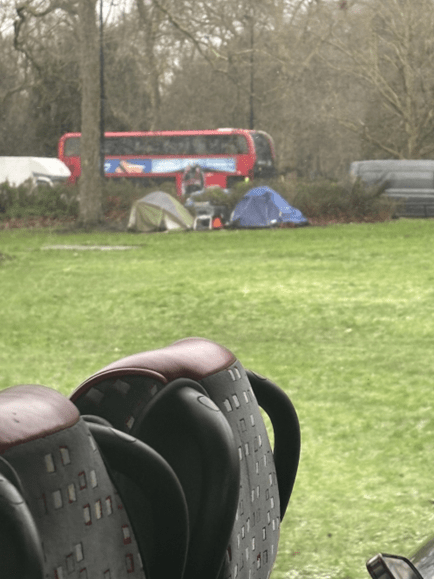
Honestly, this is a scene that perfectly summarises the deep social divisions in our society – luxury cars pulling up to the Dorchester where rooms cost more per night than many people earn in a month, while just meters away, our fellow citizens are forced to make their beds on cold pavements. As a criminologist, these scenes raise critical questions about structural violence and social harms. When we discuss crime and justice in our lectures, we often talk about root causes. Here they are, laid bare on London’s streets – the direct consequences of austerity policies, inadequate mental health support, and a housing crisis that continues to push more people into precarity. But as we say in the Nigerian dictionary of life lessons – WE MOVE!! 🚀
10:31 AM Supreme Court security check time
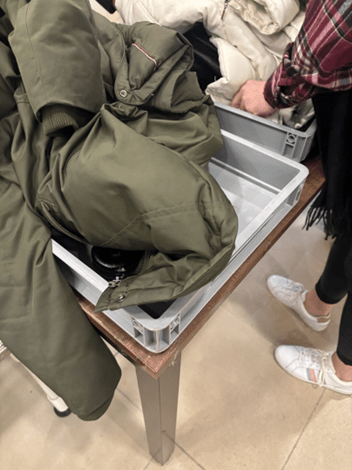
Security check time, and LISTEN to how they’re checking our students’ water bottles! The way they’re examining those drinks is giving: Nah this looks suspicious 🤔

So there I am, breezing through security like a pro (years of academic conferences finally paying off!). Our students follow suit, all very professional and courtroom-ready. But wait for it… who’s that getting the extra-special security attention? None other than our beloved department head Manos! 😂

The security guard’s face is priceless as he looks through his bags back and forth. Jes whispers to me ‘is Manos trying to sneak in something into the supreme court?’ 😂 Maybe they mistook his collection of snacks for contraband? Or perhaps his stack of risk assessment forms looked suspicious? 😂 There he is, explaining himself, while the rest of us try (and fail) to suppress our giggles. He is a free man after all.
10: 44AM Right so first stop, – Court Room 1.


Our tour guide provided an overview of this institution, established in 2009 when it took over from the House of Lords as the UK’s highest court. The transformation from being part of the legislature to becoming a physically separate supreme court marked a crucial step in the separation of powers in the country’s legislation. There’s something powerful about standing in this room where the Justices (though they usually sit in panels of 5 or 7) make decisions. Each case mentioned had our criminology students leaning in closer, seeing how theoretical concepts from their modules materialise in this very room.
10:59 AM Moving into Court 2, the more modern one!


After exploring Courtroom 1, we moved into Court Room 2, and yep, I also saw the contrast! And apparently, our guide revealed, this is the judges’ favourite spot to dispense justice – can’t blame them, the leather chairs felt lush tbh!
Speaking of judges, give it up for our very own Joseph Buswell who absolutely nailed it when the guide asked about Supreme Court proceedings! 👏🏾 As he correctly pointed out, while we have 12 Supreme Court Justices in total, they don’t all pile in for every case. Instead, they work in panels of 3 or 5 (always keeping it odd to avoid those awkward tie situations). 👏🏾 And what makes Court Room 2 particularly significant for public access to justice the cameras and modern AV equipment which allow for those constitutional and legal debates to be broadcast to the nation. Spot that sneaky camera right at the top? Transparency level: 100% I guess!

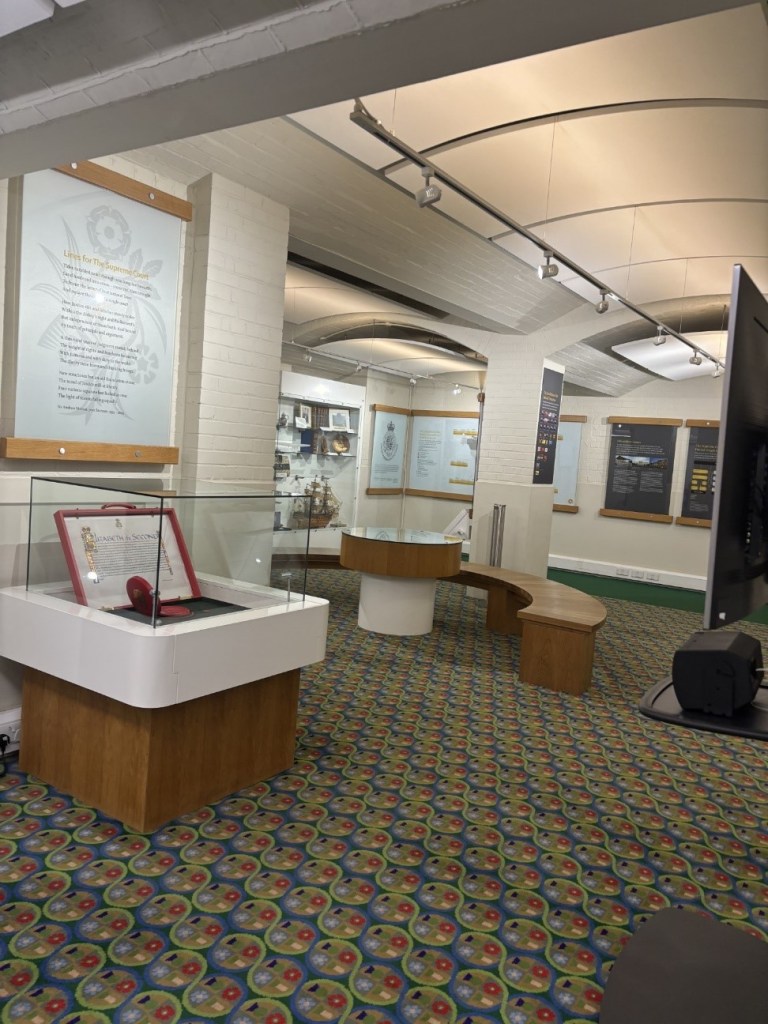
The exhibition area

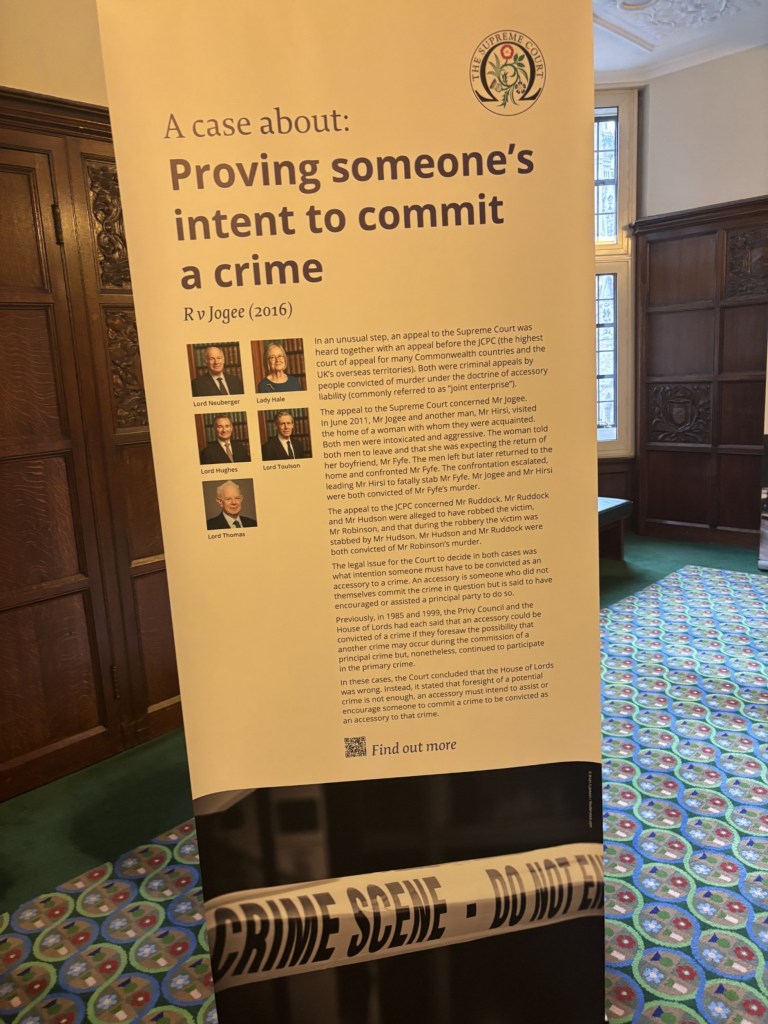
The exhibition space was packed with rich historical moments from the Supreme Court’s journey. Among the displays, I found myself pausing at the wall of Justice portraits. Let’s just say it offered quite the visual commentary on our judiciary’s journey towards representation…

Beyond the portraits, the exhibition showcased crucial stories of landmark judgments that have shaped our legal landscape. Each case display reminded us how crucial diverse perspectives are in the interpretation and application of law in our multicultural society.


11: 21AM Moving into Court 3, home of the Judicial Committee of the Privy Council (JCPC)

The sight of those Commonwealth flags tells a powerful story about the evolution of colonial legal systems and modern voluntary jurisdiction. Our guide explained how the JCPC continues to serve as the highest court of appeal for various independent Commonwealth countries. The relationship between local courts in these jurisdictions and the JCPC raises critical questions about legal sovereignty and judicial independence and the students were particularly intrigued by how different legal systems interact within this framework – with each country maintaining its own laws and legal traditions, yet looks to London for final decisions.

Breaktime!!!!
While the group headed out in search of food, Jes and I were bringing up the rear, catching up after the holiday and literally SCREAMING about last year’s Winter Wonderland burger and hot dog prices (“£7.50 for entry too? In this Keir Starmer economy?!😱”). Anyway, half our students had scattered – some in search of sustenance, others answering the siren call of Zara (because obviously, a Supreme Court visit requires a side of retail therapy 😉).


But here’s the moment that had us STUNNED – right there on the street, who should come power-walking past but Sir Chris Whitty himself! 😱 England’s Chief Medical Officer was on a mission, absolutely zooming past us like he had an urgent SAGE meeting to get to 🏃♂️. That man moves with PURPOSE! I barely had time to nudge Jes before he’d disappeared. One second he was there, the next – gone! Clearly, those years of walking to press briefings during the pandemic have given him some serious speed-walking skills! 👀
3:30 PM – Group Photo!
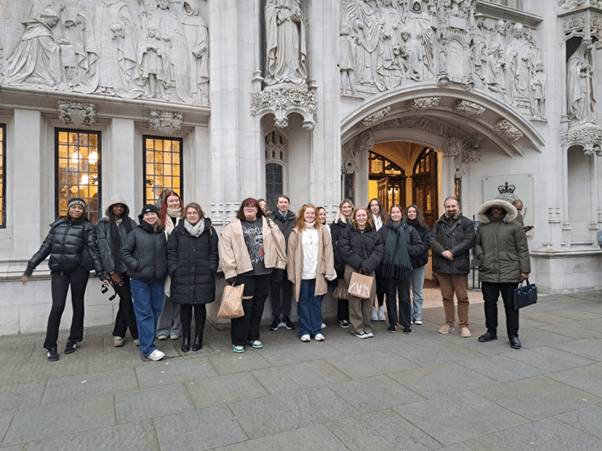
Looking at these final year criminology students in our group photo though! Even with that criminal early morning start (pun intended 😅), they made it through the whole Supreme Court experience! Big shout out to all of them 👏🏾👏🏾👏🏾👏🏾👏🏾👏🏾 Can you spot me? I’m the one on the far right looking like I’m ready for Arctic exploration (as Paula mentioned yesterday), not London weather! 🥶 Listen, my ancestral thermometer was not calibrated for this kind cold today o! Had to wrap up in my hoodie like I was jollof rice in banana leaves – and you know we don’t play with our jollof! 😤
4:55 PM Heading Back To NN

On the journey back to NN, while some students dozed off (can’t blame them – legal learning is exhausting!), I found myself reflecting on everything we’d learned. From the workings of the highest court in our land to the stark realities of social inequality we witnessed near Hyde Park, today brought our theoretical classroom discussions into sharp focus. Sitting here, watching London fade into the distance, I’m reminded of why these field trips are so crucial for our students’ understanding of justice, law, and society.


Listen, can we take a moment to appreciate our driver though?! Navigating that M1 traffic like a BOSS, and getting us back safe and sound! The real MVP of the day! 👏🏾👏🏾👏🏾👏🏾👏🏾👏🏾
And just like that, our Supreme Court trip comes to an end. From early morning rush to security check shenanigans, from spotting Chief Medical Officer on the streets to freezing our way through legal history – what a DAY!
To my amazing final years who made this trip extra special – y’all really showed why you’re the future of criminology! 👏🏾 Special shoutout to Manos (who can finally put down his attendance sheet 😂), Jes, and Liam for being the dream team! And to London… boyyyy, next time PLEASE turn up the heat! 🥶
As we all head our separate ways, some students were still chatting about the cases we learned about (while others were already dreaming about their beds 😴), In all, I can’t help but smile – because days like these? This is what university life is all about!
Until our next adventure… your frozen but fulfilled criminology lecturer, signing off! 🙌
Share this:


Labour’s Winter Fuel Allowance Cut: Austerity 2.0 and the need for De-commodification?

Last week, the Government voted as an overwhelming majority to scrap the winter fuel allowance. This has been met with fierce backlash from critics, particularly Labour MP Zara Sultana who stated her removal of taking part in ‘Austerity 2.0’. Meanwhile, in Prime Minister Questions, Kier Starmer defended the decision by referring to the ’22-billion-pound black hole’ that was left by the former Conservative Government (See Amos, 2024). This policy decision will mean that pensioners and vulnerable social groups across the UK will face a loss of financial support to pay for the ever-rising energy costs, particularly over the coming winter months. The health implications and fears onto those who will be affected were reported widely by critics. For example, Labour MP Rosie Duffield represented her constituents, some of whom were cancer patients who were severely worried about keeping warm this coming winter and relied on the winter fuel allowance as a reliable source of financial support (Lavelle, 2024).
This latest move initiated by Starmer’s Labour Government is primarily justified through the need for temporary acts of austerity, to balance the books and reduce the national debt and deficit which according to Starmer’s speech at the latest Prime Minister’s Questions now sits at over twenty billion.
A fundamental question here is not of the need for action to reduce the national deficit…. rather the question is- who should foot the bill? Latest figures show that within the same time as when the country scraps the winter fuel allowance, According to Race and Jack (2024), major energy companies such as British Gas announced its profits for 2023 has increased ten-fold to £750 million with the profits forecast to soar higher at the end of this year. There are calls by some politicians, including Zara Sultana to introduce a windfall tax that will put a cap on the gross profits gained by energy companies and large-scale businesses, through which these taxes can be put into public infrastructure, services, and spending. A common counterargument here however is how these businesses and corporations will remove themselves from the UK and situate themselves in alternative global markets, that through globalisation and free-market economy principles has become easier.
The scrapping of the winter fuel allowance demonstrates how under economic crisis, it is communities who foot the bill and suffer the consequences of government failure to protect public infrastructure and avoid generating a deficit and national debt. This policy also represents a balancing act between keeping corporations and businesses active players in the free-market economy versus protecting the countries most vulnerable and providing sufficient public infrastructure and utilities. Perhaps there is an alternative way between preserving the markets and re-orienting their purpose back to a public good…
Capitalist markets are led by profiteering… however, through the process of de-commodification, these markets are brought back under state(s) control and are re-oriented to serve a greater public good and social need (Soron & Laxer, 2006; Hilary, 2013). De-commodification turns the modes of production and consumption towards serving a greater public need. Whilst there is profit opportunities for those on the supply side, this is met with serving a greater public need. Essentially, de-commodification removes acts of disempowerment and the dependency of people from the markets and restores the power, much of which is placed back into state control. Perhaps, the model of de-commodification might not work in all contexts, particularly when one considers the intensification of globalisation and geopolitical insecurity, however there should be discussions on de-commodification…. As otherwise, the markets will continue to over-rule the state and communities will continue to pay the price…
References
Amos, O (2024) Starmer and Sunak clash on winter fuel payments at PMQs. BBC News. 11th September. Available at https://www.bbc.co.uk/news/live/c303gm7qz3pt {Accessed 13th September 2024}.
Hilary, J (2013) The Poverty of Capitalism: Economic Meltdown and the struggle for what comes next. London: Pluto Press.
Lavelle, D (2024) Winter fuel pay decision ‘brutal’ and could lead to deaths, says Labour MP. The Guardian, 7th September. Available at https://www.theguardian.com/politics/article/2024/sep/07/winter-fuel-pay-decision-brutal-labour-mp-rosie-duffield {Accessed 13th September 2024}.
Race, M., and Jack, S (2024) British Gas sees profits increase ten-fold. BBC News. 15th February. Available at https://www.bbc.co.uk/news/business-68303647#:~:text=British%20Gas%20has%20announced%20its,of%20Russia’s%20invasion%20of%20Ukraine {Accessed 13th September 2024}.
Soron, D., and Laxer, G (2006) De-commodifying Public Life. Peterborough: Broadview Press.
Share this:


Witches, Broomsticks and Libraries
My son has been gifted and collected many delightful children’s books since his recent birth. A book which stands out to me on Women’s History Month is: Room on the Broom (2001) by writer Julia Donaldson and Illustrator Axel Scheffler.
Aside from the fabulous use of words and illustrations, the main character of the story is a lovely witch who makes room on her broom for her cat, a dog, bird and frog. The latter part of the story consists of the broom snapping, presumably due to the extra weight of these passengers, then the witch risks being eaten by a dragon. But eventually all is well as the witch creates a new super broomstick with;
seats for the witch
and the cat and the dog,
a nest for the bird and
a shower for the frog.

This book’s depiction of the witch as a morally good character is wonderful but this is not usual. In popular culture, such as fiction, television and film witches seem to have flawed character traits, are morally bad cackling devious women who fly about casting spells on poor and (un/)suspecting folk.
The negative connotations of witches today reflect a long dreadful real-life history of outsiders being accused of being witches – with some being tortured and murdered due to this. The outsiders aka witches tended to be women, women who were providing a service for other women, such as support during childbirth or healing practices, or those that practice spiritualisms that differ to dominant religions. If re-born today some of these women may have been celebrated as midwifes and nurses, although their wages and workloads would still illustrate that predominantly women centered roles tend to be under appreciated.
On International Women’s Day I finished reading Disobedient Bodies (2023) by Emma Dabiri. Disobedient Bodies reminds me about how in a white capitalist cis male world bodies categorised as female and women are constructed as deviant. Proof of being a witch was apparently not just found in practices but on the bodies of women. Emma Dabiri adds to the discussion on witches that I did not consider; that groups of women aka groups of deviant witches were considered to be the most threatening to witch hunters. For a long time women have been pitted against each other, the historical nature of women meeting in groups to support each other as a threat to patriarchal capitalist white systems has added to this.
My son is very privileged to have so many book at the age of 1. Unfortunately I am writing during a time where there are threats to close 25 libraries in Birmingham. Notably, the libraries that me and my son frequent consist of mostly women staff (both paid and volunteers). In addition to the potential for job losses, if this happens there will be babies, children and adults without access to books, artistic classes, warm and safe spaces. To quote my friend and colleague, “soon there will be nothing left”.
Share this:


‘A de-construction of the term ‘Cost of Living Crisis’ in recognition of globalism’

The term ‘Cost of Living Crisis’ gets thrown around a lot within everyday discussion, often with little reference to what it means to live under a Cost-of-Living Crisis and how such a crisis is constituted and compares with crises globally. In this blog, I will unpack these questions.
The 2008 Global Financial Crash served as a moment of rupture caused and exacerbated by a series of mini events that unfolded on the world stage…. This partly led to the rise in an annual deficit impacting national growth and debt recovery. Then we entered 2010 when the Coalition Government led by David Cameron and Nick Clegg in the Conservative and Liberal Democrat parties implemented a Big Society Agenda, underpinned by an anti-statist ideology and Austerity politics. The legacies of austerity have extensively been highlighted in my own research as communities faced severed cutbacks to social infrastructure and resources, many of whom utilised these resources as a lifeline. Moving forward to the present day in 2024, austerity continues to be alive and well and the national debt has continued to rise…. Events including the Corona Virus Pandemic that started in 2019, Brexit and Russia’s invasion of Ukraine have amongst other events served as precipitators to an already existing economic downturn. The rise of interest rates and inflation have been partly led by disruptions to global supply chains, particularly essential and often taken for granted food resources such as wheat and grains. So too has political instability hindering opportunities to invest and grow the local economy contributed towards this economic downturn.
As inflation and interest rates rose, so too did the average cost of living in terms of expenditure and disposable income for both the Working and Middle-Classes. At this point, one can begin to see the emergence of the cost-of-living crisis as being constituted as an issue affecting social class.
The cost-of-living crisis is inherently a term deployed by the Middle Classes as some faced an increase of interest rates on their mortgages in addition to rising costs in the supermarkets. These are valid concerns and the reality and hardship produced under these conditions is not being contested. However, we must not lose sight of the fact that economic downturn and the reality of poverty is nothing new for many working-class communities, who have suffered from disinvestment and austerity, long before the term Cost of Living Crisis came into being.
Equally, we can understand the Cost-of-Living Crisis as being a construction led by Western states, as part of a wider Global North. The separation between the Global North and Global South is bound by geography, but economic growth and its globally recognised position as an emerged or emerging economy. Note that such constructions within themselves are applied by the Global North. Similarly, the Cost-of-Living Crisis is nothing new for these states. The reality of living below a breadline is faced by many of these countries in the Global South and should be understood as a wider systemic and global issue that members of the International Community have a moral obligation to address.
So, when applying terms such as the Cost-of-Living Crisis under every-day discussion, it is necessary to contemplate the historicisms behind such an experience and how life under poverty and hardship is experienced globally and indeed across our own communities. This will enable us to think more critically about this term Cost of Living Crisis, which as it is widely used, faces threat of oversight as to the prevalence and effects of global and local inequalities.
Share this:


When will these issues be addressed?

In the realm of education, inclusivity and accessibility should be the foundation of any society aspiring for progress. However, in the case of special education schools in the United Kingdom, there exists a troubling narrative of systemic failings. Despite efforts to provide tailored education for students with diverse needs, the British educational system’s shortcomings in special education have cast a shadow over the pursuit of equal opportunities for all.
One of the main challenges facing special education schools in the UK is inadequate funding. These institutions often struggle with limited resources, hindering their ability to provide the necessary support for students with special educational needs. Insufficient funding results in larger class sizes, fewer specialized staff, and a lack of essential resources, all of which are detrimental to the quality of education these schools can offer. Furthermore, the heavy reliance on the UKs crumbling social care services and the overstretched NHS within special education settings exasperate poor outcomes for children and young people.
Special education students require a range of support services tailored to their individual needs. However, the inconsistency in the provision of support services across different regions of the UK is a glaring issue. Disparities in access to speech therapists, occupational therapists, and other essential services create an uneven educational landscape, leaving some students without the critical support they require to thrive.
Effective collaboration and communication between educators, parents, and support professionals are vital for the success of any special education school. Unfortunately, there is often a lack of seamless coordination. The lack of collaboration can and has result in fragmented support for the students, hindering their overall development and thus making it difficult to implement cohesive and effective educational plans.
The success of special education programs relies heavily on well-trained and empathetic educators. Unfortunately, the British educational system falls short in providing comprehensive training for teachers, working in special education schools. Many teachers express a lack of preparation to address the unique challenges posed by students with diverse needs, leading to a gap in understanding and effective teaching strategies. It is also important to note that many staff members that work within special education settings are not trained teachers, although they have been given the title of teachers. This further leads to inadequate education for children and young people. Moreover, post-covid has seen a high staff turnover within these settings. There have been many reports that have alluded to the notion that British schools are failing our children, but it seems that children from special education provisions are ignored, and families are dismissed when concerns are raised about the lack of education and preparation for the ‘real world’.
I am also critical of the overreliance of labelling students with specific disabilities. While categorization can be useful for designing targeted interventions, it can also lead to a narrow understanding of a student’s capabilities and potential. This labelling approach inadvertently contributes to stereotypes and stigmas, limiting the opportunities available to students with special needs….. There tends to be a focus on the troubling history of the way people with disabilities in the UK have been treated, but what I find interesting is there is a sense of disregard for the issues that are occurring in the here and now.
There is also a lack of special education provisions in the UK. This has led to many children with additional needs without a school place. And while a specific figure of the number of children being excluded from education has not been disclosed, West Northamptonshire, has awarded families over £49,000 over special education failings in 2023 (ITV, 2023). Furthermore, Education health care plan recommendations (EHCP) have not been followed within schools. These are legally binding documents that have been continuously dismissed which has led to further legal action against West Northants council in recent years (Local Government and Care Ombudsman, 2023).
The failings in special education schools have repercussions that extend beyond the classroom. Many students who leave these schools face challenges in transitioning to higher education, entering the workforce or living independently. The lack of adequately tailored support for post-education opportunities leaves these individuals at a disadvantage, perpetuating a cycle of limited prospects, which inevitably pull people with disabilities into a cycle of poor health and poverty (Scope, 2023). The disability employment gap in the UK is 29% and the average disabled household faces a £975 a month in extra costs (Scope, 2023) access to employment and financial independence is out of reach for disabled people due to failings within education because lack of preparation for life beyond school.
There needs to be reform in British schools from mainstream to special education. There are failings across the board. Adequate funding, improved teacher training, consistent support services, enhanced collaboration, and a shift away from overreliance on labelling are all crucial steps toward creating an inclusive educational environment. It is difficult to draw on optimism when the UK government continues to ignore age old concerns. This blog entry is to bring awareness to an issue, that may not be on your radar, but will hopefully get you to reflect on the copious barriers that people with disabilities face. Childhood should be a time when there is a fence built to protect children is schools. As we get older and face the challenges of the wider world, we should be equipped with some skills. Special education schools should not be used as a holding place until a child comes of age. There should be provisions put in place to give all young people an equitable chance.

 Thoughts from the criminology team
