
Home » Anti-racism
Category Archives: Anti-racism

25 years is but a drop in time!

If I was a Roman, I would be sitting in my comfortable triclinium eating sweet grapes and dictating my thoughts to a scribe. It was the Roman custom of celebrating a double-faced god that started European celebrations for a new year. It was meant to be a time of reflection, contemplation and future resolutions. It is under these sentiments that I shall be looking back over the year to make my final calculations. Luckily, I am not Roman, but I am mindful that over 2025 years have passed and many people, have tried to look back. Since I am not any of these people, I am going to look into the future instead.
In 25 years from now we shall be heading to the middle of the 21st century. A century that comes with great challenges. Since the start of the century there has been talk of economic bust. The banking crisis slowed down the economy and decreased real income for people. Then the expectation was that crime will rise as it did before; whilst the juries may still be out. the consensus is that this crime spree did not come…at least not as expected. People became angry and their anger was translated in changes on the political map, as many countries moved to the right.
Prediction 1: This political shift to the right in the next 25 years will intensify and increase the polarisation. As politics thrives in opposition, a new left will emerge to challenge the populist right. Their perspective will bring another focus on previous divisions such as class. Only on this occasion class could take a different perspective. The importance of this clash will define the second half of the 21st century when people will try to recalibrate human rights across the planet. Globalisation has brought unspeakable wealth to few people. The globalisation of citizenship will challenge this wealth and make demands on future gains.
As I write these notes my laptop is trying to predict what I will say and put a couple of words ahead of me. Unfortunately, most times I do not go with its suggestions. As I humanise my device, I feel sorry for its inability to offer me the right words and sometimes I use the word as to acknowledge its help but afterwards I delete it. My relationship with technology is arguably limited but I do wonder what will happen in 25 years from now. We have been talking about using AI for medical research, vaccines, space industry and even the environment. However currently the biggest concern is not AI research, but AI generated indecent images!
Prediction 2: Ai is becoming a platform that we hope will expand human knowledge at levels that we could have not previously anticipated. One of its limitations comes from us. Our biology cannot receive the volume of information created and there is no current interface that can sustain it. This ultimately will lead to a divide between people. Those who will be in favour of incorporating more technology into their lives and those who will ultimately reject it. The polarisation of politics could contribute to this divide as well. As AI will become more personal and intrusive the more the calls will be made to regulate. Under the current framework to fully regulate it seems rather impossible so it will lead to an outright rejection or a complete embrace. We have seen similar divides in the past during modernity; so, this is not a novel divide. What will make it more challenging now is the control it can hold into everyday life. It is difficult to predict what will be the long-term effects of this.
During the late 20th and early 21st centuries drug abuse and trafficking seemed to continue to scandalise the public and maintain attention as much as it did back in the 1970s and 80s. Drugs have been demonised and became the topic of media representation of countless moral panics. Its reach in the public is wide and its emotional effect rivals only that of child abuse. Is drugs abuse an issue we shall be considering in 25 years from now?
Prediction 3: People used substances as far back as we can record history. Therefore, there will be drugs in the future to the joy of all these people who like to get high! It is most likely that the focus will be on synthetic drugs that will be more focused on their effects and how they impact people. The production is likely to change with printers being able to develop new substances on a massive scale. These will create a new supply line among those who own technology to develop new synthetic forms and those who own the networks of supply. In previous times a takeover did happen so it is likely to happen again, unless these new drugs emerge under formal monopolies, like drug companies who will legalise their recreative use.
One of the biggest tensions in recent years is the possibility of another war. Several European politicians have already raised it pretending to be making predictions. Their statements however are clear signs of war preparation. The language is reminiscent of previous eras and the way society is responding to these seems that there is some fertile ground. Nationalism is the shelter of every failed politician who promises the world and delivers nothing. Whether a citizen in Europe (EU/UK) the US or elsewhere, they have likely to have been subjected to promises of gaining things, better days coming, making things great…. only to discover all these were empty vacant words. Nothing has been offered and, in most cases, working people have found that their real incomes have shrunk. This is when a charlatan will use nationalism to push people into hating other people as the solution to their problems.
Prediction 4: Unfortunately, wars seem to happen regularly in human history despite their destructive nature. We also forget that war has never stopped and elusive peace happens only in parts of the world when different interests converge. There is a combination of patriotism, national pride and rhetoric that makes people overlook how damaging war is. It is awfully blindsided not to recognise the harm war can do to them and to their own families. War is awful and destroys working people the most. In the 20th century nuclear armament led to peace hanging by a thread. This fear stupidly is being played down by fraudsters pretending to be politicians. Currently the talk about hybrid war or proxy war are used to sanitise current conflicts. The use of drones seems to have altered the methodology of war, and the big question for the next 25 years is, will there be someone who will press THAT button? I am not sure if that will be necessary because irrespective of the method, war leaves deep wounds behind.
In recent years the discussion about the weather have brought a more prevailing question. What about the environment? There is a recognised crisis that globally we seem unable to tackle, and many make already quite bleak predictions about it. Decades ago, Habermas was exploring the idea of “colonization of the lifeworld” purporting that systemic industrial agriculture will lead to environmental degradation. Now it seems that this form of farming, the greenhouse gasses and deforestation are becoming the contributing factors of global warming. The inaction or the lack of international coordination has led calls for immediate action. Groups that have been formed to pressure political indecision have been met with resistance and suspicion, but ultimately the problem remains.
Prediction 5: The world acts when confronted with something eminent. In the future some catastrophic events are likely to shape views and change attitudes. Unfortunately, the planet runs on celestial and not human time. When a prospective major event happens, no one can predict its extent or its impact. The approach by some super-rich to travel to another planet or develop something in space is merely laughable but it is also a clear demonstration why wealth cannot be in the hands of few oligarchs. Life existed before them and hopefully it will continue well beyond them. On the environment I am hopeful that people’s views will change so by the end of this century we will look at the practices of people like me and despair.
These are mere predictions of someone who sits in a chair having read the news of the day. They carry no weight and hold no substantive strength. There is a recognition that things will change at some level and we shall be asked to adapt to whatever new conditions we are faced with. In 25 years from now we will still be asking similar questions people asked 100 years ago. Whatever happens, however it happens, life always finds a way to continue.
Share this:


Why I refuse to join the hate train

In a world drowning in outrage, where every headline screams division and every scroll brings fresh fury, it’s easy to forget something fundamental: there’s still beauty everywhere.
Turn on the news and you’re bombarded with it all—bans, blame, and bitter arguments about who’s ruining what. Immigrants, the wealthy, the homeless, the young, the benefits claimants—everyone’s apparently the problem. It’s a relentless tide of negativity and moaning that can sweep you under if you’re not careful.
But what if we chose differently?
Here are a few things I noticed in the last couple of weeks:
I came across a book that someone left on a park bench with a note: “Free to a good home.” On another late night, a man saw a mother struggling—baby in one arm, shopping bags in the other—and didn’t hesitate to help her to her car. And if you’re thinking “why didn’t she use a trolley?” then you’re part of the problem I’m talking about, because there were no trolleys in that shop.
In another moment, a homeless person was offering water to a runner who’d collapsed in the heat, providing comfort when it mattered most.
Elsewhere, a teacher stayed late for his “troubled” student preparing for exams. When I asked why, he said: “Everyone calls him destructive. I refuse to lose hope. He’s just a slower learner, and I’ll support him as long as it takes.”
In another event, teenagers on bikes formed a protective barrier around an elderly woman crossing the road.
Small acts. Quiet kindness. The stuff that never makes headlines, doesn't trend on social media, and doesn't fuel debates.
The truth is, these things happen everywhere, all the time. While we’re busy arguing about who’s destroying society, society is quietly rebuilding itself through a million small kindnesses. The coffee lady in the Learning Hub who remembers your order. The elderly doorman at Milton Keyens Costco who draws smiley faces on reciepts and hands them to children on their way out, just to see them smile. The neighbour who randomly helps pick up litter in the neighbourhood with her girls every Sunday afternoon. The friend who texts to check in with the simple words “how are you?”
The truth is simple: for every voice spreading hate, there are countless others spreading hope. For every person tearing down, there are builders, healers, and helpers working in the quiet spaces between the noise.
Yes, problems exist. Yes, challenges are real. But so is the grandfather teaching his grandson about dignity and respect. So is the aunty teaching her niece how to bake. So is the library volunteer reading to the shelter dogs. So is the community garden where strangers become neighbours.
Today, I’m choosing to notice the nice. Not because I’m naive, but because I refuse to let the moaning and the loudest voices drown out the most important ones. The ones that remind us we’re more alike than different. The ones that choose connection over division.
Your turn: What nice thing will you notice today? Free your mind, pay attention—you'll see one.
Because in a sea of anger, being gentle isn’t weak or naive—it’s revolutionary.
Share this:


Still holding Black women to European beauty standards

Many of you, like me will be enjoying the 2024 Olympic games in Paris: from the sheer amount of dedication, talent, and passion, to the ups and downs, the shocks and surprises and everything else in-between. However, it was something outside of the games that struck me. Simone Biles, the most decorated gymnast in history, received negative criticism online about her hair being unkempt on a video that she uploaded of herself and teammates on a bus. Simone then felt the need to address the comments and remind the public about overstepping the mark.
At first, Simone justified why her hair may have looked ‘messy’, explaining that it had been done prior to the bus journey, and that it was the heat and the long bus ride that had led to her hair falling out of place. She followed up these justifications with another post that reminded the public to kindly not mention a Black woman’s hair. This brought me back to discussions within my research where I highlight the European beauty standards that Black women are held to (Charles, 2024). Black women’s hair has for a long time been seen as unprofessional, messy and problematic. On the other spectrum, Black women’s natural hair has been marvelled at and touched without permission, causing Black women to feel hyper-visible and uncomfortable. Whichever encounter, it can lead to many Black women feeling the need to change their hair or mould it into something that looks more European (Charles, 2024; Patton, 2006). European beauty ideals and standards create further challenges and judgement that Black women face in society. Black women are scrutinised against racialised beauty ideals they cannot achieve, and they are perceived to be failing to measure up to the normative standard (Patton, 2006).
It should be a woman’s choice to style her hair how she wants, without external factors influencing or determining these choices. Additionally, Black hair needs to stop being compared to European hairstyles, in which such comparisons put European hairstyles on a pedestal. Speaking from experience, for many Black women, learning to love your hair for what it is rather than lament over what it is not can sometimes be a process. It can be a process of confusion, growth, trial and error, liberation, empowerment and pride. Moreover, it can be an important part of someone’s identity. I hope Simone Biles’ courage to challenge such comments can act as a springboard for others to do the same with power and resilience, and I hope we can start to normalise Black hair and hairstyles for future generations.
References
Charles, A. (2024) Black Women in Prison: Exploring the Intersection of Race and Gender in Experiences of Imprisonment. Unpublished PhD Thesis. Milton Keynes: The Open University.
Patton, T. O. (2006) ‘Hey Girl, Am I More than My Hair?: African American Women and Their Struggles with Beauty, Body Image, and Hair’, NWSA Journal, 18(2), pp. 24-51. Available at: http://www.jstor.org/stable/4317206
Share this:


I’m not Black; my Friends and I are Brown, not Black

I recently began the process of preparing my child for the imminent transition to a new school situated in a diverse community. Despite being born into a similarly diverse environment, his early educational exposure occurred in an ethnically varied setting. Venturing into this new chapter within a racially diverse community has sparked a keen interest in him.
My child soon articulated a perspective that challenged conventional racial labels. He asserted that he and his friend Lucien are not accurately described as ‘black,’ rather he believes they are ‘brown.’ He went further to contest the classification of a lady on TV, who was singing the song “Ocean” by Hillsong, as ‘white.’ According to him, his skin is not black like the trousers he was wearing, and the lady is not white like the paper on my lap. This succinct but profound statement held more critical significance than numerous conversations I’ve encountered in my over five years of post-PhD lecturing.
The task at hand, guiding an under seven-year-old questioning the conventional colour-based categorisation, proved challenging. How do I convince an under seven-year-old that his knowledge of colours should be limited to abstract things and that persons with brown toned skin are ‘black’ while those with fair or light toned skinned are ‘white’? I found myself unprepared to initiate this complex conversation, but his persistent curiosity and incessant ‘why prompts’ compelled me to seek creative ways to address the matter. Even as I attempted to distract myself with a routine evening shower and dinner, my mind continued to grapple with the implications of our conversation.
Post-dinner, my attempt to engage in my usual political news catch-up led me to a YouTube vlog by Adeola titled ‘How I Almost Died!’ where she shared her pregnancy challenges. One statement she made struck a chord: ‘if you are a black woman and you are having a baby in America, please always advocate for yourself, don’t ever keep quiet, whatever you are feeling, keep saying it until they do something about it’ (18:39). This sentiment echoed similar experiences of tennis star Serena Williams, who faced negligence during childbirth in 2017.
The experiences of these popular ‘black’ women not only reminds me that the concept ‘black’ and ‘white’ are not only symbolic, but a tool for domination and oppression, and disadvantaging the one against the other. Drawing inspiration from Jay-Z’s ‘the story of O.J’, the song drew attention to the experiences of race, success, and the complexities of navigating the world as a ‘black’ individual. In the song, two themes stood out for me, the collective vulnerability to prejudice and the apparent bias in the criminal justice system towards ‘black’ people. In the UK, both proportional underrepresentation in staff number and proportional overrepresentation of minoritized groups in the criminal justice system and the consequences therefrom is still topical.
Jay-Z’s nuanced understanding of ‘black’ identity rejects simplistic narratives while emphasising its multifaceted nature. The verse, “O.J. ‘like I’m not black, I’m O.J.’ Okay” underscores the challenges even successful ‘black’ individuals face within racial systems. As criminologists, we recognize the reflection of these issues in daily experiences, prompting continuous self-reflexivity regarding our values, power positions, and how our scholarly practice addresses or perpetuates these concerns. Ultimately, the question persists: Can a post-racially biassed world or systems truly exist?
Share this:


Meet the Team: Angela Charles, Senior Lecturer in Criminology

I would like to take this opportunity to say a warm hello to my colleagues and to the students at the University of Northampton.
I am Angela Charles, a senior lecturer in criminology. I have a passion and deep interest in this discipline for a number of reasons. Firstly, criminology is such a fascinating and thought-provoking subject that is constantly evolving and expanding. Secondly, criminology is a subject where I believe social justice can be fought for and in many cases achieved, through researching and gaining evidence to push for change, and through perseverance. Thirdly, criminology requires us to discuss, debate, analyse and build on what has been previously argued and discussed; thereby strengthening, tweaking or dismantling and rebuilding previous theoretical knowledge and criminological concepts.
My research interests are within prisons and penology, and race and gender. My most recent research explored and analysed the experiences of Black women in English prisons, paying particular attention to the intersections of race, class and gender. Black women are at the margins of society and face multiple intersecting oppressions. The prison is arguably a microcosm of society and perpetuates the same oppressive structural inequalities. It is often these racialised and gendered pains of imprisonment that are rarely discussed or mentioned both within scholarly literature and the public realm more widely. I hope to disseminate my research in the coming years and amplify some of the voices of Black women in UK prisons.
I’m also keen to explore research methods that arguably move away from traditional research methods and instead aim to decolonise research methods. Criminologists need to adapt the methods they use to suit the differing backgrounds and cultures of the participants that we research, and we need to incorporate different cultural aspects into the research process. I believe this not only will create richer data, but will also increase participant engagement as they become co-producers of knowledge.
Lastly, I look forward to working closely with my colleagues to learn about their research interests, passions and to collaborate on ensuring that studying criminology is enjoyable, rewarding and insightful at the University of Northampton!

Share this:


Don’t I know you from somewhere? Online trolls and other fairytales

Recently there has been a discussion if the owner of one of the social media platforms will be changing its logo. The “iconic” image is to be replaced with something new; undoubtedly this will also change in due course for as long as the medium is still relevant. Whilst people feel strong about brand representation that is something peripheral to what social media represent in recent years. Social media for a long time have been accused of harboring the worst of human interaction, tolerating intolerable actions from hate speech to incitement to violence. Is this however a fair representation of social media?
We build/cultivate and imagine in social media. They are the key to our online identity and in some ways will explain our conduct with others. Some link different media together, so that you can check Facebook to get an idea of who they are, can check their LinkedIn on education and work experience, you can read their tweets/retweets, you can follow their conversations on yammer, you can get updates of their lives on Snapchat, check their Instagram to see their photos and for the more active ones TikTok where communication is encapsulated within small video fragments. If you were to combine these social media together you can get a very good idea about a person without ever knowing them in person. Social media have ushered the era of virtual representation and people becoming clearer of how this representation works. Clearly there are those who thrive in these and others who struggle.
The ones who manage to use social media effectively can develop a personal brand and even become “social influencers”. A person that has influence over others to promote goods and services…to do so they have to build a reputation and social media works towards establishing just that. Connecting different parts of social media works to their advantage as their profile works towards their credibility of being a “real” person. The people who make it become the protagonists assuming the role of a hero, a modern-day prince/princess with a back story that is endearing. Whilst they drip feed their story of adversity with personal details of some private aspects of their lives, they also provide their followers with the commodities that they promote. I lost someone important to me, had a terrible experience at school, faced health problems but look at my stylish hat. These are the cargo trousers I left an abusive relationship in, and my cropped t-shirt is a strong statement to being environmentally
sensitive. Obviously, I deliberately exaggerate the statements here and in fairness no one will be (at least I hope) so deliberate in their product placement. What is very clear is that our social media influencers spend a significant amount of time building content and by devoting more time to that they need the necessary financial support. The top influencers have millions of people following them, a reach that
very few people have ever had before. Never before, a young person offering make-up tips, a reality star or a dancer had so many people interested in their lives. The very top of them have more than 500 million followers and we are close to the point that some of them will be reaching over a billion! What started as a personal (cottage) industry of one topic issue, has evolved into an all-consuming enterprise. The more the followers, the greater the demand for additional information. The more information, the more exposed the influencer becomes. Then marketing follows as the reward. The heroes of social media have to find ways to make an income and endorsing products seems to be the main way to do so.
The kingdom of social media doesn’t only contain heroes; there are also villains in the story. The people whose profile is not personal, doesn’t include any private details and who seem to have as their main focus to attack others. The term troll appeared in the early 90s when online identities seemed to be separate from our social ones. It was expected in a new domain that people will assume roles and whilst some went for the hero of the community others took a different turn. The early trolls under the protection of cyber identities hid their frustrations and brought to the community something we have in the real world, bullying. The evolution of social media that requires a different presence and the rules the internet community tried to deal with them meant that some of the original forms of trolling started disappearing, but were never extinguished. In fact, they became an equally useful commodity, almost equal to the influencers. Our heroes play the part of the product promoter; they look good and provide us with goodwill stories; on occasion when the appeal of the hero wanes, and people try to use social media to mobilise on social issues or promote alternative stories that’s when the trolls come in!
Out of their caves they come, trying to shut down conversations, mislead people and even intimidate people into silencing them.
This brings me to the main point of this blog; originally the internet seemed to be a worldwide phenomenon that was all inclusive and slightly anarchical. People found on the internet a companion, an ally, an adversary. It became a foundation for a virtual ecumenical community. Well, that was until big business moved in and brought in their usual tactics. The cyber world became more like our physical world and the cyber identities were quickly replaced by professional ones. At this point the internet is much more regulated and monitored than ever before. Which begs the question; how come there are so many accusations of misinformation, and intimidation now? How come such a regulated medium allows bullying and intimidation to continue? I am astounded even now to see on social media reactions on social medial about stories that do not simply lack social sensitivity they are intentionally inflammatory to coax reactions and offend people. I am still astounded to see the political alliances of the troll army and their reactions to open conversations. Therefore, it is not surprising that several minority groups have accused social media of doing very little to protect them from attacks and the use of pejorative language that has its place in a history of shame. Maybe because social media provides a fairytale with princesses and trolls, they do not have the space for those who do not promote a marketed lifestyle. Life is surprisingly diverse, and marketing is only one side of it. Ignoring some of the bigger social issues, using
trolls to shut down the conversations our global community needs, will not do. In academia the sign of a good debate lies in the ability to bring in evidence and support all claims with accurate and relevant information. Some of our colleagues are trying to take some of their knowledge outside the classroom into social media; I salute them, as we have been trying to engage as much as we can, but I also worry that the actual model that social media is built upon also at fault. Maybe it needs some rethink; there is no question that we are all equal, but we do not all have the same knowledge.

Share this:

Refugee Week 2023

Monday 19th June commences the 2023 Refugee Week and this year’s theme is compassion, a quality we have seen little of in Fortress Europe policy and practice this year. As many of you will know, Jessica James and I founded the Northampton Freedom From Torture local supporter’s group earlier this year. Part of the reason for setting up the group was to help foster compassion towards people seeking safety in our local area. Admittedly, we’ve been pretty quiet so far (workloads, life etc. – we welcome volunteers to help organise events) but for Refugee Week we have organised a film screening of MATAR and The First Drop of Rain: Making MATAR.
MATAR is a WaterBear Original following the story of an asylum seeker in England who, when confronted with the hostile immigration system in the UK, is forced to live on the fringes of society and rely on his bike to survive.
A powerful and poignant story of resilience and perseverance, based on the lived experience of co-writer Ayman Alhussein. MATAR stars actor Ahmed Malek (The Swimmers) in the titular role, with BAFTA-nominated actor Youssef Kerkour (Home) and Elmi Rashid Elmi (The Swimmers). This docu-fiction short film is directed by BAFTA-winning Hassan Akkad and produced by Deadbeat Studios in association with Choose Love.
The event will be hosted on Wednesday 21st June 2023 from 5.30pm in the Morley Room at the University of Northampton. Tickets are free and can be booked here but we welcome donations and sponsorship for @jesjames50’s forthcoming half marathon.
In October, Jes will be running the Royal Parks Half Marathon to fundraise for Freedom From Torture. Running is one of Jes’ favourite hobbies and is enjoyed by millions across the globe as a popular pastime and fitness activity. However, running in this capacity is a privilege. For some it is forced upon them to flee harm, torture and unlawful prosecution. Freedom For Torture is a charity which is dedicated to helping, healing and protecting people who have survived torture. The half marathon is 13.1miles and has raised nearly £60million for over 1000 charity partners since 2008, and in 2023 we are aiming to contribute to this! Watch this space for more details about the upcoming fundraising activities and sponsoring Jes take on her longest run ever for survivors of torture. You can find Jes’ Just Giving page here.

Now we have the promotion out of the way, let’s talk about why compassion matters. The UK government is intent on ‘stopping the boats’, yet the policies they propose to achieve this do not include opening safe and legal routes to those seeking safety here. Instead, governments throughout much of Europe opt for deterrent measures, the results of which mean border deaths as we have seen in the tragedy off the coast of Greece this week. The omission of opening safe routes contributes to the structural violence of immigration policy and practice in Europe and means that deaths at the border are, as Shahram Khosravi argues, an acceptable consequence of border practices. There exists a gaping chasm where the compassion should be.
Meanwhile, those who do show compassion such as those volunteering to help refugees, protesters and even refugees themselves risk criminal prosecution. Sara Mardini is among a group of volunteers who faced prosecution in Greece earlier this year for a number of charges relating to their voluntary work with refugees. Although acquitted of a number of charges, some of the volunteers still face investigation for people smuggling and other offences. Meanwhile in the UK protesters are routinely arrested for protesting inhumane deportation and the Nationality and Borders Act 2022 allows maximum sentences of life imprisonment for those piloting small boats to smuggle migrants into the UK, not considering that many of these people will be refugees themselves who have paid smugglers and been forced to pilot boats, or who have agreed to pilot a boat in return for their passage. The stakes are high for acts of compassion.
As a border criminologist and activist, the refugee ‘crisis’, political, media and public responses to people seeking safety can feel overwhelming at times. It is difficult to comprehend what one person can do, yet there is power where lots of individuals stand up against injustice. Just over a year ago, I was at a protest outside an immigration removal centre on the day the first flight to Rwanda was due to take place. There were others there and at various locations around the country, and even more mobilised on social media. Campaign groups, charities and lawyers worked together to bring a court case against the UK government. While the war is ongoing, we won the battle that day and the plane was not allowed to leave.
We can all do something to spread compassion towards people seeking safety. Actions could be as simple as learning about refugees by watching a film or reading a book. It could mean sharing your thoughts in conversations and viA social media platforms. You could write to your MP and ask them to show some compassion or volunteer with a group like our Freedom From Torture local group or participate in a protest.
Share this:


The Color Purple, The Musical: What in the Misogynoir?!

TW: mentions of rape, child rape, racism, and misogynoir.
Alice Walker’s novel The Color Purple is a story loved around the world. So, when I saw that it was adapted to stage and touring the UK, my interest was peaked just enough to consider a visit to my local theatre the Royal & Derngate in Northampton. A Curve and Birmingham Hippodrome co-production, it came to Northampton in the first week of October. Largely, audiences that frequent my local theatre are overwhelmingly white – thus, watching The Color Purple it was a joy to my heart to hear Black people in my community engaging with the arts, because the last time I heard so many Black people attended, was for Our Lady of Kibeho as part of the R&D’s Made in Northampton season. This dates back to 2019, a production I reviewed for The Nenequirer showing that Northampton(shire) arts has work to do.
Social media platforms like Twitter and Instagram showed me the pretty unanimous positive praise for the Leicester-Birmingham co-production, while local critics also enjoyed it – including reviews from The Chronicle & Echo and The Nenequirer as well as further reviews by The Real Chris Sparkle and Northampton Town Centre BID. However, there were elements of the show that caused me great distress, no less than the perpetuation of misogynoir and racist stereotypes against Black men. It was deeply triggering, showing how historical trauma and vicarious trauma are ever present, including when white organisations have not done the work of protecting Black mental health when producing “Black-centred media.”
At the head of this cast, Me’sha Bryan gives a knockout performance as Celie (previous played by Whoopi Goldberg in the film) accompanied by Aaliya Zhané as Nettie, with Bree Smith as Shug Avery, and brilliant musical numbers grounded in the traditions of blues music that finds its origins in the trauma of enslaved Africans in the American South. They sang when “they got the blues” … and as far as performance and the commitment from the cast, I couldn’t ask for better.
However, whilst I have praised the musical numbers above, I did not believe it fitted with the tones of The Color Purple curating a rift between what the actors were saying and doing on stage, and the intonations of the music – as well as the lighting design. And despite the directorial position deciding the rape of a child wasn’t musical material (rightly so), the choice to have it as a passing detail with no further discussion, I found particularly off-key. This is one of the moments that highlights that The Color Purple may not have been musical material and better considered as a serious drama. I did not walk away feeling that bleak, much ado with contradictory lighting choices to character moods. The characters were feeling one away and lights did something else. By the by, rather than skip over the rape to maintain “the musicalness”, it may have been more effective to have done this story as a stage drama (with musical elements, if at all). The horrors depicted at the beginning of the novel are pretty nonexistent in musical.
So, this recent adaptation was a disappointment. Not from an acting point of view but behind-the-scenes pre-production elements like direction. The start of story includes a fourteen year-old who births two children after being raped by her father. So, the amount of trauma that exists around child sexual abuse and rape appear unconsidered when they glossed over these parts of the story. Furthermore, I do question if they consulted with any survivors when doing research for this adaptation. A ‘sensitivity consultant’ would not have gone amiss either, further to considerations of intersectionality and how cultural nuances in global, but still different Black communities, will be interpreted by white people, especially in provincial Little England.
Blown away by the musical abilities of the cast, stage productions (like much art) are often labelled as “escapist” so is not afforded the same criticality as for example – policing, education, sport and so on – we are all guilty of this and we can do better. This may be art; there were no redeeming Black characters, and Black men calling Black women “ugly” (written into the script) in full face of a white audience is cultural violence. In Northampton, the large white audience laughed at this example of ableist misogynoir, and in many ways this production felt to be played up for white audiences. Lots of white people are not used to seeing Black people as full human beings, and I do feel the play draws out our humanity. And by proxy centres white comfort with a Black aesthetic reinforced by white supremacy in media.
Disability justice activist Talia Lewis has released definitions of ableism every year since 2019. In January 2022, she discussed ableism as a violent social discourse that values people’s bodies and minds according to societally constructed ideas of “normalcy, productivity, desirability, intelligence, excellence and fitness …” Lewis (2022) states that these ideas are embedded in other violent discourses such as eugenics, capitalism, misogyny and white supremacy. The adaptation of these characters is only part of this debate, where another part may want to consider how this play has informed everpresent white superemacism pervasive across Northamptonnshire. It may impact how local white audiences may view Black people when they perceive that in this cultural text – ‘this is how Black people talk and act around each other.’
“This systemic oppression leads to people and society determining people’s value based on their culture, age, language, appearance, religion, birth or living place, “health/wellness”, and/or their ability to satisfactory re/produce, “excel” and “behave.” You do not have to be disabled to experience ableism.”
Talia Lewis (2022)
In Homegrown (hooks and Mesa-Bains, 2017), bell hooks tell us “We have to constantly critique imperialist white supremacist patriarchal culture because it is so normalized by mass media and rendered unproblematic. The products of mass media offer the tools of the new pedagogy.” Theatre is no different to films, literature or television programmes. Watching the musical, it struck me how the numbers of people who haven’t done the work of unlearning their own white supremacy would be impacted by such an adaptation (yes, as we know all humans can reproduce these isms but in a global western context, however, white supremacy has put white people on the top of that racial hierarchy).
One instance of misogynoir and ableism was underpinned by the three Black women singers (their character names escape me) who were written as Sassy Black Women inherently “comedifying” Black womanhood. Brilliant singers, but were written lazily reinforcing a damaging cultural media narrative that diminishes the three-dimensional personhoods of Black women. This was offered with no alternative. The Hypersexual Jezebel (named after the “sinful” Biblical character) appears in numbers of characters while Sofia was written as the Strong Black Woman. Black men were then written as violent, comedic relief, illiterate, and other harmful stereotypes, and domestic abuser Mr Albert is redeemed to the sound of musical harmonies and joyful lighting.
At a Northampton level, the critics from local media revisited a culture of uncritically discussing art. Stories aren’t just stories but a product of the society that created them, and we are a society that finds it easier to challenge the criminal justice system than it does liberal arts institutions, in spite of both having a say in how Black people are viewed and treated. Despite “Black theatre” not being genre, we need more shows at the Derngate that centre Blackness in Britain. And whilst commissioning and hosting shows about ‘Black issues’ is not evidence of an anti-racist commitment, it would be nice to see more shows locally about Black people in the UK by Black people.
When we do get “Black stories”, they so often centre the US, most recently The Color Purple (Oct, 2022) and Two Trains Running (Sept, 2019) – denying local audiences a context for Blackness within the United Kingdom, while recentring American Blacknesses is gaslighting through art. In November, Dreamgirls centring American Blackness is coming to the Derngate. A co-production between The Curve and the Birmingham Hippodrome, this adaptation of The Color Purple was deeply problematic on many levels that local white critics may not have picked up on because of their whiteness – drawn in by a spectacle of a “Black show”, viewed through a white gaze that is unused to talking about white supremacy as a political structure.
The white audience for these misogynoir tropes specifically – largely one of laughter – reminded me of the white gaze, with white laughter as eased white supremacy. Whiteness continues to pervade through ‘acceptable racism’ where serious digs made at Black people in-text laughed at by white people may show how white people may think about Black people in designated white spaces. A Black man seriously calling a Black woman ugly and a white audience laughing at that is incredibly revealing – a comfortableness in spaces coded as white … and how white people may act when thinking and talking about Black people in private (i.e in spaces coded as culturally white and desgined to their comfort).
“I grew up in a culture of bantering and, ngl, I love a caustic riposte. And while in certain ways I resent the current policing of language, there is a distinction. I hate to break it to you, but a “joke” in which the gag is that the person is black isn’t a joke, it’s just racism disguised as humor. A joke told to a white audience where the punch line is a racist stereotype isn’t a joke, again it’s just racism; if there is only one black person present, it’s also cowardly and it’s bullying. Jokes of this nature probably aren’t funny for black people.”
Emma Dabiri (2021: 98)
Art imitating life is one thing, but when life imitates art is another. White laughter at Black people in cultural media texts goes back to the days when blackface was on the BBC (until 1978). To see this platformed by a local arts institution then profiting from it, is revealing of how whiteness is performed and profited from, when white people think they’re not being watched. Creatives have a responsibility and so do those institutions that platform them.
Myself and fellow blogger @haleysread discuss this further in our prior entries about the scandal surrounding Jimmy Carr and Netflix. On that October evening, being one of the few Black people in the audience, it was incredibly uncomfortable. To consider art uncritically is to be entertained from a vantage point of privilege (or ignorance). Attending with my friend, to see unanimous positive feedback from the public made us feel a way, no less than from many Black people. We must always be critical; being critical is not the same as criticising, and those who are critical only take the time to be so because we care.
It is not about individual actors but about the lack of critique of institutional platforming in producing “art” that goes on to cause harm. Another fellow blogger Stephanie @svr2727 talked about misogynoir and the media in her recent webinar with the Criminology Team and Black Criminology Network. Violent mistakes in arts productions show a need not for more historical consultants, but sensitivity readers and empathy viewers. One cannot teach empathy, you either have it or you do not. Extending this gaze to screen media texts as well like Bridgerton and others, it is a further reminder that social scientists are needed at the very top of media … especially those of us that research about race, racism, and other forms of violence.
These cultural texts are rehearsed, edited, and considered by multiple hands before any public audience sees them. So, why are we still having to challenge? Simple: misogynoir, ableism, and whiteness are institutionalised and normalised socially and culturally into our day-to-day practice. No less than in “liberal” arts institutions.
“Nothing but a circus, with clowns and all.” – Malcolm X
Share this:


A Punky Reggae Party

In June 1977, 45 years ago, I saw the Queen, albeit fleetingly, being driven past Piccadilly Circus en-route to Buckingham Palace for the culmination of the Silver Jubilee celebrations. I wasn’t there for the party. I was making my way to Camden Town and the rehearsal studios used by the Punk-inspired band Subway Sect, who my friend from school had joined as their drummer. The studio, part of a crumbling yard of railway buildings, some still bombed out from the War, would soon begin its transformation into trendy Camden Market.
Punk shared an interesting crossover with Black music culture, in particular reggae. As teenagers, most of us growing up in the 70s were familiar with Blues and Tamala Motown, but reggae was new to me, especially the Heavy Dub style popular in the Jamaican community. The man largely responsible for my education was Don Letts, the House DJ at The Roxy in Neil St, Covent Garden. Originally a fruit and veg warehouse, between 1976 and 1978 the Club shot to fame/notoriety as the top Punk venue in London. The problem for the promoters was that in 1977 the scene was so embryonic there were as yet no home-grown punk records to play. So, in the gaps between live bands, Don played what he wanted, namely reggae, which went down well with the mostly white crowd. To quote from his website: “he came to notoriety in the late 70s as the DJ that single handedly turned a whole generation of punks onto reggae”. In fact, the combination became so popular that Bob Marley’s Punky-Reggae Party released in 1977 as a 12 inch (Jamaica only) and as the B-side to Jamming, reached number 9 in the UK singles charts. Don’s choice of tracks from his Roxy days are captured in the critically acclaimed compilation Dread Meets The Punk Rockers Uptown (Heavenly Records).
Scroll forward a couple of years and I’m working as assistant van driver to my boss Morris, a Jamaican-born reggae fan. He was involved in the local music scene and sometimes I would help him set up a Sound System for private house parties, in and around Brixton. We would use the work van, a sackable offence given the prestige brand name of our West End employer, but worth the risk. Think Small Axe: Lovers Rock, but with more sound gear and ganja-smoking Rastas, and you’ve got the picture. While sometimes out of my comfort zone, it was uplifting to witness first-hand a community at one with its own identity while lobbying for change in wider society that remained indifferent at best.
It was also a time in London when the Metropolitan Police stop and search “SUS” law reigned high. I witnessed several occasions where Morris was subject to blatant racial harassment. Once I was on a delivery to an exclusive residential part of Town. On these visits we played a game, coined by Morris, as Dropsy or Tipsy – would we be offered a Dropsy (cup of tea/coffee) or a cash tip for the delivery, typically a sofa or expensive Persian rug? The winner was the one who made the right call in advance. We parked in the street and as we got out several police officers on foot suddenly approached Morris and demanded to know what he was doing, despite the rather obvious fact he was at work. When they saw me, the situation cooled off, but the aggressive tone of the questioning was clear and present intimidation of a black man, whose only ‘offence’, while going about his legitimate business, was to be in a white, rich area. I wish I could say this was a one-off. Unfortunately, we all know that’s not the case. Another time relates to the shocking mistreatment he got crossing a picket line. The work van was kept in a British Road Services Depot at Elephant and Castle. We both turned up on the day a lightning strike had been called by the Transport and General Workers Union. I understand emotions can run high in these situations, but there was no excuse for the barrage of racial abuse he took from sections of the crowd. He brushed it off with characteristic good humour, but the episode tainted my view of trade unions ever since.
As this is a criminology blog I should probably throw in an example of real-life criminality. It happened mid-morning one Friday following a drop-off in busy Bishopsgate. Returning to the van I noticed a castor wheel on the pavement. “Looks like it’s come from one of our sofas” I remarked. It had. When we pulled back the shutter, the van was empty. Everything we’d loaded up an hour ago was gone. Sofas, walnut dressers, rugs, porcelain table lamps, all cleaned out. The castor was all that was left! Robbed in broad daylight, next to a bus stop. In panicked disbelief we asked those in the queue if they’d seen anything but we were wasting our breath. It was left to Mr Farooqui, the long-suffering Despatch floor manager, to take the heat from angry customers as he rang round to tell them the good news. Needless to say, management weren’t impressed and dished out first and final written warnings. Soon after we went our separate ways.
Meanwhile, the overlap between black and white youth culture in London was being fostered in creative ways. Rock Against Racism (RAR), founded in 1976 along with the Anti-Nazi League (ANL), a year later, were both set up to combat a surge in far-right extremism. Music, especially the cross-over between various genres including punk and reggae, was an important enabler in that it found common ground from which more overtly political discussions could take place. I was one of the many thousands who, in April 1978, joined The Clash, Steele Pulse and others at Victoria Park, Hackney, in what was RAR’s finest hour. Also in the audience that day was Gerry Gable, the veteran anti-fascist campaigner and founder of Searchlight magazine, whose archive is hosted here at the University. I spoke to Gerry about this and he has very fond memories of the day and his role in helping it come about through his associations with both RAR and the ANL.
So, in the year of the Platinum Jubilee, has popular music culture continued as a positive force for race integration since the punky-reggae days of 77? It’s probably a PhD project or two (dozen), but Bob Marley sums it up for me nicely:
What did you say?
Rejected by society
Treated with impunity
Protected by my dignity
I search for reality
If by the search for reality we mean certainty, then how certain are we things have changed for the better? My experience is that, on average, they have, and that music has played its precious role in bring people closer together. The key here is “on average”. If by reality we mean a search for legitimacy, there is evidence to the contrary. Differences of course remain, and there is no room for complacency. The one pledge we must agree on though is to never stop searching – for melody, for rhythm, for harmony.

Share this:


Au revoir Le Pen, take the rest of the far right with you!
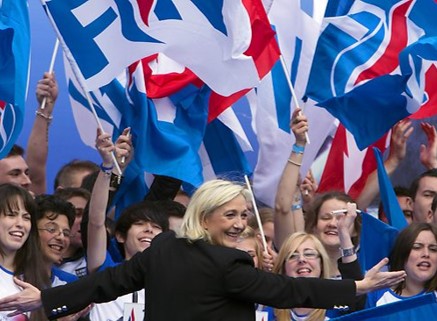
The recent French election once again saw centrist Macron head to head with far right nationalist Le Pen. Macron won the election by a much narrower margin that the 2017 elections. I have an interest in the French elections as my parents live there and are not far away from applying for citizenship. For them, the prospect of a far right president was worrying.
The politics of much of the world has shifted to the right of late, often to the far right. Perhaps this hasn’t been a recent thing. Indeed, before this wave of Trump, Modi, and Le Pen, we had UKIP and for a while the BNP was making a lot of noise. The writing was on the wall with New Labour and their many new immigration offences, Blair’s tough on crime and it’s causes approach, and not forgetting war on Iraq and Afghanistan. This was swiftly followed with then Home Secretary Theresa May’s hostile environment agenda which has been advanced again and again by consecutive Home Secretaries until we passed the point of no return with Priti Patel and her Nationality and Borders Act 2022 (it pains me to type ‘Act’ instead of ‘Bill’ – it’s black and white now) from which not the Lords nor God nor the best lawyers in the land seem have yet been able to save us from. What we see now is a Conservative government embedded with far right ideology, and this is not an isolated island in that respect.
This current uprising of the far right, racist, and xenophobic politicians is a global phenomenon. Modi, the far right Hindu nationalist is knee deep in his campaign against Muslims, revoking autonomy in Jammu and Kashmir (ironically – or deliberately – this took place on 31st October 2019, the day Britain was supposed to leave the EU), invoking the Citizenship (Amendment) Act 2019 which disproportionately affects the citizenship of Muslims who now face the possibility of expulsion, and even outright attacks on Muslims.
Then there was Trump and the less said about him, the better. But let us return to France. This is the second consecutive election in which Macron has faced Le Pen and won. In France, elections are held in two stages. All parties and candidates go head to head in stage one and if no candidate holds a majority, a second round between the top two candidates takes place. In 2017, Macron won the second stage with 66.1% of the vote. This time around, the vote was much narrower 58.6%. Le Pen’s Rassemblement National party has ‘transformed’ since the 2017 election, with the party’s councillor for Gironde arguing that they are not the far right, and instead are localists and nationalists. Are they not one and the same?
In recent years, the rise of the far right in Europe has been fuelled by fears of refugees, terrorism, and open borders within the European Union. In addition to this, concerns over employment and poverty have contributed to this. It is not all about them, it is preservation of us.

In a globalised era, we have seen decades of erosion of the working class jobs of old combined with distorted perceptions of immigration and population changes. People living in poverty, unemployed or in insecure employment look for someone to blame and the someone tends to be them. So, parties who say they stand for the working man and oppose immigration become popular, not because voters are necessarily racist but because they are fearful and suffering. Bearing that in mind, where does that leave us now? The whole of Europe is facing a cost of living crisis, war on our doorstep. Here in the UK, inflation and interest rates are rising but wages are not. We cannot blame this on them, on people fleeing persecution, on people who come to the UK to fill the jobs nobody wants or are not qualified to do. This us and them narrative causes nothing but division and hatred, fuelling hateful politicians who – let’s face it – serve nobody’s interests but their own.
My Monday message: Choose love

 Thoughts from the criminology team
%3Amax_bytes(150000)%3Astrip_icc()%3Afocal(749x0%3A751x2)%2Fsimone-biles-hair-paris-heatwave-073024-tout-52887c1302ff465d8797f003c452ecba.jpg&imgrefurl=https%3A%2F%2Fpeople.com%2Fsimone-biles-claps-back-people-commenting-hair-amid-2024-paris-olympics-heatwave-8685988&docid=8zbppZtCkxUTxM&tbnid=VEKrr21i-NVrWM&vet=12ahUKEwj_0LS80-WHAxV2UkEAHZ8GAGkQM3oECF0QAA..i&w=1500&h=1000&hcb=2&ved=2ahUKEwj_0LS80-WHAxV2UkEAHZ8GAGkQM3oECF0QAA)