
Home » Academia (Page 7)
Category Archives: Academia

Empower like Michelle

If you go to Freshers’, you will probably think this is for White people. But you’ve got to occupy your space. Better get used to occupying your space now because you’ll have to fight wherever you go, university or otherwise. Don’t let that deter you from your goals but more vitally, don’t let anybody make you feel bad about yourself. Don’t be silent in the discussions on slavery or the prison system. Use your voice, a sonicboom in the seminar. Don’t be mute to appease the White fragility of your peers, or even your lecturers and personal academic tutors.

You worked hard to get here, so occupy your space. Fill these spaces with jollof rice and jerk chicken and calypso and steel drums – the guts, determination and sheer willpower your parents and grandparents had when they arrived all those years ago. Don’t ever feel that you have to dilute your opinions for White consumption, or tell bitesize histories for the masses. In that Business class, talk loud about the Cheshire and Lancashire cotton mills written in the blood of African-American slaves.
Students, you might get lecturers that call you angry, who will have a hard time coming to terms with their own prejudice and White privilege. You will see that within a few weeks of studying. But keep your head down and think about graduation. Come and speak to me at the Students’ Union if you have any worries or just want to vent. Sometimes it’s just about finding solace in someone that gets it. Cry into that cheeky Nando’s. Buy that weave. Write a damn good assignment and prove all the naysayers wrong.
You will also find lecturers that are willing to listen to your experiences of racism and prejudice. They will implore you to write a dissertation that’s personal to you. You will find lecturers that give a shit, and will stand by you to the very end – who will say it’s absolutely fine to lace your dissertation with personal history – roots, rocks, and rebellion – academic staff that are activists in their own right (but will never openly admit it!)
Write about the politics of Black hair. Write about the Windrush Scandal or the legacy of colonialism on the Black body, or even Black men and mental health. Write every assignment for your aunties, who live in headwraps, talking in Twi and give you sound advice. Write in ruthless rebellion to the White Eurocentric reading of your degree, break the colour bar in style!
You will likely not relate to your course content. You will find it reflects the experiences of White people. No Afropean stories. No love for Sarah Forbes on History, or the Slave Trade cases of the 1700s on Law – the cases that helped forge the legal profession into what it is today. Or even the racial theories of the 18th and 19th century that we living in the remnants of – not Edward Long’s History of Jamaica nor the Black writers that top bestsellers lists. Write about a decolonised curriculum and inclusive course content.
When your lecturers make no allusion to American Slavery when you study the Industrial Revolution, give them the evilest evils you can muster. And challenge them on it. Leave them shook. Educate your “woke” White friends on why this is important. And when it comes to race, don’t feel you need to talk about race just because you’re the only non-White person in the class.
When you come to university, you will feel the urge to be someone that you are not just to fit in. BE YOU. You will try studenty things. JUST DO YOU. You’ll go out drinking, even if you don’t normally drink. You will join every society at Union Day and your emails will be chocka block. You’ll change your accent and “be friends” with people you dislike to conform to social norms. You will then admit you hate going out out and prefer a good book, or one of my poetry nights or just a chat with good people in your halls.
Tell yourself “Black is beautiful.” You know it, I know it. But there are people out there that’ll try to make you feel bad about your culture, as is life. Come back to campus in January with that Angela Davis afro, or be a dreadlock rastaman. Play cricket, like Jofra Archer or play football like Raheem Sterling. And, your hair is not an exotic specimen to gawked at and touched like a museum exhibit. Remember, say no. No means no. Always.

Black students, walk with pride. YOU DO YOU. Be united. You’ll see quickly that there are forces that are waiting for you to make a mistake. To fail. To point the finger. You’ll see quickly that failure is racialised and that failure in a White person is not as bad. You’ll see that we live in a society that doesn’t include you in its definition of beauty standards. So girls, when someone says “You’re pretty for a dark-skinned girl,” pay them no mind. Find beauty in your melanin. Find your tribe. Sisterhood is paramount.
When someone asks “Where are you from?” – it’s fine to say London or Milton Keynes or any British town or city. You do not need to entertain them when they ask “Where are you really from?” You can be British and African. You can be British and Caribbean. You belong here. You can just be British. And that is also fine. Previously, you’d not have found events that represent Black people or felt inclusive. But my philosophy is “Black History Month is every month, 365 days a year.” October, November forever. See me!
Listen, you might be made to feel conscious of your otherness and not everyone will get your “I Am Proud of My Blackness” mentality. Not everyone will understand the nuanced politics of Blackness at Northampton. That even in inaction, the supposed “woke” White people are still complicit in racism. And remember it isn’t YOUR JOB to explain what is racist and what is not. Do not take on that emotional labour. You are not the mouthpiece for Black people, and you don’t have to be.
You will have days where you will say “I hate this town, I want to go home – there is no culture and nothing to do” but Northampton can work for you. There are other communities of African and Caribbean here where you will be welcomed with rice and stew. You will find family and community.

And you are not alone. There are a lot of us here. Build communities. Join the resident ACS (African-Caribbean Society). Empower yourselves. Come to see me, as your Student Union representative. Look after each other. Be good to yourselves and one another – and above all, enjoy it.
Yours,
Tré Ventour
Vice President BME
Northampton Students’ Union
Share this:


How to prepare for a year in University

In our society consumerism seems to rain supreme. We can buy stuff to make us feel better and we can buy more stuff to express our feeling to others and mark almost most events around us. Retail and especially all the shops have long been aware of this and so they have developed their seasonal material. These seasonal promotions may have become consumer events now although they do signify something incredibly important to culture and our collective consciousness. There is time for Christmas decorations and festive foods, Easter time and chocolate eggs, mother’s day and nauseating cards father’s day for equally grinchworthy cards. There is valentine’s day to say I love you in full fat chocolates, Halloween to give little kids rotten teeth and a red poppy to remember some of our dead. To those add the summer season with the disposable BBQs and of course the back to school season!
The back to school is one of the interesting ones. Geared to prepare pupils and parents for going back to school and plan ahead. From ordering the uniforms to getting all the stationery and books required. I remember this time of the year with some rather mixed emotions. It was the end of my summer holidays, but it was also the time to get back to school. Until one day I finished school and I went to university. Education is seen as part of a continuous process that we are actively involved from the first day at school to the last day in high school and more recently for more people also involve the first day of going to university. Every year is more challenging than the next, but we move up and continue. For those of us who enjoy education we continue the journey further to further or high education.
There is something to said about the preparation process coming to University; it is interesting seeing advertisements on education this time of the year on the tv and social media promoting stuff for this transition; from the got to have smartphone to the best laptop, the fastest printer scanner all in one thingy to the greatest sound system and many more stuff that would get you ready for the year ahead. Do they really help us out and if not, what do we got to do to prepare for coming to university?
Unfortunately, there is no standard formula here but there is a reason for that. Higher education is adult education. This is the first time in our educational journey that we are sitting firmly on the driving seat. We choose to study (or ought to) what we wish to study. It is an incredibly liberating process to have choice. This however is only the beginning. We make plans of our time. In higher education the bulk of the time required is independent study, and as such we got to negotiate how we will plan our time. We got to decide which reading we are going to do first which notes to read what seminar we shall prepare and what assignment we will make a draft of.
There will be days spent in the library looking for a book, days in a coffee shop talking to fellow students about the seminar reading, days in the learning hub working on an assignment. There are highs, lows and everything in between. But regardless of the emotion at every stage thee will be a sense of ownership of knowledge.
In the first couple of sessions, the bulk of the students keep quiet expecting the correct answer to be given. One interpretation or one truth that describes all. It takes a few times before the realisation emerges that the way we analyse, and project knowledge can be different provided we go through the same processes of scrutiny and analysis. Then conversation emerges and the more reading the better the quality of the ideas that shall emerge.
The first year at University is definitely a declaration of independence and the realisation that we all have a voice. Getting on to the road on empowerment. This is a long journey, and on occasions arduous but incredibly rewarding because it leads to an insight greater than before that removes ignorance and lifts the veil of the unfamiliar.
To our newest students – Welcome to the University and to our returning 2 and 3 years – Welcome back!
Share this:


Come Together

For much of the year, the campus is busy. Full of people, movement and voice. But now, it is quiet… the term is over, the marking almost complete and students and staff are taking much needed breaks. After next week’s graduations, it will be even quieter. For those still working and/or studying, the campus is a very different place.
This time of year is traditionally a time of reflection. Weighing up what went well, what could have gone better and what was a disaster. This year is no different, although the move to a new campus understandably features heavily. Some of the reflection is personal, some professional, some academic and in many ways, it is difficult to differentiate between the three. After all, each aspect is an intrinsic part of my identity.
Over the year I have met lots of new people, both inside and outside the university. I have spent many hours in classrooms discussing all sorts of different criminological ideas, social problems and potential solutions, trying always to keep an open mind, to encourage academic discourse and avoid closing down conversation. I have spent hour upon hour reading student submissions, thinking how best to write feedback in a way that makes sense to the reader, that is critical, constructive and encouraging, but couched in such a way that the recipient is not left crushed. I listened to individuals talking about their personal and academic worries, concerns and challenges. In addition, I have spent days dealing with suspected academic misconduct and disciplinary hearings.
In all of these different activities I constantly attempt to allow space for everyone’s view to be heard, always with a focus on the individual, their dignity, human rights and social justice. After more than a decade in academia (and even more decades on earth!) it is clear to me that as humans we don’t make life easy for ourselves or others. The intense individual and societal challenges many of us face on an ongoing basis are too often brushed aside as unimportant or irrelevant. In this way, profound issues such as mental and/or physical ill health, social deprivation, racism, misogyny, disablism, homophobia, ageism and many others, are simply swept aside, as inconsequential, to the matters at hand.
Despite long standing attempts by politicians, the media and other commentators to present these serious and damaging challenges as individual failings, it is evident that structural and institutional forces are at play. When social problems are continually presented as poor management and failure on the part of individuals, blame soon follows and people turn on each other. Here’s some examples:
Q. “You can’t get a job?”
A “You must be lazy?”
Q. “You’ve got a job but can’t afford to feed your family?
A. “You must be a poor parent who wastes money”
Q. “You’ve been excluded from school?”
A. “You need to learn how to behave?”
Q. “You can’t find a job or housing since you came out of prison?”
A. “You should have thought of that before you did the crime”
Each of these questions and answers sees individuals as the problem. There is no acknowledgement that in twenty-first century Britain, there is clear evidence that even those with jobs may struggle to pay their rent and feed their families. That those who are looking for work may struggle with the forces of racism, sexism, disablism and so on. That the reasons for criminality are complex and multi-faceted, but it is much easier to parrot the line “you’ve done the crime, now do the time” than try and resolve them.
This entry has been rather rambling, but my concluding thought is, if we want to make better society for all, then we have to work together on these immense social problems. Rather than focus on blame, time to focus on collective solutions.
Share this:


Thinking “outside the box”
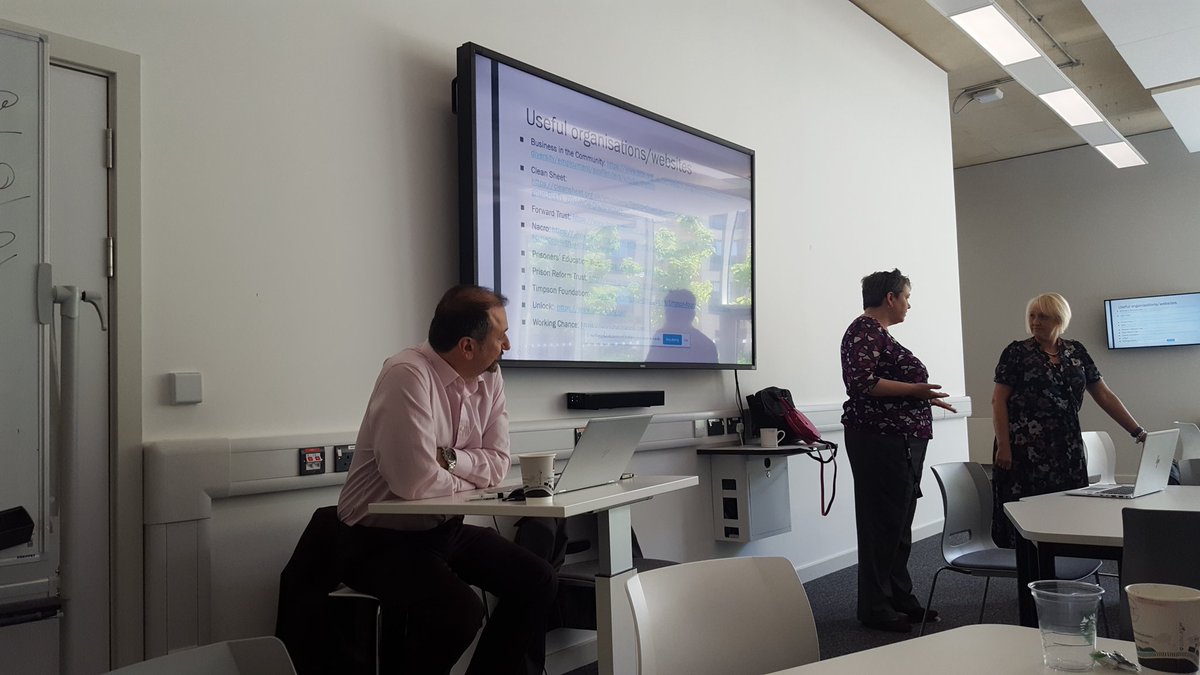
Having recently done a session on criminal records with @paulaabowles to a group of voluntary, 3rd sector and other practitioners I started thinking of the wider implications of taking knowledge out of the traditional classroom and introducing it to an audience, that is not necessarily academic. When we prepare for class the usual concern is the levelness of the material used and the way we pitch the information. In anything we do as part of consultancy or outside of the standard educational framework we have a different challenge. That of presenting information that corresponds to expertise in a language and tone that is neither exclusive nor condescending to the participants.
In the designing stages we considered the information we had to include, and the session started by introducing criminology. Audience participation was encouraged, and group discussion became a tool to promote the flow of information. Once that process started and people became more able to exchange information then we started moving from information to knowledge exchange. This is a more profound interaction that allows the audience to engage with information that they may not be familiar with and it is designed to achieve one of the prime quests of any social science, to challenge established views.
The process itself indicates the level of skill involved in academic reasoning and the complexity associated with presenting people with new knowledge in an understandable form. It is that apparent simplicity that allows participants to scaffold their understanding, taking different elements from the same content. It is easy to say to any audience for example that “every person has an opinion on crime” however to be able to accept this statement indicates a level of proficiency on receiving views of the other and then accommodating it to your own understanding. This is the basis of the philosophy of knowledge, and it happens to all engaged in academia whatever level, albeit consciously or unconsciously.
As per usual the session overran, testament that people do have opinions on crime and how society should respond to them. The intriguing part of this session was the ability of participants to negotiate different roles and identities, whilst offering an explanation or interpretation of a situation. When this was pointed out they were surprised by the level of knowledge they possessed and its complexity. The role of the academic is not simply to advance knowledge, which is clearly expected, but also to take subjects and contextualise them. In recent weeks, colleagues from our University, were able to discuss issues relating to health, psychology, work, human rights and consumer rights to national and local media, informing the public on the issues concerned.
This is what got me thinking about our role in society more generally. We are not merely providing education for adults who wish to acquire knowledge and become part of the professional classes, but we are also engaging in a continuous dialogue with our local community, sharing knowledge beyond the classroom and expanding education beyond the campus. These are reasons which make a University, as an institution, an invaluable link to society that governments need to nurture and support. The success of the University is not in the students within but also on the reach it has to the people around.
At the end of the session we talked about a number of campaigns to help ex-offenders to get forward with work and education by “banning the box”. This was a fitting end to a session where we all thought “outside the box”.
Share this:


The same old rhetoric, just another place
 My sister phoned me the other day in great excitement. She’d just met a former criminology student from the University of Northampton, and she had an awful lot to say about it. She wasn’t in her hometown and had asked directions from a stranger to the river embankment. Having visited the embankment, she returned to town only to bump into the stranger again who enquired whether she managed to find it. They ended up chatting, my sister can do a lot of that, and she found out that the stranger was a police officer. My sister asked whether she knew me, why she would ask that I have no idea, it seems that she has formulated some notion in her head that all police officers must know each other or at least know of each other. This is the bit that my sister got so animated about, yes, the stranger did know me, I’d taught her at the University, and she was now in a budding police career. Apparently, I had done so much to help her. Now I don’t know about being that helpful and I suspect that many of my colleagues played a part in her success story, but it reminded me about what it is that we do and aspire to do as lecturers.
Whilst waiting to play my part in talking to school children the other day I started to read a new edition of a seminal piece of work on policing, The Politics of the Police (Bowling et al., 2019). The preface alone makes interesting reading and in ‘mentioning populist political reactions towards crime’, ‘zero tolerance of the marginalised and outsiders’ and ‘laissez-faire economics’ that promotes individual interests, my mind turned to the managerialist ideals that have dogged policing for over three decades. Those ideals saw the introduction of performance indicators, targets and the inevitable policing by objectives (Hallam, 2000), that resulted in some quite appalling manipulation of data and a diminution of service rather than an improvement. The problem was that the targets were never achievable and were simply put in place for managers to simplify the social world over which they had no control. What didn’t get measured, because it never could be, were the myriad of tasks that police officers and staff undertake daily. Dealing with people with mental illness, searching for missing persons and dealing with minor disturbances are an example of just a few such tasks. Bowling et al. (op cit.) subscribe to the notion that the job of the police is to help maintain social order, an ideal that does not lend itself to measurement. Counting the number of crimes committed in an area or the number of detected crimes is only an indication of failure, not success.
How does that policing narrative fit in with my opening paragraph? The former student was not an ideal student from a managerialist viewpoint. She didn’t attain so called ‘good grades’, I’m not even sure if she fully completed her studies. In terms of performance measurement, she doesn’t even feature and yet she, like so many others we have seen in Criminology, has flourished. Whilst concentrating on ‘retention and progression’ and ‘fails’ and ‘good grades’ we neglect the very reason we exist. Just as in policing where the figures were pored over by managerialist who had not slightest notion of the reality of the social world, so too are we in danger of simply seeking pleasing statistics to keep the wolves from the door because explanations of real success and failure are too complex for managers to understand or manage.
Imagine a world where the police just helped maintain social order, where probation were not plagued by notions of payment by results, where patients were just seen in A&E in a reasonable time and where lecturers just opened the minds of students and allowed them to think for themselves. Imagine the time and expense that could be saved and reinvested in providing real service and dare I say it ‘value for money’ if we stopped gathering meaningless data. Imagine managers casting aside the shackles of neoliberalist ideals and managing people, not using numbers as an indication of failure and impending doom. We can but dream, but my reality, as I’m sure is the reality of many of my colleagues, is the success stories that I occasionally hear and can reminisce about. No amount of number crunching can take that away and nor will it ever provide evidence of success or failure.
Bowling, B. Reiner, R. and Sheptycki, J. (2019) The Politics of the Police. (5th ed.) Oxford: OUP.
Hallam, S. (2000) Effective and Efficient Policing: Some Problems with the Culture of Performance, in Marlow, A. and Loveday, B. (eds.) After MacPherson: Policing after the Stephen Lawrence Inquiry. Lyme Regis: Russell House
Share this:


How to boil an egg…A criminological issue?

Another academic year is coming close to an end. After the plans and the changes made there is always a little time for reflection to ask what is in a year? The rhetorical question implies that there is an expected answer and that is true, well sometimes! After years serving HE it is becoming clear that things change “τα πάντα ρει”, everything flows as Heraclitus once said. Education is about knowledge and as it progresses, we progress with it.
In previous posts the value of education and reading for a subject like criminology has been argued, but ultimately what does it really mean to complete one year of education in HE? Well if you are on your first year it is the recognition that you can do this! The first step in many more to follow on the road to academic understanding. If you are on your second year you demonstrate perseverance, sticking with the subject you chose, and you continue to read more of it. Finally, if you are on your third year it is the anticipation of completion of a course of study. The successful conclusion of studies that will award you with a title.
This end for some is the end of the formal part of their higher education, whilst for others it is simply the beginning of the end of a longer and more arduous journey in learning. An exam board shall mark this end when all colleagues will read name after name, grade after grade, but this is only part of that story. The other part is the memories on learning that it will launch. I still hear stories of students remembering a lecture with a slide title “Lesbian Vampire Killers” on a session on media and crime which seems to tickle our alumni, or a phrase used in a class again and again for emphasis. Using a metaphor or an example that takes you away from the prescribed values. Some of the readers may remember my question “How long to hard boil an egg?” A question that revealed some of us have limited culinary skills, but the intended purpose was to allow us to look at the question of positionality and context. It only takes a couple of pre vs post- war Italian cookbooks to realise that the question can be answered considering the social situation and the energy requirements of its time. A country famed for its culinary status, but also broken from a second world war that decimated infrastructures and harmed population. Poverty, theft, antisocial behaviour, violence but also recriminations for the incurred destruction became the other effects hidden behind a seemingly random change in a number on a cookbook. *
My personal favourite was going over a criminal profiling case with students of the wrong year who were looking at me rather confused on the content. I shall never of course forget my sex offenders lecture to accounting students (I got the place and time wrong) which according to my bemused colleague who was watching me from the corner an interesting interlude from his session! These little anecdotes do not sustain knowledge, but they remind us how we got to be in that place.
Regardless of the subject of study or its level, all “participants” who engage in higher education gain one significant attribute, that of perspective. The ability to look closely of a idea through the disciplinary lens but also to zoom out and look at the bigger picture, thus making perspective more relevant. Perspective is distance and as we gain more knowledge, the better our judgement becomes in using this lens to zoom in and out. This is what we acquire as we progress through higher education.
*I could also point out the existential symbolism of the egg as the representation of the soul and the time to boil it is a metaphor for torment in the proverbial purgatory…but I will not
Share this:


Who cares what I think?

Erzsébet Korb (1923) Girl’s Portrait (Thinker; Contemplation)
The other week, I went for a meal with a friend. The food was lovely, the staff and environment welcoming and friendly and company, fabulous. A couple of days later I was thinking about that evening and I wondered why I had not felt the need to write some positive feedback on google, or similar. The answer was because I felt that I and my dining companion, had expressed our pleasure both in word and deed (the plates were clean!). Thus, the relationship between diners and restaurant staff had been overwhelmingly positive and this had been expressed by both.
However, wherever we go nowadays, we are regularly confronted by requests for feedback; “how is my driving?”, “did you enjoy your meal?” “would you recommend our services to others”? Often these questions are accompanied by Likert scales, so we can record our opinion on almost everything. Sometimes we might take some time to consider the options, other times we might just tick random boxes, more usually (if I’m anything to go by) I just don’t engage with such requests. Despite their often-jolly appearance, these questions are not harmless, they have an impact, most usually to measure individuals’ performances.
Whether we engage with such requests or not, we do not question whether we are well-placed to judge. So, for instance, as a driver of probably one of the smallest cars on the market (that’s me!), I’m expected to be able to mark the driver of a lorry. Or someone, who has the cooking know-how of a small child (I speak for myself again!) is expected to form an opinion on a dish prepared by a trained chef, these questions are hardly fair. More importantly, my answers are meaningless; whilst I might respond “the lorry appeared to take the corner a bit wide”, I have neither knowledge or understanding of the turning circle of a 32-tonne lorry. Similarly, my thoughts about the heat of a Bangladeshi biryani or the sweetness of a mille-feuille is neither here nor there. Given I can neither drive a lorry nor cook these wonderful dishes, who am I to voice an opinion?
Of course, there are times when it is necessary to voice an opinion, the lorry driver is behaving in a dangerous manner liable to cause an accident, or the restaurant is serving rancid or rotten food; both scenarios likely to involve serious harm. However, these concerns would need to be raised immediately, either by alerting the police (in the case of the lorry) or the management of the restaurant. In the case of the latter, you may also feel it necessary to contact environmental health if you felt that your complaint had not been addressed or you had concerns about the hygiene of the restaurant in general. However, these types of problems are largely outside the feedback requested.
In many of the scenarios/environments we are asked to comment on, we are in a relationship with the other party. Take the restaurant; if I am friendly and polite to the staff, I can expect a reciprocal relationship. If I am rude and aggressive, is it any wonder staff behave in a different way. They are constrained by their professions to focus on customer service, but this should not lay them open to abuse. Whilst the old adage “the customer is always right” might be an excellent baseline, it is not possible for this always to be the case. As someone who has spent a previous lifetime working in retail, sometimes the customer can be obtuse, rude or even downright, ignorant and abusive. Adherence to such an adage, at all costs, can only open the way for abuse.
But what about those feedback forms? On a bad day, in a rash moment, or because I’m bored, I decide to complete one of these forms. The waiter kept me waiting, the food was too spicy, I didn’t like the feedback I was given on my job application, my essay was critiqued, my teeth haven’t been flossed regularly, I didn’t like the book recommended to me by the librarian or the book seller, I can’t believe my line manager has turned down my application for annual leave. I can easily demonstrate my unhappiness with the situation with a few judiciously placed ticks, circles or smiley/sad faces. Can I say the waiter, the chef, the HR professional, the lecturer, the dentist, the librarian, the book seller and my line manager are performing poorly? Can I say they are unprofessional, unprepared, untrained, lacking in knowledge or skills or just plain wrong? And if I do, is that fair or just? Furthermore, am I happy to be subject to the same judgement from people who do not share my experiences; professional or otherwise? Remember too much of this bad feedback, however flippant and lacking in evidence it may be, may lead to disciplinary action, including dismissal.
There is an oft-cited, albeit crude, truth: “Opinions are like arseholes; everyone has one”! Ultimately, whether we choose to share (either) in public is up to us! Think carefully before ticking those boxes and encourage others to do the same. Who knows, someone may well be ticking boxes about you!
Share this:


The Unbreakable Bond of Criminology

Every student has a different experience in their studies, be it through what they have studied, who they studied with or even where they studied. “Team Cops and Robbers” studied the same degree, the same modules at UON, yet we had different experiences. However what we share (and are all very fond of) is how positive the experience was, tackling the stresses (and joys) of the degree as a trio. We each offer a brief overview of our experience as a member of “Team Cops and Robbers”, who graduated in 2015 and still remain very involved in each other’s lives…
Jes: I was a late comer to Team Cops and Robbers, as Emma and Leona had already bonded without me (rude I know!). We were thrown together in Drew’s 2nd year History module, where there were only a few Crim students – so they didn’t get much of a choice with regards to me joining, the then, duo. And the rest as they say is history! What stemmed from there is quite remarkable; we all had own our strengths when it came to Crim. My recollection is Emma knew everything about everything, Leona kept us all motivated and on top of our seminar preparation and I kept us glued to the library and bossed us around -especially with group work (my car Geoffrey was an unofficial member of the gang taking us to and from Park campus). Although we took the same modules, due to our differing interests, we all did different assignment questions and had very different ways of writing and tackling assessments. In my third year, I distinctly remember Emma and Leona reminding me to take time to myself and to not live 24/7 in the library; and had they not been there to encourage me to breathe, it is likely I would have burned out! They were not afraid to question my views, or understanding, or challenge my bossy attitude when it came to group work, for which I am very grateful! And still today, even though we are no longer studying together, they keep me motivated with the MSc, sending me motivational gifts as a reminder that even though they are not studying with me, I am not alone! My academic journey would have been very different had it not been for our trio, and likely would not have been as successful.
Leona: Sometimes being in class with friends can be detrimental as you end up spending so much time having fun, you end up forgetting the work side of uni. However when you meet friends who are so determined to do well and hard-working, it can really motivate you to push yourself. Myself, Jes and Emma became a power trio; encouraging each other, motivating each other and always making sure we were working together for group projects. We are all completely different when it comes to learning but I think these differences really helped us. Learning from them really helped me to improve my own standard of work, and having the girls’ input and guidance throughout, really encouraged me and helped me gain confidence in my own voice. Plus it made doing all the studying we did much more bearable. I’m sure sometimes it took us longer to get through everything as we would be half working, half chatting, but as a trio it meant we could help each other if we got stuck or go for coffee breaks if we were bored or unmotivated. Having Jes and Emma there with me meant there was always someone there to go through notes with, always someone to explain something in a different way if I didn’t fully understand something, always someone to motivate me when I was exhausted and didn’t feel like working any more. It meant that my viewpoint expanded as I learned from their experiences and that once we had all finished writing our essays we could share them with each other to check, critique and make suggestions for improvement. But more than all that, it meant there was always someone there to help you balance the workload, someone to tell you when to take a break, and to “day drink” in the SU, explore winter wonderland, or have a Disney film day. During my time at uni these girls inspired me to work harder, and to really challenge myself to improve on everything I was doing. Without them there to encourage me and spur me on, I don’t think I would have come out with the grade I did, and I am certain that my uni experience wouldn’t have been half as memorable.
Emma: Meeting Jes and Leona was one of the best things about university. Not just because they are now two very dear friends of mine, but because we were vital to each other’s sanity at uni. I met Leona first in welcome week with a very interesting exchange asking if I was at the right seminar and proceeding to tell her my name, that I was from the south west and that I liked reading about serial killers. Leona reciprocated with the main difference being that she was from the north and from there our friendship blossomed. Jes was some girl who sat with another group of people. It wasn’t until 2nd year that Jes really came into our friendship group and “Cops and Robbers” was formed. We all had strengths and weaknesses that helped us when it came to group work. Jes was always super, super organised, having her essays completed with weeks to go. Leona was always bubbly and would follow Jes with completing her essay with time to spare. Me… I would research and collect quotes and references and then write my essays with 48-24hrs to go, as I liked the time pressure. This changed in my 3rd year though as being around Leona and Jes, they moulded me and proof read my concepts and challenged me back on things. Any time we had group work, I knew we would do well because as a trio we kicked ass! We did not always have the same views in our seminars and would often debate but we would always leave as friends. Best advice for getting through university sane, is to find people who are fun, you get on with and drive you to be the best.
Hopefully what is clear from each of our perspectives is how important we were to keeping each other (relatively) sane! Your friendship groups during your studies are essential to keeping you happy, but also keeping you motivated! Whilst it is independent studies, and at the end of the day is YOUR degree; the input from friends and family will shape your own ability and attitude. If you find the right group, hopefully you will find that they push you, support you and challenge you!
Share this:


The lone wolf: a media creation or a criminological phenomenon?

In a previous blog post, I spoke how the attention of the public is captivated by crime stories. Family tragedies, acts of mindless violence and other unusual cases, that seem to capture the Zeitgeist, with public discussion becoming topics in social situations. It happened again; Friday March 15 after 1:00 local time, a lone gunman entered the local Mosque in Christchurch and started shooting indiscriminately, causing the death of 50 and injuring as many, entering what the New Zealand Prime Minister would later call, in a televised address, one of NZ’s darkest days.
The singular gunman entering a public space and using a weapon/or weaponised machine (a car, nail bomb) is becoming a familiar aberration in society that the media describe as the “lone wolf”. A single, radicalised individual, with or without a cause, that leaves a trail of havoc described in the media using the darkest shades, as carnage or massacre. These reports focus on the person who does such an act, and the motivations behind it. In criminology, this is the illusive “criminal mind”. A process of radicalisation towards an ideology of hate, is usually the prevailing explanation, combined with the personal attributes of the person, including personality and previous lifestyle.
In the aftermath of such attacks, communities go through a process of introspection, internalising what happened, and families will try to come together to support each other. 23 years ago, a person entered a school in Dunblane, Scotland and murdered 16 children and their teacher. The country went into shock, and in the subsequent years the gun laws changed. The community was the focus of national and international attention, until the lights dimmed, the cameras left, and the families were left alone in grief.
Since then numerous attacks from little people with big weapons have occurred from Norway to USA, France to Russia and to New Zealand, as the latest. And still, we try to keep a sense of why this happened. We allow the media to talk about the attacker; a lone wolf is always a man, his history the backstory and his victims, as he is entitled to posthumous ownership of those he murdered. The information we retain in our collective consciousness, is that of his aggression and his methodology of murder. Regrettably as a society we merely focus on the gun and the gunman but never on the society that produces the guns and raises gunmen.
At this point, it is significant to declare that I have no interest in the “true crime” genre and I find the cult of the lone wolf, an appalling distraction for societies that feed and reproduce violence for the sake of panem et circenses. Back in 2015, in Charleston another gunman entered a church and murdered another group of people. Families of the victims stood up and court and told the defendant, that they would pray for his soul and forgive him for his terrible act. Many took issue, but behind this act, a community took matters into their own hands. This was not about an insignificant person with a gun, but the resilience of a community to rise above it and their pain. A similar response in the aftermath of the shooting in Orlando in 2016, where the LGBTQ+ community held vigils in the US and across the world (even in Northampton). In New Zealand, the Prime Minister, Jacinda Ardern was praised for her sombre message and her tribute to the community, not mentioning the gunman by name, not even once. This is not a subject that I could address in a single blog post (I feel I should come back to it in time) but there is something quite empowering to know the person who did the act, but to deliberately and publicly, ignore him. We forget the importance celebrity plays in our culture and so taking that away, from whomever decides to make a name for themselves by killing, is our collective retribution. In ancient Egypt they rubbed off the hieroglyphs of the columns. Maybe now we need to take his name from the newspaper columns, do not make the story about him, but reflect instead, on the way we live as a community and the people who matter.
Share this:


Ignorance to curiosity

My name is Sean, I started studying Criminology at the University of Northampton in 2012, graduating in July 2016.
I started University as a switched off young man. I was very much in tune with media and social attitudes as wearing them cost very little and seemed to reap gratification. Studying was always enjoyable as it sparked my brain in ways television and games, or at least my choices in such, didn’t. Appreciating the concept and the opportunity however was always lacking in my 18 year old self. Coming to University and experiencing the electricity of passion mixed with contempt was very perplexing time. Not for long had I decided to think freely or passionately; choosing to study Criminology was a start. Meeting peers and idols of simultaneous do-good and work little nature, was an intense influence. Gratification ultimately came from within and this was the basis to which I began to restructure myself.
Personally, the highest credit should be placed with my course leaders and the content provided. Never in an academical setting had I experienced someone ask me so many questions, yet rather than make me feel stupid; made me feel unprepared. Rather than build themselves up to be superior and towering; made them feel wise and welcoming. It was this, paired with the already enticingly dark yet morally complex content of Criminology that lead to me to free many barriers and much ignorance. This is when the real questions followed and the search for real answers began. Never before had I truly questioned what I had read, seen, heard, even felt or experienced and wholly questioned myself.
This change truly opened a new way of living for me. I am fully aware that such reasoning and ways of thinking could been explored previously, however it was my ignorance and choices, rebellion and ego, that locked these gates. In reference to the timeless ‘Nature vs Nurture’ topic; it was within my path that University, Criminology, @paulaabowles and @manosdaskalou were to be the ones to trigger the break in the lock. Now, admittedly, this was not just an overnight spawning of a butterfly from a larva. I still, like many in life, held onto what was familiar with a tight grasp as for an ignorant; change is to admit defeat. Furthermore, to change, to really change, requires dedication and belief. But once logically thinking, questioning and reasoning, alongside giving in to pure curiosity; it is extremely hard not to follow the exciting direction within a moral compass.
From here I can genuinely say I have enjoyed life more and all of its experiences. I have appreciated people more, and taken much more time to try and understand exactly where they stand and come from. I have spent a long time questioning everything, looking for answers or options wherever I can, trying to better myself as a human and continuing to do so. I am honestly far from where I would like to ideally be, but I am truly proud of my experience and change. When I finished University I saw this as the end of my further education, and having worked full time for a few years I could feel my curiosity shift towards less academic interests and the passion begin to fade. However it was not long before a shift back began. This is where I came to a conclusion, which fills me with a happy heart when taken with a positive perspective, that we are all students; students of life. The stronger my curiosity is, the more passionately I will study. So thank you, Criminology Team, for igniting mine. I intend to try and share this passion wherever I go.

 Thoughts from the criminology team