
Home » Academia (Page 4)
Category Archives: Academia

Avoiding challenge: A strategy for organisational change

Have you ever wondered as a manager or worker what the best way is to avoid having your ideas challenged? Tired of trying to make organisational changes and having those changes called into question. Fed up with trying to instigate something only for someone else to be less than keen. Had enough of trying to do things that will promote your ambitions only to be thwarted by others that just have to add their two pennorth in? Annoyed at extra work being created for you because of a lack of acceptance of your ideas? Are you fed up with the ‘nay sayers’? The answer is simple… don’t communicate anything, just make the changes, and wait for yet another calamity.
The above of course is somewhat tongue in cheek and I am reminded of working with some consultants several years ago (you know the ones; steal your watch to tell you the time). I jest, as they had some sage advice on change management. Two things that come to mind: If you think you have communicated enough about change, you haven’t; communicate more. And find the person or group that needs convincing and work with them, it’s the ‘nay sayers’ that need to be convinced, not the ‘yay sayers’. They are far more valuable to your organisation than those that say ‘yes’.
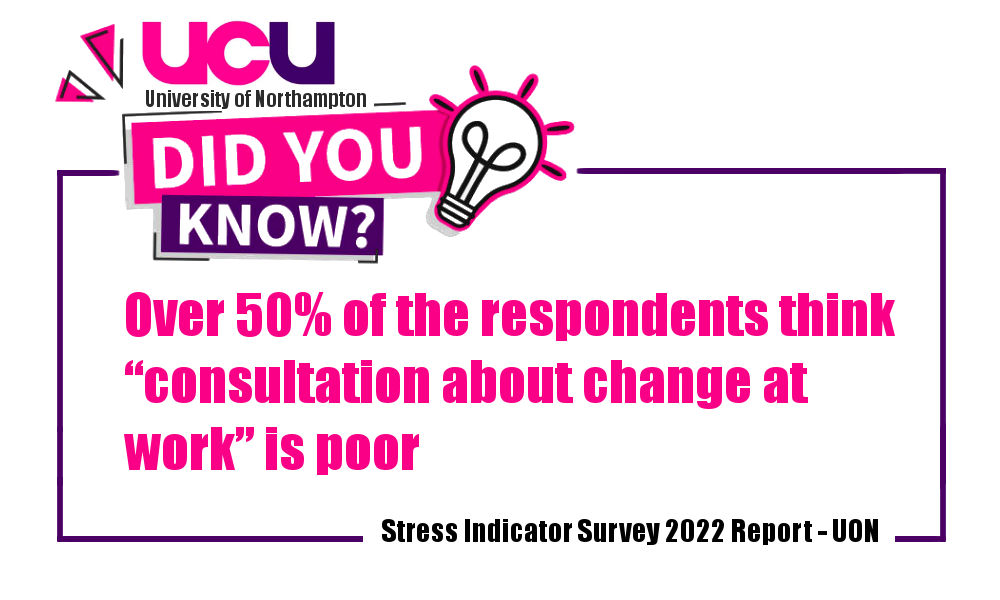
What we were talking about was major organisational change, but even small changes can have a major impact on a workforce. In our own organisation a recent staff survey suggested that ‘Over 50% of respondents considered that consultation about change at work is poor’. That of course relates to previous iterations of change and a new management team would hope to address the issues. However, in doing so there is a need for organisational change.
I’ve had recent experience of being told that something was happening because someone, in agreement with someone else, thought it was a good idea. It promotes their department, showing them in a good light; they took the idea to a meeting and lo and behold, it is agreed. No consultation with those that need to implement the idea, which may be good or bad, who knows. The point being that it is not just change brought about by managers without consultation that causes annoyance, anxiety and stress, it is those daily working practices of people in the organisation that fear challenge of their ideas. Changes are often made with the best of intentions. Sometimes those intentions are to alleviate burgeoning workloads within a department, sometimes to promote the organisation or individuals or to lighten the burden on students, for example. Often, there is consultation, but it is consultation with the wrong people, consultation with the ‘yay sayers’ and those that have little idea about the impact of the change (for the best will in the world, managers can’t know every detail of the work carried out by their staff). Such consultation avoids scrutiny but provides a thin veneer of respectability. Time and again we see staff queuing up to join consultative groups, but how many of these do so with a view to providing a real critique? Take the idea to a management meeting, get it agreed and there you are, its done. If asked about consultation, then the answer is ‘yes of course we did’. The problem is nobody asks the question ‘who exactly did you consult with’?
It will take a huge shift in organisational culture to get the ‘nay sayers’ to volunteer for consultative exercises. They need convincing that their voice is valued and yet they are a valuable asset. Challenge and scrutiny are healthy and help to mitigate unwanted and unintended consequences.
There is nothing worse than having it done to you when it could so easily have been a case of having it done with you. Next time you think about changing something, don’t assume you know best, by doing so you demonstrate how little you value others.

Share this:


ASUU vs The Federal Government

It will be 8 months in October since University Lecturers in Nigeria have embarked on a nationwide strike without adequate intervention from the government. It is quite shocking that a government will sit in power and cease to reasonably address a serious dispute such as this at such a crucial time in the country.
As we have seen over the years, strike actions in Nigerian Universities constitute an age-long problem and its recurring nature unmasks, quite simply, how the political class has refused to prioritise the knowledge-based economy.
In February 2022, the Academic Staff Union of Universities (ASUU) leadership
(which is the national union body that represents Nigerian University Lecturers during disputes) issued a 4-week warning strike to the Nigerian government due to issues of funding of the public Universities. Currently, the striking University Lecturers are accusing the government of failing to revitalise the dilapidated state of Nigerian Universities, they claim that the government has refused to implement an accountability system called UTAS and that representatives of the government have continued to backtrack on their agreement to adequately fund the Universities.
The government on the other hand is claiming that they have tried their best in negotiating with the striking lecturers – but that the lecturers are simply being unnecessarily difficult. Since 2017, several committees have been established to scrutinize the demands and negotiate with ASUU, but the inability of these committees to resolve these issues has led to this 8-month-long closure of Nigerian Universities. While this strike has generated multiple reactions from different quarters, the question to be asked is – who is to be blamed? Should the striking lecturers be blamed for demanding a viable environment for the students or should we be blaming the government for the failure of efforts to resolve this national embarrassment?
Of course, we can all understand that one of the reasons why the political class is often slow to react to these strike actions is because their children and families do not attend these schools. You either find them in private Universities in Nigeria or Universities abroad – just the same way they end up traveling abroad for medical check-ups. In fact, the problems being faced in the educational sector are quite similar to those found within the Nigerian health sector – where many doctors are already emigrating from the country to countries that appreciate the importance of medical practitioners and practice. So, what we find invariably is a situation where the children of the rich continue to enjoy uninterrupted education, while the children of the underprivileged end up spending 7 years on a full-time 4-year program, due to the failure of efforts to preserve the educational standards of Nigerian institutions.
In times like these, I remember the popular saying that when two elephants fight, it’s the grass that suffers. The elephants in this context are both the federal government and the striking lecturers, while those suffering the consequences of the power contest are the students. The striking lecturers have not been paid their salaries for more than 5 months, and they are refusing to back down. On the other hand, the government seems to be suggesting that when they are “tired”, they will call off the strike. I am not sure that strike actions of the UK UCU will last this long before some sort of agreement would have been arranged. Again, my heart goes out to the Nigerian students during these hard times – because it is just unimaginable what they will be going through during these moments of idleness. And we must never forget that if care is not taken, the idle hand will eventually become the devil’s workshop!
Having said this, Nigerian Universities must learn from this event and adopt approaches through which they can generate their income. I am not inferring that they do not, but they just need to do more. This could be through ensuring large-scale investment programs, testing local/peculiar practices at the international level, tapping into research grant schemes, remodeling the system of tuition fees, and demonstrating a stronger presence within the African markets. As a general principle, any institution that wishes to reap the dividends of the knowledge-based economy must ensure that self-generated revenues should be higher than the government’s grants – and not the other way. So, Universities in Nigeria must strive to be autonomous in their engagements and their organisational structure – while maintaining an apolitical stance at all times.
While I agree that all of these can be difficult to achieve (considering the socio-political dynamics of Nigeria), Universities must remember that the continuous dependence on the government for funds will only continue to subject them to such embarrassments rather than being seen as respected intellectuals in the society. Again, Nigerian Universities need a total disruption; there is a need for a total overhaul of the system and a complete reform of the organisational structure and policies.
Share this:


What’s happened to the Pandora papers?

Sometime last week, I was amid a group of friends when the argument about the Pandora papers suddenly came up. In brief, the key questions raised were how come no one is talking about the Pandora papers again? What has happened to the investigations, and how come the story has now been relegated to the back seat within the media space? Although, we didn’t have enough time to debate the issues, I promised that I would be sharing my thoughts on this blog. So, I hope they are reading.
We can all agree that for many years, the issues of financial delinquencies and malfeasants have remained one of the major problems facing many societies. We have seen situations where Kleptocratic rulers and their associates loot and siphon state resources, and then stack them up in secret havens. Some of these Kleptocrats prefer to collect luxury Italian wines and French arts with their ill-gotten wealth, while others prefer to purchase luxury properties and 5-star apartments in Dubai, London and elsewhere. We find military generals participating in financial black operations, and we hear about law makers manipulating the gaps in the same laws they have created. In fact, in some spheres, we find ‘business tycoons’ exploiting violence-torn regions to smuggle gold, while in other spheres, some appointed public officers refuse to declare their assets because of fear of the future. Two years ago, we read about the two socialist presidents of the southern Spanish region and how they were found guilty of misuse of public funds. Totaling about €680m, you can imagine the good that could have been achieved in that region. We should also not forget the case of Ferdinand Marcos and his wife, both of whom (we are told) amassed over $10 billion during their reign in the Philippines. As we can see below that from the offshore leak of 2013 to the Panama papers of 2016 and then the 2017 Paradise papers, data leaks have continued to skyrocket. This simply demonstrates the level to which politicians and other official state representatives are taking to invest in this booming industry.

These stories are nothing new, we have always read about them – but then they fade away quicker than we expect. It is important to note that while some countries are swift in conducting investigation when issues like these arise, very little is known about others. So, in this blog, I will simply be highlighting some of the reasons why I think news relating to these issues have a short life span.
To start with, the system of financial corruption is often controlled and executed by those holding on to power very firmly. The firepower of their legal defence team is usually unmatchable, and the way they utilise their wealth and connections often make it incredibly difficult to tackle. For example, when leaks like these appear, some journalists are usually mindful of making certain remarks about the situation for the avoidance of being sued for libel and defamation of character. Secondly, financial crimes are always complex to investigate, and prosecution often takes forever. The problem of plurality in jurisdiction is also important in this analysis as it sometimes slows down the processes of investigation and prosecution. In some countries, there is something called ‘the immunity clause’, where certain state representatives are protected from being arraigned while in office. This issue has continued to raise concerns about the position of truth, power, and political will of governments to fight corruption. Another issue to consider is the issue of confidentiality clause, or what many call corporate secrecy in offshore firms. These policies make it very difficult to know who owns what or who is purchasing what. So, for as long as these clauses remain, news relating to these issues may continue to fade out faster than we imagine. Perhaps Young (2012) was right in her analysis of illicit practices in banking & other offshore financial centres when she insisted that ‘offshore financial centers such as the Cayman Islands, often labelled secrecy jurisdictions, frustrate attempts to recover criminal wealth because they provide strong confidentiality in international finance to legitimate clients as well as to the crooks and criminals who wish to hide information – thereby attracting a large and varied client base with their own and varied reasons for wanting an offshore account’, (Young 2012, 136). This idea has also been raised by our leader, Nikos Passas who believe that effective transparency is an essential component of unscrambling the illicit partnerships in these structures.
While all these dirty behaviours have continued to damage our social systems, they yet again remind us how the network of greed remains at the core centre of human injustice. I found the animalist commandant of the pigs in the novel Animal Farm, by George Orwell to be quite relevant in this circumstance. The decree spells: all animals are equal, but some animals are more equal than others. This idea rightly describes the hypocrisy that we find in modern democracies; where citizens are made to believe that everyone is equal before the law but when in fact the law, (and in many instances more privileges) are often tilted in favour of the elites.
I agree with the prescription given by President Obama who once said that strengthening democracy entails building strong institutions over strong men. This is true because the absence of strong institutions will only continue to pave way for powerful groups to explore the limits of democracy. This also means that there must be strong political will to sanction these powerful groups engaging in this ‘thievocracy’. I know that political will is often used too loosely these days, but what I am inferring here is genuine determination to prosecute powerful criminals with transparency. This also suggests the need for better stability and stronger coordination of law across jurisdictions. Transparency should not only be limited to governments in societies, but also in those havens. It is also important to note that tackling financial crimes of the powerful should not be the duty of the state alone, but of all. Simply, it should be a collective effort of all, and it must require a joint action. By joint action I mean that civil societies and other private sectors must come together to advocate for stronger sanctions. We must seek collective participation in social movements because such actions can bring about social change – particularly when the democratic processes are proving unable to tackle such issues. Research institutes and academics must do their best by engaging in research to understand the depth of these problems as well as proffering possible solutions. Illicit financial delinquencies, we know, thrive when societies trivialize the extent and depth of its problem. Therefore, the media must continue to do their best in identifying these problems, just as we have consistently seen with the works of the International Consortium of Investigative Journalists and a few others. So, in a nutshell and to answer my friends, part of the reasons why issues like this often fade away quicker than expected has to do with some of the issues that I have pointed out. It is hoped however that those engaged in this incessant accretion of wealth will be confronted rather than conferred with national honors by their friends.
References
BBC (2021) Pandora Papers: A simple guide to the Pandora Papers leak. Available at: https://www.bbc.co.uk/news/world-58780561 (Accessed: 26 May 2022)
Young, M.A., 2012. Banking secrecy and offshore financial centres: money laundering and offshore banking, Routledge
Share this:


Industrial action, knowledge, and blurred lines

Another week has flown by, where has the time gone? Every day I diligently fill out a time sheet, every week I work over my contracted hours and at the end of every week I reflect on the things that have not been done, thinking well when I get time, I’ll have a look at that.
In conversations around the university, I hear students complaining about the current industrial action, one such conversation suggested it was disgusting that lecturers had been on strike. Another overheard student conversation thought it was disgusting that students didn’t turn up for lectures and if they were the lecturer they wouldn’t allow them back in class, after all don’t they know how long it must have taken that lecturer to prepare for the class. Juxtapose this with a workload model that only allows an hour for preparation and marking for every hour spent in the classroom and we have an interesting mosaic of what can only be described as blissful ignorance of what a lecturer’s job entails.
Now I can’t talk about other subject areas but I’m sure that many of the lecturers in those areas will have the same issues that we have in criminology or that I have regarding what we do. There are some subjects within the criminology discipline that are pretty much the staple diet and as such don’t really change much, after all Bentham’s ideas for instance were formed a couple of centuries ago and teaching a class about Bentham’s ideas won’t really change much over time. That is of course until someone, probably far brighter than me, discovers something about Bentham or produces a different take on Bentham’s writings. But generally, I suppose I might be inclined to suggest that preparation time for a lecture and seminar around the topic of Bentham’s ideas would not be too lengthy. But then what is too lengthy? How long would it take to prepare a lecture and a seminar task? That would depend on how much research was required, how many books and papers were read and probably importantly, well it is for me, how prepared the lecturer wants to be for the session. Do we as lecturers prepare for the lowest common denominator, the student that rarely reads anything and perhaps hardly turns up or do we prepare for the student that is an avid reader and will have read more than what they can find on Wikipedia. How long is a piece of string when it comes to preparation time.
Those of you that might have read my first blog about the industrial action will recall how I described that having been signed off ill with work related stress, I was told that I was burnt out. One of the questions in conversation was whether I ever turned off, the answer of course was no. And it is still difficult to do that, Criminology is one of those disciplines that is all consuming. I watch the news, or I read about something, and I immediately think of criminological aspects. I must admit most of the time I have the Metropolitan Police to thank for that. There doesn’t seem to be much delineation, certainly in terms of cerebral activity, between being at work and being off. I want to make my lectures, seminars or workshops (call them what you will) interesting and current. By exploring current issues in society, I end up researching both the current and historic, I end up making links between reality and theory and I produce what I hope is thought provoking and interesting subject matter for consumption in class. I have recently prepared a workshop which required me to read two IPCC reports and a three hundred word plus transcript of a civil case, all highly relevant to the topic of failed investigations. The civil case took me to 10 other stated cases. I can’t tell you exactly how long it took me, but it was longer than a day. Most of it in my own time because the topic is of interest to me. Lecturing, the acquisition of knowledge and at times the production of knowledge takes time, often the lines are blurred as to whose time is being used. My seeds of ideas and basic research are often in my time not my employer’s time. To have students turn up unprepared for my workshops, to turn up late (frequently) to fail to engage and then to have the gall to bemoan industrial action is soul destroying. To have a workload model that allows a pitiful time for preparation of lectures is simply ignorance and quite frankly, crass. We are in higher education not a sausage factory.
It is easy then, to see on reflection, where my time has gone each week. Given the work entailed in lecturing and the myriad of other requirements, it is hardly a surprise that there is a successful mandate for continued industrial action. I’m working more hours than is stated in my contract, cheating a bit on ASOS because it feels impossible not to, and I still can’t get anywhere near to fulfilling my workload. When I fill out my time sheet, I don’t include all of my own time as I’ve described above.
I won’t stop formulating my ideas. I wont stop using my own time to further my knowledge so that I can pass it on to students that are interested. But I would like some acknowledgement that the current system employed for gauging my workload is out of kilter with reality. And for those students that put the effort in and by doing so make my classes enjoyable, I am extremely grateful. As for the rest, well I suppose ignorance is bliss.
Share this:


Meet the Team: Helen Trinder, Associate Lecturer in Criminology

My Academic Journey
Two weeks ago, I attended a university reunion. My cohort are now in our late 40s or early 50s but it is remarkable how little we had all changed. Being back in the place where we all studied together put me in reflective mood and that (combined with some timely prompting from Paula) inspired me to share my academic journey.
I was one of those annoying kids who did well at school and knew exactly what they wanted to do. As a small child, I wanted to be a nurse but I later developed an aversion to bodily fluids which made that career choice untenable. I briefly flirted with the idea of being an English teacher, but both of my parents were in education and strenuously tried to dissuade me. So, at the age of about 14, I decided that I wanted to be a prison psychologist. I was in a careers lesson at school, and we had a big green plastic box filled with cards on which were written descriptions of different jobs. I announced that I wanted to be a psychiatrist (I think I was just being provocative) but I couldn’t find “psychiatrist” in the box, so I picked the closest one that I could find: “psychologist”. I read the card and it sounded really interesting, so I decided to find out more about psychology. The more I read, the more interesting I found it, and when I looked into the sorts of settings where I could work as a psychologist, prisons called out to me.
I was very lucky to secure a place to read Experimental Psychology at University College, Oxford in 1990. People have an image of ancient universities as being elitist, but what struck me was the huge diversity of people who were there. They were all clever and had studied hard to achieve their places, but beyond that they came from an enormous range of backgrounds – a far greater variety than I had encountered in my Shropshire comprehensive school. Our tutors worked us extremely hard. We had weekly tutorials, either in pairs or one-to-one, in two modules every term and we had to prepare an essay for each tutorial (two essays a week). In tutorials, we read out, discussed and analysed our essays and the reading on which they were based. There were lectures and practical classes on top of that and we had exams at the beginning of each term to make sure that we hadn’t forgotten anything over the vacations! That’s why I’m sometimes not very sympathetic to students who struggle to read one paper in preparation for a seminar!
At the end of my undergraduate studies, I still wanted to work in prisons but I knew very little about them. My degree had given me an excellent grounding in psychology but I knew little about the study of crime. So I applied to do an M.Phil. at the Institute of Criminology in Cambridge. This gave me an extra year as a full-time student and I thoroughly enjoyed it! I was privileged to be taught by such eminent criminologists as Loraine Gelsthorpe, Alison Liebling and David Farrington. I particularly enjoyed the penology seminars with Nigel West, which I attended just out of interest – I wasn’t taking the assessment in that module! The assessments were all coursework (extended essays and a dissertation) and had to be submitted at the start of each term, so I studied hard in the vacations, and I attended my seminars in term time, but there was also plenty of time for sport and socialising and making the most of my last year as a student!
At that time, HM Prison Service recruited new psychologists once a year through a national assessment centre. I applied in 1994, just after I had submitted my M.Phil. dissertation but I was unsuccessful. I got a job instead at the University of Wales, Swansea, as a research assistant in the Department of Social Policy and Applied Social Studies. I was involved in an evaluation of drug and alcohol treatment centres, funded by the Welsh Office, which employed both quantitative measures and participant observation. When that contract ended, I obtained another contract with Swansea City Council to compile a community profile of a “problem” estate. This required knocking on doors to interview residents, and participant observation in community settings such as the youth club, old people’s bingo sessions and the local pub. It was considered a rather intimidating environment to drop a well-educated 24-year-old English girl into, but I found the residents to be remarkably warm and welcoming and it was a highly rewarding piece of work.
By the time I finished the community profile, I had re-applied to the Prison Service and passed the assessment centre – the interpersonal skills I had developed through my action research had served me well. I had, however, joined the Prison Service at an unfortunate time. There was a recruitment ban in force which meant that although I had passed the psychologist assessment centre, I couldn’t actually secure a job. I was eventually given a temporary contract to collect data at HMP Littlehey for a large-scale research project analysing effective prison regimes. After 10 months of doing this, the recruitment ban was lifted and I was taken on as a prison psychologist, sharing my time between HMP Littlehey and HMP Wellingborough. The Prison Service used to fund a part-time M.Sc. at Birkbeck University, which all newly recruited psychologists undertook. Obtaining a suitably accredited M.Sc., along with completing a satisfactory period of supervised practice, is an essential requirement of becoming a fully qualified “Chartered” psychologist. In another piece of unfortunate timing, the Birkbeck M.Sc. ceased to run just as I joined the service. At first, there was nothing to take its place. However, other universities soon noticed the gap in the market. I, and others in my prison psychology cohort, were relieved when the University of Leicester set up an M.Sc. in Forensic and Legal Psychology by Distance Learning. The Prison Service agreed to pay my fees and my manager allowed a small amount of study leave when assignments were due. Completing a post-graduate degree while working full-time in a demanding job was hard work and I vowed I would never do it again!
I moved to HMP Woodhill in 1998, completed my M.Sc. in 1999 and became a Chartered Psychologist in 2001. At some point after that, I remember receiving a phone call at work from someone called “@manosdaskalou” at, what was then, University College Northampton! I don’t know where he got my number from, but he wanted someone to talk to his third year Forensic Psychology students about the work that psychologists do in prisons. My parents had not completely succeeded in knocking a desire to teach out of me (in fact I probably inherited my urge to educate from them), and my Dad had taught at Northampton when it was Nene College, so I was keen to fulfil the request. The talk became a regular fixture and, after a few years (by which time I was Head of Psychology at HMP Woodhill), we extended it from a single guest lecture to a series of four, to allow me to cover topics such as risk assessment and offending behaviour interventions in more detail.
My son was born in 2008 and I took 12 months maternity leave from the Prison Service. At the end of that time, I didn’t feel ready to go back, so I negotiated a further 12 months career break. I wasn’t ready to return to the full intensity of managing a team in a high security prison, but I did want to keep my brain active. I asked Manos if there were any opportunities to expand my teaching commitments. The University was in the process of setting up a foundation degree in Offender Management, which was aimed primarily at custodial officers at HMP Rye Hill but was also delivered to a small cohort of full-time students. They were short of lecturers to deliver the modules and my offer to help out was eagerly accepted. The terms of my career break meant that I couldn’t earn money from another employer, but a couple of hours a week teaching suited me very well, so I gave my services for free and taught a module on Professional Practice alongside a lecturer with a background in probation, from another university, called Keith Davies.
After a year of this arrangement, HMP Woodhill were unwilling to have me back part-time, so I resigned from the Prison Service and joined the Parole Board as a part-time psychologist member. This allowed me to work much more flexibly and, with a toddler in the family, it suited me well. It also meant that I could have a proper contract with the University of Northampton and I became an associate lecturer in September 2010. Keith had moved to a different job but I continued to teach Professional Practice on the Offender Management degree. There was also a module in Offender Management on “The Psychology of Crime and Criminal Behaviour”. The person who taught this left after a couple of years and I took it over. Returning to basic psychology and teaching it every week was daunting at first, but I really enjoyed going back to what I had learned as an undergraduate and re-discovering how relevant it was to real-life criminal justice.
The arrangement with HMP Rye Hill had never really taken off and the Offender Management degree only ever attracted small numbers of full-time students, so in 2014 the course closed. Manos was keen, however, to incorporate more psychology into the B.A. Criminology course, so we adapted “The Psychology of Crime and Criminal Behaviour” into a first-year criminology module and I’ve been teaching it ever since! I’ve also taught a module on violence and I’ve covered maternity leave and sickness absence in other modules too. My students will have heard me banging on about forensic psychologists being “scientist-practitioners” and I feel that teaching at the University of Northampton has allowed me to fulfil this role. As a practitioner, I have lots of interesting real-life examples to use to illustrate points to my students, but teaching also keeps me up-to-date with research and theory which I can use to inform my practice.
My academic journey continues to take me to new places. My position on the Parole Board was a public appointment with a fixed tenure that came to an end in September 2020. I decided at that point to start a part-time Ph.D. with the University of Birmingham. I had not wanted to go into research straight from my M.Phil. because I felt that, in order to understand people who committed offences, I really needed some direct experience of working with them, but after 24 years as a practitioner, the time seemed right. I am now 18 months into a 6-year part-time degree. I am exploring the role of empathy deficits in violent and sexual offending. Trying to undertake research (which ideally requires access to prisoners) has not been easy during a pandemic and I have faced a number of obstacles but nothing insurmountable yet.
I am still keen to maintain a scientist-practitioner balance, and I need to pay my university fees and make a contribution to the family income, so in February of last year I started working as a Forensic Psychologist at St Andrew’s hospital. I am primarily based on a medium-secure ward for men with learning disabilities. Forensic mental health is a new area of practice for me and, although I have plenty of transferable skills from my previous roles, I have had to adapt to a different approach to the people we work with and a completely new set of jargon.
Reflecting on my academic journey, it is the people that stand out. I think that the most profound learning has taken place when I have been able to engage with experts who have shared their enthusiasm. In this respect, my undergraduate tutorials and M.Phil. seminars contrast with my distance learning M.Sc., which was a means of obtaining a qualification rather than an immersive learning experience. I hope that, as a practitioner who also teaches, I have been able to share some of my enthusiasm for forensic psychology with my own students. In order to benefit from this, however, students need to take up the opportunity to engage fully with teaching and not just see their university experience as a means to a qualification. Of course, COVID has not helped this, and the university’s penchant for remote learning placed it in a good position to maintain teaching when the pandemic struck. But it is very difficult to engage students when they are just names on a screen. I hope that, as we return to more face-to-face teaching, I can once again inspire my students, not just to pass their exams but to develop a life-long fascination for understanding criminal behaviour and the people that perpetrate it.
Helen Trinder, M.A., M.Phil., M.Sc., C.Psychol.
Forensic Psychologist and Associate Lecturer

Share this:


Meet the Team: Paul Famosaya, Lecturer in Criminology

Hi all! My name is Dr Paul Famosaya and I have just joined UoN as a Lecturer in criminology. Prior to joining UoN, I have taught as a Lecturer in criminology and policing at the University of Cumbria – where I contributed to the development and running of modules at both Undergraduate and Masters level. In addition, I have taught criminology at Middlesex University, London as an HP Lecturer (during my PhD days). So, over the years really, I have developed and taught a variety of modules around the theories of crime, the crimes of the powerful, global dimensions of crime, policing, new ideas in criminology, crimes & deviance, social exclusion, criminological frameworks etc. I also serve as a reviewer of a few international reputable journals.
In terms of my academic background, I completed my undergraduate degree in Nigeria, 2010 and then went straight on to complete my Masters in Criminology at Middlesex University, London. I then dived straight in to my PhD, which I completed also at Middlesex in 2019 – with my thesis focusing on police experiences, actions and practices.
I came into the world of Criminology simply for my interest in understanding the logic of corruption and the network of greed. I realised that these two components are largely the foundational problems of my home country Nigeria, and many other countries. So, the plight to unravel these dynamics from both institutional and personal level triggered my interest in the discipline. To a large extent, this interest has continued to strengthen my area of specialisation which concentrates largely on the areas of Critical and Theoretical criminology, Police culture, Social harms and Injustice. Criminology is something I’ve really enjoyed doing and while I have taught it for many years, I still consider myself to be a student of Criminology really.
I am currently completing another article on pandemics and criminology – so it’ll be cool to chat with colleagues looking at similar area(s). Looking forward to meeting everyone soon!
Share this:

Watch Out: Inspirational Women Coming Through

In my blog post about My favourite Things I mentioned that Jane Eyre was somebody who inspires me. Upon reflection, she is somebody who inspired me a lot when I was younger, and still today, but not with the same force. Over the past 9 years there have been 4 women who at various points over these years have inspired me in one way or another and remain inspirational to this very day. These four wise, wonderful women have had a humongous impact on my life and in my character development. This blog post is a sort of thank you letter to these fabulous women, as well as an outline of how and why they inspire me. They will remain unnamed to protect myself against certain death!
The first woman I have known the longest, and whilst I would class them as a close friend now, we did not start out as such. Neither did we dislike each other (I HOPE)! This person has had a direct impact on my identity as a criminologist but also as a feminist: something I will always be grateful for. They inspire me daily to be more understanding, empathetic and kind to myself. To challenge the status quo and to think critically at all times! For me they represent whom I want to be in the future. They are hard-working, generous, morally impeccable and a fan of Toy Story (massive plus points in my book). They have overcome a number of academic obstacles and inspire me to persevere with academia and its frustrations on the toughest of days. If I turn out to be half the woman they are; I feel like I will have succeeded in life.
The second woman is one of my closest friends. They are the perfect combination of weird and wonderful. We have had similar journeys in academia, but arguably they went first, and seeing them succeed inspired me to do similar! This woman has the patience of an actual real-life saint (although it has been tested on occasion-possibly by myself)! They inspire me to let the little things go and to recognise and check my own privilege. When I feel myself wobble, I think to this person and know that we can do this together! They might not know this: but I am continuously looking up to them.
The third woman has had a very recent inspirational impact on my life. I’ve known them for a number of years, but the last few years has changed the dynamic of our relationship to a beautiful friendship: one where they kick my backside at the Switch, but share my love for cheeseboards! This woman, other than keeping me sane, has inspired me to stand up for my own self-worth and to generate a backbone (metaphorically speaking). Our challenging discussions around race and gender, her open-mindedness and critical thinking all encourage me to follow suit. Life has thrown a number of obstacles her way, and whilst she may get a little knocked, she brushes it off and continues to smash her goals! All of this leaves me in awe: not to mention their stamina when it comes to shopping!
The final, and by no means least, woman is the most recent addition to the inspirational gang of fabulous women, who bless my life and keep me grounded. They keep me motivated in things I am passionate about outside of academia, are always there as a sounding board for me to air out my frustrations, and totally gets my need for doughnuts! They balance a ridiculous work-life balance as a single parent, and do so with flare, generosity and hard-work! Her non-traditional route into academia serves as inspiration to all, that if you are passionate about something; pursue it!
All four of these women manage ridiculous work/life/study loads, are empathetic, caring and always make time for me. All of them inspire me to be a better academic, friend and human being. They have had an impact on me as a student (Undergraduate and Postgraduate) as an academic (Associate Lecturer and Lecturer) and most importantly as a person. I cannot thank them enough. But if they are reading this, which they should be as I’ll be sharing it on social media; THANK YOU WISE, WONDERFUL WOMEN!

Share this:

DIE in Solidarity with Diversity-Inclusion-Equality
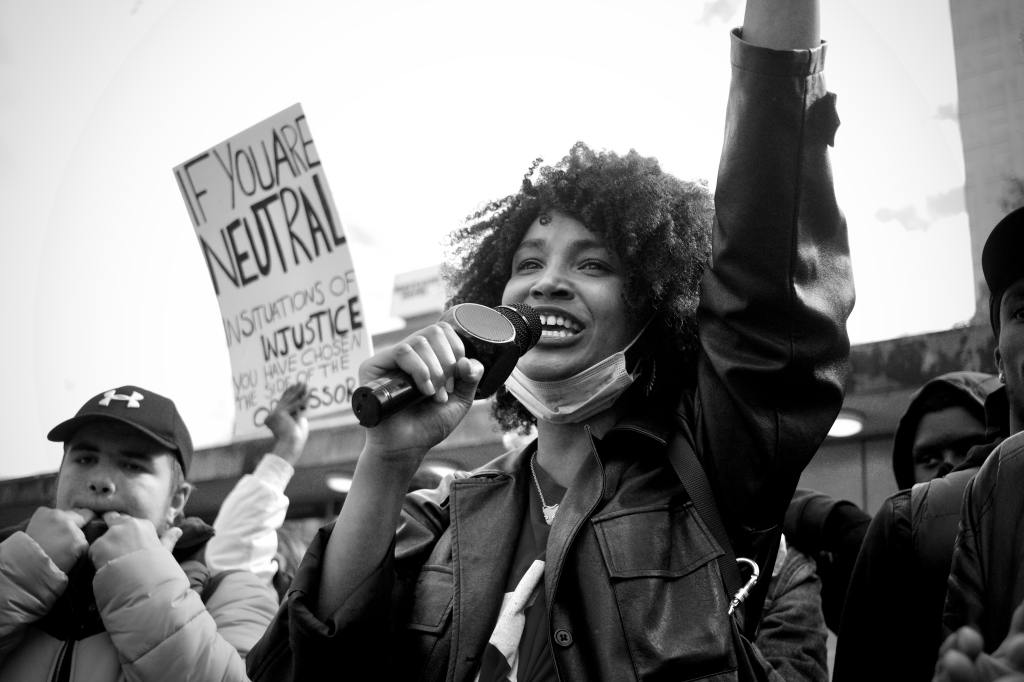
As an associate lecturer on a casual contract, I was glad to stand in solidarity with my friends and colleagues also striking as part of UCU Industrial Action. Concurrently, I was also glad to stand in solidarity with students (as a recent former undergrad and masters student … I get it), students who simply want a better education, including having a curriculum that represents them (not a privileged minority). I wrote this poem for the students and staff taking part in strike action, and it comes inspired from the lip service universities give to doing equality while undermining those that actually do it (meanwhile universities refuse to put in the investment required). This piece also comes inspired by ‘This is Not a Humanising Poem’ by Suhaiymah Manzoor-Khan, a British author-educator from Bradford in Yorkshire.
Some issues force you to protest
the way oppression knocks on your front door
and you can’t block out the noise
“protest peacefully, non-violently”
I have heard people say
show ‘the undecided’, passive respectability
be quiet, leave parts of yourself at home
show them you’re just as capable of being liked
enough for promotion into the canteen,
protest with kindness and humour
make allusions to smiling resisters in literature
they’d rather passive images of Rosa Parks all honestly
but not her politics against racism, patriarchy, and misogyny
but I wanna tell them about British histories of dissent
the good and the bad – 1919 Race Riots
the 1926 general strikes, and the not so quiet
interwar years of Caribbean resistance to military conscription
I wanna talk about how Pride was originally a protest
I wanna talk about the Grunwick Strike and Jayaben Desai
and the Yorkshire miners that came to London in solidarity
with South Asian migrant women in what was 1980s austerity
I want to rant about Thatcherism as the base
for the neoliberal university culture we work in today
I want to talk about the Poll Tax Riots of 1990
and the current whitewashing of the climate emergency
they want protesters to be frugal in activism,
don’t decolonise the curriculum
they say decolonise
they mean monetise, let’s diversify …
but not that sort of diversity
nothing too political, critical, intellectual
transform lives, inspire change?
But no,
they will make problems out of people who complain
it’s your fault, for not being able to concentrate
in workplaces that separate the work you do
from the effects of Black Lives Matter and #MeToo
they make you the problem
they make you want to leave
unwilling to acknowledge that universities
discriminate against staff and students systemically
POCs, working-class, international, disabled, LGBT
but let’s show the eligibility of staff networks
while senior leaders disproportionately hire TERFs

staff and students chequered with severe floggings
body maps of indenture and slavery
like hieroglyphics made of flesh
but good degrees, are not the only thing that hold meaning
workers rights, students’ rights to education
so this will not be a ‘people are human’ poem
we are beyond respectability now
however, you know universities will DIE on that hill
instead,
treat us well when we’re tired
productive, upset, frustrated
when we’re in back-to-back global crises
COVID-19, Black Lives Matter, femicide,
failing in class, time wasting, without the right visas,
the right accents; Black, white, homeless, in poverty,
women, trans, when we’re not A-Grade students, when we don’t
have the right last name; when we’re suicidal
when people are anxious, depressed, autistic
tick-box statistics within unprotected characteristics
all permeates through workers’ and student rights
When you see staff on strike now,
we’re protesting things related to jobs yes,
but also, the after-effects
as institutions always protect themselves
so sometimes I think about
when senior management vote on policies…
if there’s a difference between the nice ones ticking boxes
and the other ones that scatter white supremacy?
I wonder if it’s about diversity, inclusion, and equality [DIE],
how come they discriminate in the name of transforming lives
how come Black students are questioned (under caution) in disciplinaries
like this is the London Met maintaining law and order …
upholding canteen cultures of policing
Black and Brown bodies. Decolonisation is more
than the curriculum; Tuck and Yang
tell us decolonisation is not a metaphor,
so why is it used in meetings as lip service –

why aren’t staff hired in
in critical race studies, whiteness studies, decolonial studies
why is liberation politics and anti-racism not at the heart of this
why are mediocre white men failing upwards,
they tell me we have misunderstood
but promotion based on merit doesn’t exist
bell hooks called this
imperialist heteropatriarchal white supremacy
you know Free Palestine, Black Lives Matter, and the rest
we must protest how we want to protest
we must never be silenced; is this being me radical, am I radical
Cos I’m tired of being called a “millennial lefty snowflake”, when I’m just trying not to DIE?!
Further Reading
Ahmed, Sara (2012) On Being Included: Racism and Diversity in Institutional Life. London: Duke.
Ahmed, Sara (2021) Complaint. London: Duke.
Bhanot, Kavita (2015) Decolonise, Not Diversify. Media Diversified [online].
Double Down News (2021) This Is England: Ash Sakar’s Alternative Race Report. YouTube.
Chen, Sophia (2020) The Equity-Diversity-Inclusion Industrial Complex Gets a Makeover. Wired [online].
Puwar, Nirmal (2004) Space Invaders: Race, Gender and Bodies Out of Place. Oxford: Berg.
Read, Bridget (2021) Doing the Work at Work What are companies desperate for diversity consultants actually buying? The Cut [online].
Ventour, Tré (2021) Telling it Like it is: Decolonisation is Not Diversity. Diverse Educators [online].
Share this:


Complaint! (For Sara Ahmed)
This poem comes inspired from the recent UCU strikes, and also the underpinning arguements of Complaint by Sara Ahmed. The institution protects itself, while removing those who complain (or in many cases, they remove themselves). It is also inspired by ‘Testimony’ by Irish poet Seamus Heaney.
As higher education burns,
they blame white lecturers who picket,
and the Black and Brown lecturers
no longer willing to be ‘paid in exposure’
to the hull of slave ships. Colonialism’s hot mouth
at the nucleus of HE’s epistemes,
so senior leaders blame lecturers
for neglect. Meanwhile, the upper echelons
play Monopoly with staff pay checks
students left to grieve assignment
work revolving around conveyer belts
like undead corpses between indenture and slavery
it’s a Tuesday morning
a fever of claret runs riot
across picketing lines
turn cloaks to justice and equality,
there’s just ice behind the scab
where hearts used to beat. Back in the 80s,
gay and lesbian activists stood in solidarity
with the miners; and Arthur Scargill
and co scurried to Jayaben Desai at Grunwick
from the main road, you can still hear the screams
of comradery, and ‘we see yous’ …
yet behind picket tea and biscuits,
there are teary smiles –
death behind the bags,
and behind the pyre …
smoke could be seen for miles.
Share this:


United Nation’s (UN) World Day of Social Justice

Achieving justice through formal employment
This Sunday 20th February marks the United Nation’s (UN) World Day of Social Justice. The theme this year is ‘achieving justice through formal employment’. The focus is on the informal economy, in which 60% of the world’s employed population participate. Those employed in the informal economy are not protected by regulations such as health and safety or employment rights and are not entitled to employment benefits such as sickness and holiday pay. People who work in the informal economy are much more likely to be poor, in which case housing and unsanitary conditions can compound the impact of working in the informal economy.
When we in the global North talk about the informal economy, there is often an assumption that this occurs in poorer, less developed countries (it is semantics – here in the UK we use the preferred term of the ‘gig economy’). However, this is a global problem and often the richest industries and countries engage in abusive employment practices that form part of the problem of the informal economy. Let’s take Qatar as an example. Qatar has one of the highest GDP per capita in the world, but it also has an extremely high level of income inequality. I heard Natasha Iskandar recently discussing the case of migrant workers in Qatar during construction for the football world cup. Migrant workers are vulnerable to the informal economy due to various labour and visa restrictions throughout the world. In Qatar migrant workers were needed to build the stadia, however this came at a cost to employment conditions including wage theft, forced overtime, debt bondage and intimidation. At the time in Qatar, it was illegal for such workers to withhold labour and they could not voluntarily leave the country without the consent of their employers. The often-abusive employment conditions within the Kafala system of sponsored migrant labour would push people into the informal economy. Having come under some criticism, Qatar has since reformed the Kafala system to improve social protections for migrant workers and were the first of the Gulf countries to do so.
The informalisation of the education economy
On a global scale, the problem of the informal economy is vast there are unique challenges to different groups and social contexts. It will take a large-scale effort to make changes needed to abolish the informal economy globally if it ever can be abolished. Perhaps though we can start by looking a little closer to home and see if we can make a difference there. Academia has traditionally been perceived by those outside of it as a sector of elite institutions, the ‘ivory towers’, where highly paid, highly skilled academics talk from their parapets in a language those outside of it cannot understand. There is a perception that academics are highly paid, highly skilled workers with job security, good pensions, and a comfortable working life. Higher education management in some institutions have been known to refer to academics using derogatory terms such as ‘slackademics’. As every hard-working academic will tell you, this cannot be further from the truth.
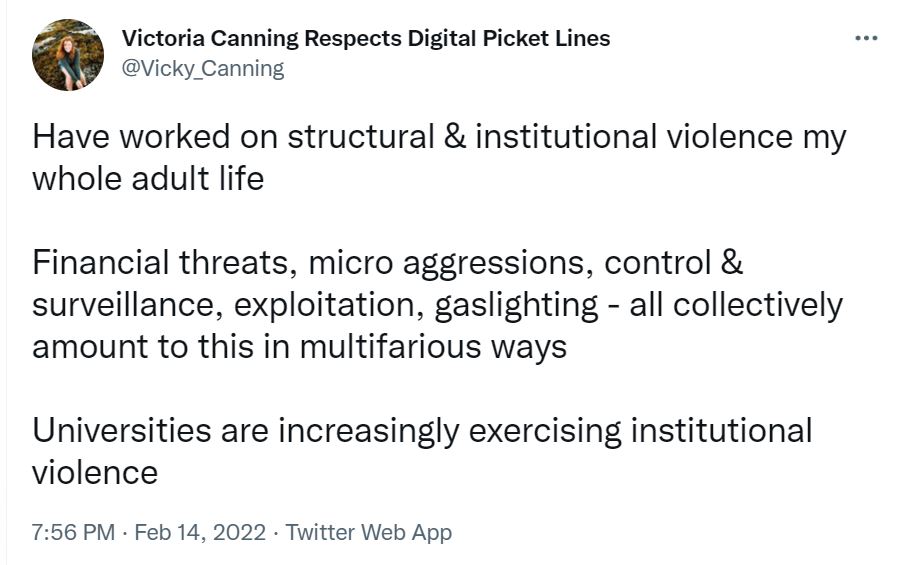
What used to be a place of free thinking, sharing of ideas, and encouraging students to do the same (note: I’m told academics used to have time to think and read) has become a place where profit and business ethos overrides such niceties. The marketisation of education, which can be traced back to the early 1990s has seen a growth in informal employment putting paid to the myths of job security inter alia, lecturing staff well-being. As Vicky Canning put it in the below Tweet, this constitutes institutional violence, something we criminologists are charged with speaking up against.
The university industry has become increasingly reliant on casualised contracts leading to staff not being able to get mortgages or tenancies. During my time at a previous institution, I worked on fixed term contracts as a teaching assistant. The teaching contracts would typically last for 10-12 weeks, there were constant HR errors with contracts, which were often not confirmed until the week before teaching or even after teaching had started. Each semester there would be at least a few teaching assistants who got paid incorrectly or did not get paid at all. These are the people delivering teaching to students paying at least £9,250 per year for their education. Is this value for money? Is this fair? In a previous round of strikes at that institution I let my students know that after all the work they put into writing, I only got paid for 20 minutes to mark one of their 3,500-word essays. They did not seem to think this was value for money.
While I was working under such contracts, I had to move to a new house. I visited many properties and faced a series of affordability checks. As the contracts were short term, landlords would not accept this income as secure, and I was rejected for several properties. I eventually had to ask a friend to be a guarantor but without this, I could easily have ended up homeless and this has happened to other university teaching staff. It was reported recently in the Guardian that a casualised lecturer was living in a tent because she was not able to afford accommodation. All this, on top of stressful, unmanageable workloads. These are the kinds of things casualised university staff must contend with in their lives. These are the humans teaching our students.
This is just one of the problems in the higher education machine. The problems of wage theft, forced overtime, debt bondage and intimidation seen in Qatar are also seen in the institutionally violent higher education economy, albeit to a lesser (or less visible) extent. Let’s talk about wage theft. A number of universities have threatened 100% salary deductions for staff engaging in action short of strike, or in simple terms, working the hours they are contracted to do. Academics throughout the country are being threatened with wage theft if they cannot complete their contractual duties within the hours they are paid for. Essentially then, some higher education establishments are coercing staff to undertake unpaid overtime, not dissimilar to the forced overtime faced by exploited migrant workers building stadia in Qatar.
Academics across the country need to see change in these academic workloads so we can research the exploitation of migrants in the informal labour market, to work towards UN sustainability goals to help address the informal economy, to engage in social justice projects within the informal economy in our local area, and to think about how we can engage our students in such projects. In effect academics need to work in an environment where they can be academics.
How can we begin to be critical of or help address global issues such as the informal economy when our education system is engaging in questionable employment practices, the kind of which drive people into the informal economy, the kind of employment practices that border the informal economy. Perhaps higher education needs to look inwards before looking out


