
Home » Articles posted by haleysread
Author Archives: haleysread

Sabrina Carpenter and Feminist Utopia
I have recently been introduced to Sabrina Carpenter via online media commentary about the image of her new album cover Man’s Best Friend. Whilst some claim the image is playing with satire, the image appears to have been interpreted by others as being hyper-sexual and pandering to the male gaze.

I am not sure why this specific album cover and artist has attracted so much attention given that the hyper-sexual depiction of women is well-represented within the music industry and society more generally. However, because Sabrina’s main audience base is apparently young women under 30 it did leave me thinking about the module CRI1009 and feminist utopia, as it left me with questions that I would want to ask the students like: In a feminist utopia should the hyper-sexualized imagery of women exist?
Some might be quick to point out that this imagery should not exist as it could be seen to contribute towards the misogynistic sexualisation of women and the danger of this, as illustrated with Glasgow Women’s Aid comments about Sabrina’s album cover via Instagram (2025)
‘Sabrina Carpenter’s new album cover isn’t edgy, it’s regressive.
Picturing herself on all fours, with a man pulling her hair and calling it “Man’s Best Friend” isn’t subversion. 😐
It’s a throwback to tired tropes that reduce women to pets, props, and possessions and promote an element of violence and control. 🚩
We’ve fought too hard for this. ✊🏻
We get Sabrina’s brand is packaged up retro glam but we really don’t need to go back to the tired stereotypes of women. ✨
Sabrina is pandering to the male gaze and promoting misogynistic stereotypes, which is ironic given the majority of her fans are young women!
Come on Sabrina! You can do better! 💖’
However, thinking about utopia is always complicated as Sabrina’s brand appears to some a ‘sex-positive feminism’ by apparently allowing women to be free to represent themselves and ‘feel sexy’ rather than being controlled by the rules and expectations of other people. For some this idea of sexual freedom aka ‘sex-positive feminism’ branded via an inequitable capitalistic male dominated industry and represented by an incredibly rich white woman would be a bit of a mythical representation. As while this idea of sexy feminism is promoted by the privileged few this occurs in a societal context where many feel that women’s rights are being/at risk of being eroded and women are being subjected to sexual violence on a daily basis.
I am not sure what a workshop discussion with CRI1009 students would conclude about this, but certainly there would need to be a circling back to more never- ending foundational questions about utopia: what else would exist in this feminist utopia? Whose feminist utopic vision should get priority? Would anyone be damaged in a utopic society that does promote this hyper-sexualization? If so, should this utopia prioritise individual expression or have collective responsibility? In a society without hyper-sexualisation of women would there be rule breakers, and if so, what do you do with them?
Share this:


25th Year Reflection

I have been part of Criminology at UON as BA Criminology student, then Associate Lecturer then Lecturer in Criminology for about 13 years in total. My last reflection on my Criminology journey was in 2020 as I had just embarked on my new role as a Lecturer in Criminology. Every now and then I reflect on how lucky I am to be able to have a job role which has the potential to encourage a passion for learning, reading, writing, critical thinking as well as other life skills.
When reflecting on the 25th year Criminology anniversary I think mostly of the old Park Campus that I used to frequent and study at as a student. It had quite a nice feel to it and there was also enough surrounding nature for a famous badger to make this place part of its habitat! There were less books available online when I was an undergraduate compared to today so I have fond memories of going to the library often to have a browse and coming away with as many criminology related books that I could fit in my bag at once. Finding places where I could study for hours that were less frequented than the main library also gave me a bit of a buzz. There also used to be a Pavilion bar near to where the majority of exams would take place, one of my favorite past time memories is sipping on a beer in the Pavilion just after the end of my final third year Criminology exam season, (whilst secretly thinking of how I thought the exams went much better than expected).
When reflecting I am also reminded of how lecturers like Dr @manosdaskalou and Dr @paulaabowles can be incredibly inspirational and influential at guiding academic paths (such as my own!). The re-occurring ideas that ‘criminology is everywhere’ and that we should ‘question everything’ has boded well for helping me to make difficult decisions and in thinking about how I interacted with people when I was working within crime related industries.
In more recent years staff and students have moved to a new campus, have worked and studied through the challenges that come with Covid-19 and contextual uncertainties. This year has had some highlights for me, such as working on a new module Imagining Crime. Whereby we used inspiration from the novel 1984 by George Orwell to task students with committing weekly ‘thought crimes’ by seeing/hearing/reading about something criminological and questioning this by using critical thinking. Listening to the development of critical thinking via the ‘thought crime’ method has been a delight. The flexible, creative and multidisciplinary nature of criminology is also quite fabulous for maintaining interest in criminology over a long period of time but also for venturing into new and less explored areas. For instance, staff and students in Imagining Crime had the pleasure of attending a guest speaker session with @saffrongarside about children’s literature and the environment this academic year – at a time when Northampton itself seemed to be struggling to cope with flooding. Of course, this did highlight the importance of seeing environmental issues as criminological issues, but also the importance of considering children’s books as criminologically cultural artifacts, was something completely new and intriguing for me. I also gained a lot from hearing what our students (who are predominantly) young people think about environmental issues outside of the mainstream media angles that I have seen.
To round up, I loved my student life whilst studying BA Criminology and I am sure many others will say ‘ditto to that’. Long may the love for Criminology at UON continue!
Share this:

Family life in Tenerife versus the UK
I have recently been on a family holiday with our toddler to Tenerife. We began the journey by getting to an airport in the UK. Whilst there the security checks were done for families alongside everyone else. Toddlers were required to get out of their prams, to have their shoes taken off and could not hold onto their toys. The security seemed relatively tight as my hands were swabbed, my toddler was searched with a security stick and the small volume of water that he was allowed was also swabbed.
Whilst arriving and departing via the airport in Tenerife the security allocated a separate quieter section of space for families, this seemed far more relaxed, staff were smiling and dared to say ‘hola’ and ‘hello’. There were no additional checks and a toddler cup of water was allowed. Some staff were also making a deliberate attempt to identify the names of babies, toddlers and children from boarding passes or passports to be able to greet them by their names with waves and smiles.
Whilst on holiday I could be forgiven for thinking that we were royalty whilst pushing a pram and toddler around the streets. As pedestrians always had the right of way, whenever there is a road to cross, the cars must stop due to zebra-like crossings marking on the ground. There are also plenty of playgrounds and toilets and plenty of opportunity for play outdoors in sea and sand.
Whilst at home in Birmingham (UK) there are far less zebra crossings and on quite a few occasions cars have failed to stop at zebra crossings whilst I have been waiting with a pram and toddler. Baby and toddler swimming pools also seem to be difficult to access due to locations and restrictions on pool opening time frames. There are parks but I have never seen a park within a shopping centre like I did in Tenerife. Despite the UK becoming quite cold in the winter, the ability to access free indoor play during winter time also seems to be a privilege, rather than a given. Whilst there are some fabulous playgroups and library sessions for babies and toddlers, sometimes establishments promoting themselves as ‘family friendly’ places do not always feel friendly to toddlers at all. This is especially the case if toddlers are required to adhere to adult informal rules, such as not touching things or making loud noise. As some how toddlers trying to explore their world are labelled by some as ‘terrible’ at ‘two’ (see below poem by Holly McNish).

Whilst I have no idea about the education system in Tenerife, these experiences did leave me reflecting on the provision of mainstream education for babies, toddlers and children in the UK. In comparison to countries such as Finland, some mainstream UK education settings are often critiqued for limiting play, time spent in the outdoors, creativity and freedom to think (Dorling and Koljonen, 2020). The popularity of European influenced Montessori nurseries and Forest Schools in the UK seem to indicate that some parents do want something different for children. Whilst on mention of difference, UK mainstream educational approaches to difference seem to be about an assimilation type of inclusivity and diversity, rather than celebrating and learning from the variety of UK cultures. For instance, it seems “marvelous” that if attending mainstream schools in the UK some Romany gypsies are required to fit the restrictive and disciplinarian like school mould, i.e., of shutting up and sitting down (see Good English by Tawona Sithole) or sitting straight and not talking (see Julia Donaldson’s children’s book: The Snail and the Whale). Yet there is little (if any) acknowledgment of how some Romany have an educating culture of fostering independence, voice, freedom and creativity through plenty of outdoor play, roaming around and human interaction is a huge positive. Dorling and Koljonen (2020) state that investment in children and family support is incredibly beneficial for society, as well as families. The reflection above left me thinking that more or something different could be done.
Reference:
Dorling, D and Koljonen, A. (2020) Finntopia : What We Can Learn from the World’s Happiest Country. Newcastle upon Tyne: Agenda Publishing.
Share this:


Will Santa Visit?
For me Christmas always acts as a stark reminder of inequity, both past and present. I tend to remember television and music, stories of inequity between the haves and the have nots at Christmas time being told by the privileged few. Such as the Muppets Christmas Carol’s (1992) depiction of Tiny Tim, as being poor and disabled but ever so grateful for what he had. Quite recently I was doing some food shopping when I heard the Band Aid (1984) song, Do they know it’s Christmas playing on the tannoy. Despite the criticism relating to white privileged saviorism apparently still this song is popular enough to have a revival in 2024.
Christmas things cost money. So the differences between Christmas experiences of the haves and the have nots are drastic. Whilst many children are very aware that it is Christmas they might also be very aware of the financial constraints that their parents and/or guardians may be in. On the flip side there are other children who will have presents galore and are able to enjoy the festivities that Christmas bring.
This is also a time where goods are advertised and sold that are not needed and not recommended by healthcare professionals. Such as the sale of children’s toys that are dangerous for young children. For example, I was considering purchasing Water Beads as a fun crafting gift option for some children this year, until I was made aware that a children’s hospital and local playgroup are warning parents of the dangers of these as if swallowed can drastically expand in the body which could cause serious health complications.
It seems that social media also adds to the idea that parents and/or guardians should be providing more to enhance the Christmas experience. With posts about creating North Pole breakfasts, Christmas Eve boxes, matching Christmas family Christmas pajamas and expensive Santa visits. All of which come at a financial cost.

As well as this some toys that seem to be trending this year might be seen to misappropriate working class culture. For example, if your parents can afford to take you to Selfridges you can get a ‘fish and chip’ experience when buying Jelly Cat soft toys in the forms of items traditionally purchased from a fish and chip shop (see image above). This experience plus a bundle of these fish chips and peas soft toys cost £130 according to the Jelly Cat website. The profits gained for the Jelly Cat owners are currently being quoted in the news as being £58 million. Whilst at the same time some customers of these real life fish and shops will find it difficult to afford to buy a bag of chips. And some real life fish and chip businesses seem to be at risk of closure, in part due to high cost of living climate which impacts on cost of produce and bills.
Given the above issues it is not surprising that some children are worried that Santa won’t visit them this year.
Share this:


Realtopia?

I have recently been reading and re-reading about all things utopic, dystopic and “real[life]topic” for new module preparations; Imagining Crime. Dystopic societies are absolutely terrifying and whilst utopic ideas can envision perfect-like societies these utopic worlds can also become terrifying. These ‘imagined nowhere’ places can also reflect our lived realities, take Nazism for an example.
In CRI1009 Imagining Crime, students have already began to provide some insightful criticism of the modern social world. Questions which have been considered relate to the increasing use of the World Wide Web and new technologies. Whilst these may be promoted as being utopic, i.e., incredibly advanced and innovative, these utopic technological ideas also make me dystopic[ly] worry about the impact on human relations.
In the documentary America’s New Female Right there are examples of families who are also shown to be using technology to further a far right utopic agenda. An example includes a parent that is offended because their child’s two favourite teachers were (described as being) ‘homosexuals’, the parents response to this appeared to be taking the child out of school to home school the child instead, but also to give their child an iPad/tablet screen to use as a replacement for the teachers. Another example consisted of a teen using social media to spread far right propaganda and organise a transphobic rally. In the UK quite recently the far right riots were organised and encouraged via online platforms.
I would not advise watching the documentary, aside from being terrifying, the report and their team did very little to challenge these ideas. I did get the sense that the documentary was made to satisfy voyeuristic tendencies, and as well as this, it seems to add to the mythical idea that far right ideology and actions only exists within self identified far right extremist groups when this is not the case.
Mills (1959) suggests that people feel troubled if the society in which they live in has wide scale social problems. So might the unquestioning and increased use of technologies add to troubles due to the spreading of hate and division? And might this have an impact on our ability to speak to and challenge each other? Or to learn about lives different to our own? This reminds me of Benjamin Zephaniah’s children’s book titled People Need People (2022), maybe technologies and use of the internet are both connecting yet removing us from people in some way.
References
Mills, C. W. (2000) The Sociological Imagination. Fortieth anniversary edition. Oxford: Oxford University Press.
Zephaniah, B. (2022) People Need People. (London: Orchard Books)
Share this:


Gypsy Roma Traveller History Month: A Romany Museum
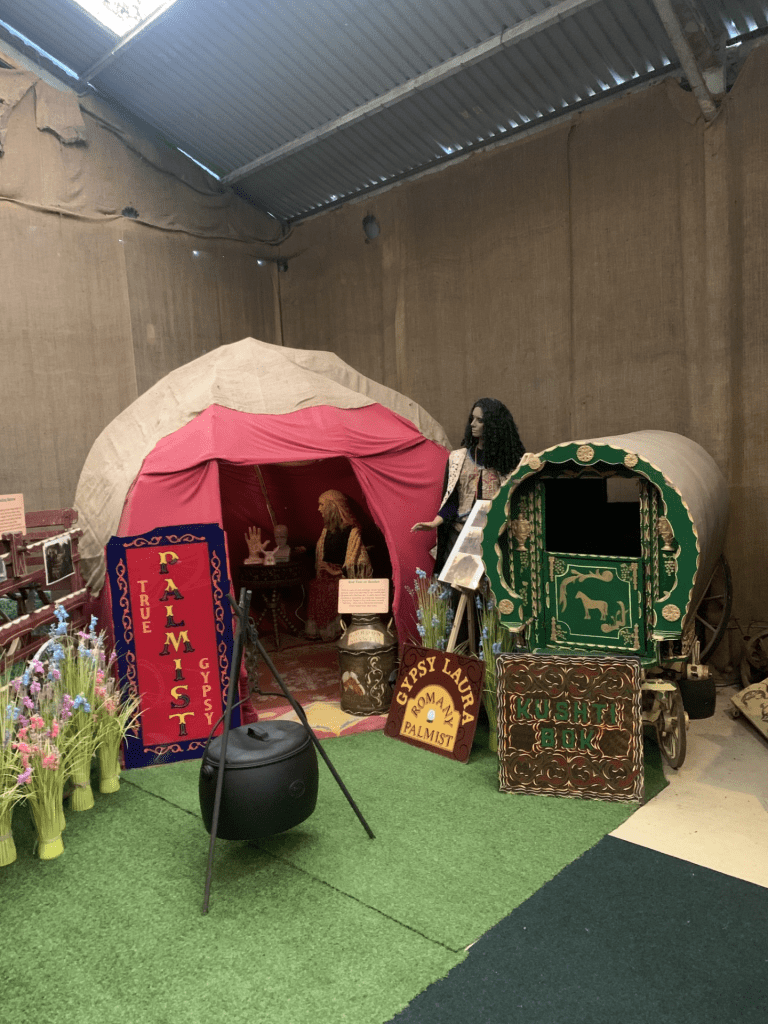
In April I visited the Gordon Boswell Romany Museum, museums in this country tend to operate under the guise of whiteness, but this one is different – it seems to be unapologetically and traditionally Romany.
The museum has an off grid feel to it, it appears after driving miles amongst countryside fields and if you would like to contact the museum staff, apparently telephone is best, not social media or email. This museum is also situated within what seems to be a Romany family home area and working scrapyard business. So even before entering the building, the culture of close family ties for building home and business that is outside of mainstream culture, are there.
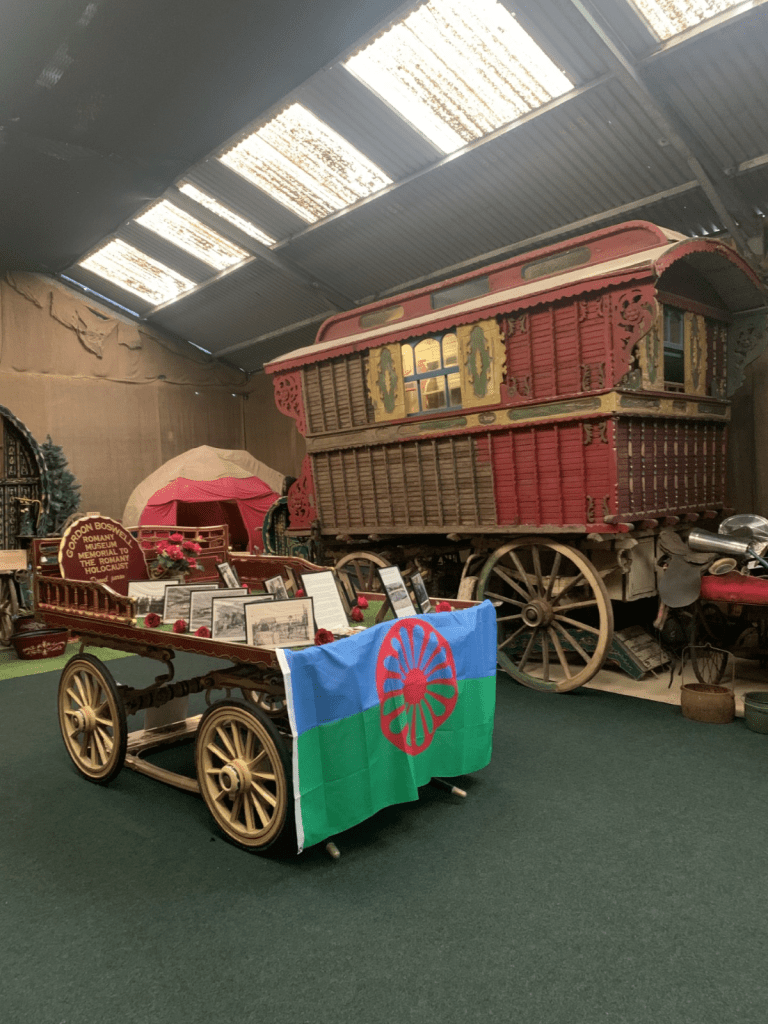
Inside the museum there are a variety of traditional Romany artefacts, which includes wagon, trailers, horse related items and handmade gifts, as well as other wagons curated by the owners and close contacts themselves. You will be pressed to find any written signage here, as in-line with tradition Romany history is passed on through verbal story telling. So if you want to know more about something you will need to ask those running the place, who are keen to have a chat with you.
I was surprised to see that the museum had a decent amount of visitors considering that this was a weekday and located in a lowly populated area in Spalding. The museum seems to be aimed at celebrating and illustrating traditions, instead of being motivated by profit. The visitors that were there also seemed to be touched by their visit, perhaps it is the attempt at preserving a traditional culture that has been under constant pressure, that makes this so meaningful. Or the memories of the past which the museum seems to hold onto.
Upon exiting the museum, seemingly Romany people pull up with a horse and cart near-by. A reminder of a slower paced yet hard working traditional life, where the outside world and mainstream culture does not matter so much as long as there is food on the table and supportive family near by. Although, I was left with more questions after the visit, such as where are the museums/spaces for other groups, such as Traveller culture? Where are the celebrations for more contemporary lives lived by Gypsy Roma and Traveller people?

This year the month in which I celebrated Romany culture the most was in April with a visit to The Gordon Boswell Romany Museum and I really did enjoy the visit. I have not done much to celebrate this month as I wonder – how do you to celebrate these specific History Month in a way that is meaningful and not performative?
Share this:


Birth Trauma
I recently passed through Rugby Motorway Services with my family and I was amazed by what was on offer. It consisted of a free internal and external play area and the most baby friendly changing rooms that I have ever encountered. This visit to the Rugby services made me think;
Isn’t it a shame that the same amount of family friendly consideration is not found elsewhere.
Even more so;
Isn’t it a shame that many babies, mothers and birthing parents are treated with such a common and serious violence during the birth
The Birth Trauma Inquiry has been published this week, I am sure that CRI3003 students would be able to critique this Inquiry but in terms of the responses from mothers who have experienced birth trauma it makes for an incredibly harrowing read.
In the words of one mother;
‘Animals were treated better than the way we were treated in hospital’ (p.26).
Yet, none of these accounts of violence are surprising; casual conversations with friends, family, relatives resemble many of the key themes highlighted within the inquiry. The inquiry includes accounts of mothers before, during and after birth being ‘humiliated’ (p.20) and bullied, experiencing extreme amounts of pain, financial ruin, life limiting physical and mental health problems, due to institutional issues raised such as: negligence, poor professional practice, mistakes, mix ups, lack of consent, inhumane treatment, lack of pain relief and compassion. With the most serious consequences being baby and or mother loss.
The report also makes reference to at least a couple of incidents involving mobile phone usage. This did remind me of a conversation that I was having with a fellow criminologist quite recently. Aside from issues that have existed for a long time, it seems that the use of phones may impact on our ability to work in a safe and compassionate manner. I am sure that some staff scroll on phones when victims of crime report to the police station, or scroll whilst ‘caring’ for someone who is either mentally or physically unwell. How such small technological devices seem to have such huge impact on human interaction amazes me.
A quote from the inquiry states: ‘the baby is the candy, the mum is the wrapper, and once the baby is out of the wrapper, we cast it aside’ (p.20), how awful is that?
All-Party Parliamentary Group. Listen to Mums: Ending the Postcode Lottery on Perinatal Care (2024). Available at: https://www.theo-clarke.org.uk/sites/www.theo-clarke.org.uk/files/2024-05/Birth%20Trauma%20Inquiry%20Report%20for%20Publication_May13_2024.pdf [Accessed 16/05/24].
Share this:


Witches, Broomsticks and Libraries
My son has been gifted and collected many delightful children’s books since his recent birth. A book which stands out to me on Women’s History Month is: Room on the Broom (2001) by writer Julia Donaldson and Illustrator Axel Scheffler.
Aside from the fabulous use of words and illustrations, the main character of the story is a lovely witch who makes room on her broom for her cat, a dog, bird and frog. The latter part of the story consists of the broom snapping, presumably due to the extra weight of these passengers, then the witch risks being eaten by a dragon. But eventually all is well as the witch creates a new super broomstick with;
seats for the witch
and the cat and the dog,
a nest for the bird and
a shower for the frog.

This book’s depiction of the witch as a morally good character is wonderful but this is not usual. In popular culture, such as fiction, television and film witches seem to have flawed character traits, are morally bad cackling devious women who fly about casting spells on poor and (un/)suspecting folk.
The negative connotations of witches today reflect a long dreadful real-life history of outsiders being accused of being witches – with some being tortured and murdered due to this. The outsiders aka witches tended to be women, women who were providing a service for other women, such as support during childbirth or healing practices, or those that practice spiritualisms that differ to dominant religions. If re-born today some of these women may have been celebrated as midwifes and nurses, although their wages and workloads would still illustrate that predominantly women centered roles tend to be under appreciated.
On International Women’s Day I finished reading Disobedient Bodies (2023) by Emma Dabiri. Disobedient Bodies reminds me about how in a white capitalist cis male world bodies categorised as female and women are constructed as deviant. Proof of being a witch was apparently not just found in practices but on the bodies of women. Emma Dabiri adds to the discussion on witches that I did not consider; that groups of women aka groups of deviant witches were considered to be the most threatening to witch hunters. For a long time women have been pitted against each other, the historical nature of women meeting in groups to support each other as a threat to patriarchal capitalist white systems has added to this.
My son is very privileged to have so many book at the age of 1. Unfortunately I am writing during a time where there are threats to close 25 libraries in Birmingham. Notably, the libraries that me and my son frequent consist of mostly women staff (both paid and volunteers). In addition to the potential for job losses, if this happens there will be babies, children and adults without access to books, artistic classes, warm and safe spaces. To quote my friend and colleague, “soon there will be nothing left”.
Share this:


Christmas Toys

In CRI3002 we reflected on the toxic masculine practices which are enacted in everyday life. Hegemonic masculinity promotes the ideology that the most respectable way of being ‘a man’ is to engage in masculine practices that maintain the White elite’s domination of marginalised people and nations. What is interesting is that in a world that continues to be incredibly violent, the toxicity of state-inflicted hegemonic masculinity is rarely mentioned.
The militaristic use of State violence in the form of the brutal destruction of people in the name of apparent ‘just’ conflicts is incredibly masculine. To illustrate, when it is perceived and constructed that a privileged position and nation is under threat, hegemonic masculinity would ensure that violent measures are used to combat this threat.
For some, life is so precious yet for others, life is so easily taken away. Whilst some have engaged in Christmas traditions of spending time with the family, opening presents and eating luxurious foods, some are experiencing horrors that should only ever be read in a dystopian novel.
Through privileged Christmas play-time with new toys like soldiers and weapons, masculine violence continues to be normalised. Whilst for some children, soldiers and weapons have caused them to be victims of wars with the most catastrophic consequences.
Even through children’s play-time the privileged have managed to promote everyday militarism for their own interests of power, money and domination. Those in the Global North are lead to believe that we should be proud of the army and how it protects ‘us’ by dominating ‘them’ (i.e., ‘others/lesser humans and nations’).
Still in 2023 children play with symbolically violent toys whilst not being socialised to question this. The militaristic toys are marketed to be fun and exciting – perhaps promoting apathy rather than empathy. If promoting apathy, how will the world ever change? Surely the privileged should be raising their children to be ashamed of the use of violence rather than be proud of it?
Share this:


In Praise of Howard S. Becker (1928-2023)

Three months ago, Howard S. Becker died at the age of 95, some of the Criminology Team reflect below on his impact.
I re-read Becker’s Outsider’s during the covid-19 pandemic. It reminded me of how Becker’s critical take on criminology helped me to understand and articulate the world in which I grew up in. Yes, street crime happens, and yes it causes victims to suffer but street crime seemed to be a survival response from the powerless aka ‘the deviants’ who were oppressed by the disciplining State and its police force. Becker’s work must have been groundbreaking at the time that it was published, and it continues to resonate within more contemporary critical theories surrounding intersectional oppressions that I am most interested in today…what a game changer!
@haleysread
I first encountered Becker’s (1963) Outsiders as an undergraduate, since then I have revisited many times. The book and the ideas within are so well-written, so accessible, allowing the reader to see criminality and criminal justice from an entirely different perspective. Although profound, it is not this Becker text which is closest to my heart, for that we go to 1967 and the publication of his article ‘Whose Side Are We On?‘ It is this succinct piece of writing that allowed me to understand that criminologists can never be neutral, they have to take a side. Furthermore, they must always be on the side of the powerless and never the powerful. The Criminal Justice System [CJS] and all of the agents within it, are working within and for the State and thus have plenty of supporters. Individuals in their engagement with the CJS, do not have the same support or protection, they are always outnumbered and out resourced. If we truly want to gain a holistic understanding of deviance and criminality, Becker (1967) is very helpful.
Alongside, his writing around crime and deviance, Becker also identifies the importance of language and writing style, to research practice. In Writing for Social Scientists (1986) and Tricks of the Trade (1998) and Telling About Society (2007) offers clear, practical guidance and comfort for uncertain scholars (whatever level of study).
Finally, we need to mention Becker’s music, his beloved jazz which provides the soundtrack to a scholarly life well lived, which means you can study his life’s work (both written and aural) simultaneously. A unique man, whose impact will be felt by criminologist and other social scientists for a very long time.
@paulaabowles
In 2006, during my undergraduate studies in sociology, I was introduced to Howard Becker’s labelling theory. While it marked a significant departure from the traditional explanation of deviance, it sparked lively debates among my peers. I distinctly recall vehemently opposing the theory’s practical application in Nigeria, my home country. Some of my peers argued passionately, citing numerous examples of deviance, including instances of crimes of the powerful. They contended that corruption and the misappropriation of public funds in Nigeria were products of eroding social values, driven by immense societal pressure on political officeholders to maintain an image of ‘big men.’ No doubt, Becker had a point on this and despite my initial reservations about labelling theory, Becker’s scholarly contributions have undeniably been influential in shaping both my sociological imagination and my criminological lenses. So long to a respected scholar!
@sallekmusa
It is impossible to list eminent criminologists without at least giving a nod to Howard Becker, although I would suggest a nod is far from sufficient. Becker it seems to me had the ability to write meaningful texts that could be understood by all. Of course his narrative in Outsiders is a product of its time but much of it is still applicable today. I first read Outsiders as part of my undergraduate degree and much of resonated and yet as with all great work, it doesn’t explain everything. What it does though is provide a very different perspective on deviance and society as a whole. In his later work Becker discussed labelling stating it wasn’t a theory. Well worth returning to the book then just to understand that statement alone.
@5teveh
This August 16, 2023, Howard Becker died. He was a 95 years old social scientist/sociologist (depending on who you will ask) with a long and significant legacy on his tome of work. My colleagues above predictably chose Outsiders as representative sample of his work. Not surprising really considering this was one of his seminal pieces of work that articulated the basis of theories that sociologists, criminologists and other social scientists based their own theories and understanding on social reality. His work on labelling theory became a significant influence on criminologists who tried to understand the relationship between postmodernity and deviance. It comes as no surprise that his influence to those who followed him in academia was so important.
What I thought most fitting was to concentrate on one of his latest papers written a few years ago when he was 91. In the midst of the pandemic with the lockdown and the great uncertainty it ensued Howard retreats to what he knows best; to be a social scientist and contextualise his observations the best way he knows. The paper in a praise of neighbourhood spirit and collective consciousness under the guise of urban sociology. Howard Becker is very reflective of his location, the history of the place and its social development and it is a testament of the importance of interactionism and positionality.
Using personal experience his paper “In San Francisco, when my neighborhood experiences pandemics” Becker retains his criticality as a social scientist, using observations and personal narratives to humanise an inhuman and repressive situation. People around him become actors in the crisis especially to those who as more in need and his impressions give us a snapshot of the time. In his own words “Those of us who do social science to be ready to observe life around us” a legacy to all of us that social situations continuously challenge us to explore things differently. That is because “social life does the experiment for us”. One of his last lessons on “life goes on” is so important to the sociology of everyday life.
This paper may not have the significance of some of his earlier work but it is a testament of what a restless mind can produce. He was able to record a situation that in years, decades to come, people will write about it and its impact. Yet, despite his age, his writing remained fresh, current and relevant. In academic terms he was the eternal teenager. Solon of Athens once said “Γηράσκω αεί διδασκόμενος” “I grow old while always learning” projecting that the pursue of knowledge is continuous and lifelong. In Howard Becker this seemed to have been the case. Thank you for your company all those years in the libraries, the seminars, the essays that we read you, thought of your ideas and talk about them. Goodbye to the social scientist, the thinker, the philosopher, the person.
@manosdaskalou

 Thoughts from the criminology team