
Home » Articles posted by aysheaobrien1ca0bcf715
Author Archives: aysheaobrien1ca0bcf715

The Caracas Job: International Law and Geo-Political Smash and Grab

So, they actually did it, eh?
It’s January 2026, and I, for one, am still trying to remember my work logins and wondering if this is the year that Aliens invade Earth. Yet, across the pond, the Americans have decided to kick off the New Year with a throwback classic: decapitating a sovereign Latin-American government.
Adiós Maduro. We hardly know yer pal. Well, we all knew you enough to know you were a disastrous authoritarian kleptocrat who managed to bankrupt a country sitting on a lake of oil. But we need to talk about how it happened, because if you listen carefully enough to the wind wuthering through the empty corridors of the UN Building in New York, you can probably hear the death rattle of what I once studied and was quaintly entitled, ‘Rules-Based International Order’-aka International Law.
As one colleague and our very own Dr Manos Daskolou pointed out to me this very day, it’s almost eighty years since 1945. Eight decades of pretending we built a civilised global architecture out of the ashes of World War II. We built tribunals in The Hague, we wrote very sternly worded Geneva Conventions, and we created a Security Council where superpowers could veto each other into paralysis. It was a lovely piece of Geo-Political theatre.
The days-old removal of the Venezuelan head of state by direct US intervention isn’t just a deviation from the norm: it’s a flagrant breach of the foundational prohibition on the ‘use of force’ found in Article 2(4) of The UN Charter. The mask has slipped, and underneath it is just raw, naked power.
As a Brit observing this rigmarole from the very cold and soggy sidelines, it’s hard not to view this from a very specific lens. We invented modern imperialism, after all. Criminologists will often discuss concepts like State Crimes. They will often question who indeed polices the Police?
If I decide to kick down my neighbour’s door because I don’t like the way she runs her household, steal her assets and install her sister as the new head of the family, I’m going to court. I am a burglar, a thug and a violent criminal. If a superpower does the same thing to a sovereign nation, they get a press conference at Mar-a-Lago.
For eighty years, the West has been incredibly successful at labelling its own interventions as ‘police actions’ or ‘humanitarian missions’, all the while labelling acts of rivals as ‘aggression’. The Caracas job is the ultimate expression of this.
Listen to the rhetoric coming out of Washington right now. It’s textbook gaslighting. ‘Maduro was a tyrant’, ‘Other countries do worse’, i.e condemning the condemners. They certainly are not arguing that entry into Caracas was legal under the UN Charter was legal because it most definitely wasn’t. They are arguing that the law should not apply to them because their intentions were pure.
Deja Vu-Iraq
The darkest irony of the Venezuelan decapitation is the crushing sense of deja vu. We cannot talk about removing a dictator in the 2020s without flashbacks to Saddam Hussein and Dr David Kelly entering the scene. The parallels are screaming at us. In 2003, the justification for taking Saddam (and, sadly, Dr Kelly as a direct result) out was a cocktail of WMD lies and dangerous rhetoric. As the Chilcot Report stated years ago, the legal basis for military action against Iraq was ‘far from satisfactory’.
The critical failure in Iraq and the one we are doomed to repeat in Venezuela is that it is terrifyingly easy for a superpower like the USA to smash a second-rate military. The hard part is what on earth comes next?
Perhaps it would have been better for the superpowers to manipulate Maduro’s own people, taking him out, so to speak. Organic change in any situation lends legitimacy that enforced or imported change never does. When you decapitate a state at 30,000 feet, you create a vacuum. The USA may have created a dependency, effectively violating the principle of self-determination, which is enshrined in the Human Rights Convention.
The Iranian Elephant In The Room
Of course, none of this is actually happening in a vacuum. Being a Yorkshire lass with Middle Eastern Heritage, I am keenly aware of the politics of the regions hitting the headlines on an almost daily basis. Yet, no one has to have bloodline ties to any of the countries or regions involved to see the obvious Elephant in the room. It’s that flipping obvious. Maduro wasn’t just an irritant because of his economy-crashing style. It was a strategic flipping of the bird for America’s rivals-Crucially, Iran. This is where the narrative gets even darker. This is gang warfare.
The danger here is escalation. If Tehran decides that the fall of Maduro constitutes a direct challenge to its own deterrence strategy, it will not retaliate in the Caribbean. They are likely (if history has taught us anything) to retaliate in the Strait of Hormuz. The butterfly effect of a regime change in Caracas could easily result in the closure of the Suez Canal. Yes, that old chestnut.
The old guard loved International Law. They loved it because they knew how to manipulate it. They used the UN Council like a skilled Barrister uses a loophole. They built coalitions. The current approach-Let’s call it ‘Act Now Think Later Diplomacy’ dispenses with the formalities and paperwork. It sees International Law NOT as a tool to be manipulated, but as an annoying restraint to be ignored. It confirms the narrative that the Nuremberg trials were merely ‘Victors’ Justice’, a system where legal accountability is the privilege of the defeated.
The difference between Putin invading Ukraine and the USA decapitating Venezuela is rapidly becoming a distinction without a difference.
So, here we go in 2026. The powerful have shown they don’t give a toss about the rules. They’ve shown that ‘sovereignty’ is just a word they use in speeches, not really a word they respect.
When people stop believing in the legitimacy of the law, they usually stop following it. We are about to see what happens when the entire world stops believing in the legitimacy of International Law.
It is going to be a messy few decades. Cheers, mine’s a double.
Share this:

Festive Frights

The festive season is almost upon us, and for many of us this means a well-deserved break! As the calendar wraps up and the holidays beckon, why not give your criminological mind a holiday, too? It’s the perfect opportunity to let your imagination soar and dive headfirst into the thrilling world of paranormal fiction.
Taking a temporary step away from cold, hard facts allows us to explore narratives that defy easy explanation, using different parts of our investigative minds. This shift from reality to the realm of the supernatural can be a refreshing break and a wonderful way to recharge before heading into a new year.
This year, something spooky happened! The core mission of the Kids’ Criminology Club, which focuses on expanding knowledge, logic, deduction, and evidence, was temporarily suspended. For a one-off Halloween-esque special, the club transformed into the Kids Paranormal Club.
I am a senior lecturer in Law with a keen interest in the paranormal, and I took our young investigators on a journey into the inexplicable. Together, we explored theories such as the Stone Tape Theory and shared accounts of supernatural phenomena. Following our fascinating session, I challenged the kids to channel their inner storytellers and enter a paranormal story writing competition, with a strict limit of no more than 500 words. The results were chilling, creative, and certainly a departure from Criminology and the Law! All entries, including the winning entry, can be found below.
As you settle in for your holiday break, we hope you’ll find inspiration in these young authors’ terrifying tales. Whether you’re investigating a fictional haunting or simply enjoying a peaceful evening, remember to let your mind wander beyond the police tape and evidence markers. Enjoy the comfort and quiet, and maybe keep an ear out for any strange sounds in your own home…
And finally, while you’re enjoying the comfort and safety of the season and your well-earned break from reality, spare a thought for those who may be facing their own real-life terrors, or simply without the security, warmth, company and peace we often take for granted at Christmas time.
🏆 The Winning Stories
Here are those standout entries that captured our imaginations and sent shivers down our spines.
🥇 Winner: The Radio in Number 13 by Paisley G., age 10
9th October 1967 11:00 pm I have been prompted to start this journal because of an experience I have had in which I don’t feel safe, so I am creating this just in case. My first experience was at night. I was listening to the radio like I always do before bed, there was some show on, I wasn’t really listening; I never really listen, it was just something to do, I suppose. I’m sitting at my desk when I hear footsteps. I live alone and don’t have any pets, that’s when I realised the voices had stopped with a shocking realisation. I knew that the footsteps were coming from the radio. It sounded like heavy boots on stone. I live in a large house with a stone road leading up to the front door. There was a static noise and then the voices were back. I was unsettled but didn’t think much about it. My wife had died only a couple of weeks ago, and I had an odd feeling that they were connected somehow. She was a lovely woman,n and she used to always wear a pair of big black boots.
10th October 1967 11:00 pm Slept uneasy last night – I had a nagging feeling of not being alone. I went about my usual business as normal and had the same experience again: same time, same show, same footsteps.
11th October 1967 11:00 pm Uneasy sleeping again. In the morning, when I left my house, I saw my neighbour Lucy. She is usually a lovely old lady, but when I walked past he house, she ran outside and grabbed me by the hands, looked right into my eyes and said ‘Don’t do it! Don’t open the door! They’re coming!’ Then she ran back inside. It was unsettling, but again didn’t think much of it. The noises were different tonight, footsteps and again they stopped, and I thought the talking would start again, but no, not yet there was the sound of knocking on a door, then it cut back to the show.
12th October 1967 11:00 pm Decided to test it tonight I don’t know what made me do it, but I left the front door open, brought the radio down and sat on a chair by the door. The old lady’s words were ringing in my head, but I had a weird feeling of wanting to prove her wrong. I turned on the radio there was more knocking th-
3:41 am I woke up in my bed, confused about what happened. I ran downstairs to check the door, but it was closed, the chair back in its place, the radio on my desk, as if it had never happened.
13th October 1967 I just turned on the radio the footsteps were going upstairs. They stopped, then the sound of a door rattling my my my door is being shaken help help please pleas ple-
Note from the doctor: The subject had no apparent injuries; they just… died.
Note from the builder: The walls have a trace of a type of mould that could lead to possible madness.
Ghost Mary by Riddhi P., age 11
Fourteen-year-old Isabel Smith and her best friend Anna Hazel live in Riverbend town. Isabel’s twin sister Mary had died two years ago from mysterious reasons, but when Isabel and Anna begin getting chilling messages from her, they find out, she had been taken by wicked blood ghosts that can only take souls on the Day of the Dead! The girls discover a book that says they may be able to bring Mary back by going to the ghost underworld. Desperate, the girls decide to do a ritual that can teleport them to the ghost world! They lit one hundred candles in a perfect circle,e and they both sat in the middle and whispered the forbidden words. When Isabel opened her eyes, she wasn’t in her room anymore; she was in a dark, gloomy place that looked like a graveyard. Fog pressed her skin, whispering, never lifting. Isabel and Anna looked around when Isabel froze. Her heart stopped! Mary was standing just a couple of feet away from them! Mary’s face looked white, her eyes were a pit of black, her clothes were torn and filthy, a black mist surrounded her body. Mary opened her mouth to say something, but before she could, the girls grabbed her hand and pulled her in the circle of candles. “We have to chant the forbidden words backwards fifteen times,” they told her. They began chanting the words once, twice, three times…. “Wait! We have to get the book and burn it, or the blood ghosts will be able to take me and many others again,” cried Mary. Anna dashed to grab the book, but in the shadows, she saw something terrifying – the blood ghosts! Their hollow eyes oozing blood staring at her, their skeleton hands reaching out trying to catch her. Anna grabbed the book and ran towards the circle where Isabel’s voice trembled as she started to chant the words for the tenth time. “Quick, burn the book!” yelled Mary. Just then, the blood ghosts lunged at them and grabbed Mary’s arm. Mary screamed; they were pulling her away from them! Isabel quickly grabbed Mary and dragged her back into the circle. As soon as she did, Anna threw the book in the flames. There was a gust of wind, a ball of energy cloaked the circle of candles like a shield, and the blood ghosts screamed in agony, fading to dust. Isabel finished chanting, the world flippe,d and they were back in Isabel’s room. “What just happened?” Whispered Mary. “It’s over. We’re home!” answered Isabel. They hugged. No more blood ghosts, underworlds or magic words. They were safe. Or were they?.
The Towers of Terror by Quinn G., age 12
Welcome to the Towers of Terror annual story release. Ok, I’m hoping you know what the stone tape theory is. If not, here is a quick rundown: basically, it is the theory that buildings or places have a memory and can replay it, hence ghosts. But what happens at sea? Well, I can tell you that they go to the nearest lighthouse house which then replays them through its beam, and it’s my job to tell the world the stories of wrecked ships, crashed planes and fallen sailors.
Southwold Lighthouse, Norfolk 31/10/2020 Keeper John 12:30 am I’m in for a night tonight with it being Halloween and all. 6:00 pm, just some light activity, a couple of fishing boats, S.S.Mary, an unnamed skipper, a rowboat and a cliff jumper who didn’t want to come to the surface. 7:00 pm, it’s weird that the projections have just stopped. 7:30 pm still nothing. Wait! It is back. No. It’s me, I’m on shore – wait – I’m crumpling to the ground, there is a figure behi-
That’s where his lighthouse log ends, when his colleague went up to take over and found him dead with his pen still clutched in his hand. It is not unusual for things to creep out of the projections. That is why he was there in the first place, to monitor the lighthouse. Even though it is not in operation for ships, you can’t have all those stories building up in such a small space because they will find a way out. But what happened that night was different. Never before has one of the projections interacted with the world outside the projections. There are several other accounts that all go the same way: projections stop, they start again, you see yourself crumble to the floor, and … dead, so we can’t just have people dropping like flies, someone will notice! But if we leave them unattended, they will cause more destruction. So, what would you do? Well, I will tell you what I did/am doing. Finding what came out and how to stop it from coming out again.
That was 5 years ago, and now I can bring you up to date: The entity that was coming out of the projections is now known as the Siren Reaper of the drowned and lost and cannot be explained away. Believe me, I’ve tried, but to no avail. Now to get on to the solution: the one thing that connects the deaths of those keepers was that they had all had a connection with the se, old captains, anglers, sea goers and other jobs that are to do with the sea. After years of contemplation, I have a theory. I think that the Reaper has killed these people because it thinks that they have escaped from it. The solution is to make the keepers not connected with the sea, because then the Reaper will have no business with them. But this does not explain why the projections just stop beforehand, or why the Reaper shows them their death….
Share this:


UK Justice v The Demonic and Others

The sanctity of a civilised court room demands rationality, but the laws of the distant and not so distant past in this jurisdiction are entrenched in the uncanny. Rules safeguarding the impartiality of the jury are grim “wards” against the spiritual chaos that once dictated verdicts. The infamous case of the Ouija Board jurors, aka R v Young[i] only thirty years ago is not merely a legal curiosity: it is a modern chilling echo of a centuries old struggle defining the judiciary’s absolute commitment to a secular process that refuses to share its authority with the spectral world. The ancient rule, now applied to Google and the smartphone, has always been simple: the court cannot tolerate a decision derived from an unvetted external source.
When Law Bowed To The Supernatural-Ancient Past?
For millennia, the outcome of a criminal trial in Britain was terrifyingly dependent on the supernatural, viewing the legal process as a mechanism for Divine Judgement[ii]. The state feared the power of the otherworldly more than it trusted human evidence.
Prior to the 13th century, the determination of guilt was not based on evidence but on the Judicium Dei [iii](Judgement of God). The accused’s fate lay not with the court but with the elements of the earth itself.
The Ordeal of Hot Iron: The accused would carry a piece of red-hot iron. If their subsequent wound was judged “unclean” after three days-a sign of God withholding his grace-the accused was condemned to death. The burden of proof was literally placed upon a miracle.
The Ordeal of Cold Water: This was an essential test in early witch-finding. If the bound accused floated, the pure water was thought to reject them as impure agents of the Devil, condemning them as guilty. The collapse of these ordeals after the Fourth Lateran Council in 1215 was the first, forced act of separation between the secular law and the spiritual realm, necessitating the creation of a human, rational jury[iv]
Legislating against the Demonic: The Witchcraft Acts
Even after the rise of the jury, the judiciary was consumed by the fear of the demonic. The Act against Conjuration, Witchcraft and dealing with evil and wicked Spirits 1604 (1 Jas.4 1. c. 12)[v] made contacting the demonic a capital felony, ensuring that the courtroom remained a battleground against perceived occult evil.
The Pendle Witch Trials (1612): This event is a spectral stain on UK legal history. Ten people were executed based on testimony that included spectral evidence, dreams, and confessions extracted under duress. The judges and juries legally accepted that the Devil and his agents had caused tangible harm. The failure to apply any rational evidential standards resulted in judicial murder.[vi]
Even the “rational” repeal in the Witchcraft Act 1735 (9 Geo. 2. c. 5),[vii] which only criminalised pretending to use magic (fraud), haunted the system. The prosecution of medium Helen Duncan in 1944 under this very Act, for deceiving the public with her spiritualist services, demonstrated that the legal system was still actively policing the boundaries of the occult well into the modern era, fearful of supernatural deceit if not genuine power.
The Modern Séance: R v Young and the Unholy Verdict
The 1994 murder trial of Stephen Young[viii], accused of the double murder of Harry and Nicola Fuller, brought the full weight of this historical conflict back into the spotlight. The jury, isolated and burdened with the grim facts of the case, succumbed to an uncanny primal urge for absolute certainty.
The jury had retired to a sequestered hotel to deliberate the grim facts of the double murder.During a break in deliberations on the Friday night, four jurors initiated a makeshift séance in their hotel room. They used paper and a glass to fashion a crude Ouija board, placing their life-altering question to the “spirits” of the deceased victims, Harry and Nicola Fuller.
The glass, according to the jurors’ later testimony, moved and chillingly spelled out the words “STEPHEN YOUNG DONE IT.”
The Court of Appeal, led by Lord Taylor CJ, ruled that the séance was a “material irregularity” because it took place outside the official deliberation room (in the hotel). This activity amounted to the reception of extrinsic, prejudicial, and wholly inadmissible evidence after the jury had been sworn. The verdict was quashed because a system based on proof cannot tolerate a decision derived from ‘the other side’
The core rule remains absolute: the verdict must be based only on the facts presented in court. The modern threat to this principle is not possession by a demon, but digital contamination, a risk the law now treats as functionally identical to the occult inquiry of 1994.
The Digital Contamination: R v Karakaya[ix]
The Criminal Justice and Courts Act 2015 (CJCA 2015) was the formal legislative “ward” against the digital equivalent of the séance.
The New Medium: In the 2018 trial of Huseyin Karakaya, a juror used a mobile phone to research the defendant’s previous conviction. The smartphone became the unauthorised medium. The Legal Equivalence: The Juries Act 1974, s 20A (inserted by CJCA 2015)[x] makes it a criminal offence for a juror to intentionally research the case. In the eyes of the law, consulting Google for “defendant’s past” is legally equivalent to consulting a ghost for “who done it.” Both are dangerous acts of unauthorized external inquiry.
The Court of Appeal, in R v Karakaya quashed the conviction because introducing external, inadmissible evidence (like a prior conviction) created a real risk of prejudice, fundamentally undermining the fair trial principle raised in Young.
The lesson of the Ouija Board Jurors and the digital contamination in R v Karakaya is a chilling warning from the past: the moment the courtroom accepts an external, unverified source—be it a spirit or a search engine—the entire structure of rational justice collapses, bringing back the judicial catastrophe of the Pendle Trials. In 2025, the UK criminal justice system continues to fight the ghosts of superstition, ensuring the verdict is determined by the cold, impartial scrutiny of the facts.
[i] R v Young [1995] QB 324
[ii]R Bartlett, Trial by Fire and Water: The Medieval Judicial Ordeal (Oxford University Press 1986). (https://amesfoundation.law.harvard.edu/lhsemelh/materials/BartlettTrialByFireAndWater.pdf)
[iii] J G Bellamy, The Criminal Law of England 1066–1307: An Outline (Blackwell 1984) p42
[iv] Margaret H. Kerr, Richard D. Forsyth, Michael J. Plyley
The Journal of Interdisciplinary History, Vol. 22, No. 4 (Spring, 1992), pp. 573-595
[v] https://archives.blog.parliament.uk/2020/10/28/which-witchcraft-act-is-which/
[vi] https://www.historic-uk.com/CultureUK/The-Pendle-Witches/
[vii] Witchcraft Act 1735 (9 Geo. 2. c. 5) https://statutes.org.uk/site/the-statutes/eighteenth-century/1735-9-george-2-c-5-the-witchcraft-act/
[viii] R v Young [1995] QB 324
[ix] R v Karakaya[ 2020] EWCA Crim 204
[x]The Juries Act 1974, s 20A https://www.legislation.gov.uk/ukpga/1974/23/section/20A
Share this:

LET THEM EAT SOUP

Introduction
What is a can of soup? If you ask a market expert, it is a high-profit item currently pushing £2.30 (branded) in some UK shops[i]. If you ask a historian[ii], it is the very bedrock of organised charity-the cheapest, easiest way to feed a penniless and hungry crowd.
The high price of something so basic, like a £2.30 can of soup, is a massive conundrum when you remember that soup’s main historical job was feeding poor people for almost nothing. Soup, whose name comes from the old word Suppa[iii](meaning broth poured over bread), was chosen by charities because it was cheap, could be made in huge pots, and best of all could be ‘stretched’ with water to feed even more people on a budget[iv].
In 2025, the whole situation is upside down. The price of this simple food has jumped because of “massive economic problems and big company greed[v]. At the same time, the need for charity has exploded with food bank use soaring by an unbelievable 51% compared to 2019[vi]. When basic food is expensive and charity is overwhelmed, it means our country’s safety net is broken.
For those of us who grew up in the chilly North, soup is more than a commodity: it is a core memory. I recall winter afternoons in Yorkshire, scraping frost off the window, knowing a massive pot of soup was bubbling away. Thick, hot and utterly cheap. Our famous carrot and swede soup cost pennies to make, tasted like salvation and could genuinely “fix you.” The modern £2.30 price tag on a can feels like a joke played on that memory, a reminder that the simplest warmth is now reserved for those who can afford the premium.
This piece breaks down some of the reasons why a can of soup costs so much, explores the 250-year-old long, often embarrassing history of soup charity in Britain and shows how the two things-high prices and huge charity demand-feed into a frustrating cycle of managed hunger.
Why Soup Costs £2.30
The UK loves its canned soup: it is a huge business worth hundreds of millions of pounds every year[vii], but despite being a stable market, prices have been battered by outside events.
Remember that huge cost of living squeeze? Food inflation prices peaked at 19.1% in 2023, the biggest rise in 40 years[viii]. Even though things have calmed down slightly, food prices jumped again to 5.1% in August 2025, remaining substantially elevated compared to the overall inflation rate of 3.8% in the same month[ix]. This huge price jump hits basic stuff the hardest, which means that poor people get hurt the most.
Why the drama? A mix of global chaos (like the Ukraine conflict messing up vegetable oil and fertiliser supplies) and local headaches (like the extra costs from Brexit) have made everything more expensive to produce[x].
Here’s the Kicker: Soup ingredients themselves are super cheap. You can make a big pot of vegetable soup at home for about 66p a serving, but a can of the same stuff? £2.30. Even professional caterers can buy bulk powdered soup mix for just 39p per portion[xi].
The biggest chunk of that price has nothing to do with the actual carrots and stock. It’s all the “extras”. You must pay for- the metal can, the flashy label and the marketing team that tries to convince you this soup is a “cosy hug”, and, most importantly everyone’s cut along the way.
Big supermarkets and shops are the main culprits. They need a massive 30-50% profit margin on that can for just putting it on the shelf[xii]. Because people have to buy food to live (you can’t just skip dinner) big companies can grab massive profits, turning something that you desperately need into something that just makes them rich.
This creates the ultimate cruel irony. Historically, soup was accessible because it was simple and cheap. Now, the people who are too busy, too tired or too broke to cook from scratch-the working poor are forced to buy the ready-made cans[xiii]. They end up paying the maximum premium for the convenience they need most, simply because they don’t have the time or space to do it the cheaper way.
How Charity Got Organised
The idea of soup as charity is ancient, but the dedicated “soup kitchen” really took off in late 18th century Britain[xiv].
The biggest reasons were the chaos after the Napoleonic wars and the rise of crowded industrial towns, which meant that lots of people had no money if their work dried up. By 1900 England had gone from a handful of soup kitchens to thousands of them[xv].
The first true soup charity in England was likely La Soupe, started by Huguenot refugees in London in the late 17th Century[xvi]. They served beef soup daily-a real community effort before the phrase “soup kitchen” was even popular.
Soup was chosen as the main charitable weapon because it was incredibly practical. It was cheap, healthy and could be made in enormous quantities. Its real superpower was that it could be “stretched” by adding more water allowing charities to serve huge numbers of people for minimum cost[xvii].
These kitchens were not just about food; they were tools for managing poor people. During the “long nineteenth century” they often fed up to 30% of a local town’s population in winter[xviii]. This aid ran alongside the stern rules of the Old Poor Laws which sorted people into “deserving” (the sick or old) and the ‘undeserving’ (those considered lazy).
The queues, the rules, and the interviews at soup kitchens were a kind of “charity performance” a public way of showing who was giving and who was receiving, all designed to reinforce class differences and tell people how to behave.
The Stigma and Shame of Taking The Soup
Getting a free bowl of soup has always come with a huge dose of shame. It’s basically a public way of telling you “We are the helpful rich people and you are the unfortunate hungry one” Even pictures in old newspapers were designed to make the donors look amazing whilst poor recipients were closely watched[xix].
Early British journalists like Bart Kennedy used to moan about the long, cold queues and how staff would ask “degrading questions” just before you got your soup[xx]. Basically, you had to pass a misery test to get a bowl of watery vegetables, As one 19th Century writer noted, the typical soup house was rarely cleaned, meaning the “aroma of old meals lingers in corners…when the steam from the freshly cooked vegetables brings them back to life”[xxi].
For the recipient, the act of accepting aid became a profound assault on their humanity. The writer George Orwell, captured this degradation starkly, suggesting that a man enduring prolonged hunger “is not a man any longer, only a belly with a few accessory organs”[xxii]. That is the tragic joke here, you are reduced to a stomach that must beg.
By the late 19th Century, people started criticising soup kitchens arguing that they “were blamed for creating the problem they sought to alleviate”[xxiii]. The core problem remains today: giving someone a temporary food handout is just a “band-aid” solution that treats the symptom but ignores the real disease i.e. not enough money to live on.
This critique was affirmed during the Great Depression in Britain, when mobile soup kitchens and dispersal centres became a feature of the British urban landscape[xxiv]. The historical lesson is clear: private charity simply cannot solve a national economic disaster.
The ultimate failure of the system as the historian A.J.P. Taylor pointed out is that the poor demanded dignity. “Soup kitchens were the prelude to revolution, The revolutionaries might talk about socialism, those who actually revolted wanted ‘the right to work’-more capitalism, not it’s abolition[xxv]” They wanted a stable job, not perpetual charity.
Expensive Soup Feeds The Food Bank
The UK poverty crisis means that 7.5 million people (11% of the population) were in homes that did not have enough food in 2023/24[xxvi]. The Trussell Trust alone gave out 2.9 million emergency food parcels in 2024/2025[xxvii]. Crucially, poverty has crept deeper into the workforce: research indicates that three in every ten people referred to in foodbanks in 2024 were from working households[xxviii]. They have jobs but still can’t afford the supermarket prices.
The charities themselves are struggling, hit by a “triple whammy” of rising running costs (energy, rent) and fewer donations[xxix]. This means that many charities have had to cut back, sometimes only giving out three days food instead of a week[xxx]. The safety net in other words is full of holes.
The necessity of navigating poverty systems just to buy food makes people feel trapped and hopeless which is a terrible way to run a country[xxxi].
Modern food banks are still stuck in the old ways of the ‘deserving poor.’ They usually make you get a formal referral—a special voucher—from a professional like a doctor, a Jobcentre person, or the Citizens Advice bureau[xxxii].It’s like getting permission from three different people to have a can of soup.
Charity leaders know this system is broken. The Chief Executive of the Trussell Trust has openly said that food banks are “not the answer” and are just a “fraying sticking plaster[xxxiii].” The system forces a perpetual debate between temporary relief and systemic reform[xxxiv]. The huge growth of private charity, critics argue, just gives the government an excuse to cut back on welfare, pretending that kind volunteers can fix the problem for them[xxxv].
The final, bitter joke links the expensive soup back to the charity meant to fix the cost. Big food companies use inflation to jack up prices and boost profits. Then, they look good by donating their excess stock—often the highly processed, high-profit stuff—to food banks.
This relationship is called the “hunger industrial complex”[xxxvi]. The high-margin, heavily processed canned soup—the quintessential symbol of modern pricing failure—often becomes a core component of the charitable food parcel. The high price charged for the commodity effectively pays for the charity that manages the damage the high price caused[xxxvii]. You could almost call it “Soup-er cyclical capitalism.”
Conclusion
The journey from the 18th-century charitable pot to the 21st-century £2.30 can of soup shows a deep failure in our society. Soup, the hero of cheap hunger relief, has become too pricey for the people who need it most. This cost is driven by profit, not ingredients.
This pricing failure traps poor people in expensive choices, forcing them toward overwhelmed charities. The modern food bank, like the old soup kitchen, acts as a temporary fix that excuses the government from fixing the root cause: low income. As social justice campaigner Bryan Stevenson suggests, “Poverty is the parent of revolution and crime”[xxxviii]. No amount of £2.30 soup can mask the fact that hunger is fundamentally an issue of “justice,” not merely “charity”.
Fixing this means shifting focus entirely. We must stop just managing hunger with charity[xxxix] and instead eliminate the need for charity by making sure everyone has enough money to live and buy their own food. This requires serious changes: regulating the greedy markups on basic food and building a robust state safety net that guarantees a decent income[xl]. The price of the £2.30 can is not just inflation: it’s a receipt for systemic unfairness.
[i]Various Contributors, ‘Reddit Discussion on High Soup Prices’ (Online Forum, 2023) https://www.reddit.com/r/CasualUK/comments/1eooo3o/why_has_soup_gotten_so_expensive
[ii] Philip J Carstairs, ‘A generous helping? The archaeology of Soup Kitchens and their role in post-medieval philanthropy 1790-1914 (PhD Thesis, University of Leicester 2022) https://figshare.le.ac.uk/articles/thesis/A_generous_helping_The_archaeology_of_soup_kitchens_and_their_role_in_post-medieval_philanthropy_1790-1914/21187117?file=37564186
[iii] Soup – etymology, origin & meaning[iii] https://www.etymonline.com/word/soup
[iv] Philip J Carstairs, ‘A generous helping? The archaeology of soup kitchens and their role in post-medieval philanthropy 1790–1914’ (Summary, University of Leicester 2022)(https://figshare.le.ac.uk/articles/thesis/A_generous_helping_The_archaeology_of_soup_kitchens_and_their_role_in_post-medieval_philanthropy_1790-1914/21187117)
[v] ONS, ‘Food Inflation Data, UK: August 2025’ (Trading Economics Data) https://tradingeconomics.com/united-kingdom/food-inflation
[vi] The Trussell Group-End Of Year Foodbank Stats
https://www.trussell.org.uk/news-and-research/latest-stats/end-of-year-stats
[vii] GlobalData, ‘Ambient Soup Market Size, Growth and Forecast Analytics, 2023-2028’ (Market Report, 2023) https://www.globaldata.com/store/report/uk-ambient-soup-market-analysis/
[viii] ONS, ‘Consumer Prices Index, UK: August 2025’ (Summary) https://www.ons.gov.uk/economy/inflationandpriceindices
[ix] Food Standards Agency, ‘Food System Strategic Assessment’ (March 2023) https://www.food.gov.uk/research/food-system-strategic-assessment-trends-and-issues-impacted-by-uk-economic-condition
[x] Wholesale Soup Mixes (Brakes Foodservice) https://www.brake.co.uk/dry-store/soup/ambient-soup/bulk-soup-mixes
[xii] A Semuels, ‘Why Food Company Profits Make Groceries Expensive’ (Time Magazine, 2023) https://time.com/6269366/food-company-profits-make-groceries-expensive/
[xiii] Christopher B Barrett and others, ‘Poverty Traps’ (NBER Working Paper No. 13828, 2008) https://www.nber.org/system/files/chapters/c13828/c13828.pdf
[xiv] Philip J Carstairs, ‘A generous helping? The archaeology of soup kitchens and their role in post-medieval philanthropy 1790–1914’ (Summary, University of Leicester 2022)(https://figshare.le.ac.uk/articles/thesis/A_generous_helping_The_archaeology_of_soup_kitchens_and_their_role_in_post-medieval_philanthropy_1790-1914/21187117
[xv] Philip J Carstairs, ‘A generous helping? The archaeology of soup kitchens and their role in post-medieval philanthropy 1790–1914’ (Summary, University of Leicester 2022)(https://figshare.le.ac.uk/articles/thesis/A_generous_helping_The_archaeology_of_soup_kitchens_and_their_role_in_post-medieval_philanthropy_1790-1914/21187117
[xvi] The Soup Kitchens of Spitalfields (Blog, 2019) https://spitalfieldslife.com/2019/05/15/the-soup-kitchens-of-spitalfields/
[xvii] Birmingham History Blog, ‘Soup for the Poor’ (2016) https://birminghamhistoryblog.wordpress.com/2016/02/04/soup-for-the-poor/
[xviii] [xviii] Philip J Carstairs, ‘A generous helping? The archaeology of soup kitchens and their role in post-medieval philanthropy 1790–1914’ (Summary, University of Leicester 2022)(https://figshare.le.ac.uk/articles/thesis/A_generous_helping_The_archaeology_of_soup_kitchens_and_their_role_in_post-medieval_philanthropy_1790-1914/21187117
[xix] Journal Panorama, ‘Feeding the Conscience: Depicting Food Aid in the Popular Press’ (2019) https://journalpanorama.org/article/feeding-the-conscience/
[xx] Journal Panorama, ‘Feeding the Conscience: Depicting Food Aid in the Popular Press’ (2019) https://journalpanorama.org/article/feeding-the-conscience/
[xxi] Joseph Roth, Hotel Savoy (Quote on Soup Kitchens) https://www.goodreads.com/quotes/tag/soup-kitchens
[xxii] Convoy of Hope, (Quotes on Dignity and Poverty) https://convoyofhope.org/articles/poverty-quotes/
[xxiii] Philip J Carstairs, ‘A generous helping? The archaeology of soup kitchens and their role in post-medieval philanthropy 1790–1914’ (Summary, University of Leicester 2022)(https://figshare.le.ac.uk/articles/thesis/A_generous_helping_The_archaeology_of_soup_kitchens_and_their_role_in_post-medieval_philanthropy_1790-1914/21187117
[xxiv] Science Museum Group, ‘Photographs of Poverty and Welfare in 1930s Britain’ (Blog, 2017) https://blog.scienceandmediamuseum.org.uk/photographs-of-poverty-and-welfare-in-1930s-britain/
[xxv] AJ P Taylor, (Quote on Revolution) https://www.goodreads.com/quotes/tag/soup-kitchens
[xxvi] House of Commons Library, ‘Food poverty: Households, food banks and free school meals’ (CBP-9209, 2024) https://commonslibrary.parliament.uk/research-briefings/cbp-9209/
[xxvii] Trussell Trust, ‘Factsheets and Data’ (2024/25) https://www.trussell.org.uk/news-and-research/latest-stats/end-of-year-stats
[xxviii] The Guardian, ‘Failure to tackle child poverty UK driving discontent’ (2025) https://www.theguardian.com/society/2025/sep/10/failure-tackle-child-poverty-uk-driving-discontent
[xxix] Charity Link, ‘The cost of living crisis and the impact on UK charities’ (Blog) https://www.charitylink.net/blog/cost-of-living-crisis-impact-uk-charities
[xxxi] The Soup Kitchen (Boynton Beach), ‘History’ https://thesoupkitchen.org/home/history/
[xxxii] Transforming Society, ‘4 uncomfortable realities of food charity’ (Blog, 2023) https://www.transformingsociety.co.uk/2023/12/01/4-uncomfortable-realities-of-food-charity-power-religion-race-and-cash
[xxxiii] The Trussell Group-End Of Year Foodbank Stats
https://www.trussell.org.uk/news-and-research/latest-stats/end-of-year-stats
[xxxiv] The Guardian, ‘Food banks are not the answer’ (2023) https://www.theguardian.com/society/2023/jun/29/food-banks-are-not-the-answer-charities-search-for-new-way-to-help-uk-families
[xxxv] The Guardian, ‘Britain’s hunger and malnutrition crisis demands structural solutions’ (2023) https://www.theguardian.com/uk-news/commentisfree/2023/dec/27/britain-hunger-malnutrition->
[xxxvi] Jacques Diouf, (Quote on Hunger and Justice, 2007) https://www.hungerhike.org/quotes-about-hunger/
[xxxvii] Borgen Magazine, ‘Hunger Awareness Quotes’ (2024) https://www.borgenmagazine.com/hunger-awareness-quotes/
[xxxviii] he Guardian, ‘Failure to tackle child poverty UK driving discontent’ (2025) https://www.theguardian.com/society/2025/sep/10/failure-tackle-child-poverty-uk-driving-discontent
[xxxix] Charities Aid Foundation, ‘Cost of living: Charity donations can’t keep up with rising costs and demand’ (Press Release, 2023) https://www.cafonline.org/home/about-us/press-office/cost-of-living-charity-donations-can-t-keep-up-with-rising-costs-and-demand
[xl] The “Hunger Industrial Complex” and Public Health Policy (Journal Article, 2022) https://pmc.ncbi.nlm.nih.gov/articles/PMC9437921/
Share this:


Exploring the National Museum of Justice: A Journey Through History and Justice

As Programme Leader for BA Law with Criminology, I was excited to be offered the opportunity to attend the National Museum of Justice trip with the Criminology Team which took place at the back end of last year. I imagine, that when most of us think about justice, the first thing that springs to mind are courthouses filled with judges, lawyers, and juries deliberating the fates of those before them. However, the fact is that the concept of justice stretches far beyond the courtroom, encompassing a rich tapestry of history, culture, and education. One such embodiment of this multifaceted theme is the National Museum of Justice, a unique and thought-provoking attraction located in Nottingham. This blog takes you on a journey through its historical significance, exhibits, and the essential lessons it imparts and reinforces about justice and society.
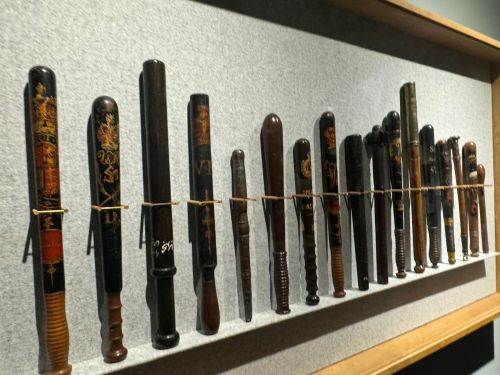
A Historical Overview
The National Museum of Justice is housed in the Old Crown Court and the former Nottinghamshire County Gaol, which date back to the 18th century. This venue has witnessed a myriad of legal proceedings, from the trials of infamous criminals to the day-to-day workings of the justice system. For instance, it has seen trials of notable criminals, including the infamous Nottinghamshire smuggler, and it played a role during the turbulent times of the 19th century when debates around prison reform gained momentum. You can read about Richard Thomas Parker, the last man to be publicly executed and who was hanged outside the building here. The building itself is steeped in decade upon decade of history, with its architecture reflecting the evolution of legal practices over the centuries. For example, High Pavement and the spot where the gallows once stood.
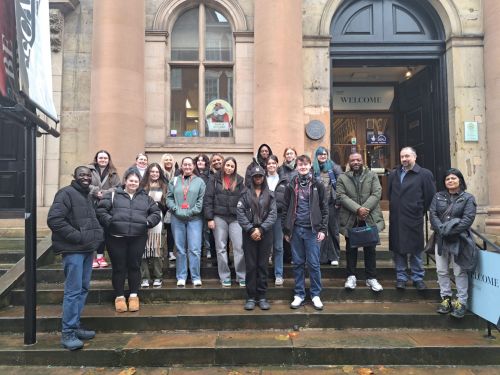
By visiting the museum, it is possible to trace the origins of the British legal system, exploring how societal values and norms have shaped the laws we live by today. The National Museum of Justice serves as a reminder that justice is not a static concept; it evolves as society changes, adapting to new challenges and perspectives. For example, one of my favourite exhibits was the bench from Bow Street Magistrates Court. The same bench where defendants like Oscar Wilde, Mick Jagger and the Suffragettes would have sat on during each of their famous trials. This bench has witnessed everything from defendants being accused of hacking into USA Government computers (Gary McKinnon), Gross Indecency (Oscar Wilde), Libel (Jeffrey Archer), Inciting a Riot (Emmeline Pankhurst) as well as Assaulting a Police Officer (Miss Dynamite).
Understanding this rich history invites visitors to contextualize the legal system and appreciate the ongoing struggle for a just society.
Engaging Exhibits
The National Museum of Justice is more than just a museum; it is an interactive experience that invites visitors to engage with the past. The exhibits are thoughtfully curated to provide a comprehensive understanding of the legal system and its historical context. Among the highlights are:



1. The Criminal Courtroom: Step into the courtroom where real trials were once held. Here, visitors can learn about the roles of various courtroom participants, such as the judge, jury, and barristers. This is the same room that the Criminology staff and students gathered in at the end of the day to share our reflections on what we had learned from our trip. Most students admitted that it had reinforced their belief that our system of justice had not really changed over the centuries in that marginalised communities still were not dealt with fairly.
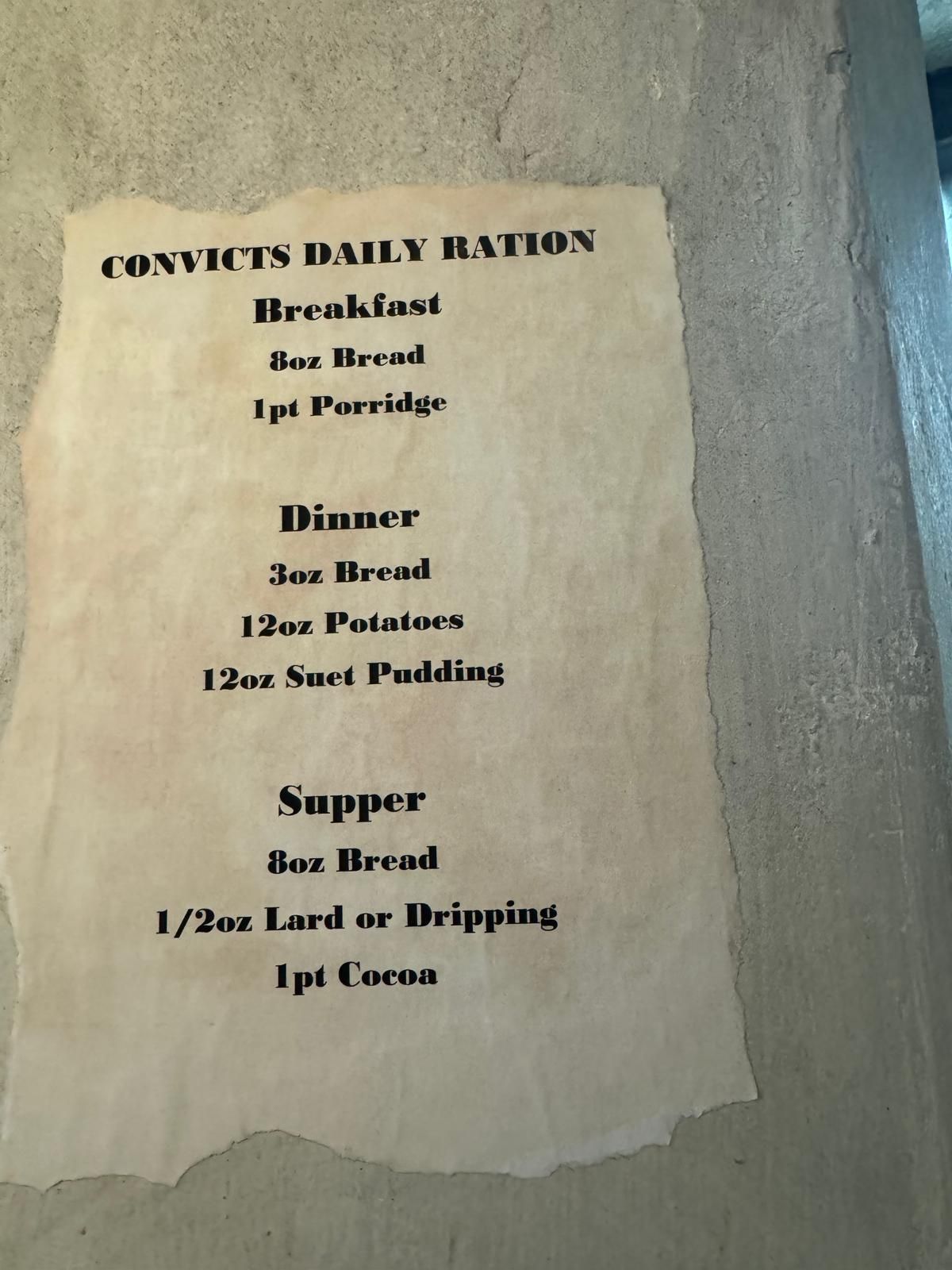
2. The Gaol: We delved into the grim reality of life in prison during the Georgian and Victorian eras. The gaol section of the gallery offers a sobering look at the conditions inmates faced, emphasizing the societal implications of punishment and rehabilitation. For example, every prisoner had to pay for his/ her own food and once their sentence was up, they would not be allowed to leave the prison unless all payments were up to date. The stark conditions depicted in this exhibit encourage reflections on the evolution of prison systems and the ongoing debates surrounding rehabilitation versus punishment. Eventually, in prisons, women were taught skills such as sewing and reading which it was hoped may better their chances of a successful life in society post release. This was an evolution within the prison system and a step towards rehabilitation of offenders rather than punishment.
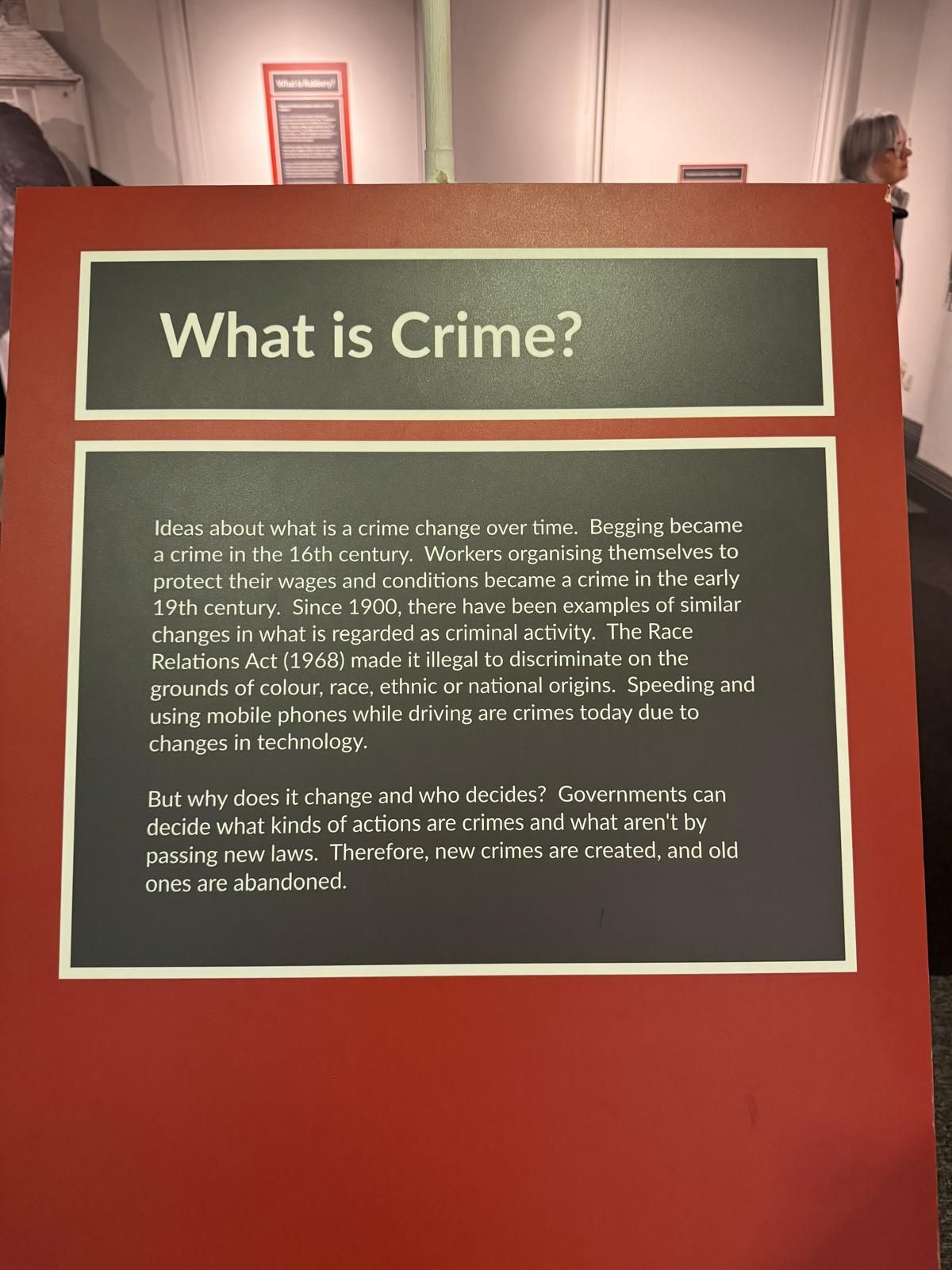
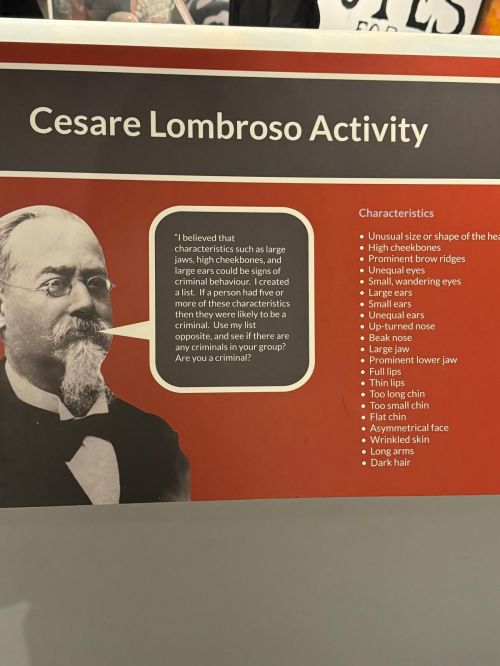
3. The Crime and Punishment Exhibit: This exhibit examines the relationship between crime and society, showcasing the changing perceptions of criminal behaviour over time. For example, one famous Criminologist of the day Cesare Lombroso, once believed that it was possible to spot a criminal based on their physical appearance such as high cheekbones, small ears, big ears or indeed even unequal ears. Since I was not familiar with Lombroso or his work, I enquired with the Criminology department as to studies that he used to reach the above conclusions. Although I believe he did carry out some ‘chaotic’ studies, it really reminded me that it is possible to make statistics say whatever it is you want them to say. This is the same point in relation to the law generally. As a lawyer I can make the law essentially say whatever I want it to say in the way I construct my arguments and the sources I include. Overall, The Inclusions of such exhibits raises and attempts to tackle difficult questions about personal and societal morality, justice, and the impact of societal norms on individual actions. By examining such leading theories of the time and their societal reactions, the exhibit encourages visitors to consider the broader implications of crime and the necessity of reform within the justice system. Do you think that today, deciding whether someone is a criminal based on their physical appearance would be acceptable? Do we in fact still do this? If we do, then we have not learned the lessons from history or really moved on from Cesare Lombroso.
Lessons on Justice and Society
The National Museum of Justice is not merely a historical site; it also serves as a platform for discussions about contemporary issues related to justice. Through its exhibits and programs, our group was invited to reflect on essentially- The Evolution of Justice: Understanding how laws have changed (or not!) over time helps us appreciate the progress (or not!) made in human rights and justice and with particular reference to women. It also encourages us to consider what changes may still be needed. For example, we were incredibly privileged to be able to access the archives at the museum and handle real primary source materials. We, through official records followed the journey of some women and girls who had been sent to reform schools and prisons. Some were given extremely long sentences for perhaps stealing a loaf of bread or reel of cotton. It seemed to me that just like today, there it was- the huge link between poverty and crime. Yet, what have we done about this in over two or three hundred years? This focus on historical cases illustrates the importance of learning from the past to inform present and future legal practices.
– The Importance of Fair Trials: The gallery emphasizes the significance of due process and the presumption of innocence, reminding us that justice must be impartial and equitable. In a world where public opinion can often sway perceptions of guilt or innocence, this reminder is particularly pertinent. The National Museum of Justice underscores the critical role that fair trials play in maintaining the integrity of the legal system. For example, if you were identified as a potential criminal by Cesare Lombroso (who I referred to above) then you were probably not going to get a fair trial versus an individual who had none of the characteristics referred to by his studies.
– Societal Responsibility: The exhibits prompt discussions about the role of society in shaping laws and the collective responsibility we all share in creating a just environment. The National Museum of Justice encourages visitors to think about their own roles in advocating for justice, equality, and reform. It highlights that justice is not solely the responsibility of legal professionals but also of the community at large.
– Ethics and Morality: The museum offers a platform to explore ethical dilemmas and moral questions surrounding justice. Engaging with historical cases can lead to discussions about right and wrong, prompting visitors to consider their own beliefs and biases regarding justice.
Conclusion
The National Museum of Justice in Nottingham is a remarkable destination that beautifully intertwines history, education, and advocacy for justice. By exploring its rich exhibits and engaging with its thought-provoking themes, visitors gain a deeper understanding of the complexities surrounding justice and its vital role in society. Whether you are a history buff, a legal enthusiast, a Criminologist or simply curious about the workings of justice, the National Museum of Justice offers a captivating journey that will leave you enlightened and inspired.
As we navigate the complexities of the modern world, it is essential to remember the lessons of the past and continue striving for a fair and just society for all. The National Museum of Justice stands as a powerful testament to the ongoing quest for justice, inviting us all to be active participants in that journey. In doing so, we honour the legacy of those who have fought for justice throughout history and commit ourselves to ensuring that the principles of fairness and equity remain at the forefront of our society. Sitting on that same bench that Emmeline Pankhurst once sat really reminded me of why I initially studied law.
The main thought that I was left with as I left the museum was that justice is not just a concept; it is a lived experience that we all contribute to shaping.


 Thoughts from the criminology team

