

Tis very quiet on a Friday…

Fridays are an especially busy day for the BA Criminology and BA Criminology with Psychology students and staff: for some there are 6hours of classes today, finishing their Friday at 6pm! What a way to finish off the ‘working’ week: packed full of interesting discussions and learning. However, the vibe on the roads in via the morning commute and the silence rolling through the Library at 10am would suggest not everyone shares in a full-on Friday experience!
Friday evenings would mark the end of a long week for many, and the, hopefully, exciting possibilities the weekend might hold. But as I travelled into Northampton, on my usually very early and busy commute, I couldn’t help but notice the lighter quieter roads. It makes a nice change up- can leave a little later than usual and do not have to comprehend with the stresses of the morning rush hour: but why? Why have Fridays become quiet?
As many staff and students will know: car parking can be a smidge of a challenge when arriving for 9ams: but not on a Friday. Usually, to beat the rush, it is ideal to arrive at campus before 0830: but not on a Friday. 0845 and there remain many car parking spaces- again excellent to set up for a long day of studying but why the sudden quietness on a Friday? Is this a symptom of a wider issue?
There is a peaceful sense around campus today- despite the busy day for some courses. It feels very much like the week is over: should this be so overtly felt at 9am instead of 6pm? I have asked friends not in academia, and this Friday quietness appears to be across industries. Friday appears to be a favourite day to work from home: a gentle ease into the weekend. But should we be easing into the weekend or ending the ‘working’ week a little frazzled and desperate for the weekend ahead? Does it really matter? The grey weather we’ve been blessed with today I am sure does not help, and it is a nice change up from the mid-week hustle and bustle which exists on campus. But why have Fridays crept into this sort of ‘start of the weekend’ status? The Friday evening I can see being that representation: but the Friday morning? Maybe it’s a one-off and next week the roads and campus will be buzzing and hopefully the sun will be shining. But for today, the last Friday in February: its very much a gentle atmosphere on campus.
Share this:


Crime II: Nature and Nurture?
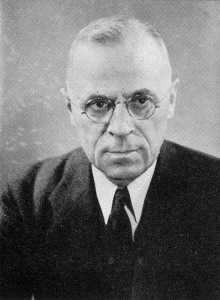
Fifty years after Lombroso’s theory of the “born criminal” an American criminologist explored the origins of criminality from a different perspective. For Edwin Sutherland people weren’t born criminal but more likely influenced by their environment. Differential association became a theory that changed the focus from biology to environment. This change signified the change of focus within criminology from biological attributes to social features.
This change, whilst it appears to have capture a wider social sciences debate at the time is also the outcome of trying to understand a world in motion. Sutherland’s theory comes in the early 20th century after the First World War and a massive economic crash. These placed in doubt the scientific and political economy of the time, putting many of these earlier ideas to the test. Popular movements challenged the authority of the state and the way hegemony suppressed people. Differential association was exploring how people learn crime by observing others; it becomes what Kornhouser called a ‘cultural deviance theory’.
What Sutherland articulated is that crime is learned through group conflict, again attempting to explain all types of crime like the biological theories before. The 20th century with its fast pace, European (World) wars, was the embodiment of modernity, progression and change. The world outside Europe began to rise against colonial rule, whilst civil rights became a rallying objective for many disenfranchised groups. In most countries worldwide women got the vote in the 20th century whilst, many countries recognised unions, and civil rights organisations, a consequence of people’s mobilisation.
It comes as no surprise then that differential association was a theory of crime that tried to account for social change and understand criminality as a process that moves within this change. The foundations of the theory in its simplest form are straightforward, covered in 9 main points:
1. Criminal behavior is learned from other individuals.
2. Criminal behavior is learned in interaction with other persons in a process of communication.
3. The principle part of the learning of criminal behavior occurs within intimate personal groups.
4. When criminal behavior is learned, the learning includes (a) techniques of committing the crime, which are sometimes very complicated, sometimes simple; (b) the specific direction of motives, drives, rationalizations, and attitudes.
5. The specific direction of motives and drives is learned from definitions of the legal codes as favorable or unfavorable.
6. A person becomes delinquent because of an excess of definitions favorable to violation of law over definitions unfavorable to violation of the law.
7. Differential associations may vary in frequency, duration, priority, and intensity.
8. The process of learning criminal behavior by association with criminal and anti-criminal patterns involves all of the mechanisms that are involved in any other learning.
9. While criminal behavior is an expression of general needs and values, it is not explained by those needs and values, since non-criminal behavior is an expression of the same needs and values.
The theory is more than a compilation of points and citing them is informative, but it doesn’t really explain the reach and extent. As a general theory of crime it can account for violent crime, theft and even white collar crimes. This reach of theory coincided with the wider discussion on “normative conflict” that focused on cultures. As discussions on cultural dominance, subcultures and the role of social groups became a sociological and criminological point these ideas introduced by Sutherland seemed to bare relevance.
There were questions already regarding the theory’s basis in terms of clarity as a cultural deviance theory, when culture focused away from poverty and social struggles. The cultural conflict seemed to resonate with certain crime categories, but it could not account for harm, leaving zemiologists to doubt the accuracy of its scope as theory. Furthermore, whilst the focus moved on from an arbitrary biology to the role of the environment some of the fundamental problems expected to be resolved in a general theory of crime remained unanswered.
So what is the answer? We can safely say that crime and most importantly criminality isn’t the product of a singularity nor its binary. How can we account for example for a social phenomenon whose definition of crime (in some instances) relies on law. A mechanism that the establishment uses to safeguard its privileges and position. The definitional factors therefore ought to transcend general conventions of biology or social interaction. Often they don’t, they merely describe the phenomenon but in closed cultural formats. There is a much more interesting and complex explanation that take us away from this binary. If you are more curious and you want to know more, why not join a criminology course and see if you can get the answer you expect or not. Criminology is a fascinating discipline not because we talk blood and bones but because we reflect on the current state of crime and imagine a world of crime (or free of crime) in the future. If you wish to share that imagination you can but join us!
https://www.northampton.ac.uk/courses/criminology-ba-hons/ https://www.northampton.ac.uk/courses/criminology-phd/ https://www.northampton.ac.uk/courses/criminology-with-psychology-ba-hons/ https://www.northampton.ac.uk/blog/why-i-chose-criminology/
Share this:

Crime I: Nature or Nurture?
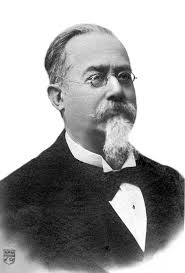
This is a two-part blog on embracing some of the criminological theory origin stories in the Western hemisphere. Is crime the product of bad genes or bad society? Are we born or made criminal?
In this week we shall be exploring our understanding of biological theories originating back in the 19th century with the “born criminal”. The following week we will look at the role of the environment.
The born criminal.
In 1871 Cesare Lombroso became the director at the Pesaro Mental Health Hospital (asylum) that housed the clinically insane. In that environment he examined the anatomical anomalies of residents in laboratory conditions. The era of the scientific exploration of deviance had begun. These meticulous explorations of bodily features and skulls formed the basis for his later thesis on The Born Criminal. The basis of his criminal population were residents of the asylum. His control group (i.e. those deemed non-criminal) were soldiers. Later, these were combined with the population of inmate prison population Lombroso and his associates visited. As he assumed an academic role in one of the finest Italian universities the world read his seminal publication of L’uomo delinquente {The Born Criminal] .Which in 1876 became one of the publications that influence the work of its contemporaries. In later years studied in exactly the same way. criminality in women using sex workers and prisoners as his research population cumulating into the 1893 publication of La Donna Delinquente: La prostituta e la donna normale [The Criminal Woman: The Prostitute and the Normal Woman.
His theoretical reach transcended borders and became widely read in the English-speaking world. This is an origin story according to numerous textbooks about the biological understanding of criminality. When embellished with some of the original quotes this becomes a theory of crime that explains different criminalities and makes the most significant leap that combines scientific rationale with crime. The methodology of anthropometry is a careful measuring of human features, prominently skulls! The main theoretical “innovation” was the recognition of a state of atavism; a regression onto a prior evolutionary stage for those engaged in crime.
A theory of crime on the born criminal seemed as a logical step at a time hailed as an era of discovery and exploration. A time that social and political movements in Europe asked profound questions about self and society. This narrative of course largely overlooks that whilst West European and US philosophers are posing these questions their elites and establishment are preoccupied with colonialism and dominance. In fact, it is the time European conflict around the world for dominance intensified. By the late 19th century, the European powers will try to manage their dominance in other continents by carving the world according to their own interests. The Berlin conference of 1884-85 is the culmination of such European competition and led to the split of Africa into zones of colonial influence.
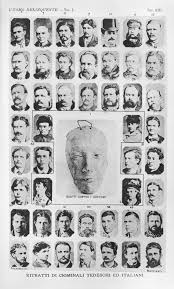
In what way is The Born Criminal related with colonialism?
The theory of the “born criminal” breaks down humanity into two; the “normals” and the “atavists” which conveniently separates us from them. The criminal becomes the outcome of a lack of civilisation that can be seen in their physical features. There is history in separating people for the sake of exploitation, subjugation and even genocide. In this context of using civilisation (solely European) as the feature of separation is something previously seen in the colonisation of the Americas. When the European explorers landed in a new (for their map’s) continent the question of whom it belongs to was answered using religious decree. Several popes described the native population of these “discovered lands” as uncivilised and unworthy of human rights. It was the papal “Doctrine of Discovery” that denied the indigenous people rights to their land because uncivilised, faithless people (calling it terra nullus or empty land) do not count. Therefore, this separation for discrimination is not new, but Lombroso brought some scientific veneer to it.
It is important to remind all that “the born criminal” theory was widely discredited already in the early 20th century, when data analysis found no support for atavism and the biological features seemingly associated with criminality. Yet still this approach seems to capture even today some interest in the collective criminological imagination. Can you tell the prospective criminality reflected in someone’s gaze? It is a question that people still wonder, despite any lack of empirical or scientific data. The line of separating criminals from non-criminal provides an arbitrary differentiation that offers some clarity of how criminals should look, in a similar fashion to separating the “civilised” from the “savages”. In this overreaching correlation crime becomes the act of the uncivilised. It can also be flipped over and the uncivilised are the criminals contributing to the continuous fear of those who see the foreigner with suspicion.
A theory about the biological origins on crime that has offered us an explanation of the born criminal that has no scientific evidence but carries populist imagination because we take comfort in differentiating people. Next week we shall be exploring a theory that explores of the environmental factors of crime.
Share this:


A new model for policing: same old rhetoric, same old politics, same old reality

The Home Secretary’s White Paper ‘From Local to National: A New Model for Policing’ promises a complete revamp of policing in England and Wales. The Northamptonshire Police Federation website provides a fairly good synopsis of what the white paper contains. Although one does hope that they didn’t resort to the use of AI to produce it otherwise they may find themselves going the same way as the beleaguered former chief constable of the West Midlands Police.
When listening to the Home Secretary Shabana Mahmood’ address to parliament regarding these reforms, I am reminded of a timeless quote from Robert Reiner regarding a former Home Secretary, Michael Howard’s address to parliament regarding another Home Office police reform White Paper back in the early 1990s. Michael Howard had stated that ‘the job of the police was to catch criminals’ and Robert Reiner, if I remember the quote correctly, stated that this statement was ‘breathtaking in its audacious simple mindedness’.
My bookshelf used to be full of Home Office White papers regarding police reform. If I went through every one of them, I would find almost all the suggestions, in one form or another, being put forward by this Home Secretary. It is like revisiting my former reality, change for change’s sake to detract from a poor performing government. Although no one could have guessed that Lord Mandelson would quickly hog the news and railroad the political landscape.
The police don’t do themselves any favours, you’ve only got to look at the headlines over the decades to know that. But of course, policing is not easy and sometimes hitting the headlines for the wrong reasons is inevitable. Rarely do the police hit the headlines for the right reasons, not because there aren’t plenty of right reasons, they simply aren’t newsworthy. However, every failure or perceived failure is ammunition for the ambitious politician and police reform is always a headline grabbing option and a distraction from other politically difficult and damning matters.
Let’s be clear, policing doesn’t happen in a vacuum. Policing relies on the public; it relies on other institutions within the criminal justice system and outside of it and it relies on good governance. If the police are underfunded, then the service they deliver to the public is substandard and this then dents confidence in the police which in turn impacts public co-operation. If the other institutions within the criminal justice system are poorly funded such as the courts, then it doesn’t matter what the police do, cases do not get to court in a timely manner, the public withdraw their support and cases collapse. If prisons are overcrowded due to lack of funding and other issues, the courts can’t function correctly and the public lose confidence. As an aside remember the furore around the wrong prisoners being released and the number of prisoners wrongly released over a year. Funny how that seems to have disappeared from the news.
But the problems for policing and the rest of the judicial system pale into insignificance when compared to the issues with underfunding in areas of social services, welfare, the NHS, education and so much more. It is easy to point to policing when the key areas that impact the public the most are decimated. People don’t just commit crime because they are greedy, they don’t resort to violence for absolutely no reason. And it doesn’t take a rocket scientist to work out that if you stop supporting young people, stop giving them hope for a future, stop keeping them engaged in meaningful activities when they are out of school then you will see crime and anti-social behaviour spiral out of control. And of course, its not just young people that feel the impact. Not so long ago there was a movement towards defunding the police. The ideas behind the movement were sound but I think perhaps a little naïve. But what was right was the idea of pouring more money into welfare and youth services. Crime is so much more than just policing, and the police have very little control over it, despite all the rhetoric.
As for policing, the white paper is just a rehash of the same old ideas and another way of wasting public money, not dissimilar to that in 2006 when another Home Secretary decided on police mergers which saw millions spent before the idea was shelved as too expensive. The police have adapted to issues identified by HMIC prior to the proposed mergers in 2006. Collaboration between forces works well, saves money and enables smaller forces to deal with large scale issues. There is no evidence anywhere that big is better. In fact there is plenty of evidence to suggest that it may not be.
If the police have retracted from neighbourhood policing it is because of underfunding. Austerity measures introduced in 2010/11 decimated police forces and their ability to deliver both neighbourhood and response policing. Neighbourhood policing became a luxury and coincidentally was also the area where instant savings could be made. Police Community Support Officers could be shed because unlike police officers, they can be made redundant. As for vetting, something that has grabbed the headlines, well what did you expect? Cut the budgets and those important but less immediate functions are also decimated. Add to this the political pressure to recruit 20,000 officers in a short space of time and you have a recipe for disaster.
I do wonder whether those chief officers that support the latest police reform agenda do so because they really understand policing and its history or because they are naïve or ambitious or perhaps a bit of both. To return to Robert Reiner, the reforms are quite simply ‘breathtaking in their audacious simple mindedness’ and the sooner they are shelved the better.

 Thoughts from the criminology team


