
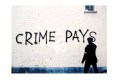
A Criminal Called Bob

It was years ago that Bob was born in St. Mary’s Hospital. His mum delivered a relatively healthy baby that she called Robert, after her father despite kicking her out when he found out that she was pregnant from a casual encounter. Bob’s early memory was of a pain in the arm in a busy place he could not remember what it was. His mother was grabbing his arm an early sign that he was unwanted. He would remember many of these events becoming part of everyday life. He remembers one day a stern looking woman came to the place he was living with his mother and take him away. This was the last time he would ever see his mother; he was 5 or 6. A few years afterwards his mother will die from a bad heart. Later, he would find out it was drugs related.
The stern looking lady will take him to another place to live with a family. One of many that he would be placed in. At first, he tried to get to know the hosts but soon it became difficult to keep track. He also lost track of how many times he moved around. There were too many to count but the main memory was of fear going into a place he did not know to stay with people who treated him as an inconvenience. He owned nothing but a bin bag with a few clothes and people will always comment on how scruffy he looked. He remembers discovering some liquorice allsorts in a drawer with the kid he was sharing the room with. He cannot forget the beating he got for eating some of them. The host was very harsh, and they used the belt on him.
School was hell for Bob. As he moved from place to place the schools also changed. The introduction to the class was almost standard. Bob is joining us from so and so and although he lives in foster care, I hope you will be making him feel welcomed…and welcomed he was. The bullying was relentless so was the name calling and the attacks. On occasion he would meet an aloof man who was his “designated tutor”. His questions were abrupt and focused only if he was behaving, if he was making any trouble, if he did as was told. It was hardly ever about education or any of his needs. He remembers going to see him once with a bruised eye to be asked “what did you do?”
And he did a lot! Early on he learned that in order not to go hungry he must hide food away. If he was to meet a new person, he had to show them that he is cannot be taken for granted, he needed to show them he can handle himself. Sometime during his early teenage years his greeting gesture was a headbutt. Violence was a clear vehicle for communication. One person is down the other is up. This became a language he became prolific in. He could read a room quickly and in later years be able to assess the person opposite. If he can take him or not!
The truth that others kept talking about around him became a luxury and an unnecessary situation. Lying about things got him to avoid punishment and any consequences to any of his actions. The only problem was when he was get caught lying. The consequences were dire. So, what he needed to do was to become very good at it. He did. He could lie looking people straight in the eye and not even blink about it.
Later in life he discovered this was an amazing talent to possess. It was useful when he was stealing from shops, it was good when people asking him for the truth, it was profitable when his lies covered other people’s crimes. Before he turned 18, he was an experienced thief and a creative liar. His physique allowed him to take to violence should anyone was to question his “honesty”. When he was 15, he discovered that a combination of cider and acid gives him such a buzz. To mute his brain and to relax his body even for little was so welcomed. This habit became one of his most loyal relationships in his life.
In prison he didn’t go until he was 22 but he went to a young offender’s institution at the age of 17 for GBH. The “victim” was a former friend who stole some of his gear. That really angered him; even days after the event in court he was still outraged with the theft. He was still making threats that he will find him and kill him, in some very graphic descriptions! The court sought no other way but to send him away. From the age of 22 he would become a “frequent flyer” of the prison estate! A long list of different sentences ranging from everything on offer. Usually repeated in pattern; fine, community sentence, prison….and back again! By the time he was 35 he had been in prison for more than 8 years collectively. He did plenty of offender management courses and met a variety of probation and prison officers, well-meaning and not so good. Some tried to help, and others couldn’t care but all of them fade in the background.
Now at the ripe age of 45 he is out of the prison, and he is sofa surfing and claiming universal credit. He gets nothing because he has unpaid fines, so he is struggling financially. In prison he did a barista apprenticeship, but he cannot find any work. As it stands, he is very likely to be recalled back to prison, if the cold weather doesn’t claim him first.
In context, there are some lives that are never celebrated or commemorated. There are people who exist but virtually no one recognises their existence. Their lives are someone else’s inconvenience and in a society that prioritises individual achievement and progression they have none. Bob is a fictional character. His name and circumstances are made up but form part of a general criminological narrative that identifies criminality through the complexity of social circumstance.
Share this:


Is the UK a good place to live?: II

As part of preparing for University, new students were encouraged to engage in a number of different activities. For CRI1009 Imagining Crime, students were invited to contribute a blog on the above topic. These blog entries mark the first piece of degree level writing that students engaged with as they started reading for their BA (Hons) Criminology. With the students’ agreement these thought provoking blogs have been brought together in a series which we will release over the next few weeks.
Whether the UK is a good place to live is up for debate in recent months, but some necessary requirements to ensure that it is include having access to democracy and free healthcare, but the rising cost of living in the UK can suggest the opposite; however, this is dependent on each individual.
On the one hand, the UK government has democracy, which allows for people to elect representatives to make and govern the laws. Allowing for democracy in society allows for more progressive and forward-thinking views, such as the legalisation of gay marriage in 2013. This benefits future generations as it reinforces the idea of equality and respect. In comparison to America, which can be argued to be under a dictatorship, as it severely limits the citizens’ freedom, such as by making abortion illegal. This is done to maintain a political belief that is thought to be superior. Therefore, democracy is beneficial and a requirement of a good country, as it sets a standard for elected representatives to uphold the key morals.
An opposing thought is that the UK has quite high living costs, with transportation rates, as an example, increasing, making it costly for students and workers to get to their destinations. Stagecoach have implemented a pay no more than £3 scheme recently as an effort to keep bus fare to a minimum. However, this is still ineffective. Students like myself that needed to take multiple buses to sixth form suffered from such high rates, costing around £60 a month towards bus fare. As a result of the high transportation rates, this can result in students in lower-income households missing out on their education due to prioritising money. Also, it can prevent people looking for employment from jobs that are further away, as a good portion of their salary would be going towards this. Therefore, this demonstrates that to ensure the stability of making the UK a good place to live, reforms need to be made in order to reduce the rising costs which dramatically impact the quality of life for people living here, as it still instils the priority of needing to survive first and delays employment and education.
Alternatively, the UK is a good place to live, as we have access to publicly funded healthcare regardless of your financial status. This relieves financial pressures of high medical costs without the need to sell assets, as patients are protected through the equal care being provided, which can be argued is a fundamental human right that everyone deserves to have. Ultimately, through having the NHS, it provides better economic benefits to the UK, as it reduces the strain of families going to be in poverty. Therefore, by having publicly funded healthcare, it has the ability to strengthen the country by promoting equality through equal care of each patient regardless of their financial status, which enhances the fact that the UK is a good place to live.
Living in the UK can come with many benefits, such as having democracy and access to free healthcare, but this shadows the negatives that it is becoming increasingly difficult to live here due to rising costs of living as well as the fact that the weather is not great.
Share this:


Grief through art and privilege

Recently, I find myself constantly listening to Cat Burns’ (2025) new album ‘How to be Human’. An incredibly catchy, moving and soulful album. Lyrically, it navigates two types of grief; the death of a loved one (father and grandfather) and the end of a relationship. The lyrics are poignant and the melodies peaceful yet emotional. For somebody who has had this album hit too close too home, it is very much a ‘box of tissues at the ready’ type of album with some ‘get up and dance’ tracks included too.
Engaging with art (music, literature, print) which embodies and navigates grief can assist some in the healing process. Different people frame different emotions which hit in a whole new way. Music, art, literature are a necessity for human kind: but they are also a privilege. A privilege for those who can create, access and afford. Space, money, creativity are needed to create but also arguably to consume art as well. Is this fair given the unfortunate reality that we all will/have been bed fellows with grief, and these resources could help people process/address/feel?
This got me thinking about the broader collective which is grief: grieving for a previous version of yourself, grieving people, grieving a home, grieving something you want but cannot have, the ending of a relationship, loss of income. When I think about it, we grieve all sorts, yet these types of grief are not ‘mainstream’, or at least I hadn’t perceived them as such. And as I thought about grief, it made me think of those within the Secure Estate (children and adults), grieving the loss of loved ones, of relationships, of possibilities and of their liberties. Are they afforded the space to grieve? They are viewed as criminally responsible, and therefore deserving of punishment, and part of this punishment is loss but how do they process this? Do they view this loss of liberty in terms of grief? Are they afforded this privilege? I highly doubt it, and I wonder if this framing of grief and loss is something which needs deeper consideration when looking at rehabilitation. How can you rebuild and move forward if you haven’t processed, or at least begun to process, the loss. The loss of who you were, the loss of time, the loss of relationships, skills, knowledge etc.
In my humble opinion the album is beautiful and has made me deal with a new wave of feelings: but I think this is a good thing. As Burns (2025) identifies in ‘All this love’: it’s just part of the process. A process, given my positionality, I am privileged to be navigating with music, literature, family and friends. A privilege not afforded to all, or for all forms of grief. I think this should change. Grief can be all consuming, even on days when you think you’re on your feet, suddenly the rug is pulled from beneath you. And the tools you have, the space to be and to feel, are essential. So why then do we only afford them to some?
Bibliography:
Burns, C. (2025) ‘How to Be Human’. Available at Amazon Music (Accessed 31st October 2025)
Rosen, M. (2004) Sad Book. Somerville, MA: Candlewick Press
Savage, M. (2025) ‘Cat Burns’ new album shows a softer side to the Traitors star’, BBC, 31st October. Available at: https://www.bbc.co.uk/news/articles/cx2pxz14ypro (Accessed 11th November 2025)
Share this:

Is the UK a good place to live?: I
As part of preparing for University, new students were encouraged to engage in a number of different activities. For CRI1009 Imagining Crime, students were invited to contribute a blog on the above topic. These blog entries mark the first piece of degree level writing that students engaged with as they started reading for their BA (Hons) Criminology. With the students’ agreement these thought provoking blogs have been brought together in a series which we will release over the next few weeks.
The UK is widely favoured and known across the world due to its many attractions and key figures that reside in and outside of London, such as: the Harry potter franchise, the London eye, Buckingham palace, Shakespeare, Windsor castle, stone henge, big ben, and many more. But despite all of its magnificent attractions it raises the question “Is the UK actually a good place to live”?
What are the benefits of living in the UK?
- The NHS
- Education is free
- Diversity in culture
- Strong labour laws
In the UK we have something called the NHS (national health service), which allows UK residents to receive free healthcare when it’s needed due to it being primarily funded by general taxing and national insurance contributions. Although it’s important to note that the NHS isn’t subject to only the UK but also Scotland and Wales too.
Education is often looked at as one of the core necessities that a child must have, so it makes sense that it would be free right? Unfortunately, in many countries’ education is seen as a luxury (for certain demographics) rather than a need. Due to this, I would argue that it’s a benefit, no matter how obvious it may seem.
In the UK there are a variety of cultures and races which I personally believe is beautiful because not only are we able to enjoy the gift of multiple different cuisines, but we’re also able to grow up with the ideology that we’re not so different from one another even if we may appear that way (which is a valuable lesson for children to learn and cherish as they grow older).
The benefit of having strong labour laws also ties into my previous point about diversity since it protects citizens from discrimination (Equality act 2010) in the workplace. Not only that but it also ensures that workers are paid at least minimum wage, they don’t face unnecessary/unlawful wage deductions, they receive time off for holidays, workers will be protected if they report an incident at work, workers can’t be dismissed from work without good reason (Employments act 1966), and that they’re not overworked (48 hours a week max).
What are the disadvantages of living in the UK?
- Although most services are free, there are still charges that may apply to medications, prescriptions, dental treatment and eye care. However, it’s still important to note that if you’re in full education or you have other exemptions (such as universal credit or a disability) these may not apply; there are also other circumstances where they also may not apply.
- It’s true that the UK is incredibly diverse but that doesn’t mean there isn’t a constant problem of racism, it just means that there’s more people who can relate to the same issue. It goes without saying that even with labour laws in place, and the never ending resources that someone could use to educate themselves on a specific topic that is unique to a certain race, many people still experience discriminatory behaviours. While its understood that this is an issue everywhere in the world, I don’t think it should be normalised. Rather than dismissing it with a permissive attitude, I think everyone should work towards eradicating such ideologies and behaviours.
- The minimum wage isn’t enough to actually live on, which leaves multiple people homeless or struggling to stay afoot. Thus, leading to more unethical methods to gaining money or other necessities. It should go without saying that the minimum wage should be enough to be somewhat comfortable, or better yet survive on… which evidently isn’t the case for some.
What are the requirements for a good country? :
Those in power would have to love and care for their people. By that I mean- their own money shouldn’t be on the forefront of their mind when it comes to prioritising needs such as having a stable income to live on. Not only that but those in power shouldn’t have a secret racial or gender bias that peeks out whenever they’re trying to make a change. For obvious reason, this would be incredibly damaging to society on a whole, not just for those targeted. Last but not least, I believe that housing should be an option for everyone, even the less fortunate. It shouldn’t be a luxury to have a place to live, everyone deserves comfort, especially in their darkest moments; housing should be provided for those that need it, especially individuals with children.
Share this:


UK Justice v The Demonic and Others

The sanctity of a civilised court room demands rationality, but the laws of the distant and not so distant past in this jurisdiction are entrenched in the uncanny. Rules safeguarding the impartiality of the jury are grim “wards” against the spiritual chaos that once dictated verdicts. The infamous case of the Ouija Board jurors, aka R v Young[i] only thirty years ago is not merely a legal curiosity: it is a modern chilling echo of a centuries old struggle defining the judiciary’s absolute commitment to a secular process that refuses to share its authority with the spectral world. The ancient rule, now applied to Google and the smartphone, has always been simple: the court cannot tolerate a decision derived from an unvetted external source.
When Law Bowed To The Supernatural-Ancient Past?
For millennia, the outcome of a criminal trial in Britain was terrifyingly dependent on the supernatural, viewing the legal process as a mechanism for Divine Judgement[ii]. The state feared the power of the otherworldly more than it trusted human evidence.
Prior to the 13th century, the determination of guilt was not based on evidence but on the Judicium Dei [iii](Judgement of God). The accused’s fate lay not with the court but with the elements of the earth itself.
The Ordeal of Hot Iron: The accused would carry a piece of red-hot iron. If their subsequent wound was judged “unclean” after three days-a sign of God withholding his grace-the accused was condemned to death. The burden of proof was literally placed upon a miracle.
The Ordeal of Cold Water: This was an essential test in early witch-finding. If the bound accused floated, the pure water was thought to reject them as impure agents of the Devil, condemning them as guilty. The collapse of these ordeals after the Fourth Lateran Council in 1215 was the first, forced act of separation between the secular law and the spiritual realm, necessitating the creation of a human, rational jury[iv]
Legislating against the Demonic: The Witchcraft Acts
Even after the rise of the jury, the judiciary was consumed by the fear of the demonic. The Act against Conjuration, Witchcraft and dealing with evil and wicked Spirits 1604 (1 Jas.4 1. c. 12)[v] made contacting the demonic a capital felony, ensuring that the courtroom remained a battleground against perceived occult evil.
The Pendle Witch Trials (1612): This event is a spectral stain on UK legal history. Ten people were executed based on testimony that included spectral evidence, dreams, and confessions extracted under duress. The judges and juries legally accepted that the Devil and his agents had caused tangible harm. The failure to apply any rational evidential standards resulted in judicial murder.[vi]
Even the “rational” repeal in the Witchcraft Act 1735 (9 Geo. 2. c. 5),[vii] which only criminalised pretending to use magic (fraud), haunted the system. The prosecution of medium Helen Duncan in 1944 under this very Act, for deceiving the public with her spiritualist services, demonstrated that the legal system was still actively policing the boundaries of the occult well into the modern era, fearful of supernatural deceit if not genuine power.
The Modern Séance: R v Young and the Unholy Verdict
The 1994 murder trial of Stephen Young[viii], accused of the double murder of Harry and Nicola Fuller, brought the full weight of this historical conflict back into the spotlight. The jury, isolated and burdened with the grim facts of the case, succumbed to an uncanny primal urge for absolute certainty.
The jury had retired to a sequestered hotel to deliberate the grim facts of the double murder.During a break in deliberations on the Friday night, four jurors initiated a makeshift séance in their hotel room. They used paper and a glass to fashion a crude Ouija board, placing their life-altering question to the “spirits” of the deceased victims, Harry and Nicola Fuller.
The glass, according to the jurors’ later testimony, moved and chillingly spelled out the words “STEPHEN YOUNG DONE IT.”
The Court of Appeal, led by Lord Taylor CJ, ruled that the séance was a “material irregularity” because it took place outside the official deliberation room (in the hotel). This activity amounted to the reception of extrinsic, prejudicial, and wholly inadmissible evidence after the jury had been sworn. The verdict was quashed because a system based on proof cannot tolerate a decision derived from ‘the other side’
The core rule remains absolute: the verdict must be based only on the facts presented in court. The modern threat to this principle is not possession by a demon, but digital contamination, a risk the law now treats as functionally identical to the occult inquiry of 1994.
The Digital Contamination: R v Karakaya[ix]
The Criminal Justice and Courts Act 2015 (CJCA 2015) was the formal legislative “ward” against the digital equivalent of the séance.
The New Medium: In the 2018 trial of Huseyin Karakaya, a juror used a mobile phone to research the defendant’s previous conviction. The smartphone became the unauthorised medium. The Legal Equivalence: The Juries Act 1974, s 20A (inserted by CJCA 2015)[x] makes it a criminal offence for a juror to intentionally research the case. In the eyes of the law, consulting Google for “defendant’s past” is legally equivalent to consulting a ghost for “who done it.” Both are dangerous acts of unauthorized external inquiry.
The Court of Appeal, in R v Karakaya quashed the conviction because introducing external, inadmissible evidence (like a prior conviction) created a real risk of prejudice, fundamentally undermining the fair trial principle raised in Young.
The lesson of the Ouija Board Jurors and the digital contamination in R v Karakaya is a chilling warning from the past: the moment the courtroom accepts an external, unverified source—be it a spirit or a search engine—the entire structure of rational justice collapses, bringing back the judicial catastrophe of the Pendle Trials. In 2025, the UK criminal justice system continues to fight the ghosts of superstition, ensuring the verdict is determined by the cold, impartial scrutiny of the facts.
[i] R v Young [1995] QB 324
[ii]R Bartlett, Trial by Fire and Water: The Medieval Judicial Ordeal (Oxford University Press 1986). (https://amesfoundation.law.harvard.edu/lhsemelh/materials/BartlettTrialByFireAndWater.pdf)
[iii] J G Bellamy, The Criminal Law of England 1066–1307: An Outline (Blackwell 1984) p42
[iv] Margaret H. Kerr, Richard D. Forsyth, Michael J. Plyley
The Journal of Interdisciplinary History, Vol. 22, No. 4 (Spring, 1992), pp. 573-595
[v] https://archives.blog.parliament.uk/2020/10/28/which-witchcraft-act-is-which/
[vi] https://www.historic-uk.com/CultureUK/The-Pendle-Witches/
[vii] Witchcraft Act 1735 (9 Geo. 2. c. 5) https://statutes.org.uk/site/the-statutes/eighteenth-century/1735-9-george-2-c-5-the-witchcraft-act/
[viii] R v Young [1995] QB 324
[ix] R v Karakaya[ 2020] EWCA Crim 204
[x]The Juries Act 1974, s 20A https://www.legislation.gov.uk/ukpga/1974/23/section/20A
Share this:


Leading with Integrity: Standing Firm Against the Echo Chamber

Sallek Yaks Musa
Truth hurts. Few appreciate it, and even fewer defend it when it threatens comfort or convention. My understanding of this reality came through personal experience, an early lesson in leadership that continues to shape how I view authority and the dangerous allure of sycophancy.
Two decades ago, my journey into education began in an unusual way. For five years, my father had spoken passionately about his dream to establish a nursery, primary, and secondary school that would help transform the state of education in our city. In 2004, we finally decided to bring that dream to life. What followed was both the beginning of my passion for education and my first encounter with the complexity of leading people and institutions.
The process of establishing the school was neither smooth nor simple. I remember every detail – the struggle to develop infrastructure that met required standards and equip it, the endless paperwork, the defence of proposals before career bureaucrats, and the scrutiny of regulatory inspections. Each stage tested our patience and resolve, yet the experience became invaluable. It offered me lessons no textbook could teach and laid the solid foundation of my leadership philosophy.
By the time we received approval to open in September 2005, I led over a hundred interviews to staff the school. That period sharpened my ability to read people and situations intuitively, a skill I have trusted ever since. The school went on to succeed beyond expectation: self-sustaining, thriving, and impacting tens of thousands of young lives. Yet, behind this success lay one central principle – truth.
My commitment to truth shaped the school’s ethos. Every decision, from recruitment to remuneration, from board meetings to relationships with parents and staff, was guided by sincerity. My academic training would later frame this conviction in philosophical terms. With leadership, I align with Auguste Comte’s positivist epistemology, rooted in the belief that truth is objective, concrete, and independent of social interpretation. This, I discovered, is easier preached than practised.
In practice, truth is disruptive. It offends vanity, challenges comfort, and exposes deception. My insistence on it often placed me in direct opposition to others on the Board, including my father. He later confided that while my defiance was difficult to bear, it forced him to confront realities he had overlooked. I further learned that the defender of truth often stands alone. My father eventually recognised what I had resisted all along: the quiet but corrosive power of flattery.
Sycophancy, though rarely discussed openly, remains one of the greatest dangers to leadership. It thrives where authority is unquestioned, and dissent discouraged. Flattery seduces leaders into believing they are infallible. It builds an echo chamber that filters information, reinforcing biases and creating an illusion of competence. Over time, this isolation from reality becomes costly as decisions are made on false premises, honest critics are sidelined, and mediocrity is rewarded over merit. But this is not a modern affliction.
The 16th-century political theorist Niccolò Machiavelli, in The Prince, warned rulers of this very danger. He cautioned that the wise Prince must deliberately surround himself with people courageous enough to speak the truth, for flatterers ‘take away the liberty of judgment.’ Centuries later, the philosopher Hannah Arendt would echo this concern, arguing that the loss of truth in public life leads to moral decay and political collapse. The persistence of these warnings shows how deeply entrenched sycophancy remains in systems of power.
The psychology behind flattery is deceptively simple. It feeds the ego, providing comfort that masquerades as respect and support. Leaders, craving affirmation, often mistake it for loyalty. But as Daniel Kahneman and other cognitive theorists have shown, human judgment is easily distorted by bias and praise. Flattery, therefore, becomes not merely a social nicety but a psychological trap, one that blinds decision-makers to inconvenient truths.
For those newly stepping into student’s course representative roles, these lessons carry special relevance. Academic leadership is often less about authority and more about stewardship, the quiet work of creating conditions where ideas can flourish, student’s voices are heard, and students can contribute honestly. Resist the temptation to surround yourself with agreeable voices. Encourage critique, invite dissent, and create a culture where questioning is not perceived as confrontation but as commitment to excellence. The strength of representation lies not in the leader’s popularity but in their willingness to confront complexity, admit limits, and make decisions grounded in truth rather than convenience.
As the once “baby school” turned twenty this year, its anniversary passed in my absence. My father’s message of appreciation reached me nonetheless, and his words reminded me why truth, though often costly, remains indispensable to authentic leadership. He wrote:
Remember, son, true leadership lies in listening attentively, sieving facts from noise, embracing unpopular voices, acting on truth, and valuing others above yourself.
That reflection closed a circle that began two decades ago. It reminded me that leadership rooted in truth is not about being right but about being realistic. It is about creating space where honesty thrives, even when it unsettles.
Flattery may offer short-term peace, but truth builds long-term strength and relationships. The leader who welcomes honesty, however uncomfortable, not only guards against failure but also nurtures a culture of integrity that outlives their term.
Twenty years after that first bold step into education, leading teams and managing academic programmes in education, I remain convinced that truth is not a luxury in leadership – it is its lifeline. Legacies are not defined by applause or position, but by the integrity to lead with sincerity, listen without fear, and act with unwavering commitment to what is right. People are ultimately remembered not for simply opposing flattery, but for the truth they championed and the courage they demonstrated to stand firm in their convictions when it mattered most.
Share this:

A thin veneer of respectability – management culture in uncertain times

I’ve long been interested in management culture in organisations, particularly policing and other organisations that provide a service, rather than a product per se. Although, management jargon might suggest that, in thinking outside the box, the service is a product, produced by a human resource, and therefore productivity is as easy to measure as that of a product coming off a conveyor belt; nothing like a bit of Neo-Taylorism (Pollitt, 1993) to get the party started.
Anyway, enough of that, the other day in a student discussion I was talking about policing and ethics and professionalism and all that stuff. Stuff that, I was trying to convey, was easier said than done because the social world is both complex and complicated. We happened to discuss the Mission and Vision of New York Police, and it reminded me of research carried out regarding how the New York Police recorded, or more to the point failed to record, crimes (Eterno and Silverman, 2012). Some of the crimes were very serious and at least one case led to an offender going on to commit more crime, when had the original crime been recorded, he might well have been caught before inflicting further serious harm.
This all occurred in the nineties at a time when crime in New York was through the roof and when Mayor Guiliani and Commissioner Bratton were at the helm. Under their stewardship, crime came down, detection rates went up, and Bratton was hailed as a hero with a suggestion that he could become the new commissioner of the Metropolitan Police in this country. Those of you that are old enough to remember will know it was more than just mooted by government sources. Zero Tolerance policing (based on the much-criticised Broken Windows Theory) had been forged in New York and Jack Straw our home secretary was talking about it being introduced here. The so-called success also lay in the fact that CompStat had been introduced in New York where borough commanders were publicly hauled over the coals and humiliated if their crime figures were not up to scratch. The fact that they had little or no control over crime (Hough, 1987), and the reduction of crime had more to do with the declining crack market (Bowling, 1999), was neither here nor there. What Bratton and Guiliani had done was to throw a thin veneer of respectability over the crime problem.
Eterno and Silverman (2012) through their research, however, threw a whole new light on what turned out to be corrupt practices and, research in England and Wales began to throw up the same issues in crime recording practices on this side of the ‘pond’ (Her Majesty’s Inspectorate of Constabulary, 1999; 2000). In this country the practices emanated from government’s preoccupation with statistics and the measurement of success through what can only be described as bean counting or what was officially known as objectives and Key Performance Indicators. The Audit Commission and Her Majesty’s Inspectorate of Constabulary (HMIC) applied pressure on forces to ‘perform’ and league tables were developed and published, the media love league tables. The ideal place to be; mid table. That way no-one scrutinised what you were doing. Crime figures were massaged to produce the desired results. There was a whole industry in examining and manipulating statistics. If you were at the bottom of the table, then interventions were put in place. An action plan was imposed, the rationale behind the figures was ignored, this was not about quality, although the action plans were dressed up as quality improvement, this was simply about applying sufficient pressure to get forces to produce pleasing statistics. The pressure was applied at the top, but very quickly through managerial manoeuvring, became a problem for those at the bottom. Chief constables were quick to point out the failures of departments and individuals in departments. CompStat but in a different guise came to the fore. What became clear was that those at the bottom were supposedly, both ‘lazy and incompetent’. If they weren’t, they were certainly made to feel that they were.
The corrupt practices that ensued (manipulation of crime statistics, misclassification of crimes, failure to record crimes, detection of crimes that were not really detected) were a direct consequence of overburdened frontline staff being charged with producing results that were not within their control and managers, rather than managing expectations, directing operations through innuendo and veiled threats. Or in some cases such as CompStat, very direct threats. Officers that were ignorant of the issues such practices might cause, obliged and were fêted as being exemplary, others that were not compliant, perhaps because they knew what the consequences were to the public, were shunned and humiliated, until they bowed to the inevitable. The bottom line was simply to cheat and not get caught, forget integrity and ethics, those values were just not worth the stress. Although of course, the cheats if caught, were on their own as managers pointed to current published policy and rules (not the real policy and rules though). Some forces ended up in deep water as whistle-blowers spilled the beans on what was going on and the press had a field day. Institutional reputations took a major blow and to this day the Office for National Statistics carries a rider about the validity of police statistics.
Over a period of time, to some extent, the issues of performance management were addressed at government level, but the culture had become so inculcated that problems continued and manifest themselves in different ways to this day.
What of this tale? My observations are that other organisations are not immune to this phenomenon particularly in times of financial stress and political uncertainty. A management culture that either wittingly or unwittingly pushes staff on the front line, to make unethical decisions may produce a thin veneer of respectability, but they fail society miserably and risk significant reputational damage whilst doing so.
It seems to me that organisations can learn a great deal from the historic mismanagement of policing and the lack of ethical leadership in uncertain times.
References
Bowling, B. (1999) The rise and fall of New York murder: Zero tolerance or crack’s decline? The British Journal of Criminology, 39 (4), p.p. 531–554.
Eterno, J. A. and Silverman E. B. (2012) The Crime Numbers Game: Management by Manipulation. Boca Raton: CRC Press
Her Majesty’s Inspectorate of Constabulary (1999) Police Integrity: securing and maintaining public confidence. London: Her Majesty’s Inspectorate of Constabulary.
Her Majesty’s Inspectorate of Constabulary (2000) On the Record: Thematic Inspection Report on Police Crime Recording, the Police National Computer and Phoenix Intelligence System Data Quality. London: Her Majesty’s Inspectorate of Constabulary.
Hough, M. (1987) Thinking About Effectiveness. In Reiner, R. and Shapland, J. (eds.), Why Police? Special Issue on Policing in Britain: British Journal of Criminology, 27, 1, p.p. 70-79
Pollitt, C. (1993) Managerialism and the Public Services: Cuts or Cultural Change in the 1990’s. 2nd edn. Oxford: Blackwell.

 Thoughts from the criminology team

