

25th Year Reflection

I have been part of Criminology at UON as BA Criminology student, then Associate Lecturer then Lecturer in Criminology for about 13 years in total. My last reflection on my Criminology journey was in 2020 as I had just embarked on my new role as a Lecturer in Criminology. Every now and then I reflect on how lucky I am to be able to have a job role which has the potential to encourage a passion for learning, reading, writing, critical thinking as well as other life skills.
When reflecting on the 25th year Criminology anniversary I think mostly of the old Park Campus that I used to frequent and study at as a student. It had quite a nice feel to it and there was also enough surrounding nature for a famous badger to make this place part of its habitat! There were less books available online when I was an undergraduate compared to today so I have fond memories of going to the library often to have a browse and coming away with as many criminology related books that I could fit in my bag at once. Finding places where I could study for hours that were less frequented than the main library also gave me a bit of a buzz. There also used to be a Pavilion bar near to where the majority of exams would take place, one of my favorite past time memories is sipping on a beer in the Pavilion just after the end of my final third year Criminology exam season, (whilst secretly thinking of how I thought the exams went much better than expected).
When reflecting I am also reminded of how lecturers like Dr @manosdaskalou and Dr @paulaabowles can be incredibly inspirational and influential at guiding academic paths (such as my own!). The re-occurring ideas that ‘criminology is everywhere’ and that we should ‘question everything’ has boded well for helping me to make difficult decisions and in thinking about how I interacted with people when I was working within crime related industries.
In more recent years staff and students have moved to a new campus, have worked and studied through the challenges that come with Covid-19 and contextual uncertainties. This year has had some highlights for me, such as working on a new module Imagining Crime. Whereby we used inspiration from the novel 1984 by George Orwell to task students with committing weekly ‘thought crimes’ by seeing/hearing/reading about something criminological and questioning this by using critical thinking. Listening to the development of critical thinking via the ‘thought crime’ method has been a delight. The flexible, creative and multidisciplinary nature of criminology is also quite fabulous for maintaining interest in criminology over a long period of time but also for venturing into new and less explored areas. For instance, staff and students in Imagining Crime had the pleasure of attending a guest speaker session with @saffrongarside about children’s literature and the environment this academic year – at a time when Northampton itself seemed to be struggling to cope with flooding. Of course, this did highlight the importance of seeing environmental issues as criminological issues, but also the importance of considering children’s books as criminologically cultural artifacts, was something completely new and intriguing for me. I also gained a lot from hearing what our students (who are predominantly) young people think about environmental issues outside of the mainstream media angles that I have seen.
To round up, I loved my student life whilst studying BA Criminology and I am sure many others will say ‘ditto to that’. Long may the love for Criminology at UON continue!
Share this:


Reflections and Perspectives from an Ex-masters Student and Current PhD Student

Back in September, I submitted my final dissertation for my Master of Science in International Social Policy and Welfare. The masters was not what I expected at all, but at the same time it was pretty much what I anticipated.
During my undergraduate degree, I never really felt that my socio-economic status effected my time at university that much. Of course, it did to a certain level, but it never felt overt. Perhaps the more diverse student population made me feel that way, as going to university and studying at undergraduate level is an opportunity that a range of people get, from a range of backgrounds. Since finishing my masters and beginning my PhD level study, I’m starting to appreciate how entering postgraduate study as a working class person can be particularly challenging. Applying for my masters, and my PhD, was extremely challenging as I didn’t know anyone else who had done it previously, being the first in my family and peers to continue so far with formal education.
In light of this, I really wanted to write this entry sharing some of the things I have learnt and realised during my postgraduate study. Hopefully this could maybe reach someone who is the first of their family or circle of friends, for whatever reason, to take the step into postgraduate education.
For context, my masters was a year at Anglia Ruskin University and entirely course work based with a fifteen thousand word dissertation carried out in the third semester. Here are some of my most prominent realisations and things to consider about postgraduate study in the social sciences.
1- A masters is not like a repeat of the third year of your undergraduate degree:
So perhaps I was slightly naïve when I started my masters thinking this would be the case. I thought I’d be writing 2,500- 3,000 word essays every so often then calling it a day, maybe 3,500 at a push. This wasn’t the case, some of my essays were 3,500 words, but the majority were 4,000 or 6,000 words typically. It felt daunting to start of with, but as you explore issues more critically, widely and with greater complexity, the word count really does get used up easily.
2- You might get to practise your presentation skills:
As someone who doesn’t typically enjoy presenting, this was difficult for me. But often your masters peer group is smaller, and your topic is really tailored to what you want to study, so its not as bad as doing it at undergraduate level, at my university, three out of the four modules I took involved some presenting.
3- The dissertation sounds scary to start off with:
I started my masters just under four months after finally finishing my undergraduate dissertation, so I had the stress and exertion still fresh in my mind. I was nervous thinking about how I was going to conduct research and write up a 15,000 word masters dissertation, especially as the dissertation module only formally started in the final semester (12 weeks before submission). But the whole point of education is learning how to do things you currently cannot do, if I attempted to do my research and masters dissertation in the first month of the course, I would have probably catastrophically failed, but that’s sort of the whole point. Writing lengthier essays, exploring ideas further and practising applying theoretical frameworks to other issues prepared me for the dissertation.
4- Make a Gantt chart:
Linked to number 3, my Gantt chart saved my life during my dissertation. You can easily make one on Excel, I also broke down my work into week chunks, and at the top I wrote any social commitments so I had a clear idea on how much work I could realistically aim to get done each week. You can see lots of examples of this time management strategy online by searching for google images of Gantt charts, below is an example of the one I’ve made for my PhD.

5- Read, read, read:
Demonstrate that you have wider understanding of a concept, that goes beyond the lectures and seminars. And read for pleasure too, reading long documents is a skill and skills need practise and rehearsal! But if there is a key document/ paper that you simply just can’t get into the groove of, copy and paste the text into a word document and use the text to speech function and listen to it like a podcast.
6- It’s really independent:
At my university, we had six hours of face to face contact per week. So this means a lot of independent study. I found trying to maintain self discipline and routine more helpful than maintaining motivation; motivation is something that can be really unstable depending on your mood, and you can’t necessarily gain motivation when you don’t have it. But sticking to routines and developing an environment of self discipline is something you have a bit more control over, but remember to carve rest periods into that routine.
7- A word on using AI:
Universities often have their own policy on using AI. Personally, I would avoid it and I haven’t used it for any of my university work across both degrees and I’m not planning on doing so for my PhD. However, that being said, if you do want to use it, check the university’s AI policy, clarify with your lecturers, double check information with additional sources and do not use it just to do your work. I know some students use it to gather preliminary sources or to time manage. For one of my Masters module, three people used AI to make their presentations, and it was painfully obvious, very embarrassing for them and it is academic misconduct.
8- Consider PhD options a few months into your masters:
Being extremely early on in my PhD journey (I started the programme in January) I can only give one piece of advice regarding it so far. Start considering things to do with your PhD a few months into your masters. I didn’t realise how extensive the application processes are, most universities will ask you to create a research proposal- universities I looked at ranged between a 1,000- 2,500 word count- and some ask for an academic and professional CV. Choosing a university isn’t as simple as undergrad or even masters study, you need to find a university that has supervisors that supervise the topic you want to research, then they sometimes like you to identify an appropriate supervisor and send the research proposal draft to them before submitting an application. Some supervisors may then want to talk to you about your research multiple times before recommending you to apply/ giving an offer to you. But don’t panic if you leave it later, or can’t cope with thinking about those things during your masters. I only started seriously applying a month after my Masters finished, and I still had just enough time to figure it all out and get it done in time.
Share this:


Exploring the National Museum of Justice: A Journey Through History and Justice

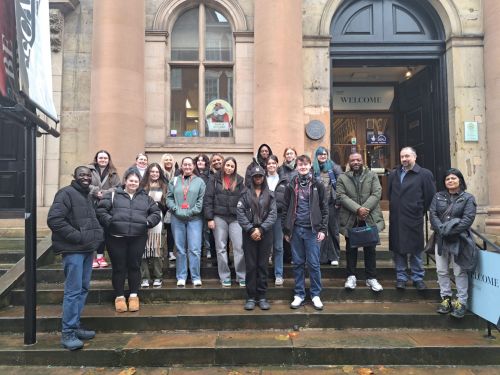
As Programme Leader for BA Law with Criminology, I was excited to be offered the opportunity to attend the National Museum of Justice trip with the Criminology Team which took place at the back end of last year. I imagine, that when most of us think about justice, the first thing that springs to mind are courthouses filled with judges, lawyers, and juries deliberating the fates of those before them. However, the fact is that the concept of justice stretches far beyond the courtroom, encompassing a rich tapestry of history, culture, and education. One such embodiment of this multifaceted theme is the National Museum of Justice, a unique and thought-provoking attraction located in Nottingham. This blog takes you on a journey through its historical significance, exhibits, and the essential lessons it imparts and reinforces about justice and society.
A Historical Overview
The National Museum of Justice is housed in the Old Crown Court and the former Nottinghamshire County Gaol, which date back to the 18th century. This venue has witnessed a myriad of legal proceedings, from the trials of infamous criminals to the day-to-day workings of the justice system. For instance, it has seen trials of notable criminals, including the infamous Nottinghamshire smuggler, and it played a role during the turbulent times of the 19th century when debates around prison reform gained momentum. You can read about Richard Thomas Parker, the last man to be publicly executed and who was hanged outside the building here. The building itself is steeped in decade upon decade of history, with its architecture reflecting the evolution of legal practices over the centuries. For example, High Pavement and the spot where the gallows once stood.
By visiting the museum, it is possible to trace the origins of the British legal system, exploring how societal values and norms have shaped the laws we live by today. The National Museum of Justice serves as a reminder that justice is not a static concept; it evolves as society changes, adapting to new challenges and perspectives. For example, one of my favourite exhibits was the bench from Bow Street Magistrates Court. The same bench where defendants like Oscar Wilde, Mick Jagger and the Suffragettes would have sat on during each of their famous trials. This bench has witnessed everything from defendants being accused of hacking into USA Government computers (Gary McKinnon), Gross Indecency (Oscar Wilde), Libel (Jeffrey Archer), Inciting a Riot (Emmeline Pankhurst) as well as Assaulting a Police Officer (Miss Dynamite).
Understanding this rich history invites visitors to contextualize the legal system and appreciate the ongoing struggle for a just society.
Engaging Exhibits
The National Museum of Justice is more than just a museum; it is an interactive experience that invites visitors to engage with the past. The exhibits are thoughtfully curated to provide a comprehensive understanding of the legal system and its historical context. Among the highlights are:




1. The Criminal Courtroom: Step into the courtroom where real trials were once held. Here, visitors can learn about the roles of various courtroom participants, such as the judge, jury, and barristers. This is the same room that the Criminology staff and students gathered in at the end of the day to share our reflections on what we had learned from our trip. Most students admitted that it had reinforced their belief that our system of justice had not really changed over the centuries in that marginalised communities still were not dealt with fairly.
2. The Gaol: We delved into the grim reality of life in prison during the Georgian and Victorian eras. The gaol section of the gallery offers a sobering look at the conditions inmates faced, emphasizing the societal implications of punishment and rehabilitation. For example, every prisoner had to pay for his/ her own food and once their sentence was up, they would not be allowed to leave the prison unless all payments were up to date. The stark conditions depicted in this exhibit encourage reflections on the evolution of prison systems and the ongoing debates surrounding rehabilitation versus punishment. Eventually, in prisons, women were taught skills such as sewing and reading which it was hoped may better their chances of a successful life in society post release. This was an evolution within the prison system and a step towards rehabilitation of offenders rather than punishment.
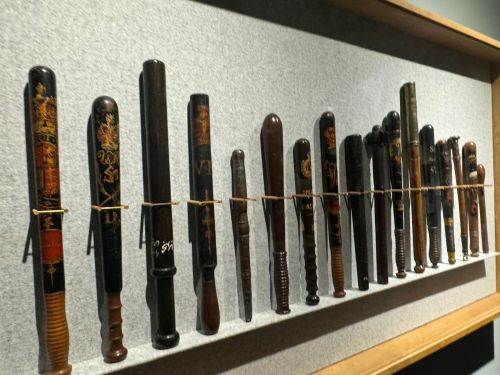
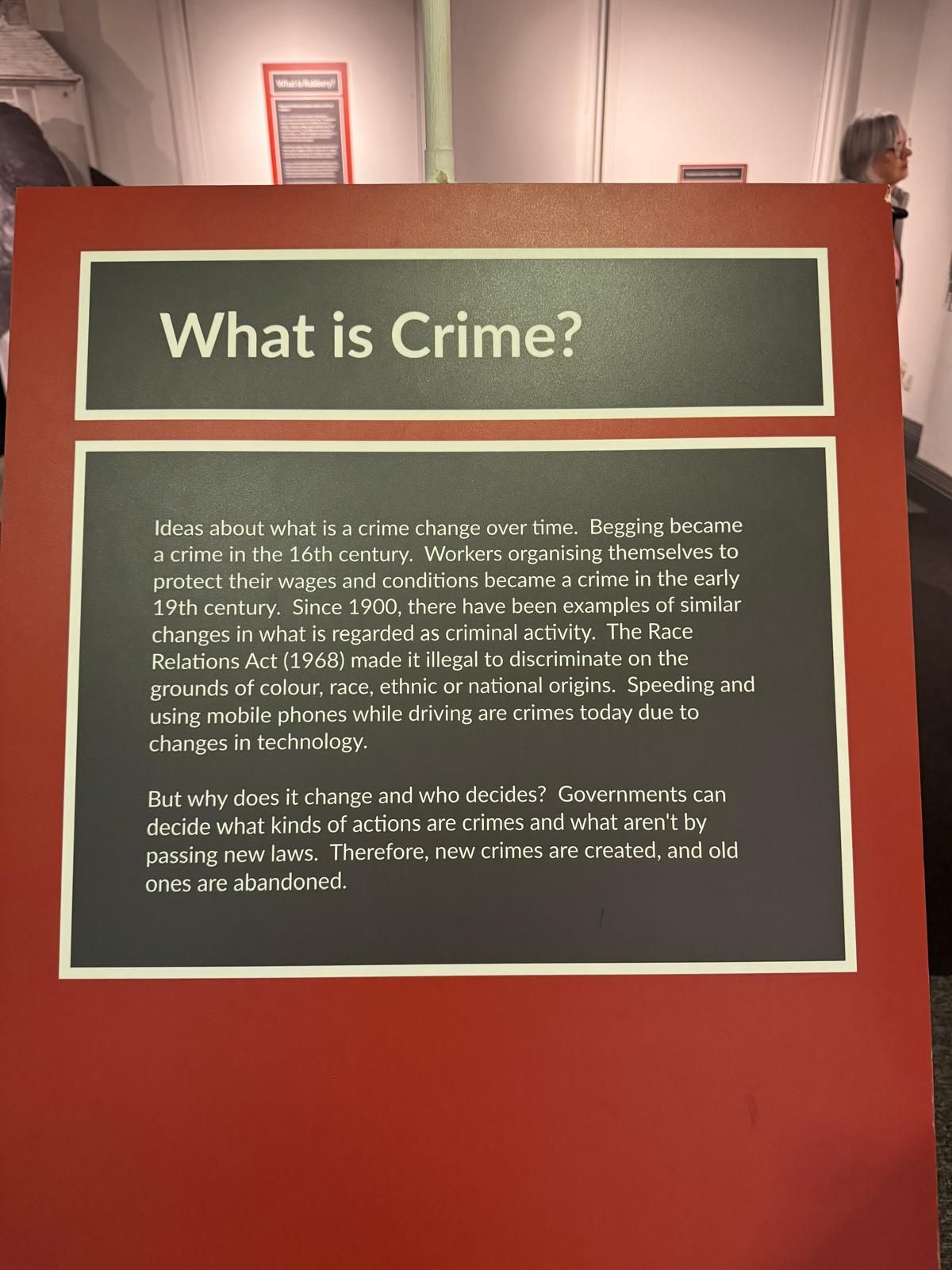
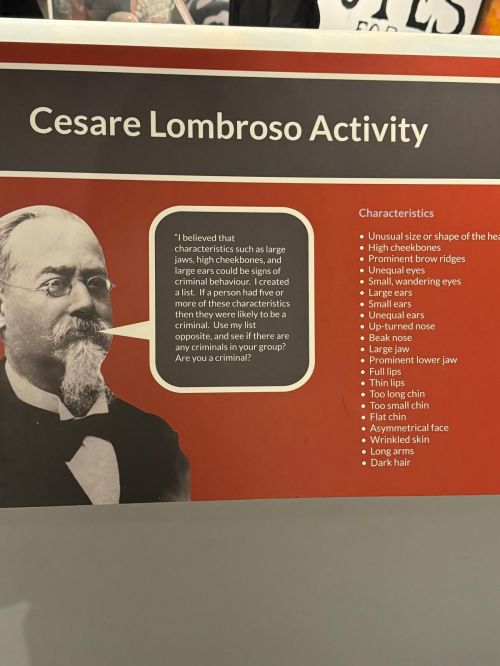
3. The Crime and Punishment Exhibit: This exhibit examines the relationship between crime and society, showcasing the changing perceptions of criminal behaviour over time. For example, one famous Criminologist of the day Cesare Lombroso, once believed that it was possible to spot a criminal based on their physical appearance such as high cheekbones, small ears, big ears or indeed even unequal ears. Since I was not familiar with Lombroso or his work, I enquired with the Criminology department as to studies that he used to reach the above conclusions. Although I believe he did carry out some ‘chaotic’ studies, it really reminded me that it is possible to make statistics say whatever it is you want them to say. This is the same point in relation to the law generally. As a lawyer I can make the law essentially say whatever I want it to say in the way I construct my arguments and the sources I include. Overall, The Inclusions of such exhibits raises and attempts to tackle difficult questions about personal and societal morality, justice, and the impact of societal norms on individual actions. By examining such leading theories of the time and their societal reactions, the exhibit encourages visitors to consider the broader implications of crime and the necessity of reform within the justice system. Do you think that today, deciding whether someone is a criminal based on their physical appearance would be acceptable? Do we in fact still do this? If we do, then we have not learned the lessons from history or really moved on from Cesare Lombroso.
Lessons on Justice and Society
The National Museum of Justice is not merely a historical site; it also serves as a platform for discussions about contemporary issues related to justice. Through its exhibits and programs, our group was invited to reflect on essentially- The Evolution of Justice: Understanding how laws have changed (or not!) over time helps us appreciate the progress (or not!) made in human rights and justice and with particular reference to women. It also encourages us to consider what changes may still be needed. For example, we were incredibly privileged to be able to access the archives at the museum and handle real primary source materials. We, through official records followed the journey of some women and girls who had been sent to reform schools and prisons. Some were given extremely long sentences for perhaps stealing a loaf of bread or reel of cotton. It seemed to me that just like today, there it was- the huge link between poverty and crime. Yet, what have we done about this in over two or three hundred years? This focus on historical cases illustrates the importance of learning from the past to inform present and future legal practices.
– The Importance of Fair Trials: The gallery emphasizes the significance of due process and the presumption of innocence, reminding us that justice must be impartial and equitable. In a world where public opinion can often sway perceptions of guilt or innocence, this reminder is particularly pertinent. The National Museum of Justice underscores the critical role that fair trials play in maintaining the integrity of the legal system. For example, if you were identified as a potential criminal by Cesare Lombroso (who I referred to above) then you were probably not going to get a fair trial versus an individual who had none of the characteristics referred to by his studies.
– Societal Responsibility: The exhibits prompt discussions about the role of society in shaping laws and the collective responsibility we all share in creating a just environment. The National Museum of Justice encourages visitors to think about their own roles in advocating for justice, equality, and reform. It highlights that justice is not solely the responsibility of legal professionals but also of the community at large.
– Ethics and Morality: The museum offers a platform to explore ethical dilemmas and moral questions surrounding justice. Engaging with historical cases can lead to discussions about right and wrong, prompting visitors to consider their own beliefs and biases regarding justice.
Conclusion
The National Museum of Justice in Nottingham is a remarkable destination that beautifully intertwines history, education, and advocacy for justice. By exploring its rich exhibits and engaging with its thought-provoking themes, visitors gain a deeper understanding of the complexities surrounding justice and its vital role in society. Whether you are a history buff, a legal enthusiast, a Criminologist or simply curious about the workings of justice, the National Museum of Justice offers a captivating journey that will leave you enlightened and inspired.
As we navigate the complexities of the modern world, it is essential to remember the lessons of the past and continue striving for a fair and just society for all. The National Museum of Justice stands as a powerful testament to the ongoing quest for justice, inviting us all to be active participants in that journey. In doing so, we honour the legacy of those who have fought for justice throughout history and commit ourselves to ensuring that the principles of fairness and equity remain at the forefront of our society. Sitting on that same bench that Emmeline Pankhurst once sat really reminded me of why I initially studied law.
The main thought that I was left with as I left the museum was that justice is not just a concept; it is a lived experience that we all contribute to shaping.

Share this:


Criminology in the neo-liberal milieu

I do not know whether the title is right nor whether it fits what I want to say, but it is sort of catchy, well I think so anyway even if you don’t. I could never have imagined being capable of thinking up such a title let alone using words such as ‘milieu’ before higher education. I entered higher education halfway through a policing career. I say entered; it was more of a stumble into. A career advisor had suggested I might want to do a management diploma to advance my career, but I was offered a different opportunity, a taster module at a ‘new’ university. I was fortunate, I was to renew an acquaintance with Alan Marlow previously a high-ranking officer in the police and now a senior lecturer at the university. Alan, later to become an associate professor and Professor John Pitts became my mentors and I never looked back, managing to obtain a first-class degree and later a PhD. I will be forever grateful to them for their guidance and friendship. I had found my feet in the vast criminology ocean. However, what at first was delight in my achievements was soon to be my Achilles heel.
Whilst policing likes people with knowledge and skills, some of the knowledge and skills butt up against the requirements of the role. Policing is functional, it serves the criminal justice system, such as it, and above all else it serves its political masters. Criminology however serves no master. As criminologists we are allowed to shine our spotlight on what we want, when we want. Being a police officer tends to put a bit of a dampener on that and required some difficult negotiating of choppy waters. It felt like I was free in a vast sea but restrained with a life ring stuck around my arms and torso with a line attached so as to never stray too far from the policing ideology and agenda. But when retirement came, so too came freedom.
By design or good luck, I landed myself a job at another university, the University of Northampton. I was interviewed for the job by Dr @manosdaskalou., along with Dr @paulaabowles (she wasn’t Dr then but still had a lot to say, as criminologists do), became my mentors and good friends. I had gone from one organisation to another. If I thought I knew a lot about criminology when I started, then I was wrong. I was now in the vast sea without a life ring, freedom was great but quite daunting. All the certainties I had were gone, nothing is certain. Theories are just that, theories to be proved, disproved, discarded and resurrected. As my knowledge widened and I began to explore the depths of criminology, I realised there was no discernible bottom to knowledge. There was only one certainty, I would never know enough and discussions with my colleagues in criminology kept reminding me that was the case.
Why the ‘neo-liberal milieu’ you might ask, after all this seems to be a romanticised story about a seemingly successful transition from one career to another. Well, here’s the rub of it, universities are no different to policing, both are driven, at an arm’s length, by neo liberal ideologies. The business is different but subjugation of professional ideals to managerialist ideology is the same. Budgets are the bottom line; the core business is conducted within considerable financial constraints. The front-line staff take the brunt of the work; where cuts are made and processes realigned, it is the front-line staff that soak up the overflow. Neo-Taylorism abounds, as spreadsheets to measure human endeavour spring up to aide managers both in convincing themselves, and their staff, that more work is possible in and even outside, the permitted hours. And to maintain control, there is always, the age-old trick of re-organisation. Keep staff on their toes and in their place, particularly professionals.
The beauty of being an academic, unlike a police officer, is that I can have an opinion and at least for now I’m able to voice it. But such freedoms are under constant threat in a neo-liberal setting that seems to be seeping into every walk of life. And to be frank and not very academic, it sucks!
Share this:


Will Keir Starmer’s plans to abolish NHS England, help to save the NHS?

In a land-mark event, British Prime Minister Keir Starmer has unveiled plans to abolish NHS England, to bring the NHS back into government control. Starmer justifies much of this change with streamlining operations and enhancing efficiency within the NHS, that in recent years has faced a backlash following long queues and an over-stretched staff pool. Moreover, this is part of Starmer’s plan to limit the power of control from bureaucratic systems.
NHS England was established in 2013 and has taken control and responsibility of the NHS’s daily operational priorities. Primarily, NHS England is invested in allocating regional funds to local health care systems and ensuring the smooth delivery of health care across the NHS. However, concerns, particularly in Parliament have been raised in relation to the merging of NHS England and the Department’s of Health and Social care that is alleged by critics to have brought inefficient services and an increase of administrative costs.
Considering this background, the plans to abolish NHS England, for Starmer come under two core priorities. The first is enhancing democratic accountability. This is to ensure that the expenditures of the NHS are contained within government control, thus it is alleged that this will improve efficiency and suitable allocation of spending. The second is to reduce the number of redundancies. This is backed by the idea that by streamlining essential services will allow for more money to be allocated to fund new Doctors and Nurses, who of course work on the front line.
This plan by Starmer has been met with mixed reviews. As some may say that it is necessary to bring the NHS under government control, to eliminate the risks of inefficient services. However, some may also question if taking the NHS under government control may necessarily result in stability and harmony. What must remain true to the core of this change is the high-quality delivery of health care to patients of the NHS. The answer to the effectiveness of this policy will ostensibly be made visible in due course. As readers in criminology, this policy change should be of interest to all of us… This policy will shape much of our public access to healthcare, thus contributing to ideas on health inequalities. From a social harm perspective, this policy is of interest, as we witness how modes of power and control play a huge role in instrumentally shaping people’s lives.
I am interested to hear any views on this proposal- feel free to email me and we can discuss more!
Share this:


Global perspectives of crime, state aggression and conflict resolutions

As I prepare for the new academic module “CRI3011 – Global Perspectives of Crime” launching this September, my attention is drawn to the ongoing conflicts in Africa, West Asia and Eastern European nations. Personally, I think these situations provide a compelling case study for examining how power dynamics, territorial aggression, and international law intersect in ways that challenge traditional understandings of crime.
When examining conflicts like those in major Eastern European nations, one begins to see how geopolitical actors strategically frame narratives of aggression and defence. This ongoing conflict represents more than just a territorial dispute in my view, but I think it allows us to see new ways of sovereignty violations, invasions, state misconduct and how ‘humanitarian’ efforts are operationalised. Vincenzo Ruggiero, the renowned Italian criminologist, along with other scholars of international conflict including von Clausewitz, have contributed extensively to this ideology of hostility and aggression perpetrated by state actors, and the need for the criminalisation of wars.
While some media outlets obsess over linguistic choices or the appearance of war leaders not wearing suits, our attention must very much consider micro-aggressions preceding conflicts, the economy of war, the justification of armed interventions (which frequently conceals the intimidation of weaker states), and the precise definition of aggression vs the legal obligation to protect. Of course, I do recognise that some of these characteristics don’t necessarily violate existing laws of armed conflict in obvious ways, however, their impacts on civilian populations must be recognised as one fracturing lives and communities beyond repair.
Currently, as European states are demonstrating solidarity, other regions are engaging in indirect economic hostilities through imposition of tariffs – a form of bloodless yet devastating economic warfare. We are also witnessing a coordinated disinformation campaigns fuelling cross-border animosities, with some states demanding mineral exchange from war-torn nations as preconditions for peace negotiations. The normalisation of domination techniques and a shift toward the hegemony of capital is also becoming more evident – seen in the intimidating behaviours of some government officials and hateful rhetoric on social media platforms – all working together to maintain unequal power imbalance in societies. In fact, fighting parties are now justifying their actions through claims of protecting territorial sovereignty and preventing security threats, interests continue to complicate peace efforts, while lives are being lost. It’s something like ‘my war is more righteous than yours’.
For students entering the global perspectives of crime module, these conflicts offer some lessons about the nature of crime – particularly state crimes. Students might be fascinated to discover how aggression operates on the international stage – how it’s justified, executed, and sometimes evades consequences despite clear violations of human rights and international law. They will learn to question the various ways through which the state can become a perpetrator of the very crimes it claims to prevent and how state criminality often operates in contexts where culpability is contested and consequences are unevenly applied based on power, rather than principle and ethics.

 Thoughts from the criminology team