

Media Madness

Unless you have been living under a rock or on a remote island with no media access, you would have been made aware of the controversy of Russell Brand and his alleged ‘historic’ problematic behaviour. If we think about Russell Brand in the early 2000s he displayed provocative and eccentric behaviour, which contributed to his rise to fame as a comedian, actor, and television presenter. During this period, he gained popularity for his unique style, which combined sharp wit, a proclivity for wordplay, and a rebellious, countercultural persona.
Brand’s stand-up comedy routines was very much intertwined with his personality, which was littered with controversy, something that was welcomed by the general public and bosses at big media corporations. Hence his never-ending media opportunities, book deals and sell out shows.
In recent years Brand has reinvented (or evolved) himself and his public image which has seen a move towards introspectivity, spirituality and sobriety. Brand has collected millions of followers that praise him for his activist work, he has been vocal on mental health issues, and he encourages his followers to hold government and big corporations to an account.
The media’s cancellation of Russell Brand without any criminal charges being brought against him raises important questions about the boundaries of cancel culture and the presumption of innocence. Brand, a controversial and outspoken comedian, has faced severe backlash for his provocative statements and unconventional views on various topics. While his comments have undoubtedly sparked controversy and debate, the absence of any criminal charges against him highlights the growing trend of public figures being held to account in the court of public opinion, often without a legal basis.
This situation underscores the importance of distinguishing between free speech and harmful behaviour. Cancel culture can sometimes blur these lines, leading to consequences that may seem disproportionate to the alleged transgressions. The case of Russell Brand serves as a reminder of the need for nuanced discussions around cancel culture, ensuring that individuals are held accountable for their actions while also upholding the principle of innocent until proven guilty in a court of law. It raises questions about how society should navigate the complex intersection of free expression, public accountability, and the potential consequences for individuals in the public eye.
There is also an important topic that seems to be forgotten in this web of madness……..what about the alleged victims. There seems to be a theme that continuously needs to be highlighted when criminality and victimisation is presented. There is little discussion or coverage on the alleged victims. The lack of media sensitivity and lay discussion on this topic either dehumanises the alleged victims by using lines such as ‘Brand is another victim of MeToo’ and comparing him to Cliff Richard and Kevin Spacey, two celebrities that were accused of sexual crimes and were later found not guilty, which in essence creates a narrative that does not challenge Brand’s conduct, on the basis of previous cases that have no connection to one another.
We also need to be mindful on the medias framing of the alleged witch hunt against Russell Brand and the problematic involvement that the UK government. The letter penned by Dame Dinenage sent to social media platforms in an attempt to demonetize Brand’s content should also be highlighted. While I support Brand being held accountable for any proven crimes he has committed, I feel these actions by UK government are hasty, and problematic considering there have been many opportunities for the government to step in on serious allegations about media personalities on the BBC and other news stations and they have not chosen to act. The step made by Dame Dinenage has contributed to the media madness and contributes to the out of hand and in many ways, nasty discussion around freedom of speech. The government’s involvement has deflected the importance of the victimisation and criminality. Instead, it has replaced the discussion around the governments overarching punitive control over society.
Brand has become a beacon of understanding to is 6.6 million followers during Covid 19 lockdowns, mask mandates and vaccinations. This was at a time when many people questioned government intentions and challenged the mainstream narratives around autonomy. Because Brand has been propped up as a hero to his ‘awakened’ followers the shift around his conduct and alleged crimes have been erased from conversation and debates around BIG BROTHER and CONTROL continue to shape the media narrative………
Share this:


Welcome to class. What’s your name?
Often when I ask my newest students to introduce themselves in class – to say and hear their names called out loud – I am reminded that this part of the classroom experience is a fresh opening-up of the classroom as a learning space. I share my full name and invite students to address me as they please. First-year university students often arrive with the weight of their own names – and identities – from their school days. There are often unseen wounds, perhaps unknown. They often arrive in “our” classrooms primed to refashion their own professional personae. A great introduction is their most important networking tool.
On the first day of second grade at my new school, our teacher said my name was so complicated that she nicknamed me by my initials, D.K., which I was called until I decided otherwise. That happened precisely, and abruptly, in the summer between middle and high school, culminating in September 1989. I remember begging my aunt to take me to the music store so I could buy the new Rhythm Nation 1814 cassette.
By then, most of us had attended this same, small school the whole time, so we all knew one another well. I decided to return as a high schooler, and asked folks to call me Diepiriye, no longer D.K. All did, seamlessly.
What’s more, when we’d have a substitute teacher, several of my classmates would yell out my name when they stumbled in taking the roster. They’d always stumble. I’d memorised the roster early on in elementary school; I knew I came between J. King and M. Love. I’d wait.
Caldwell, Cannon, Cummings, Dunbar, Eubanks, Friedman, Gage, Howard (getting closer). While waiting for my name, I’d even write sentences in my mind’s eye using the last names of the kids sandwiching mine – King, Kuku, Love. I could see our names lined-up on the printed page, put together in this order – for years – by the hands of fate. I’d manoeuvre the words around in space, hear how they fit together differently, or in phrases. Stevie Wonder would have a field day with these three words.
I wouldn’t understand this until decades later, but this is one of the typical sorts of imagination that comes along with dyslexia. It’s not just that we mix-up letters and words, rather, our imaginations are less fixed to any simple meaning like in neurotypical people’s minds. Love, King Kuku could have many deeper endings than last names, depending on how you see it. I’m depending on you to use your imagination, here, too. Depending on how you see it, the ship is free, or it is sinking.
McConnell, McGimsey, Montgomery, O’Neil, Palma, Palmer…Todd, Trimmer… Watkins, Welsch, Williams.
It seemed like all but I and one of my classmates’ last names were not English (or Anglicised). Not only that, both our two dads were actually from Nigeria, and our were mothers were best friends from college. Not only that, both our parents grew up on the east and west sides of their respective communities/countries. While I have a funny African name – according to kids – my friend had a Christian first name, and his last name is recognisably Yoruba.
Of course, there was never any civil war between the east and west ends of Louisville, Kentucky – both had black ghettos. Also, both our mothers had ‘desegregated’ every classroom they’d ever entered since elementary in that era’s culture wars. Kids were placed on the frontlines of that war, as author Toni Morrison was quick to remind us.
Both our dads had ended up in America on government scholarships at the University of Louisville, in the aftermath of the chaos of the Nigerian Civil War, albeit through radically differing paths. My dad was a Biafran child soldier. His mother rescued him from a camp, and whisked him out of the country. She named me.
Now, as an educator, I hold the roster. Today, in the UK, roster power is even tied to enforcing national borders. Also of critical value, students’ names will be called many times in class: Called upon to read or respond to text; comment on images; offer perspective or analysis; share lived experience; and crucially, pose critical questions to instructors and peers. The classroom is a busy place.
Call me by my Name.
Too often, in the business of running the classroom, we may overlook simply honouring one another by name, to make the effort to call, recall, and call upon one another in the learning space. As educators, we are called upon to continually demonstrate good practice, shows of good faith.
Everyone uses nicknames in the American South, and uniquely at my school, we called our teachers by their first names. This was one of many ways our ‘liberal’ school broke away from traditional power hierarchies. My second-grade teacher gave me a nickname as a way to shield myself, so I could enter and participate in the learning community untethered. I used this shield until I was strong enough to fly in my own right/light.
University students are in the unique position of fashioning their authentic professional selves. Our students need space to practice calling their names as they wish to be called, professionally. We can share our own curiosity with the stories of all our names, yes, even when we have to be reminded a million times. Yes, even when they have funny African names like Doctor Kuku. Yes, it’s also the proverbial ‘you’re a name not a number’. Sharing is the ethos of community… and crucially, learning. Call me by my Name.
It’s not just my ‘magination, but, we’ve all seen someone respond to an unfamiliar name with the ugly, squished-up face. No one should have their name responded to with what looks like disgust, let alone a child…let alone any student, at any level, in any learning community.
Calling students by name is an important first step in building trust. “Trust,” bell hooks reminds us in Conflict, the 15th the 32 short chapters of her Engaged Pedagogy guide, Teaching Critical Thinking, “must be cultivated in the classroom if there is to be open dialectical exchange and positive dissent.” Trust provides space for students to allow themselves to be known.
Trust also reifies mutual respect. In turn, mutual respect forms the needed basis for the rigorous inquiry, discussion, and crucially, dissent and debate which enlivens and enriches each collective learning experience.
As Badu says: I think y’ betta call Tyrone. Call him! And tell him c’mon … let his voice be heard in class. Call Keisha, Tasha, Joanne, Sian, and Jo, Joey, Joachim, Jane, Paul, Precious, Jean-Paul, Ali, Aliyah, Amadou, Kalliah and Khalil … all of “they and them,” too. And, teachers, let students know stories of your name, too. For example, I wasn’t born Dr. Kuku, but now you can certainly call me by my name!

Pictured here during my first year at college. A high school classmate & I honouring Lyman T. Johnson, a civil rights leader/educator we’d interviewed for our 12th grade oral history project.
Share this:


A Snapshot of My Dissertation: Portuguese Drug Decriminalisation and Some Other Things
I submitted my dissertation back in April, and now the dust has settled I thought it would be good to share the most interesting parts of my research, think of this blog post as an abridged version of my dissertation. Towards the end I’ve also included some tips for completing a dissertation, along with some reading you might like to do if you found this interesting.
What Was my Research About?
My research was about two main areas; Firstly, I wanted to assess the effects of Portugal’s 2001 drug policy whereby all illicit drugs were decriminalised, meaning drug offences relating to personal possession result in a civil punishment rather than a criminal punishment. I assessed key indicators within Portuguese society, gathering data from international, European and national databases which measured public health trends, criminal justice trends and economic trends. Some fields of data I looked at included prices of drugs at market level, drug seizure data, HIV/ AIDS rates among people who inject drugs and the Portuguese prison population.
The second part of my research involved understanding whether a drug decriminalisation policy similar to Portugal’s could currently happen in the UK. I researched this by performing a discourse analysis on drug related House of Commons debate occurring between the years 1970- 2023, selecting roughly one debate every two years. By doing this, I was able to analysis common themes across the years, understanding the political barriers which may mean drug decriminalisation is not a feasible policy idea at the moment given the political attitude and climate within the House of Commons when it comes to illicit drug policy.
What Did I Find Out?
Look through the slideshow below to view summaries of my findings.

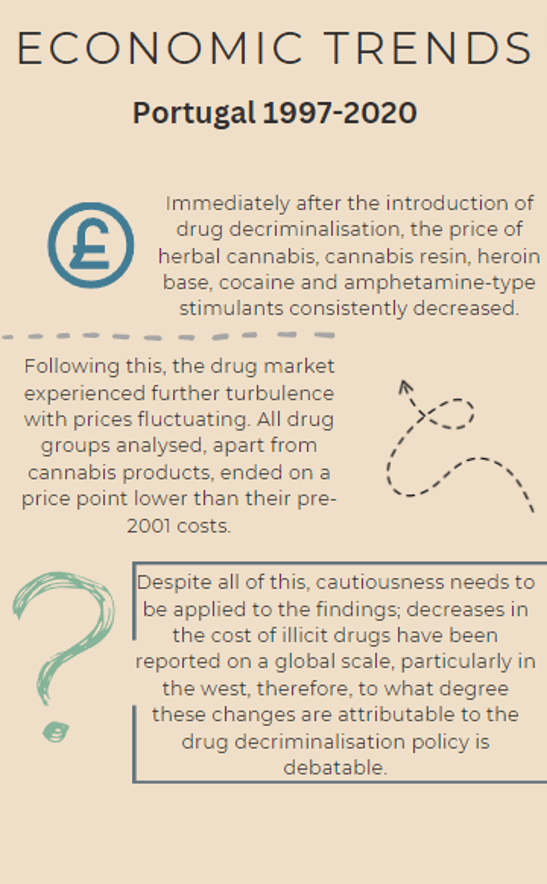


Some Final Comments and Conclusions:
Generally, my research found that Portuguese drug decriminalisation correlated with effects that can be seen as positives. Of course, my research needs to be looked at critically, I don’t claim that all of the societal indicators are directly attributable to the drug decriminalisation policy, however, the correlations that were found are promising. Policy is always a really complex, multi-faceted topic and it would be simplistic to suggest otherwise.
So is a drug decriminalisation policy likely to happen in the UK? The short answer is probably not very likely at all. My discourse analysis pointed towards five decades of debate which was hyper focused on a law and order approach to drug use, a fixation on low level cannabis use and an insistence on the idea that deterrence measures and the war on drugs is actually working. The debates felt stagnant, with new and progressive approaches being hindered by penal populism and ‘tough on crime’ stances.
During my research I found some really interesting reads and different points of view that I hadn’t considered before. I’ve listed some of my favourite pieces below if you’d like to have a read further into this subject.
- Cebral T.S. (2017) “The 15th anniversary of the Portuguese Drug Policy: Its history, its success and its future,” Drug Science, Policy and Law, 3. https://doi.org/10.1177/2050324516683640
- Eastwood, N., Fox, E. and Rosmarin, A. (2016) “Portugal,” in A quiet revolution: Drug decriminalisation across the Globe. London, UK: Release drugs the law and human rights. https://www.release.org.uk/sites/default/files/pdf/publications/A%20Quiet%20Revolution%20-%20Decriminalisation%20Across%20the%20Globe.pdf
- Goldstein, P.J. (1985) “The drugs/violence nexus: A Tripartite Conceptual Framework,” Journal of Drug Issues, 15(4). https://doi.org/10.1177/002204268501500406
- Jacques, S. and Allen, A. (2015) “Drug market violence: Virtual anarchy, police pressure, predation, and retaliation,” Criminal Justice Review, 40(1). https://doi.org/10.1177/0734016814553266
All of the data used is available from The Hansard Archives, European Monitoring Centre for Drugs and Drug Addiction, European Centre for Disease Prevention and Control and The World Prison Brief. Also, I used Taguette to analyse my qualitative data, it’s totally free and it was so useful.

Share this:


What cost justice? What crisis?
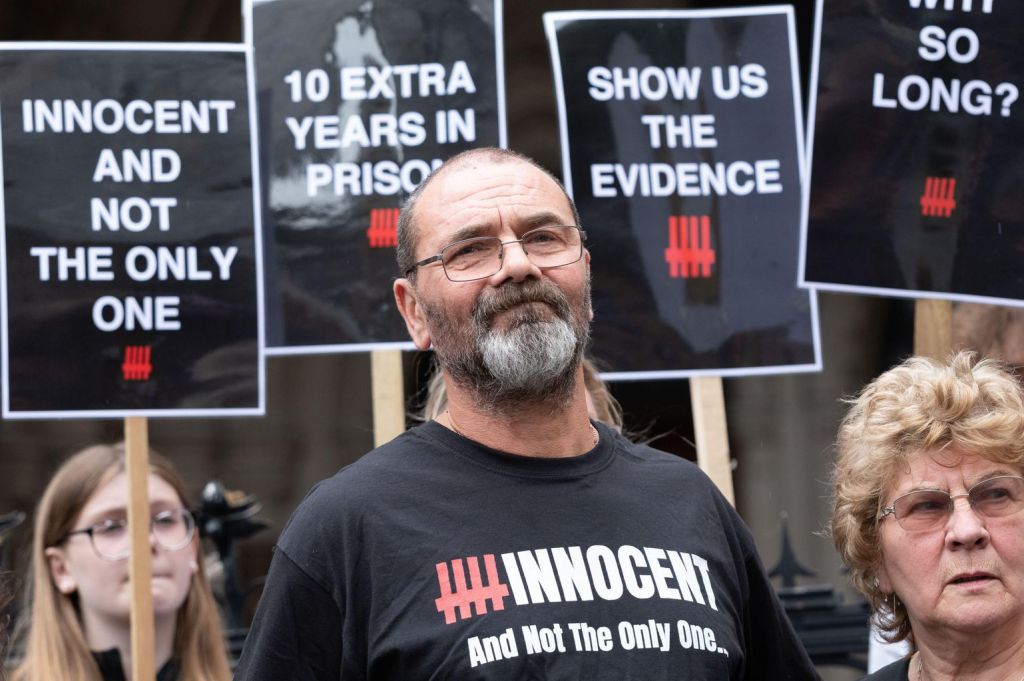
The case of Andrew Malkinson represents yet another in the long list of miscarriages of justice in the United Kingdom. Those that study criminology and those practitioners involved in the criminal justice system have a reasonable grasp of how such cases come about. More often than not it is a result of police malpractice, negligence, culture and error. Occasionally it is as a result of poor direction in court by the trial judge or failures by the CPS, the prosecution team or even the defence team. The tragic case of Stefan Kiszko is a good example of multiple failures by different bodies including the defence. Previous attempts at addressing the issues have seen the introduction of new laws such as the Police and Criminal Evidence Act 1984 and the Criminal Procedure and Investigations Act 1996. The former dealing in part with the treatment of suspects in custody and the latter with the disclosure of documents in criminal proceedings. Undoubtedly there have been significant improvements in the way suspects are dealt with and the way that cases are handled. Other interventions have been the introduction of the Crown Prosecution Service (CPS), removing in part, charging decisions from the police and the introduction of the Criminal Cases Review Commission (CCRC) to review cases where an appeal has been lost but fresh evidence or information has come to light.
And yet, despite better police training regarding interviews and the treatment of suspects, better training in investigations as a whole, new restrictive laws and procedures, the independence of the CPS, the court appeal system and oversight by a body such as the CCRC, miscarriages of justice still occur. What sets the Malkinson case aside from the others appears to be the failure of the CCRC to take action on new information. The suggestion being that the decision was a financial one, with little to do with justice. If the latter is proved to be true, we will of course have to wait for the results of the inquiry, then how can anyone have any confidence in the justice system?
Over the years we have already seen swingeing cuts in budgets in the criminal justice system such that the system is overloaded. Try to pop into the local police station to make a complaint of a crime, you won’t find a station open to the public. Should you have been unfortunate enough to have been caught for some minor misdemeanour and need to go to magistrates’ court for a hearing, you’ll be lucky if you don’t have to travel some considerable distance to get there, good luck with that if you rely on public transport. Should you be the victim of a more serious crime or indeed charged with a more serious offence, triable in crown court, then you’ll probably wait a couple of years before the trial. Unfortunate if you are the alleged offender and on remand, and if you are the victim, you could be forgiven for deciding that you’d rather put it all behind you and disengage with the system. But even to get to that stage, there has to be sufficient evidence to secure a prosecution and it has to be in the public interest to do so. Your day in court as a victim is likely to be hang on the vagaries of the CPS decision making process. A process that has one eye on the court backlog and another on performance targets. Little wonder the attrition rate in sex offences is so high. Gone are the days of letting a jury decide on occasions where the evidence hangs on little more than one person’s word against the other.
Andrew Malkinson and his legal representative have called for a judicial review, a review where witnesses can be compelled to attend to give evidence and documentary evidence can be demanded to be produced. Instead, the government has said there will be an independent inquiry. On a personal note, I have little faith in such inquiries. My experience is that they are rarely independent of government direction and wishes. Andrew Malkinson’s case is a travesty and the least that can be done is to have a proper inquiry. I suspect though that the Malkinson case might just be the tip of the iceberg. The Criminal Justice System is in crisis but budgetary restraint and political whim seem to be far more important than justice. We can look forward to more finger pointing and yet more reorganisation and regulation.
Share this:


Can Barbie ever be Feminist?

Barbie certainly has people talking, the commentary surrounding the film takes a variety of angles. A quick google search shows that Barbie’s ironic take on the patriarchy appears to have ruffled the fragility feathers with some viewers describing it as ‘man-hating’. I could not help but chuckle at a YouTube video titled; Barbie Bombs Innocent Families with Feminist Propaganda…because apparently, equality is such a bad idea.
There have been some superficial and tokenistic attempts to ‘diversify’ the brand. Yet, at its core the imagery of Barbie still appears to be an obvious symbol of oppressive white feminism. The Barbie doll could be seen to project the white feminine beauty ideal, and the main character within the film, Margot Robbie, appears to embody this ideal. I.e., the appearance of a white, cis-gender, heterosexual women with the wealth to be able to afford all sorts of powdery pink capitalist goods and a body type which is impossible to achieve.
In the contemporary era this ideal continues to be damaging. Even for the most privileged of women, it promotes the spending of much more of women’s income than men on items such as beauty, food and lifestyles, and encourages restrictive dieting practices, which can be damaging to physical and mental health (Naomi Wolf, 1990). For marginalised women there is damage caused due to living in a world which promotes the white privileged as normative. Some examples include, the advertising and selling of skin bleaching products to achieve this white or ‘light’ beauty ideal, to schools excluding Black and Brown school children for having afro textured hair (Emma Dabiri, 2019 and Ibram X. Kendi, 2019).
Whilst the Barbie film apparently has a dig at capitalism, the film and the merchandise sold will produce huge profits by selling this particular brand of feminism. So those interested can buy into feminism and make the capitalists happy rather than being political or radical.
Apparently, the film depicts a comedic take on the patriarchy, with Ken’s toxicity and Barbie having to deal with microaggressions when entering the ‘real world’. How far does the film go with illustrating patriarchal oppression? Is the intersectional oppression experienced by the most marginalised of women present? Does Barbie and Co have issues with femicide, police brutality, poverty, mental ill health, rape, incarceration, immigration detention, homelessness or drowning whilst in a boat whilst trying to seek refuge? Or is the patriarchy in film only palatable and profitable if it presents itself in the form of privileged women experiencing comedic microagressions?
Maybe Barbie will lead to some (probably white and privileged) people thinking more critically or feeling empowered but it doesn’t seem to be a type of feminism ‘for all people’, so perhaps it’s not feminism at all (bell hooks, 1982).
I wonder what will happen to the profits made from the film…
Note* I have not watched the Barbie film so apologies for the vague analysis and sketchy details*
References:
Dabiri, Emma. (2020) Don’t touch my hair. United Kingdom: Penguin Books.
hooks, bell. (1982) Ain’t I a Woman : Black women and feminism. London: Pluto.
Kendi, Ibram. X. (2019) How to be an antiracist. London: The Bodley Head.
Wolf, Naomi. (1991) The Beauty Myth : How images of beauty are used against women. New York: William Morrow and Company.

 Thoughts from the criminology team