
Home » 2021 (Page 2)
Yearly Archives: 2021

At The Mouth of ‘Bloody Sunday’ #Travel #Prose #History
At the Mouth of Bloody Sunday
I know the one thing we did right, was the day we started to fight. Keep your eyes on the prize…hold on. Hold on.
Bloody Sunday in Selma only highlighted the bloody Mondays, Tuesdays, Wednesdays, Thursdays, Fridays, and Saturdays that Black people in America have faced from the first time we laid eyes on these shores. It took people to gather and protest to change. In December ’64, the good Rev. Dr. King was awarded the Nobel Peace Prize for this movement. That spring in Selma, people marched across a bridge in order to highlight the normal voter suppression practices still happening throughout the south – and still in 2021.
“If you can’t vote, you ain’t free. If you ain’t free, well then you a slave.” –Intro interview to Eyes on the Prize part 6/8.
According to the National Park Service, who oversees the important civic monument now:
“On “Bloody Sunday,” March 7, 1965, some 600 civil rights marchers headed east out of Selma on U.S. Route 80. They got only as far as the Edmund Pettus Bridge six blocks away, where state and local lawmen attacked them with billy clubs and tear gas and drove them back into Selma.”
From my 7th grade social studies class circa ‘87, I would also add: The good white citizens of Selma gathered at the mouth of the bridge for the spectacle, to witness or probably participate in the oppression. We see them in the footage, films, pictures and media coverage of the events, and we know many are likely still alive. Black-n-white news footage of the days leading to Bloody Sunday show the sheriff and his angry henchmen prodding people with their clubs, plenty of ‘regular’ people watching in joy.
The people prodded? Well-dressed and behaved Black citizens of Selma and activists who’d come to support them. According to the footage, white citizens came out in droves for what they knew would be a bloody suppression of simple voting rights. As spectators, their presence made the massacre spectacular.

I’ve visited the National Voter Rights Museum and Institute at the mouth of the bridge, and there they have an actual jar of jellybeans used to test Black people coming to sign up to vote at the local government office. Yes, sitting behind that booth was a white man who demanded that a black person – any citizen of the darker complexion – accurately guess the number of jellybeans in a jar in order to be allowed – in order for him to allow them – to register to vote. I feel like I have to repeat that, or say it in different ways because it is so unbelievable.
This September, I visited a museum at the edge of the Edmund Pettus bridge in Selma, Alabama, on the way to Montgomery, the state capital. This historical museum marks local efforts to contest voter restriction practices. These practices were heinous in tone and texture, yet creative and cringe-worthy in nurture and nature. For example, consider the ingenious of these jellybean-counting white men in DC who created the separate-n-unequal space to inspire a variety of voter suppression taxes, tests and clauses throughout the south. It is these sorts of mad men who make decisions that impact the entire world as we have come to know and understand it now.
Yes, it is these sorts of men who send politicians to the state houses, and sent/send senators to Washington DC, to cajole politicians of every hue to compromise on their values. Now, we also know they send mobs to storm the capitol on the very day all the legislators gather to confirm the election results.
I know the one thing we did right, was the day we started to fight. Keep your eyes on the prize…hold on. Hold on.

Imagine yourself standing there in a museum, looking at a shelf, and there is a jar of jellybeans. There’s nothing spectacular about the jar, nor its contents. For any of us have seen something like this in virtually any kitchen, or supermarket. My granny grew, harvested and canned vegetables, so growing up I got to handle many mason jars first hand.
In fact, I love jellybeans. I used to visit the gourmet jellybeans shop in the mall after school when I was a kid. You could pick out any flavour that you liked, and I always went for blueberry, and cherry. I loved the contrast between the royal blue and Corvette red. It is a childhood fascination that my dentists still adore me for to this day. Naturally, these gourmet jellybeans were a little more expensive than the ones you get in the supermarkets, but I liked to save my money and treat myself sometimes. Plus, it felt very special being able to pick out the ones you like, and not have to discard the disgusting ones – who ever thought licorice or cola belonged on a jelly bean!?!
As a candy, jellybeans are so visually enticing. As you enter the shop, the walls are covered from floor to ceiling with all sorts of bright neon colors. Every shade of the rainbow grabs your eyes, calls to you. Between stacks of plastic bags and scoops, you are awed by the massive jars of each individual jellybean color ready for you to pick-and-mix. There are also tables with stacks of both empty and pre-filled jars. There are jars of all sizes filled with colorful patterns of jellybeans with matching ribbons tied in bows around the lids. Of course, the entire shop smells like fruit, all kinds of fruits, sweet, succulent fruits that you cannot even imagine. You are the customer, you are king. By virtue of entering the fancy shop, this is your kingdom.
Now take all of that and put it in a jar. To get to this jar, you have to enter an official government building in the town center. Next to the entrance stands an armed, uniformed white man who gives you a disgruntled look as you enter, signaling that he’s not there for your safety but aggravation. Now, as you approach, you see the jar, sitting on a counter, and behind it sits another white man. Try to imagine this white man, probably with a gun next to him or somewhere nearby, with nothing better to do than to threaten your life. Because the town is so small, he knows your last name, and may know of your family.
Since this is a small town, he knows your employer, he knows where you live as you’ve just written this down. He may even know your family, as the local history is so insidious, his family may have even owned or overseen yours at one time. Or, at that very moment, you or a family member may work for him or his kin. Your kids might play together. You may have played with him as a kid when, for example, your mother was his nanny (read-and-said-in-the-south: Mammy). Yet now, here in a free democracy, it is his job to register citizens to vote.
It is his prerogative, the birthright of this individual, plain (white) man on the other side of the glass to demand that you count the number of jellybeans in the goddamn jar. It is a privilege that no one anywhere near here has ever questioned. So, with a smile, he plops a big red “DENIED” stamp on your registration form. Of course yo’cain’t! A “killing rage” surges. Be glad you don’t have a gun with you.

Share this:


#CriminologyBookClub: Dying in Brighton
As you know by now, a small group of us decided the best way to thrive in lockdown was to seek solace in reading and talking about books. Hence the creation of #CriminologyBookClub! Building on on what has quickly become standard practice, we’ve decided to continue with all eight bloggers contributing! This title was the second chosen by @manosdaskalou and is our 14th book. Read on to find out what we thought….
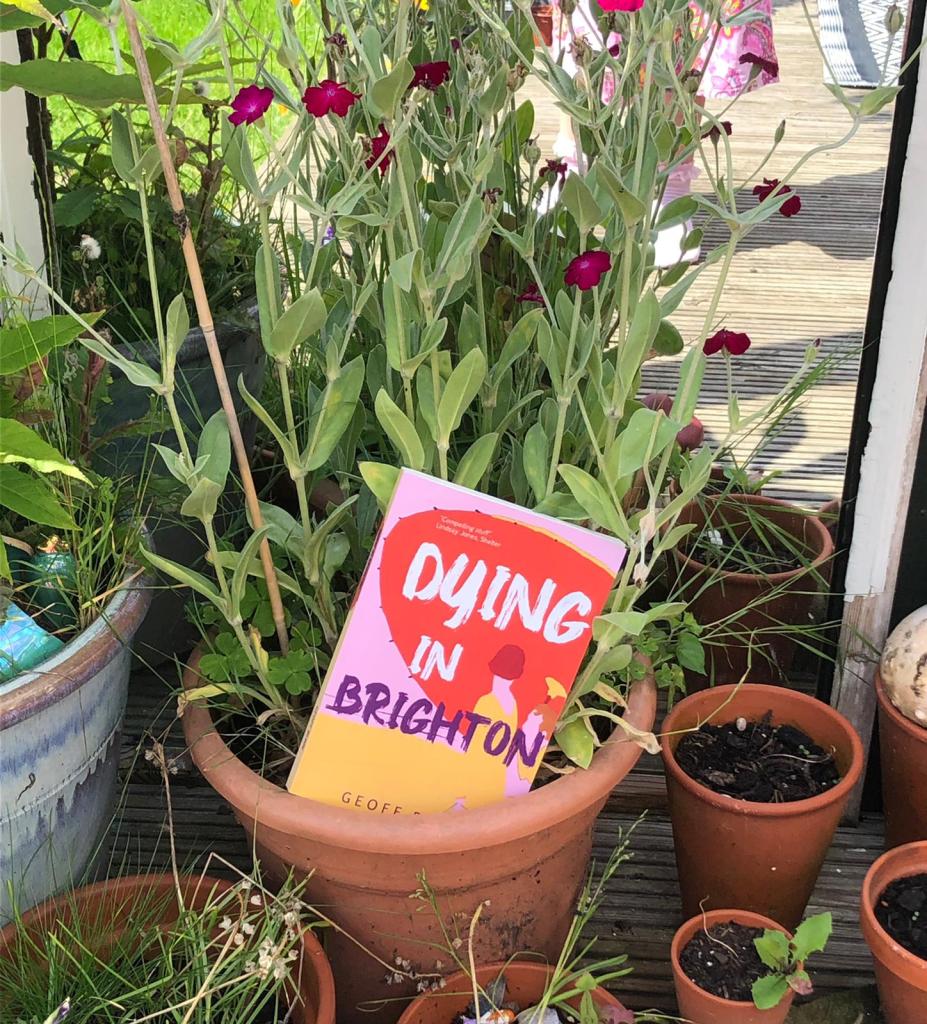
I have no profound objection to self-published books but have read only one other. The rationale for reading the first one was to proof-read/copy edit for the author. That can’t really be called reading, because you miss the story by studying the text so closely. However, I digress. The blurb for this book sounded fascinating, individual narratives heading toward one place: Brighton. Unfortunately, whilst the idea for the book was clever, the writing was overly descriptive and at times, turgid. There is no space for the reader to imagine the characters or the places, everything is told in minute detail. There is a clear attempt to be inclusive with the choice of characters, but they are largely one-dimensional and lack authenticity. The final character talks about his supposed lack of representation as a white man in Brighton (with a white population of 90%) and at that point, I lost what little interest remained. In feminist circles, the question “what would a mediocre white man do?” is prevalent, a possible response could be; write this book. The only positive I have to offer is the support offered by sales to Shelter.
@paulaabowles
The format and style of the book was unlike anything I had read before: and I really liked it. The characters were full of life: a life riddled with inequalities, harm and pain. Unlike other reads where I have failed to feel anything for the characters (or anything other than a serious dislike), Dying in Brighton evoked a number of emotions from myself towards the people in the book. However these emotions were left in a sort of vacuum, with myself feeling very ‘meh’ at the end of the book. I was disappointed with the final chapter. Whilst I can appreciate the ending and the manner in which it is told, I did not like it. I wanted to know more about how Akeem, Nicola, Wasim, Lori and Paul got to the end they got to. Considering the ‘end result’ and my emotions from the previous chapters, I feel I should have had a more powerful response to the end: but I did not. The short snippets were not enough for me: and I feel that the last chapter does not do their stories or their lives justice. Despite this, I would recommend!
@jesjames50
The title Dying in Brighton does not leave much to the imagination. I am glad that the purchase of this book supports a charity. Unfortunately, I found this book to be problematic. I did not understand his selection of characters or how their stories linked. The book reads as though a heterosexual white man who is not disabled is congratulating the white men characters within the book for being friends with people who are migrants or LGBT. There is even a point where a character feels ‘underrepresented’ as a white man…I skimmed the book as I am sick of hearing similar to this in reality.
@haleysread
This is a book that definitely divided the book club and I have to say the comments were by far more negative than positive. For my part, I found the narrative interesting in a strange sort of way. I didn’t find myself labouring on the description and attributes of the characters but rather took in an overall sense of ordinary people that were troubled and in trouble for some reason or another and therefore found themselves gravitating to Brighton; in fairness they could have gone anywhere. The book didn’t take long to read, and the narrative ends rather abruptly but I think that is probably the point. The book left me with a sense of sadness, and it reminded me that homeless people are real people with real lives and yet are very often invisible in our society. Would I read something from the same author again, probably not? Would I recommend the book, probably not, but it did hit a mark somewhere along the line?
@5teveh
This book was a very quick read. Each chapter presented a very stereotypical view of a member of every marginalised group you can think of – a refugee, a trans woman, a troubled teenage girl. The book ended with a chapter about a rich white man with houses all over the world, finding himself feeling like he wasn’t represented. It turns out – spoiler alert – that all the marginalised people went to Brighton, became homeless and died. At the end a woman was selling craftwork with each of the dead, marginalised homeless person’s face. Now I can see how, to a critical criminologist, all this is problematic to say the least. However, the book carried a message that homeless people are invisible. People walk past them every day without a second glance. The author also donated profits of the book to Shelter so it was for a good cause. So, although the book was heavily criticised during our discussion, for people in many walks of life I’d like to think the book would quite literally open their eyes and say hello to a person living on the streets.
@amycortvriend
This book centres around 5 different characters and their life experiences and choices that lead them to Brighton. When I first read the blurb, I assumed this book would take me on a thought-provoking journey about individuals that could be seen as outsiders within society, and how their stories are interwoven. What was thought provoking for me was how the representation of individuals can be so wrong. Throughout the book I was distracted by the problematic ways in which the characters were portrayed. I didn’t like the hyper sexualisation of Lori, I felt like this was an attempt to explore transgender issues without any understanding of transgender issues… it was tasteless and done from a male gaze. I also didn’t like the lack of context and understanding of refugees, this exploration was very tone deaf and seemed informed by how the ‘Western world’ views refugees. Usually when reading a book I have some emotion to the characters, however I felt far removed from all the characters and their stories. At the end of the book I also felt like the stories of the five individuals were rushed, there was no back story to why or how they had died in Brighton just that they were dead. I don’t know what angle the author was going for but for me the ending fell flat.
@svr2727
This book sounded very promising and I usually really enjoy short stories about very different characters and their experiences and how they converge but this book was disappointing in so many ways. Obviously being self-published meant that it wasn’t as polished as it could’ve been and I find little mistakes to spelling and punctuation really distracting from a story. I wish this was my only complaint! The characters were badly written caricatures – you got the sense that the author had never spent any time with anyone from those backgrounds and that perhaps he wasn’t the right person to be telling these stories. The most authentic chapter of the book was the final one where the narrator (a successful white man) feels that he isn’t represented! Easily the worst book I’ve ever read.
@saffrongarside
This is an anthology of different stories of people in very adverse circumstances all of whom are heading to Brighton. In most cases it is not clear why they are heading that way and what they hope from their move there. The short stories are independent from each other and there is no obvious connection between them. Each story explores a different character faced with different issues from abuse, sexuality and substance use. It sends out a signal of some of the social vulnerabilities people are exposed; this however is done as a matter of fact not exploring the social dimensions of the situation. The end brings the stories together but for me this was unsatisfactory. This book has a great idea, an interesting layout but its execution does not meet the goal. The stories are interesting but some of them feel a bit rushed; more character development would have allowed the reader to get closer to the situation and the social issues the author wants to alert people to. As I read it, I thought that some of the stories read more like vignettes that we use in exercises or training for making people aware of certain problems. In terms of literary merit, these are not quite there.
@manosdaskalou

Share this:

My First Foreign Friend #ShortStory #BlackAsiaWithLove
I love school.
In the third grade, we had a foreign student named Graham. His parents had come over to our hometown from England with a job, and his family was to stay in our town for a year or two.
Other than Graham’s accent, at first he didn’t in anyway appear, or feel different.
The only time that Graham’s difference mattered , or that I knew Graham’s difference mattered, was on the spelling test. We had moved far away from three letter words, to larger words and sentences, and by fourth grade we were writing our own books.
But in the third grade, there was Graham on our first spelling test, and our teacher drilling words like color.
The teacher made it fun by using word association to aid in memory. Then, he paused to explain that Graham would be excused if he misspelled certain words because where he’s from, they spelt (spelled) things differently. Spell “color” differently, we all wondered?
Our teacher explained that there are many words where they add the letter U, that are pronounced in the same way. Anyway we have different accents in our own country. Heck, we had different ways of saying the word “colour” in our own city. Where does the extra-U go? Then of course, the teacher spelled out the word. He could not write it on the chalkboard because we were sitting in a circle on the area rug, on the library side of the classroom. It is then that I also realized that I had a visual memory, even visualizing words audible words, both the letters and images representing the meaning. I wanted to know why people in England spelled things differently than in America. Despite Graham’s interesting accent, and easy nature which got him along fine with everyone, he was going to have to answer some questions.
Though our teacher did not write the letters, in hearing them I could see them in my mind moving around. I started imagining how moving the different letters shifted – or did not shift – differences in sound, across distances, borders, and cultures. I started imagining how the sounds moved with the people. Irish? Scottish? People in our city claimed these origins, and they talk funny on TV. Britain has many accents, our teacher explained. “I’m English,” blurted Graham.
We didn’t know much, but we knew that except for our Jewish classmates, everyone in that room had a last name from the British Isles, which we took a few moments to discuss. Most our last names were English, like my maternal side. A few kids had heard family tales of Scottish or Irish backgrounds, German, too. One girl had relatives in Ireland. And wherever the McConnell’s are from, please come get Mitch. Hurry up!
How did we Blacks get our Anglicized names? Ask Kunta Kinte! And how did this shape Black thought/conscience, or the way we talk? I wanted to know MORE. I thought Jewish people were lucky: At least they knew who they were, and they were spoken of with respect. Since my dad is Nigerian, (and my name identifiably African) I had a slight glimpse of this. I knew I had a history, tied to people and places beyond the plantation, and outside of any textbook I’ve ever had (until now where I get to pick the texts and select the books).
My family is full of migrants, both geographically and socially, so homelife was riddled with a variety of accents. Despite migrating north, my grandparents’ generation carried their melodic Alabama accents with them their whole lives. Their kids exceeded them in education, further distancing our kin from cotton farming, both in tone and texture. This meant that my generation was the first raised by city-folk, and all the more distant from our roots since we came of age in the early days of Hip-Hop. At home, there were so many different kinds of sounds, music, talk and accents. Fascinating we can understand done another.
Our teacher also told us that Americans also used some of the same words differently. Now, I’ve lived here in the UK for a decade and I can’t be bothered to call my own car’s trunk a boot. Toilet or loo? Everybody here gets it. Unfortunately, Graham explained that he knew the British term for what we call ‘eraser’, which the teacher couldn’t gloss over because we each had one stashed in our desks, and he knew we’d have the giggles each time the word was mentioned.
I was still struck by the fact that in spite of all these differences and changes, meanings of words could shift or be retained, both in written and spoken forms. I wanted to know more about these words – which words had an extra U – and where had the British got their languages and accents. For me, Graham represented the right to know and experience different people, that this was what was meant by different cultures coming together.
“Here I am just drownin’ in the rain/With a ticket for a runaway train…” – Soul Asylum, 1992, senior year.
In retrospect it’s weird that Graham’s my first foreign friend. Both my father and godmother immigrated to America – initially to attend my hometown university. They’d come from Nigeria and China, respectively, and I’d always assumed that I’d eventually visit both places, which I have. Perhaps this particular friendship sticks with me because Graham’s the first foreign kid I got to know.
Through knowing Graham, I could for the first time imagine myself, in my own shoes, living in another part of the world, not as a young adult like my folks, but in my 8-year-old body. What interested me more was that I could also see Graham was not invested in the macho culture into which we were slowly being indoctrinated (bludgeoned). For example, Graham had no interest in basketball, which is big as sh*t in Kentucky. Nor did I. “Soccer is more popular over there,” our teacher explained, deflecting from Graham’s oddness. “But they call it football.” Who cares! I’d also seen Graham sit with his legs crossed, which was fully emasculating as far as I knew back then. The teacher defended him, saying that this also was different where Graham came from. I definitely knew I wanted to go there, and sit anyway I wanted to sit.
Share this:


A microcosm of deviancy

A little over a week ago our university introduced the compulsory wearing of face masks indoors. This included wearing of masks in classrooms as well as common areas and offices. Some may argue that the new rules were introduced a little too late in the day, whilst I’m sure others will point to the fact that government guidance is that the wearing of face masks is advisory and therefore the introduction of the new rules was unwarranted. Let’s be honest the government and their political party haven’t set much of an example regarding the basic safety ideas, let alone rules, as evidenced by the recent Conservative party conference. The new rules at the university, however, are not enforced, instead there is a reliance that students and staff will comply. This of course creates several dilemmas for students and staff where there is a failure to comply and it makes for some interesting observations about general human behaviour and deviance. To that extent, university life might be viewed as a microcosm of life in the general population and this lends itself quite nicely to the analogy of behaviours whilst driving on a road.
Driving behaviours vary, from those drivers that consistently and diligently stick to the speed limit despite what others may be doing, to those that have complete disregard for limits or indeed others including those that police the roads. Let us be quite clear at this stage, speed limits are nearly always there for a reason. There is ample research that speed kills and that reductions in speed limits injuries and saves life. Whilst those drivers that drive over the speed limit will not always be involved in a collision and that a collision will not always result in serious injury or death, there is a much greater potential for this. The risks of course are spread across the population in the locality, the impact is not just felt by the speeding driver but other drivers and pedestrians as well. To some extent we can make the comparison to the risks associated with catching Covid and the wearing of masks and social distancing, failure to comply increases risks to all. As a quick reminder, the wearing of masks is to protect others more so than it is to protect the individual mask wearer.
Observations of behaviours regarding staff and students wearing masks at the university are interesting. There are those that comply, regardless of what others are doing, some of these will have been wearing masks indoors before the new rules came in. Not dissimilar to the careful driver, sticking to the speed limit but also prepared to drive slower where they perceive there is a greater risk. Then there is the well-intentioned mask wearer, the one that knows the rules and will stick to them but through absent mindedness or through some of life’s many distractions, they fail to wear their masks at various points of the day. As with the well-meaning driver, they are easily reminded and often apologetic, even if it is only to themselves. Of course, there is the ‘follow the flock’ wearer, the person that could quite easily be persuaded to not wear their mask by the rest of the flock as they fail to wear theirs. The driver that joins the rest and drives at 40mph in a 30mph limit because the rest of the traffic is doing so. Next is the deviant that has disregard for the rules as long as no one in authority is looking. The person that keeps their mask handy, probably under their chin and then when challenged in some way, perhaps by a disapproving look from a member of staff or by a direct challenge, puts their mask on but only for the duration they are under observation. Not dissimilar to the speedster that slows down when they see a police vehicle or a static speed camera only to speed up again when the danger of being caught and sanctioned has passed. Finally, there is the person that has complete disregard for any rules, they will blatantly fail to wear a mask and wave away with complete disdain any attempt by student ambassadors positioned at the door to offer them a mask. They like the speeding driver that fails to obey any of the rules of the road have complete disregard for the rules or indeed any rules.
Whilst we may lament the fact that some people forget, are distracted but are generally well meaning, we probably wouldn’t want to impose any sanction for their deviance. But what of those that have complete disregard for the rules? It is worth returning here to the general ethos of wearing masks; to protect others. The disregard for the rules is inter alia a disregard for the safety of others. Whilst we might observe that the deviancy is apparent amongst several students (a problem that might be generalised to society), it is somewhat disconcerting that there are a significant number of staff who clearly do not think the rules apply to them. They seem to neither care about their colleagues nor the students and it would seem consider themselves above the rules. Another comparable trait in general society where those in positions of power seem to have a disregard for rules and others. Finally, we might consider how we could police these new rules as clearly our university society of students and staff are unable to do so. I can hear the cries now, haven’t you got anything better to do, this is a sledgehammer to crack a nut and all the usual rhetoric endured by the police across the land. If you make a rule, you must be prepared to enforce it otherwise there’s no point in having it. Imposing an unenforceable rule is simply playing politics and attempting to appease those that question the conditions in which students and staff work. Imagine speed limits on the road but no enforcement cameras, no police and no sanctions for breaches. It will be interesting to see how long the general population at the university follow the new rules, recent observations are that the flock of sheep mentality is starting to come to the fore. As a parting thought, isn’t it amazing how easy it is to study crime and deviance.
Share this:


On doing a Masters degree in a year that felt like the last level of Jumanji
For the short time I have been writing on this blog (thanks @paulaabowles and @manosdaskalou for the first invite), I am certain I have said before that I never expected to go to university. At school, I was not particularly ‘academically gifted’ and was treated differently to the other children. Not only because I was a Black child in an almost homogenously white mass, but also because I was neurodivergent. Back then, I did not know terms like ‘neurodiversity’ or ‘disability‘ but I knew I was different because the teachers went out of the way to treat me differently (and not in the best way). It was only recently that I saw my school experience was intersectional, and how I was treated was traumatisingly ableist. At sixteen, I was forced to go to college to retake my GCSEs (or the equivalent), where I retook English and Maths while doing a BTEC Level 2 qualifiaction. Going on to do A-Levels at seventeen years old, I realised I did not exam well.
There, I saw I did well in coursework which I could do at home in an environment I was comfortable in, with time to mull things over and think. I also realised I did well in things I enjoyed. When it came to coursework, I almost sailed through it all, but exams that relied on memory tests … here, I struggled exponentially. Particularly as my dyspraxia impacts memory. As part of a longer thread on children’s education, Professor David Bowles tweeted
“Do you want kids to learn?
Here’s something we’ve discovered.
Kids learn things that matter to them, either because the knowledge and skills are “cool,” or because …
… they give the kids tools to liberate themselves and their communities.
Maintaining the status quo? Nope.”
@DavidOBowles (2020)
When people talk to me now, they have this belief that I have always been collected and together. And when people come to my sessions, or even came to see me when I was an SU sabbatical officer, they did not believe that I got into my undergraduate course (Creative Writing) via clearing. The fact I struggle (and still struggle) with exams is unbelievable to them. To them, I do not fit the picture (built on media-made stereotypes) of what is now called Special Educational Needs [SEN]. As a child, I had a Maths and English tutor in school (Mrs Thomas) and outside of school (JJ, who I’m still in contact with now … great human). It’s only now that I’m seeing that due to the institutionalisation of education, seeing students as individual learners is a challenge for many. One size does not fit all, and now I’m imagining that if autistic children, for example, were able to learn in the system via our special interests, how different things would be for those of us that learn in less conventional ways.
Doing my undergraduate degree, then graduating in July 2019 (mere months prior to the outbreak of COVID in March 2020), I am seeing I did well because I was in a discipline I liked. But more than that, because I was writing about things that mattered to me. The university’s creative writing course did not show me anything about Black British writing, so just as I recommend to all students I meet now (particularly those from historically excluded backgrounds), make two sets of notes: do your own reading as well as those your lecturer gives you. From late summer of 2019, I was in conversation with Criminology’s Stephanie Richards @svr2727 about masters programmes and she of course had all the solutions! Off the back of years of being interested in issues pertaining to racial inequalities and like-issues, I signed on to Leeds Beckett University’s MA in Race, Education, and Decolonial Thought.
Since then, my life has not been the same. Unknown at the point of signing up in the January/February of 2020 for the coming autumn, that we would be in intermittent lockdowns during my study time, I guess this worked out in the end. Yet, following Bowles’ points about learning, I was in an academic discipline that mattered to me (Critical Race/Whiteness Studies) and my final grades reflected the passion I have for these subjects and how courses like mine give students some of the tools to liberate themselves and their communities. My modules were in Research Methods; Decolonial Thought and Critical Race Theory; Race, Identity, and Culture in the Black Atlantic; Children’s Cultural Worlds (elective); Diverse Childhoods (elective), and Critical Whiteness Studies. They also offered Critical Ethnic Studies and Critical Discourses as electives. These modules (minus Research Methods) gave students free reign to write what they wanted as long as it tied into the topic in some way. e.g., in Children’s Cultural Worlds I wrote a postcolonial analysis of the classic C.S Lewis Narnia text The Horse and His Boy, with further comments on how the implementation of canonical texts on the English curriculum is not the problem, the issue is our gaze (later turning the essay into an online talk, which helped teachers inside and outside of my community).
The Coronavirus pandemic was stated to be ‘unprecedented’ but I would argue otherwise, as many generations before us all experienced pandemics. From the Plague to the Spanish Flu, there is a precedent. Yet, when disease has impacted countries in the Global South, countries like Britain have turned the other cheek. Ironically, it is also some of the countries in the Global South that have showed better preparation in fighting COVID-19. Doing my MA, the events of the last 18+ months are also things that lend themselves so appropriately to the course content. In discussions about colonialism and empire, this is not a conversation one can have without thinking about disease historically nor current climate change or capitalism. The nature of my masters was not only relevant to COVID, disproportionality, and others, but also the events in society following the Murder of George Floyd and the subsequent discourses around race equity/equality and anti-racism. One cannot pioneer anti-racism whilst ignoring the destructive nature of capitalism and how racial capitalism functions in our society.
Between September 2020 and September 2021, I did this degree online without setting foot in Leeds. Our lectures were pre-recorded and our seminars were on Microsoft Teams. There was something lost online, but the nature of the discussions was excellent. The fact I was the youngest in my cohort (25) was also welcome, so I was happy to learn from those often over ten years older than me, with many of them doing this course whilst also working in schools as teachers and senior leaders. Listening to their lives and stories was as sombre as they were enlightening. Teachers doing this degree whilst being treated ambominably in schools, we must consider how personal experience is also researchable (as I found doing an autoethnographic dissertation)

As someone that is neurodivergent, my ability to hyperfocus on subjects that interest me (even to the point where I forget to eat/sleep … quite typical of many neurodivergents I know), whilst previously was stigmatised in school, with Leeds it was actually encouraged. Not the not sleeping/eating part, but the critical analysis and taking those ideas further part. To overanalyse in my essays and take it that step further was a real boost for my confidence, to then be invited to make contributions to the primary education teacher training course as well. With lots of my colleagues being based in the North of England, it struck me when I also visited Manchester and Lancaster this year to meet two of my new friends, that there’s something in the northern air that quite agrees with me. It’s something that does not exist in the Midlands or the South. I cannot place it, but I want to inquire! My lockdown experience is very different to most students as my course was previously designed to be mixed-mode. Furthermore, my introverted nature means I can also be happy in my own space for long periods. Whilst my extroverted friends get their dopamine from being around others, those encounters when I do have them require me to be alone for long periods to get the same feelings.
What I do miss is the feeling of being on campus, while simultaneously being in a solitary corner of the library. However, our MA WhatsApp chat has bee invaluable, further to discourses on #AcademicTwitter. Whilst my undergrad often positioned lecturers as a bit more ‘us and them’ (almost like the schoolteacher-student relationship), my MA lecturers positioned themselves as mentors and more human who also love to tweet. Frequently, particularly Shona, would be tagging us in things useful to our interests which I still greatly enjoy. On my MA, I also got the opportunity to write a book chapter on empire, racism, corruption, and COVID-19 for an upcoming anthology (to be published by June 2022) in addition to be part of Leeds Beckett’s CRED paper series where I wrote a paper on how we can better teacher Black history as something that is multidisciplinary. Not looking at history through a tunnel.
In a year or nearly two years, that has felt like fourth level of Jumanji, my masters experience has been invaluable in keeping me grounded. Leeds Beckett gave me something that Northamptonshire (the place I grew up in) has not, and is still unable to give me, and it did so without even having to go there. I have still never been to Leeds, but hopefully I get to visit for graduation next year.
As this level of Jumanji continues, who knows what the future holds? Both COVID-19 and the reinterest in Black Lives Matter have shown us that society needs to be redesigned in a way that benefits the many not the few. The lockdowns have shown that those of us with disabilities were needlessly suffering under institutional violence from employers and education providers, and post-lockdown many employers are shifting back to those ableist ways of functioning. And doing my MA in one of the most interesting (yet bleak) years since 1919 is a reminder of what I am capable of. I just needed some coaxing into it!
Share this:


Kisses from Granny Don’t Count! #BlackenAsiaWithLove #ShortStory
In America, and most certainly in the land of Dixie and cotillions, at the end of junior high school year we have a tradition of getting our senior class rings. By “getting,” I mean individually buying a ring from the same one or two companies in our city who cash in on this ritual annually. We knew that many of us had to foot the bill with our own after-school jobs, while others’ parents could virtually write a blank check! (Hopefully, at least, or perhaps most assuredly, somebody in the school system gets a kickback from all this cash flow.)
While class rings appeared personalized, the rings – and the ritual – were effectively mass manufactured, complete with standardized shapes and design features: school’s name and mascot – in our case a bear – class year (1993!), and maybe our initials inscribed inside. Oh, and a heteronormative adolescent sexualized ritual to which I shall return shortly.
Rings are generally presented at a school ceremony. Until graduation, class rings are worn facing the wearer as motivation towards the ultimate achievement, after which it is worn outward as a badge of pride and honor. A graduating class could all agree to the same design – usually the school colors – which I believe the majority of my class did. While I prefer the look of silver against my dark skin, our school colors were royal blue and gold, so classes at our school often got blue sapphire set in the lowest Karat gold available that didn’t look cheap. For such a notoriously liberal school (i.e., gender and racially/geographically* integrated by design), this was one of the few explicit acts of conformity.
‘You Wear it Well’ – DeBarge, 1985
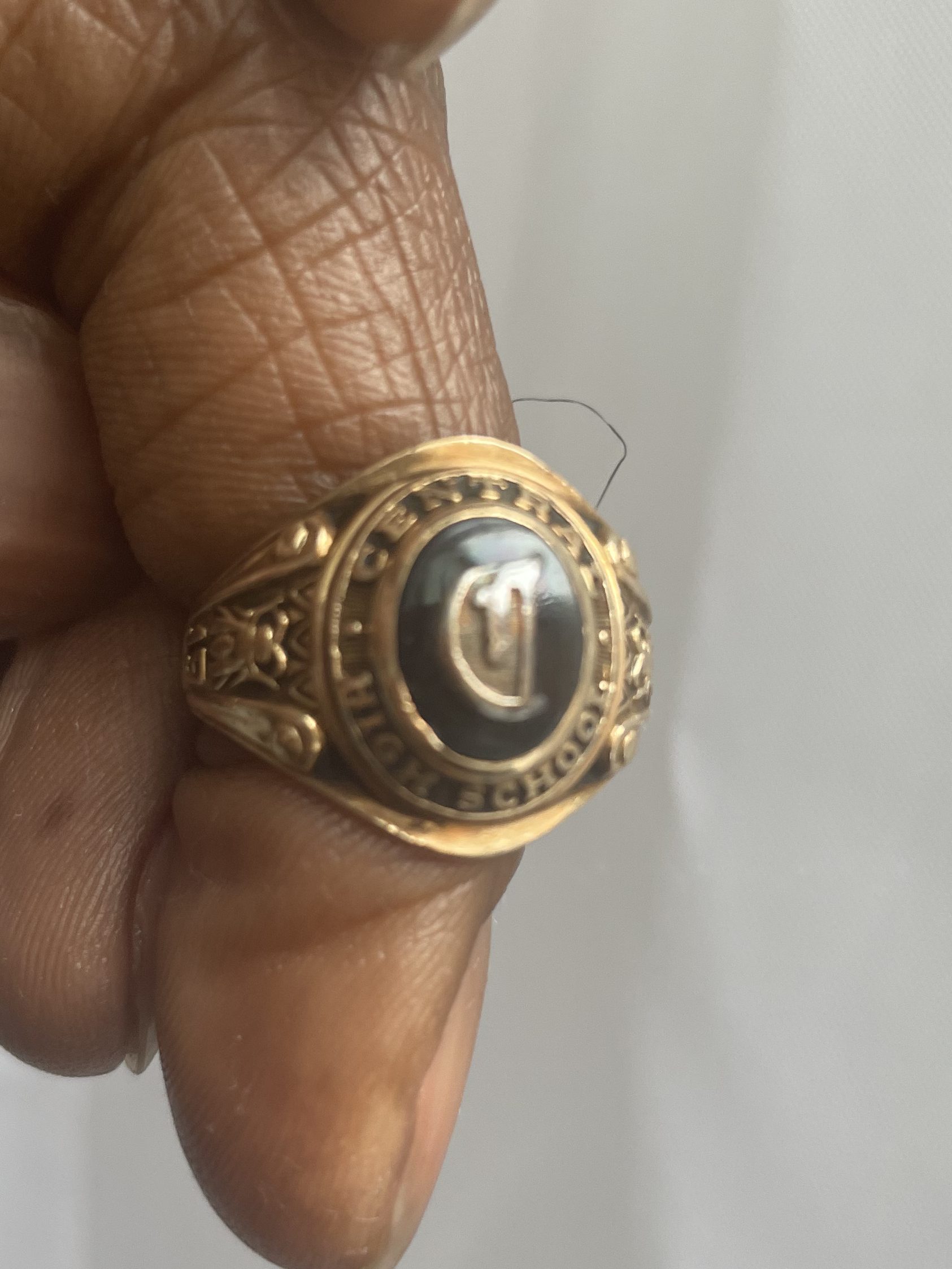
The next part of the tradition is having 100 different people turn the ring, as sort of an acknowledgement of becoming a senior. The first 99 turn it in one direction, while the final person reverses the order. This clockwise/counter-clockwise turn seals the deal. Yet get this, you’re supposed to kiss the hundredth person who turns the ring. You say the word “kiss” in front of most any group of adolescents and they’ll giggle. We knew what kind of kiss was meant. FRENCH like fries! Somehow becoming a senior in high school had been coopted by this hetero-ritual, a hetero-rite of passage (het-or-no-rites!).
I am troubled that this academic milestone is linked to gender. Worse, the ritual is predictably a performance act that fixes gender to normative sexual roles; yes, heteropatriarchy. Worse still, this binary gender performance is discrete, couched in achieving a basic education.
The ring dealer comes to school and makes a sales pitch to the class, and sets up a booth in the lobby after school. In his pitch, he promises a ‘free’ glossy little form to collect all the signatures. It was a bait and switch. These dealers sold us the rings but gave us the forms, the evidence we needed to prove we’d passed another stage towards adulthood. And what were we supposed to do with the blank glossy forms? Come back to school and boast?
The first 50 or so signatures were just us. Our own schoolmates turning each other’s rings, filling in each other’s forms on the very day the rings arrived. Family filled in a lot, too. I distinctly remember a teacher or two requesting to be excluded from the tradition, or take part in the ring ritual of becoming a senior, else we whittle their fingers away.
We all know everybody only wanted to see who signed the final line – a prompt to incite heteronormalizing speech-acts. Well, a few folks weren’t single and already had that 100th spot reserved and filled by sundown. Needless to say, kisses from granny don’t count! I’m pretty sure this wasn’t written on the dealer’s well-crafted sheet. Our market dominated, heteronormative introduction to adulthood for all to see.
I’d attended the same school since second grade so I’d seen people celebrate this class ring ritual for years, and even attended several graduations. I’d watched the “Senior run” year after year – a day at the end of school, when the graduating class runs through all the halls, cheering, banging on lockers as all the kids in all the classes rush out to line the hallways and egg them on. I loved school, adored our school, adored my classmates, and even looked forward to our turn, though parting so bittersweet.
At 16, I was only starting to be able to fully disidentify with the barrage of heterosexualized norms that engulfed me. I had to disentangle heterosexuality from virtually every facet of life – even finishing high school, a normal step we’re all expected to take. It’s as if to gain access to what bell hooks calls ‘the good life’ one had to signify alignment with compulsory heterosexuality.
I knew that I could not even turn my ring 100 times without kissing a girl. No way I’d risk putting a guy’s name at the end of that glossy list – someone I’d actually dreamt of French-kissing. Not like I knew any guy who’d be game. Damn. This was a lot of pressure. This junior prom was forcing me to make all kinds of adult decisions.
“The more I get of you, the stranger it feels…”
I was 16, and wasn’t out yet. Unlike at twelve when these feelings first bubbled over, by 16 I was on the cusp of self-acceptance, and preparing to face this possibility that I was gay. Perhaps it was pure timing. By the 11thgrade I knew for sure I’d be leaving home months after graduation, which was suddenly within reach. I could chart my own homo path. But still, at that age, I had doubts. I tried seriously dating a young woman as my last-ditch effort to see if I was straight or (at least) bisexual.
Kaye wasn’t a classmate, which wouldn’t have worked anyway because in retrospect all my classmates already knew, and had decided to accept me without question. Kaye attended an all-girls’ school, so we’d met through an extracurricular, Black youth empowerment program. Kaye was clearly college bound. She had her own dreams and ambitions, and pursued them – an ideal mate for me. She was the most attractive woman I knew, both inside and out, both to me and others. Yes, THAT sister who is not invulnerable, but has it all together. If she didn’t do, then dammit I was gay!
Fortunately, my girl was smart. And by smart, I mean that she was intelligent, real smart as in NOT clueless at all. We agreed to a kiss on the cheek, and she’d sign the last line on my glossy form. And by ‘agreed to’, I mean that this is what Kaye put on the table as her firm and final offer. She also had the good sense to let me turn her ring, too, but she reserved the 100th signature for someone special. I respected that. This clarified our plutonic status – no Facebook updates needed: I’m gay.
“Gotta find out what I meant to you…You were sweet as cheery pie/ Wild as Friday night”
Share this:


Black History Month: A Final Thought

As we come to the end of Black History Month it is important to shine a light on the Black Lives Matters Movement and highlight the historical significance to the problematic discourse of racialisation.
Black history month is an opportunity for people from the various pockets of the Black community to learn about our own history and educate those who are not from the Black community, in order to decolonise our institutions and our society. As Black people we have our own history formed by systemic oppressions and great triumphs. While it is easy (and lazy) for institutions to use terms such as BAME and People of Colour (POC) these problematic uses of language oppress blackness. We are not a monolith of coloured people. Different racialised groups have and will experience, and uphold difference, harms and achievements within society. Furthermore, it would be naïve to ignore the narrative of anti-blackness that people from racialised groups uphold. Therefore, it is important for us and people that look like us, to continue to have the space to talk about our history and our experiences.
For many people in the UK and indeed around the world BLM became a mainstream topic for discussion and debate following the murder of George Floyd. While the term BLACK LIVES MATTER is provocative and creates a need for debate, it signifies the historical ideology that black lives haven’t mattered in historical and in many ways, contemporary terms.
While it is easy to fall into the trap of describing the Black experience as an experience of victimhood, Black history months allows us to look deep at all our history and understand why and where we are as a society.
The UK is one of the most diverse places in the world, yet we continue to fall prey to the Eurocentric ideology of history. And while it is important to always remember our history, the negativity of only understanding black history from the perspective of enslavement needs to be questioned. Furthermore, the history of enslavement is not just about the history of Black people, we need to acknowledge that this was the history of the most affluent within our society. Of course, to glaze over the triangle trade is problematic as it allows us to understand how and why our institutions are problematic, but it is redundant to only look at Black history from a place of oppression. There are many great Black historical figures that have contributed to the rich history of Britain, we should be introducing our youth to John Edmonstone, Stuart Hall, Mary Prince and Olive Morris (to name a few). We should also be celebrating prominent Black figures that still grace this earth to encourage the youth of today to embrace positive Black role models.
Black history for us, is not just about the 1st-31st of October. We are all here because of history we need to start integrating all our history into our institutions, to empower, educate and to essentially make sense of our society.
Share this:


Meet the Team: Stephanie Richards, Associate Lecturer in Criminology

A Warm Welcome
Hello all! I would like to introduce myself. My name is Stephanie Richards and I am your Student Success Mentor (SSM). Some of the criminology and criminal justice students would have already had the opportunity to meet me, as I was their Student Success Mentor previously. So, it will be great to touch base with you all and it would also be great for the new cohorts to say hi when you see me on campus.
It is that time of the year when we see new students and our existing students getting ready to tackle the trials of higher education. Being a SSM I am fully aware of the challenges that you will face, and I am here to support you throughout your time at UON. As a previous student I can testify that studying at university is incredibly challenging. The leap from school/ college can be daunting at first. A new building that seems like a maze or the idea of being surrounded by strangers that you probably think you have nothing in common with can be enough to encourage you to run for the hills….stepping into a workshop for the first time can give you a stomach flip, but once you take that first seat in class you will come to realise it does get easier.
Upon reflection of my experience as a new undergraduate student I would have to be honest and express the difficulties that I suffered adjusting to my new way of life. I could not keep my head above the masses of reading, and when I did manage to get some of the seminar prep completed, most of the time I struggled with the new questions and concepts that were posed to me. This will be the experience of most, if not all the new students starting out on their university education. This is part of the complex journey of academia. My advice would be to pace yourself, time management is key, if you struggle to understand the work that has been set, ask for clarity and develop positive relationships with your peers and the staff at UON…………..being part of a strong community will get you through a lot!
My role is not just about assisting the new students that have started their university journey, I am also here to help UONs existing students. Getting back into the swing of studying can be daunting after the summer break. Adjusting to face-to-face education can be an overwhelming process but one that should be embraced. We will all miss our pyjama bottoms and slippers but being back on campus and getting some normality back in your day is worth the sacrifice.
The team of SSM’s are here to support you throughout your journey so please get in touch if you require our assistance. We never want you to feel alone in this journey and we want to assist you the best ways we can. We want you to progress and meet your full learning potential, and to get the most out of your university experience.
Share this:

And still the message is the same…
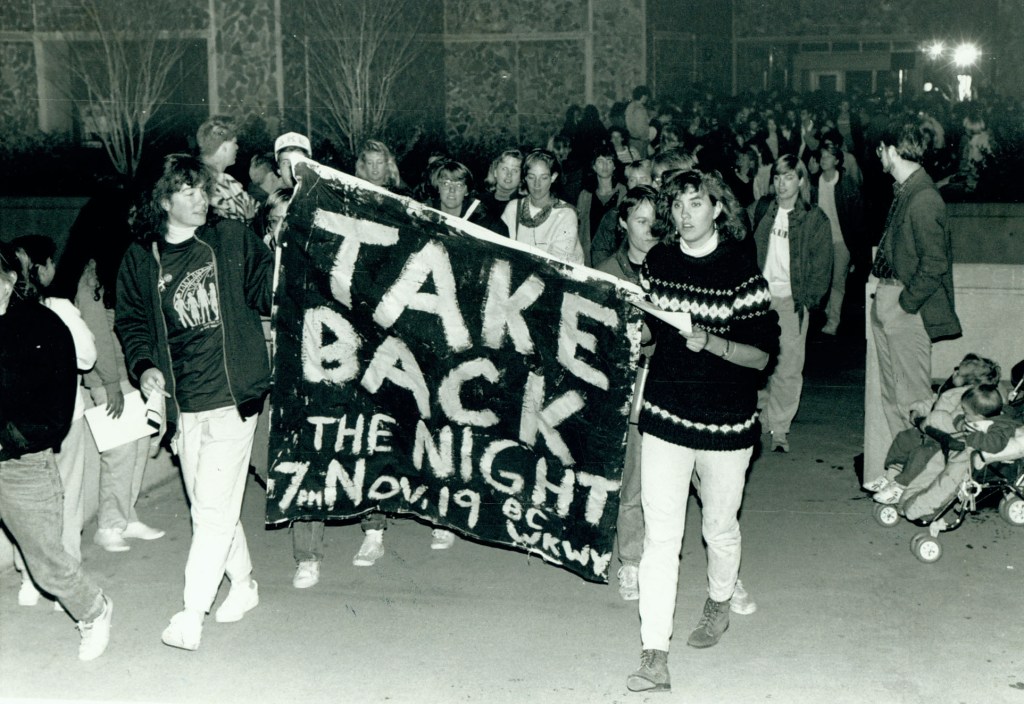
Following on from last week’s blog entry from @5teveh, @jesjames50 explores further dimensions of Sarah Everard’s murder.
Recently we saw the sentencing of Sarah Everard’s kidnapper, rapist and murderer. He has received a whole life sentence. As a woman within society I welcome this sentence. As a criminologist I am at a loss. There is a lot to unpick here in terms of ‘justice’ and whether this has been served. It is pertinent to question the use of a whole life order on a violent, misogynistic, kidnapper, rapist and murderer; who cooperated after arrest, who pleaded guilty and expected the full force of the law. But I shall leave that to another day, as the media’s portrayal of the sentencing and aftermath is what is currently fuelling my anger. The message remains the same, women can and should do more to prevent their victimisation.
The sentence given is at odds with the coverage which has followed. Handing down the most severe sentence available in England and Wales represents the seriousness of the offence, and the damage it has caused to those directly involved and those further afield. The possibility that the offender was in a position of trust, has violated this trust and committed abhorrent acts appears to justify the whole life order. The comparison to terrorism, something which violence against women has been linked to before within academia, is also very telling. But what is the focus? The focus is on how women can go about feeling safe in society and make lines of inquiry if they have doubts about a police officer’s conduct! Here the onus is on women acting in a manner of keeping themselves safe. The message remains the same: women should prevent their victimisation. Excellent I’ll add this nugget of information to my bag of ‘top tips for walking alone at night’.
Why aren’t the media building on this platform to challenge misogynist attitudes? Why are they not raising awareness of violence against women? Sarah’s kidnapping, rape and murder is horrific: but what about the women who undergo daily violence at the hands of their partners, family, friends? These individuals are also in a position of trust and abuse this position to cause harm to women! Here the media could raise awareness about how deep-rooted the issue of violence against women is, but instead they reinforce the idea that women can prevent their victimisation, and that violence occurs at night, by a stranger, and will have the offender brought to justice. This is not the reality for the vast majority of women. It is an extreme and exceptional case (no doubt something True Crime will encapsulate in years to come) and this is further reinforced by the sentence given. Yet violence against women is not exceptional, or rare: it is an everyday reality! Something the media has failed to draw attention to. And by failing to cement Sarah’s kidnapping, rape and murder in the wider context of violence against women, it raises the potential to set a standard of violence against women. Those everyday cases which do not fit the same circumstances are not considered an issue.
My intentions are in no way to take away from the abhorrent crimes committed against Sarah. The crimes sit in the context of violence against women which is still a fundament issue overlooked within society, and has been overlooked once again. And the rhetoric which has followed, yet again, is around how women can protect themselves in the future. The message remains the same…
Share this:


Meet the Team: Francine Bitalo, Associate Lecturer in Criminology

Hi everyone! My name is Francine Bitalo and I will be your new Student Success Mentor for this year. I am looking forward to meeting and assisting you all in your academic journey. Feel free to contact me for any support.
Being a graduate from the University of Northampton I can relate to you all, I know how challenging student life can be especially when dealing with other external factors. You may go through stages where you doubt your creativity, abilities and maybe even doubt whether the student life is for you. When I look back at when I was a student, I definitely regret not contacting the Student Success Mentors that were available to me or simply utilising more of the university’s support system. It is important for you seek support people like myself are here to help and recommend you to the right people.
Besides everything, Criminology is such an interesting course to study if you are anything like me by the end of it all you won’t view the world the same. Many of you have probably already formed your views on life especially when it comes to understanding crime. Well by the end of it all your ways of viewing the world will enhance and become more complex, theoretical and constructive. The advice I give you all is to enjoy the journey, be open minded and most importantly prepare for exciting debates and conversations.
Look forward to meeting you all.

 Thoughts from the criminology team