

Criminology Society!
President: Natalie Humphrey
Secretary: Maisie Storr
Treasurer: Megan Petford
As many of you are aware, back at the beginning of the year, the Criminology was set up. However, I will admit we have been very lacking with content. I am writing this blog to try and get the word out and become proactive. This society could be something that bring all students studying criminology, joint and single honours, together. We have a few ideas in the works, with our first meet up being a movie night. This will be happening in the next few weeks, where we will be watching the new Ted Bundy film, with Zac Efron. Our other ideas include, visiting a court, an escape room and we are hoping for an abroad trip at some stage. However, we need many more suggestions from those who are part of the society. Please feel free to add our social media which I will leave at the end of this blog. We will be posting mainly on our Instagram where we have polls for you to partake in, asking you what you want from the society. If you haven’t already, and are interested, please visit Northampton’ Student Union website where you can officially join the society. Any suggestions would be really appreciated, so just contact us through social media to get your voice heard!
Twitter: @uon_criminology
Instagram: criminologysociety_uon
Share this:


Small island, smaller minds: it takes a village
“In times of crisis, the wise build bridges while the foolish build barriers. We must find a way to look after one another, as if we were one single tribe.” – King T’Challa, Black Panther
If you are White British, racism is not a narrative you would be familiar with, as far as your daily existence is concerned. Whilst racism has always been a day in the life for people of colour, there was a spike in hate crime in 2016 with the Brexit vote. Brexit was triggered on January 31 in the same way it began, in the tint of racism and violence. And that does not always mean physical pain on another. Violence can be verbal abuse, whether that’s direct from the horse’s mouth in terms like “Paki” and “nigger” , or on a note in a Norwich tower block.
On January 31, or Brexit Day, CBBC posted a video from its Horrible Histories TV show on Twitter. British comedian Nish Kumar preludes the clip with an introduction. What was meant to be a child-friendly look at British things, flag-waving Brexiteers turned into something else entirely. They don’t take to being told that tea, cotton and sugar aren’t British things, but products of a very British means of production called colonisation.
In 2018, we began to feel the quakes of the Windrush crisis, which is still happening today. When members of the Windrush Generation were / are being deported under then prime minister Theresa May’s hostile environment policy, Amber Rudd simply fell on her sword. Despite this scandal being buried by “other news”, this hysteria simply echoes that of when they first arrived, well-depicted in Pathé film reels.
In Andrea Levy’s Small Island, this is Britain at its bones. Britain as I know it. Little Britain. This text is about deception; and the biggest ruse is that Britain is a tolerant place and all are welcome. This was just after the Second World War. However, the stories of the working class is at its core, irrespective of skin colour. It has often been said that Britain is the least racist society in Europe, but this is only really if you happen to be born into the calm of being affluent, White and British. And the people publicising these opinions are from this same demographic, those born into privilege.

Brexit won’t only make us poorer economically, it’ll make us poorer spiritually. Smaller. Brittler. Littler. Alone. Isolated. No longer a nation others looked to, like in the postwar years – now little Britain drunk in jingoism and nationalism. As Nigel Farage waves his miniature union jacks in Brussels, I see bodybags. “Get Brexit Done” was the phrase; yes, Brexit is done and Britain with it. I feel tremors in Scotland and calls for independence will echo, as the Act of the Union (1707) will be undone.
In the years to come, will we still be Britain? Or will we go back to being England? Little old England in the vice of America. Pals with real British problems like institutional racism, austerity and auctioning off people’s health to American businessmen. A hopelessness, sledgehammered like Jeremy’s Labour by billionaire-owned media. 14m people currently live in poverty and it will only get worse, a Red Scare and Depression at dawn.
In this winter of discontent, we will see how art runs tandem with activism. The next ten years will do wonders for arts. Some of the greatest art came at times of hardship and oppression, from the Slave Trade to the Vietnam War. Charlie Chaplin in The Great Dictator will be a solace of sorts for me. His final speech at the end of that film is a call to humanity to find their humanity. “One does not have to be a Jew to be anti-Nazi” says Chaplin in his biography. One does not have to be Black to be anti-racism, or a woman to be a feminist or pro-choice, or gay or trans to be pro-LGBT rights.
Forty-seven years of membership put to bed because a portion of the country wanted to be independent. Independent from whom? A country with a history of colonisation and paternalism, who celebrate with the Commonwealth Games and say The Empire is no more. Whilst the Third Reich harked back to the Golden Age of the Roman Empire, Britain harks back to its nostalgia for Slavery and Suez, colonialism raised at half-mast.
Whilst many think The Empire to be a good thing, I picture images of my ancestors hanging from trees in the Caribbean. I think about pilgrims and preachers pontificating the word of God whilst raping Black women slaves throwing them down a hole. I think about how stop and search began way back in colonial times, and: Partition, Boer Concentration Camps, Opium Wars, Easter Risings, and the genocide of the indigenous American peoples.
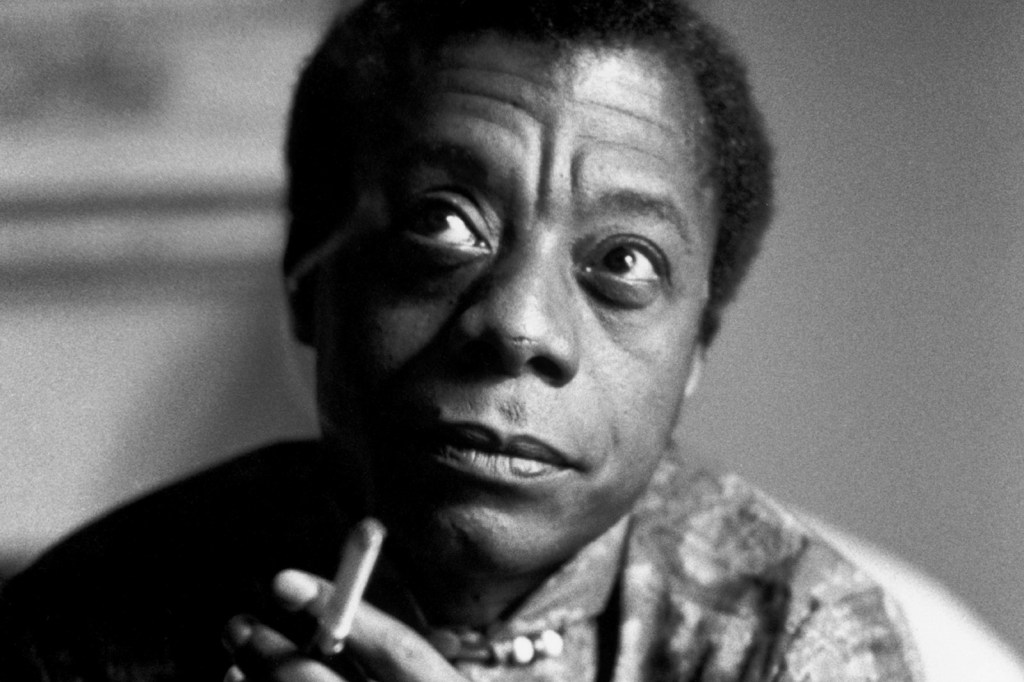
In the mid-twentieth century, author James Baldwin spent time in Paris, fleeing the violent Jim Crow America. When the Brexit vote went through, I was in Hyderabad, India. Another former-British colony. Say Churchill in India and you’d lose a hand. That’s hyperbole, but he is not loved there. And in India, I felt more welcome than when I came home, told to go home the day after the vote. My cultural bond for Britain thawed, my patience with it.
Whiteness walks into a bar and waves his flag. If you are not rich, you are closer to the poverty line than owning a Lambo. If you could not afford rent if you lost your job, you have no business voting Conservative or cheering come our exit from the EU. Race, gender, sexuality, disability… what unites us all is class but these characteristics make those issues ten times worse.
To say I am nervous about Brexit would be an understatement. To the working class and people of colour that voted against the futures of their children and grandchildren by voting leave, and Tory, (in the last election), I am speechless. Whilst racism has always been part of the British way of life, I never used to look over my shoulder walking down Northampton streets.
But Hell is here and devils walks amongst us; a long winter has come, and we are a long way from dawn.
Share this:


“TW3” in Criminology
In the 1960s, or so I am told, there was a very popular weekly television programme called That Was The Week That Was, informally known as TW3. This satirical programme reflected on events of the week that had just gone, through commentary, comedy and music. Although the programme ended before I was born, it’s always struck me as a nice way to end the week and I plan to (very loosely) follow that idea here.
This week was particularly hectic in Criminology, here are just some of the highlights. On Monday, I was interviewed by a college student for their journalism project, a rather surreal experience, after all, ‘Who cares what I think?’
On Tuesday, @manosdaskalou and I, together with a group of enthusiastic third years, visited the Supreme Court in London. This trip enabled a discussion which sought to unpack the issue of diversity (or rather the lack of) within justice. Students and staff discussed a variety of ideas to work out why so many white men are at the heart of justice decisions. A difficult challenge at the best of times but given a new and urgent impetus when sat in a courtroom. It is difficult, if not impossible, to remain objective and impartial when confronted with the evidence of 12 Supreme Judges, only two of which are women, and all are white. Arguments around the supposed representativeness of justice, falter when the evidence is so very stark. Furthermore, with the educational information provided by our tour guide, it becomes obvious that there are many barriers for those who are neither white nor male to make their way through the legal ranks.

Wednesday saw the culmination of Beyond Justice, a module focused on social justice and taught entirely in prison. As in previous years, we have a small ceremony with certificate presentation for all students. This involves quite a cast, including various dignitaries, as well as all the students and their friends and family. This is always a bittersweet event, part celebration, part goodbye. Over the months, the prison classroom leaves its oppressive carceral environment behind, instead providing an intense and profound tight-knit learning community. No doubt @manosdaskalou and I will return to the prison, but that tight-knit community has now dissipated in time and space.

On Thursday, a similarly bitter-sweet experience was my last focused session this year on CRI3003 Violence: From Domestic to Institutional. Since October, the class has discussed many different topics relating to institutional violence focused on different cases including the deaths of Victoria Climbié, Blair Peach, Jean Charles de Menezes, as well as the horror of Grenfell. We have welcomed guest speakers from social work, policing and the fire service. Discussions have been mature, informed and extremely sensitive and again a real sense of a learning community has ensued. It’s also been my first experience of teaching an all-female cohort which has informed the discussion in a variety of meaningful ways. Although I haven’t abandoned the class, colleagues @manosdaskalou and @jesjames50 will take the reins for a while and focus on exploring interpersonal violence. I’ll be back before the end of the academic year so we can reflect together on our understanding of the complexity of violence.
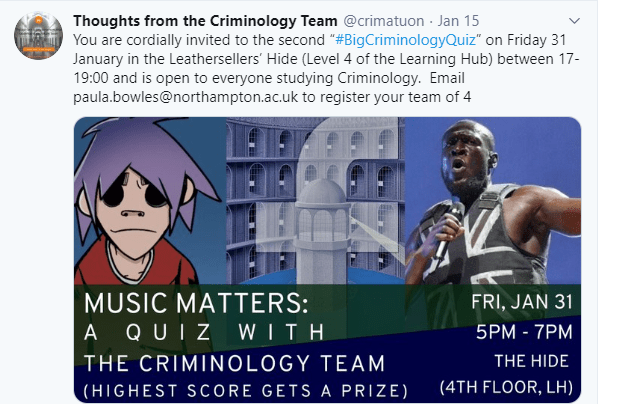
Finally, Friday saw the second ever #BigCriminologyQuiz and the first of the new decade. At the end of the first one, the participants requested that the next one be based on criminology and music. Challenge completed with help from @manosdaskalou, @treventoursu, @svr2727, @5teveh and @jesjames50. This week’s teams have requested a film/tv theme for the next quiz so we’ll definitely have our work cut out! But it’s amazing to see how much criminological knowledge can be shared, even when you’re eating snacks and laughing. [i]
So, what can I take from my criminological week:
- Some of the best criminological discussions happen when people are relaxed
- Getting out of the classroom enables and empowers different voices to be heard
- Getting out of the classroom allows people to focus on each and share their knowledge, recognising that
- A classroom is not four walls within a university, but can be anywhere (a coach, a courtroom a prison, or even the pub!)
- A new environment and a new experience opens the way for discord and dissent, always a necessity for profound discussion within Criminology
- When you open your eyes and your mind you start to see the world very differently
- It is possible (if you try very hard) to ignore the reality of Friday 31 January 23:00 ☹
- It is possible to be an academic, tour guide, mistress of ceremonies and quiz mistress, all in the same week!
Here’s looking forward to next week….not least Thursday’s Changemaker Awards where I seem to have scored a nomination with my #PartnerinCriminology @manosdaskalou.
[i] The first quiz was won by a team made up of 1st and 2nd years. This week’s quiz was won by a group of third years. The next promises to be a battle royale 😊 These quizzes have exposed, just how competitive criminologists can be….

 Thoughts from the criminology team